2018 SUBARU CROSSTREK door lock
[x] Cancel search: door lockPage 4 of 474

(3,1)
北米Model "A1320BE-C" EDITED: 2017/ 10/ 10
Warranties&Warranties for U.S.A.SUBARU vehicles distributed by Subaru of
America, Inc. and sold at retail by an
authorized SUBARU dealer in the United
States come with the following warranties:
.SUBARU Limited Warranties
.Federal Emission Control Systems
Warranties
.California Emissions Control Sys-
tems Warranties
All warranty information, including applic-
ability, details of coverage and exclusions,
is in the“Warranty and Maintenance
Booklet”. Read these warranties carefully.&Warranties for CanadaSUBARU vehicles distributed by Subaru
Canada, Inc. and sold at retail by an
authorized SUBARU dealer in Canada
come with the following warranties:
.SUBARU Limited Warranty
.Emission Control System Warranty
All warranty information, including applic-
ability, details of coverage and exclusions,
is in the“Warranty and Service Booklet”.
Read these warranties carefully.
&Warranties except for U.S.A.
and CanadaAll warranty information, including details
of coverage and exclusions, is in the
“Warranty and Maintenance Booklet”.
Read these warranties carefully.
How to use this Owner’s
Manual&Using your Owner’s ManualBefore you operate your vehicle, carefully
read this manual. To protect yourself and
extend the service life of your vehicle,
follow the instructions in this manual.
Failure to observe these instructions may
result in serious injury and damage to your
vehicle.
This manual is composed of fourteen
chapters. Each chapter begins with a brief
table of contents, so you can usually tell at
a glance if that chapter contains the
information you want.
Chapter 1: Seat, seatbelt and SRS air-
bags
This chapter informs you how to use the
seat and seatbelt and contains precau-
tions for the SRS airbags.
Chapter 2: Keys and doors
This chapter informs you how to operate
the keys, locks and windows.
Chapter 3: Instruments and controls
This chapter informs you about the opera-
tion of instrument panel indicators and how
to use the instruments and other switches.
–CONTINUED–
1
0
Page 8 of 474

(7,1)
北米Model "A1320BE-C" EDITED: 2017/ 10/ 10
collision, because the child will
be caught between the passen-
ger and objects inside the vehi-
cle.
.While riding in the vehicle, infants
and small children should always
be seated in the REAR seat in an
infant or child restraint system
which is appropriate for the
child’s age, height and weight. If
a child is too big for a child
restraint system, the child should
sit in the REAR seat and be
restrained using the seatbelts.
According to accident statistics,
children are safer when properly
restrained in the rear seating
positions than in the front seating
positions. Never allow a child to
stand up or kneel on the seat.
.Place children in the REAR seat
properly restrained at all times in
a child restraint device or in a
seatbelt. The SRS airbag deploys
with considerable speed and
force and can injure or even kill
children, especially if they are not
restrained or improperly re-
strained. Because children are
lighter and weaker than adults,
their risk of being injured from
deployment is greater..NEVER INSTALL A FORWARD OR
REARWARD FACING CHILD
SEAT IN THE FRONT SEAT.
DOING SO RISKS SERIOUS IN-
JURY OR DEATH TO THE CHILD
BY PLACING THE CHILD’S HEAD
TOO CLOSE TO THE SRS AIR-
BAG.
.Always turn the child safety locks
to the“LOCK”position when
children sit in the rear seat.
Serious injury could result if a
child accidentally opens the door
and falls out. Refer to“Child
safety locks”F2-28.
.Always lock the passenger’s win-
dows using the lock switch when
children are riding in the vehicle.
Failure to follow this procedure
could result in injury to a child
operating the power window. Re-
fer to“Windows”F2-28.
.Never leave unattended children,
adults or animals in the vehicle.
They could accidentally injure
themselves or others through
inadvertent operation of the ve-
hicle. Also, on hot or sunny days,
temperature in a closed vehicle
could quickly become high en-
ough to cause severe or possibly
fatal injuries to them..When leaving the vehicle, close
all windows and lock all doors.
For instructions and precautions, carefully
read the following sections.
.For the seatbelt system, refer to“Seat-
belts”F1-12.
.For the child restraint system, refer to
“Child restraint systems”F1-25.
.For the SRS airbag system, refer to
“SRS airbag (Supplemental Restraint Sys-
tem airbag)”F1-37.
–CONTINUED–
5
0
Page 15 of 474

(14,1)
北米Model "A1320BE-C" EDITED: 2017/ 10/ 10
Illustrated index&Exterior
1) Engine hood (page 11-5)
2) Front wipers (page 3-77)
3) Headlights (page 3-67)
4) Replacing bulbs (page 11-36)
5) Moonroof (page 2-32)
6) Roof rails (page 8-13)
7) Outside mirror (page 3-88)
8) Door locks (page 2-21)
9) Tire pressure (page 11-23)
10) Flat tires (page 9-5)
11) Snow tires (page 8-10)
12) Fog lights (page 3-74)
13) Tie-down hooks (page 9-13)
14) Towing hook (page 9-13)
12
Page 18 of 474

(17,1)
北米Model "A1320BE-C" EDITED: 2017/ 10/ 10
1) Power windows (page 2-28)
2) Door locks (page 2-21)
3) Outside mirror switch (page 3-88)
4) Glove box (page 6-5)
5) Front power supply socket (page 6-7)
6) Shift lever (MT models) (page 7-21)/
Select lever (CVT models) (page 7-24)
7) Seat heater switches (page 1-10)
8) Cup holder (page 6-6)
9) X-mode switch (page 7-39)
10) Center console (page 6-6)
11) Parking brake lever (page 7-43)
–CONTINUED–
15
0
Page 28 of 474

(27,1)
北米Model "A1320BE-C" EDITED: 2017/ 10/ 10
Function settingsA SUBARU dealer can change the settings of the functions shown in the following table to meet your personal requirements. Contact the
nearest SUBARU dealer for details. If your vehicle is equipped with a combination meter display (color LCD)*, audio unit or navigation
unit*, the settings for some of these functions can be changed using the display. For details, refer to“Combination meter display (color
LCD)”F3-33.
*: if equippedItem Function Possible settings Default setting
Alarm system Alarm system Operation/Non-operation Operation
Monitoring start delay time (after
closure of doors)0 seconds/30 seconds 30 seconds
Dome light, cargo area light, and
map lights illuminationON/OFF OFF
Keyless Access (if equipped) Hazard warning flasher Operation/Non-operation Operation
Audible signal Operation/Non-operation Operation
Audible signal volume Level 1 to 7 Level 5
Door unlock selection function (dri-
ver’s door unlock)Driver’s door only/All doors Driver’s door only
Door unlock selection function (rear
gate unlock)Rear gate only/All doors Rear gate only
Remote keyless entry system Hazard warning flasher Operation/Non-operation Operation
Audible signal Operation/Non-operation Operation
Audible signal volume Level 1 to 7 Level 5
Key lock-in prevention Key lock-in prevention Operation/Non-operation Operation
Defogger and deicer system for
models with the automatic climate
control systemRear window defogger, outside mir-
ror defogger and windshield wiper
deicerOperation for 15 minutes/
Continuous operationOperation for 15 minutes
–CONTINUED–
25
0
Page 44 of 474
(45,1)
北米Model "A1320BE-C" EDITED: 2017/ 10/ 10
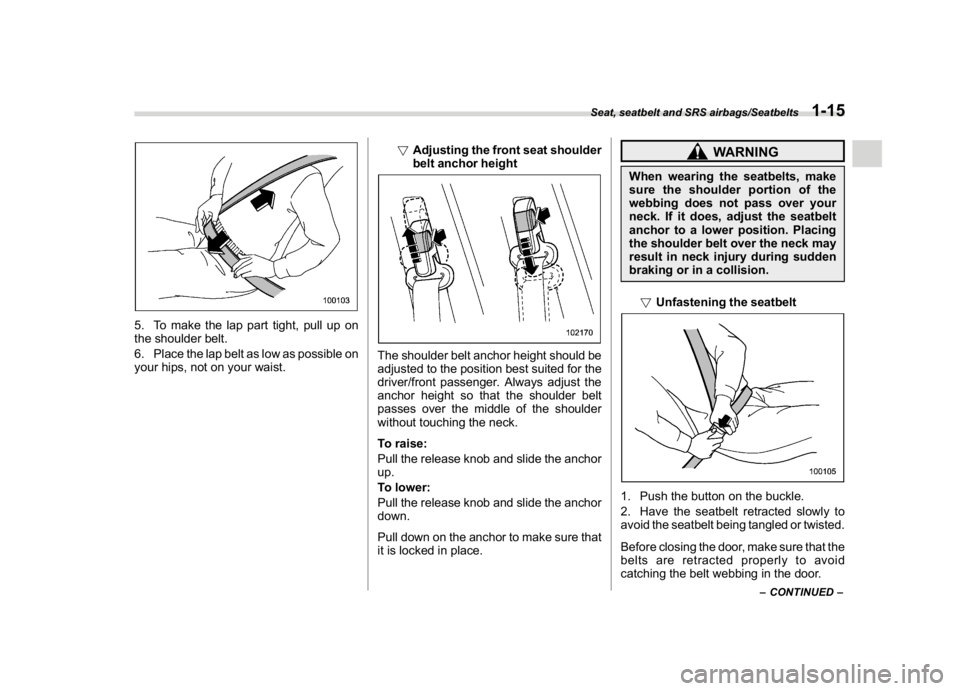
5. To make the lap part tight, pull up on
the shoulder belt.
6. Place the lap belt as low as possible on
your hips, not on your waist.!Adjusting the front seat shoulder
belt anchor height
The shoulder belt anchor height should be
adjusted to the position best suited for the
driver/front passenger. Always adjust the
anchor height so that the shoulder belt
passes over the middle of the shoulder
without touching the neck.
To raise:
Pull the release knob and slide the anchor
up.
To lower:
Pull the release knob and slide the anchor
down.
Pull down on the anchor to make sure that
it is locked in place.
WARNING
When wearing the seatbelts, make
sure the shoulder portion of the
webbing does not pass over your
neck. If it does, adjust the seatbelt
anchor to a lower position. Placing
the shoulder belt over the neck may
result in neck injury during sudden
braking or in a collision.
!Unfastening the seatbelt1. Push the button on the buckle.
2. Have the seatbelt retracted slowly to
avoid the seatbelt being tangled or twisted.
Before closing the door, make sure that the
belts are retracted properly to avoid
catching the belt webbing in the door.
–CONTINUED–
Seat, seatbelt and SRS airbags/Seatbelts
1-15
1
Page 45 of 474
(46,1)
北米Model "A1320BE-C" EDITED: 2017/ 10/ 10
!Rear seatbelts (except rear center
seatbelt)
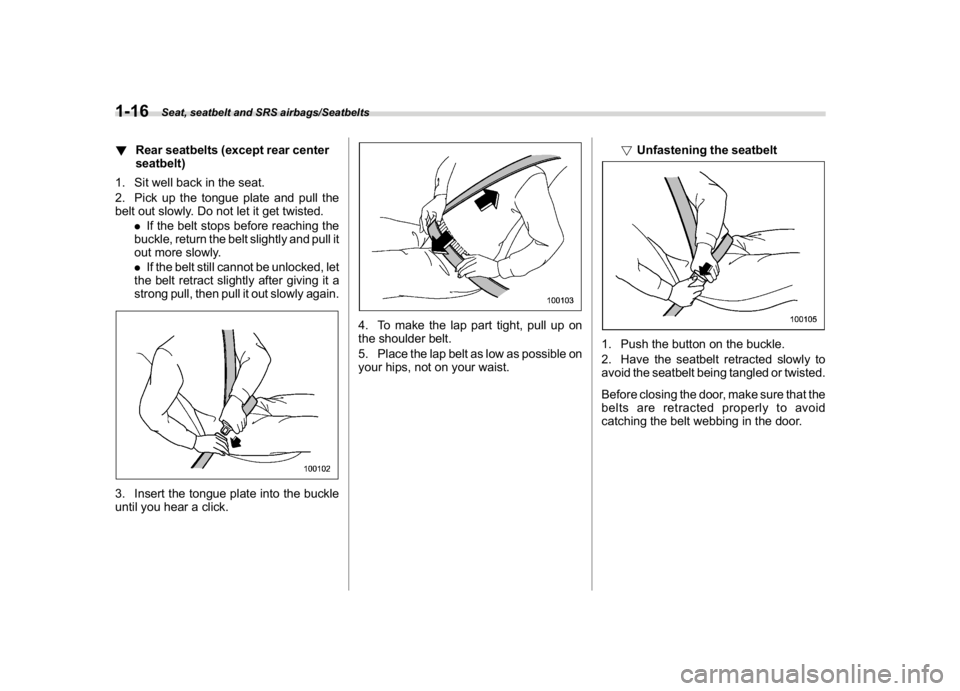
1. Sit well back in the seat.
2. Pick up the tongue plate and pull the
belt out slowly. Do not let it get twisted.
.If the belt stops before reaching the
buckle, return the belt slightly and pull it
out more slowly.
.If the belt still cannot be unlocked, let
the belt retract slightly after giving it a
strong pull, then pull it out slowly again.3. Insert the tongue plate into the buckle
until you hear a click.
4. To make the lap part tight, pull up on
the shoulder belt.
5. Place the lap belt as low as possible on
your hips, not on your waist.!Unfastening the seatbelt
1. Push the button on the buckle.
2. Have the seatbelt retracted slowly to
avoid the seatbelt being tangled or twisted.
Before closing the door, make sure that the
belts are retracted properly to avoid
catching the belt webbing in the door.
Seat, seatbelt and SRS airbags/Seatbelts
1-16
Page 51 of 474

(52,1)
北米Model "A1320BE-C" EDITED: 2017/ 10/ 10
.Side impact sensor
.Front door impact sensor
.Rollover sensor
If the sensor detects a certain predeter-
mined amount of force during frontal or
side collisions or rollover accidents, any
seatbelt that has a seatbelt pretensioner is
quickly drawn back in by the retractor to
take up the slack so that the belt more
effectively restrains the seat occupant.
The driver’s seatbelt pretensioner includes
a tension reducing device which limits the
peak forces exerted by the seatbelt on the
occupant in the event of a collision.
When a seatbelt pretensioner is activated,
an operating noise will be heard and a
small amount of smoke will be released.
These occurrences are normal and not
harmful. This smoke does not indicate a
fire in the vehicle.
Once the seatbelt pretensioner has been
activated, the seatbelt retractor remains
locked. Consequently, the seatbelt can not
be pulled out and retracted and therefore
must be replaced.!In cases of rollover accident, frontal
collisions or side collisions, the
following components will operate
simultaneously
For details, refer to“In cases of rollover
accident, frontal collisions or side colli-
sions, the following components will oper-
ate simultaneously”F1-23.
&Seatbelt with shoulder belt
and lap belt pretensioners
NOTEThis section is applicable to the front
passenger’s side seatbelt.1) Seatbelt retractor assembly (shoulder
belt pretensioner and adaptive force
limiter)
2) Lap belt pretensioner
On the front passenger’sside,the
shoulder belt pretensioner is supplemen-
ted by a lap belt pretensioner, which is
located at the base of the center pillar. Like
the shoulder belt pretensioner, the lap belt
pretensioner instantaneously pulls in the
belt to eliminate slack if a certain level of
frontal collision force is detected. As a
result, the seatbelt restrains the front seat
occupant more effectively.
The front passenger’s seatbelt preten-
sioner includes a tension reducing device
which limits the peak forces exerted by the
seatbelt on the occupant in the event of a
collision.
The adaptive force limiter will select a
reducing load to the suit body size of
occupant as detected by the occupant
detection sensor.
When a seatbelt pretensioner is activated,
an operating noise will be heard and a
small amount of smoke will be released.
These occurrences are normal and not
harmful. This smoke does not indicate a
fire in the vehicle.
Once the seatbelt pretensioner has been
activated, the seatbelt pretensioner re-
mains locked. Consequently, the seatbelt
cannot be pulled out and retracted and
therefore must be replaced.
Seat, seatbelt and SRS airbags/Seatbelt pretensioners
1-22