2018 Peugeot Boxer load
[x] Cancel search: loadPage 52 of 232

50
To avoid the risks of poisoning or
asphyxia, the additional heating must
not be used, even for short periods, in
a closed environment such as a garage or
workshop which are not equipped with an
exhaust gas extraction system.
The additional heating switches off when
the battery voltage is low, so as to allow
engine starting.
The additional heating is fed by the
vehicle's fuel tank. Ensure that the low fuel
warning lamp is not on.
Always switch off the additional heating
when refuelling to avoid any risk of fire or
explosion!
The temperature near the heating
system must not exceed 120°C. A higher
temperature (e.g. when baking the
paint) could damage the components of
electronic circuits.
The additional heating is fitted with
a
temperature limiter which cuts off
the combustion in the event of engine
overheating due to a
lack of coolant.
Check the level and top up if necessary.
For more information on Checking levels ,
refer to the corresponding section.
Then press the programme selection
button before switching the heating on
again.Recommendations for ventilation and air conditioning
In order for these systems to be fully effective,
follow the operation and maintenance
guidelines below:
F
T
o ensure that the air is distributed evenly,
keep the external air intake grilles at the
base of the windscreen, the nozzles, the
vents, the air outlets and the air extractor
in the boot free from obstructions.
F
D
o not cover the sunshine sensor,
located on the dashboard; this is used for
regulation of the automatic air conditioning
system.
F
O
perate the air conditioning system for
at least 5
to 10 minutes once or twice
a
month to keep it in per fect working order.
F
E
nsure that the passenger compartment
filter is in good condition and replace
the filter elements periodically. We
recommend the use of a
combined
passenger compartment filter. Thanks to
its special active additive, it helps both to
purify the air breathed by the occupants
and to keep the passenger compartment
clean (reduction of allergic symptoms, bad
odours and greasy deposits). F
T o ensure correct operation of the
air conditioning system, you are also
advised to have it checked regularly
as recommended in the Warranty and
Maintenance Record.
F
I
f the system does not produce cold air,
switch it off and contact a
PEUGEOT
dealer or a
qualified workshop.
When towing the maximum load on a
steep
gradient in high temperatures, switching off
the air conditioning increases the available
engine power and so improves the towing
ability.
To avoid the windows misting up and
deterioration in the quality of the air:
-
d
o not drive for too long with the
ventilation switched off.
-
d
o not keep air recirculation set for an
extended period.
Ease of use and comfort
Page 58 of 232
56
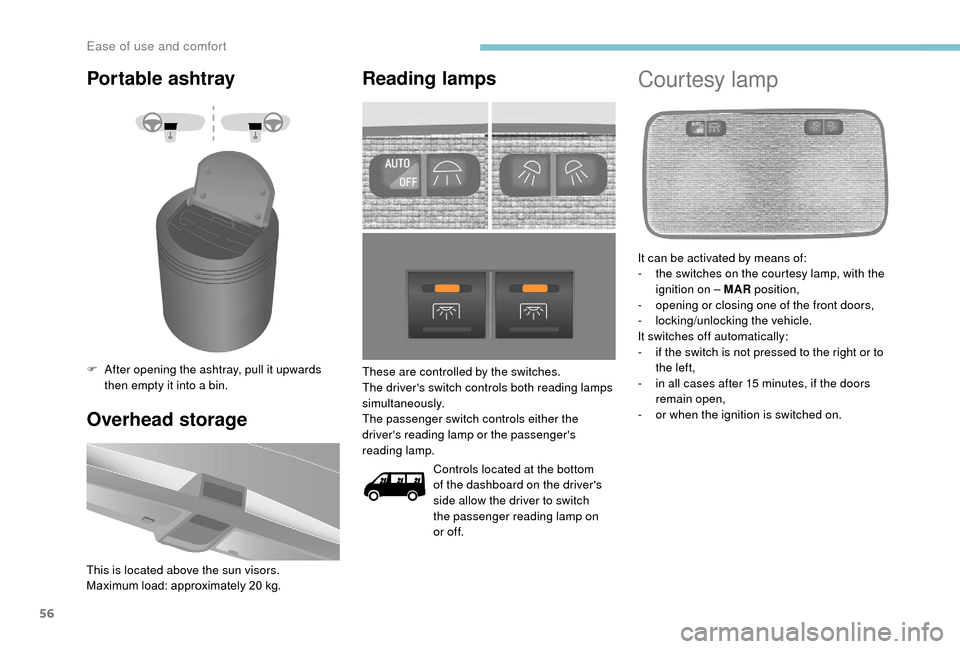
Portable ashtray
F After opening the ashtray, pull it upwards then empty it into a bin.
Overhead storage
This is located above the sun visors.
Maximum load: approximately 20 kg.
Reading lamps
Controls located at the bottom
of the dashboard on the driver's
side allow the driver to switch
the passenger reading lamp on
or of f.
These are controlled by the switches.
The driver's switch controls both reading lamps
simultaneously.
The passenger switch controls either the
driver's reading lamp or the passenger's
reading lamp.
Courtesy lamp
It can be activated by means of:
-
t he switches on the courtesy lamp, with the
ignition on – MAR position,
-
o
pening or closing one of the front doors,
-
l
ocking/unlocking the vehicle.
It switches off automatically:
-
i
f the switch is not pressed to the right or to
the left,
-
i
n all cases after 15 minutes, if the doors
remain open,
-
o
r when the ignition is switched on.
Ease of use and comfort
Page 59 of 232

57
Rear fittings
Stowing rings
As a safety precaution in case of sharp
b raking, you are advised to place heavy
objects as far for wards towards the cab as
possible.
Support for stowing rail
Supports for securing a stowing rail are
a vailable above the trims, on each side of the
vehicle.
Maximum load: 200
kg.
Side trim
The lower parts of the sides are fitted with load
protection trims.
Stowing rings are provided on the floor to
secure and make safe your loads: 8
for L1
and
L2
length vehicles, 10
for L3
and L4
length
vehicles.
Two additional rings are located on the partition
behind the cab.
Maximum load: 500
kg.
12 Volt socket
The connection of an electrical device
not approved by PEUGEOT, such as
a
USB charger, may adversely affect the
operation of vehicle electrical systems,
causing faults such as poor radio
reception or inter ference with displays in
the screens.
Maximum power: 180
W.
3
Ease of use and comfort
Page 60 of 232

58
Cigarette lighter
F Press and wait a few moments until the
lighter pops out automatically.
Courtesy lamps Reading lamps
They are located above each row
of seats.
Interior roof rack
This is a storage compartment located in the
l oad space, above the cab. Its capacity varies
depending on the height of the van
(type H2
or H3).
As a
safety measure, do not place heavy
objects in the roof storage space.
Load retainerIf fitted on your vehicle, one or two courtesy
lamps are located above the rear and side
doors.
They can be activated by:
-
t
ilting the courtesy lamp (to the left or to the
right),
-
o
pening or closing the rear or side doors.
This lighting switches off automatically, after
a
few minutes, if the doors are left open. On the floor, behind the front seats, a
horizontal partition protects the driver and front
passengers against the risk of load movement.
Ladder type vertical
partition
Depending on the country of sale, behind the
driver's seat, a ladder type vertical partition
protects the driver against the risk of load
movement.
Ease of use and comfort
Page 61 of 232

59
Glazed partition
Depending on the country of sale, a glazed
partition separates the cabin from the load
space.
However, you can use the control to open/close
its sliding window.
To r c h
Remove the torch from its base by pressing the
button then pivoting the torch downwards by
90
de
grees.
To switch on the torch, slide the switch
forwards.
To change the 4
batteries (NiMH type), remove
the protective cover, located on the torch.
To put the torch back in place, engage it in the
notches on the base and pivot it upwards.
If your vehicle has one, the magnetic torch is
located at the rear courtesy lamp.
A light is installed in the centre of the torch
base. With the vehicle stationary, key in the
ignition switch or removed, recharging
of and lighting from the torch stops after
around 15
minutes.
The torch batteries recharge automatically
while driving.Sliding side windows
While driving, the window must be closed
or secured in an intermediate position.
Do not project long objects outside the
vehicle through the window.
Depending on the vehicle's equipment, the side
windows of row 2
can be opened.
F
S
queeze the two controls then slide the
window.
3
Ease of use and comfort
Page 67 of 232

65
Headlamp beam height
adjustment
To avoid causing a nuisance to other road
u sers, the height of the halogen headlamp
beams must be adjusted according to the load
in the vehicle.
This function works in the dipped and main
beam headlamps position.
Press these controls several times in
succession to adjust the headlamps.
An indicator in the screen shows
the adjustment position selected (0,
1, 2, 3).
Wiper control stalk
Windscreen wipers
Wiping is active only when the ignition key is in
the MAR position.
The control can have five different positions:
-
W
ipers off.
-
I
ntermittent wiping: 1 notch downwards.
In this position, four wiping frequencies can be
selected by turning the ring.
Automatic rain sensitive
windscreen wipers
If your vehicle is fitted with this system, the
wiping speed is adapted automatically to the
intensity of the rainfall.
Automatic wiping: 1
notch downwards. This is
confirmed by a
single wipe. Must be reactivated
after each time the ignition is switched off.
In this position, it is possible to increase the
sensitivity of the rain sensor by turning the ring.
Do not cover the rain sensor, located at
the top centre of the windscreen.
When washing the vehicle, switch off the
ignition or deactivate the automatic rain
sensitive wipers.
Check that the windscreen wiper blades
can operate freely when using the wipers
in icy weather.
Use the step in the front bumper to remove
any accumulation of snow at the base of
the windscreen and on the blades.
-
v
ery slow frequency,
-
sl
ow frequency,
-
s
tandard frequency,
-
f
ast frequency.
-
S
low continuous wiping: 2
notches
downwards. -
F
ast continuous wiping: 3 notches
downwards.
-
S
ingle wipe: pull the control stalk towards
the steering wheel.
4
Lighting and visibility
Page 73 of 232

71
Intelligent Traction Control
System to improve traction on slippery sur faces
(snow, ice, mud, etc.)
This system checks for situations of difficult
sur face grip that could make it difficult to move
off or make progress.
In these situations, Intelligent Traction
Control takes over from the ASR system, by
transferring drive to the wheel with the best grip
on the ground to provide the best traction and
trajectory control.
Switching on
On starting the vehicle, this system is
deactivated.
F
Press this button to switch the system on; the warning lamp in the button comes on.
This system is active up to about 19
mph (30 km/h).
Once the speed exceeds 19
mph (30 km/h),
the system is deactivated automatically, but the
warning lamp in the button stays on. The system is reactivated automatically as soon as
the speed drops below 19
mph (30 km/h).
Deactivation
F Press this button to deactivate the system;
the warning lamp in the button goes off and
the ASR system is active again.
Malfunction
If a fault occurs with the intelligent
t raction control, this warning lamp
comes on.
Have it checked by a
PEUGEOT dealer or by
a
qualified workshop.
Load inertia control
All such variations have an effect on braking,
traction, the behaviour of the vehicle when
cornering and the tendency to overturn.
The true total weight of a
commercial vehicle
can vary considerably depending on the load
carried. As a
result, the centre of gravity of the
vehicle can move, both longitudinally and in
height. Load inertia control estimates the true total
weight of the vehicle by analysing its behaviour
under acceleration and braking.
This system then adapts the operation of the
DSC and ASR systems according to the weight
distribution in the vehicle. In critical situations,
your vehicle therefore remains more securely
on its intended trajectory.
Hill Descent Control
System that provides assistance when
descending on sur faces with poor grip (mud,
gravel, etc.) or on a
steep gradient.
This system reduces the risk of slip or loss of
control of the vehicle while descending a
hill.
It keeps the vehicle at a
steady speed during
a
descent by acting independently and with
varying force on each of the brakes.
5
5
Safety
Page 90 of 232

88
Manoeuvre cautiously, at low
speed
The dimensions of your vehicle differ from
those of a light vehicle, in width, in height, as
well as in length, and some obstacles will be
more difficult to notice.
Manoeuvre slowly.
Before turning, check that there are no
obstacles at mid-height along the sides.
Before reversing, check that there are no
obstacles, particularly at high level behind the
vehicle.
Be aware of the external dimensions, if ladders
are fitted.
Load the vehicle correctly
With a load, the vehicle must remain within the
m aximum authorised weight, the Gross Vehicle
Weight.
To avoid upsetting the balance of the vehicle,
the load should be centred and the heaviest
part placed on the floor in front of the rear
wheels.
It is inadvisable to place heavy loads on a
roof
rack.
Loading also implies adherence to the
maximum load of the roof bar anchor points.
Adhere to the maximum permissible weight,
according to PEUGEOT dealer specifications.
Loads must be securely lashed down.
A load that is not properly secured inside the
vehicle may affect vehicle handling and create
a
risk of accident.
Drive the vehicle in a prudent
a nd efficient way
Take corners gently.
Anticipate the need to brake as the stopping
distance is increased, particularly on wet or icy
roads.
Be aware of the effect of side winds on the
vehicle.
Effective eco-driving saves fuel; accelerate
progressively, anticipate the need to slow down
and adapt your speed to suit the situation.
Indicate changes of direction well in advance
so that you are seen by other road users.
Take care
The tyres must be inflated to at least the
pressures indicated on the label, even over-
inflated by 0.2
to 0.3 bar for long journeys.
In case of towing
Driving with a trailer places greater
d emands on the towing vehicle and
requires extra care from the driver.
Distribution of loads
F Distribute the load in the trailer so that the heaviest items are as close as possible to
the axle and the nose weight approaches
the maximum permitted without exceeding
it.
Air density decreases with altitude, thus
reducing engine performance. The maximum
towed load must be reduced by 10% for every
1,000
metres of altitude.
For more information on the Technical
data of your vehicle and particularly on
towable loads, refer to the corresponding
section.
Side wind
F Take into account the increased sensitivity to wind.
If your vehicle is fitted with a
drop-side back,
the height and width of the load must remain
within the overall dimensions of the vehicle.
Driving