Page 286 of 615
2.Connect the other end of the positive (+)cable to the positive (+) terminal of thebooster vehicle battery.
3. Connect the negative (-) cable to thenegative (-) terminal of the boostervehicle battery.
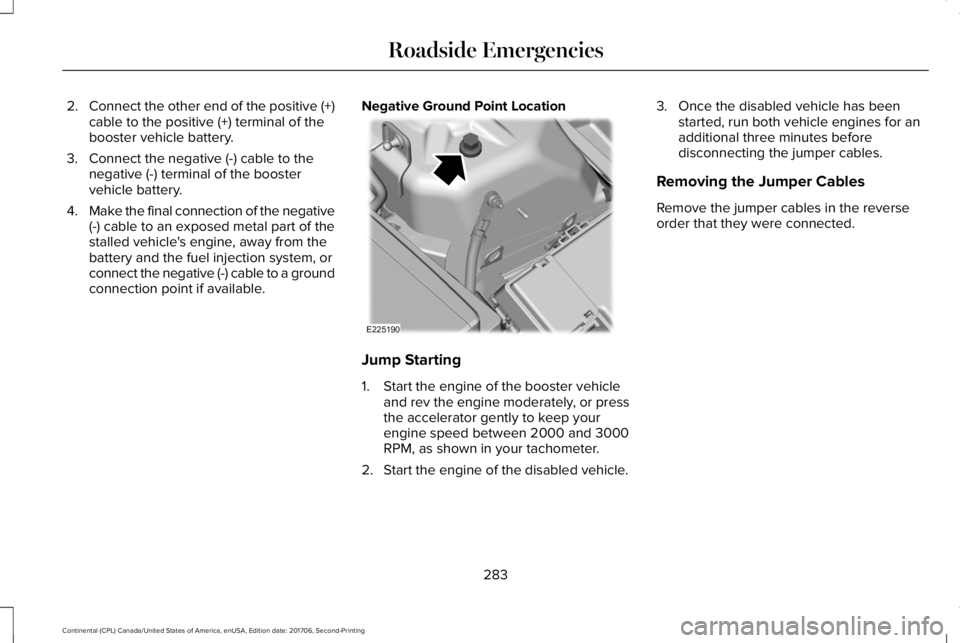
4.Make the final connection of the negative(-) cable to an exposed metal part of thestalled vehicle's engine, away from thebattery and the fuel injection system, orconnect the negative (-) cable to a groundconnection point if available.
Negative Ground Point Location
Jump Starting
1. Start the engine of the booster vehicleand rev the engine moderately, or pressthe accelerator gently to keep yourengine speed between 2000 and 3000RPM, as shown in your tachometer.
2. Start the engine of the disabled vehicle.
3. Once the disabled vehicle has beenstarted, run both vehicle engines for anadditional three minutes beforedisconnecting the jumper cables.
Removing the Jumper Cables
Remove the jumper cables in the reverseorder that they were connected.
283
Continental (CPL) Canada/United States of America, enUSA, Edition date: 201706, Second-Printing
Roadside EmergenciesE225190
Page 293 of 615
In the CAMVAP program, impartial third-partyarbitrators conduct hearings at mutuallyconvenient times and places in an informalenvironment. These impartial arbitratorsreview the positions of the parties, makedecisions and, when appropriate, renderawards to resolve disputes. CAMVAPdecisions are fast, fair, and final as thearbitrator’s award is binding on both you andFord of Canada.
CAMVAP services are available in allCanadian territories and provinces. For moreinformation, without charge or obligation, callyour CAMVAP Provincial Administratordirectly at 1-800-207-0685 or visitwww.camvap.ca.
GETTING ASSISTANCE OUTSIDE
THE U.S. AND CANADA
Before exporting your vehicle to a foreigncountry, contact the appropriate foreignembassy or consulate. These officials caninform you of local vehicle registrationregulations and where to find unleaded fuelor petrol/gas engines or the proper sulfurfuel for diesel engines.
If you cannot find the proper fuelrecommended for your vehicle, contact ourCustomer Relationship Center.
The use of improper fuels in your vehiclewithout proper conversion may damage theeffectiveness of your emission control systemand may cause engine knocking or seriousengine damage. Ford Motor Company orFord of Canada is not responsible for anydamage caused by use of improper fuel.Using improper fuels may also result indifficulty importing your vehicle back into theUnited States.
If your vehicle must be serviced while youare traveling or living in Asia-Pacific Region,Sub-Saharan Africa, U.S. Virgin Islands and/orPuerto Rico, Central America, the Caribbean,and Israel and the Middle East, contact thenearest authorized dealer. If the authorizeddealer cannot help you, contact thecorresponding Ford Customer AssistanceCenter:
FORD MOTOR COMPANY
Customer Relationship Centers in:
290
Continental (CPL) Canada/United States of America, enUSA, Edition date: 201706, Second-Printing
Customer Assistance
Page 299 of 615
Protected ComponentsFuse Amp RatingFuse Or Relay Number
Powertrain control module power.20A 11
Engine emissions (MIL).20A 12
A/C clutch control relay coil.20A 13VACC.Active grill shutters.Cooling fan relays.All-wheel drive module (2.7L and 3.7Lengines).
Ignition coils.20A 14
Not used.—5
Fuel injectors (3.7L engine).15A 16
Rear recline relay box.5A 17
Not used.—8
Not used.—9
Not used.—10
Torque vectoring relay (3.0L engine).—11
296
Continental (CPL) Canada/United States of America, enUSA, Edition date: 201706, Second-Printing
Fuses
Page 303 of 615
Protected ComponentsFuse Amp RatingFuse Or Relay Number
Not used.—51
Anti-lock brake system pump.60A 352
Adaptive front steering.40A 353
Heated windshield.40A 254
Heated rear window.40A 255
Power inverter.40A 256
Power deck lid module.30A 257Manual deck lid latch.
Not used.—58
Not used.—59
Fuel pump.30A 260
Not used.—61
Power point 2A.20A 262
Power seat control module.30A 263Front heated seats.
300
Continental (CPL) Canada/United States of America, enUSA, Edition date: 201706, Second-Printing
Fuses
Page 304 of 615
Protected ComponentsFuse Amp RatingFuse Or Relay Number
Not used.—64
Fuel pump 2.30A 265
Passenger power seat.30A 266
Power point 1B.20A 267
Auxiliary blower.15A 268
Power point 1A.20A 269
Not used.—70
Not used.—71
Driver power seat module.30A 272
Not used.—73
Wiper motor.25A 274
Not used.—75
Not used (spare).20A 276
Not used.—77
301
Continental (CPL) Canada/United States of America, enUSA, Edition date: 201706, Second-Printing
Fuses
Page 315 of 615
GENERAL INFORMATION
Have your vehicle serviced regularly to helpmaintain its roadworthiness and resale value.There is a large network of authorizeddealers that are there to help you with theirprofessional servicing expertise. We believethat their specially trained technicians arebest qualified to service your vehicle properlyand expertly. They are supported by a widerange of highly specialized tools developedspecifically for servicing your vehicle.
If your vehicle requires professional service,an authorized dealer can provide thenecessary parts and service. Check yourwarranty information to find out which partsand services are covered.
Use only recommended fuels, lubricants,fluids and service parts conforming tospecifications. Motorcraft® parts aredesigned and built to provide the bestperformance in your vehicle.
Precautions
•Do not work on a hot engine.
•Make sure that nothing gets caught inmoving parts.
•Do not work on a vehicle with the enginerunning in an enclosed space, unless youare sure you have enough ventilation.
•Keep all open flames and other burningmaterial (such as cigarettes) away fromthe battery and all fuel related parts.
Working with the Engine Off
1. Set the parking brake and shift thetransmission to park (P).
2. Switch off the engine.
3. Block the wheels.
Working with the Engine On
WARNING: To reduce the risk ofvehicle damage and personal burn injuries,do not start your engine with the air cleanerremoved and do not remove it while theengine is running.
1. Set the parking brake and shift thetransmission to park (P).
2. Block the wheels.
OPENING AND CLOSING THE
HOOD
Opening the Hood
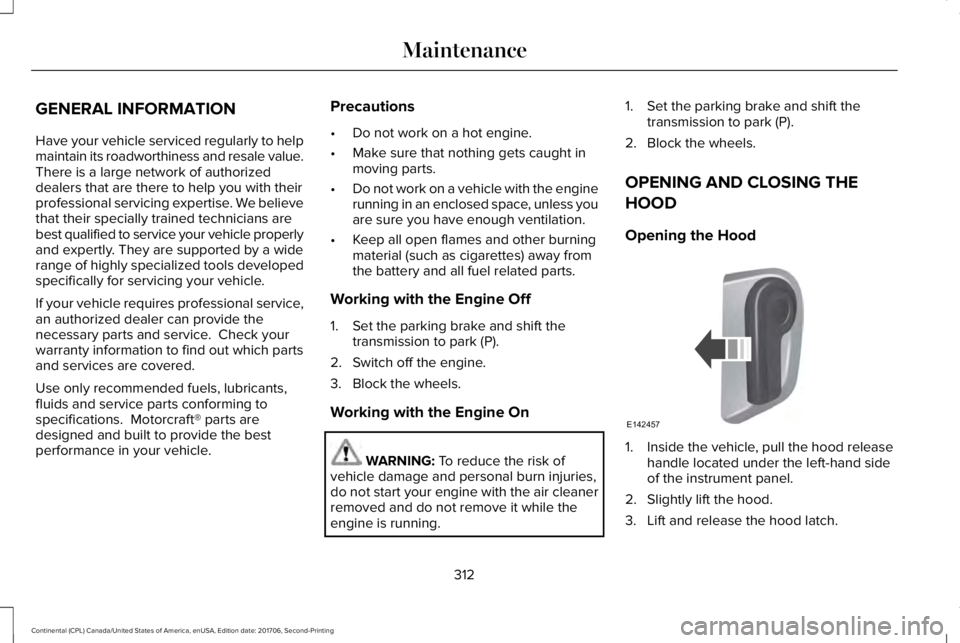
1. Inside the vehicle, pull the hood releasehandle located under the left-hand sideof the instrument panel.
2. Slightly lift the hood.
3. Lift and release the hood latch.
312
Continental (CPL) Canada/United States of America, enUSA, Edition date: 201706, Second-Printing
MaintenanceE142457
Page 321 of 615

Note:Do not remove the dipstick when theengine is running.
Note: If the oil level is between themaximum and minimum marks, the oil levelis acceptable. Do not add oil.
Note:The oil consumption of new enginesreaches its normal level after approximately3,000 mi (5,000 km).
Adding Engine Oil
WARNING: Do not remove the fillercap when the engine is running.
Do not use supplemental engine oil additivesbecause they are unnecessary and couldlead to engine damage that may not becovered by the vehicle Warranty.
Only use oils certified for gasoline enginesby the American Petroleum Institute (API). An oil with this trademark symbol conformsto the current engine and emission systemprotection standards and fuel economyrequirements of the International LubricantsSpecification Advisory Committee (ILSAC).
To top up the engine oil level do thefollowing:
1. Clean the area surrounding the engineoil filler cap before you remove it.
2. Remove the engine oil filler cap. SeeUnder Hood Overview (page 315). Turnit counterclockwise and remove it.
3. Add engine oil that meets ourspecifications. See Capacities andSpecifications (page 382). You may haveto use a funnel to pour the engine oil intothe opening.
4. Recheck the oil level.
5. If the oil level is correct, replace thedipstick and make sure it is fully seated.
6. Replace the engine oil filler cap. Turn itclockwise until you feel a strongresistance.
Note: Do not add oil further than themaximum mark. Oil levels above themaximum mark may cause engine damage.
Note:Make sure you install the oil filler capcorrectly.
Note:Soak up any spillage with anabsorbent cloth immediately.
OIL CHANGE INDICATOR RESET
Use the information display controls on thesteering wheel to reset the oil changeindicator.
318
Continental (CPL) Canada/United States of America, enUSA, Edition date: 201706, Second-Printing
MaintenanceE142732
Page 328 of 615
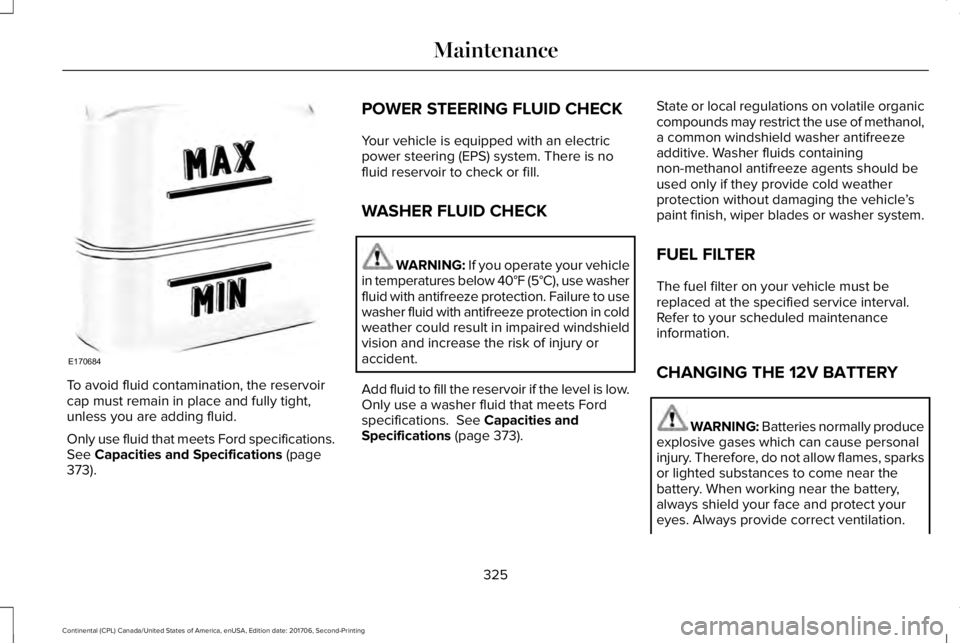
To avoid fluid contamination, the reservoircap must remain in place and fully tight,unless you are adding fluid.
Only use fluid that meets Ford specifications.See Capacities and Specifications (page373).
POWER STEERING FLUID CHECK
Your vehicle is equipped with an electricpower steering (EPS) system. There is nofluid reservoir to check or fill.
WASHER FLUID CHECK
WARNING: If you operate your vehiclein temperatures below 40°F (5°C), use washerfluid with antifreeze protection. Failure to usewasher fluid with antifreeze protection in coldweather could result in impaired windshieldvision and increase the risk of injury oraccident.
Add fluid to fill the reservoir if the level is low.Only use a washer fluid that meets Fordspecifications. See Capacities andSpecifications (page 373).
State or local regulations on volatile organiccompounds may restrict the use of methanol,a common windshield washer antifreezeadditive. Washer fluids containingnon-methanol antifreeze agents should beused only if they provide cold weatherprotection without damaging the vehicle’spaint finish, wiper blades or washer system.
FUEL FILTER
The fuel filter on your vehicle must bereplaced at the specified service interval.Refer to your scheduled maintenanceinformation.
CHANGING THE 12V BATTERY
WARNING: Batteries normally produceexplosive gases which can cause personalinjury. Therefore, do not allow flames, sparksor lighted substances to come near thebattery. When working near the battery,always shield your face and protect youreyes. Always provide correct ventilation.
325
Continental (CPL) Canada/United States of America, enUSA, Edition date: 201706, Second-Printing
MaintenanceE170684


