Page 207 of 594

CLIMATE CONTROL
}}
* Option/accessory.205
Activating/deactivating ventilation of the front seat*
Steering wheel and seat buttons in the climate row.
1. Press the left or right-hand side's steering
wheel and seat button in the climate row in the centre display in order to open the con-trols for seat and steering wheel. If the car is not equipped with heated seats or heated steering wheel, the button for ven-tilated seats is immediately available in theclimate row.
2. Repeatedly press the button for ventilated seats in order to change between the four levels:
Off, High, Medium and Low.
> The level changes and the button shows the set level.
NOTE
The seat ventilation should be used carefully by people sensitive to draughts. Level Low is
recommended for long-term use.
IMPORTANT
Seat ventilation cannot be started if the pas- senger compartment temperature is too low.This is in order to avoid cooling down the per-son sitting in the seat.
Related information
• Climate controls (p. 186)
• Climate controls in the centre display (p. 187)
Activating/deactivating heating of steering wheel
*
The steering wheel can be heated in order to increase comfort for the driver when it is cold.
Activating/deactivating heating of
steering wheel
Steering wheel and seat buttons in the climate row.
1. Press the driver's side steering wheel and seat button in the climate row of the centre display in order to open the controls for seatand steering wheel. If the car is not equipped with heated seats or ventilated seats, the button for heatedsteering wheel is immediately available in theclimate row.
Page 221 of 594
LOADING AND STORAGE
* Option/accessory.219
Tunnel console The tunnel console is located between the front seats.
Storage compartment with hatch *. The hatch
is opened/closed with a push on the handle.
Storage compartment with cup holder for driver and passenger as well as 12 V socket.If ashtray and cigarette lighter were specifiedthen there is a cigarette lighter in the 12 Vsocket and a detachable ashtray in the cupholder.
Storage compartment and AUX/USB input under the armrest.
Climate controls for the rear seat climate functions * or storage compartment.
Related information
• Passenger compartment interior (p. 218)
• Electrical sockets (p. 220)
• Using the cigarette lighter
* (p. 224)
• Emptying ashtrays
* (p. 224)
• Connecting media via AUX/USB input (p. 448)
• Climate controls at the rear of the tunnel console
* (p. 188)
Page 234 of 594

LOADING AND STORAGE
* Option/accessory.
232 •
Safety net
* (p. 232)
• Load retaining eyelets (p. 228)
Safety net
*
The safety net prevents loads from being thrown forward in the passenger compartment in theevent of sudden braking.
The safety net is fitted into four mounting points.
For reasons of safety, the safety net must always be fastened and anchored as described below. The net is made of a strong nylon fabric and can be secured two different locations in the car:
• Rear fitting - behind the rear seat.
• Front fitting - behind the front seats.
WARNING
Loads in the luggage compartment must be anchored well, and also using a correctly fit-ted safety net.
Installation
Rear fitting
1. If necessary, fold the rear seat backrests for-
ward in order to facilitate installation.
2. Lower the safety net cassette's end pieces over the mounting eyelets in the recess of the side panels. Press down the end pieceone side at a time. Check that the cassette isproperly secured.
3. Pull up the net.
4. Hook one of the safety net's retaining hooks into the rear roof mounting and then press it forward to the end position.
5. Hook the other of the safety net's retaining hooks on the opposite side and press it for-ward to the end position.
Page 387 of 594

STARTING AND DRIVING
}}
385
Ignition positions The car's electrical system can be set in different levels/positions and in this way make the differ-ent functions available.
In order to facilitate the use of a limited number of functions with the engine switched off, thecar's electrical system can be set in 3 different levels - 0, I and II. These levels are described
with the denomination "ignition position" throughout the owner's manual. The following table shows the functions available in each ignition position/level:
Level Functions
0 •Odometer, clock and temperature gauge are illuminated.
• Power seats can be adjusted.
• The power windows can be used.
• The centre display is started andcan be used.
• It is possible to start the audio.
The functions are time-controlled inthis ignition position and are switchedoff automatically after a period of time.
I •Panorama roof, power windows,12V socket in the passenger com-partment, navigation, phone, venti-lation fan and windscreen wiperscan be used.
• Power seats can be adjusted.
• 12 V sockets in the cargo areacan be used.
• The audio is started automaticallyif it was running when the car wasleft.
Power is taken from the battery inthis ignition position.Level Functions
II •The headlamps come on.
• Warning/indicator lamps illuminate for 5 seconds.
• Several other systems are acti-vated. However, heating in seatcushions and the rear window canonly be activated after the car hasbeen started.
This ignition position consumes alot of current from the battery andshould therefore be avoided!
Selecting ignition position
Start knob in the tunnel console.
• Ignition position 0
- Unlock the car and
store the remote control key inside the car.
Page 411 of 594
STARTING AND DRIVING
* Option/accessory.409
•
Rear Collision Warning (p. 340)
• Blind Spot Information
* (p. 340)
Parking brake The parking brake prevents the car from rolling away from stationary by means of mechanicallylocking/blocking two wheels.
The control for the parking brake is located in the tunnel console between the seats.
A faint electric motor noise can be heard when the electrically-operated parking brake is beingapplied. The noise can also be heard during theautomatic function checking of the parking brake. If the car is stationary when the parking brake is applied then it only acts on the rear wheels. If it isapplied when the car is moving then the normalfoot brake is used, i.e. the brake acts on all fourwheels. Brake function changes over to the rearwheels when the car is almost stationary.
Related information
• Brake functions (p. 406)
• Using the parking brake (p. 410)
• In the event of a fault in the parking brake(p. 411)
Page 546 of 594
||
MAINTENANCE AND SERVICE
* Option/accessory.
544
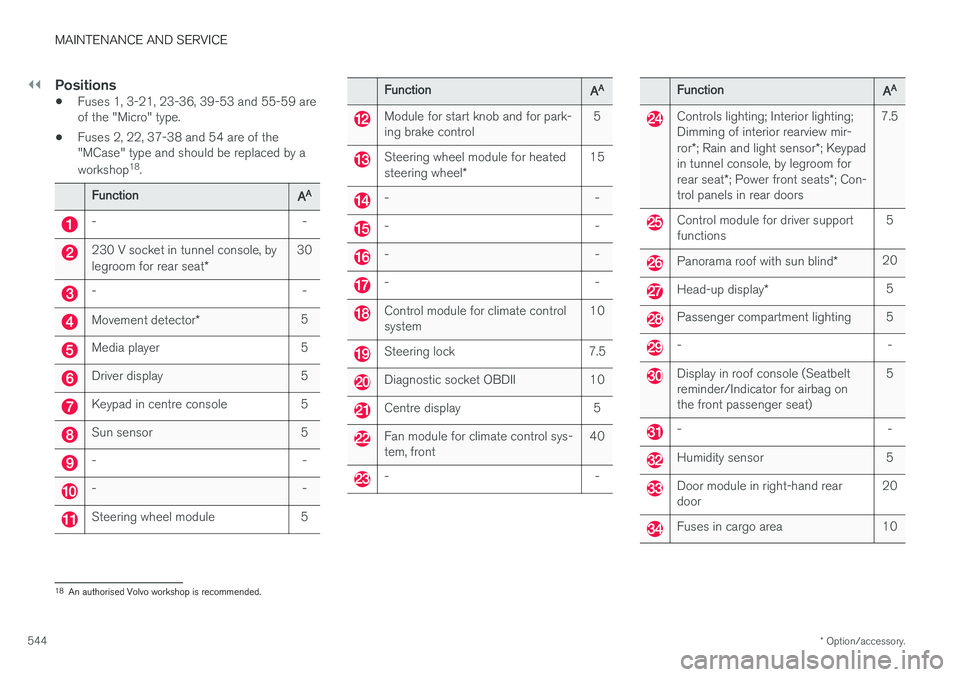
Positions
• Fuses 1, 3-21, 23-36, 39-53 and 55-59 are of the "Micro" type.
• Fuses 2, 22, 37-38 and 54 are of the"MCase" type and should be replaced by a workshop 18
.
Function AA
- -
230 V socket in tunnel console, by legroom for rear seat
*30
- -
Movement detector
* 5
Media player 5
Driver display 5
Keypad in centre console 5
Sun sensor 5
- -
- -
Steering wheel module 5
Function
AA
Module for start knob and for park- ing brake control 5
Steering wheel module for heated steering wheel
* 15
- -
- -
- -
- -
Control module for climate control system
10
Steering lock 7.5
Diagnostic socket OBDII 10
Centre display 5
Fan module for climate control sys- tem, front40
- -
Function
AA
Controls lighting; Interior lighting; Dimming of interior rearview mir- ror
*; Rain and light sensor *; Keypad
in tunnel console, by legroom forrear seat *; Power front seats *; Con-
trol panels in rear doors 7.5
Control module for driver support functions
5
Panorama roof with sun blind
*20
Head-up display
* 5
Passenger compartment lighting 5
- -
Display in roof console (Seatbelt reminder/Indicator for airbag onthe front passenger seat) 5
- -
Humidity sensor 5
Door module in right-hand rear door
20
Fuses in cargo area 10
18
An authorised Volvo workshop is recommended.
Page 548 of 594
MAINTENANCE AND SERVICE
* Option/accessory.
546
Fuses in cargo area
Fuses in the cargo area protect, amongst other things, power seats *, airbags and seatbelt ten-
sioners.
Page 565 of 594

SPECIFICATIONS
563
Weights Max. gross vehicle weight, etc. can be read on a label in the car.
Kerb weight includes the driver, the fuel tank 90% full and all fluids. The weight of passengers and accessories, and towball load (when a trailer is hitched) influencethe load capacity and are not included in the kerbweight. Permitted max. load = Gross vehicle weight - Kerb weight.
NOTE
The documented kerb weight applies to cars in the standard version - i.e. a car withoutextra equipment or accessories. This meansthat for every accessory added the loadingcapacity of the car is reduced correspondinglyby the weight of the accessory. Examples of accessories that reduce load capacity are the different equipment levels(e.g. Kinetic, Momentum, Summum), as wellas other accessories such as towbar, loadcarrier, space box, audio system, auxiliarylamps, GPS, fuel-driven heater, safety grille,carpets, cargo cover, power seats, etc. Weighing the car is a certain way of ascer- taining the kerb weight of your own particularcar.
WARNING
The car's driving characteristics change depending on how heavily it is loaded andhow the load is distributed.
The decal is positioned on the door pillar, and will be visible when the right-hand rear door is opened.
Max. gross vehicle weight
Max. train weight (car+trailer)
Max. front axle load
Max. rear axle load
Equipment level
Max. load: See registration document. Max. roof load: 100 kg.
Related information
• Type designations (p. 558)
• Towing capacity and towball load (p. 564)


