Page 79 of 594
SAFETY
77
i-Size/ISOFIX mounting points The car is equipped with i-Size/ISOFIX4
mount-
ing points for child seats in the rear seat.
i-Size/ISOFIX is a fixture system for car child seats that is based on an international standard. Always follow the manufacturer's installation instructions when connecting a child seat to thei-Size/ISOFIX mounting points.
The location of the mounting points
Mounting point locations are indicated by symbols 4
on
the upholstery of the backrest.
The mounting points for i-Size/ISOFIX are located behind covers in the lower section of therear seat's backrest, in the outer seats. Lift the covers in order to access the mounting points.
Related information
• Child seats (p. 71)
• Upper mounting points for child seats (p. 73)
• Lower mounting points for child seats (p. 74)
• Table for location of i-Size child seats(p. 81)
• Table for location of ISOFIX child seats(p. 78)
4
Names and symbols change depending on market.
Page 80 of 594
SAFETY
78
Table for location of ISOFIX child seats
The table gives a recommendation for which ISOFIX child seats suit which locations, and forwhat size of child.The child seat must be approved in accordance with UN Reg R44 and the car model must beincluded in the manufacturer's vehicle list.NOTE
Always read the section "Child seats" before fitting a child seat in the car.
Weight Size classA
Type of child seat Front seat (with deactivated air-
bag, only rear-facing child
seats)B Front seat (with activated air-
bag, only front-facing child
seats)B Outer rear seat
Centre rear seat
Group 0 max 10 kg E Rear-facing infant seat
ILB, C
, XD
XILC
X
Group 0+max 13 kg E Rear-facing infant seat
ILB, C, E
, XD
XILC
X
C Rear-facing child seat
D Rear-facing child seat
Page 81 of 594

SAFETY
}}
79
WeightSize classA
Type of child seat Front seat (with deactivated air-
bag, only rear-facing child
seats)B Front seat (with activated air-
bag, only front-facing child
seats)B Outer rear seat
Centre rear seat
Group 1 9-18 kg A Front-facing child seat
XILB, E, F
, XD
ILF
, IUF F
X
B Front-facing child seat
B1 Front-facing child seat C Rear-facing child seat ILB, E
, XD
XILG
X
D Rear-facing child seat
IL: Suitable for particular ISOFIX child restraint systems. These child restraint systems are those of the specific vehicle, restricted or semi-universal catego-
ries.IUF: Suitable for ISOFIX forward child restraint systems of universal category approved for use in the mass group.X: Not suitable for ISOFIX child restraint systems.
A For child seats with the ISOFIX fixture system there is a size classification to help users choose the right type of child seat. The size class can be read on the child seat's label.
B Works for the installation of ISOFIX child seats that are semi-universally approved (IL) if the car is equipped with the ISOFIX console accessory (the accessory range varies depending on market).
C Volvo recommends: Volvo infant seat secured using the ISOFIX fixture system (type approval E1 04301146).
D Applicable if the car is not fitted with an ISOFIX bracket.
E Adjust the backrest so that the head restraint does not touch the child seat.
F Volvo recommends rear-facing child seat for children in this mass group.
G Volvo recommends: BeSafe iZi Kid X3 ISOfix (type approval E5 04200).
WARNING
Never use a rear-facing child seat on the front passenger seat if the passenger airbag isactivated.
NOTE
If an i-Size/ISOFIX child seat has no size classification, the car model must be includedon the vehicle list for the child seat.
NOTE
Volvo recommends contacting an authorised Volvo dealer for information about which i-Size/ISOFIX child seats Volvo recommends.
Page 82 of 594
||
SAFETY
80
Related information
•Child seats (p. 71)
• i-Size/ISOFIX mounting points (p. 77)
• Table for location of i-Size child seats (p. 81)
• Table for location of child seats using thecar's seatbelts (p. 75)
Page 83 of 594
SAFETY
81
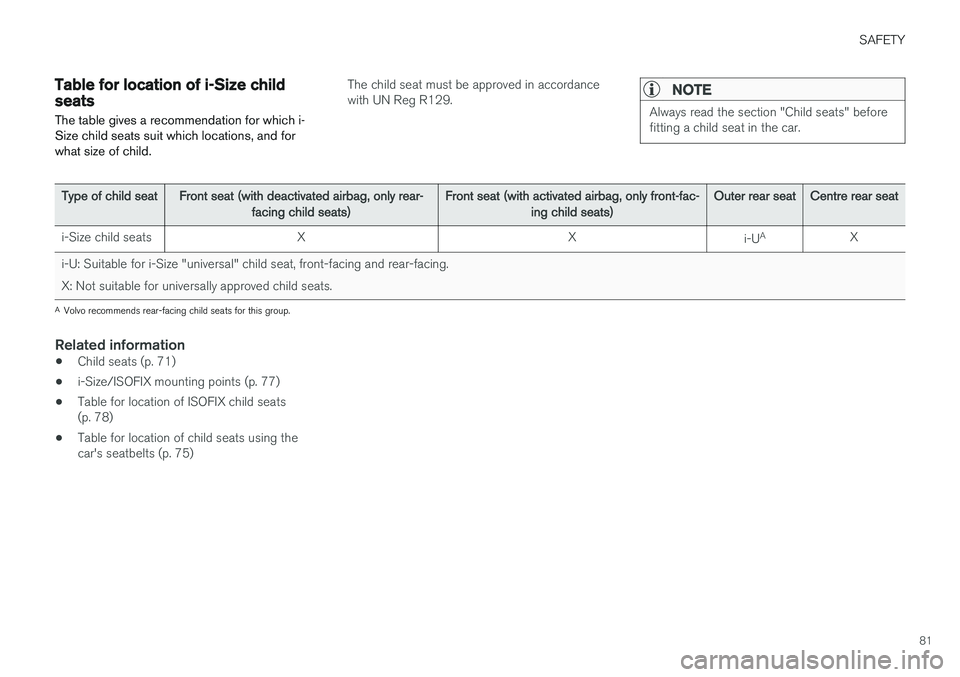
Table for location of i-Size child seats
The table gives a recommendation for which i- Size child seats suit which locations, and forwhat size of child.The child seat must be approved in accordance with UN Reg R129.NOTE
Always read the section "Child seats" before fitting a child seat in the car.
Type of child seat Front seat (with deactivated airbag, only rear-
facing child seats) Front seat (with activated airbag, only front-fac-
ing child seats) Outer rear seat
Centre rear seat
i-Size child seats X X
i-UA
X
i-U: Suitable for i-Size "universal" child seat, front-facing and rear-facing.
X: Not suitable for universally approved child seats.
A Volvo recommends rear-facing child seats for this group.
Related information
• Child seats (p. 71)
• i-Size/ISOFIX mounting points (p. 77)
• Table for location of ISOFIX child seats (p. 78)
• Table for location of child seats using thecar's seatbelts (p. 75)
Page 84 of 594
SAFETY
* Option/accessory.
82
Integrated booster cushion *
The integrated booster cushions on the outer seats in the rear seat allow children to sit com-fortably and safely.
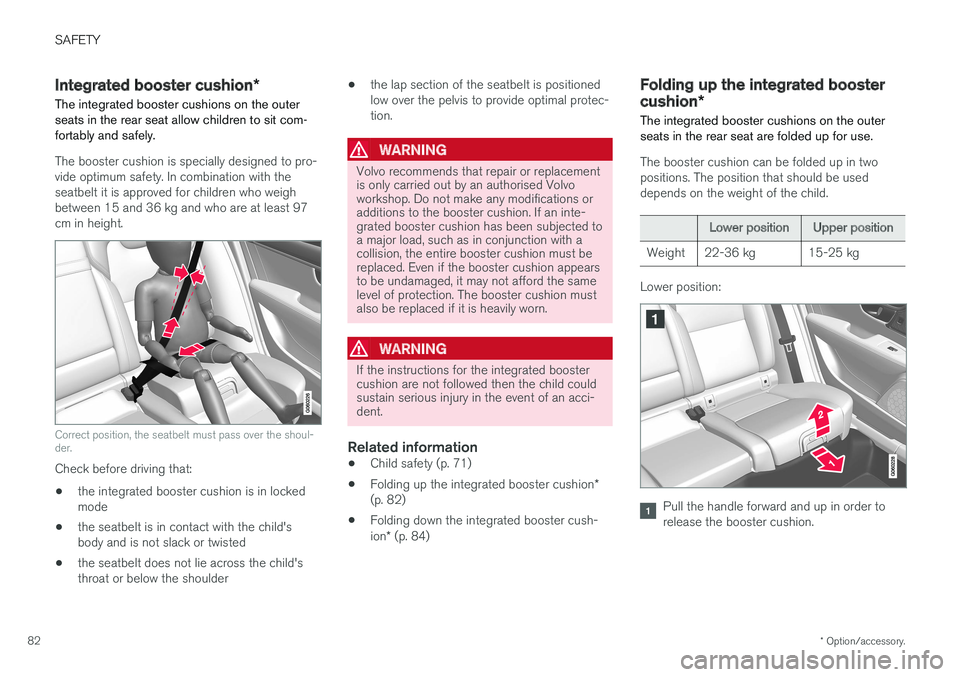
The booster cushion is specially designed to pro- vide optimum safety. In combination with theseatbelt it is approved for children who weighbetween 15 and 36 kg and who are at least 97cm in height.
Correct position, the seatbelt must pass over the shoul- der.
Check before driving that: • the integrated booster cushion is in locked mode
• the seatbelt is in contact with the child'sbody and is not slack or twisted
• the seatbelt does not lie across the child'sthroat or below the shoulder •
the lap section of the seatbelt is positionedlow over the pelvis to provide optimal protec-tion.
WARNING
Volvo recommends that repair or replacement is only carried out by an authorised Volvoworkshop. Do not make any modifications oradditions to the booster cushion. If an inte-grated booster cushion has been subjected toa major load, such as in conjunction with acollision, the entire booster cushion must bereplaced. Even if the booster cushion appearsto be undamaged, it may not afford the samelevel of protection. The booster cushion mustalso be replaced if it is heavily worn.
WARNING
If the instructions for the integrated booster cushion are not followed then the child couldsustain serious injury in the event of an acci-dent.
Related information
•Child safety (p. 71)
• Folding up the integrated booster cushion
*
(p. 82)
• Folding down the integrated booster cush- ion
* (p. 84)
Folding up the integrated booster cushion *
The integrated booster cushions on the outer seats in the rear seat are folded up for use.
The booster cushion can be folded up in two positions. The position that should be useddepends on the weight of the child.
Lower position Upper position
Weight 22-36 kg 15-25 kg
Lower position:
Pull the handle forward and up in order to release the booster cushion.
Page 86 of 594
SAFETY
* Option/accessory.
84
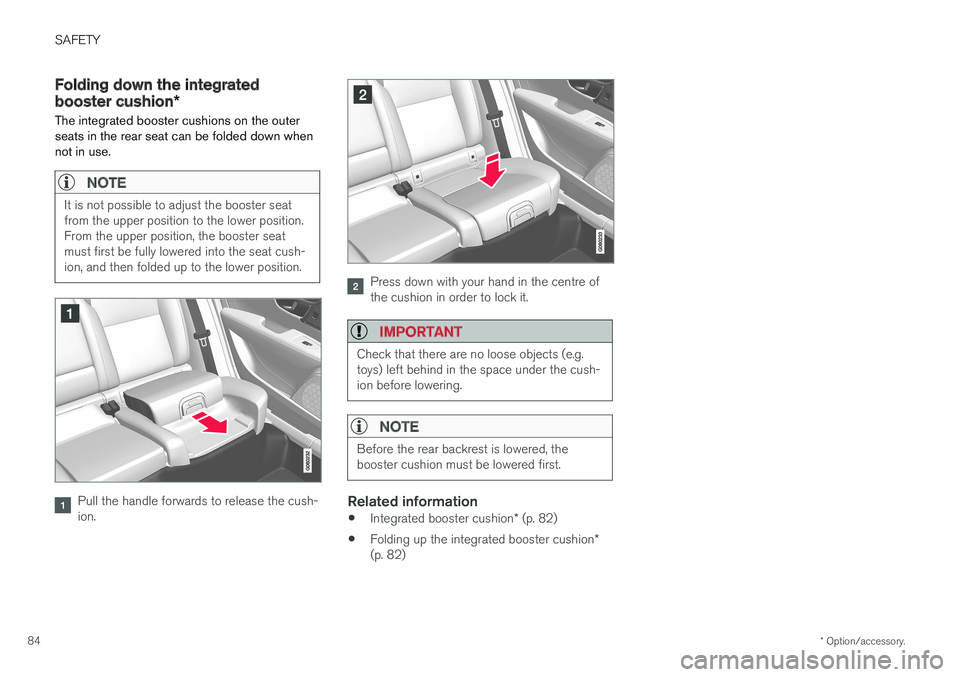
Folding down the integrated booster cushion *
The integrated booster cushions on the outer seats in the rear seat can be folded down whennot in use.
NOTE
It is not possible to adjust the booster seat from the upper position to the lower position.From the upper position, the booster seatmust first be fully lowered into the seat cush-ion, and then folded up to the lower position.
Pull the handle forwards to release the cush- ion.
Press down with your hand in the centre of the cushion in order to lock it.
IMPORTANT
Check that there are no loose objects (e.g. toys) left behind in the space under the cush-ion before lowering.
NOTE
Before the rear backrest is lowered, the booster cushion must be lowered first.
Related information
• Integrated booster cushion
* (p. 82)
• Folding up the integrated booster cushion
*
(p. 82)
Page 123 of 594

INSTRUMENTS AND CONTROLS
* Option/accessory.121
Manual front seat
The car's front seats have different setting options for optimum seating comfort.
Raise/lower the front edge of the seat cush- ion * by pumping up/down.
Change the length of the seat cushion by pulling the lever up and moving the seatcushion forward/backward by hand.
Adjust the seat forward/backward by lifting the handle and adjusting the distance to thesteering wheel and pedals. Check that theseat is locked after the position has beenadjusted.
Change the lumbar support * by pressing the
button upward/downward/forward/back.
Raise/lower the seat by means of adjusting the control up/down.
Change the backrest rake by turning the control knob.
WARNING
Adjust the position of the driver's seat before setting off, never while driving. Make sure thatthe seat is in locked position in order to avoidpersonal injury in the event of heavy brakingor an accident.
Related information
• Power front seat
* (p. 121)
• Multi-functional front seat
* (p. 123)
• Activating/deactivating heating of the seats
*
(p. 203)
• Seatbelt (p. 59)
Power front seat
*
The car's front seats have different setting options for optimum seating comfort. The powerseat can be moved forward/backward and up/down. The front edge of the seat cushion can beraised/lowered and the backrest rake can bechanged. The lumbar support can be adjustedupward/downward/forward/backward.
The power seats have overload protection which is tripped if a seat is blocked by an object. If thishappens, remove the object and then operate theseat again. The seat can be adjusted for a period of time after unlocking the door without the engine run-ning. Seat adjustment can always be performedwhen the engine is running. Adjustment can alsobe performed for a period of time after theengine has been switched off.
Related information
• Multi-functional front seat
* (p. 123)
• Adjusting the power front seat
* (p. 122)
• Using the memory function in the power front seat
* (p. 122)
• Manual front seat (p. 121)
• Activating/deactivating heating of the seats
*
(p. 203)