2017 RENAULT ALASKAN belt
[x] Cancel search: beltPage 30 of 340
THREE-POINT TYPE SEAT BELTS
Fastening seat belts WARNING
The seatback should not be in
areclined position
any more than needed for comfort. Seat belts are
most effective when the passenger sits well back
and straight up in the seat.
1. Adjust the seat. (See “Manual seat adjustment
(where fitted)” earlier in this section.)
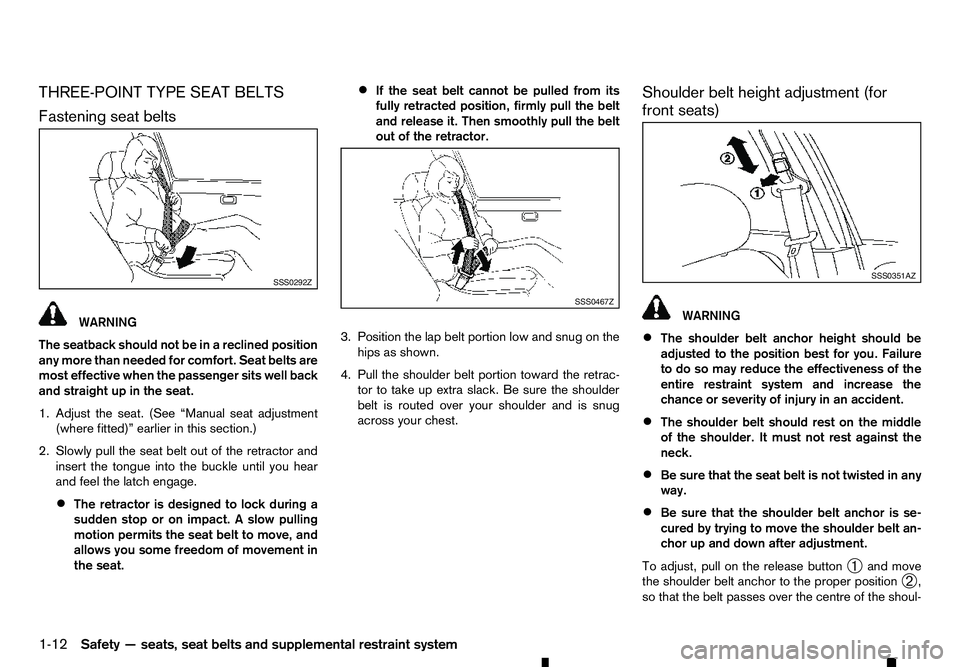
2. Slowly pull the seat belt out of the retractor and insert the tongue into the buckle until you hear
and feel the latch engage.
• The retractor is designed to lock during a
sudden stop or on impact.
Aslow pulling
motion permits the seat belt to move, and
allows you some freedom of movement in
the seat. •
If the seat belt cannot be pulled from its
fully retracted position, firmly pull the belt
and release it. Then smoothly pull the belt
out of the retractor.
3. Position the lap belt portion low and snug on the hips as shown.
4. Pull the shoulder belt portion toward the retrac- tor to take up extra slack. Be sure the shoulder
belt is routed over your shoulder and is snug
across your chest. Shoulder belt height adjustment (for
front seats) WARNING
• The shoulder belt anchor height should be
adjusted to the position best for you. Failure
to do so may reduce the effectiveness of the
entire restraint system and increase the
chance or severity of injury in an accident.
• The shoulder belt should rest on the middle
of the shoulder. It must not rest against the
neck.
• Be sure that the seat belt is not twisted in any
way.
• Be sure that the shoulder belt anchor is se-
cured by trying to move the shoulder belt an-
chor up and down after adjustment.
To adjust, pull on the release button ➀and move
the shoulder belt anchor to the proper position ➁,
so that the belt passes over the centre of the shoul- SSS0292Z
SSS0467Z SSS0351AZ
1-12 Safety —seats, seat belts and supplemental restraint system
Page 31 of 340
der. The belt should be away from your face and
neck, but not falling off your shoulder. Release the
button to lock the shoulder belt anchor into position.
Unfastening seat belts
Push the button on the buckle. The seat belt auto-
matically retracts.
Checking seat belt operation
Seat belt retractors are designed to lock seat belt
movement:
• When the seat belt is pulled quickly from the
retractor.
• When the vehicle slows down rapidly.
To increase your confidence in the seat belts, check
the operation by grasping the shoulder belt and pull-
ing forward quickly. The retractor should lock and
restrict further belt movement. If the retractor does
not lock during this check, contact an approved
dealer or qualified workshop immediately.
TWO-POINT TYPE SEAT BELTS (where fitted)
Fastening seat belts WARNING
Every person who drives or rides in this vehicle
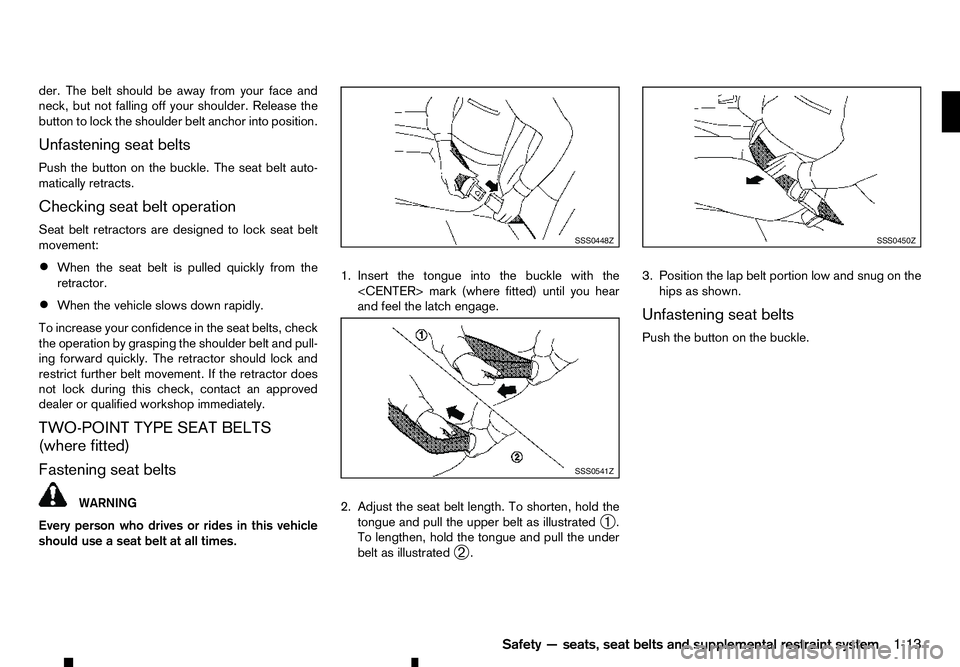
should use aseat belt at all times. 1. Insert the tongue into the buckle with the
and feel the latch engage.
2. Adjust the seat belt length. To shorten, hold the tongue and pull the upper belt as illustrated ➀.
To lengthen, hold the tongue and pull the under
belt as illustrated ➁. 3. Position the lap belt portion low and snug on the
hips as shown.
Unfastening seat belts
Push the button on the buckle. SSS0448Z
SSS0541Z SSS0450Z
Safety —seats, seat belts and supplemental restraint system
1-13
Page 32 of 340
SEAT BELT MAINTENANCE
Periodically check that the seat belt and all the metal
components, such as buckles, tongues, retractors,
flexible wires and anchors, work properly. If loose
parts, deterioration, cuts or other damage on the
seat belt webbing is found, the entire seat belt as-
sembly should be replaced.
If dirt builds up in the shoulder belt guide of the seat
belt anchors, the seat belts may retract slowly. Wipe
the shoulder belt guide with aclean, dry cloth.
To clean the seat belt webbing, apply amild soap
solution or any solution recommended for cleaning
upholstery or carpet. Then wipe with acloth and
allow the seat belts to dry in the shade. Do not allow
the seat belts to retract until they are completely dry. PRECAUTIONS ON CHILD
RESTRAINT USAGE WARNING
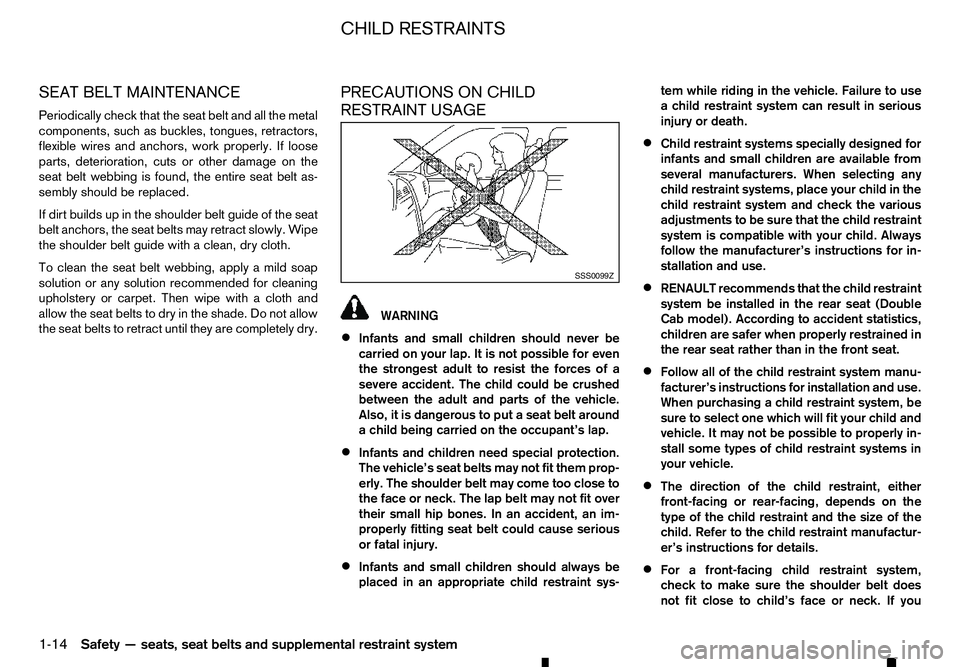
• Infants and small children should never be
carried on your lap. It is not possible for even
the strongest adult to resist the forces of a
severe accident. The child could be crushed
between the adult and parts of the vehicle.
Also, it is dangerous to put aseat belt around
ac hild being carried on the occupant’s lap.
• Infants and children need special protection.
The vehicle’s seat belts may not fit them prop-
erly. The shoulder belt may come too close to
the face or neck. The lap belt may not fit over
their small hip bones. In an accident, an im-
properly fitting seat belt could cause serious
or fatal injury.
• Infants and small children should always be
placed in an appropriate child restraint sys- tem while riding in the vehicle. Failure to use
ac
hild restraint system can result in serious
injury or death.
• Child restraint systems specially designed for
infants and small children are available from
several manufacturers. When selecting any
child restraint systems, place your child in the
child restraint system and check the various
adjustments to be sure that the child restraint
system is compatible with your child. Always
follow the manufacturer’s instructions for in-
stallation and use.
• RENAULT recommends that the child restraint
system be installed in the rear seat (Double
Cab model). According to accident statistics,
children are safer when properly restrained in
the rear seat rather than in the front seat.
• Follow all of the child restraint system manu-
facturer’s instructions for installation and use.
When purchasing
achild restraint system, be
sure to select one which will fit your child and
vehicle. It may not be possible to properly in- stall some types of child restraint systems in
your vehicle.
• The direction of the child restraint, either
front-facing or rear-facing, depends on the
type of the child restraint and the size of the child. Refer to the child restraint manufactur-
er’s instructions for details.
• For
afront-facing child restraint system,
check to make sure the shoulder belt does
not fit close to child’s face or neck. If you SSS0099Z
CHILD RESTRAINTS
1-14 Safety —seats, seat belts and supplemental restraint system
Page 33 of 340
must install
afront-facing child restraint sys-
tem in the front seat, see “Installation on front
passenger’s seat” later in this section.
• Never install
arear-facing child restraint sys-
tem on the front passenger’s seat when the
front passenger’s air bag is active. Supple- mental front-impact air bags inflate with great
force. Arear-facing child restraint system
could be struck by the supplemental front-im-
pact air bags in an accident and could seri-
ously injure or kill your child.
• Do not install
achild restraint in the jump seats
(where fitted for King Cab model). These
seats are not suitable for child restraint instal-
lation.
• Adjustable seatbacks should be positioned to
fit
ac hild restraint system, but as upright as
possible. see “Installation on rear outboard
seats” later in this section and “Child restraint
installation using three-point type seat belt”
later in this section.
• If the seat belt in the position where
achild
restraint system is installed requires alocking
clip and if it is not used, injuries could result
from achild restraint system tipping over dur-
ing normal vehicle braking or cornering.
• After attaching
achild restraint system, test it
before you place the child in it. Tilt it from side
to side. Try to tug it forward and check if it is
held securely in place. The child restraint sys-
tem should not move more than 25 mm (1 in). If the restraint is not secure, tighten the belt
as necessary, or install the restraint in another
seat and test it again.
• Check the child restraint system in your ve-
hicle to be sure that it is compatible with the
vehicle’s seat belt system.
• If
ac hild restraint system is not anchored
properly, the risk of achild being injured in a
collision or asudden stop greatly increases.
• Improper use of
achild restraint system can
increase the risk or severity of injury for both
the child and other occupants in the vehicle.
• Always use an appropriate child restraint sys-
tem. An improperly installed child restraint
system could lead to serious injury or death in
an accident.
• When the child restraint system is not in use,
keep it secured with the ISOFIX and i-Size
child restraint system or
aseat belt to prevent
it from being thrown around in case of asud-
den stop or accident.
RENAULT recommends that infants and small chil-
dren be seated in achild restraint system. You
should choose achild restraint system that fits your
vehicle and always follow the manufacturer’s in-
structions for installation and use. In addition, there
are many types of child restraint systems available
for larger children that should be used for maximum
protection. CAUTION
Remember that
achild restraint system left in a
closed vehicle can become very hot. Check the
seating surface and buckles before placing your
child in achild restraint system.
UNIVERSAL CHILD RESTRAINTS FOR
FRONT SEAT AND REAR SEATS (for
Europe)
NOTE
Child restraints approved to UN Regulation No.
44 or No. 129 are clearly marked with the catego-
ries such as Universal, Semi-universal or ISOFIX.
When selecting any child restraint, keep the follow-
ing points in mind:
• Choose
achild restraint that complies with the
latest European safety standard, UN Regulation
No. 44 or No. 129.
• Place your child in the child restraint and check
the various adjustments to be sure the child re-
straint is compatible with your child. Always fol-
low all of the recommended procedures.
• Check the child restraint in your vehicle to be
sure it is compatible with vehicle’s retention sys-
tem.
• Refer to the tables later in this section for
alist of
the recommended fitment positions and the ap-
proved child restraints for your vehicle.
Safety —seats, seat belts and supplemental restraint system 1-15
Page 34 of 340
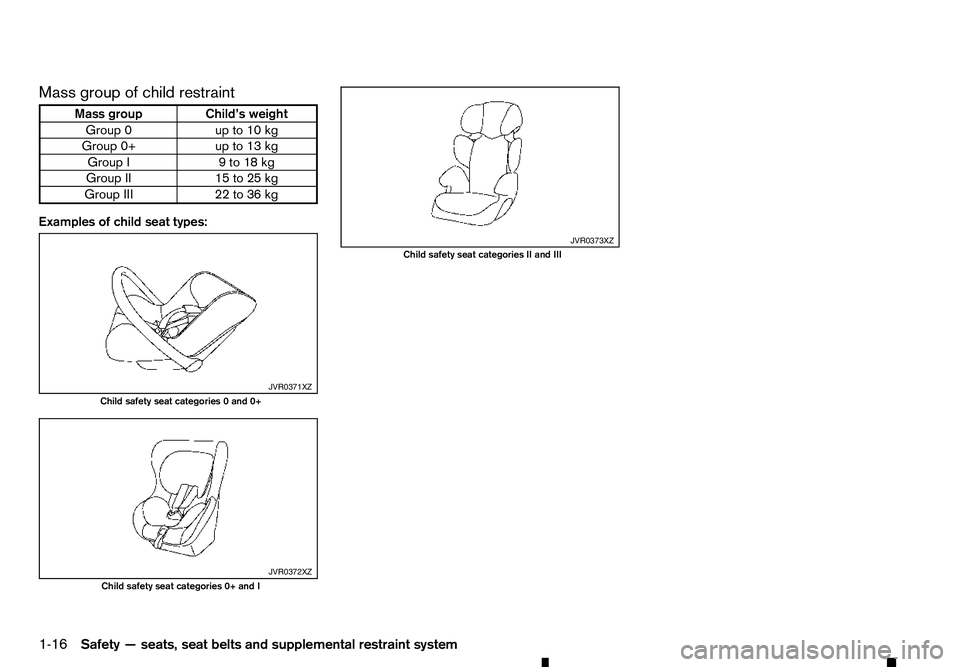
Mass group of child restraint
Mass group Child’s weight
Group 0u pto10kg
Group 0+ up to 13 kg
Group I9 to 18 kg
Group II 15 to 25 kg
Group III 22 to 36 kg
Examples of child seat types: JVR0371XZ
Child safety seat categories
0and 0+ JVR0372XZ
Child safety seat categories 0+ and I JVR0373XZ
Child safety seat categories II and III
1-16 Safety —seats, seat belts and supplemental restraint system
Page 35 of 340
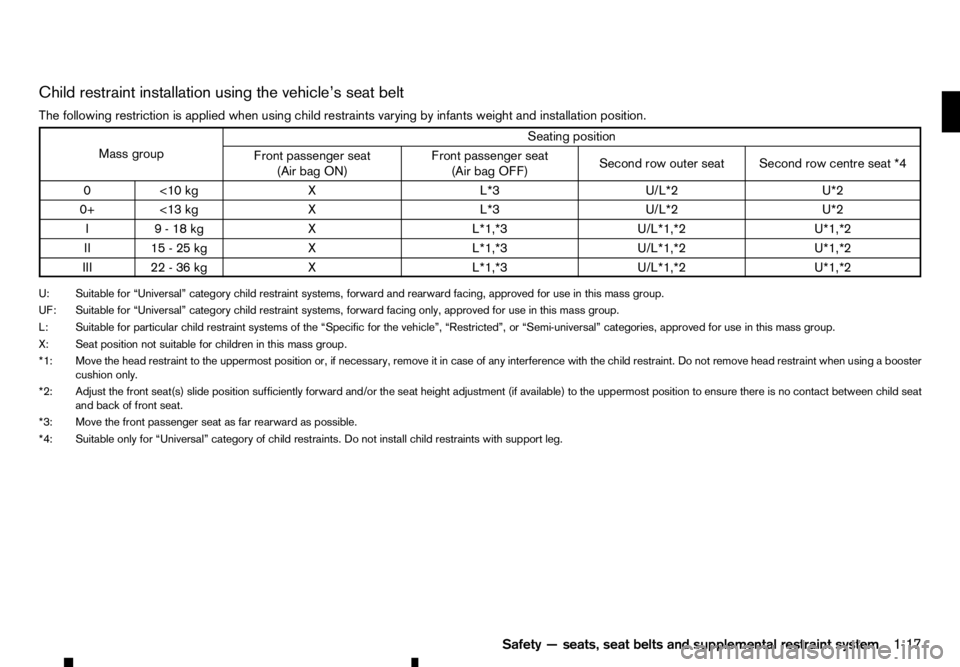
Child restraint installation using the vehicle’s seat belt
The following restriction is applied when using child restraints varying by infants weight and installation position. Mass group
Seating position
Front passenger seat (Air bag ON) Front passenger seat
(Air bag OFF) Second row outer seat Second row centre seat *4
0< 10 kg XL *3U/L*2 U*2
0+ <13 kg XL *3U/L*2 U*2
I9 -18kgX L*1,*3U/L*1,*2 U*1,*2
II 15 -25kgX L*1,*3U/L*1,*2 U*1,*2
III 22 -36kgX L*1,*3U/L*1,*2 U*1,*2
U: Suitable for “Universal” category child restraint systems, forward and rearward facing, approved for use in this mass group.
UF: Suitable for “Universal” category child restraint systems, forward facing only, approved for use in this mass group.
L: Suitable for particular child restraint systems of the “Specific for the vehicle”, “Restricted”, or “Semi-universal” categories, approved for use in this mass group. X: Seat position not suitable for children in this mass group.
*1: Move the head restraint to the uppermost position or, if necessary, remove it in case of any interference with the child restraint. Do not remove head restraint when using abooster
cushion only.
*2: Adjust the front seat(s) slide position sufficiently forward and/or the seat height adjustment (if available) to the uppermost position to ensure there is no contact between child seat and back of front seat.
*3: Move the front passenger seat as far rearward as possible.
*4: Suitable only for “Universal” category of child restraints. Do not install child restraints with support leg.
Safety—seats, seat belts and supplemental restraint system 1-17
Page 36 of 340
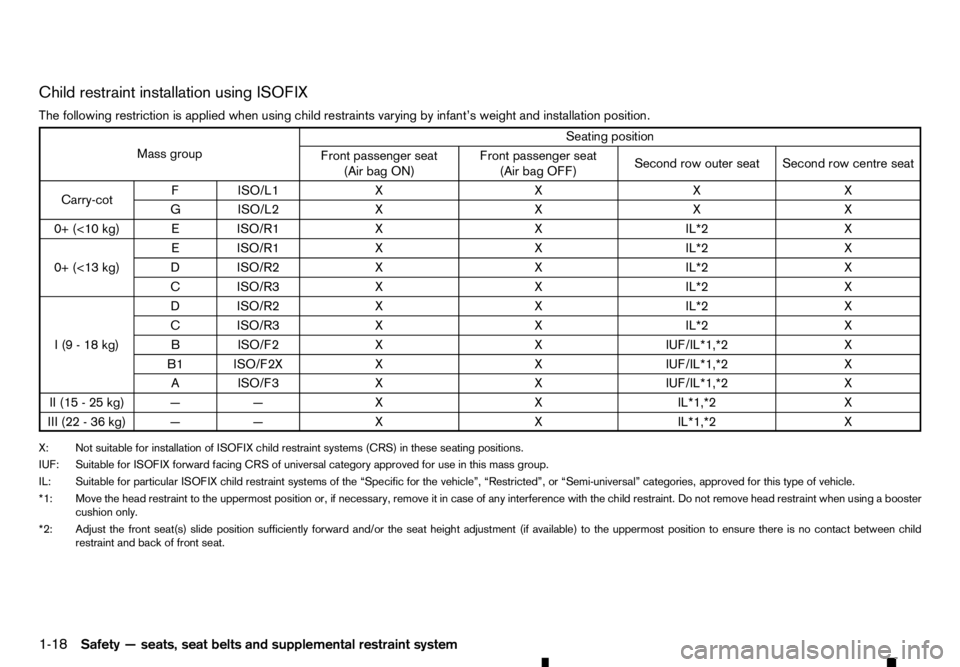
Child restraint installation using ISOFIX
The following restriction is applied when using child restraints varying by infant’s weight and installation position. Mass group
Seating position
Front passenger seat (Air bag ON) Front passenger seat
(Air bag OFF) Second row outer seat Second row centre seat
Carry-cot FI
SO/L1 XX XX
GI SO/L2 XX XX
0+ (<10 kg) EISO/R1 XX IL*2X
0+ (<13 kg) EI
SO/R1 XX IL*2X
DI SO/R2 XX IL*2X
CI SO/R3 XX IL*2X
I(9-18k g) DI
SO/R2 XX IL*2X
CI SO/R3 XX IL*2X
BI SO/F2 XX IUF/IL*1,*2X
B1 ISO/F2X XX IUF/IL*1,*2X
AI SO/F3 XX IUF/IL*1,*2X
II (15 -25kg) —— XX IL*1,*2X
III (22 -36kg) —— XX IL*1,*2X
X: Not suitable for installation of ISOFIX child restraint systems (CRS) in these seating positions.
IUF: Suitable for ISOFIX forward facing CRS of universal category approved for use in this mass group.
IL: Suitable for particular ISOFIX child restraint systems of the “Specific for the vehicle”, “Restricted”, or “Semi-universal” categories, approved for this type of vehicle.
*1: Move the head restraint to the uppermost position or, if necessary, remove it in case of any interference with the child restraint. Do not remove head restraint when using abooster
cushion only.
*2: Adjust the front seat(s) slide position sufficiently forward and/or the seat height adjustment (if available) to the uppermost position to ensure there is no contact between child restraint and back of front seat.
1-18 Safety —seats, seat belts and supplemental restraint system
Page 37 of 340
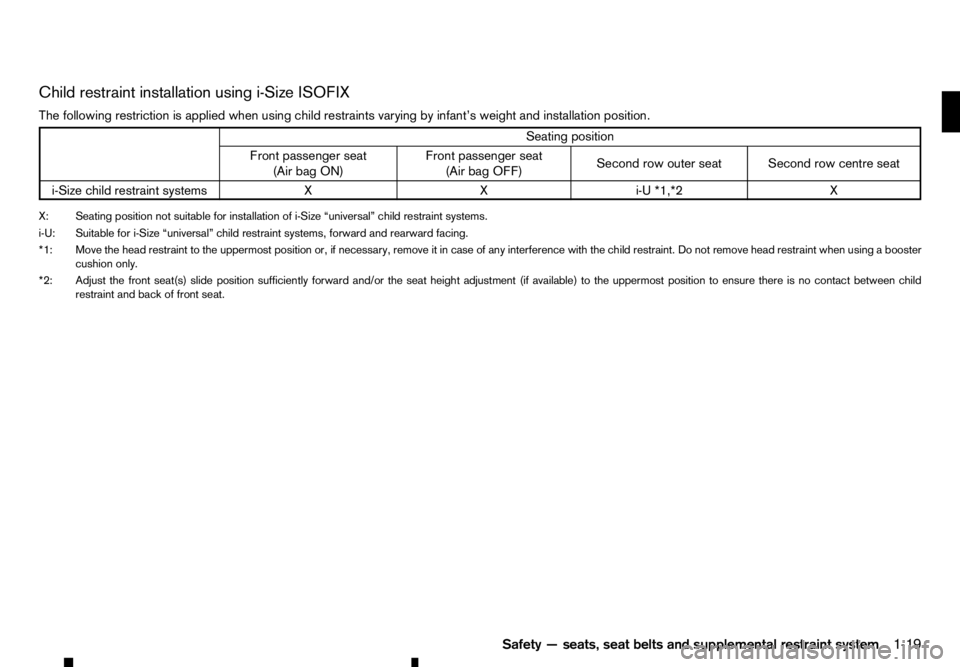
Child restraint installation using i-Size ISOFIX
The following restriction is applied when using child restraints varying by infant’s weight and installation position. Seating position
Front passenger seat (Air bag ON) Front passenger seat
(Air bag OFF) Second row outer seat Second row centre seat
i-Size child restraint systems XX i-U *1,*2X
X: Seating position not suitable for installation of i-Size “universal” child restraint systems.
i-U: Suitable for i-Size “universal” child restraint systems, forward and rearward facing.
*1: Move the head restraint to the uppermost position or, if necessary, remove it in case of any interference with the child restraint. Do not remove head restraint when using abooster
cushion only.
*2: Adjust the front seat(s) slide position sufficiently forward and/or the seat height adjustment (if available) to the uppermost position to ensure there is no contact between child restraint and back of front seat.
Safety—seats, seat belts and supplemental restraint system 1-19