2017 RENAULT ALASKAN belt
[x] Cancel search: beltPage 22 of 340
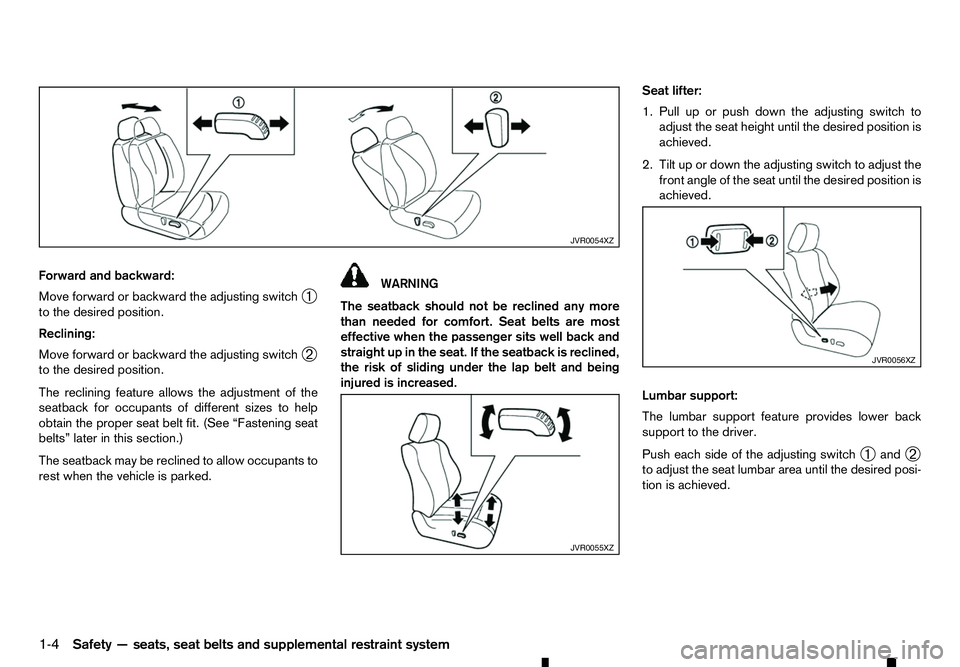
Forward and backward:
Move forward or backward the adjusting switch ➀
to the desired position.
Reclining:
Move forward or backward the adjusting switch ➁
to the desired position.
The reclining feature allows the adjustment of the
seatback for occupants of different sizes to help
obtain the proper seat belt fit. (See “Fastening seat
belts” later in this section.)
The seatback may be reclined to allow occupants to
rest when the vehicle is parked. WARNING
The seatback should not be reclined any more
than needed for comfort. Seat belts are most
effective when the passenger sits well back and
straight up in the seat. If the seatback is reclined,
the risk of sliding under the lap belt and being
injured is increased. Seat lifter:
1. Pull up or push down the adjusting switch to
adjust the seat height until the desired position is
achieved.
2. Tilt up or down the adjusting switch to adjust the front angle of the seat until the desired position is
achieved.
Lumbar support:
The lumbar support feature provides lower back
support to the driver.
Push each side of the adjusting switch ➀and
➁
to adjust the seat lumbar area until the desired posi-
tion is achieved. JVR0054XZ
JVR0055XZ JVR0056XZ
1-4 Safety —seats, seat belts and supplemental restraint system
Page 23 of 340

Heated seats (where fitted)
The front seats can be warmed by built-in heaters.
The switches located on the centre console can be
operated independently of each other.
1. Start the engine.
2. Select heat range. • For high heat, push the (High) side of
the switch
➀.
• For low heat, push the
Page 24 of 340
WARNING
• Never allow anyone to ride on the rear seats
when they are in the fold-up position. Use of
this area by passengers without proper re-
straints could result in serious injury or death
in an accident or sudden stop.
• When folding or returning the rear seat, be
careful not to squeeze your finger between
the seat cushion and the body side.
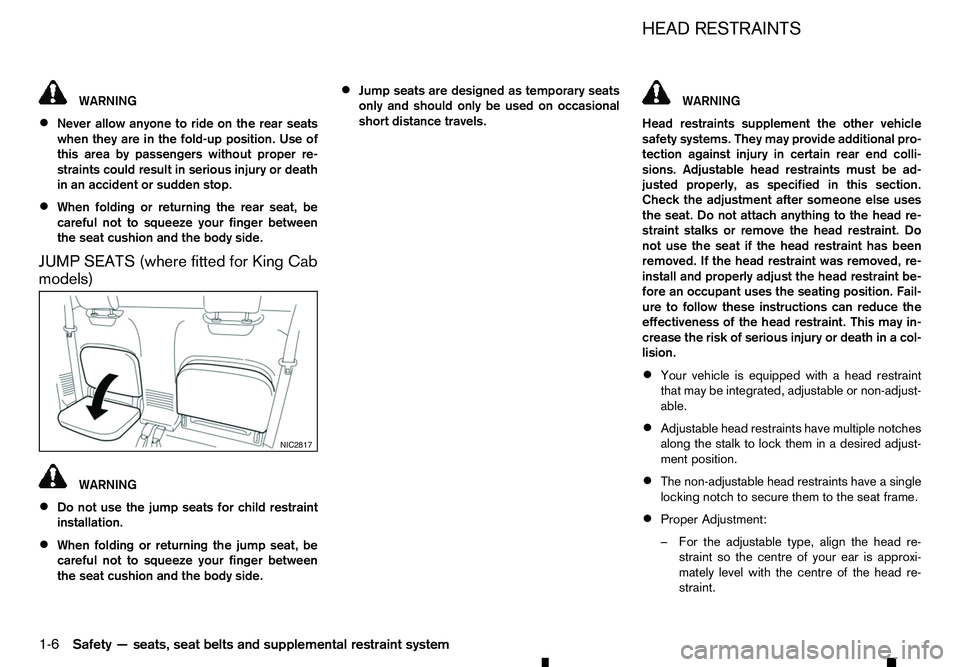
JUMP SEATS (where fitted for King Cab
models) WARNING
• Do not use the jump seats for child restraint
installation.
• When folding or returning the jump seat, be
careful not to squeeze your finger between
the seat cushion and the body side. •
Jump seats are designed as temporary seats
only and should only be used on occasional
short distance travels. WARNING
Head restraints supplement the other vehicle
safety systems. They may provide additional pro-
tection against injury in certain rear end colli-
sions. Adjustable head restraints must be ad-
justed properly, as specified in this section. Check the adjustment after someone else uses
the seat. Do not attach anything to the head re-
straint stalks or remove the head restraint. Do
not use the seat if the head restraint has been
removed. If the head restraint was removed, re-
install and properly adjust the head restraint be-
fore an occupant uses the seating position. Fail-
ure to follow these instructions can reduce the
effectiveness of the head restraint. This may in-
crease the risk of serious injury or death in acol-
lision.
• Your vehicle is equipped with
ahead restraint
that may be integrated, adjustable or non-adjust-
able.
• Adjustable head restraints have multiple notches
along the stalk to lock them in
adesired adjust-
ment position.
• The non-adjustable head restraints have
asingle
locking notch to secure them to the seat frame.
• Proper Adjustment:
–F
or the adjustable type, align the head re-
straint so the centre of your ear is approxi-
mately level with the centre of the head re-
straint. NIC2817 HEAD RESTRAINTS
1-6 Safety —seats, seat belts and supplemental restraint system
Page 25 of 340
–I
fyour ear position is still higher than the rec-
ommended alignment, place the head
restraint at the highest position.
• If the head restraint has been removed, ensure
that it is reinstalled and locked in place before
riding in that designated seating position.
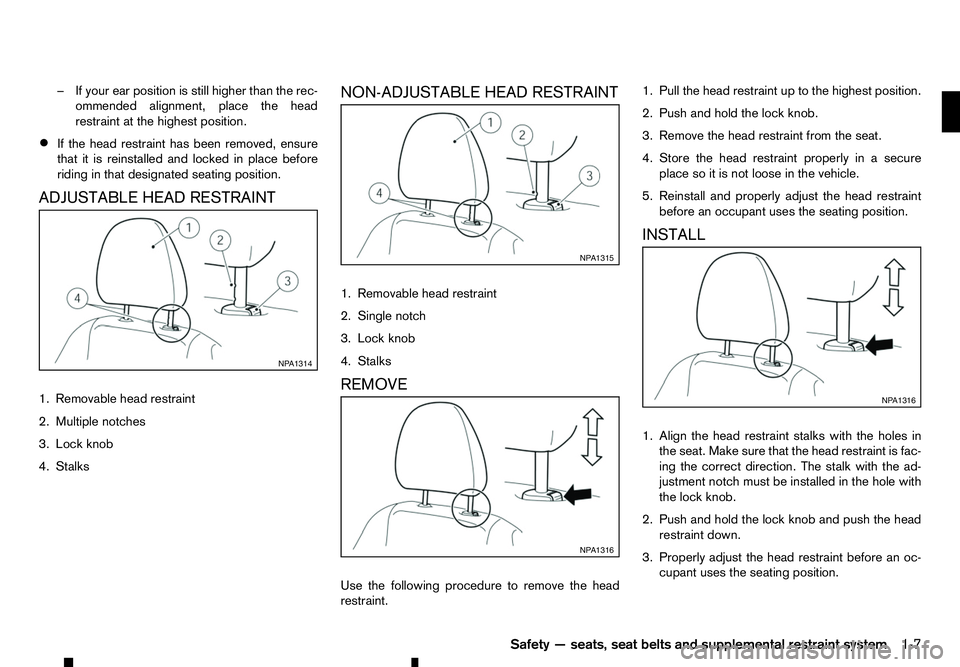
ADJUSTABLE HEAD RESTRAINT
1. Removable head restraint
2. Multiple notches
3. Lock knob
4. Stalks NON-ADJUSTABLE HEAD RESTRAINT
1. Removable head restraint
2. Single notch
3. Lock knob
4. Stalks
REMOVE
Use the following procedure to remove the head
restraint. 1. Pull the head restraint up to the highest position.
2. Push and hold the lock knob.
3. Remove the head restraint from the seat.
4. Store the head restraint properly in
asecure
place so it is not loose in the vehicle.
5. Reinstall and properly adjust the head restraint before an occupant uses the seating position.
INSTALL
1. Align the head restraint stalks with the holes in the seat. Make sure that the head restraint is fac-
ing the correct direction. The stalk with the ad-
justment notch must be installed in the hole with
the lock knob.
2. Push and hold the lock knob and push the head restraint down.
3. Properly adjust the head restraint before an oc- cupant uses the seating position. NP A1314 NP A1315
NP A1316 NP A1316
Safety —seats, seat belts and supplemental restraint system 1-7
Page 26 of 340
ADJUST
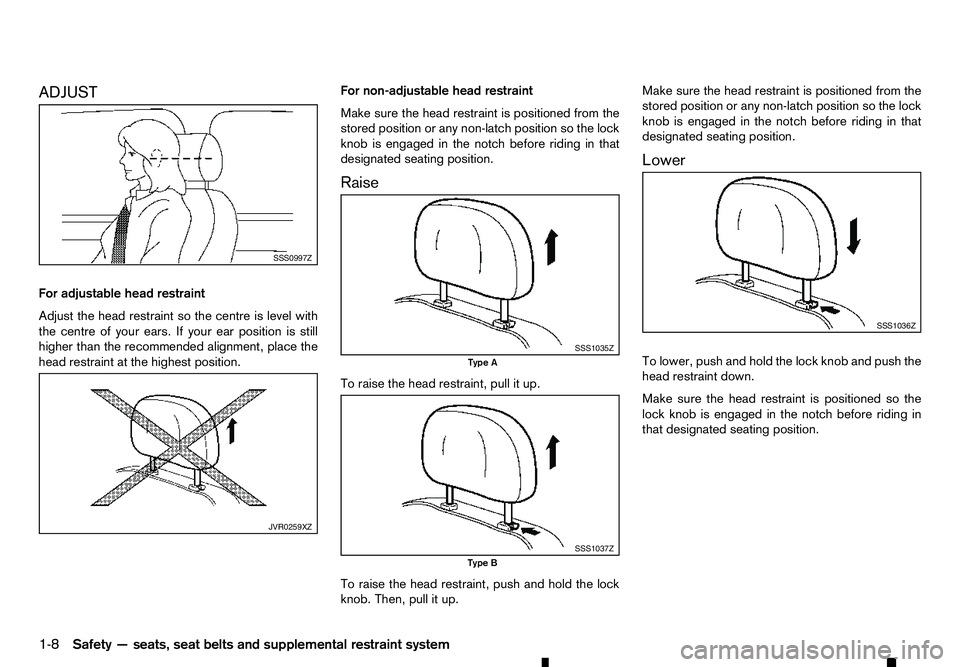
For
adjustable head restraint
Adjust the head restraint so the centre is level with
the centre of your ears. If your ear position is still
higher than the recommended alignment, place the
head restraint at the highest position. For non-adjustable head restraint
Make sure the head restraint is positioned from the
stored position or any non-latch position so the lock
knob is engaged in the notch before riding in that
designated seating position.
Raise
To raise the head restraint, pull it up.
To raise the head restraint, push and hold the lock
knob. Then, pull it up. Make sure the head restraint is positioned from the
stored position or any non-latch position so the lock
knob is engaged in the notch before riding in that
designated seating position.
Lower
To lower, push and hold the lock knob and push the
head restraint down.
Make sure the head restraint is positioned so the
lock knob is engaged in the notch before riding in
that designated seating position. SSS0997Z
JVR0259XZ SSS1035Z
Type A
SSS1037Z
Type B SSS1036Z
1-8 Safety —seats, seat belts and supplemental restraint system
Page 27 of 340
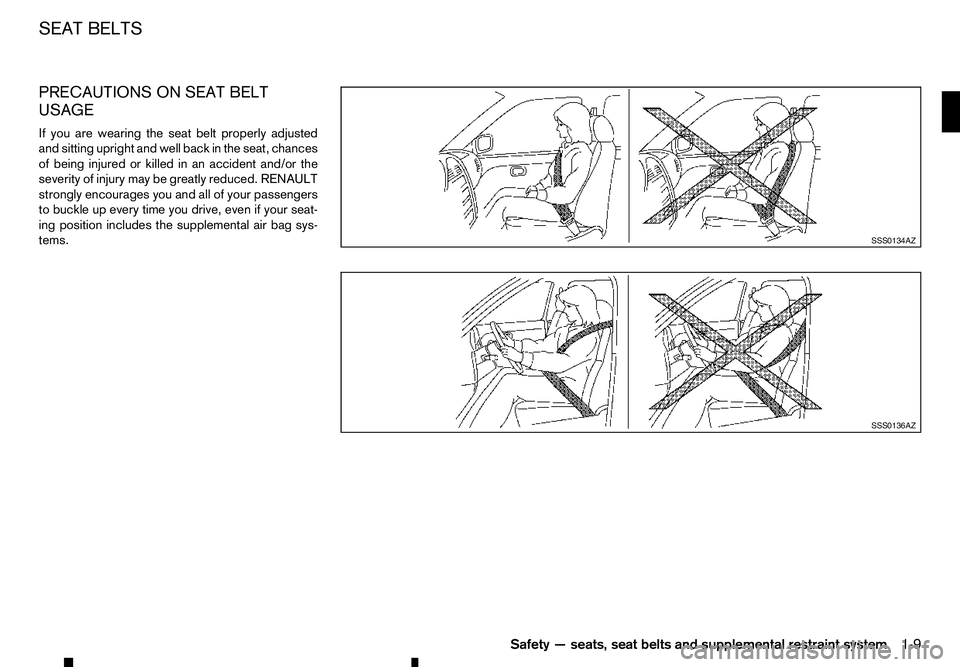
PRECAUTIONS ON SEAT BELT
USAGE
If you are wearing the seat belt properly adjusted
and sitting upright and well back in the seat, chances
of being injured or killed in an accident and/or the
severity of injury may be greatly reduced. RENAULT
strongly encourages you and all of your passengers
to buckle up every time you drive, even if your seat-
ing position includes the supplemental air bag sys-
tems. SSS0134AZ
SSS0136AZ
SEAT BELTS
Safety—seats, seat belts and supplemental restraint system 1-9
Page 28 of 340
WARNING
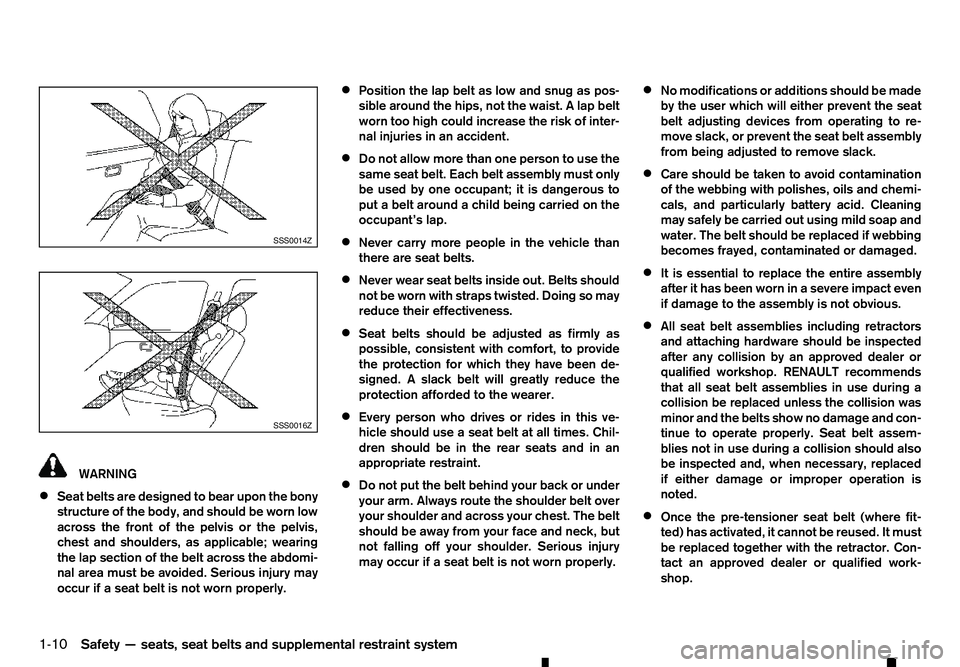
• Seat belts are designed to bear upon the bony
structure of the body, and should be worn low
across the front of the pelvis or the pelvis,
chest and shoulders, as applicable; wearing
the lap section of the belt across the abdomi-
nal area must be avoided. Serious injury may
occur if aseat belt is not worn properly. •
Position the lap belt as low and snug as pos-
sible around the hips, not the waist.
Alap belt
worn too high could increase the risk of inter-
nal injuries in an accident.
• Do not allow more than one person to use the
same seat belt. Each belt assembly must only
be used by one occupant; it is dangerous to
put
abelt around achild being carried on the
occupant’s lap.
• Never carry more people in the vehicle than
there are seat belts.
• Never wear seat belts inside out. Belts should
not be worn with straps twisted. Doing so may
reduce their effectiveness.
• Seat belts should be adjusted as firmly as
possible, consistent with comfort, to provide
the protection for which they have been de-
signed.
Aslack belt will greatly reduce the
protection afforded to the wearer.
• Every person who drives or rides in this ve-
hicle should use
aseat belt at all times. Chil-
dren should be in the rear seats and in an
appropriate restraint.
• Do not put the belt behind your back or under
your arm. Always route the shoulder belt over
your shoulder and across your chest. The belt
should be away from your face and neck, but
not falling off your shoulder. Serious injury
may occur if aseat belt is not worn properly. •
No modifications or additions should be made
by the user which will either prevent the seat
belt adjusting devices from operating to re-
move slack, or prevent the seat belt assembly
from being adjusted to remove slack.
• Care should be taken to avoid contamination
of the webbing with polishes, oils and chemi-
cals, and particularly battery acid. Cleaning
may safely be carried out using mild soap and
water. The belt should be replaced if webbing
becomes frayed, contaminated or damaged.
• It is essential to replace the entire assembly
after it has been worn in
asevere impact even
if damage to the assembly is not obvious.
• All seat belt assemblies including retractors
and attaching hardware should be inspected
after any collision by an approved dealer or
qualified workshop. RENAULT recommends
that all seat belt assemblies in use during a
collision be replaced unless the collision was
minor and the belts show no damage and con-
tinue to operate properly. Seat belt assem-
blies not in use during
acollision should also
be inspected and, when necessary, replaced
if either damage or improper operation is
noted.
• Once the pre-tensioner seat belt (where fit-
ted) has activated, it cannot be reused. It must
be replaced together with the retractor. Con-
tact an approved dealer or qualified work-
shop. SSS0014Z
SSS0016Z
1-10 Safety —seats, seat belts and supplemental restraint system
Page 29 of 340
•
Removal and installation of the pre-tensioner
seat belt system (where fitted) components
should be done by an approved dealer or
qualified workshop.
CHILD SAFETY WARNING
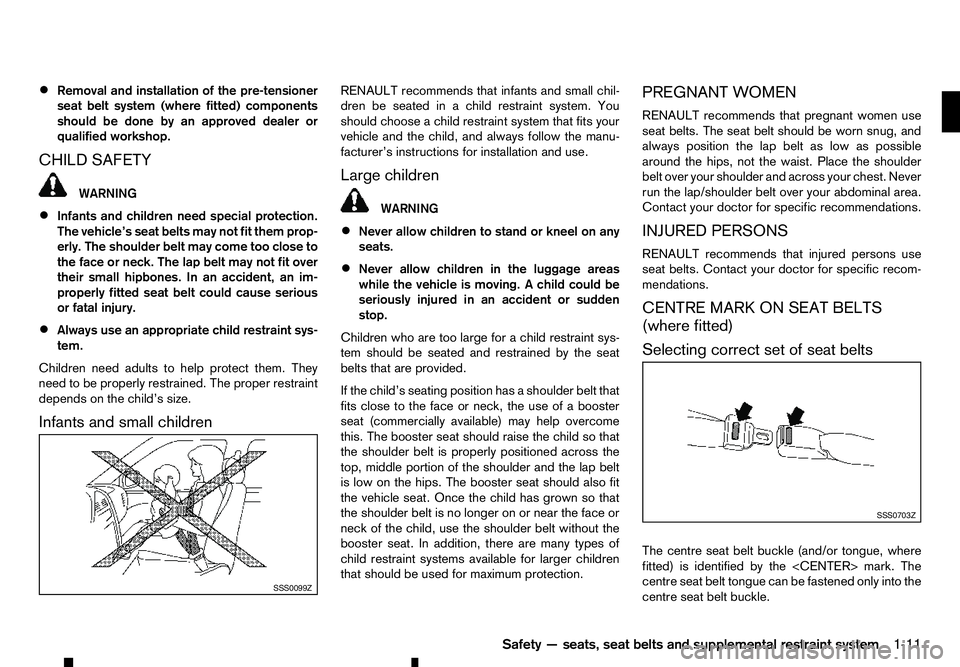
• Infants and children need special protection.
The vehicle’s seat belts may not fit them prop- erly. The shoulder belt may come too close to
the face or neck. The lap belt may not fit over
their small hipbones. In an accident, an im-
properly fitted seat belt could cause serious
or fatal injury.
• Always use an appropriate child restraint sys-
tem.
Children need adults to help protect them. They
need to be properly restrained. The proper restraint
depends on the child’s size.
Infants and small children RENAULT recommends that infants and small chil-
dren be seated in
achild restraint system. You
should choose achild restraint system that fits your
vehicle and the child, and always follow the manu-
facturer’s instructions for installation and use.
Large children WARNING
• Never allow children to stand or kneel on any
seats.
• Never allow children in the luggage areas
while the vehicle is moving.
Achild could be
seriously injured in an accident or sudden
stop.
Children who are too large for achild restraint sys-
tem should be seated and restrained by the seat
belts that are provided.
If the child’s seating position has ashoulder belt that
fits close to the face or neck, the use of abooster
seat (commercially available) may help overcome
this. The booster seat should raise the child so that the shoulder belt is properly positioned across the
top, middle portion of the shoulder and the lap belt
is low on the hips. The booster seat should also fit
the vehicle seat. Once the child has grown so that
the shoulder belt is no longer on or near the face or
neck of the child, use the shoulder belt without the
booster seat. In addition, there are many types of
child restraint systems available for larger children
that should be used for maximum protection. PREGNANT WOMEN
RENAULT recommends that pregnant women use
seat belts. The seat belt should be worn snug, and
always position the lap belt as low as possible
around the hips, not the waist. Place the shoulder
belt over your shoulder and across your chest. Never
run the lap/shoulder belt over your abdominal area.
Contact your doctor for specific recommendations.
INJURED PERSONS
RENAULT recommends that injured persons use
seat belts. Contact your doctor for specific recom-
mendations.
CENTRE MARK ON SEAT BELTS
(where fitted)
Selecting correct set of seat belts
The centre seat belt buckle (and/or tongue, where
fitted) is identified by the
centre seat belt tongue can be fastened only into the
centre seat belt buckle.
SSS0099Z SSS0703Z
Safety —seats, seat belts and supplemental restraint system
1-11