2017 RENAULT ALASKAN light
[x] Cancel search: lightPage 261 of 340

•
Do not galvanise the emergency tyre punc-
ture repair kit.
• Do not use the emergency tyre puncture re-
pair kit under the following conditions. Con-
tact an approved dealer or qualified workshop
or professional road assistance.
–w
hen the sealant has passed its expiration
date (shown on the label attached to the
bottle)
–w hen the cut or the puncture is approxi-
mately 6mm(0.25 in) or longer
–w hen the side of the tyre is damaged
–w hen the vehicle has been driven with a
considerable loss of air from the tyre
–w hen the tyre is completely displaced in-
side or outside the rim
–w hen the tyre rim is damaged
–w hen two or more tyres are flat Getting emergency tyre puncture repair
kit
Take the emergency tyre puncture repair kit from its
storage position under the left rear seat. The repair
kit consists of the following items:
➀
Tyre sealant bottle
➁ Air compressor
➂ Speed restriction sticker
NOTE
For models with the emergency tyre puncture
repair kit, aspare tyre, jack and rod are not
equipped as standard. These parts are dealer
options. Contact an approved dealer or qualified
workshop about obtaining these parts. See
“Changing flat tyre (for models with spare tyre) ”
earlier in this section for usage of jacking tools
and tyre replacement. Before using emergency tyre puncture
repair kit
• If any foreign object (for example,
ascrew or
nail) is embedded in the tyre, do not remove it.
• Check the expiration date of the sealant (shown
on the label attached to the bottle). Never use a
sealant whose expiration date has passed.
Repairing tyre WARNING
Observe the following precautions when using
the emergency tyre puncture repair kit.
• Swallowing the compound is dangerous. Im-
mediately drink as much water as possible
and seek prompt medical assistance.
• Rinse well with lots of water if the compound
comes into contact with skin or eyes. If irrita-
tion persists, seek prompt medical attention.
• Keep the repair compound out of the reach of
children.
• The emergency repair compound may cause
am
alfunction of the tyre pressure sensors
(where fitted) and cause the low tyre pres-
sure warning light (where fitted) to illuminate.
Have the tyre pressure sensor replaced as
soon as possible. NCE483
In case of emergency
6-7
Page 262 of 340
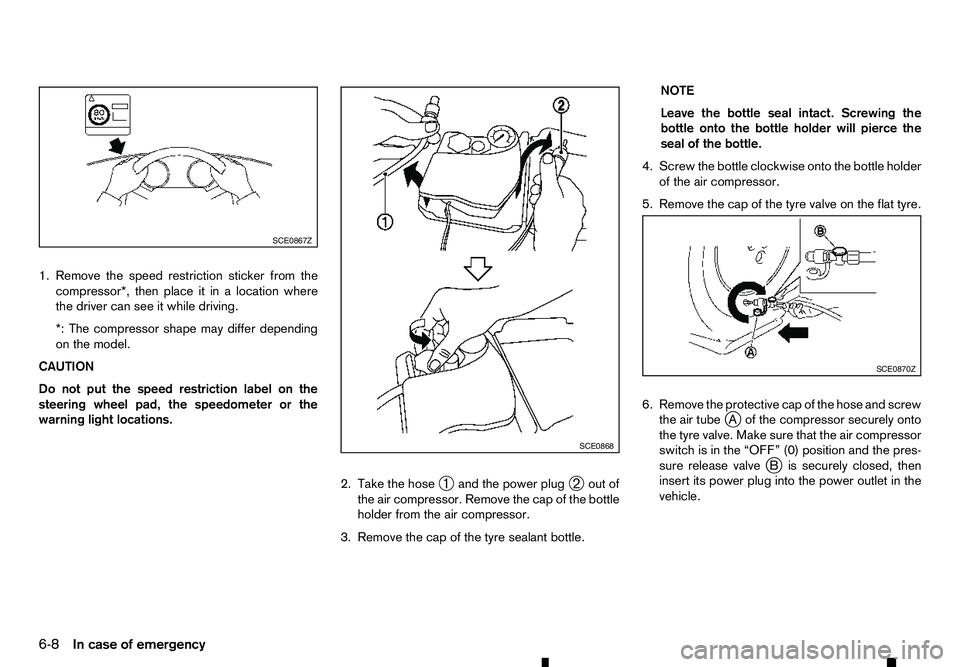
1. Remove the speed restriction sticker from the
compressor*, then place it in alocation where
the driver can see it while driving.
*: The compressor shape may differ depending
on the model.
CAUTION
Do not put the speed restriction label on the
steering wheel pad, the speedometer or the
warning light locations.
2. Take the hose➀and the power plug
➁out of
the air compressor. Remove the cap of the bottle holder from the air compressor.
3. Remove the cap of the tyre sealant bottle. NOTE
Leave the bottle seal intact. Screwing the
bottle onto the bottle holder will pierce the
seal of the bottle.
4. Screw the bottle clockwise onto the bottle holder of the air compressor.
5. Remove the cap of the tyre valve on the flat tyre.
6. Remove the protective cap of the hose and screw the air tube j
Ao fthe compressor securely onto
the tyre valve. Make sure that the air compressor
switch is in the “OFF” (0) position and the pres-
sure release valve j
Bi ssecurely closed, then
insert its power plug into the power outlet in the
vehicle. SCE0867Z
SCE0868 SCE0870Z
6-8 In case of emergency
Page 265 of 340

1. If the booster battery is in another vehicle
jA,
position the two vehicles j
Aa ndjBt obring the
batteries into close proximity to each other.
CAUTION
• Do not allow the two vehicles to touch.
• If the battery of vehicle
jBe quipped with
the Remote Control Key system is dis- charged, the steering wheel will lock and
cannot be turned with the ignition switch
in the OFF position. Supply power using
jumper cables before pushing the ignition
switch to any position other than the OFF
position and disengaging the steering lock.
2. Apply the parking brake. 3.
Automatic transmission (AT) model:
Move the shift lever to the P(Park) position.
Manual transmission (MT) model:
Move the shift lever to the N(Neutral) position.
4. Switch off all unnecessary electrical systems (headlights, heater, air conditioner, etc.).
5. Place the ignition switch in the OFFposition.
6. Remove the vent caps, where fitted, on the bat- tery.
7. Cover the battery with afirmly wrung out moist
cloth to reduce the hazard of an explosion.
8. Connect the jumper cables in the sequence as illustrated ( ➀,
➁ ,
➂ ,
➃ ).
CAUTION
• Always connect positive
j+t opositive
j +a nd negative j-t obody ground, NOT
to the battery’s negative j
-.
• Be sure that the jumper cables do not
touch moving parts in the engine compart-
ment.
• Be sure that the jumper cable’s clamps do
not contact any other metal.
9. Start the engine of the booster vehicle j
Aa nd let
it run for afew minutes.
10. Depress the accelerator pedal of the booster vehicle j
At orace the engine at about 2,000
rpm. NCE477
M9T 2.3DCI engine models
In case of emergency6-11
Page 272 of 340
In order to maintain the appearance of your vehicle,
it is important to take proper care of it.
Whenever possible, park your vehicle inside aga-
rage or in acovered area to minimise the chances
of damaging the paint surface of your vehicle.
When it is necessary to park outside, park in ashady
area or protect the vehicle with abody cover. Be
careful not to scratch the paint surface when put-
ting on or removing the body cover.
WASHING
In the following instances, wash your vehicle as soon
as possible to protect the paint surface:
• After
arainfall, which may cause the paint sur-
face damage from acid rain.
• After driving on coastal roads, which may cause
rusting from the sea breeze.
• When contaminants such as soot, bird drop-
pings, tree sap, metal particles or bugs get on
the paint surface.
• When dust or mud builds up on the paint sur-
face.
1. Wash the vehicle surface with awet sponge and
plenty of water.
2. Clean the vehicle surface gently and thoroughly using amild soap, aspecial vehicle soap or a
general purpose dishwashing liquid mixed with
clean, lukewarm (never hot) water. CAUTION
• Do not wash the vehicle with strong house-
hold soap, strong chemical detergents,
petrol or solvents.
• Do not wash the vehicle in direct sunlight
or while the vehicle body is hot, as the
paint surface may become water-spotted.
• Avoid using tight-napped or rough cloths,
such as washing mitts. Care must be taken
when removing caked-on dirt or other for-
eign substances so the paint surface is not
scratched or damaged.
• Lock all doors before going through auto-
matic car wash. Locking doors helps pre-
vent fuel filler lid from opening and be-
coming damaged.
3. Rinse the vehicle thoroughly with plenty of clean water.
4. Use adampened chamois to dry the paint sur-
face and avoid leaving water spots.
When washing the vehicle, take care of the follow- ing:
• Inside flanges, joints and folds on the doors,
hatches and bonnet are particularly vulnerable to
the effects of road salt. Therefore, these areas
must be cleaned regularly.
• Be sure that the drain holes in the lower edge of
the doors are not clogged. •
Spray water on the underbody and in the wheel
wells to loosen the dirt and/or wash away road
salt.
REMOVING SPOTS
Remove tar and oil spots, industrial dust, insects,
and tree sap as quickly as possible from the paint
surface to avoid lasting damage or staining. Special
cleaning products are available at an approved
dealer or any automotive accessory store.
WAXING
Regular waxing protects the paint surface and helps
maintain anew vehicle appearance.
After waxing, polishing is recommended to remove
built-up residue and to avoid aweathered appear-
ance.
An approved dealer can assist you in choosing the
appropriate waxing products.
CAUTION
• Wash your vehicle thoroughly and completely
before applying wax to the paint surface.
• Always follow the manufacturer’s instructions
supplied with the wax.
• Do not use
awax containing any abrasives,
cutting compounds or cleaners that may dam-
age the vehicle finish.
Machine compounding or aggressive polishing on a
base coat/clear coat paint finish may dull the finish
or leave swirl marks.
CLEANING EXTERIOR
7-2
Appearance and care
Page 277 of 340

8
Maintenance and do-it-yourself
Maintenance and do-it-yourself
Maintenance requirements ....................................... 8-2 Scheduled maintenance...................................... 8-2
General maintenance .......................................... 8-2
Where to go for service ...................................... 8-2
General maintenance ............................................... 8-2 Explanation of general maintenance items ........... 8-2
Maintenance precautions .................................... 8-4
Engine compartment check locations ....................... 8-5
Engine cooling system ............................................. 8-5 Checking engine coolant level............................. 8-6
Changing engine coolant .................................... 8-6
Engine oil................................................................. 8-6
Checking engine oil level .................................... 8-6
Changing engine oil and oil filter ......................... 8-7
Protect environment ............................................ 8-7
AdBlue® tank (where fitted for diesel engine
model) ..................................................................... 8-7 Refilling the AdBlue® tank .................................. 8-7
Drive belt ................................................................. 8-8
Automatic Transmission Fluid (ATF) (where fitted).... 8-8 7-speed Automatic Transmission (AT) model....... 8-8
Power steering fluid ................................................. 8-8
Brakes ..................................................................... 8-9 Checking parking brake ...................................... 8-9
Checking footbrake ............................................ 8-9
Brake booster ..................................................... 8-9
Brake fluid ............................................................... 8-10
Clutch fluid (where fitted) ......................................... 8-11 Window washer fluid ............................................... 8-11
Battery..................................................................... 8-12
Vehicle battery .................................................... 8-13
Remote controller battery (where fitted) .............. 8-13
Remote Control Key battery (where fitted)........... 8-14
Air cleaner filter........................................................ 8-15
Wiper blades ........................................................... 8-16 Windscreen wiper blades ................................... 8-16
Variable voltage control system (where fitted) ........... 8-17
Fuses ...................................................................... 8-18 Engine compartment ........................................... 8-18
Passenger compartment ..................................... 8-19
Lights ...................................................................... 8-20
Headlights .......................................................... 8-20
Exterior lights ...................................................... 8-21
Interior lights....................................................... 8-22
Light locations .................................................... 8-23
Tyres and wheels ..................................................... 8-26 Tyre inflation pressure......................................... 8-26
Types of tyres ..................................................... 8-26
Tyre chains ......................................................... 8-27
Tyre rotation ....................................................... 8-27
Tyre wear and damage ....................................... 8-28
Tyre age ............................................................. 8-28
Changing tyres and wheels................................. 8-28
Wheel balance.................................................... 8-28
Spare tyre .......................................................... 8-28
Page 279 of 340

Lights*:
Clean the headlights on
aregular basis. Make sure
that the headlights, stop lights, tail lights, turn signal
lights, and other lights are all operating properly and
installed securely. Also check the aim of the head-
lights.
Tyres*:
Check the pressure with agauge often and always
prior to long distance trips. Adjust the pressure in all
tyres, including the spare, to the pressure specified.
Check carefully for damage, cuts or excessive wear.
Tyre rotation*:
In the case of Two-Wheel Drive (2WD), and where
front and rear tyres are the same size: tyres should
be rotated every 10,000 km (6,000 miles). Tyres
marked with directional indicators can only be ro-
tated between front and rear. Make sure that the
directional indicators point in the direction of wheel
rotation after the tyre rotation is completed.
In the case of the Four-Wheel Drive and All Wheel
Drive (4WD/AWD), and where front and rear tyres
are the same size: tyres should be rotated every
5,000 km (3,000 miles). Tyres marked with direc-
tional indicators can only be rotated between front
and rear. Make sure that the directional indicators
point in the direction of wheel rotation after the tyre
rotation is completed.
In the case that front tyres are different size from
rear tyres: tyres cannot be rotated.
The timing for tyre rotation may vary according to
your driving habits and the road surface conditions. Tyre Pressure Monitoring System (TPMS)
transmitter components (where fitted):
Replace the TPMS transmitter grommet seal, valve
core and cap when the tyres are replaced due to
wear or age.
Wheel alignment and balance:
If the vehicle should pull to either side while driving
on astraight and level road, or if you detect uneven
or abnormal tyre wear, there may be aneed for
wheel alignment. If the steering wheel or seat vi-
brates at normal highway speeds, wheel balancing
may be needed.
Windscreen:
Clean the windscreen on aregular basis. Check the
windscreen at least every six months for cracks or
other damage. Repair as necessary.
Wiper blades*:
Check for cracks or wear if not functioning cor-
rectly. Replace as necessary.
Inside vehicle
The maintenance items listed here should be
checked on aregular basis, such as when perform-
ing periodic maintenance, cleaning the vehicle, etc.
Accelerator pedal:
Check the pedal for smooth operation and make
sure that the pedal does not catch or require uneven
effort. Keep the floor mats away from the pedal. Brake pedal*:
Check the pedal for smooth operation and make
sure that it is the proper distance from the floor mat
when depressed fully. Check the brake booster
function. Be sure to keep the floor mats away from
the pedal.
Parking brake*:
Check the parking brake operation regularly. Check
that the lever (where fitted) or the pedal (where fit-
ted) has the proper travel. Also make sure that the
vehicle is held securely on
afairly steep hill when
only the parking brake is applied.
Seat belts:
Check that all parts of the seat belt system (for
example, buckles, anchors, adjusters and retrac-
tors) operate properly and smoothly, and are in-
stalled securely. Check the belt webbing for cuts,
fraying, wear or damage.
Steering wheel:
Check for changes in the steering condition, such
as excessive play, hard steering or strange noises.
Warning lights and chimes:
Make sure that all warning lights and chimes are
operating properly.
Windscreen defogger:
Check that the air comes out of the defogger outlets
properly and in good quantity when operating the
heater or air conditioner.
Maintenance and do-it-yourself 8-3
Page 285 of 340

CHECKING PARKING BRAKE
From the released position, pull the parking brake
lever slowly and firmly. If the number of clicks is out
of the range listed, see an approved dealer or quali- fied workshop.
7to9c licks under apulling force of 196 N(20
kg, 44 lb) CHECKING FOOTBRAKE WARNING
See an approved dealer or qualified workshop
for abrake system check if the brake pedal height
does not return to normal.
With the engine running, check the distance be-
tween the upper surface of the pedal and the metal
floor. If it is out the range listed, see an approved
dealer or qualified workshop. Depressing force
490N(50 kg, 110 lb) LHD model RHD model
Diesel engine
model 110 mm (4.3
in) or more100 mm (3.9
in) or more
Petrol engine
model 109 mm (4.3
in) or more Brake pad wear warning
The disc brake pads have audible wear warnings.
When
abrake pad requires replacement, it will make
ah igh pitched scraping sound when the vehicle is in
motion. This scraping sound will first occur only
when the brake pedal is depressed. After more wear
of the brake pad, the sound will always be heard
even if the brake pedal is not depressed. Have the
brakes checked as soon as possible if the wear
warning sound is heard.
Under some driving or climate conditions, occa-
sional brake squeaks, squeals or other noises may
be heard. Occasional brake noise during light to
moderate stops is normal and does not affect the
function or performance of the brake system.
The rear drum brakes do not have audible wear indi-
cators. Should you ever hear an unusually loud noise
from the rear drum brakes, have them checked as
soon as possible by an approved dealer or qualified
workshop.
Proper brake inspection intervals should be
followed. For additional information, see aseparate
maintenance booklet.
BRAKE BOOSTER
Check the brake booster function as follows:
1. With the engine off, depress and release the footbrake pedal several times. When the brake
pedal movement (distance of travel) remains the
same from one pedal application to the next, con-
tinue on to the next step. SDI1447AZ DI1020MMZ
BRAKES
Maintenance and do-it-yourself
8-9
Page 286 of 340

2. While depressing the footbrake pedal, start the
engine. The pedal height should drop alittle.
3. With the footbrake pedal depressed, stop the engine. Keep the pedal depressed for about 30
seconds. The pedal height should not change.
4. Run the engine for 1minute without depressing
the footbrake pedal, then turn it off. Depress the
footbrake pedal several times. The pedal travel
distance will decrease gradually with each de-
pression as the vacuum is released from the
booster.
If the brakes do not operate properly, have the
brakes checked by an approved dealer or qualified
workshop. WARNING
• Use only new fluid from
asealed container.
Old, inferior, or contaminated fluid may dam-
age the brake system. The use of improper
fluids can damage the brake system and af-
fect the vehicle’s stopping ability.
• Clean the filler cap before removing.
• Brake fluid is poisonous and should be stored
carefully in marked containers out of the reach
of children.
CAUTION
• Refilling and checking the brake system
should be left to an approved dealer or quali-
fied workshop who will have the necessary
brake fluid and technical knowledge.
• Do not spill the fluid on painted surfaces. This
will damage the paint. If fluid is spilled, wash
with water.
For details of recommended fluids, refer to the main-
tenance service booklet for your vehicle. Check the fluid level in the reservoir. If the fluid is
below the MIN line
➁,t
he brake warning light will
illuminate. Add fluid up to the MAX line ➀.
If fluid must be added frequently, the system should
be thoroughly checked by your approved dealer or
qualified workshop. JVM0450XZ
BRAKE FLUID
8-10 Maintenance and do-it-yourself