2017 RENAULT ALASKAN lock
[x] Cancel search: lockPage 258 of 340

CAUTION
When storing the wheel, be sure to mount the
wheel horizontally. Securing awheel that is in a
tilted position as illustrated may cause looseness
and dropping of the wheel while driving. Lower
the wheel on to the ground again, and make sure that the hanging plate is properly set. Hang the
wheel again and make sure that the wheel is
held horizontally, then store the wheel.
Blocking wheels WARNING
Be sure to block the appropriate wheel to pre-
vent the vehicle from moving, which may cause
personal injury.
Place suitable blocks ➀at both the front and back
of the wheel diagonally opposite the flat tyre j
Ato
prevent the vehicle from moving when it is jacked
up.
Removing tyre WARNING
• Be sure to read and follow the instructions in
this section.
• DO NOT GET UNDER
AVEHICLE THAT IS
SUPPORTED BY AJACK. •
Never use
ajack which was not provided with
your vehicle.
• The jack, which is provided with your vehicle,
is designed only to lift your vehicle during a
tyre change.
• Never jack up the vehicle at
alocation other
than the jack-up point that is specified.
• Never lift the vehicle more than necessary.
• Never use blocks on or under the jack.
• Never start or run the engine while the vehicle
is on the jack. The vehicle may move sud-
denly, and this may cause an accident.
• Never allow passengers to remain in the ve-
hicle while the tyre is off the ground.
• Be sure to read the caution label attached to
the jack body before using.
Removing the wheel cap (where fitted):
Remove the centre wheel cap ➀as illustrated. SCE0982Z MCE0001DZ
SCE0139HZ
6-4 In case of emergency
Page 259 of 340

Jacking up vehicle:
j A For front wheel
j B For rear wheel
1. Place the jack directly under the jack-up points jA jBa sillustrated.
The jack should be placed on firm level
ground. 2. Loosen each wheel nut, anticlockwise, one or
two turns with the wheel nut wrench.
Do not remove the wheel nuts until the tyre is
off the ground.
3. Install the assembled jack rod into the jack as shown.
4. Carefully raise the vehicle until the clearance be- tween the tyre and ground is achieved.
5. To lift the vehicle, securely hold the jack lever and rod with both hands and turn the jack lever.
Removing tyre:
1. Remove the wheel nuts.
2. Remove the damaged tyre.
CAUTION
The tyre is heavy. Be sure that your feet are clear
from the tyre and use gloves as necessary to
avoid injury. NCE480 NCE130Z
In case of emergency
6-5
Page 262 of 340
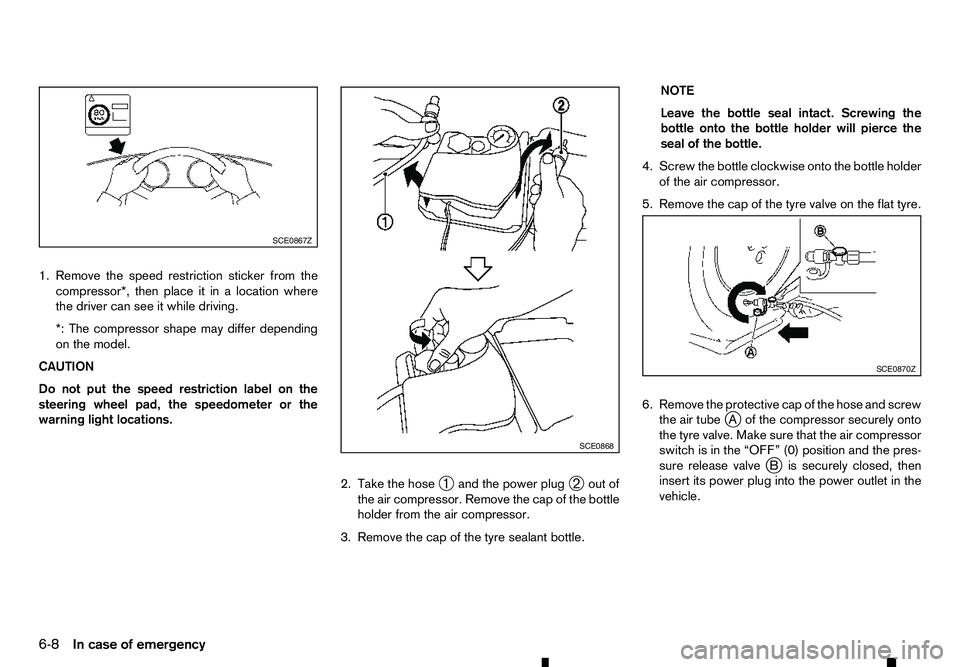
1. Remove the speed restriction sticker from the
compressor*, then place it in alocation where
the driver can see it while driving.
*: The compressor shape may differ depending
on the model.
CAUTION
Do not put the speed restriction label on the
steering wheel pad, the speedometer or the
warning light locations.
2. Take the hose➀and the power plug
➁out of
the air compressor. Remove the cap of the bottle holder from the air compressor.
3. Remove the cap of the tyre sealant bottle. NOTE
Leave the bottle seal intact. Screwing the
bottle onto the bottle holder will pierce the
seal of the bottle.
4. Screw the bottle clockwise onto the bottle holder of the air compressor.
5. Remove the cap of the tyre valve on the flat tyre.
6. Remove the protective cap of the hose and screw the air tube j
Ao fthe compressor securely onto
the tyre valve. Make sure that the air compressor
switch is in the “OFF” (0) position and the pres-
sure release valve j
Bi ssecurely closed, then
insert its power plug into the power outlet in the
vehicle. SCE0867Z
SCE0868 SCE0870Z
6-8 In case of emergency
Page 265 of 340

1. If the booster battery is in another vehicle
jA,
position the two vehicles j
Aa ndjBt obring the
batteries into close proximity to each other.
CAUTION
• Do not allow the two vehicles to touch.
• If the battery of vehicle
jBe quipped with
the Remote Control Key system is dis- charged, the steering wheel will lock and
cannot be turned with the ignition switch
in the OFF position. Supply power using
jumper cables before pushing the ignition
switch to any position other than the OFF
position and disengaging the steering lock.
2. Apply the parking brake. 3.
Automatic transmission (AT) model:
Move the shift lever to the P(Park) position.
Manual transmission (MT) model:
Move the shift lever to the N(Neutral) position.
4. Switch off all unnecessary electrical systems (headlights, heater, air conditioner, etc.).
5. Place the ignition switch in the OFFposition.
6. Remove the vent caps, where fitted, on the bat- tery.
7. Cover the battery with afirmly wrung out moist
cloth to reduce the hazard of an explosion.
8. Connect the jumper cables in the sequence as illustrated ( ➀,
➁ ,
➂ ,
➃ ).
CAUTION
• Always connect positive
j+t opositive
j +a nd negative j-t obody ground, NOT
to the battery’s negative j
-.
• Be sure that the jumper cables do not
touch moving parts in the engine compart-
ment.
• Be sure that the jumper cable’s clamps do
not contact any other metal.
9. Start the engine of the booster vehicle j
Aa nd let
it run for afew minutes.
10. Depress the accelerator pedal of the booster vehicle j
At orace the engine at about 2,000
rpm. NCE477
M9T 2.3DCI engine models
In case of emergency6-11
Page 266 of 340

11. Start the engine of the jumped vehicle
jBi nthe
normal manner.
CAUTION
Never keep the starter motor engaged for
more than 10 seconds. If the engine does not
start right away, place the ignition switch in
the “LOCK” position and wait at least 10 sec-
onds before trying again.
12. After the engine is started, carefully disconnect the jumper cables in the opposite sequence
from that illustrated ( ➃,
➂ ,
➁ ,
➀ ).
13. Remove and dispose of the cloth properly as it may be contaminated with corrosive acid.
14. Replace the vent caps, if removed. Do not attempt to start the engine by pushing the
vehicle.
CAUTION
• Automatic Transmission (AT) model cannot
be started by pushing. Attempting to do so
may cause damage to the transmission.
• Three-way catalyst equipped model should
not be started by pushing. Attempting to do
so may cause damage to the three-way cata-
lyst.
• Diesel Oxidation Catalyst equipped model
should not be started by pushing. Attempting
to do so may cause damage to the catalyst.
• Never try to start the engine by towing. When
the engine starts, the forward surge could
cause the vehicle to collide with the towing
vehicle. WARNING
• Never continue driving if your vehicle over-
heats. Doing so could cause engine damage
and/or avehicle fire.
• Never open the bonnet if steam is coming
out.
• Never remove the radiator or coolant reser-
voir cap while the engine is hot. If the radiator
or coolant reservoir cap is removed when the
engine is hot, pressurised hot water will spurt
out and possibly cause burning, scalding or
serious injury.
• If steam or coolant is coming from the engine,
stand clear of the vehicle to prevent getting
scalded.
• The engine cooling fan can start at any time
when the coolant temperature exceeds pre-
set degrees.
• Be careful not to allow your hands, hair, jewel-
lery or clothing to come into contact with, or
to get caught in the cooling fan or drive belts.
If your vehicle is overheating, or if you feel alack of
engine power, detect unusual noise, etc., take the
following steps:
1. Safely move the vehicle off the road away from traffic.
2. Turn on the hazard indicator flashers.
3. Apply the parking brake.
PUSH STARTING
IF YOUR VEHICLE OVERHEATS
6-12 In case of emergency
Page 272 of 340
In order to maintain the appearance of your vehicle,
it is important to take proper care of it.
Whenever possible, park your vehicle inside aga-
rage or in acovered area to minimise the chances
of damaging the paint surface of your vehicle.
When it is necessary to park outside, park in ashady
area or protect the vehicle with abody cover. Be
careful not to scratch the paint surface when put-
ting on or removing the body cover.
WASHING
In the following instances, wash your vehicle as soon
as possible to protect the paint surface:
• After
arainfall, which may cause the paint sur-
face damage from acid rain.
• After driving on coastal roads, which may cause
rusting from the sea breeze.
• When contaminants such as soot, bird drop-
pings, tree sap, metal particles or bugs get on
the paint surface.
• When dust or mud builds up on the paint sur-
face.
1. Wash the vehicle surface with awet sponge and
plenty of water.
2. Clean the vehicle surface gently and thoroughly using amild soap, aspecial vehicle soap or a
general purpose dishwashing liquid mixed with
clean, lukewarm (never hot) water. CAUTION
• Do not wash the vehicle with strong house-
hold soap, strong chemical detergents,
petrol or solvents.
• Do not wash the vehicle in direct sunlight
or while the vehicle body is hot, as the
paint surface may become water-spotted.
• Avoid using tight-napped or rough cloths,
such as washing mitts. Care must be taken
when removing caked-on dirt or other for-
eign substances so the paint surface is not
scratched or damaged.
• Lock all doors before going through auto-
matic car wash. Locking doors helps pre-
vent fuel filler lid from opening and be-
coming damaged.
3. Rinse the vehicle thoroughly with plenty of clean water.
4. Use adampened chamois to dry the paint sur-
face and avoid leaving water spots.
When washing the vehicle, take care of the follow- ing:
• Inside flanges, joints and folds on the doors,
hatches and bonnet are particularly vulnerable to
the effects of road salt. Therefore, these areas
must be cleaned regularly.
• Be sure that the drain holes in the lower edge of
the doors are not clogged. •
Spray water on the underbody and in the wheel
wells to loosen the dirt and/or wash away road
salt.
REMOVING SPOTS
Remove tar and oil spots, industrial dust, insects,
and tree sap as quickly as possible from the paint
surface to avoid lasting damage or staining. Special
cleaning products are available at an approved
dealer or any automotive accessory store.
WAXING
Regular waxing protects the paint surface and helps
maintain anew vehicle appearance.
After waxing, polishing is recommended to remove
built-up residue and to avoid aweathered appear-
ance.
An approved dealer can assist you in choosing the
appropriate waxing products.
CAUTION
• Wash your vehicle thoroughly and completely
before applying wax to the paint surface.
• Always follow the manufacturer’s instructions
supplied with the wax.
• Do not use
awax containing any abrasives,
cutting compounds or cleaners that may dam-
age the vehicle finish.
Machine compounding or aggressive polishing on a
base coat/clear coat paint finish may dull the finish
or leave swirl marks.
CLEANING EXTERIOR
7-2
Appearance and care
Page 278 of 340

Some day-to-day and regular maintenance is essen-
tial to maintain your vehicle’s good mechanical con-
dition, as well as its emission and engine perfor-
mance.
It is the owner’s responsibility to make sure that the
specified maintenance, as well as general mainte-
nance, is performed.
As the vehicle owner, you are the only one who can
ensure that your vehicle receives the proper mainte-
nance care.
SCHEDULED MAINTENANCE
For your convenience, the required scheduled main-
tenance items are described and listed in aseparate
Warranty Information and Maintenance booklet. You
must refer to that booklet to ensure that necessary
maintenance is performed on your vehicle at regular
intervals.
GENERAL MAINTENANCE
General maintenance includes those items which should be checked during normal day-to-day opera-
tion of the vehicle. They are essential if your vehicle
is to continue to operate properly. It is your respon-
sibility to perform these procedures regularly as pre- scribed.
Performing general maintenance checks requires
minimal mechanical skill and only afew general au-
tomotive tools.
These checks or inspections can be done by your-
self, aqualified technician, or if you prefer, your
approved dealer or qualified workshop. WHERE TO GO FOR SERVICE
If maintenance service is required or your vehicle
appears to malfunction, have the systems checked
and tuned by an authorised approved dealer or
qualified workshop.
During normal day-to-day operation of the vehicle,
general maintenance should be performed regularly
as prescribed in this section. If you detect any un-
usual sounds, vibrations or smells, be sure to check
for the cause or have an approved dealer or quali-
fied workshop do it promptly. In addition, you should
notify an approved dealer or qualified workshop if
you think that repairs are required.
When performing any checks or maintenance work,
closely observe “Maintenance precautions” later in
this section.
EXPLANATION OF GENERAL
MAINTENANCE ITEMS
Additional information on the following items with
“*” is found later in this section.
Outside vehicle
The maintenance items listed here should be per-
formed from time to time, unless otherwise speci-
fied.
Doors and bonnet:
Check that all doors and the bonnet operate
smoothly as well as the tailgate. Also make sure that
all latches lock securely. Lubricate if necessary.
Make sure that the secondary latch keeps the bon-
net from opening when the primary latch is released.
When driving in areas using road salt or other cor-
rosive materials, check lubrication frequently.
MAINTENANCE REQUIREMENTS
GENERAL MAINTENANCE
8-2 Maintenance and do-it-yourself
Page 280 of 340

Windscreen wiper and washer*:
Check that the wipers and washer operate properly
and that the wipers do not streak.
Under bonnet and vehicle
The maintenance items listed here should be
checked periodically (for example, each time you
check the engine oil or refuel).
Battery (except for maintenance free batter-
ies)*:
Check the fluid level in each cell. It should be be-
tween the
operated in high temperatures or under severe con-
ditions require frequent checks of the battery fluid
level.
Brake (and clutch) fluid level(s)*:
For Manual Transmission (MT) model: make sure
that the brake and clutch fluid levels are between
the
Except for Manual Transmission (MT) model: make
sure that the brake fluid level is between the
and
Engine coolant level*:
Check the coolant level when the engine is cold.
Make sure that the coolant level is between the
Engine drive belt(s)*:
Make sure that drive belt(s) is/are not frayed, worn,
cracked or oily. Engine oil level*:
Check the level after parking the vehicle (on
alevel
ground) and turning off the engine.
Fluid leaks:
Check under the vehicle for fuel, oil, water or other
fluid leaks after the vehicle has been parked for a
while. Water dripping from the air conditioner after
use is normal. If you should notice any leaks or if fuel
fumes are evident, check for cause and have it cor-
rected immediately.
Power steering fluid level and lines*:
Check the level when the fluid is cold, with the en-
gine off. Check the lines for proper attachment,
leaks, cracks, etc.
Windscreen washer fluid*:
Check that there is adequate fluid in the reservoir.
MAINTENANCE PRECAUTIONS
When performing any inspection or maintenance
work on your vehicle, always take care to prevent
serious accidental injury to yourself or damage to
the vehicle. The following are general precautions
which should be closely observed. WARNING
• Park the vehicle on
alevel surface, apply the
parking brake securely and block the wheels
to prevent the vehicle from moving. Move the
shift lever to the P(Park) position (AT model)
or the shift lever to the N(Neutral) position
(MT model). •
Be sure the ignition switch is in the LOCK
position when performing any parts replace-
ment or repairs.
• Do not work under the bonnet while the en-
gine is hot. Always turn off the engine and
wait until it cools down.
• If you must work with the engine running,
keep your hands, clothing, hair and tools away
from moving fans, belts and any other moving
parts.
• It is advisable to secure or remove any loose
clothing and any jewellery, such as rings,
watches, etc. before working on your vehicle.
• If you must run the engine in an enclosed
space such as
agarage, be sure there is
proper ventilation for exhaust gasses to es-
cape.
• DO NOT GET UNDER
AVEHICLE THAT IS
SUPPORTED BY AJACK.
• Keep smoking materials, flame and sparks
away from fuel and the battery.
• Never connect or disconnect either the bat-
tery or any transistorised component connec-
tor while the ignition switch is in the ON posi-
tion.
8-4 Maintenance and do-it-yourself