2017 NISSAN JUKE fuel
[x] Cancel search: fuelPage 283 of 416

5-22Starting and driving
SSD1144
Example
DRIVE MODE
Three drive modes (NORMAL, SPORT and
ECO) can be selected depending on the driving
condition. When each mode is selected, the
control state of the engine, CVT (if so
equipped) , steering and climate appears on
the display briefly.
Each selected Drive mode (NORMAL, SPORT
or ECO) is displayed at the top of the display
screen.
NOTE:
.The display values of torque, boost and
current fuel economy may differ de-
pending on driving conditions. Use the display values as reference only.
. The vehicle will be set to the NORMAL
drive mode when restarting the engine.
SSD1145
NORMAL drive mode
The NORMAL drive mode is recommended for
normal driving. To set the NORMAL drive mode,
press the Drive mode select button and then
press the NORMAL drive mode button. The
control state of the engine, CVT (if so equipped)
steering and climate is displayed briefly.
When the NORMAL drive mode is selected, a
voltage meter and an engine torque meter
appear on the display screen.
NOTE:
.The voltage meter may change accord-
ing to the driving condition. This is not
a malfunction.
Page 284 of 416

.At start up, the vehicle is automatically
set to the NORMAL drive mode.
SSD1146
SPORT drive mode
The SPORT drive mode is recommended for an
enhanced performance feel. To set the SPORT
drive mode, press the drive mode select button.
The control state of the engine, CVT (if so
equipped) , steering and climate control is
displayed briefly. In the SPORT mode, the
engine, CVT (if so equipped) and steering are
set to SPORT. Climate control is set to
NORMAL.
When the SPORT drive mode is selected, a
boost meter appears on the display screen. NOTE:
In the SPORT mode, fuel economy may be
reduced.
Starting and driving5-23
Page 285 of 416

5-24Starting and driving
SSD1147
ECO drive mode
The ECO drive mode is recommended for
maximum fuel economy. In the ECO drive mode,
the engine and CVT (if so equipped) are
adjusted to enhance fuel economy.
To set the ECO drive mode, press the drive
mode select button and then press the ECO
drive mode button. The control state of the
engine, CVT (if so equipped) , steering and
climate control is displayed briefly.
When the ECO drive mode is selected, the
current fuel economy appears on the display
screen.
When the climate ECO mode is also switchedon, the climate control system is adjusted to
further enhance fuel economy.
The climate ECO mode can be switched on or
off in the SETUP mode. See “Setting the climate
ECO mode” (P.5-24) .
NOTE:
.
Many driving factors influence fuel
economy. Selecting the ECO drive
mode may not improve fuel economy.
. In the ECO drive mode, performance
may be reduced.
SSD1148
Setting the climate ECO mode:
When the climate ECO mode is switched on,
the climate control system operates to enhance
fuel economy.
To turn the climate ECO mode on or off
1. Press the drive mode select button to select
the drive mode.
2. Press the SETUP button.
3. Turn the selection dial until “CLIMATE ECO” is selected.
4. Press the ENTER button to switch climate ECO on or off. When the CLIMATE ECO
mode is turned on, the CLIMATE ECO
indicator
*Aturns red on the display
Page 289 of 416

5-28Starting and driving
Follow these easy-to-use Fuel Efficient Driving
Tips to help you achieve the most fuel economy
from your vehicle.
1. Use smooth accelerator and brake pedalapplication.
.Avoid rapid starts and stops..Use smooth, gentle accelerator andbrake application whenever possible.
.Maintain constant speed while commut-
ing and coast whenever possible.
2. Maintain constant speed.
.Look ahead to try and anticipate and minimize stops.
.Synchronizing your speed with traffic
lights allows you to reduce your number
of stops.
.Maintaining a steady speed can minimize red light stops and improve fuel effi-
ciency.
3. Use air conditioning (A/C) at higher vehicle speeds.
.Below 40 MPH (64 km/h) , it is moreefficient to open windows to cool the
vehicle due to reduced engine load.
.Above 40 MPH (64 km/h) , it is moreefficient to use A/C to cool the vehicle
due to increased aerodynamic drag.
.Recirculating the cool air in the cabinwhen the A/C is on reduces cooling load.
4. Drive at economical speeds and distances.
.Observing the speed limit and not ex- ceeding 60 MPH (97 km/h) (where
legally allowed) can improve fuel effi-
ciency due to reduced aerodynamic
drag.
.Maintaining a safe following distancebehind other vehicles reduces unneces-
sary braking.
.Safely monitoring traffic to anticipatechanges in speed permits reduced brak-
ing and smooth acceleration changes.
.Select a gear range suitable to road conditions.
5. Use cruise control.
.Using cruise control during highway driving helps maintain a steady speed.
.Cruise control is particularly effective in providing fuel savings when driving on
flat terrains.
6. Plan for the shortest route.
.Utilize a map or navigation system to determine the best route to save time.
7. Avoid idling.
.Shutting off your engine when safe for stops exceeding 30-60 seconds saves fuel and reduces emissions.
8. Buy an automated pass for toll roads.
.Automated passes permit drivers to use special lanes to maintain cruising speed
through the toll and avoid stopping and
starting.
9. Winter warm up.
.Limit idling time to minimize impact to fuel economy.
.Vehicles typically need no more than 30seconds of idling at start-up to effectively
circulate the engine oil before driving.
.Your vehicle will reach its ideal operatingtemperature more quickly while driving
versus idling.
10. Keeping your vehicle cool.
.Park your vehicle in a covered parking area or in the shade whenever possible.
.When entering a hot vehicle, opening thewindows will help to reduce the inside
temperature faster, resulting in reduced
demand on your A/C system.
FUEL EFFICIENT DRIVING TIPS
Page 290 of 416
.Keep your engine tuned up.
. Follow the recommended scheduled main-
tenance.
. Keep the tires inflated to the correct
pressure. Low tire pressure increases tire
wear and lowers fuel economy.
. Keep the wheels in correct alignment.
Improper alignment increases tire wear and
lowers fuel economy.
. Use the recommended viscosity engine oil.
(See “Engine oil and oil filter recommenda-
tion” (P.10-7) .)
WARNING
.For AWD equipped vehicles, do not
attempt to raise two wheels off the
ground and shift the transmission to
any drive or reverse position with
the engine running. Doing so may
result in drivetrain damage or un-
expected vehicle movement which
could result in serious vehicle da-
mage or personal injury.
. Do not attempt to test an AWD
equipped vehicle on a 2-wheel dy-
namometer (such as the dynam-
ometers used by some states for
emissions testing) or similar equip-
ment even if the other two wheels
are raised off the ground. Make sure
that you inform the test facility
personnel that your vehicle is
equipped with AWD before it is
placed on a dynamometer. Using
the wrong test equipment may re-
sult in drivetrain damage or unex-
pected vehicle movement which
could result in serious vehicle da-
mage or personal injury.
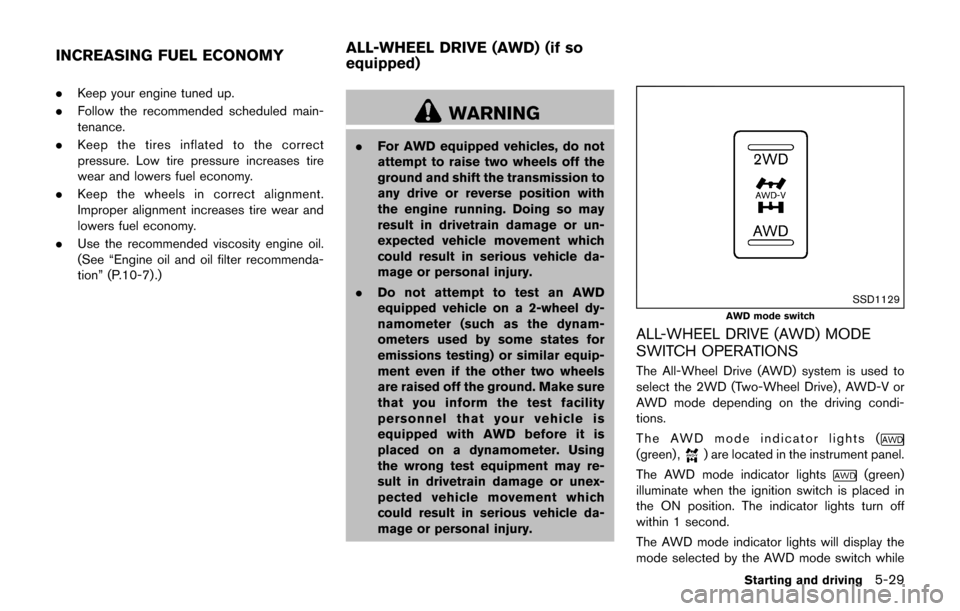
SSD1129
AWD mode switch
ALL-WHEEL DRIVE (AWD) MODE
SWITCH OPERATIONS
The All-Wheel Drive (AWD) system is used to
select the 2WD (Two-Wheel Drive) , AWD-V or
AWD mode depending on the driving condi-
tions.
The AWD mode indicator lights (
(green) ,) are located in the instrument panel.
The AWD mode indicator lights
(green)
illuminate when the ignition switch is placed in
the ON position. The indicator lights turn off
within 1 second.
The AWD mode indicator lights will display the
mode selected by the AWD mode switch while
Starting and driving5-29
INCREASING FUEL ECONOMY ALL-WHEEL DRIVE (AWD) (if so
equipped)
Page 325 of 416
7-8Appearance and care
Temperature
A temperature increase will accelerate the rate
of corrosion to those parts which are not well
ventilated.
Air pollution
Industrial pollution, the presence of salt in the air
in coastal areas, or heavy road salt use will
accelerate the corrosion process. Road salt will
also accelerate the disintegration of paint
surfaces.
TO PROTECT YOUR VEHICLE FROM
CORROSION
.Wash and wax your vehicle often to keep the
vehicle clean.
. Always check for minor damage to the paint
and repair it as soon as possible.
. Keep drain holes at the bottom of the doors
open to avoid water accumulation.
. Check the underbody for accumulation of
sand, dirt or salt. If present, wash with water
as soon as possible.
CAUTION
.NEVER remove dirt, sand or other
debris from the passenger compart-
ment by washing it out with a hose. Remove dirt with a vacuum cleaner.
. Never allow water or other liquids to
come in contact with electronic
components inside the vehicle as
this may damage them.
Chemicals used for road surface deicing are
extremely corrosive. They accelerate corrosion
and deterioration of underbody components
such as the exhaust system, fuel and brake
lines, brake cables, floor pan and fenders.
In winter, the underbody must be cleaned
periodically.
For additional protection against rust and
corrosion, which may be required in some areas,
it is recommended you consult a NISSAN
dealer.
Page 327 of 416
8-2Do-it-yourself
When performing any inspection or mainte-
nance work on your vehicle, always take care
to prevent serious accidental injury to yourself or
damage to the vehicle. The following are general
precautions which should be closely observed.
WARNING
.Park the vehicle on a level surface,
apply the parking brake securely
and block the wheels to prevent
the vehicle from moving. Move the
shift lever to the P (Park) position
(CVT model) or the shift lever to the
N (Neutral) position (MT model) .
. Be sure the ignition switch is in the
OFF or LOCK position when per-
forming any parts replacement or
repairs.
. If you must work with the engine
running, keep your hands, clothing,
hair and tools away from moving
fans, belts and any other moving
parts.
. It is advisable to secure or remove
any loose clothing and remove any
jewelry, such as rings, watches, etc.
before working on your vehicle. .
Always wear eye protection when-
ever you work on your vehicle.
. If you must run the engine in an
enclosed space such as a garage, be
sure there is proper ventilation for
exhaust gases to escape.
. Never get under the vehicle while it
is supported only by a jack. If it is
necessary to work under the vehicle,
support it with safety stands.
. Keep smoking materials, flame and
sparks away from fuel tank and the
battery.
. Because the fuel lines are under
high pressure even when the engine
is off, it is recommended you visit a
NISSAN dealer for service of the
fuel filter or fuel lines.
CAUTION
.Do not work under the hood while
the engine is hot. Turn the engine
off and wait until it cools down.
. Avoid direct contact with used en-
gine oil and coolant. Improperly
disposed engine oil, and engine coolant and/or other vehicle fluids
can damage the environment. Al-
ways conform to local regulations
for disposal of vehicle fluid.
. Never leave the engine or the CVT
related component harnesses dis-
connected while the ignition switch
is in the ON position.
. Never connect or disconnect the
battery or any transistorized com-
ponent while the ignition switch is
in the ON position.
. Your vehicle is equipped with an
automatic engine cooling fan. It may
come on at any time without warn-
ing, even if the ignition key is in the
OFF position and the engine is not
running. To avoid injury, always
disconnect the negative battery
cable before working near the fan.
This “8. Do-it-yourself” section gives instruc-
tions regarding only those items which are
relatively easy for an owner to perform.
A genuine NISSAN Service Manual is also
available. (See “Owner’s manual/service manual
order information” (P.10-22) .)
You should be aware that incomplete or
MAINTENANCE PRECAUTIONS
Page 339 of 416
8-14Do-it-yourself
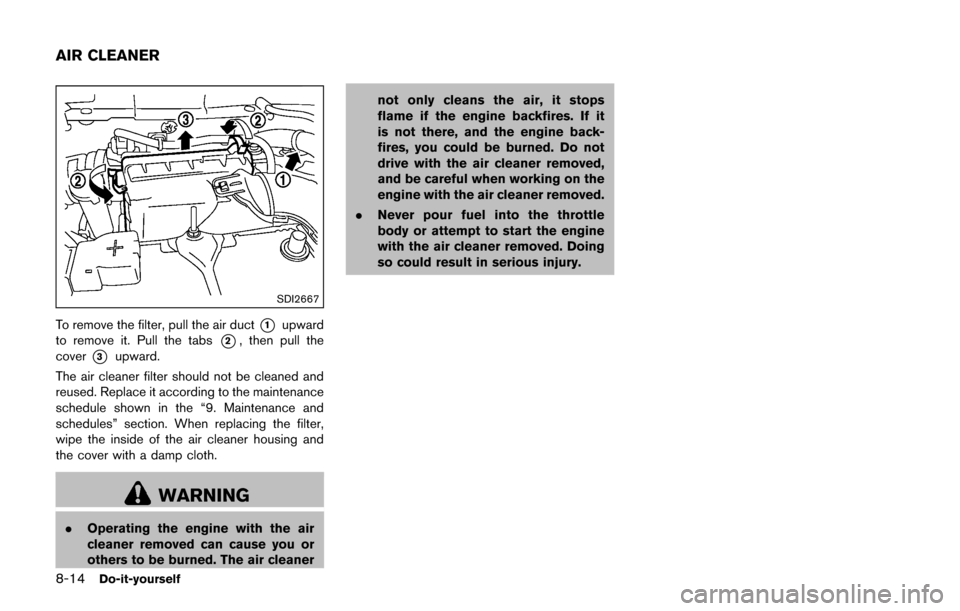
SDI2667
To remove the filter, pull the air duct*1upward
to remove it. Pull the tabs
*2, then pull the
cover
*3upward.
The air cleaner filter should not be cleaned and
reused. Replace it according to the maintenance
schedule shown in the “9. Maintenance and
schedules” section. When replacing the filter,
wipe the inside of the air cleaner housing and
the cover with a damp cloth.
WARNING
. Operating the engine with the air
cleaner removed can cause you or
others to be burned. The air cleaner not only cleans the air, it stops
flame if the engine backfires. If it
is not there, and the engine back-
fires, you could be burned. Do not
drive with the air cleaner removed,
and be careful when working on the
engine with the air cleaner removed.
. Never pour fuel into the throttle
body or attempt to start the engine
with the air cleaner removed. Doing
so could result in serious injury.
AIR CLEANER