2017 MITSUBISHI OUTLANDER SPORT wheel size
[x] Cancel search: wheel sizePage 328 of 399
How to change a tire
For emergencies 8-7
8
N00849701355
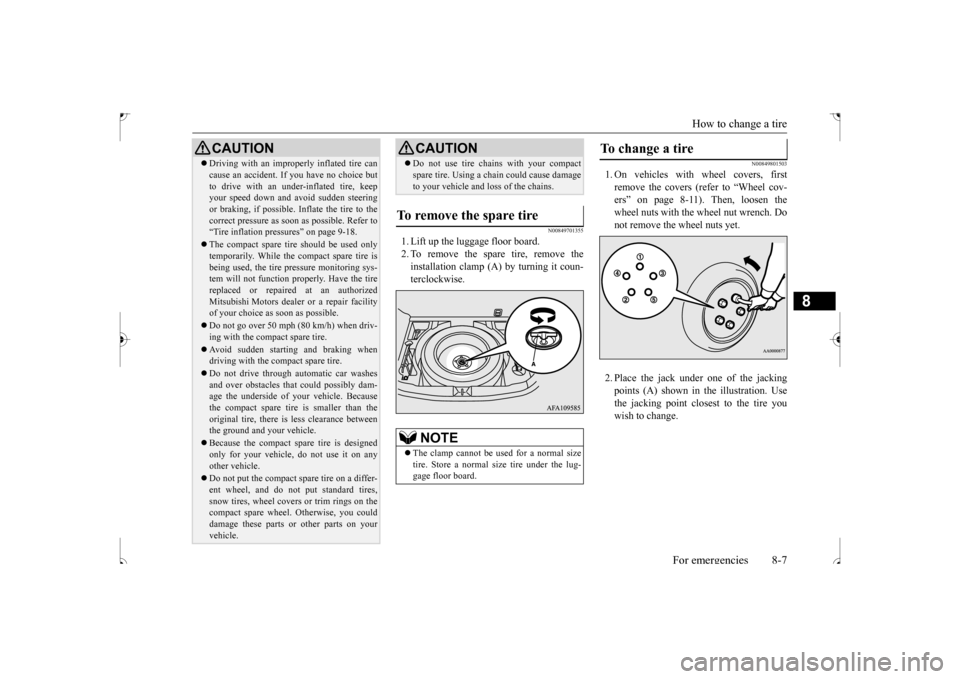
1. Lift up the luggage floor board. 2. To remove the spare tire, remove theinstallation clamp (A) by turning it coun-terclockwise.
N00849801503
1. On vehicles with wheel covers, firstremove the covers (refer to “Wheel cov-ers” on page 8-11). Then, loosen the wheel nuts with the wheel nut wrench. Do not remove the wheel nuts yet. 2. Place the jack under
one of the jacking
points (A) shown in the illustration. Use the jacking point closest to the tire youwish to change.
Driving with an improperly inflated tire can cause an accident. If you have no choice but to drive with an under-inflated tire, keep your speed down and avoid sudden steering or braking, if possible
. Inflate the tire to the
correct pressure as soon as possible. Refer to “Tire inflation pressures” on page 9-18. The compact spare tire should be used only temporarily. While the compact spare tire is being used, the tire pressure monitoring sys-tem will not function properly. Have the tire replaced or repaired at an authorized Mitsubishi Motors dealer or a repair facilityof your choice as soon as possible. Do not go over 50 mph (80 km/h) when driv- ing with the compact spare tire. Avoid sudden starting and braking when driving with the compact spare tire. Do not drive through automatic car washes and over obstacles that could possibly dam- age the underside of your vehicle. Because the compact spare tire is smaller than theoriginal tire, there is less clearance between the ground and your vehicle. Because the compact spare tire is designed only for your vehicle, do not use it on any other vehicle. Do not put the compact spare tire on a differ- ent wheel, and do not put standard tires, snow tires, wheel covers or trim rings on the compact spare wheel. Otherwise, you coulddamage these parts or other parts on your vehicle.CAUTION
Do not use tire chains with your compact spare tire. Using a chain could cause damage to your vehicle and loss of the chains.
To remove the spare tire
NOTE
The clamp cannot be us
ed for a normal size
tire. Store a normal size tire under the lug- gage floor board.CAUTION
To change a tire
BK0239500US.bo
ok 7 ページ 2016年5月13日 金曜日 午前8時53分
Page 332 of 399
How to change a tire
For emergencies 8-11
8
N00850000162
Reverse the removing procedure when stor- ing the flat tire or spare tire, jack, bar and wheel nut wrench. Refer to “To remove the spare tire” on page8-7 and “Jack and tools” on page 8-5.
N00849400195
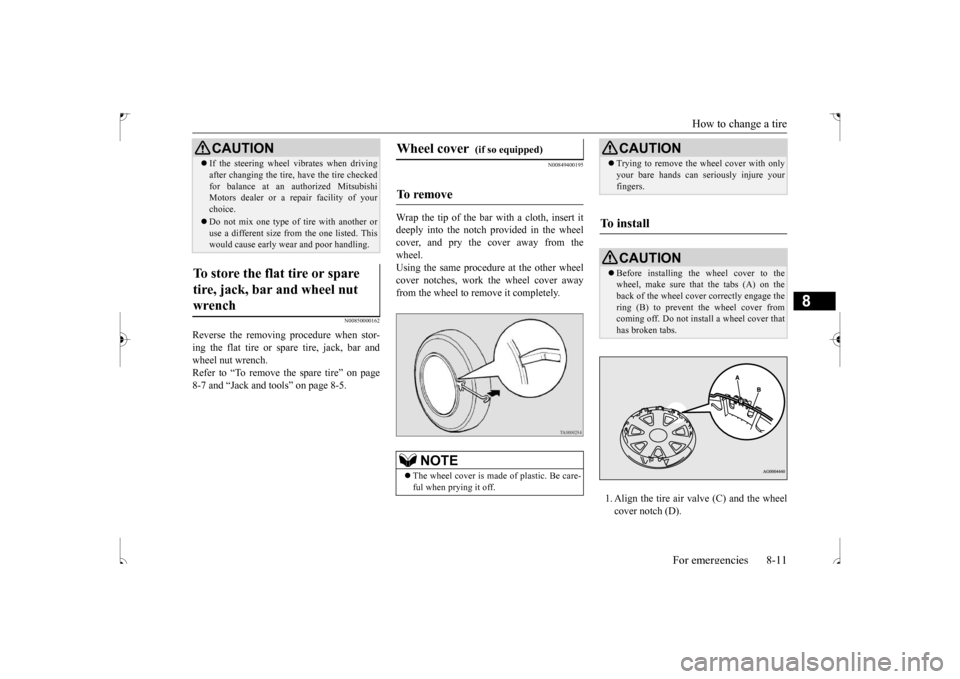
Wrap the tip of the bar with a cloth, insert itdeeply into the notch provided in the wheelcover, and pry the cover away from the wheel. Using the same procedure at the other wheelcover notches, work the wheel cover awayfrom the wheel to remove it completely.
1. Align the tire air valve (C) and the wheel cover notch (D).
If the steering wheel vibrates when driving after changing the tire, have the tire checked for balance at an authorized Mitsubishi Motors dealer or a repair facility of your choice. Do not mix one type of tire with another or use a different size from the one listed. Thiswould cause early wear and poor handling.
To store the flat tire or spare tire, jack, bar and wheel nut wrench
CAUTION
Wheel cover
(if so equipped)
To remove
NOTE
The wheel cover is made of plastic. Be care- ful when prying it off.
CAUTION Trying to remove the wheel cover with only your bare hands can seriously injure your fingers.
To install
CAUTION Before installing the wheel cover to the wheel, make sure that the tabs (A) on theback of the wheel cover correctly engage the ring (B) to prevent the wheel cover from coming off. Do not install a wheel cover thathas broken tabs.
BK0239500US.bo
ok 11 ページ 2016年5月13日 金曜日 午前8時53分
Page 354 of 399

Tires
Vehicle care and maintenance 9-17
9
EXAMPLE: DOT MA L9 ABCD 1504
The treadwear grade is a comparative rating based on the wear rate of the tire when tested under controlledconditions on a specified government test course. For example, a tire graded 150 would wear one and one- half (1
1/2) times as well on the gov-
ernment course as a tire graded 100. The relative performance of tiresdepends upon the actual conditions of their use, however, and may depart significantly from the norm due tovariations in driving habits, service practices and differences in road characteristics and climate. The traction grades, from highest to lowest, are AA, A, B and C. Thosegrades represent the tire’s ability to stop on wet pavement as measured
under controlled conditions on speci- fied government test surfaces of asphalt and concrete. A tire marked C may have poor traction perfor- mance. The temperature grades are A (the highest), B and C, representing the tire’s resistance to the generation ofheat and its ability to dissipate heat when tested under controlled condi- tions on a specified indoor laboratorytest wheel. Sustained high tempera- ture can cause the material of the tire to degenerate and reduce tire life, andexcessive temperature can lead to sudden tire failure. The grade C cor- responds to a level of performancewhich all passenger car tires must meet under the Federal Motor Vehi- cle Safety Standard No. 109. Grades B and A represent higher levels of performance on the laboratory testwheel than the minimum required by law.
DOT
Department of Transporta- tion This symbol certifies that the tire is in compliance with the U.S. Department of Trans- portation tire safety stan-dards, and is approved for highway use.
MA
Code representing the tire manufacturing location. (2 digits)
L9 ABC D
Code representing the tire size. (2 digits)Code used by tire manufac- turer. (1 to 4 digits)
15
Number representing the week in which the tire was manufactured. (2 digits)
04
Number representing the year in which the tire was manufactured. (2 digits)
Treadwear, Traction and Temper- ature Grades Treadwear Tr a c t i o n
Temperature
BK0239500US.bo
ok 17 ページ 2016年5月13日 金曜日 午前8時53分
Page 355 of 399
Tires 9-18 Vehicle care and maintenance
9
N00939301955
Proper tire inflation pressure is essential for the safe and satisfactory operation of yourvehicle. The wrong tire pressure will cause problems in three major areas: Safety Too little pressure increases flexing in thetire and can cause tire failure. Too muchpressure can cause a tire to lose its ability to cushion shock. Objects on the road and potholes could then cause tire damage thatmay result in tire failure. Economy The wrong tire pressure can cause unevenwear patterns in the tire tread. These abnormal wear patterns will reduce the tread life, and the tire will have to bereplaced sooner. Too little pressure also makes it harder for the tire to roll, and this uses up more fuel. Ride comfort and vehicle stability The superior riding experience built into your vehicle partly depends on the correcttire pressure. Too much pressure gives an uncomfortable and jarring ride. Too little pressure feels as if your vehicle is slow torespond. Unequal tire pressures can make steering your vehicle uneven and unpredictable.
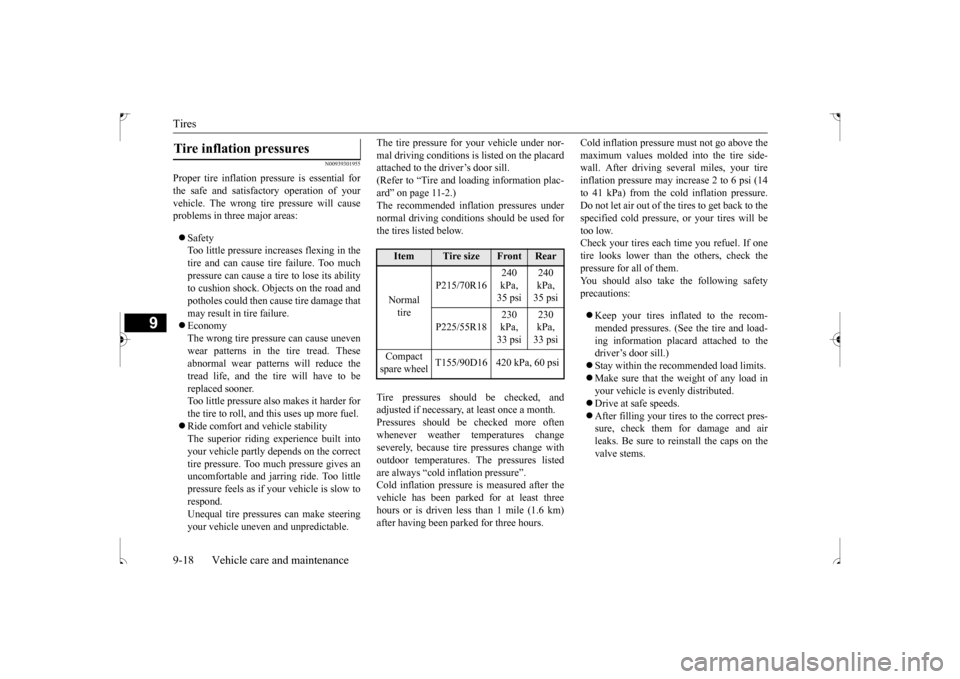
The tire pressure for your vehicle under nor- mal driving conditions is listed on the placard attached to the driver’s door sill. (Refer to “Tire and loading information plac-ard” on page 11-2.) The recommended infl
ation pressures under
normal driving conditions should be used forthe tires listed below. Tire pressures should be checked, and adjusted if necessary, at least once a month. Pressures should be checked more oftenwhenever weather temperatures change severely, because tire pressures change with outdoor temperatures. The pressures listedare always “cold inflation pressure”. Cold inflation pressure is measured after the vehicle has been parked for at least threehours or is driven less than 1 mile (1.6 km) after having been parked for three hours.
Cold inflation pressure must not go above the maximum values molded into the tire side- wall. After driving several miles, your tire inflation pressure may increase 2 to 6 psi (14to 41 kPa) from the cold inflation pressure. Do not let air out of the tires to get back to the specified cold pressure, or your tires will betoo low. Check your tires each time you refuel. If one tire looks lower than the others, check thepressure for all of them.You should also take the following safety precautions: Keep your tires inflated to the recom- mended pressures. (See the tire and load-ing information placard attached to the driver’s door sill.) Stay within the recommended load limits. Make sure that the weight of any load in your vehicle is evenly distributed. Drive at safe speeds. After filling your tires to the correct pres- sure, check them for damage and air leaks. Be sure to reinstall the caps on thevalve stems.
Tire inflation pressures
Item
Tire size
Front
Rear
Normal tire
P215/70R16
240 kPa, 35 psi
240 kPa, 35 psi
P225/55R18
230 kPa, 33 psi
230 kPa, 33 psi
Compact spare wheel
T155/90D16 420 kPa, 60 psi
BK0239500US.bo
ok 18 ページ 2016年5月13日 金曜日 午前8時53分
Page 356 of 399
Tires
Vehicle care and maintenance 9-19
9
N00939600241 N00939700141
The following maintenance steps are recom- mended:
Check tire pressures regularly. Have regular maintenance done on the wheel balance and front and rear suspen- sion alignment. Rotate your tires regularly as described in the “Tire rotation” section on page 9-19.
N00939800184
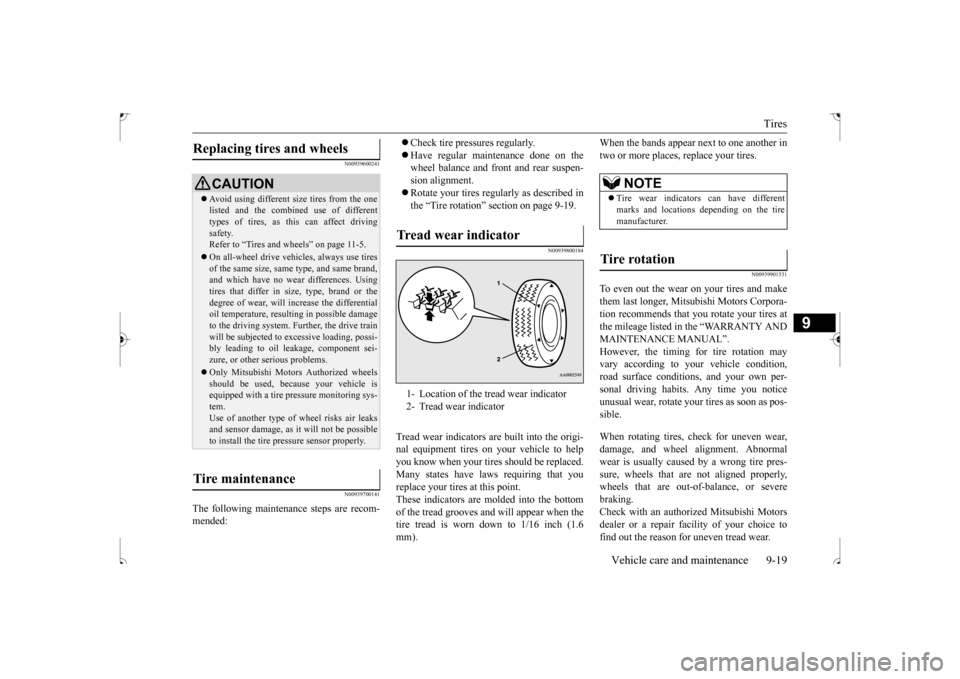
Tread wear indicators are built into the origi- nal equipment tires on your vehicle to helpyou know when your tires should be replaced. Many states have laws requiring that you replace your tires at this point.These indicators are molded into the bottom of the tread grooves and will appear when the tire tread is worn down to 1/16 inch (1.6mm).
When the bands appear next to one another in two or more places, replace your tires.
N00939901531
To even out the wear on your tires and makethem last longer, Mitsubishi Motors Corpora- tion recommends that you rotate your tires at the mileage listed in the “WARRANTY ANDMAINTENANCE MANUAL”. However, the timing for tire rotation may vary according to your vehicle condition,road surface conditions, and your own per- sonal driving habits. Any time you notice unusual wear, rotate your tires as soon as pos-sible. When rotating tires, check for uneven wear, damage, and wheel alignment. Abnormal wear is usually caused by a wrong tire pres-sure, wheels that are not aligned properly, wheels that are out-of-balance, or severe braking.Check with an authorized Mitsubishi Motors dealer or a repair faci
lity of your choice to
find out the reason for uneven tread wear.
Replacing tires and wheels
CAUTION Avoid using different size tires from the one listed and the combined use of different types of tires, as this can affect driving safety.Refer to “Tires and wheels” on page 11-5. On all-wheel drive vehicles, always use tires of the same size, same type, and same brand, and which have no wear differences. Using tires that differ in size, type, brand or thedegree of wear, will increase the differential oil temperature, resulting in possible damage to the driving system. Further, the drive trainwill be subjected to excessive loading, possi- bly leading to oil leakage, component sei- zure, or other serious problems. Only Mitsubishi Motors Authorized wheels should be used, because your vehicle isequipped with a tire pressure monitoring sys- tem. Use of another type of wheel risks air leaksand sensor damage, as it will not be possible to install the tire pressure sensor properly.
Tire maintenance
Tread wear indicator 1- Location of the tread wear indicator 2- Tread wear indicator
NOTE
Tire wear indicators can have different marks and locations depending on the tire manufacturer.
Tire rotation
BK0239500US.bo
ok 19 ページ 2016年5月13日 金曜日 午前8時53分
Page 357 of 399
Tires 9-20 Vehicle care and maintenance
9
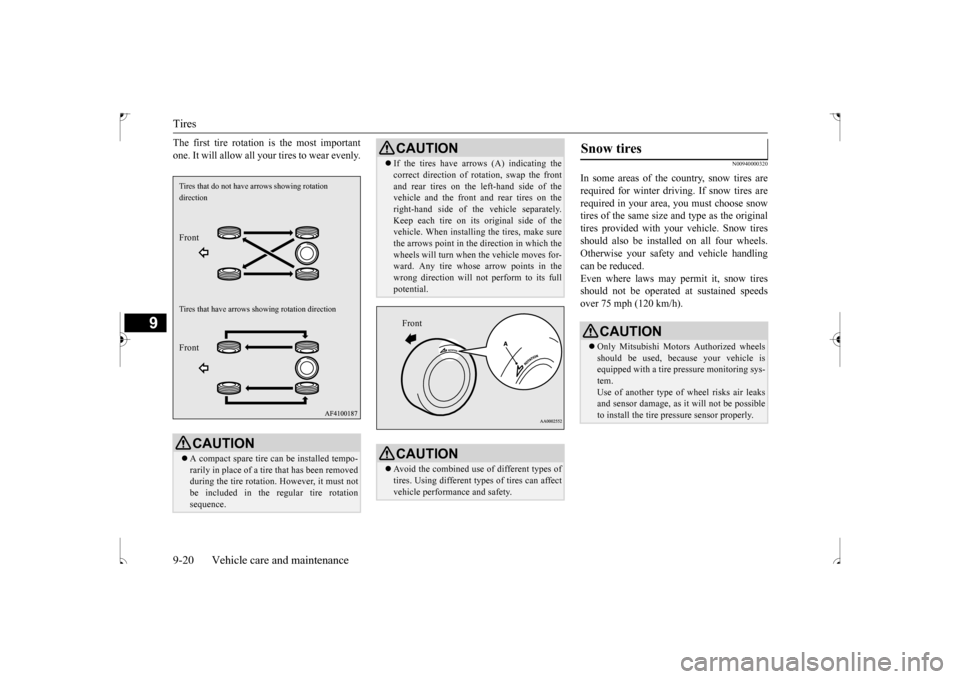
The first tire rotation is the most important one. It will allow all your
tires to wear evenly.
N00940000320
In some areas of the country, snow tires are required for winter driving. If snow tires arerequired in your area, you must choose snow tires of the same size and type as the original tires provided with your vehicle. Snow tiresshould also be installed on all four wheels. Otherwise your safety and vehicle handling can be reduced.Even where laws may permit it, snow tiresshould not be operated at sustained speeds over 75 mph (120 km/h).
CAUTION A compact spare tire can be installed tempo- rarily in place of a tire that has been removed during the tire rotation. However, it must not be included in the regular tire rotationsequence.Tires that do not have
arrows showing rotation
directionFrontTires that have arrows
showing rotation direction
Front
If the tires have arrows (A) indicating the correct direction of rotation, swap the front and rear tires on the left-hand side of the vehicle and the front and rear tires on the right-hand side of the vehicle separately.Keep each tire on its original side of the vehicle. When installing the tires, make sure the arrows point in the direction in which thewheels will turn when the vehicle moves for- ward. Any tire whose arrow points in the wrong direction will not perform to its fullpotential.CAUTION Avoid the combined use of different types of tires. Using different types of tires can affect vehicle performance and safety.CAUTIONFront
Snow tires
CAUTION Only Mitsubishi Motors Authorized wheels should be used, because your vehicle isequipped with a tire pressure monitoring sys- tem. Use of another type of wheel risks air leaksand sensor damage, as it will not be possible to install the tire pressure sensor properly.
BK0239500US.bo
ok 20 ページ 2016年5月13日 金曜日 午前8時53分
Page 392 of 399

Tires and wheels
Specifications 11-5
11
N01147901816
PCD: Pitch Circle Diameter (installation holes)
N01148002244
Tires and wheels Tire
P215/70R16
99H
P225/55R18
97H
Wheel
Size 16 x 6 1/2J 18 x 7JPCD 4.5 in (114.3 mm)Off- set
1.81 in (46 mm)
1.50 in (38 mm)
NOTE
Contact an authorized Mitsubishi Motors dealer for details on the combination used on your vehicle. These tires satisfy vehicle loading conditions described in this owner’s manual.
Capacity
Item
Capacity
Lubricants
Fuel (approximate)
Front-wheel drive vehicles 16.6 gal (63 L)
Refer to “Fuel selection” on page 3-2.
All-wheel drive vehicles 15.8 gal (60 L)Vehicles with manual trans- axle
Oil pan 4.2 qt (4.0 L)
Engine oils displaying the IL
SAC certification mark (“star-
burst” symbol) on the container. If these oils are not available,
API classification SN or higher
can be used.
Oil filter .32 qt (0.3 L)
Vehicles with continuously variable trans- mission (CVT)
Oil pan 4.5 qt (4.3 L)Oil filter .32 qt (0.3 L)
Manual transaxle 2.6 qt (2.5 L)
Mitsubishi Motors Genuine NEW MULTI GEAR OIL API classification GL-3 SAE 75W-80
Continuously variable trans- mission (CVT)
2.0 liter models 7.3 qt (6.9 L)
Refer to “Continuously variable
transmission (CVT) fluid” on
page 9-9.
2.4 liter models 7.5 qt (7.1 L)
BK0239500US.bo
ok 5 ページ 2016年5月13日 金曜日 午前8時53分
Page 398 of 399

Alphabetical index
12-5
12
Tire
...........................
........................
9-14
Inflation pressure
............................
9-18
Maintenance
..................
.................
9-19
Quality grading
...............................
10-2
Replacing tires and wheels
...............
9-19
Rotation
....................
.....................
9-19
Size (tire and wheel)
.......................
11-5
Snow tires
.....................
.................
9-20
To change a tire
................
................
8-6
Tread wear indicator
.......................
9-19
Tire pressure monitoring system
...........
5-77
Tires
Tire and loading information placard 11-2 Tire chains
....................
.................
9-21
Tools
.........................
..........................
8-5
Storage
.........................
...................
8-5
Towing
......................
........................
8-12
Trailer towing
....................
.................
6-12
Transfer oil
................
.................
9-9
, 11-5
Turn signal light
Indicators
..................
...................
5-119
Lever
........................
...................
5-129
U
USB input terminal
...........................
5-160
How to connect an iPod
.................
5-161
USB input terminal device
How to connect a USB memory
.....
5-160
V
Vanity mirror
...................
.................
5-164
Vanity mirror lights
Bulb capacity
..................
...............
9-32
Vehicle care precautions
.....................
9-40
Vehicle dimensions
............................
11-3
Vehicle labeling
..................
...............
11-2
Vehicle preparation before driving
.........
6-4
Vehicle weights
...................
...............
11-3
Vents
..........................
........................
7-2
W
Warning lights
.................
.................
5-120
Washer
Fluid
....................
.................
9-10
, 11-5
Rear window washer
.....................
5-135
Switch
.....................
.....................
5-134
Washing
......................
......................
9-42
Waxing
.......................
......................
9-43
Weights
.......................
......................
11-3
Wheel
Covers
.........................
..................
8-11
Specification
...................
...............
11-5
Wiper
Rear window wiper
.......................
5-135
Switch
.....................
.....................
5-131
Wiper blades
...................
...............
9-22
BK0239500US.bo
ok 5 ページ 2016年5月13日 金曜日 午前8時53分