2017 MERCEDES-BENZ G-Class length
[x] Cancel search: lengthPage 156 of 286
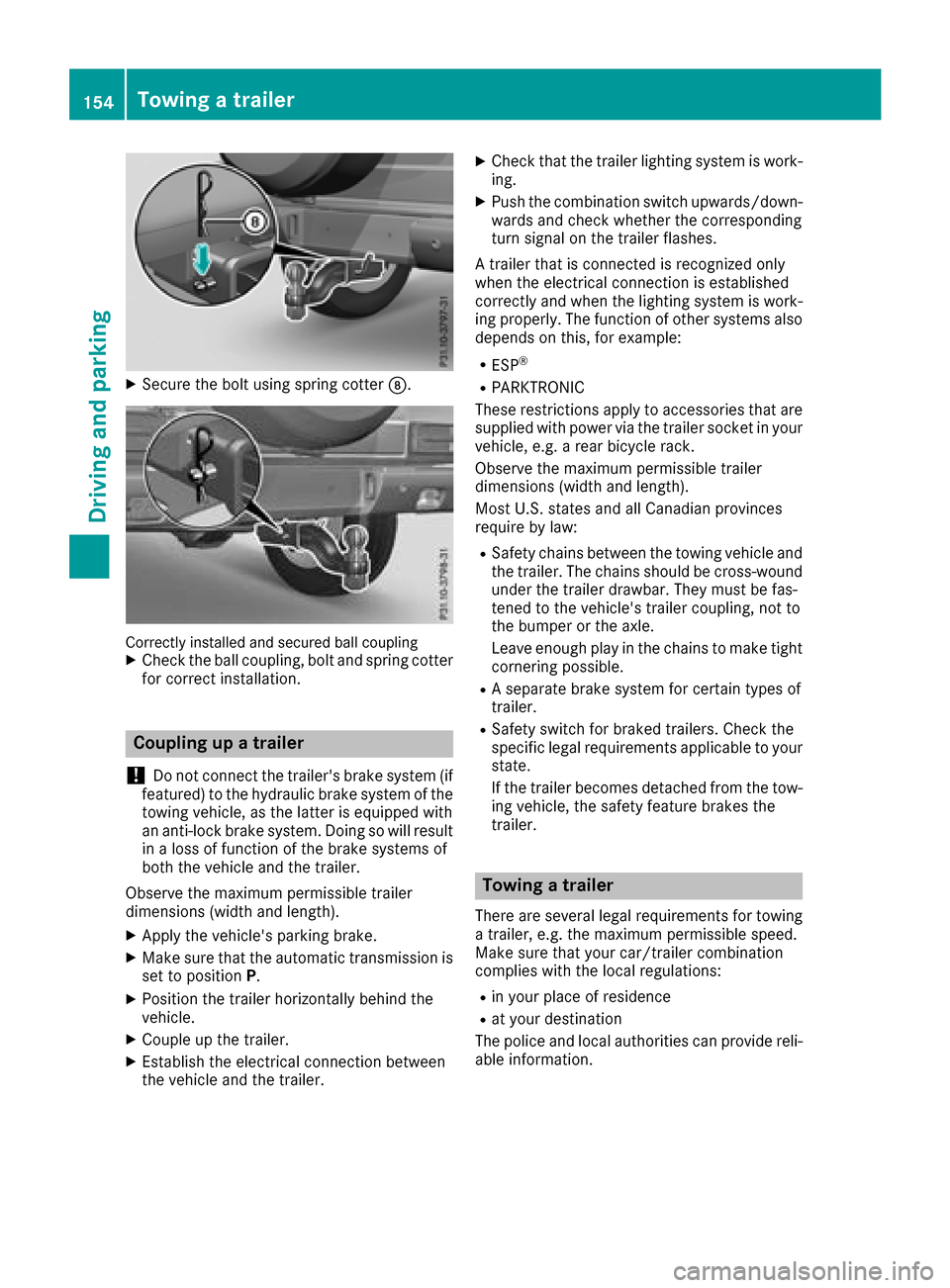
XSecure the boltusing spring cotter D.
Correctlyinstalled and secured ball couplingXCheck the ball coupling, bol tand spring cotter
for correct installation.
Coupling up atrailer
!
Do not connect the trailer's brake system (if
featured) to the hydraulic brake system of the
towing vehicle, as the latter is equipped with
an anti-lock brake system. Doing so will result
in alossoff unction of the brake systems of
both the vehicl eand the trailer.
Observe the maximum permissible trailer
dimensions (width and length).
XAppl ythe vehicle's parking brake.
XMake sure that the automatic transmissio nis
set to position P.
XPosition the traile rhorizontally behind the
vehicle.
XCouple up the trailer.
XEstablish the electrical connection between
the vehicl eand the trailer.
XCheck that the traile rlighting system is work-
ing.
XPush the combination switch upwards/down- wards and check whethert he corresponding
turn signal on the traile rflashes.
At raile rthat is connecte disrecognize donly
when the electrical connection is established
correctly and when the lighting system is work-
ing properly .The function of others ystems also
depends on this ,for example:
RESP®
RPARKTRONIC
These restrictions appl ytoaccessorie sthat are
supplie dwithp ower via the traile rsocketiny our
vehicle, e.g. arearb icycl erack.
Observe the maximum permissible trailer
dimensions (width and length).
MostU .S. state sand al lCanadia nprovinces
require by law
:
RSafety chains between the towing vehicl
eand
the trailer. The chains shoul dbecross-wound
under the traile rdrawbar. Theym ustb efas-
tened to the vehicle's traile rcoupling, not to
the bumpe rorthe axle.
Leave enough play in the chains to make tight
cornering possible.
RAs eparate brake system for certain types of
trailer.
RSafety switch for braked trailers. Check the
specifi clegal requirements applicabl etoyour
state.
If the traile rbecomes detached from the tow-
ing vehicle, the safety feature brakes the
trailer.
Towin gatrailer
There are several legalr equirements for towing
at railer, e.g. the maximum permissible speed.
Make sure that your car/traile rcombination
complies with the local regulations:
Rin your place of residence
Rat your destination
The police and local authorities can provid ereli-
able information.
154Towingat railer
Driving and parking
Page 157 of 286

In order to accumulate driving experience and
accustom yourself to the new handling charac-
teristics, practice the following atalocation
where there is no traffic:
RCornering
RStopping
RBacking up
Before driving, check the following:
RTrailer tow hitch
RSafety switch for braked trailers
RSafety chains
RElectrical connections
RLighting system
RWheelsa nd tires
RLoad-securing measures
Adjust the exterior mirrors to provide an unob-
structed view of the rear section of the trailer.
Trailers with electronically controlled
brakes: pullawaycarefully in the vehicle/trailer
combination, brake manually using the brake
controller and check whether the brakes func-
tion correctly.
Check the load securing measures on aregular
basis.
When towing atrailer, you rvehicle's handling
characteristics willbed ifferent in comparison
with when driving withoutat railer.
The vehicle/trailer combination:
Ris heavier
Ris restricted in its acceleration and gradient-
climbing capability
Rhas an increased braking distance
Ris affected more by strong crosswinds
Rdemands more sensitive steering
Rhas alargert urning radius
Avoid sudden steering movements.
Avoid braking abruptly. If possible, brake gently
at first to allow the trailer to run on. Then,
increase the braking force rapidly.
When overtaking, pay particular attention to the
extended length of you rvehicle/trailer combi-
nation.
Due to the length of the vehicle/trailer combi-
nation, you require additional road space when
overtaking before you can change back to the
originall ane.
If the automatic transmission repeatedly shifts
betweeng ears on uphill or downhill gradients,
shift to alowerg ear. Driving in
alowerg ear and at areduced speed
decreases the risk of engine damage.
Avoid constant braking. Otherwise,t he vehicle
brakes and possibly also the trailerb rakes may
overheat.
When driving downhill, shift to alowerg ear to
utilize the engine's braking effect.
If the coolant temperature increases dramati-
cally whilet he air-conditioning system is
switched on, switch off the air-conditioning sys- tem.
Coolant heat can also be dissipated by opening
the windowsa
nd sw
itching the ventilation
blower and the interior temperature to the high-
est level.
Decoupling atrailer
GWARNING
If you uncoupl eatrailerwith the overrun
brake engaged,y ou could trap you rhand
betweent he vehicle and the trailerd rawbar.
There is arisk of injury.
Do not uncoupl eatrailerift he overrun brake
is engaged.
!Do not disconnect atraile rwith an engaged
overrun brake. Otherwise,y ourv ehicle could
be damaged by the rebounding of the overrun
brake.
XApply the parking brake.
XMake sure that the automatic transmission is
set to position P.
XSecure the vehicle and trailera gainst rolling
away.
XClose all doors, including the rear door.
XRemove the trailerc able.
XRemove the safety chains, if there are any.
XUncouple the trailer.
Permissible trailer and drawbar loads
Weight specifications
The gross trailerw eight is calculated as the
weight of the trailerp lusthe weight of the load
and the trailer'se quipment.
Towingatrailer155
Driving and parking
Z
Page 171 of 286
Resetting the current lap
XStop the RACETIMER (Ypage 168).
XPress the=or; button to select
ResetL ap.
XPressato resett he laptime to "0".
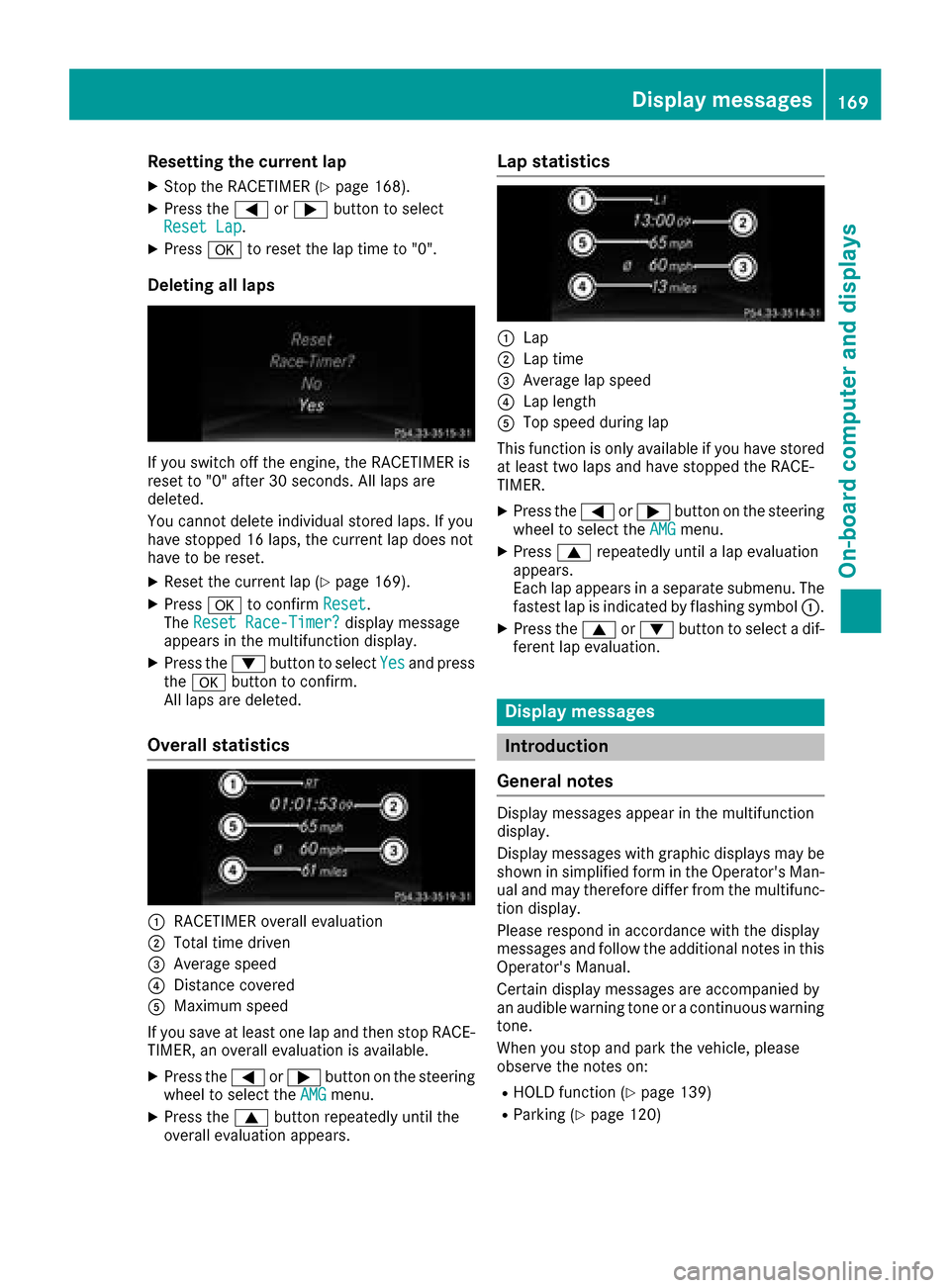
Deleting all laps
If yo uswitch off the engine, the RACETIMER is
resetto" 0" after30seconds .All laps are
deleted.
You cannot delete individual storedl aps. If you
have stopped 16 laps, the current la pdoesn ot
have to be reset.
XReset the current la p(Ypage 169).
XPressato confirm Reset.
The ResetR ace-Timer?display message
appears in the multifunction display.
XPress the :button to select Yesand press
the a button to confirm.
All laps are deleted.
Overall statistics
:RACETIMER overal levaluation
;Totalt ime driven
=Average speed
?Distance covered
AMaximu mspeed
If yo usaveatl east one la pand then stop RACE-
TIMER, an overal levaluation is available.
XPress the =or; button on the steering
wheel to select the AMGmenu.
XPress the9button repeatedl yuntilthe
overal levaluation appears.
Lap statistics
:Lap
;Lap time
=Average la pspeed
?Lap length
ATop speed during lap
Thisf unction is only available if yo uhaves tored
at leas ttwo laps and have stopped the RACE-
TIMER.
XPress the =or; button on the steering
wheel to select the AMGmenu.
XPress9repeatedl yuntilal apevaluation
appears.
Each la pappears in aseparate submenu. The
fastest la pisindicated by flashing symbol :.
XPress the9or: button to select adif-
ferent la pevaluation.
Display messages
Introduction
General notes
Displa ymessages appea rinthe multifunction
display.
Displa ymessages with graphicd isplay smay be
shown in simplified form in the Operator's Man-
ua land may therefore differ from the multifunc-
tion display.
Please respond in accordance with the display
messages and follow the additiona lnotes in this
Operator's Manual.
Certai ndisplay messages are accompanied by
an audiblew arning tone or acontinuousw arning
tone.
Wheny oustop and park the vehicle ,please
observe the notes on:
RHOLD function (Ypage 139)
RParking (Ypage 120)
Display messages169
On-board computer and displays
Z
Page 244 of 286
HEnvironmentalnote
Batteries contain dangerous
substances. It is agains tthe
law to dispose of them with
th eh ousehold rubbish. They
must be collected separately and recycled to protect the
environment.
Dispose of batteries in an
environmentally friendly
manner .Take discharged
batteries to aqualifieds pe-
cialis tworkshop or aspecial
collection pointf or used bat-
teries.
!Hav ethe battery checked regularly at a
qualifieds pecialist workshop.
Observe th eservicei ntervals in th eMainte-
nance Bookle torcontac taqualifieds pecialist
workshop for morei nformation.
!Always have work on batteries carried out at
aq ualifieds pecialist workshop.S hould it, in
exceptional circumstances, be absolutely
necessaryt odisconnect th e12-vol tbattery
yourself, observe th efollowing:
RSecure th evehicle to prevent it fro mrolling
away.
RSwitch off th eignition.
RDisconnec tthe negativ eterminal first and
then th epositive terminal.
The transmission is locked in position j
after disconnecting th ebattery.
After th ework has been done, install th ebat-
ter ya nd replacet hecover of th epositive ter-
minal clam pfirmly.
Comply with safet yprecautions and tak epro-
tectiv emeasures when handling batteries.
Risk of explosion.
Fire, open flames and smokin gare
prohibited when handling th ebat-
tery. Avoid creating sparks.
Batter yacid is caustic.
Avoid contac twith skin, eyes or
clothing.
Wear eye protection.
Keep children away.
Observe this Operator's Manual.
For safety reasons ,Mercedes-Ben zrecom-
mends that you onl yuse batteries whichh ave
been tested and approved for your vehicle by
Mercedes-Benz. Theseb atteries provide
increasedi mpactprotection to prevent vehicle
occupant sfroms ufferinga cid burnsshould the
battery be damagedint heeven tofana ccident.
In orderf or thebattery to achieve th emaximum
possible servicel ife, it must always be suffi-
ciently charged.
Likeo ther batteries,t hevehicle battery may
dischargeo ver timeifyou do not use th evehicle.
In this case ,have th ebattery disconnected at a
qualifieds pecialist workshop.Y ou can also
charge th ebattery with acharger recommended
by Mercedes-Benz. Contact aqualifieds pecial-
ist workshop for further information.
Hav ethe battery condition of charge checked
moref requently if you use th evehicle mainly for
shortt rips or if you leave it standin gidle for a
length yperiod. Consult aqualifieds pecialist
workshop if you wish to leave your vehicle
parked for alongp eriodoft ime.
Removet heSmartKey if you park th evehicle
and do not requirea ny electrical consumers.
The vehicle will then use veryl ittle energy, thus
conservingb attery power.
iIf thepower supply has been interrupted,
e.g .due to adischarged battery, you will have
to:
Rreset th ehead restraint sonthefront seats
(Ypage 76)
Rreset th efunction for automatically folding
th ee xteriorm irrorsin/out by folding the
mirrorso ut once(
Ypage 82)
242Battery (vehicle)
Breakdown assistance
Page 246 of 286

Particularly avoid fire, open flames, creatingsparks and smoking. Ensure there is sufficient ven-
tilation while charging and jump-starting. Do not lean over abattery.
GWARNING
During the charging process, abattery produces hydrogen gas. If ashort circuit occurs or sparks
are created, the hydrogen gas can ignite. There is arisk of an explosion.
RMake sure that the positive terminal of aconnected battery does not come into contact with
vehicle parts.
RNever place metal object sortools on abattery.
RIt is importan tthat you observe the described order of the battery terminals when connecting
and disconnectin gabattery.
RWhen jump-starting, make sure that the battery poles with identical polarity are connected.
RIt is particularly importan ttoobserve the described order when connectin gand disconnecting
the jumper cables.
RNever connect or disconnect the battery terminals while the engine is running.
GWARNING
Ad ischarged battery can freeze at temperatures below freezin gpoint. When jump-starting the
vehicle or charging the battery, gases can escape from the battery. There is arisk of an explosion.
Allow the frozen battery to thaw out before charging it or jump-starting.
!Avoid repeated and lengthy starting attempts. Otherwise, the catalytic converter could be
damaged by the non-combusted fuel.
If the warning and indicator lamps do not light up on the instrument cluster when temperatures are
low, it is probably because the discharged battery has frozen. In this case, you may neither charge
the battery nor jump-start the vehicle. The service life of athawed-out battery may be shorter .The
starting characteristics can be impaired, particularly at low temperatures. Have the thawed-out
battery checked at aqualified specialist workshop.
Do not start the vehicle using arapid charging device. If your vehicle's battery is discharged, the
engine can be jump-started from another vehicle or from asecond battery using jumper cables.
Observe the following points:
RThe battery is not accessible in all vehicles. If the other vehicle's battery is not accessible, jump-
start the vehicle using asecond battery or ajump-starting device.
RYou may only jump-start the vehicle when the engine and exhaust system are cold.
RDo not start the engine if the battery is frozen. Let the battery thaw first.
RJump-starting may be performed only using batteries with anominal voltage of 12 V.
ROnly use jumper cables which have asufficient cross-section and insulated terminal clamps.
RIf the battery is fully discharged, leave the battery that is being used to jump-start connected for
afew minutes before attempting to start .This charges the battery slightly.
RMake sure that the two vehicles do not touch.
Make sure that:
Rthe jumper cables are not damaged.
Rwhen the jumper cables are connected to the battery, uninsulated sections of the terminal clamp
do not come into contact with other metal sections.
Rthe jumper cables cannot come into contact with parts which can move when the engine is
running, such as the V-belt pulley or the fan.
244Jump-starting
Breakdown assistance
Page 284 of 286

Mercedes-AMGG63A MG
:Upper-edge clear-
ance74.5 in -78.4 in
(1892 mm - 1992 mm)
; Lower-edge clear-
ance26.3 in -30.2 in
(667 mm - 767 mm)
= Range of movement36.7 in (931 mm)
Mercedes-AMG
G65A MG
:Distance to top
edge
; Distance to lower
edge
= Range of movement
Missing values were not available at time of
going to print.
G5 50
Vehicle length187.6 in
(4764 mm)
Vehicle width including
exterio rmirrors80.9 in
(2056 mm)
Vehicle height76.9 in
(1954 mm)
Wheelbase112.2 in
(2850 mm)
Minimum ground clear-
ance7.6 in
(193 mm)
Turning radius44.6 ft
(13.60 m)
Gross vehicle weight rat-
ing (GVWR)7054.8 lb
(3200 kg)
Gross axle weight rating
(GAWR), front3417.1 lb
(1550 kg)
Gross axle weight rating
(GAWR), rear4188.7 lb
(1900 kg)
Mercedes-AMG G63
Vehicle length187.8 in
(4769 mm)
Vehicle width including
exterio rmirrors80.9 in
(2056 mm)
Vehicle height76.3 in
(1938 mm)
Wheelbase112.2 in
(2850 mm)
Minimum ground clear-
ance7.7 in
(196 mm)
Turning radius44.6 ft
(13.60 m)
Gross vehicle weight rat-
ing (GVWR)7054.8 lb
(3200 kg)
Gross axle weight rating
(GAWR), front3417.1 lb
(1550 kg)
Gross axle weight rating
(GAWR), rear4122.6 lb
(1870 kg)
Mercedes-AMG G65
Vehicle length
Vehicle width including
exterio rmirrors
Vehicle height
Wheelbase
Minimum ground clear-
ance
Turning radius
Gross vehicle weight rat-
ing (GVWR)
Gross axle weight rating
(GAWR), front
Gross axle weight rating
(GAWR), rear
iGross vehiclew eight (GVW)isthe vehicle
weight including fuel ,service products, spare
wheel, accessories installed, loada nd, if
applicable, trailer drawbar load. The GVW
must never exceed the GVWR.
282Vehicle data
Technical data