2017 MERCEDES-BENZ G-Class inflation pressure
[x] Cancel search: inflation pressurePage 255 of 286
Drivingwiths ummer tires
At temperature sbelo w45‡( +7 †), elasticity in
summe rtires is significantly lower and thus also
traction and braking power. Change the tires on
you rvehicle to M+S tires .Using summe rtires at
very cold temperatures coul dcause cracks to
form, therebyd amaging the tires permanently.
Mercedes-Benz cannot accep tresponsibility for
this type of damage.
GWARNING
Damaged tires can cause tire inflation pres-
sure loss.Asar esult, you couldlose control of
you rvehicle. There is arisk of accident.
Check the tires regularly for signs of damage
and replace any damaged tires immediately.
M+S tires
GWARNING
M+S tires with atire tread depth of less than
ã in (4 mm )are not suitabl efor use in winter
and do not provide sufficient traction. There is
ar isk of an accident.
M+S tires with atread depth of less than ãin
(4 mm) must be replaced immediately.
GWARNING
Wheela nd tire dimensions as wel lasthe type
of tire can vary between the spare wheel and
the wheel to be replaced .When the spare
wheel is mounted ,driving characteristics may
be severely affected .There is arisk of an acci-
dent.
In order to reduce risks:
Ryou should thereforea dapt yourdriving
styl eand drive carefully.
Rnever mount more than one spare wheel
that differs from the wheel to be replaced.
Ronly use aspare wheel that differs from the
wheel to be replaced for ashort time.
Rdo not deactivate ESP®.
Rhave aspare wheel that differs from the
wheel that has beenc hangedreplaced at
the nearest qualified specialist workshop.
You must observe the correct wheel and
tire dimensions as wel lasthe wheel type.
Do not exceed amaximu mspeedof50m ph
(80 km/h) if aspare wheel of adifferent size is
installed.
At temperatures below 45 ‡(+7 †), use winter
tires or all-season tires. Both type softire are
identified by the M+S marking.
Only winter tires bearing the isnowflake
symbol in addition to the M+S marking provide
the best possibleg rip in wintry road conditions.
Only these tires wil lallow driving safety systems
such as ABS and ESP
®to function optimally in
winter. Theset ires have beend eveloped specif-
ically for driving in snow.
Use M+S tires of the same make and tread on all
wheels to maintain safe handling characteris-
tics.
Always observe the maximu mpermissible
speeds pecified for the M+S tires you have
mounted.
When you have mounted the M+S tires:
XCheck the tire pressures (Ypag e257).
XRestart the tire pressure monitor
(Ypag e259).
Snowc hains
GWARNING
If you drive too fast with snow chains moun-
ted, they may snap. As aresult, you could
injure others and damage the vehicle. There is
ar isk of an accident.
Observe the maximu mpermissible speedf or
operation with snow chains.
!Information about the use of snow chain
compatibleA MG winter tires is applicable for
AMG tires. Use of snow chains is only per-
missible with these tires.
!On some tire sizes there is not enoug hspace
for snow chains. To avoi ddamage to the vehi-
cle or tires, observe the "Wheel and tire com-
binations" section unde r"Tires and wheels".
Wintero peration253
Wheels and tires
Z
Page 256 of 286
!Check the snow chains for damage before
mounting them. Damaged or worn snow
chains may snap and damage the following
components:
Rwheel
Rwheel housing
Rwheel suspension
For this reason, you must use only snow
chains that are free of defects. Observe the
manufacturer's mounting instructions.
For safety reasons, Mercedes-Benz recom-
mends that you only use snow chains that have
been speciallya pproved for your vehicle by
Mercedes-Benz,ora re ofacorresponding
standard of quality. For more information,
please contact aqualified specialist workshop.
If you intend to mount snow chains, please bear
the following points in mind:
RSnow chains may not be mounted on all
wheel/tire combinations. Observe the infor-
mation regarding permitted wheel/tire com-
binations (
Ypage 273).
RInstall the snow chains on all four wheels for
maximum tractive power and driving stability.
If you only have two snow chains, install these
as ap air on the rear wheels. The vehicle then
remains more stable under braking.
ROnly use snow chains when driving on roads
completely covered by snow. Remove the
snow chains as soon as possible when you
come to aroad that is not snow-covered.
RLocal regulations may restrict the use of snow
chains. Observe the appropriate regulations if
you wish to mount snow chains.
RDo not exceed the maximum permissible
speed of 30 mph (50 km/h).
You may wish to deactivate ESP
®when pulling
awayw ith snow chains installed (Ypage 59).
You can thereby allow the wheels to spin in a
controlled manner, achieving an increased driv- ing force (cutting action).
Tire pressure
Tire pressure specifications
Important safety notes
GWARNING
Underinflated or overinflated tires pose the
following risks:
Rthe tires may burst, especially as the load
and vehicle speed increase.
Rthe tires may wear excessively and/or
unevenly, which may greatly impair tire
traction.
Rthe driving characteristics, as well as steer-
ing and braking, may be greatly impaired.
There is arisk of an accident.
Follow recommended tire inflation pressures
and check the pressure of all the tires includ-
ing the spare wheel:
Rmonthly, at least
Rif the load changes
Rbefore beginning along journey
Runder different operating conditions, e.g.
off-road driving
If necessary, correct the tire pressure.
The data on the Tire and Loading Information
placard and tire pressure table shown here are
examples. Tire pressure specifications are vehi-
cle-specific and may deviate from the data
shown here. The tire pressure specifications
that are valid for your vehicle can be found on
the Tire and Loading Information placard and
tire pressure table on the vehicle.
General notes
The recommended tire pressures for the tires
mounted at the factory can be found on the
labelsd escribed here.
Operation with atrailer: the applicable value
for the rear axle is the maximum tire pressure
value stated in the table inside the fuel filler flap.
Further information on tire pressures can be
obtained at aqualified specialist workshop.
254Tire pressure
Wheels and tires
Page 258 of 286
not permitany reliableconclusio nabout the tire
pressure. On vehicles equipped with the elec-
tronict ire pressure monitor, the tire pressure
can be checked in the on-board computer.
The tire temperature and pressure increase
when the vehicl eisinmotion. Thi sisdependent
on the driving speed and the load.
Therefore, yo ushoul donlyc orrect tire pres-
sures when the tire sare cold.
The tire sare cold:
Rif the vehicl ehasbeen parked withou tdirect
sunlight on the tire sfor at leas tthreeh ours
and
Rif the vehicl ehasnot been driven further than
1m ile( 1.6 km)
The tire temperature changes depending on the outsid etemperature ,the vehicl espeed and the
tire load .Ifthe tire temperature changes by
18 ‡(10 †), the tire pressure changes by
approximately10k Pa (0.1 bar/1.5 psi). Take
thisi nto account when checking the pressure of
warm tires. Onlyc orrect the tire pressure if it is
too lo wfor the current operating conditions. If
yo uc heck the tire pressure when the tire sare
warm, the resulting value will be highe rthani f
the tire swerec old. Thi sisnormal. Do not
reduce the tire pressure to the value specified
for coldt ires. The tire pressure woul dotherwise
be too low.
Observe the recommende dtire pressures for
coldt ires:
Ron the Tire and Loading Informatio nplacard
on the B-pillar on the driver's side
Rin the tire pressure table in the fue lfille rflap
(Ypage 119)
Underinflated or overinflated tires
Underinflated tires
GWARNING
Tires with pressure thati stoo lo wcan over-
hea tand burst as aconsequence .Inaddition,
they also suffer from excessive and/or irreg-
ular wear, which can severely impai rthe brak-
ing propertie sand the driving characteristics.
There is ariskofana ccident.
Avoidt ire pressures thata re too lowinallthe
tires, including the spare wheel. Underinflated tire
smay:
Roverheat, leading to tire defects
Radversel yaffect handling
Rwear excessivelya nd/or unevenly
Rhave an adverseeffect on fuelconsumption
Overinflated tires
GWARNING
Tires with excessivelyh ighp ressure can burst
because they are damaged more easily by
roadd ebris, potholes etc. In addition, they
also suffer from irregula rwear, which can
severely impai rthe braking propertie sand the
driving characteristics. There is ariskofa n
accident.
Avoi dtire pressures thata re too high in allthe
tires, including the spare wheel.
Overinflated tire smay:
Rincreas ethe braking distance
Radversel yaffect handling
Rwear excessivelya nd/or unevenly
Rhave an adverseeffect on ridecomfort
Rbe more likelytob ecome damaged
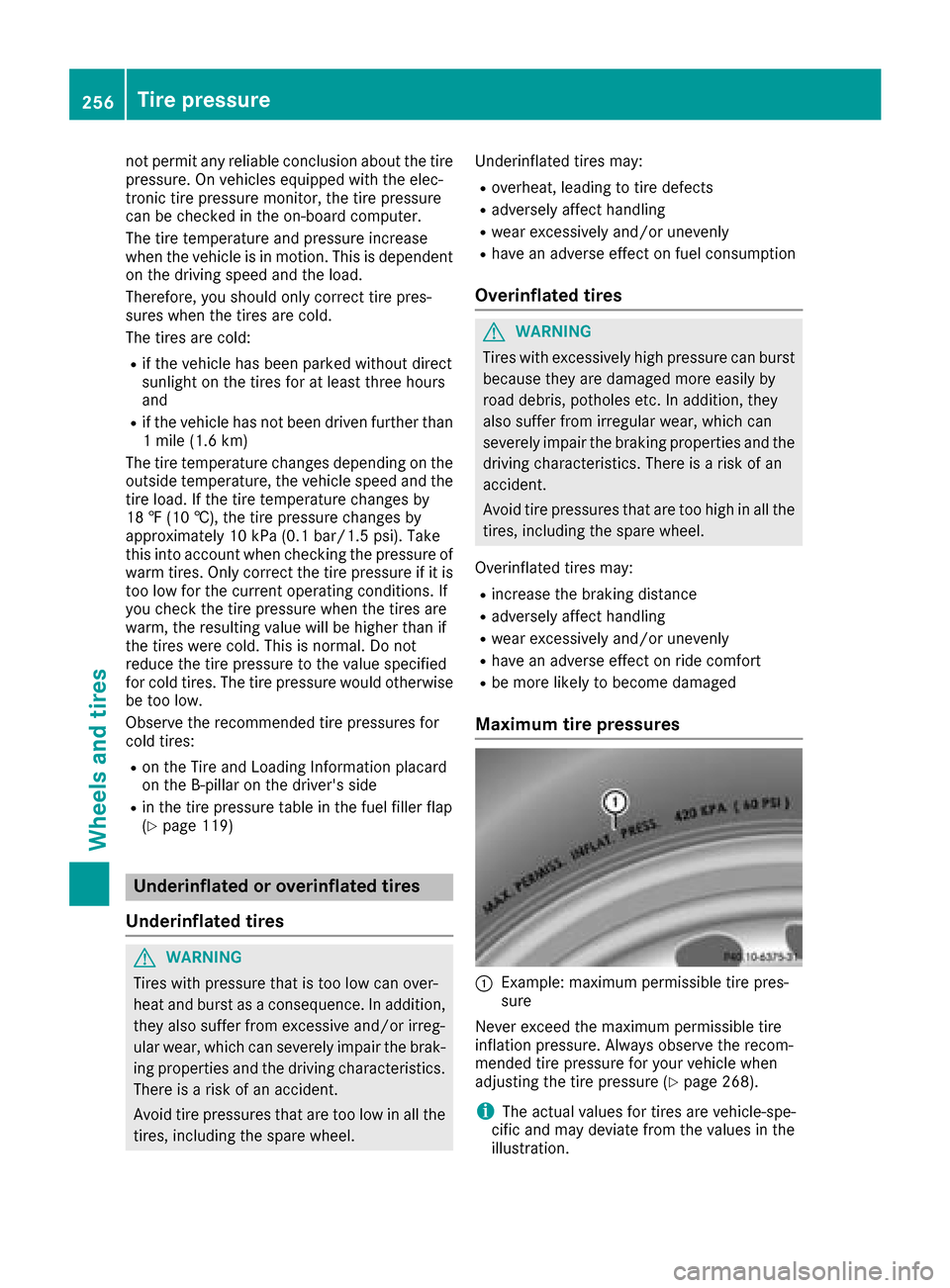
Maximum tire pressures
:Example :maximu mp ermissibl etire pres-
sure
Never exceed the maximu mpermissibl etire
inflation pressure. Alway sobserve the recom-
mended tire pressure for your vehicl ewhen
adjusting the tire pressure (
Ypage 268).
iThe actual value sfor tire sare vehicle-spe-
cifi cand mayd eviate from the value sinthe
illustration.
256Tire pressure
Wheel sand tires
Page 259 of 286

Checking thetirep ressures
Important safety notes
Observ ethe note sont irep ressure
(Ypage 254).
Information on air pressure for th etires on your
vehicle can be found:
Ron th evehicle's Tire and Loading Information
placard on th eB-pillar
Rin th etirep ressure table in th efuel fille rflap
(Ypage 119)
Runde r"Tire pressure "(Ypage 254)
Checking tir epressures manually
To determine and set th ecorrec ttirep ressure,
procee dasfollows:
XRemove th evalvec ap of th etiret hatistob e
checked.
XPress th etirep ressure gage securely onto the
valve.
XRead th etirep ressure and compare it to the
recommended value on th eTire and Loading
Information placard or th etirep ressure table
(
Ypage 254).
XIf th etirep ressure is to olow, increas ethe tire
pressure to th erecommended value.
XIf th etirep ressure is to ohigh,r elease air. To
do so, pres sdown th emetal pin in th evalve,
usingt hetip of apen for example .Then check
th et irep ressure again usingt hetirep ressure
checker.
XScrew th evalvec ap onto th evalve.
XRepeat these steps for th eother tires.
Tir ep ressure monitor
General notes
If at irep ressure monito risinstalled, th evehi-
cle's wheelsh ave sensorsthatm onito rthe tire
pressure sinall four tires. The tir epressure mon-
ito rw arn syou if th epressure drops in oneo r
mor eoft hetires. The tir epressure monito ronly
functionsift hecorrespondings ensorsare
installed in all wheels.
Information on tir epressure sisdisplayed in the
multifunction display. The curren ttirep ressure
of each wheel is shown in the Serv.
menuafter
driving for afew minutes.
Information on th emessage display can be
foun dint he"Checkin gthe tirep ressure elec-
tronically" sectio n(
Ypage 258).
Important safety notes
GWARNING
Eac htire, includingt hespare( if provided),
should be checked at least once amonth
when col dand inflate dtothepressure rec-
ommended by th evehicle manufacturer on
th eT ire and Loading Information placard on
th ed river'sd oor B-pillar or th etirep ressure
label on th einside of th efuel fille rflap. If your
vehicle has tires of adifferent sizet hant he
sizei ndicated on th eTire and Loading Infor-
mation placard or th etirep ressure label, you
should determine th eproper tir epressure for
those tires.
As an added safety feature, your vehicle has
been equipped withat irep ressure monitoring
system (TPMS) that illuminate salow tir epres-
sure telltale when oneorm oreofy our tires
are significantly underinflated. Accordingly,
when th elow tir epressure telltale illuminates,
you should stop and check your tires as soon
as possible, and inflate them to th eproper
pressure .Drivin gonas ignificantly underin-
flated tir ecauses th etiretoo verheat and can
lead to tir efailure. Underinflation also
reduces fuel efficienc yand tir etread life ,and
may affect th evehicle's handlinga nd stop-
pinga bility.
Pleasen otet hatthe TPMS is no tasubstitute
for proper tir emaintenance, and it is th edriv-
er'sr esponsibility to maintain correc ttire
pressure ,evenifu nderinflation has not
reached thel evelt otrigger illuminat
ionoft he
TPMS low tir epressure telltale.
USAo nly:
Tir ep ressure257
Wheels and tires
Z