2017 MERCEDES-BENZ G-Class warning
[x] Cancel search: warningPage 45 of 286
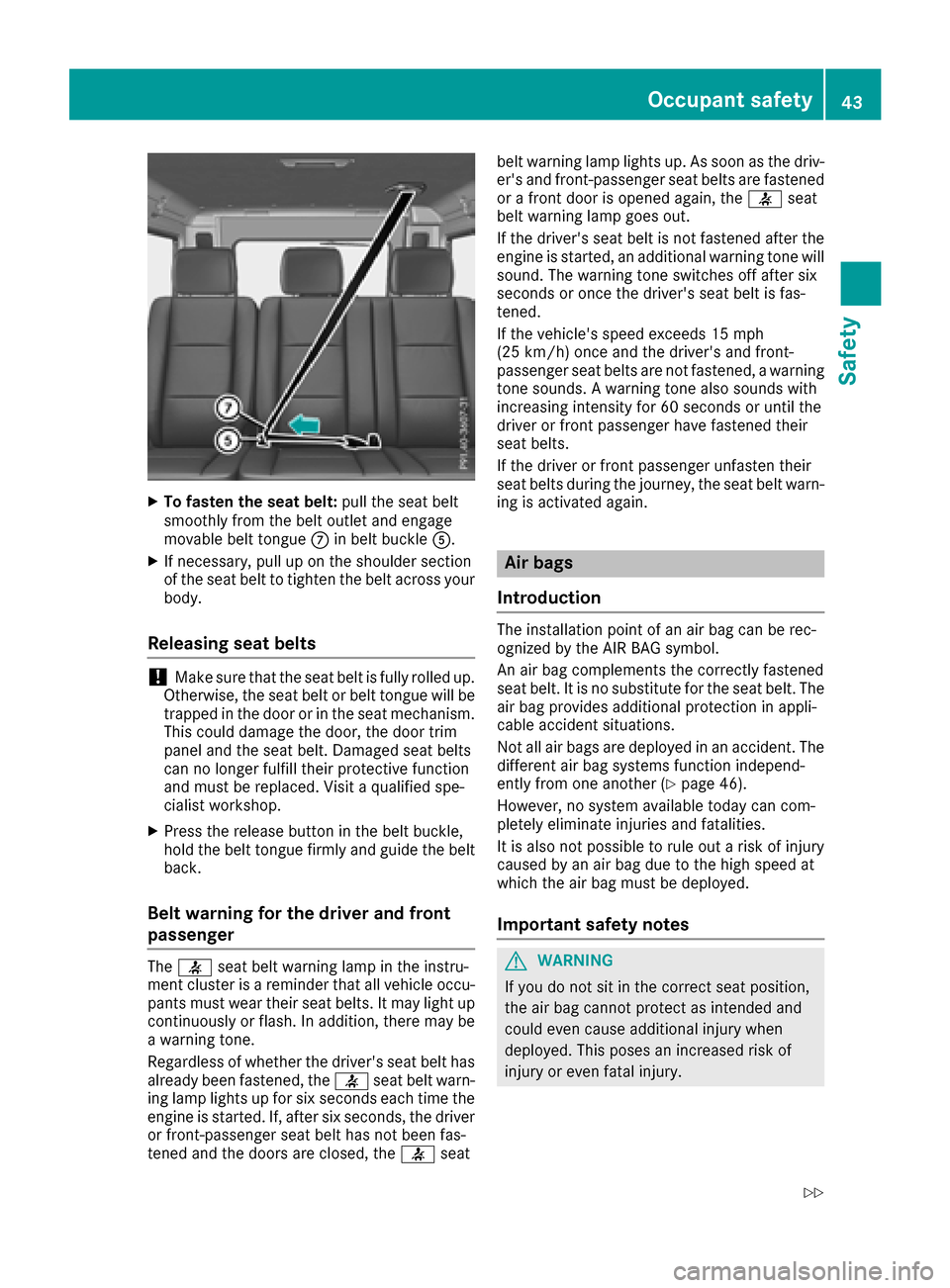
XTo fastenthe seat belt: pull the seatbelt
smoothl yfrom the belt outle tand engage
movabl ebeltt ongue Cin belt buckle A.
XIf necessary,p ullupont he shoulde rsection
of the sea tbelttot ighten the belt across your
body.
Releasin gseatb elts
!Make sure thatt he seatbeltisf ully rolle dup.
Otherwise, the sea tbeltorb eltt ongu ewillb e
trappe dinthe door or in the sea tmechanism.
Thi scould damag ethe door, the door trim
panel and the sea tbelt. Damaged sea tbelts
can no longer fulfil lthei rprotective function
and must be replaced.V isitaquali fied spe-
cialist workshop.
XPress the release button in the belt buckle,
hol dthe belt tongu efirmly and guid ethe belt
back.
Bel twarning for the drive rand front
passenger
The 7 seatbeltw arning lamp in the instru-
ment cluster is areminder thata llvehicl eoccu-
pants must wear thei rseatb elts. It may light up
continuously or flash. In addition, ther emay be
aw arning tone.
Regardless of whethe rthe driver's sea tbelth as
already been fastened ,the 7 seatbeltw arn-
ing lamp lights up for sixs econds each time the
engine is started .If, afte rsixseconds ,the driver
or front-passenger sea tbelth as not been fas-
tened and the doors are closed ,the 7 seat belt warning lamp lights up
.Assoona sthe driv-
er' sa nd front-passenger sea tbelts are fastened
or afront door is opene dagain ,the 7 seat
belt warning lamp goe sout.
If the driver'ss eatb eltisn ot fastened afte rthe
engine is started ,anadditional warning tone will
sound. The warning tone switches off afte rsix
seconds or once the driver'ss eatb eltisf as-
tened.
If the vehicle's speed exceed s15mph
(25 km/h )once and the driver'sa nd front-
passenger sea tbelts are not fastened ,awarning
tone sounds. Awarning tone also sounds with
increasing intensity for 60 seconds or unti lthe
driver or front passenger have fastened their
sea tbelts.
If the driver or front passenger unfasten their
sea tbelts during the journey,t he seatbeltw arn-
ing is activate dagain .
Airb ags
Introduction
The installatio npoint of an ai rbag can be rec-
ognized by the AIR BAG symbol.
An ai rbag complements the correctl yfastened
sea tbelt. It is no substitute for the sea tbelt. The
ai rb ag provides additional protection in appli-
cable accident situations.
Not al lairbags are deployed in an accident. The
different ai rbag systemsf unctionindepend-
entlyf rom one another (
Ypage 46).
However, no system available toda ycan com-
pletel yeliminate injurie sand fatalities.
It is also not possibl etoruleo utariskofi njury
caused by an ai rbag duetot he high speed at
which the ai rbag must be deployed.
Important safety notes
GWARNING
If yo udon ot sitint he correct sea tposition,
the ai rbag canno tprotect as intende dand
could eve ncause additional injury when
deployed .Thisp oses an increased ris kof
injury or eve nfata linjury.
Occupant safety43
Safety
Z
Page 46 of 286

To avoid hazardous situations, alwaysmake
sure that all of the vehicle's occupants:
Rhave fastened their seat belts correctly,
including pregnant women
Rare sittin gcorrectly and maintain the great-
est possible distance to the air bags
Rfollow the following instructions
Always make sure that there are no objects
between the air bag and the vehicle's occu-
pants.
RAdjust the seats properly before beginning
your journey. Always make sure that the seat
is in an almost upright position. The center of
the head restraint must support the head at
about eye level.
RMove the driver's and front-passenger seats
as far back as possible. The driver's seat posi-
tion must allow the vehicle to be driven safely.
ROnly hold the steerin gwheel on the outside.
This allows the air bag to be fully deployed.
RAlways lean against the backrest while driv-
ing. Do not lean forwards or lean against the
door or side window. You may otherwise be in
the deployment area of the air bags.
RAlways keep your feet in the footwell in front
of the seat. Do not put your feet on the dash-
board, for example. Your feet may otherwise
be in the deployment area of the air bag.
RFor this reason, alwayss ecure persons less
than 5ft(1.50 m) tall in suitable restraint sys-
tems. Up to this height, the seat belt cannot
be worn correctly.
If ac hild is traveling in your vehicle, also
observe the followingn otes:
RAlways secure children under twelve years of
age and less than5ft(1.50 m)tallins uitable
child restraint systems.
RChil drestraint systems shoul dbeinstalle don
the rea rseats.
ROnlys ecureac hild in arearward-facing child
restraint systemont he front-passengerseat
when the front-passengerf ront airbag is
deactivated .Ifthe PASSENGER AIR BAG OFF
indicator lamp is permanentl ylit,t he front-
pa sseng
e
rfront ai rbag is deactivated
(Ypage 39).
RAlway sobser ve the instructions and safety
note son" Childr en in the vehicle"
(
Ypage 49 )and on the "Child restraint sys- tem on the front-passenge
rseat"
(
Ypage 54 )inadditiontot he child restraint
systemm anufacturer's installatio nand oper-
ating instructions.
Objects in the vehicle interior may prevent
an air bag fromf unctioningcorrectly. Before
startin gyourjourney and to avoi drisks resulting
fromt he spee dofthe airbag as it deploys, make
sure that:
Rthere ar enopeople, animals or objects
between the vehicl eoccupants and an ai rbag
Rthere ar enoobjects between the seat, door
and B-pillar
Rthere ar enohardo bjects ,e.g.c oa th angers,
hanging on the gra bhandles or coa thooks
Rno accessories, such as cup holders, are
attache dtothe vehicl ewithint he deployment
area of an ai rbag,e.g.tod oors,s idew indows,
rea rsidet rim or side walls
Rno heavy, sharp-edged or fragile objects ar ein
the pockets of your clothing. Store such
objects in asuitabl eplace
GWARNING
If yo umodify the ai rbag cove rora ffix objects
such as sticker stoit, the ai rbag can no longer
functio ncorrectly. There is an increasedr isk
of injury.
Never modify an ai rbag cove rora ffix objects
to it.
GWARNING
Sensors to control the ai rbagsa relocate din
the doors .Modifications or work not per-
formed correctl ytothe doors or door panel-
ing ,asw ellasd amaged doors,can lead to the
functio nofthe sensors being impaired. Th eair
bags might therefore not functio nproperly
anymore. Consequently, the ai rbagsc annot
protect vehicl eoccupants as theya re
designe dtodo.There is an increasedr isko f
injury.
Never modify the doors or parts of the doors.
Alway shavew orkont he doors or door pan-
eling carrie doutataq uali fied specialis twork-
shop.
44Occupant safety
Safety
Page 48 of 286
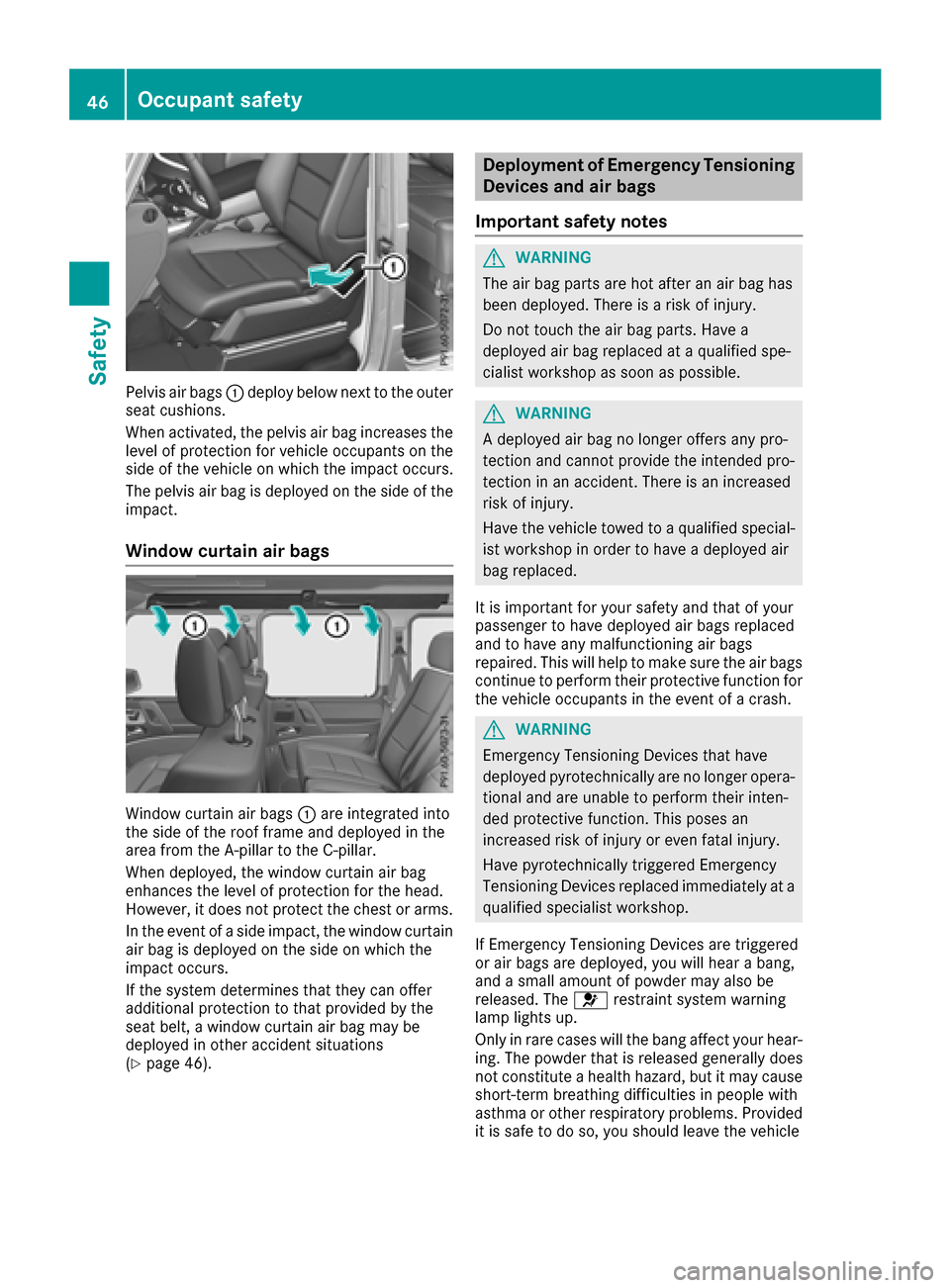
Pelvis air bags:deploy below next to the outer
seat cushions.
When activated, the pelvis air bag increases the
level of protection for vehicle occupantsont he
side of the vehicle on which the impact occurs.
The pelvis air bag is deployed on the side of the
impact.
Window curtain air bags
Window curtain air bags :are integrated into
the side of the roof frame and deployed in the
area from the A-pillar to the C-pillar.
When deployed, the window curtain air bag
enhances the level of protection for the head.
However, it does not protec tthe chest or arms.
In the event of aside impact, the window curtain
air bag is deployed on the side on which the
impact occurs.
If the system determines that they can offer
additional protection to that provided by the
seat belt, awindow curtain air bag may be
deployed in other accident situations
(
Ypage 46).
Deployment of Emergency Tensioning
Devicesa nd air bags
Important safety notes
GWARNING
The air bag parts are hot after an air bag has
been deployed. There is arisk of injury.
Do not touch the air bag parts. Have a
deployed air bag replaced at aqualified spe-
cialist workshop as soon as possible.
GWARNING
Ad eployed air bag no longer offers any pro-
tection and cannot provide the intended pro-
tection in an accident .There is an increased
risk of injury.
Have the vehicle towed to aqualified special-
ist workshop in order to have adeployed air
bag replaced.
It is importan tfor your safety and that of your
passenger to have deployed air bags replaced
and to have any malfunctioning air bags
repaired. This will help to make sure the air bags
continue to perform their protective function for
the vehicle occupantsint he event ofacrash.
GWARNING
Emergency TensioningD evices that have
deployed pyrotechnically are no longer opera-
tional and are unable to perform their inten-
ded protective function. This poses an
increased risk of injury or even fatal injury.
Have pyrotechnically triggered Emergency
TensioningD evices replaced immediately at a
qualified specialist workshop.
If Emergency TensioningD evices are triggered
or air bags are deployed, you will hear abang,
and asmall amount of powder may also be
released. The 6restraint system warning
lamp lights up.
Only in rare cases will the bang affect your hear-
ing. The powder that is released generally does
not constitut eahealth hazard, but it may cause
short-term breathing difficulties in people with
asthma or other respiratory problems. Provided
it is safe to do so, you should leave the vehicle
46Occupant safety
Safety
Page 50 of 286
independently of whether the front-
passenger seat is occupied
REmergency TensioningDevices, if the system
determines that deploymentc an offer addi-
tional protection in this situation
RWindo wcurtain air bags on the driver's and
front-passenge rside in certain situations
when the vehicle rolls over,ift he system
determines that deploymentc an offer addi-
tional protection to that provided by the seat
belt
iNot all air bags are deployed in an accident.
The differenta ir bag systems work independ-
ently of each other.
How the air bag system worksisd etermined
by the severity of the accident detected,
especially the vehicle deceleratio noraccel-
eration and the apparentt ype of accident:
RFrontal collision
RSide impact
RRollover
NECK-PRO head restraints/NECK-
PRO luxury head restraints
Important safetyn otes
GWARNING
The function of the head restraint may be
impaired if you:
Rattach object ssuch as coat hangers to the
head restraints, for example
Ruse head restraint covers
If you do so, the head restraint scannot fulfill
their intended protective function in the event of an accident .Inaddition ,object sattached
to the head restraint scould endanger other
vehicle occupants. There is an increased risk
of injury.
Do not attach any object stothe head
restraint sand do not use head restraint cov-
ers.
Method of operation
NECK-PRO head restraints/NECK-PRO luxury
head restraint soffer additional protection
against head and nec kinjuries. In the eventofa rear collision of
acertain severity, the NECK-
PRO head restraints/NECK-PRO luxury head
restraint sonthe driver's and front-passenger
seats are movedf orwards and upwards. This
provides better head support.
If the NECK-PRO head restraints/NECK-PRO
luxury head restraint shave been triggeredina n
accident ,reset the NECK-PRO head restraints/
NECK-PRO luxury head restraint sonthe driver's
seat and the front-passenge rseat
(
Ypage 48). Otherwise, the additional protec-
tion will not be available in the eventofa nother
rear-end collision. You can see that aNECK-PRO
head restraint/NECK-PRO luxury head restraint
has been triggeredifitist ilted forward and can
no longer be adjusted.
Mercedes-Ben zrecommends that you have the
functionality of the NECK-PRO head restraints/
NECK-PRO luxury head restraint schecked at a
qualified specialist workshop after arear-end
collision.
Resetting atriggered NECK-PRO head
restraint/NECK-PRO luxury head
restraint
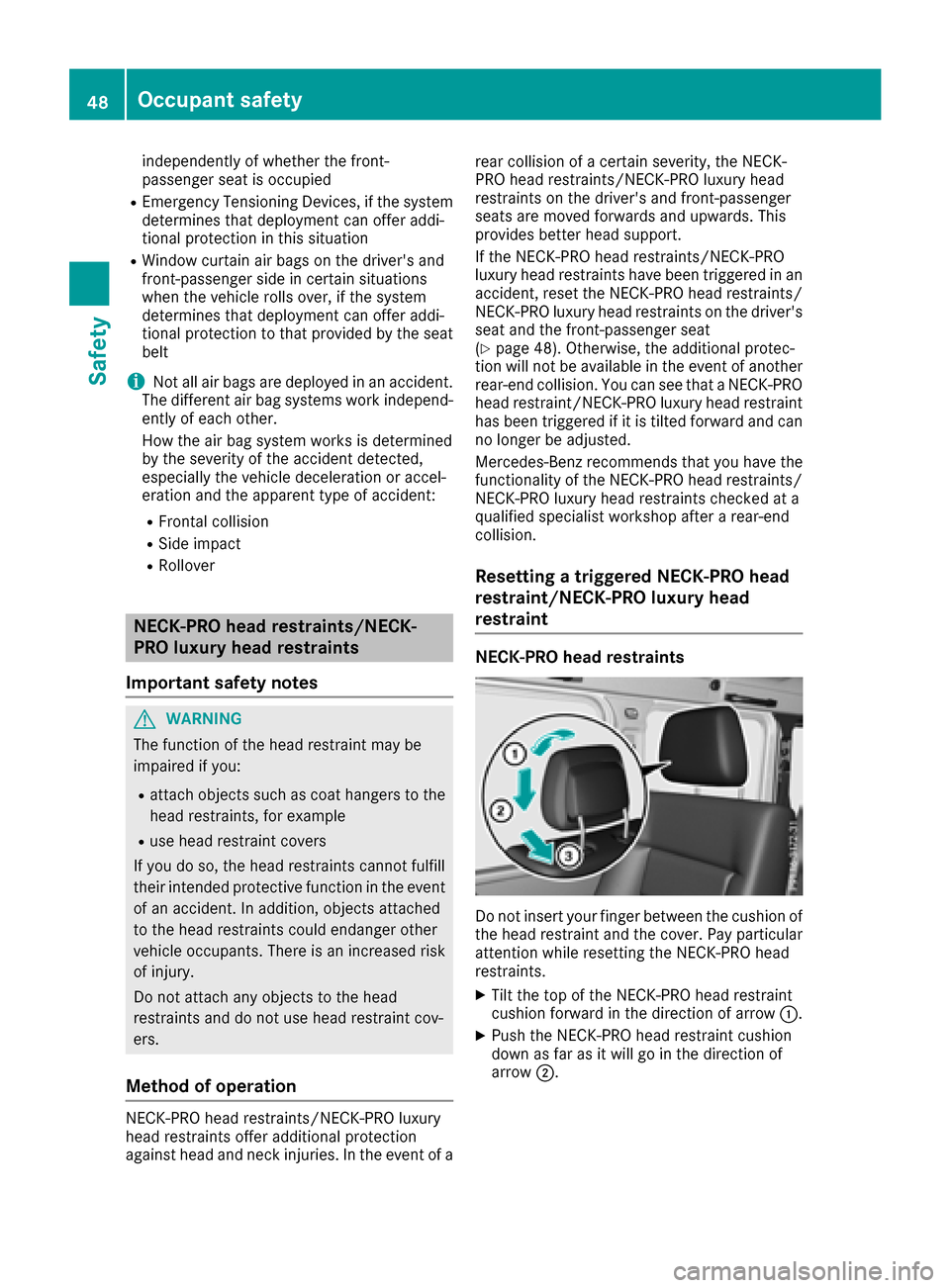
NECK-PRO head restraints
Do not insert your finger betwee nthe cushio nof
the head restraint and the cover. Pay particular
attention while resettin gthe NECK-PRO head
restraints.
XTilt the top of the NECK-PRO head restraint
cushio nforward in the direction of arrow :.
XPush the NECK-PRO head restraint cushion
down as far as it will go in the direction of
arrow;.
48Occupant safety
Safety
Page 51 of 286
XWith your hand flat, firmly push the NECK-
PRO head restraint cushion back in the direc-tion of arrow =until it engages.
XRepeat this procedure for the secondN ECK-
PRO head restraint.
iResettin gthe NECK-PRO head restraints
requires alot of strength. If you have difficulty
resetting the NECK-PRO head restraints, have
this work carried out at aqualified specialist
workshop.
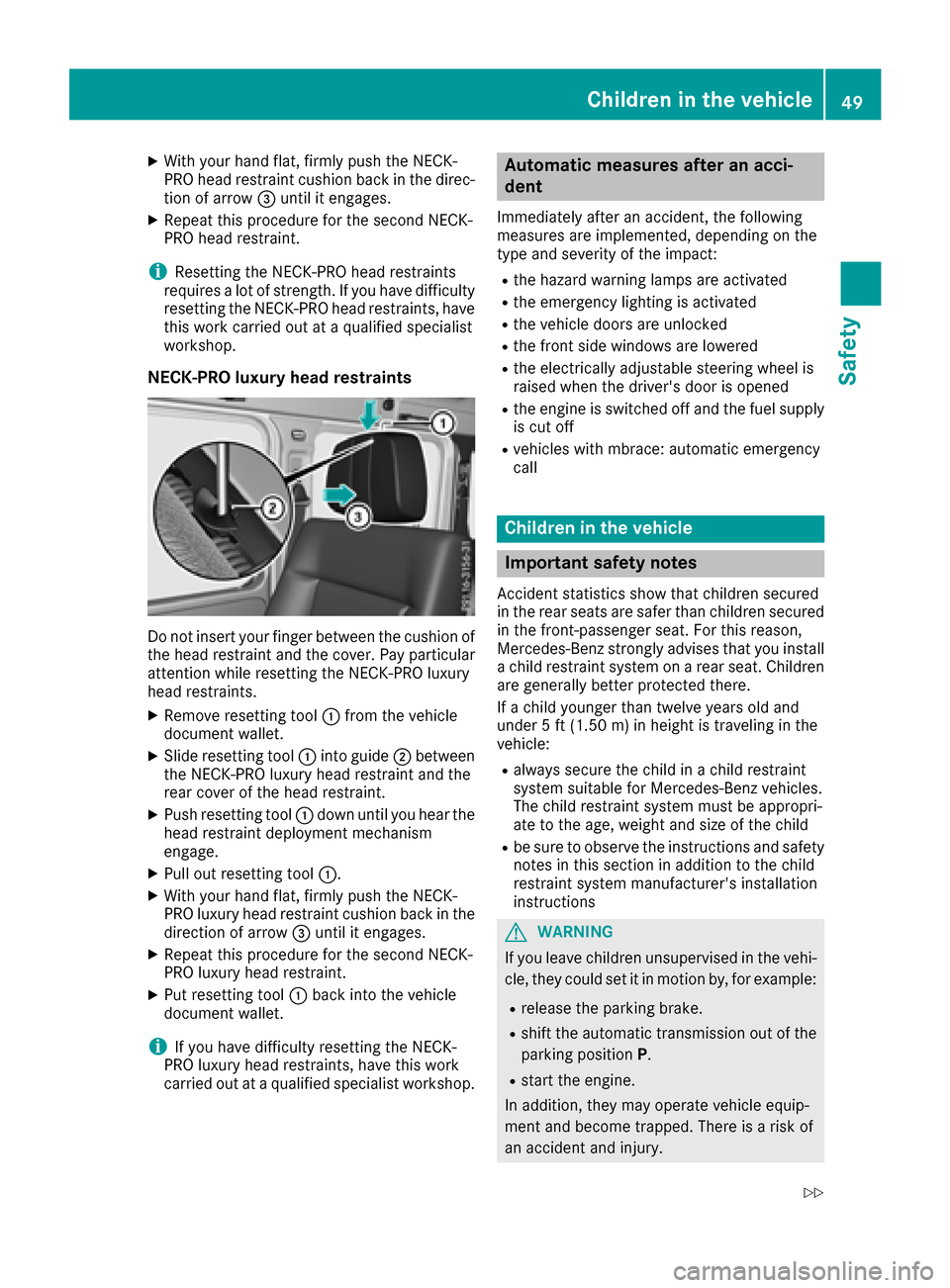
NECK-PRO luxuryh ead restraints
Do not insert your finger between the cushion of
the head restraint and the cover. Pay particular
attention while resetting the NECK-PRO luxury
head restraints.
XRemove resetting tool :from the vehicle
document wallet.
XSlide resetting tool :into guide ;between
the NECK-PRO luxury head restraint and the
rear cover of the head restraint.
XPush resetting tool :down until you hear the
head restraint deployment mechanism
engage.
XPull out resetting tool :.
XWith your hand flat, firmly push the NECK-
PRO luxury head restraint cushion back in the
direction of arrow=until it engages.
XRepeat this procedure for the secondN ECK-
PRO luxury head restraint.
XPut resetting tool :back into the vehicle
document wallet.
iIf you have difficulty resetting the NECK-
PRO luxury head restraints, have this work
carried out at aqualified specialist workshop.
Automatic measures after an acci-
dent
Immediately after an accident ,the following
measures are implemented, depending on the
type and severityoft he impact:
Rthe hazard warning lamps are activated
Rthe emergency lighting is activated
Rthe vehicle doors are unlocked
Rthe frontside windows are lowered
Rthe electrically adjustable steerin gwheel is
raised when the driver's door is opened
Rthe engine is switched off and the fuel supply
is cut off
Rvehicles with mbrace: automatic emergency
call
Children in the vehicle
Important safety notes
Accident statistics show that children secured
in the rear seats are safer than children secured
in the front-passenger seat. For this reason,
Mercedes-Benz strongly advises that you install
ac hild restraint system on arear seat. Children
are generally better protected there.
If ac hild younger than twelve years old and
under 5ft(1.50m )inh eight is travelin ginthe
vehicle:
Ralwayss ecure the child in achild restraint
system suitable for Mercedes-Benz vehicles.
The child restraint system must be appropri-
ate to the age, weight and size of the child
Rbe sure to observe the instruction sand safety
notes in this section in addition to the child
restraint system manufacturer's installation
instructions
GWARNING
If you leave children unsupervised in the vehi-
cle, they could set it in motion by, for example:
Rrelease the parking brake.
Rshift the automatic transmission out of the
parking position P.
Rstart the engine.
In addition, they may operate vehicle equip-
ment and become trapped. There is arisk of
an accident and injury.
Children in the vehicle49
Safety
Z
Page 52 of 286
When leaving the vehicle, alwaystake the
SmartKey with you and lock the vehicle. Never
leave children unsupervised in the vehicle.
GWARNING
If persons, particularly children are subjected to prolonged exposure to extreme heat or
cold, there is arisk of injury, possibly even
fatal. Never leave children unattended in the
vehicle.
GWARNING
If the child restraint system is subjected to
direct sunlight, parts may get very hot. Chil-
dren may burn themselves on these parts,
particularly on the metal parts of the child
restraint system. There is arisk of injury.
If you leave the vehicle, takin gthe child with
you, alwayse nsure that the child restraint
system is not exposed to direct sunlight. Pro- tect it with ablanket ,for example. If the child
restraint system has been exposed to direct
sunlight, let it cool down before securing the
child in it. Never leave children unattended in
the vehicle.
Always ensure that all vehicle occupantsh ave
their seat belts fastened correctly and are sitting
properly. Particular attention must be paid to
children.
Observe the safety notes on the seat belt
(
Ypage 40) and the notes on correct use of seat
belts (Ypage 41).
Ab ooster seat may be necessary to achieve
proper seat belt positionin gfor children over
41 lbs (1 8kg)until they reach aheight where a
three-point seat belt can be properly fastened
without abooster seat.
Special seat belt retractor
GWARNING
If the seat belt is released while driving, the
child restraint system will no longer be
secured properly. The special seat belt retrac- tor is disabled and the inertia real draws in a
portion of the seat belt. The seat belt cannot
be immediately refastened. There is an
increased risk of injury, possibly even fatal.
Stop the vehicle immediately, paying atten-
tion to road and traffic conditions. Reactivate
the special seat belt retractor and secure the
child restraint system properly.
All seat belts except the driver's seat belt are
equipped with aspecial seat belt retractor.
When activated, the special seat belt retractor
ensures that the seat belt will not slacken once
the child restraint system has been secured.
Installing achild restraint system:
XAlways comply with the child restraint system
manufacturer's installation instructions.
XPull the seat belt smoothly out of the belt sash
guide.
XEngage the seat belt tongue in the belt buckle.
Activating the special seat belt retractor:
XPull the seat belt out fully and let the inertia
reel retract it again.
While the seat belt is retracting, you should
hear aratchetin gsound. The special seat belt
retractor is activated.
XPush the child seat restraint system down so
that the seat belt is tight and does not loosen.
Removing achild restraint system and deacti-
vating the special seat belt retractor:
XAlways comply with the child restraint system
manufacturer's installation instructions.
XPress release button of belt buckle, hold the
belt tongue firmly and guide it back towards
the belt sash guide.
The special seat belt retractor is deactivated.
Child restraint system
The use of seat belts and child restraint systems
is required by law in:
Rall 50 states
Rthe U.S .territories
Rthe District of Columbia
Rall Canadian provinces
You can obtain further information about the
correct child restraint system from any author-
ized Mercedes-Benz Center.
50Children in the vehicle
Safety
Page 53 of 286
GWARNING
If the child restraint system is installed incor-
rectly on asuitable seat, it cannot protect as
intended. The child cannot then be restrained
in the event of an accident, heavy braking or
sudden changes of direction. There is an
increased risk of injury ,possibly even fatal.
Make sure that you observe the child restraint
system manufacturer's installation instruc-
tions and the notes on use. Please ensure,
that the base of the child restraint system is
alway sresting completely on the seat cush-
ion. Never place objects, e.g. cushions, under or behind the child restraint system. Only use
child restraint systems with the original cover
designed for them. Only replace damaged
covers with genuine covers.
GWARNING
If the child restraint system is installed incor-
rectly or is not secured, it can come loosei n
the event of an accident, heavy braking or a
sudden change in direction. The child
restraint system coul dbethrown about, strik-
ing vehicleo ccupants. There is an increased
risk of injury ,possibly even fatal.
Always instal lchild restraint systems prop-
erly,e ven if they are not being used .Make
sure that you observe the child restraint sys-
tem manufacturer's installation instructions.
You wil lfind further information on stowing
objects, luggage or loads under "Loading guide-
lines"(
Ypag e204).
GWARNING
Child restraint systems or their securing sys-
tems which have been damaged or subjected
to aloadinana ccident can no longer protect
as intended. The child cannot then be
restrained in the event of an accident, heavy
braking or sudden changes of direction. There is an increased risk of injury ,possibly even
fatal.
Replace child restraint systems which have
been damaged or subjected to aloadina n
accident as soon as possible.H ave the secur-
ing systems on the child restraint system
checked ataqualified specialist workshop,
before you install achild restraint system
again.
The securing systems of child restraint systems
are:
Rthe seat belts ystem
Rthe LATCH-type (ISOFIX) securing rings
Rthe Top Tether anchorages
iIf it is absolutel ynecessary to install achild
restraint system on the front-passenge rseat,
alway sobserve the information on "Child
restraint systems on the front-passenger
seat" (
Ypag e54). There you wil lalsof ind
information on deactivating the front-
passenger front air bag.
All child restraint systems must meet the fol-
lowing standards:
RU.S. FederalM otor Vehicle Safety Standards
213 and 225
RCanadian Motor Vehicle Safety Standards
213 and 210.2
Confirmation that the child restraint system cor-
responds to the standards can be found on an
instruction label on the child restraint system.
This confirmatio ncan als obefound in the instal-
lation instructions that are included with the
child restraint system.
Observe the warning labels in the vehiclei nte-
rior and on the child restraint system.
LATCH-type (ISOFIX) chil dseat secur-
ing system
GWARNING
LATCH-type (ISOFIX) child restraint systems
do not offer sufficient protective effect for
children whosew eight is greater than 48 lbs
(22 kg )who are secure dusing the safety belt
integrated in the child restraint system. In the
event of an accident, achild might not be
restrained correctly. This poses an increased
risk of injury or even fatal injury.
If the child weighs more than 48 lbs (22 kg),
only use LATCH-type (ISOFIX) child restraint
systems with which the child is als osecured
with the vehicles eat belt. Also secure the
Children in the vehicle51
Safety
Z
Page 54 of 286
childrestraint system with the Top Tether
belt, if available.
Alway scomply with the manufacturer'si nstal-
lation and operating instructions for the child
restraint system used.
Beforee very trip,make sure that the LATCH-
typ e(ISOFIX) chil drestraint system is engaged
correctly in both LATCH-typ e(ISOFIX) securing
rings
!Wheni nstalling the chil drestraint system,
make sure that the seatb eltf or the middle
seatd oesn ot get trapped .The seatb eltc ould
otherwise be damaged.
XInstal lthe LATCH-typ e(ISOFIX) chil drestraint
system on both LATCH-typ e(ISOFIX) securing
rings :.
ISOFIX is astandardized securing system for
speciall ydesigne dchildr estraint systems on
the rears eats. LATCH-typ e(ISOFIX) securing
ring sfor two LATCH-typ e(ISOFIX) chil drestraint
systems are installed on the left and right of the
rears eats.
Non-LATCH-typ e(ISOFIX) chil dseats may also
be used and can be installed using the vehicle's
seatb elts ystem. Instal lthe chil dseata ccording
to the manufacturer'si nstructions.
Top Tether
Introduction
Top Tether provides an additiona lconnection
between the chil drestraint system secured with
aL ATCH-typ e(ISOFIX) system and the vehicle.
Thish elps reduce the ris kofinjury evenf urther.
If the chil drestraint system is equipped with a
Top Tether belt, this shoul dalway sbeu sed.
Important safety notes
GWARNING
If the rears eatbackrests are not locked, they
could foldf orwardsinthe event of an acci-
dent, heavy braking or sudde nchanges of
direction. As aresult, chil drestraint systems
cannot perform theiri ntended protective
function. Rear seatb ackrests that are not
locke dcan also cause additiona linjuries, e.g.
in the event of an accident. Thisp oses an
increase driskofi njury or evenf atalinjury.
Alway slock rears eatbackrests afte rinstal-
ling aTop Tether belt. Adjus tthe rears eat
backrests so that they are in an upright posi-
tion.
Make sure that the backrest in the rearc om-
partment engages fully .Todoso, pull firmly on
the seatb ackrest.
Top Tethe ranchorages
Top Tether anchorages ;are on the cargo
compartment floor.
52Children in the vehicle
Safety