2017 MERCEDES-BENZ E43AMG ESP
[x] Cancel search: ESPPage 168 of 482
#Take into account the tra ffic situation
before calling up thestored speed.
#If th estored speed is not known, store
th e desired speed again.
&
WARNING Risk of accident due tounex‐
pecte d acceleration byDis tance Pilot
DISTRONIC
If Dis tance Pilot DISTRONIC no longer
de tects a vehicle in front, it may unexpect‐
edly accelerate tothe speed stored.
RThis speed may be too high for a turning
lane or an exit lane.
RIf driving in theright lane, this speed may
be so high that you pass vehicles driving
on the left (in count ries where tra ffic
drives on theright).
RIf driving in the left lane, this speed may
be so high that you pass vehicles driving
on theright (in countri es where traffic
drives on the left).
Alw ays carefully obser vethe tra ffic condi‐
tions and be ready tobrake at all times.
&
WARNING Risk of accident due toDis‐
ta nce Pilot DISTRONIC pulling away auto‐
matically
If Dis tance Pilot DISTRONIC pe rforms an
automatic driving-off procedure, theve hicle
may accelerate unexpectedl y.
Where necessar y,brake theve hicle yourself
and take evasive action.
&
WARNING Risk of accident due toSpeed
Limit Pilot adapting theve hicle's speed
The speed adop tedby the Speed Limit Pilot
may be too high or incor rect in some individ‐
ual cases, such as:
RInthewe t or in fog
RWhen towing a trailer
Ensure that the driven speed complies with
traf fic re gulations.
Re quirementsRThe vehicle's engine or must be switched on.
RThe electric parking brake must be released.
RPa rking Pilot is not being used topark the
ve hicle or toexit from a parking space.
RESP®must be switched on, but not inter ven‐
ing.
RThe transmission must be in positionD.
RThe driver door, front passenger door and the
re ar doors must be closed.
RThe engine hood must be closed.
16 6
Driving and pa rking
Page 171 of 482
RIfth e sy stem de tects that there are no lane
markings, it uses theve hicle ahead as a ref‐
erence up toa speed of 80 mph(1 30 km/h).
RWhen the sy stem is actively steering, the
è symbol is shown in green in the multi‐
function displa y.
St eering Pilot sy stem limits
St eering Pilot has a limited steering torque for
lateral guidance. In some cases, thesteering
inter vention is not suff icienttokeep theve hicle
in the lane.
If de tection of lane markings and vehicles ahead
is impaired, Steering Pilot switches topassive
mode. The sy stem pr ovides no support in this
case. During the transition from the active to
passive status theè symbol is shown as
enlar ged and flashes yello w. Once the sy stem is
passive theè symbol is gr ayed out in the
multifunction displa y.
The sy stem may be impaired or may not function
in thefo llowing situations:
RIf th ere is poor visibility, e.g. due toinsuf fi‐
cient illumination of thero ad, or due tosno w,
ra in, fog or spr ay.
RIfth ere is glare, e.g. from oncoming traf fic,
dire ct sunlight or reflection from other vehi‐
cles (e.g. if thero ad sur face is wet).
RIfth e windshield is dirty, fogged up, damaged
or co vered, for ins tance byast icke r,in the
vicinity of the camer a.
RIf no, or se
veral, unclear lane markings are
present for one lane, e.g. in a construction
area.
RIf th e lane markings are wornaw ay, dark or
co vered up, e.g. bydirt or sno w.
RIfth e dis tance totheve hicle in front is too
small and the lane markings thus cannot be
de tected.
RIfth e lane markings change quickl y,e.g.
lanes branch off, cross one ano ther or
mer ge.
RIfth ero ad is nar rowand winding.
RIfth ere are highly variable shade conditions
on thero ad.
RIfth ere are obs tacles such as traffic guid‐
ance posts on the lane or projecting out into
th e lane. The sy
stem does not pr ovide assis tance in the
fo llowing conditions:
ROn very sharp bends.
RWhen towing a trailer.
RIfyo u actively change lane without switch ing
on the turn signal indicator.
RIfyo uswit chon the turn signal indicator and
th e conditions for activating Active Lane
Change Assi stare not fulfilled.
Note s onSteering Pilot
St eering Pilot is only an aid. You are responsible
fo rth e dis tance totheve hicle in front, forve hi‐
cle speed, for braking in good time and forst ay ‐
ing in your lane. Before changing lanes, make
sure that the neighboring lane is free (shoulder
view).
Ac tive Lane Change Ass
i
st
% The availability of thefo llowing function is
countr y-dependent.
St eering Pilot remains active even if the turn sig‐
nal indicator is switched on. Steering Pilot then
assists the driver when changing lanes byapply‐
ing steering torque toinitiate the lane change.
Driving and parking 16
9
Page 172 of 482
Assistance when changing lanes is pr ovided if all
th efo llowing conditions are me t:
RYou are driving on a highwa yor high-speed
multi-lan emajo rro ad with multiple lanes in
th e direction of tr avel.
RThe neighboring lane is free and separated
bya broken lane marking.
RThe driven speed is between 50 mph
(80 km/h) and 110mp h(1 80 km/h).
RThe turn signal indicator is switched on for
longer than two seconds.
If th e sy stem is impaired, Active Lane Change
Assi stmay be inter rupte d. If an inter ruption
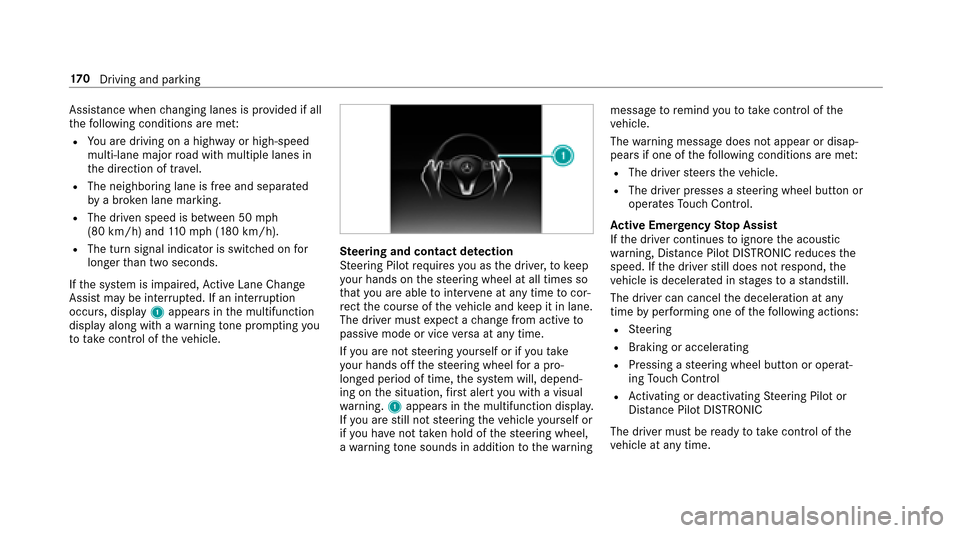
occurs, display 1appears in the multifunction
display along with a warning tone prom pting you
to take control of theve hicle.Ste ering and contact de tection
St eering Pilot requ ires you as the driver, tokeep
yo ur hands on thesteering wheel at all times so
th at you are able tointer vene at any time tocor‐
re ct the course of theve hicle and keep it in lane.
The driver must expect a change from active to
passive mode or vice versa at any time.
If yo u are not steering yourself or ifyo u take
yo ur hands offthesteering wheel for a pro‐
longed period of time, the sy stem will, depend‐
ing on the situation, firs t alert youwit h a visual
wa rning. 1appears in the multifunction displa y.
If yo u are still not steering theve hicle yourself or
if yo u ha venot take n hold of thesteering wheel,
a wa rning tone sounds in addition tothewa rning message
toremind youto take control of the
ve hicle.
The warning message does not appear or disap‐
pears if one of thefo llowing conditions are me t:
RThe driversteers theve hicle.
RThe driver presses a steering wheel button or
operates Touch Control.
Ac tive Eme rgency Stop Assist
If th e driver continues toigno rethe acoustic
wa rning, Dis tance Pilot DISTRONIC reduces the
speed. If the driver still does not respond, the
ve hicle is decelerated in stages to
ast an
dstill.
The driver can cancel the deceleration at any
time byper form ing one of thefo llowing actions:
RSt eering
RBraking or accelerating
RPressing a steering wheel button or operat‐
ing Touch Control
RAc tivating or deacti vating Steering Pilot or
Dis tance Pilot DISTRONIC
The driver must beready totake control of the
ve hicle at any time.
17 0
Driving and pa rking
Page 173 of 482
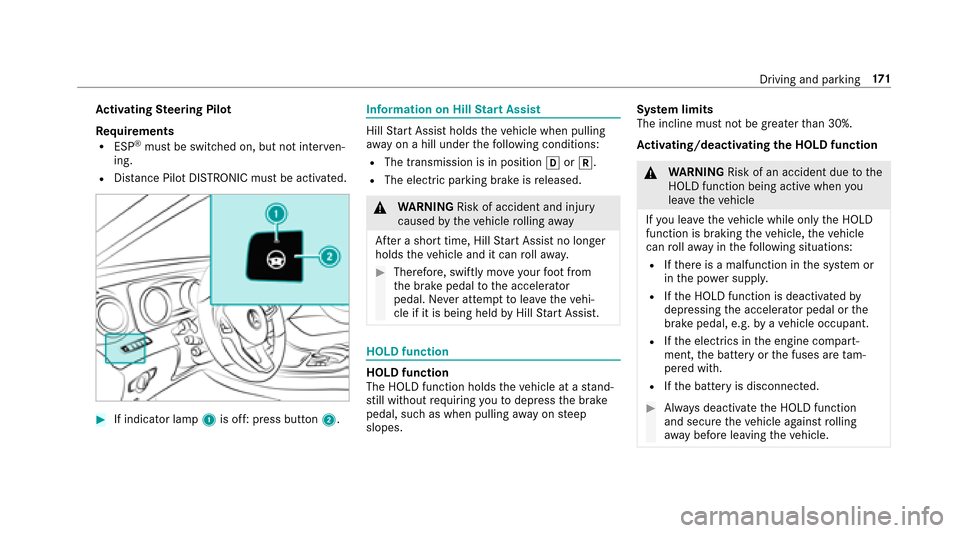
Activating Steering Pilot
Re quirements
RESP®must be switched on, but not inter ven‐
ing.
RDis tance Pilot DISTRONIC must be activated.
#If indicator lamp1is off: press button 2.
Information on Hill Start Assist
Hill Start Assist holds theve hicle when pulling
aw ay on a hill under thefo llowing conditions:
RThe transmission is in position hork.
RThe elect ric park ing brake is released.
&
WARNING Risk of accident and injury
caused bytheve hicle rolling away
Af ter a short time, Hill Start Assist no longe r
holds theve hicle and it can rollaw ay.
#Therefore, swiftly mo veyour foot from
th e brake pedal tothe accelerator
pedal. Ne ver attem pttolea vetheve hi‐
cle if it is being held byHill Start Assist.
HOLD function
HOLD function
The HOLD function holds theve hicle at a stand‐
st ill without requ iring youto depress the brake
pedal, such as when pulling away on steep
slopes. Sy
stem limits
The incline must not be greaterth an 30%.
Ac tivating/deactivating the HOLD function
&
WARNING Risk of an accident due tothe
HOLD function being active when you
lea vetheve hicle
If yo u lea vetheve hicle while only the HOLD
function is braking theve hicle, theve hicle
can rollaw ay inthefo llowing situations:
RIf th ere is a malfunction in the sy stem or
in the po wer supp ly.
RIf th e HOLD function is deactivated by
depressing the accelera tor pedal or the
brake pedal, e.g. byave hicle occupant.
RIfth e electrics in the engine compart‐
ment, the battery or the fuses are tam‐
pered with.
RIf th e battery is disconnected.
#Alw ays deactivate the HOLD function
and secure theve hicle against rolling
aw ay before leaving theve hicle.
Driving and parking 17
1
Page 178 of 482

Parking Assist PARKTRONIC
Functions of Parking Assist PARKTRONIC
Parking Assist PARKTRONI Cis an electronic
parkin gassi stance sy stem with ultrasound. It
monitors the area around your vehicle using six
sensors 1inthe front bumper and six sensors
in there ar bumper. Parking Assist PARKTRONI C
indicates visuall yand audibl yth e dis tance
between your vehicle and an object.
Pa rking Assist PARKTRONI Cis on lyan aid. It is
not a substitute foryo ur attention tothe sur‐
ro undings. The responsibility for safe maneu ver‐
ing and parking remains with you. Make sure
th at there are no persons, animals or objects in th
e maneuvering area while maneuvering and
parking in/exiting parking spaces.
In thest andard setting, an intermitte ntwa rning
to ne sounds from a di stance of appr oximately
1. 0 ft (0.3 m) toan obs tacle. A continuous tone
sounds from a di stance of appr oximately 0.7 ft
(0.2 m). You can set thewa rning tone in the mul‐
timedia sy stem so that it will sound earlier at a
grea ter dis tance of appr oximately 3.3 ft(1.0 m)
(
→page 178).
If Pa rking Assist PARKTRONI Cis deacti vated,
Pa rking Pilot is una vailable.
Pa rking Assist PARKTRONIC displ ayinthe
mu ltimedia sy stem
If Pa rking Pilot is deactivated and an obs tacle i
s
de tected in the path of theve hicle, a pop-up win‐
dow forPa rking Assist PARKTRONI C1 appear s
in the multimedia sy stem at speeds up to
appr oximately 6 mph (10 km/h).
Vehicles with Parking Pilot and rear view cam‐
era
Ve hicles with Parking Pilot and 360° Camera
17 6
Driving and pa rking
Page 181 of 482
#Activate Oor deacti vate ª the function.
Re versing camera
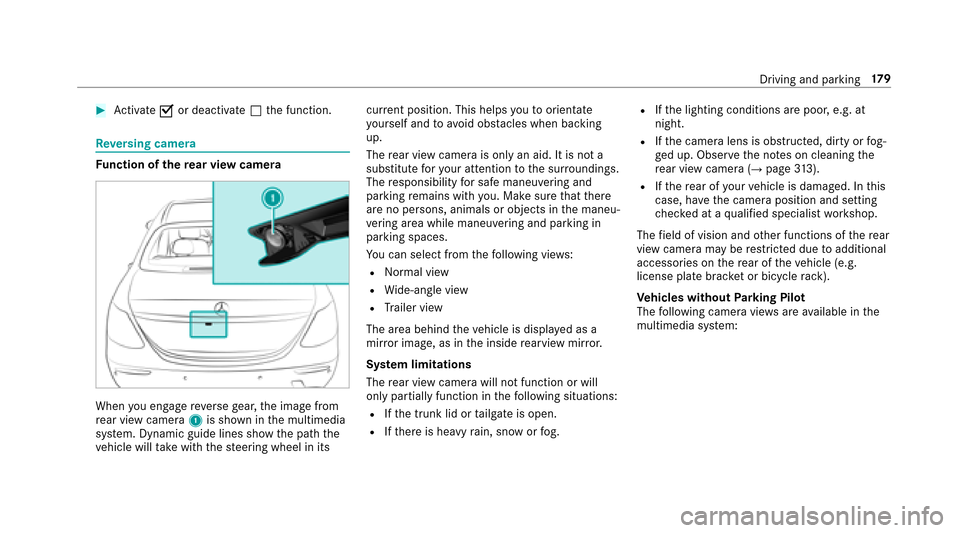
Fu nction of there ar view camera
When you enga gereve rsege ar, the image from
re ar view camera 1is shown in the multimedia
sy stem. Dynamic guide lines show the path the
ve hicle will take with thesteering wheel in its cur
rent position. This helps youto orientate
yo urself and toavo id obs tacles when back ing
up.
The rear view camera is only an aid. It is not a
substitute foryo ur attention tothe sur roundings.
The responsibility for safe maneu vering and
pa rking remains with you. Make sure that there
are no persons, animals or objects in the maneu‐
ve ring area while maneu vering and pa rking in
parking spaces.
Yo u can select from thefo llowing vie ws:
RNo rmal view
RWide-angle view
RTrailer view
The area behind theve hicle is displa yed as a
mir ror image, as in the inside rearview mir ror.
Sy stem limitations
The rear view camera will not function or will
only pa rtially function in thefo llowing situations:
RIf th e trunk lid or tailgate is open.
RIfth ere is heavy rain, snow or fog.
RIf th e lighting conditions are poor, e.g. at
night.
RIf th e camera lens is obstructed, dirty or fog‐
ge d up. Obser vethe no tes on cleaning the
re ar view camera (
→page 313).
RIfth ere ar of your vehicle is damaged. In this
c
ase, ha vethe camera position and setting
ch ecked at a qualified specialist workshop.
The field of vision and other functions of there ar
view camera may be restricted due toadditional
accessori es onthere ar of theve hicle (e.g.
license plate brac ket or bicycle rack ).
Ve hicles without Parking Pilot
The following camera vie wsare available in the
multimedia sy stem:
Driving and parking 17
9
Page 183 of 482
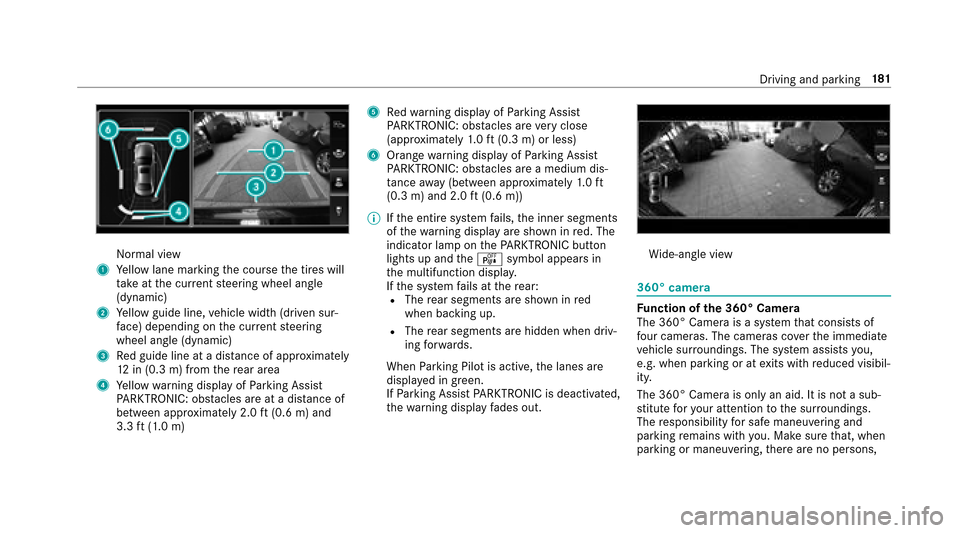
Normal view
1Yellow lane marking the course the tires will
ta ke atthe cur rent steering wheel angle
(dynamic)
2Ye llow guide line, vehicle width (driven sur‐
fa ce) depending on the cur rent steering
wheel angle (dynamic)
3Re d guide line at a dis tance of appr oximately
12 in (0.3 m) from there ar area
4Ye llow warning display of Parking Assist
PA RKTRONIC: obstacles ar eat adis tance of
between appr oximately 2.0 ft(0.6 m) and
3.3 ft(1.0 m)
5Re dwa rning display of Parking Assist
PA RKTRONIC: obstacles ar eve ry close
(appr oximately 1.0 ft (0.3 m) or less)
6Orange warning display of Parking Assist
PA RKTRONIC: obstacles ar e amedium dis‐
ta nce away (between appr oximately 1.0 ft
(0.3 m) and 2.0 ft(0.6 m))
% Ifth e entire sy stem fails, the inner segments
of thewa rning display are shown in red. The
indicator lamp on thePA RKTRONI Cbut ton
lights up and theé symbol appears in
th e multifunction displa y.
If th e sy stem fails at there ar:
RThe rear segments are shown in red
when backing up.
RThe rear segments are hidden when driv‐
ing forw ards.
When Parking Pilot is active, the lanes are
displa yed in green.
If Pa rking Assist PARKTRONI Cis deacti vated,
th ewa
rnin
g display fades out.
Wi de-angle view
360° camera
Fu nction of the 360° Camera
The 360° Camera is a sy stem that consists of
fo ur cameras. The cameras co verth e immediate
ve hicle sur roundings. The sy stem assists you,
e.g. when parking or at exits with reduced visibil‐
ity.
The 360° Camera is only an aid. It is not a sub‐
st itute foryo ur attention tothe sur roundings.
The responsibility for safe maneu vering and
pa rking remains with you. Make sure that, when
parking or maneuvering, there are no persons,
Driving and parking 18
1
Page 187 of 482
Parking Pilot is only an aid. It is not a substitute
fo ryo ur attention tothe sur roundings. The
re sponsibility for safe maneu vering and pa rking
re mains with you. Make sure that no persons,
animals or objects etc. are in the maneuvering
ra nge.
Pa rking Pilot is canceled if, among other things,
one of thefo llowing actions is car ried out:
RYo uswit choff Parking Assist PARKTRONIC.
RYouswit choff Parking Pilot.
RYo u begin steering.
RYo uappl yth e parking brake.
RVe hicles with automatic transmission:
Yo u enga gej.
RESP®inter venes.
Pa rking Pilot sy stem limitations
Objects located abo veor below the de tection
ra nge of Parking Pilot are not de tected when the
parking space is being measured. These are also
not taken into account when the parking maneu‐
ve r is calculated, e.g. overhanging loads, over‐
hangs or loading ramp s of truc ksorthe bounda‐
ri es of the parking space. In some circums tan‐ ces,
Parking Pilot may therefore guide you into
th e parking space prematurely.
&
WARNING Risk of accident due to
objects located abo veor below the
de tection range of Parking Pilot
If th ere are objects abo veor below the
de tection range, thefo llowing situations may
arise:
RPa rking Pilot may steer too early.
RVe hicles with automatic transmis‐
sion: Thevehicle may not stop in front of
th ese objects.
This could cause a collision.
#In these situations, do not use Parking
Pilot.
Sn owfa ll or heavy rain may lead toa parking
space being measured inaccuratel y.Pa rking
spaces that are partial lyoccupied bytrailer
dr aw bars might not be identified as such or be
measured incor rectly. Only use Parking Pilot on
le ve l, high-grip ground. Do not use
Parking Pilot, forex ample, in thefo l‐
lowing situations:
RIn extreme weather conditions such as ice or
pac ked snow or in heavy rain.
RIfyo u are transport ing a loadthat pr otru des
be yond theve hicle.
RIfth e parking space is on a steep downhill or
uphill gradient.
RIf yo u ha veins talled snow chains.
Pa rking Pilot may also display parking spaces
th at are not suitable for parking, e.g.:
RPa rking spaces where parking is prohibited.
RPa rking spaces on unsuitable sur faces.
Pa rking Pilot will not assist youwit h parking
spaces at right angles tothe direction of tr avel
in thefo llowing situations:
RIf two parking spaces are located immedi‐
ately next toeach other.
RIfth e parking space is directly next toa low
obs tacle such as a low curb.
Driving and parking 18
5