2017 MERCEDES-BENZ E43AMG ESP
[x] Cancel search: ESPPage 43 of 482
A person in the front passenger seat could
th en, forex ample, come into con tact wi th
th eve hicle interior, especially if the person is
sitting too close tothe cockpit.
If th e front passenger seat is occupied,
alw ays ensure that:
RThe classification of the person in the
front passenger seat is cor rect and the
front passenger airbag is enabled or disa‐
bled in accordance with the person in the
front passenger seat.
RThe front passenger seat has been mo ved
as far back as possible.
RThe person is seated cor rectl y.
#Ensure , bothbefore and during the jour‐
ne y,that thest atus of the front
passenger airbag is cor rect.
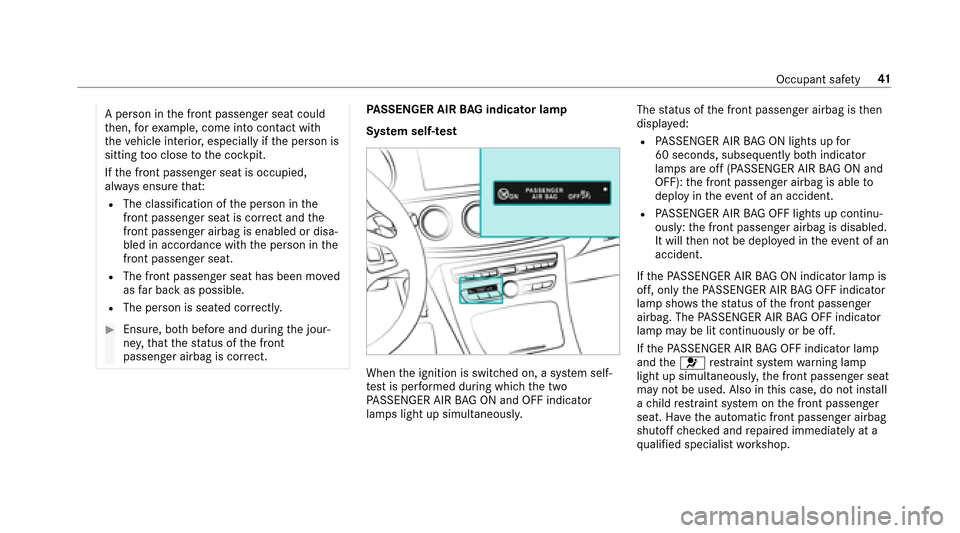
PA SSENGER AIR BAG indicator lamp
Sy stem self-te st
Whenthe ignition is switched on, a sy stem self-
te st is per form ed during which the two
PA SSENGER AIR BAG ON and OFF indicator
lamps light up simultaneousl y.The
status of the front passenger airbag is then
displa yed:
RPA SSENGER AIR BAG ON lights up for
60 seconds, subsequently bo thindicator
lamps are off (PASSENGER AIR BAG ON and
OFF): the front passenger airbag is able to
deploy in theeve nt of an accident.
RPASSENGER AIR BAG OFF lights up continu‐
ously: the front passenger airbag is disabled.
It will then not be deplo yed in theev ent of an
accident.
If th ePA SSENGER AIR BAG ON indicator lamp is
off, only thePA SSENGER AIR BAG OFF indicator
lamp sho wsthest atus of the front passenger
airbag. The PASSENGER AIR BAG OFF indicator
lamp may be lit continuously or be off.
If th ePA SSENGER AIR BAG OFF indicator lamp
and the6 restra int sy stem warning lamp
light up simultaneousl y,the front passenger seat
may not be used. Also in this case, do not ins tall
a ch ild restra int sy stem on the front passenger
seat. Ha vethe automatic front passenger airbag
shutoff checked and repaired immediately at a
qu alified specialist workshop.
Occupant saf ety 41
Page 45 of 482
adjustthe seat belt outlet and the front
passenger seat accordingly.
#Alw ays obser vethech ild restra int sys‐
te m manufacturer's ins tallation instruc‐
tions.
When ins talling a child restra int sy stem on the
front passenger seat, observ eth eve hicle-spe‐
cific information (
→page 39).
If a person is sitting in the front passenger
seat: PASSENGER AIR BAG OFF may be lit con‐
tinuously or be off, depending on the person's
st ature. Alw ays obser vethefo llowing informa‐
tion.
If th e front passenger seat is occupied by:
RAn adult or a pe rson with a build cor respond‐
ing tothat of an adult, thePA SSENGER AIR
BA G OFF indicator lamp must be off. This
indicates that the front passenger air bag is
enabled.
If th ePA SSENGER AIR BAG OFF indicator
lamp is lit continuousl y,an adult or person
with a build cor responding tothat of an adult should not use
the front passenger seat.
Ins tead, they should use a rear seat.
RA person with a smaller build (e.g. a teenager
or small adult), thePA SSENGER AIR BAG OFF
indicator lamp either lights up and remains lit
depending on there sult of the classification
or, alternativel y,goes out.
-PA SSENGER AIR BAG OFF is off: mo ve
th e front passenger seat as far back as
possible or a person of smaller stature
should use a rear seat.
-Ifth ePA SSENGER AIR BAG OFF indicator
lamp is lit continuously: a person of
smaller stature should not use the front
passenger seat.
& WARNING Risk of injury or death when
th ePA SSENGER AIR BAG OFF indicator
lamp is lit
If th ePA SSENGER AIR BAG OFF indicator
lamp remains lit af terth e sy stem self-test,
th e front passenger air bag is deactivated. It
will not be deplo yed in theeve nt of an acci‐
dent. In this case, the front passenger air bag
cannot perform its intended pr otective func‐
tion, e.g. when a person is seated in the front
passenger seat.
That person could, forex ample, come into
con tact wi th theve hicle interior, especially if
th e person is sitting too close tothe cockpit.
If th e front passenger seat is occupied,
alw ays ensure that:
RThe classification of the person in the
front passenger seat is cor rect and the
front passenger air bag is enabled or
deactivated in accordance with the per‐
son in the front passenger seat.
RThe person is seated properly with a cor‐
re ctly fastened seat belt.
RThe front passenger seat has been mo ved
as far back as possible.
Fu rther related subjects:RChild restra int sy stem on the front passenger
seat (→page 51).
Occupant saf ety 43
Page 56 of 482
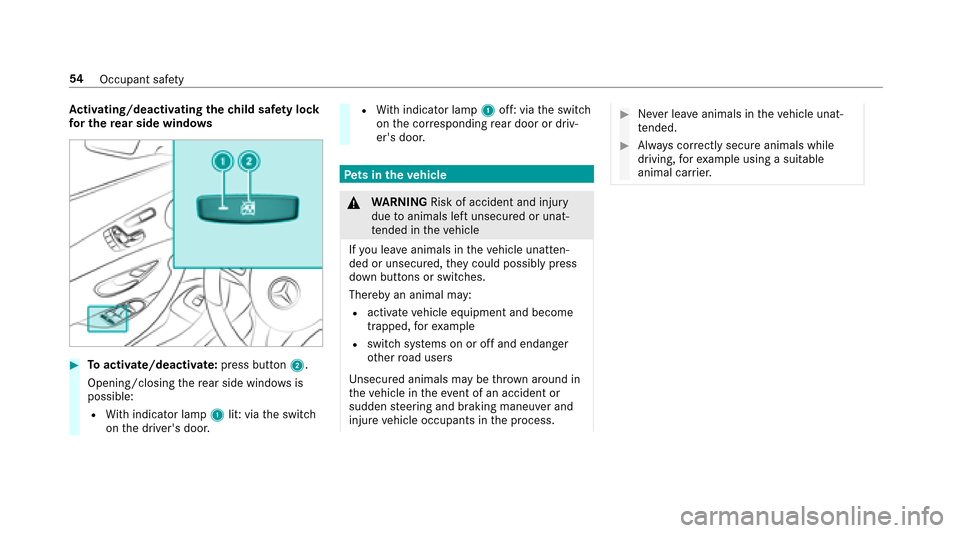
Activating/deactivating the child saf ety lock
fo r the rear side windo ws
#Toactivate/deacti vate:press button 2.
Opening/closing there ar side wind owsis
possible:
RWi th indicator lamp 1lit: via the switch
on the driver's door.
RWi th indicator lamp 1off: via the switch
on the cor responding rear door or driv‐
er's door.
Pe ts in the vehicle
&
WARNING Risk of accident and injury
due toanimals left unsecured or unat‐
te nded in theve hicle
If yo u lea veanimals in theve hicle unatten‐
ded or unsecured, they could possib lypress
down buttons or switches.
Thereby an animal may:
Ractivate vehicle equipment and become
trapped, forex ample
Rswitch systems on or off and endanger
ot her road users
Uns ecured animals may be throw n around in
th eve hicle in theeve nt of an accident or
sudden steering and braking maneuver and
injure vehicle occupants in the process.
#Ne ver lea veanimals in theve hicle unat‐
te nded.
#Alw ays cor rectly secure animals while
driving, forex ample using a suitable
animal car rier.
54
Occupant saf ety
Page 59 of 482
#Todeactivate: pressthe& button on the
SmartK eytwice in rapid succession.
The battery check lamp of the SmartK ey
fl ashes twice brief lyand lights up once.
#To activate: press any button on the Smart‐
Ke y.
% When theve hicle is star ted with the Smart‐
Ke yin thestow age compartment of the cen‐
te r console (
→page 131), the SmartK ey
functions are au tomatically activated.
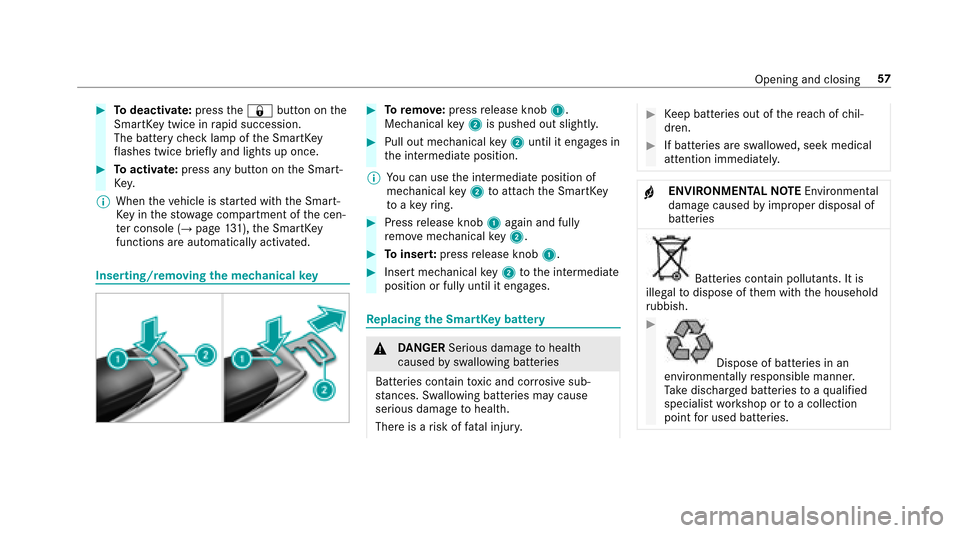
Inserting/re moving the mechanical key
#To remo ve:press release knob 1.
Mechanical key2 is pushed out slight ly.
#Pull ou tme chanical key2 until it en gage s in
th e intermediate position.
% You can use the intermediate position of
mechanical key2 toattach the SmartK ey
to ake yring.
#Press release knob 1again and fully
re mo vemechanical key2.
#To inser t:press release knob 1.
#Insert mechanical key2 tothe intermediate
position or fully until it engages.
Re placing the SmartK eybattery
&
DANG ER Serious damage tohealth
caused byswallowing batteries
Batteries contain toxic and cor rosive sub‐
st ances. Swallowing batte ries may cause
serious damage tohealth.
There is a risk of fata l injur y.
#Keep batteries out of there ach of chil‐
dren.
#If batteries are swallo wed, seek medical
attention immediately.
+ENVIRONMEN TALNO TEEnvironmental
damage causedbyimproper disposal of
batteries
Bat teries conta in pollutants. It is
illegal todispose of them with the household
ru bbish.
#
Dispose of batteries in an
environmen tally responsible manner.
Ta ke dischar ged batteries toaqu alified
specialist workshop or toa collection
point for used batteries.
Opening and closing 57
Page 65 of 482
Unlocking/locking the driver's door using
th e emer gency key
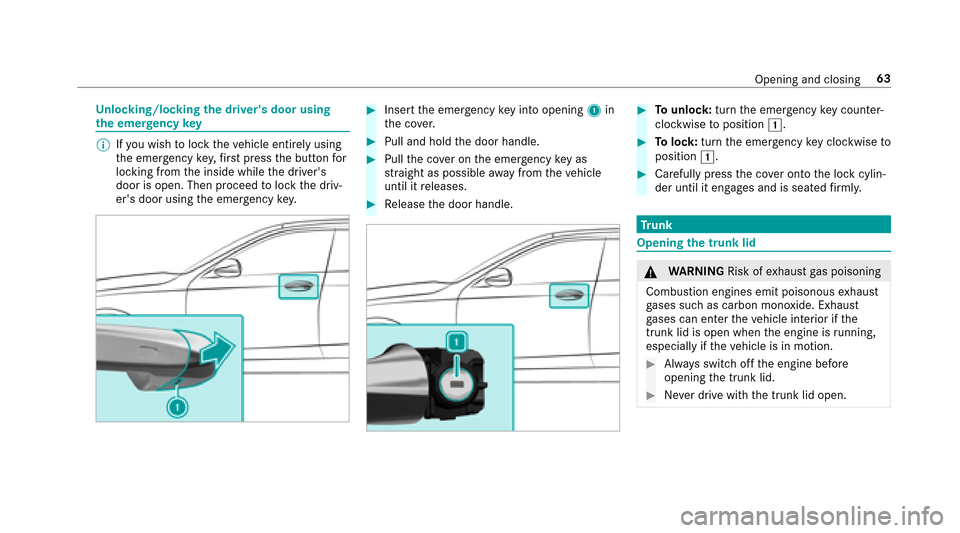
%
Ifyo uwish tolock theve hicle entirely using
th e emer gency key,firs t press the button for
locking from the inside while the driver's
door is open. Then proceed tolock the driv‐
er's door using the emer gency key.
#Insert the emer gency keyin to opening 1in
th e co ver.
#Pull and hold the door handle.
#Pull the co ver on the emer gency keyas
st ra ight as possible away from theve hicle
until it releases.
#Re lease the door handle.
#To unlock :turn the emer gency keycounter -
clo ckwise toposition 1.
#Tolock: turnthe emer gency keyclo ckwise to
position 1.
#Carefully press the co ver onto the lock cylin‐
der until it engages and is seated firm ly.
Tr unk
Opening the trunk lid
&
WARNING Risk ofexhaust gas poisoning
Combustion engines emit poisonous exhaust
ga ses such as carbon monoxide. Exhaust
ga ses can enter theve hicle interior if the
trunk lid is open when the engine is running,
especially if theve hicle is in motion.
#Alw ays switch off the engine before
opening the trunk lid.
#Ne ver drive with the trunk lid open.
Opening and closing 63
Page 68 of 482
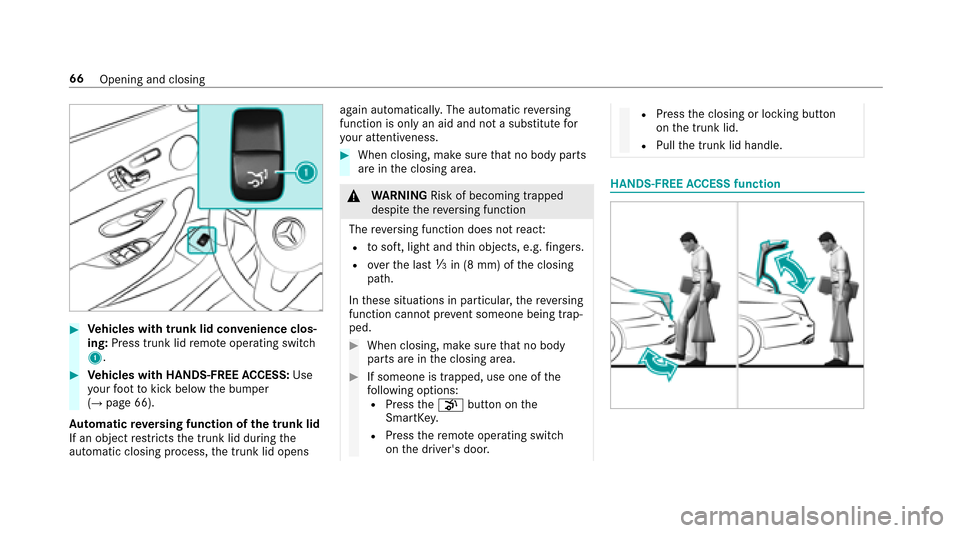
#Vehicles with trunk lid co nvenience clos‐
ing: Press trunk lid remo teoperating switch
1.
#Ve hicles with HANDS-FREE ACCESS: Use
yo ur foot to kick below the bumper
(
→page 66).
Au tomatic reve rsing function of the trunk lid
If an object restricts the trunk lid during the
automatic closing process, the trunk lid opens again automaticall
y.The automatic reve rsing
function is only an aid and not a substitute for
yo ur attentiveness.
#When closing, make sure that no body parts
are in the closing area.
&
WARNING Risk of becoming trapped
despite there ve rsing function
The reve rsing function does not react:
Rto soft, light and thin objects, e.g. fingers.
Rove rth e last Óin (8 mm) of the closing
path.
In these situations in particular, there ve rsing
function cannot pr event someone being trap‐
ped.
#When closing, make surethat no body
parts are in the closing area.
#If someone is trapped, use one of the
fo llowing options:
RPress thep button on the
SmartK ey.
RPress there mo teoperating switch
on the driver's door.
RPress the closing or locking button
on the trunk lid.
RPull the trunk lid handle.
HANDS-FREE ACCESS function
66
Opening and closing
Page 73 of 482
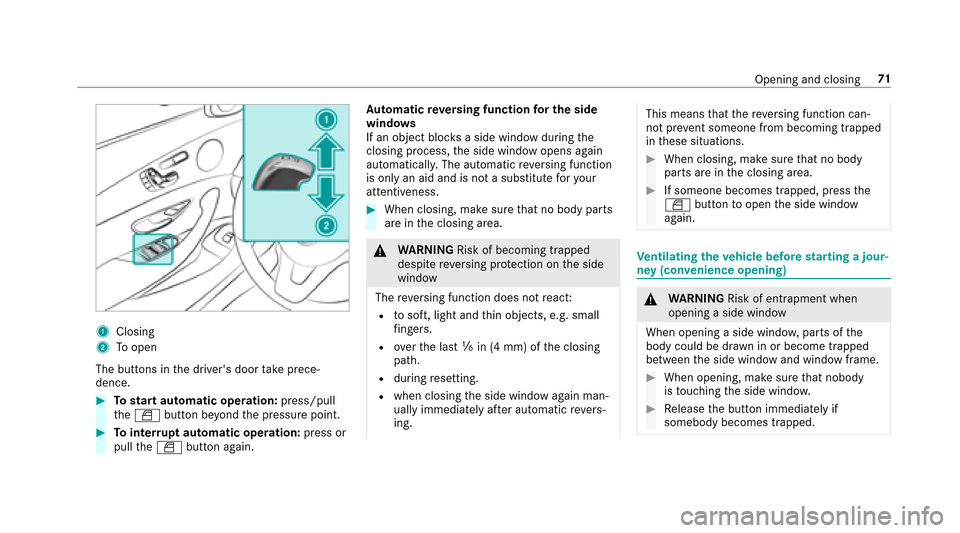
1Closing
2Toopen
The buttons in the driver's door take prece‐
dence.
#To start automatic operation: press/pull
th eW button be yond the pressure point.
#To inter rupt automatic operation: press or
pull theW button again. Au
tomatic reve rsing function for the side
windo ws
If an object bloc ksa side wind owduring the
closing process, the side window opens again
automaticall y.The automatic reve rsing function
is only an aid and is not a substitute foryo ur
attentiveness.
#When closing, make sure that no body parts
are in the closing area.
&
WARNING Risk of becoming trapped
despite reve rsing pr otection on the side
window
The reve rsing function does not react:
Rto soft, light and thin objects, e.g. small
fi ngers.
Rove rth e last ãin (4 mm) of the closing
path.
Rduring resetting.
Rwhen closing the side window again man‐
ually immediately af ter au tomatic reve rs‐
ing.
This means that there ve rsing function can‐
not pr event someone from becoming trapped
in these situations.
#When closing, make sure that no body
parts are in the closing area.
#If someone becomes trapped, press the
W button toopen the side window
again.
Ve ntilating theve hicle before starting a jour‐
ney (con venience opening)
&
WARNING Risk of entrapment when
opening a side window
When opening a side windo w,parts of the
body could be dr awn in or become trapped
between the side window and window frame.
#When opening, make sure that nobody
is touching the side windo w.
#Release the button immediately if
somebody becomes trapped.
Opening and closing 71
Page 75 of 482
ProblemPossible causes/consequences and MSolutions
& WARNING Risk of entrapment if reve rsing pr otection is not activated
If yo u close a side windowagain immediately af ter it has been bloc ked or reset, the side window closes
with increased or maximum forc e. The reve rsing function is then not active.
Pa rts of the body could be trapped in the closing area in the process.
#Make sure that no parts of the body are in the closing area.
#To stop the closing process, release the button or press the button again toreopen the side win‐
do w.
If a side window is obstructed during closing and reopens again slightly:
#Immediately af terth e window bloc ks, pull the cor responding button again until the side window has
closed, and hold the button for an additional second.
The side window is closed with increased forc e.
If a side window is obstructed again during closing and reopens again slightly:
#Re peat the pr evious step.
The side window is closed without the automatic reve rsing function.
Opening and closing 73