2017 FIAT 500L LIVING engine
[x] Cancel search: enginePage 69 of 240
54)The ESC system cannot alter the
natural laws of physics, and cannot
increase grip which depends on the
condition of the road.
55)The ESC system cannot prevent
accidents, including those due to excessive
speed on corners, driving on low-grip
surfaces or aquaplaning.
56)The capability of the ESC system must
never be tested irresponsibly and
dangerously, in such a way as to
compromise the safety of the driver, the
other occupants of the car or any other
road user.
57)For the correct operation of the ESC
and ASR systems it is extremely important
that the tyres are the same brand and
the same type on all the wheels, in perfect
condition and, above all, the
recommended type and size.
58)The performance of the ESC and ASR
systems must not encourage the driver
to take unnecessary risks. Your driving style
must always be suited to the road
conditions, visibility and traffic. The driver
is, in any case, responsible for safe driving.
59)The ESC functions even when the
space-saver wheel is being used. Always
remember that the space-saver wheel,
being smaller than the original wheel,
provides less grip.
60)The Hill Holder system is not a parking
brake; therefore, never leave the car
without having engaged the handbrake,
turned the engine off and engaged first
gear, so that the vehicle is parked in safe
conditions (for further information read the
"Parking" paragraph in the "Starting and
driving" chapter).61)There may be situations on small
gradients (less than 5%), with car laden, in
which the Hill Holder system may not
activate, causing a slight reversing motion
and increasing the risk of collision with
another vehicle or object. The driver is, in
any case, responsible for safe driving.
62)DST is an aid for driving and does not
relieve the driver of responsibility while
driving the vehicle.
63)The performance of a vehicle with ERM
must never be tested in imprudent or
dangerous ways, with the possibility of
putting the safety of the driver or other
people at risk.DRIVING
ASSISTANCE
SYSTEMS
The vehicle can be equipped with the
following active safety devices:
❒Traction Plus;
❒City Brake Control - "Collision
Mitigation";
❒iTPMS.
For the operation of the systems, see
the following pages.
TRACTION PLUS SYSTEM(for versions/markets, where provided)
The system works as a driving aid,
useful for setting off in poor grip
conditions (snow, ice, mud, etc.), which
allows the drive force to be distributed
optimally on the front axle.
The system acts by braking the wheels
with poor grip (or those slipping more
than the others), transferring the drive
force to those which have greater
grip on the ground.
The activation of the Traction Plus
system generates the differential locking
effect on the front axle through the
braking system, to optimise traction on
irregular terrain.
When the engine is started the system
is deactivated.
67
Page 70 of 240
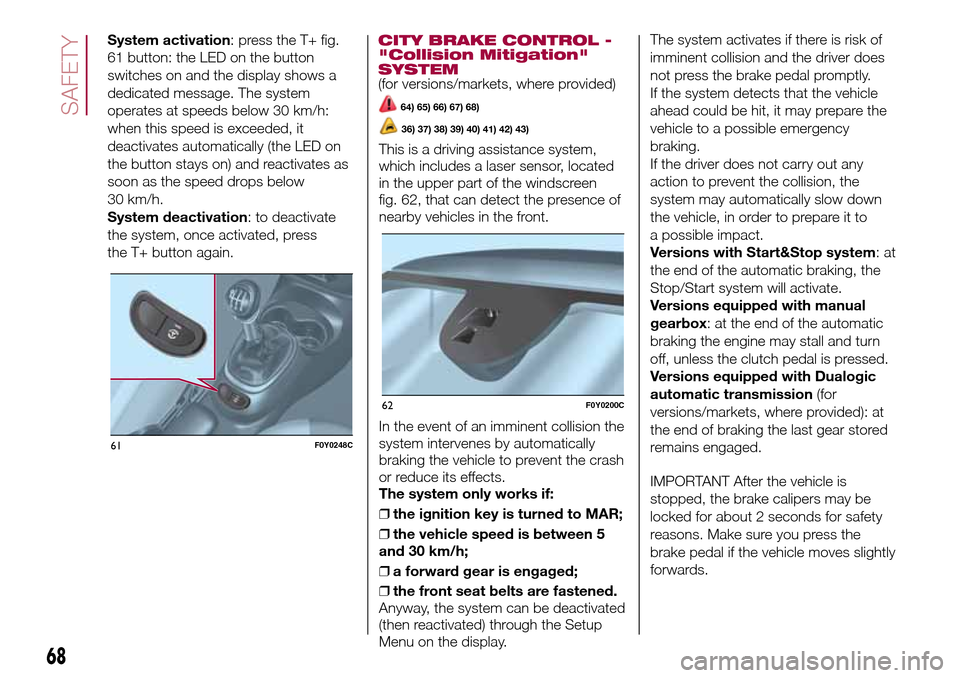
System activation: press the T+ fig.
61 button: the LED on the button
switches on and the display shows a
dedicated message. The system
operates at speeds below 30 km/h:
when this speed is exceeded, it
deactivates automatically (the LED on
the button stays on) and reactivates as
soon as the speed drops below
30 km/h.
System deactivation: to deactivate
the system, once activated, press
the T+ button again.CITY BRAKE CONTROL -
"Collision Mitigation"
SYSTEM
(for versions/markets, where provided)
64) 65) 66) 67) 68)
36) 37) 38) 39) 40) 41) 42) 43)
This is a driving assistance system,
which includes a laser sensor, located
in the upper part of the windscreen
fig. 62, that can detect the presence of
nearby vehicles in the front.
In the event of an imminent collision the
system intervenes by automatically
braking the vehicle to prevent the crash
or reduce its effects.
The system only works if:
❒the ignition key is turned to MAR;
❒the vehicle speed is between 5
and 30 km/h;
❒a forward gear is engaged;
❒the front seat belts are fastened.
Anyway, the system can be deactivated
(then reactivated) through the Setup
Menu on the display.The system activates if there is risk of
imminent collision and the driver does
not press the brake pedal promptly.
If the system detects that the vehicle
ahead could be hit, it may prepare the
vehicle to a possible emergency
braking.
If the driver does not carry out any
action to prevent the collision, the
system may automatically slow down
the vehicle, in order to prepare it to
a possible impact.
Versions with Start&Stop system:at
the end of the automatic braking, the
Stop/Start system will activate.
Versions equipped with manual
gearbox: at the end of the automatic
braking the engine may stall and turn
off, unless the clutch pedal is pressed.
Versions equipped with Dualogic
automatic transmission(for
versions/markets, where provided): at
the end of braking the last gear stored
remains engaged.
IMPORTANT After the vehicle is
stopped, the brake calipers may be
locked for about 2 seconds for safety
reasons. Make sure you press the
brake pedal if the vehicle moves slightly
forwards.
61F0Y0248C
62F0Y0200C
68
SAFETY
Page 71 of 240

Driving in special conditions
In certain driving conditions, such as,
for example: driving around a bend (see
fig. 63) / small vehicles and/or vehicles
not aligned with the driving lane (see fig.
64) / lane change by other vehicles
(see fig. 65) the system operation might
be unexpected or delayed. Pay the
utmost attention, keeping control of the
vehicle to drive in complete safety.
iTPMS (indirect Tyre
Pressure Monitoring
System)
(for versions/markets, where provided)
44) 45) 46) 47) 48) 49)
The iTPMS can monitor the tyre inflation
status through the wheel speed
sensors. The system warns the driver if
one or more tyres are flat by switching
on the warning light
on the
instrument panel and a warning
message on the display, along with an
acoustic signal.
If one tyre only is flat, the system can
indicate its position: it is in any case
recommended to check the pressure
on all four tyres.
This indication is displayed also when
turning the engine off and on again until
the "Reset" procedure is carried out.
"Reset" procedure
The iTPMS needs an initial "self-
learning" phase (with length dependingon the driving style and road conditions:
optimal conditions being driven on a
straight road at 80 km/h for at least 20
minutes) which starts when the "Reset"
procedure is carried out.
The "Reset" procedure must be carried
out:
❒each time tyre pressure is modified;
❒when even only one tyre is changed;
❒when tyres are rotated/inverted;
❒when the space-saver wheel is fitted.
Before carrying out the "Reset"
procedure, inflate the tyres to the rated
pressure values specified in the inflation
pressure table (see the "Wheels"
paragraph in the "Technical
specifications" chapter).
If the "Reset" procedure is not carried
out, in all above cases, the
warning
light may give false indications on
one or more tyres.
To carry out the "Reset" procedure,
with the vehicle stopped and the
ignition device at MAR, use the Setup
Menu as follows:
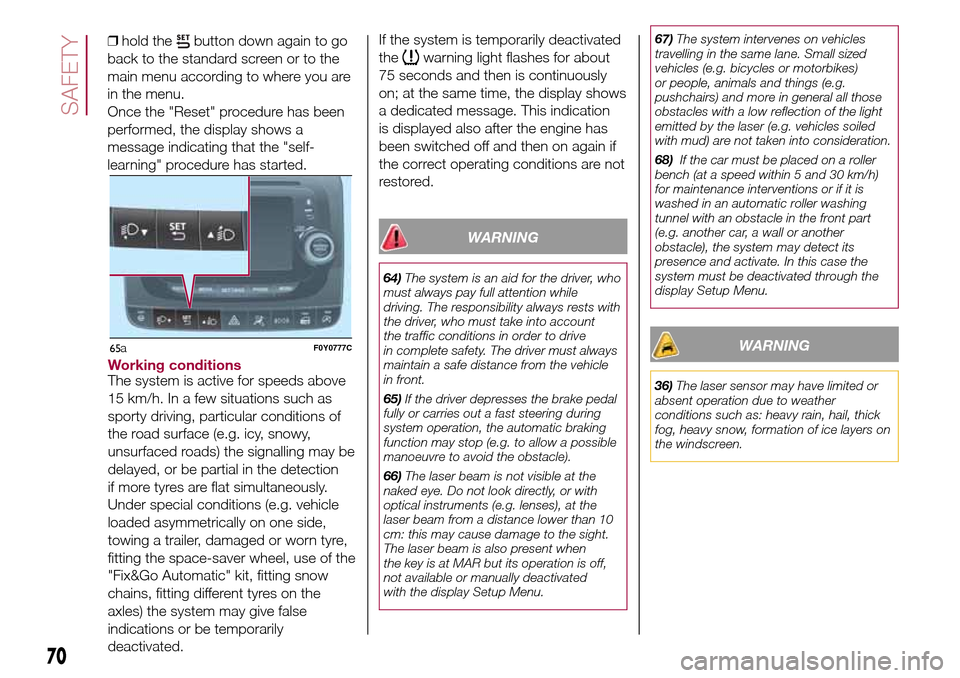
❒briefly press the
button fig. 65a:
the display will show "Reset";
❒press the
button or the
button to select ("Yes" or "No");
63F0Y0320C
64F0Y0321C
65F0Y0322C
69
❒briefly press thebutton: the
display will show "Confirm";
❒press the
button or the
button to select ("Yes" to "Reset"
or "No" to exit the screen);
Page 72 of 240
❒hold thebutton down again to go
back to the standard screen or to the
main menu according to where you are
in the menu.
Once the "Reset" procedure has been
performed, the display shows a
message indicating that the "self-
learning" procedure has started.
Working conditionsThe system is active for speeds above
15 km/h. In a few situations such as
sporty driving, particular conditions of
the road surface (e.g. icy, snowy,
unsurfaced roads) the signalling may be
delayed, or be partial in the detection
if more tyres are flat simultaneously.
Under special conditions (e.g. vehicle
loaded asymmetrically on one side,
towing a trailer, damaged or worn tyre,
fitting the space-saver wheel, use of the
"Fix&Go Automatic" kit, fitting snow
chains, fitting different tyres on the
axles) the system may give false
indications or be temporarily
deactivated.If the system is temporarily deactivated
the
warning light flashes for about
75 seconds and then is continuously
on; at the same time, the display shows
a dedicated message. This indication
is displayed also after the engine has
been switched off and then on again if
the correct operating conditions are not
restored.
WARNING
64)The system is an aid for the driver, who
must always pay full attention while
driving. The responsibility always rests with
the driver, who must take into account
the traffic conditions in order to drive
in complete safety. The driver must always
maintain a safe distance from the vehicle
in front.
65)If the driver depresses the brake pedal
fully or carries out a fast steering during
system operation, the automatic braking
function may stop (e.g. to allow a possible
manoeuvre to avoid the obstacle).
66)The laser beam is not visible at the
naked eye. Do not look directly, or with
optical instruments (e.g. lenses), at the
laser beam from a distance lower than 10
cm: this may cause damage to the sight.
The laser beam is also present when
the key is at MAR but its operation is off,
not available or manually deactivated
with the display Setup Menu.67)The system intervenes on vehicles
travelling in the same lane. Small sized
vehicles (e.g. bicycles or motorbikes)
or people, animals and things (e.g.
pushchairs) and more in general all those
obstacles with a low reflection of the light
emitted by the laser (e.g. vehicles soiled
with mud) are not taken into consideration.
68)If the car must be placed on a roller
bench (at a speed within 5 and 30 km/h)
for maintenance interventions or if it is
washed in an automatic roller washing
tunnel with an obstacle in the front part
(e.g. another car, a wall or another
obstacle), the system may detect its
presence and activate. In this case the
system must be deactivated through the
display Setup Menu.
WARNING
36)The laser sensor may have limited or
absent operation due to weather
conditions such as: heavy rain, hail, thick
fog, heavy snow, formation of ice layers on
the windscreen.
70
SAFETY
65F0Y0777Ca
Page 75 of 240

WARNING
69)Never press button C fig. 66 when
travelling.
70)Remember that in the event of a violent
impact the rear seat passengers not
wearing seat belts are exposed to a very
serious risk and also represent a serious
danger for the front seat occupants.
SBR (Seat Belt
Reminder) SYSTEM
This system consists of a device which,
in conjunction with the
warning
light coming on in the instrument panel
fig. 70 (initially in fixed mode with
continuous acoustic signal and then in
flashing mode with intermittent acoustic
signal), warns the driver and front
passenger that their seat belts have not
been fastened.
To deactivate the acoustic warning
permanently go to a Fiat Dealership.
The acoustic warning can be
reactivated at any time through the
display Setup Menu.
DRIVER
If the driver is the only occupant and
the seat belt is not fastened, when 20
km/h is exceeded or when travelling
at a speed from 10 to 20 km/h for
longer than 5 seconds, an acoustic
signal sequence will be started (front
seats) consisting of a tone for 6
seconds followed by a 90 second
beep. The
warning light will flash.
The warning light will stay on constantly
at the end of the cycle until the engine
is stopped. The acoustic signal will
be interrupted immediately when the
driver's seat belt is fastened and the
warning light will switch off.
The reminder cycle (acoustic and visual)
will be repeated as described above if
the seat belt is unfastened while
travelling.
PASSENGER
A similar solution applies for the
passenger, but the indication is
interrupted when the passenger leaves
the car as well.
If both the front seat belts are
unfastened with car in motion and
within a few seconds one from
the other, the acoustic signal and
activation of the warning light will refer
to the most recent event.70F0Y0116C
73
Page 93 of 240
88)SEVERE DANGER: when an active
passenger airbag is fitted, DO NOT install
rearward facing child restraint systems
on the front passenger seat. Deployment of
the airbag in an accident could cause fatal
injuries to the child regardless of the
severity of the impact. Therefore, always
deactivate the passenger side airbag when
a rearward facing child restraint system is
installed on the front passenger seat.
The front passenger seat must also be
positioned back as far as possible in order
to prevent the child restraint system from
coming into contact with the dashboard.
Immediately reactivate the passenger
airbag as soon as the child restraint system
has been removed.
89)When an active passenger airbag is
fitted, DO NOT install rear facing child
restraint systems on the front seat.
Deployment of the airbag in an accident
could cause fatal injuries to the child
regardless of the severity of the impact.
90)If the
warning light does not switch
on when the key is turned to MAR, or
stays on whilst driving, a fault may have
occurred in the restraint systems. In this
case the airbags or pretensioners may not
deploy in an impact or, in a lower number
of cases, they may be deployed
accidentally. Before proceeding, contact a
Fiat Dealership immediately to have the
system checked.
91)On some versions if the
warning
light does not switch on, thewarning
light switches on instead, deactivating
the explosive charges of the passenger
airbag.
92)If a side bag is present, do not cover
the front seat backrests with extra covers.93)Do not travel carrying objects in your
lap, in front of your chest or between your
lips (pipe, pencils, etc.). They could cause
severe injury if the airbag is deployed.
94)If the vehicle has been subject to theft,
attempted theft, vandalism, or flooding,
have the airbag system inspected at a Fiat
Dealership.
95)When the ignition key is inserted and
turned to MAR, airbags may be deployed if
another vehicle crashes into yours, even if
the engine is not running and the vehicle
is stationary. Therefore, even if the vehicle
is stationary, when an active front
passenger airbag is fitted, DO NOT install
rearward facing child restraint systems
on the front passenger seat. Deployment of
the airbag following an impact could cause
fatal injuries to the child. Therefore, always
deactivate the passenger side airbag
when a rearward facing child restraint
system is installed on the front passenger
seat. The front passenger seat must also
be positioned back as far as possible in
order to prevent the child restraint system
from coming into contact with the
dashboard. Immediately reactivate the
passenger airbag as soon as the child
restraint system has been removed. Also
remember that, if the key is turned to
STOP, none of the safety devices (airbags
or pretensioners) will be deployed in the
event of collision. Non-deployment in such
cases does not indicate a system
malfunction.96)The
LED indicates the passenger
side airbag protection status. If the LED is
off, passenger side protection is active:
to deactivate it, use the Setup Menu (in this
case the LED lights up). When the engine
is started (ignition key turned to MAR
position), the LED turns on for about 8
seconds, provided that at least 5 seconds
have elapsed from when it was switched
off. If not, contact a Fiat Dealership. If
the engine is switched off/on again in less
than 5 seconds the LED may remain off.
In this case, to check correct LED
operation, switch the engine off, wait for at
least 5 seconds and switch the engine
on again. The LED may light up with
various intensity levels depending on the
vehicle conditions. The intensity may also
vary during the same key cycle.
97)The airbag deployment threshold is
higher than that of the pretensioners. When
the impact is between the two deployment
thresholds, it is normal that pretensioners
only are engaged.
98)The airbag does not replace seat belts,
but increases their efficiency. Because
front airbags are not deployed for
low-speed crashes, side collisions,
rear-end shunts or rollovers, occupants are
protected, in addition to any side bags,
only by their seat belts, which must
therefore always be fastened.
91
Page 94 of 240
STARTING AND DRIVING
Let’s get to the core of the vehicle:
seeing how you can exploit all of its
potential to the full.
We’ll look at how to drive it safely in any
situation, so that it can be a welcome
companion, with our comfort and
our wallets in mind.STARTING THE ENGINE ................. 93
HANDBRAKE .................................. 94
USING THE MANUAL GEARBOX .... 95
USING THE DUALOGIC
GEARBOX....................................... 96
STOP/START SYSTEM ................... 98
CRUISE CONTROL (CONSTANT
SPEED REGULATOR) ..................... 99
SPEED LIMITER ..............................100
PARKING SENSORS.......................101
REAR VIEW CAMERA .....................103
TOWING TRAILERS ........................104
REFUELLING THE VEHICLE ...........105
92
STARTING AND DRIVING
Page 95 of 240
STARTING THE
ENGINE
99) 100)51) 52) 53) 54) 55)
Before starting the engine, adjust the
seat, the interior rear view mirrors,
the door mirrors and fasten the seat
belt correctly.
Never press the accelerator pedal for
starting the engine.
VERSIONS WITH MANUAL
GEARBOX
Petrol versions
Proceed as follows:
❒engage the handbrake and place the
gear lever in neutral.For 0.9 TwinAir
Turbo 105 HP versionsengage the
handbrake and place the gear lever
in neutral or fully press the clutch pedal
if a gear other than neutral is engaged;
❒for all versions (except 0.9
TwinAir Turbo 105 HP)fully depress
the clutch pedal, without pressing
the accelerator;
❒turn the ignition key to AVV and
release it as soon as the engine starts.
Diesel versions
Proceed as follows:
❒engage the handbrake, put the gear
lever into neutral and turn the ignition
key to MAR: the warning lights
andon the instrument panel
will turn on;
❒wait for the warning lights
and
to turn off and then fully depress
the clutch pedal without pressing the
accelerator;
❒turn the ignition key to AVV as soon
as warning light
switches off.
Release the ignition key as soon as the
engine starts.
IMPORTANT If the engine does not
start at the first attempt, return the
ignition key to STOP before repeating
the procedure. If, with the ignition
key at MAR, the warning lights
and
(only for petrol versions) stay on
in the instrument panel, the ignition key
must be brought back to STOP and
then to MAR again. If the
warning
light stays on, retry with the other
keys provided. Contact a Fiat
Dealership if you still cannot start the
engine.
VERSIONS WITH
DUALOGIC GEARBOX
101)Engine starting is allowed both with a
gear engaged and with the gearbox
in neutral (N).
However, the brake pedal must always
be pressed first if neutral is not
engaged. It is therefore advisable to
place the gear lever in neutral (N) before
starting the engine.
LPG AND NATURAL
POWER VERSIONS
The engine always starts up on petrol
independently of the mode previously
selected.
There must therefore always be an
adequate reserve of petrol in the tank to
protect the petrol pump and to
guarantee temporary switching from
methane or LPG to petrol operation, if
high performance is required.
STOPPING THE ENGINE
Turn the ignition key to STOP while the
engine is idling.
IMPORTANT After a demanding drive,
before turning the engine off you should
allow it to idle to allow the temperature
in the engine compartment to
decrease.
93