2017 FIAT 500L LIVING engine
[x] Cancel search: enginePage 50 of 240

Warning light What it means
ENGINE COOLANT TEMPERATURE TOO HIGH
The warning light switches on (on some versions together with a message and a symbol on the display)
when the engine is overheated. The display shows the dedicated message.
When driving normally: stop the vehicle, switch off the engine and check that the water level in the
reservoir is not below the MIN mark. If it is, wait for the engine to cool down, then slowly and carefully open
the cap, top up with coolant and check that the level is between the MIN and MAX marks on the reservoir.
Also check visually for any fluid leaks. If, when restarting, the warning light switches on (or the symbol is
displayed) again, contact a Fiat Dealership.
If the vehicle is used under demanding conditions(e.g. in high-performance driving): slow down and,
if the warning light stays on, stop the vehicle. Stop for 2 or 3 minutes with the engine running and slightly
accelerated to promote a better coolant circulation. Then stop the engine. Check that the coolant level is
correct as described above.
IMPORTANT Over demanding routes, it is advisable to keep the engine on and slightly accelerated for a
few minutes before switching it off.
48
KNOWING THE INSTRUMENT PANEL
Page 51 of 240

Warning light What it means
CONTINUOUSLY ON: LOW ENGINE OIL PRESSURE
The warning light turns on constantly, on some versions along with a message and a symbol on the
display, when the system detects that engine oil pressure is insufficient.
28)
FLASHING: EXHAUSTED ENGINE OIL (only Diesel versions with DPF)
The warning light switches on and flashes, on some versions with the displaying of a message. Depending
on the versions, the warning light will continue to flash in cycles for 1 minute every two hours or for 3
minute cycles with the warning light off for 5 seconds until the oil is changed.
After the first indication, at each engine start up the warning light will continue flashing as described above
until the oil is changed. On some versions, the display shows a dedicated message.
If the warning light flashes, this does not mean that there is a fault, but simply informs that it is now
necessary to change the oil as a result of regular use of the vehicle.
Engine oil degradation is accelerated by a predominant town use of the vehicle, which makes DPF
regeneration process more frequent, and also by use of the vehicle for short trips, preventing the engine to
reach the operating temperature, repeated interruptions of the regeneration process reported by the
switching on of the
warning light.29)
WARNING
28)If the warning light comes on when the vehicle is travelling, stop the engine immediately and contact a Fiat Dealership.
29)If the warning light switches on, the degraded engine oil must be changed as soon as possible, and never more than 500 km from the
first time that the warning light has switched on. Failure to observe the above indications may result in severe damage to the engine and
invalidate the warranty. The activation of this warning light is not related to the amount of oil in the engine. Therefore, never top up with oil
when the warning light starts flashing.
49
Page 52 of 240

Warning light What it means
“DUALDRIVE” ELECTRIC POWER STEERING FAILURE
During the engine start: when the key is turned to MAR, the warning light switches on, but it should
switch off after a few seconds. If the warning light stays on, turn the ignition key to STOP and start the
engine again. If the warning light stays on (on some versions, together with a message and a symbol on
the display), the effort to operate the steering wheel could be increased; steering is, however, possible. In
this case, contact a Fiat Dealership as soon as possible.
While driving: if the warning light switches on whilst driving (on some versions, together with a message
and a symbol on the display) you may not have steering assistance from the system. Although it will still be
possible to steer the vehicle, the effort needed to operate the steering wheel could be increased: contact a
Fiat Dealership as soon as possible.
IMPORTANT In some circumstances, factors independent of the electric power steering could cause the
warning light on the instrument panel to switch on. In this case, stop the vehicle immediately (should it be
in motion), stop the engine for about 20 seconds and then restart the engine. If the warning light (or, on
some versions, a message and a symbol on the display) remains on constantly, contact a Fiat Dealership.
IMPORTANT After the battery is disconnected, the steering must be initialised. The warning light switches
on to indicate this. To carry out this procedure turn the steering wheel all the way from one end to the other
or drive in a straight line for about a hundred metres.
50
KNOWING THE INSTRUMENT PANEL
Page 56 of 240
Warning light What it means
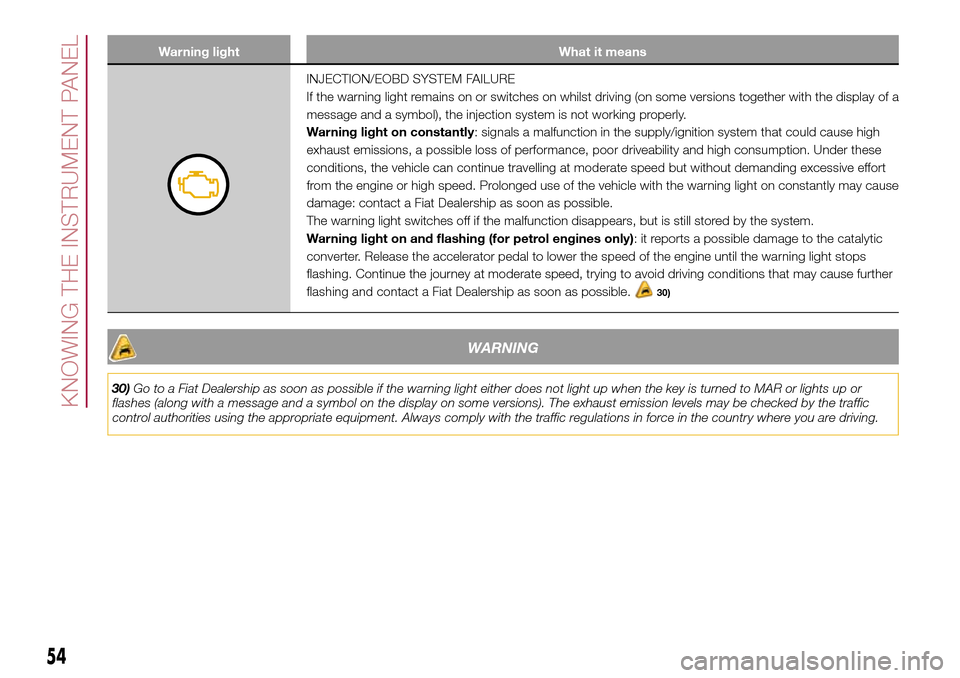
INJECTION/EOBD SYSTEM FAILURE
If the warning light remains on or switches on whilst driving (on some versions together with the display of a
message and a symbol), the injection system is not working properly.
Warning light on constantly: signals a malfunction in the supply/ignition system that could cause high
exhaust emissions, a possible loss of performance, poor driveability and high consumption. Under these
conditions, the vehicle can continue travelling at moderate speed but without demanding excessive effort
from the engine or high speed. Prolonged use of the vehicle with the warning light on constantly may cause
damage: contact a Fiat Dealership as soon as possible.
The warning light switches off if the malfunction disappears, but is still stored by the system.
Warning light on and flashing (for petrol engines only): it reports a possible damage to the catalytic
converter. Release the accelerator pedal to lower the speed of the engine until the warning light stops
flashing. Continue the journey at moderate speed, trying to avoid driving conditions that may cause further
flashing and contact a Fiat Dealership as soon as possible.
30)
WARNING
30)Go to a Fiat Dealership as soon as possible if the warning light either does not light up when the key is turned to MAR or lights up or
flashes (along with a message and a symbol on the display on some versions). The exhaust emission levels may be checked by the traffic
control authorities using the appropriate equipment. Always comply with the traffic regulations in force in the country where you are driving.
54
KNOWING THE INSTRUMENT PANEL
Page 58 of 240

Warning light What it means
DPF (PARTICULATE FILTER) CLEANING IN PROGRESS (Diesel versions with DPF only)
The warning light (on some versions, together with a message and a symbol on the display) switches on
constantly to notify the driver that the DPF system needs to eliminate captured pollutants (particulate)
through the regeneration process.
The warning light does not come on during every DPF regeneration, but only when driving conditions
require that the driver is notified.
To switch the warning light off, the car must be kept moving until the regeneration process is completed.
As an average, the process lasts fifteen minutes. The best conditions to complete the regeneration process
are reached driving the car at about 60 km/h with engine speed over 2000 rpm.
When this warning light switches on, it does not indicate a car failure and thus it should not be taken to a
workshop. On some versions, together with the warning light switching on, the display shows a dedicated
message.
31)
WARNING
31)Vehicle travel speed should always be adapted to the traffic and weather conditions, and must always comply with traffic regulations. The
engine can be stopped even if the warning light is on: however, repeated interruptions of the regeneration process could cause premature
degradation of the engine oil. For this reason, it is always advisable to wait for the warning light to go off before turning the engine off,
following the instructions appearing above. It is not advisable to complete DPF regeneration with the vehicle stationary.
56
KNOWING THE INSTRUMENT PANEL
Page 59 of 240
Warning light What it means
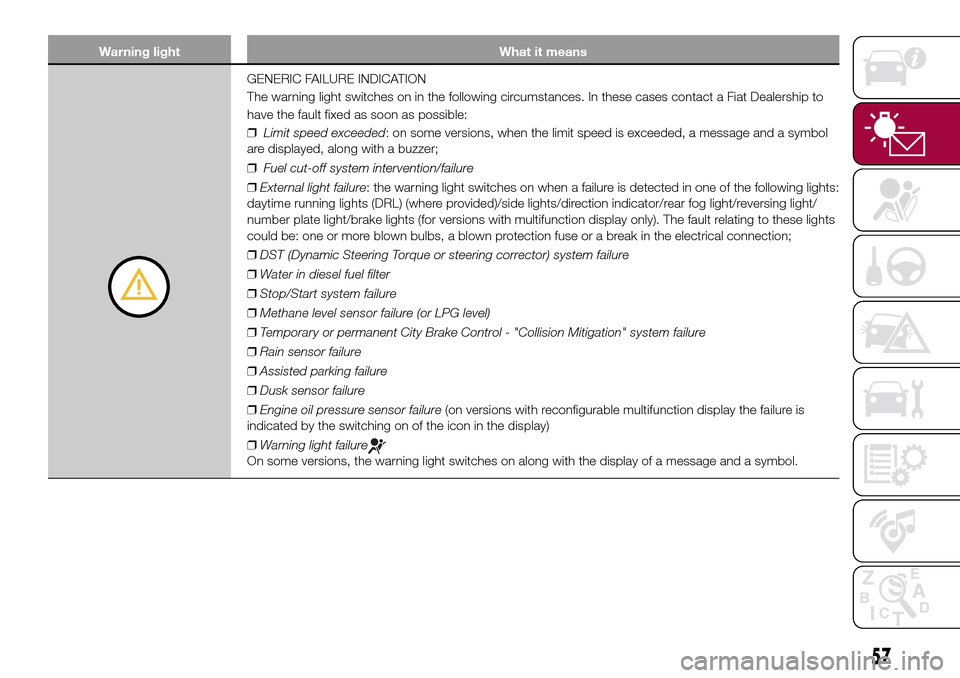
GENERIC FAILURE INDICATION
The warning light switches on in the following circumstances. In these cases contact a Fiat Dealership to
have the fault fixed as soon as possible:
❒Limit speed exceeded: on some versions, when the limit speed is exceeded, a message and a symbol
are displayed, along with a buzzer;
❒Fuel cut-off system intervention/failure
❒External light failure: the warning light switches on when a failure is detected in one of the following lights:
daytime running lights (DRL) (where provided)/side lights/direction indicator/rear fog light/reversing light/
number plate light/brake lights (for versions with multifunction display only). The fault relating to these lights
could be: one or more blown bulbs, a blown protection fuse or a break in the electrical connection;
❒DST (Dynamic Steering Torque or steering corrector) system failure
❒Water in diesel fuel filter
❒Stop/Start system failure
❒Methane level sensor failure (or LPG level)
❒Temporary or permanent City Brake Control - "Collision Mitigation" system failure
❒Rain sensor failure
❒Assisted parking failure
❒Dusk sensor failure
❒Engine oil pressure sensor failure(on versions with reconfigurable multifunction display the failure is
indicated by the switching on of the icon in the display)
❒Warning light failure
On some versions, the warning light switches on along with the display of a message and a symbol.
57
Page 67 of 240

ACTIVE SAFETY
SYSTEMS
ABS (Anti-lock Braking
System)
44) 45) 46) 47) 48) 49) 50)This system, which is an integral part of
the braking system, prevents one or
more wheels from locking and slipping
in all road surface conditions,
irrespective of the intensity of the
braking action, ensuring that the vehicle
can be controlled even during
emergency braking and optimising
stopping distances.
The ABS also includes the following
systems: EBD (Electronic Braking Force
Distribution), MSR (Motor
Schleppmoment Regelung) and HBA
(Hydraulic Brake Assist).
51) 52) 53)
IMPORTANT To obtain the maximum
efficiency of the braking system, a
bedding-in period of about 500 km is
needed: during this period it is better to
avoid sharp, repeated and prolonged
braking.
System intervention
The driver can feel that the ABS system
has come into action because the
brake pedal pulsates slightly and the
system gets noisier: this is entirely
normal with the system operating.
ESC (Electronic Stability
Control) SYSTEM
54) 55) 56) 57) 58) 59)The ESC system improves the
directional control and stability of the
vehicle in various driving conditions,
correcting understeer and oversteer,
distributing the brake force on the
appropriate wheels.
System intervention
The intervention of the system is
indicated by the flashing of theESC
warning light on the instrument panel,
to inform the driver that the vehicle is in
critical stability and grip conditions.
System activation
The ESC system switches on
automatically when the engine is
started and cannot be switched off.
HH (Hill Holder) SYSTEM
60) 61)This system is an integral part of the
ESC system and facilitates starting on
slopes.
The device is automatically switched on
in the following cases:
❒uphill: vehicle stationary on a road
with a gradient higher than 5%, engine
running, brake pressed and
transmission in neutral or gear other
than reverse engaged;
❒downhill: vehicle stationary on a road
with a gradient higher than 5%, engine
running, brake pressed and reverse
gear engaged.
ASR (AntiSlip
Regulation) SYSTEM
The ASR system automatically operates
in the event of one or both drive
wheels slipping, loss of grip on wet
roads (aquaplaning) and acceleration
on slippery, snowy or icy roads, etc.
65
Page 68 of 240

DST (Dynamic Steering
Torque or steering
corrector) system
62)The DST (steering corrector) function
uses the integration of the ESC system
with the electric power steering to
increase the safety level of the whole
vehicle. In critical situations
(understeering, oversteering, braking
with different grip conditions), through
the DST function the ESC system
controls the steering to implement an
additional torque contribution on the
steering wheel, to suggest the most
correct manoeuvre to the driver.
ERM (Electronic Rollover
Mitigation) SYSTEM
63)The system monitors the tendency of
the wheels to rise from the ground if the
driver performs extreme manoeuvres
like quick steering to avoid an obstacle,
especially in poor road conditions.
If these conditions occur, the system
intervenes on the brakes and engine
power to reduce the possibility that the
wheels are raised from the ground. It
is not possible to avoid tendency to roll
over if the phenomenon is due to
reasons such as driving on high side
gradients, collision with objects or other
vehicles.
WARNING
44)When the ABS intervenes and you feel
the brake pedal pulsating, do not reduce
the pressure, but hold it down firmly and
confidently; in doing so you will brake
in the shortest distance possible,
depending on the current road conditions.
45)To obtain the maximum efficiency of
the braking system, a bedding-in period of
about 500 km is needed: during this period
it is better to avoid sharp, repeated and
prolonged braking.46)If the ABS intervenes, this indicates
that the traction of the tyres on the road is
about to reach its limit. You must slow
down to a speed compatible with the
available grip.
47)The ABS cannot alter the natural laws
of physics, and cannot increase grip which
depends on the condition of the road.
48)The ABS cannot prevent accidents,
including those due to excessive speed on
corners, driving on low-grip surfaces or
aquaplaning.
49)The capability of the ABS must never
be tested irresponsibly and dangerously, in
such a way as to compromise personal
safety and the safety of others.
50)For the correct operation of the ABS,
the tyres must of necessity be the same
make and type on all wheels, in perfect
condition and, above all, of the prescribed
type and dimensions.
51)The HBA system cannot increase tyre
grip on the road over the limits imposed by
laws of physics: always drive carefully
according to the conditions of the road
surface.
52)The HBA system cannot prevent
accidents, including those due to excessive
speed on corners, driving on low-grip
surfaces or aquaplaning.
53)The HBA system is an aid for the driver,
who must always pay full attention while
driving. The responsibility always rests with
the driver. The capability of the HBA
system must never be tested irresponsibly
and dangerously, in such a way as to
compromise the safety of the driver, the
other occupants of the car or any other
road user.
60F0Y0164C
66
SAFETY
Engagement/disengagement of the
ASR system
The system comes on automatically
whenever the engine is started. Whilst
driving, the ASR can be switched off
and subsequently switched on again by
pressing the ASR OFF button fig. 60.