Page 360 of 828
Frequently Asked Questions
Can the head restraints be re- moved? Yes The 2nd row head restraints on
bench and fixed quad seats and inthe center seat (if equipped), are
removable. 2nd row outboard stow ’n go head restraints are not re-
movable. The 3rd row center head restraint is removable in all ve-
hicles, but the 3rd row outboard
head restraints are not removable.
NOTE: If the folding, non-adjustable head restraint in-
terferes with the installation of the child restraint, the
head restraint may be folded and the child seat installed
in front of it.
WARNING!
Always make sure the head restraint is in its upright
position when the seat is to be used by an occupant
who is not in a child restraint. Sitting in a seat with
the head restraint in its lowered position could result
in serious injury or death in a collision.
358 SAFETY
Page 364 of 828

center position blocks the outboard LATCH anchors or
seat belt, do not install a child seat in that outboard
position.
WARNING!
•Use anchorages C and D to install a LATCH-
compatible child restraint in the center seating
position (2). Do not install a LATCH-compatible
child restraint using anchorages B and C. This is
not a LATCH-compatible position in your vehicle.
• Never use the same lower anchorage to attach more
than one child restraint. Please refer to “Installing
The LATCH-Compatible Child Restraint System”
for typical installation instructions.
Always follow the directions of the child restraint
manufacturer when installing your child restraint. Not
all child restraint systems will be installed as described
here.
To install a LATCH-Compatible Child Restraint
If the selected seating position has a Switchable Auto-
matic Locking Retractor (ALR) seat belt, stow the seat
belt, following the instructions below. See the section
“Installing Child Restraints Using the Vehicle Seat Belt”
to check what type of seat belt each seating position has.
1. Loosen the adjusters on the lower straps and on the tether strap of the child seat so that you can more
easily attach the hooks or connectors to the vehicle
anchorages.
2. Place the child seat between the lower anchorages for that seating position. For some second row seats, you
may need to recline the seat and / or raise the head
restraint to get a better fit. If the rear seat can be moved
forward and rearward in the vehicle, you may wish to
move it to its rear-most position to make room for the
child seat. You may also move the front seat forward
to allow more room for the child seat.
362 SAFETY
Page 365 of 828
3. Attach the lower hooks or connectors of the childrestraint to the lower anchorages in the selected seat-
ing position.
4. If the child restraint has a tether strap, connect it to the top tether anchorage. See the section “Installing Child
Restraints Using the Top Tether Anchorage” for direc-
tions to attach a tether anchor.
5. Tighten all of the straps as you push the child restraint rearward and downward into the seat. Remove slack
in the straps according to the child restraint manufac-
turer ’s instructions.
6. Test that the child restraint is installed tightly by pulling back and forth on the child seat at the belt
path. It should not move more than 1 inch (25.4 mm)
in any direction.How To Stow An Unused ALR Seat Belt
When using the LATCH attaching system to install a
child restraint, stow all ALR seat belts that are not being
used by other occupants or being used to secure child
restraints. An unused belt could injure a child if they play
with it and accidentally lock the seat belt retractor. Before
installing a child restraint using the LATCH system,
buckle the seat belt behind the child restraint and out of
the child’s reach. If the buckled seat belt interferes with
the child restraint installation, instead of buckling it
behind the child restraint, route the seat belt through the
child restraint belt path and then buckle it. Do not lock
the seat belt. Remind all children in the vehicle that the
seat belts are not toys and that they should not play with
them.
5
SAFETY 363
Page 367 of 828
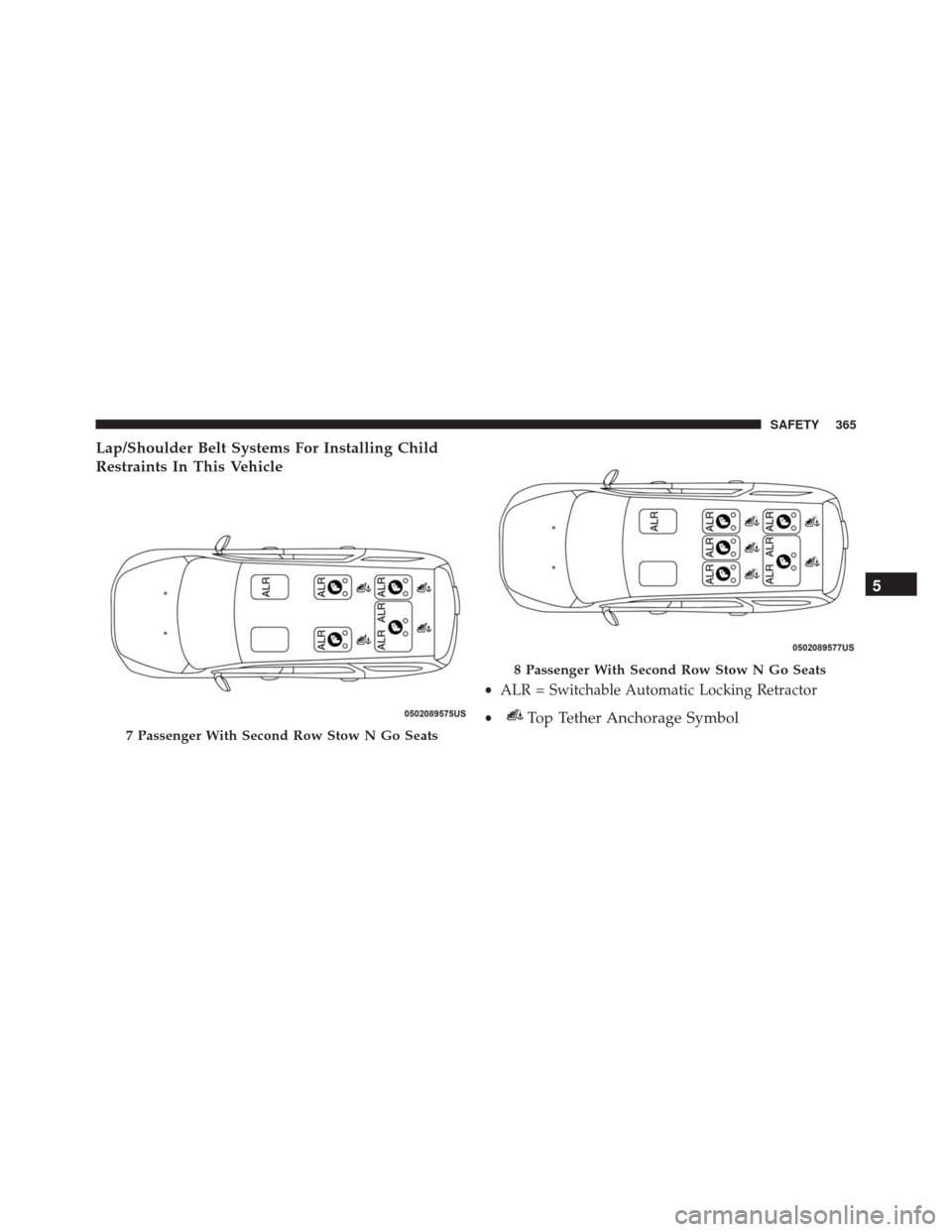
Lap/Shoulder Belt Systems For Installing Child
Restraints In This Vehicle
7 Passenger With Second Row Stow N Go Seats
8 Passenger With Second Row Stow N Go Seats
•ALR = Switchable Automatic Locking Retractor
•
Top Tether Anchorage Symbol 5
SAFETY 365
Page 368 of 828

Frequently Asked Question About Installing Child Restraints With Seat Belts
Frequently Asked Questions
What is the weight limit (child’s weight +
weight of the child restraint) for using the
Tether Anchor with the seat belt to attach a forward facing child restraint? Weight limit of the
Child Restraint Always use the tether anchor when using
the seat belt to install a forward facing
child restraint, up to the recommended weight limit of the child restraint.
Can the rear-facing child restraint touch the back of the front passenger seat? Yes
Contact between the front passenger seat
and the child restraint is allowed, if the
child restraint manufacturer also allows contact.
Can the head restraints be removed? YesThe 2nd row head restraints on bench and
fixed quad seats, and in the center seat (if
equipped) are removable. 2nd row stow ’n go head restraints are not removable. The
3rd row center head restraint is removable in all vehicles, but the 3rd row outboard head restraints are not removable.
366 SAFETY
Page 384 of 828

▫LaneSense Operation ...................487
▫ Turning LaneSense ON Or OFF ............489
▫ LaneSense Warning Message ..............490
▫ Changing LaneSense Status ..............494
� PARKVIEW REAR BACK UP CAMERA — IF
EQUIPPED .......................... .494
� SURROUND VIEW CAMERA SYSTEM — IF
EQUIPPED .......................... .497
� REFUELING THE VEHICLE ...............502
� VEHICLE LOADING ....................504
▫ Certification Label ....................504
� TRAILER TOWING .....................506
▫ Common Towing Definitions .............507
▫ Trailer Hitch Classification ...............510 ▫
Trailer Towing Weights (Maximum Trailer Weight
Ratings) ............................511
▫ Vehicle Loading Chart ..................512
▫ Trailer And Tongue Weight ..............514
▫ Towing Requirements ..................515
▫ Towing Tips ........................ .520
� RECREATIONAL TOWING ...............521
▫ Towing This Vehicle Behind Another Vehicle . .521
▫ Recreational Towing — All Models .........522
� DRIVING TIPS ........................ .523
▫ Driving On Slippery Surfaces .............523
▫ Driving Through Water .................524
382 STARTING AND OPERATING
Page 387 of 828

1. Install a battery charger or jumper cables to the batteryto ensure a full battery charge during the crank cycle.
2. Cycle the ignition in the START position and release it when the engine starts.
3. If the engine fails to start within ten seconds, cycle the ignition to the STOP (OFF/LOCK) position, wait five
seconds to allow the starter to cool, then repeat the
Extended Park Starting procedure.
4. If the engine fails to start after eight attempts, allow the starter to cool for at least 10 minutes, then repeat
the procedure.
CAUTION!
To prevent damage to the starter, do not crank con-
tinuously for more than 10 seconds at a time. Wait 10
to 15 seconds before trying again.
After Starting — Warming Up The Engine
The idle speed is controlled automatically and it will
decrease as the engine warms up.
If Engine Fails To Start
WARNING!
•Never pour fuel or other flammable liquid into the
throttle body air inlet opening in an attempt to start
the vehicle. This could result in flash fire causing
serious personal injury.
• Do not attempt to push or tow your vehicle to get it
started. Vehicles equipped with an automatic trans-
mission cannot be started this way. Unburned fuel
could enter the catalytic converter and once the
engine has started, ignite and damage the converter
and vehicle.
(Continued)
6
STARTING AND OPERATING 385
Page 389 of 828

Connect the cord to a 110-115 Volt AC electrical outlet
with a grounded, three-wire extension cord.
For ambient temperatures below 0°F (-18°C), the engine
block heater is recommended. For ambient temperatures
below -20°F (-29°C), the engine block heater is required.
The engine block heater cord is routed under the hood,
behind to the passenger ’s side headlamp. Follow the
steps below to properly use the engine block heater:
1. Locate the engine block heater cord (behind the pas-senger ’s side headlamp).
2. Undo the Velcro strap that secures the heater cord in place.
3. Pull the cord to the front of the vehicle and plug it into a grounded, three-wire extension cord. 4. After the vehicle is running, reattach the cord to the
Velcro strap and properly stow away behind the
passenger ’s side headlamp.
NOTE:
• The engine block heater cord is a factory installed
option. If your vehicle is not equipped, heater cords
are available from your authorized MOPAR dealer.
• The engine block heater will require 110 Volts AC and
6.5 Amps to activate the heater element.
• The engine block heater must be plugged in at least
one hour to have an adequate warming effect on the
engine.
6
STARTING AND OPERATING 387