2017 CHEVROLET EXPRESS CARGO VAN tow
[x] Cancel search: towPage 225 of 346
Chevrolet Express Owner Manual (GMNA-Localizing-U.S./Canada/Mexico-9967827) - 2017 - crc - 5/2/16
224 Vehicle Care
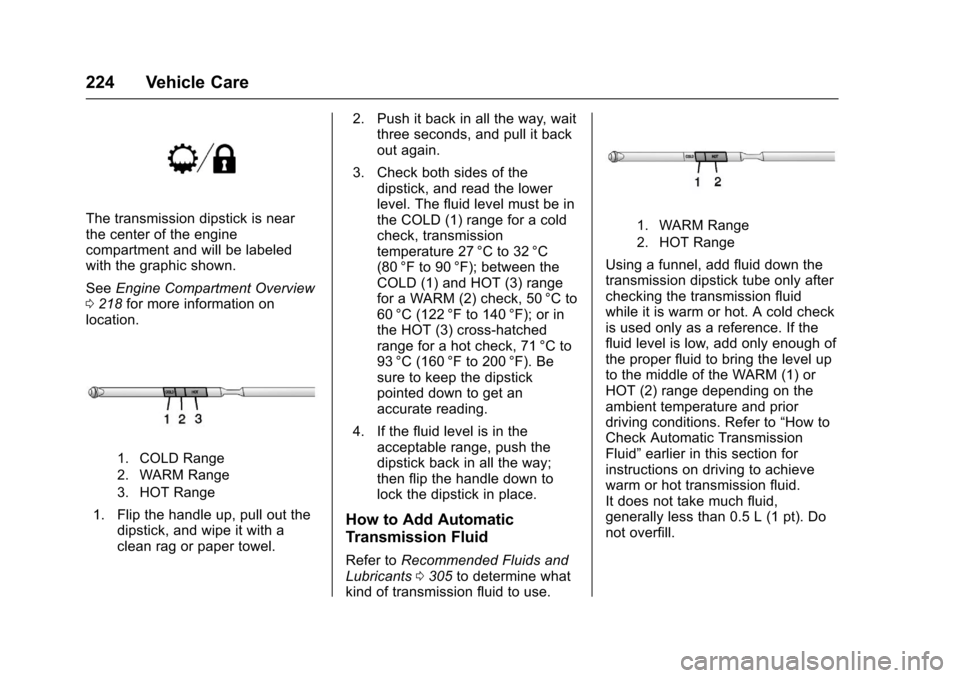
The transmission dipstick is nearthe center of the enginecompartment and will be labeledwith the graphic shown.
SeeEngine Compartment Overview0218for more information onlocation.
1. COLD Range
2. WARM Range
3. HOT Range
1. Flip the handle up, pull out thedipstick, and wipe it with aclean rag or paper towel.
2. Push it back in all the way, waitthree seconds, and pull it backout again.
3. Check both sides of thedipstick, and read the lowerlevel. The fluid level must be inthe COLD (1) range for a coldcheck, transmissiontemperature 27 °C to 32 °C(80 °F to 90 °F); between theCOLD (1) and HOT (3) rangefor a WARM (2) check, 50 °C to60 °C (122 °F to 140 °F); or inthe HOT (3) cross-hatchedrange for a hot check, 71 °C to93 °C (160 °F to 200 °F). Besure to keep the dipstickpointed down to get anaccurate reading.
4. If the fluid level is in theacceptable range, push thedipstick back in all the way;then flip the handle down tolock the dipstick in place.
How to Add Automatic
Transmission Fluid
Refer toRecommended Fluids andLubricants0305to determine whatkind of transmission fluid to use.
1. WARM Range
2. HOT Range
Using a funnel, add fluid down thetransmission dipstick tube only afterchecking the transmission fluidwhile it is warm or hot. A cold checkis used only as a reference. If thefluid level is low, add only enough ofthe proper fluid to bring the level upto the middle of the WARM (1) orHOT (2) range depending on theambient temperature and priordriving conditions. Refer to“How toCheck Automatic TransmissionFluid”earlier in this section forinstructions on driving to achievewarm or hot transmission fluid.It does not take much fluid,generally less than 0.5 L (1 pt). Donot overfill.
Page 232 of 346
Chevrolet Express Owner Manual (GMNA-Localizing-U.S./Canada/Mexico-9967827) - 2017 - crc - 5/2/16
Vehicle Care 231
If Steam is Coming from the
Engine Compartment
{Warning
Steam from an overheated engine
can burn you badly, even if you
just open the hood. Stay away
from the engine if you see or hear
steam coming from it. Just turn it
off and get everyone away from
the vehicle until it cools down.
Wait until there is no sign of
steam or coolant before you open
the hood.
If you keep driving when the
engine is overheated, the liquids
in it can catch fire. You or others
could be badly burned. Stop the
engine if it overheats, and get out
of the vehicle until the engine
is cool.
If No Steam is Coming from
the Engine Compartment
If an engine overheat warning isdisplayed but no steam can be seenor heard, the problem may not be
too serious. Sometimes the enginecan get a little too hot when thevehicle:
.Climbs a long hill on a hot day.
.Stops after high-speed driving.
.Idles for long periods in traffic.
.To w s a t r a i l e r . S e e“Driving onGrades”underTr a i l e rTo w i n g0205.
If the overheat warning is displayedwith no sign of steam:
1. Turn the air off.
2. Turn the heater on to thehighest temperature and to thehighest fan speed. Open thewindows as necessary.
3. When it is safe to do so, pull offthe road, shift to P (Park) orN(Neutral) and let theengine idle.
If the engine coolant temperaturegauge is no longer in the overheatzone or an overheat warning nolonger displays, the vehicle can bedriven. Continue to drive the vehicleslowly for about 10 minutes. Keep asafe vehicle distance from the
vehicle in front. If the warning doesnot come back on, continue to drivenormally and have the coolingsystem checked for proper fill andfunction.
If the warning continues, pull over,stop, and park the vehicleright away.
If there is still no sign of steam,push down the accelerator until theengine speed is about twice as fastas normal idle speed for at leastthree minutes while parked. If thewarning is still on, turn off theengine until it cools down.
If the decision is made not to lift thehood, get service help right away.
Engine Fan
The vehicle has a clutched enginecooling fan. When the clutch isengaged, the fan spins faster toprovide more air to cool the engine.In most everyday driving conditions,the fan is spinning slower and theclutch is not fully engaged. Thisimproves fuel economy and reducesfan noise. Under heavy vehicleloading, trailer towing, and/or high
Page 267 of 346
Chevrolet Express Owner Manual (GMNA-Localizing-U.S./Canada/Mexico-9967827) - 2017 - crc - 5/2/16
266 Vehicle Care
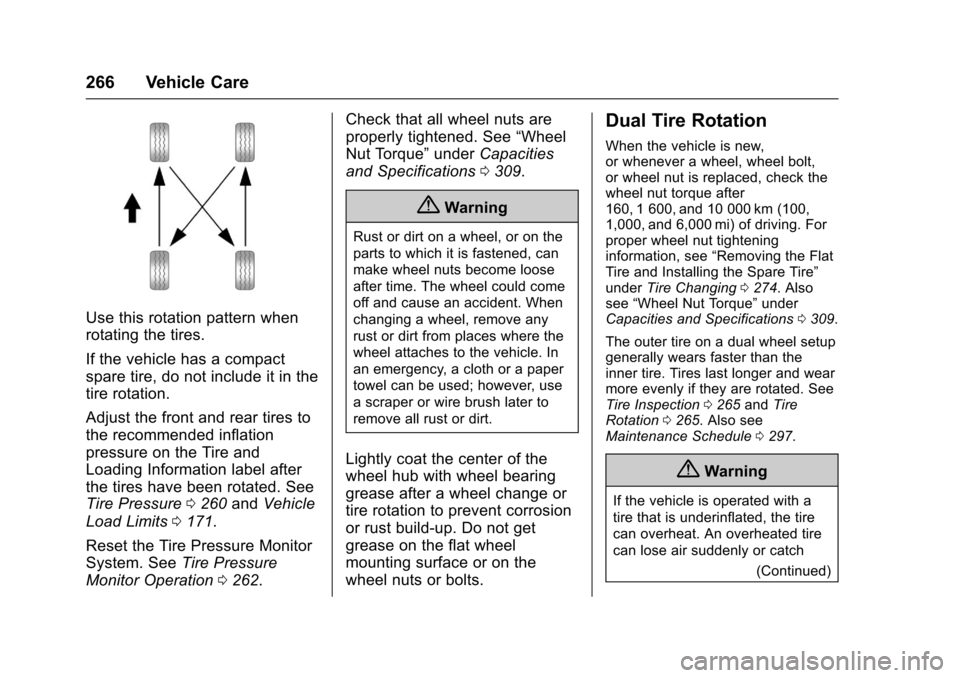
Use this rotation pattern when
rotating the tires.
If the vehicle has a compact
spare tire, do not include it in the
tire rotation.
Adjust the front and rear tires to
the recommended inflation
pressure on the Tire and
Loading Information label after
the tires have been rotated. See
Tire Pressure0260andVehicle
Load Limits0171.
Reset the Tire Pressure Monitor
System. SeeTire Pressure
Monitor Operation0262.
Check that all wheel nuts are
properly tightened. See“Wheel
Nut Torque”underCapacities
and Specifications0309.
{Warning
Rust or dirt on a wheel, or on the
parts to which it is fastened, can
make wheel nuts become loose
after time. The wheel could come
off and cause an accident. When
changing a wheel, remove any
rust or dirt from places where the
wheel attaches to the vehicle. In
an emergency, a cloth or a paper
towel can be used; however, use
ascraperorwirebrushlaterto
remove all rust or dirt.
Lightly coat the center of the
wheel hub with wheel bearing
grease after a wheel change or
tire rotation to prevent corrosion
or rust build-up. Do not get
grease on the flat wheel
mounting surface or on the
wheel nuts or bolts.
Dual Tire Rotation
When the vehicle is new,or whenever a wheel, wheel bolt,or wheel nut is replaced, check thewheel nut torque after160, 1 600, and 10 000 km (100,1,000, and 6,000 mi) of driving. Forproper wheel nut tighteninginformation, see“Removing the FlatTire and Installing the Spare Tire”underTire Changing0274.Alsosee“Wheel Nut Torque”underCapacities and Specifications0309.
The outer tire on a dual wheel setupgenerally wears faster than theinner tire. Tires last longer and wearmore evenly if they are rotated. SeeTire Inspection0265andTireRotation0265.AlsoseeMaintenance Schedule0297.
{Warning
If the vehicle is operated with a
tire that is underinflated, the tire
can overheat. An overheated tire
can lose air suddenly or catch
(Continued)
Page 272 of 346
Chevrolet Express Owner Manual (GMNA-Localizing-U.S./Canada/Mexico-9967827) - 2017 - crc - 5/2/16
Vehicle Care 271
Traction
The traction grades, from
highest to lowest, are AA, A, B,
and C. Those grades represent
the tire's ability to stop on wet
pavement as measured under
controlled conditions on
specified government test
surfaces of asphalt and
concrete. A tire marked C may
have poor traction performance.
Warning: The traction grade
assigned to this tire is based on
straight-ahead braking traction
tests, and does not include
acceleration, cornering,
hydroplaning, or peak traction
characteristics.
Temperature
The temperature grades are A
(the highest), B, and C,
representing the tire's resistance
to the generation of heat and its
ability to dissipate heat when
tested under controlled
conditions on a specified indoor
laboratory test wheel. Sustained
high temperature can cause the
material of the tire to degenerate
and reduce tire life, and
excessive temperature can lead
to sudden tire failure. The grade
Ccorrespondstoalevelof
performance which all
passenger car tires must meet
under the Federal Motor Safety
Standard No. 109. Grades B and
Arepresenthigherlevelsof
performance on the laboratory
test wheel than the minimum
required by law. Warning: The
temperature grade for this tire is
established for a tire that is
properly inflated and not
overloaded. Excessive speed,
underinflation, or excessive
loading, either separately or in
combination, can cause heat
buildup and possible tire failure.
Wheel Alignment and Tire
Balance
The tires and wheels were alignedand balanced at the factory toprovide the longest tire life and bestoverall performance. Adjustments towheel alignment and tire balancingare not necessary on a regularbasis. Consider an alignment checkif there is unusual tire wear or thevehicle is significantly pulling to oneside or the other. Some slight pull tothe left or right, depending on thecrown of the road and/or other roadsurface variations such as troughsor ruts, is normal. If the vehicle isvibrating when driving on a smoothroad, the tires and wheels may needto be rebalanced. See your dealerfor proper diagnosis.
Wheel Replacement
Replace any wheel that is bent,cracked, or badly rusted orcorroded. If wheel nuts keep comingloose, the wheel, wheel bolts, andwheel nuts should be replaced.If the wheel leaks air, replace it.
Page 274 of 346
Chevrolet Express Owner Manual (GMNA-Localizing-U.S./Canada/Mexico-9967827) - 2017 - crc - 5/2/16
Vehicle Care 273
Caution (Continued)
chains on the tires of the front
axle. Tighten them as tightly as
possible with the ends securely
fastened. Drive slowly and follow
the chain manufacturer's
instructions. If the chains contact
the vehicle, stop and retighten
them. If the contact continues,
slow down until it stops. Driving
too fast or spinning the wheels
with chains on will damage the
vehicle.
For Cutaway models with LT245/75R16, LT225/75R16 or LT215/85R16 size single or dual rear tires,use Low Profile Z-Chain or SAEClass S cables.
For Cargo or Passenger modelswith P245/70R17, LT225/75R16 orLT 2 4 5 / 7 5 R 1 6 s i z e t i r e s , u s e L o wProfile Z-Chain cables. SAE Class Schains are not recommended.
If the vehicle has dual rear tires, donot use individual tire chains. Usetire chains that fit across both dualtires.
If a Tire Goes Flat
It is unusual for a tire to blow outwhile driving, especially if the tiresare maintained properly. SeeTires0252.Ifairgoesoutofatire,itismuch more likely to leak out slowly.But if there ever is a blowout, hereare a few tips about what to expectand what to do:
If a front tire fails, the flat tirecreates a drag that pulls the vehicletoward that side. Take your foot offthe accelerator pedal and grip thesteering wheel firmly. Steer tomaintain lane position, and thengently brake to a stop, well off theroad, if possible.
Arearblowout,particularlyonacurve, acts much like a skid andmay require the same correction asused in a skid. Stop pressing theaccelerator pedal and steer tostraighten the vehicle. It may be
very bumpy and noisy. Gently braketo a stop, well off the road,if possible.
{Warning
Driving on a flat tire will cause
permanent damage to the tire.
Re-inflating a tire after it has been
driven on while severely
underinflated or flat may cause a
blowout and a serious crash.
Never attempt to re-inflate a tire
that has been driven on while
severely underinflated or flat.
Have your dealer or an authorized
tire service center repair or
replace the flat tire as soon as
possible.
{Warning
Lifting a vehicle and getting under
it to do maintenance or repairs is
dangerous without the
appropriate safety equipment and
(Continued)
Page 280 of 346
Chevrolet Express Owner Manual (GMNA-Localizing-U.S./Canada/Mexico-9967827) - 2017 - crc - 5/2/16
Vehicle Care 279
Warning (Continued)
towel can be used; however, use
ascraperorwirebrushlaterto
remove all rust or dirt.
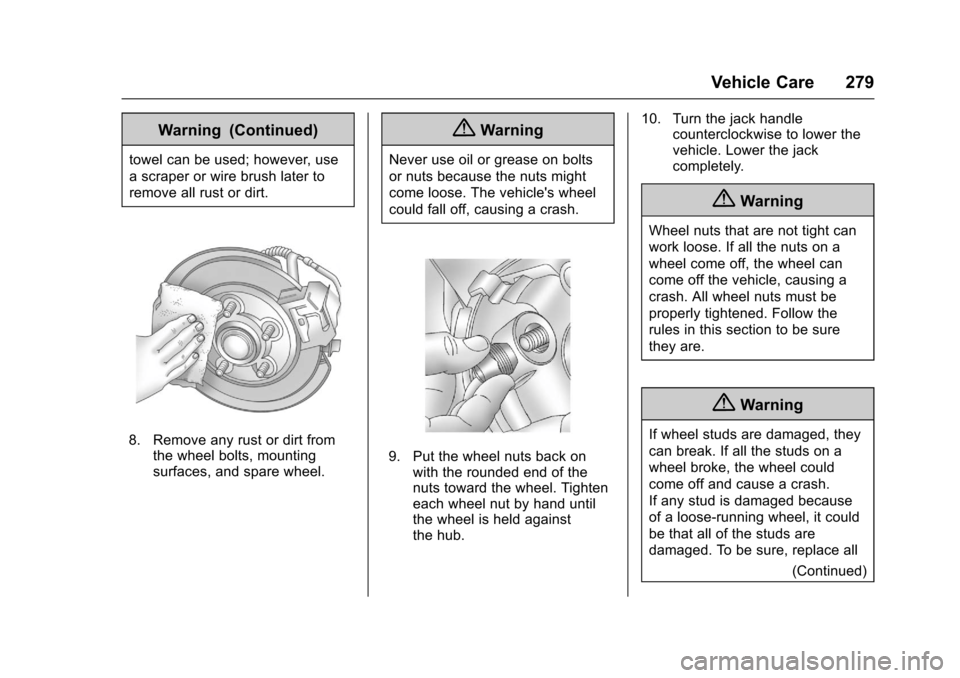
8. Remove any rust or dirt fromthe wheel bolts, mountingsurfaces, and spare wheel.
{Warning
Never use oil or grease on bolts
or nuts because the nuts might
come loose. The vehicle's wheel
could fall off, causing a crash.
9. Put the wheel nuts back onwith the rounded end of thenuts toward the wheel. Tighteneach wheel nut by hand untilthe wheel is held againstthe hub.
10. Turn the jack handlecounterclockwise to lower thevehicle. Lower the jackcompletely.
{Warning
Wheel nuts that are not tight can
work loose. If all the nuts on a
wheel come off, the wheel can
come off the vehicle, causing a
crash. All wheel nuts must be
properly tightened. Follow the
rules in this section to be sure
they are.
{Warning
If wheel studs are damaged, they
can break. If all the studs on a
wheel broke, the wheel could
come off and cause a crash.
If any stud is damaged because
of a loose-running wheel, it could
be that all of the studs are
damaged. To be sure, replace all
(Continued)
Page 282 of 346
Chevrolet Express Owner Manual (GMNA-Localizing-U.S./Canada/Mexico-9967827) - 2017 - crc - 5/2/16
Vehicle Care 281
serviced. SeeCapacities andSpecifications0309for moreinformation.
Storing a Flat or Spare Tire
and Tools
{Warning
Storing a jack, a tire, or other
equipment in the passenger
compartment of the vehicle could
cause injury. In a sudden stop or
collision, loose equipment could
strike someone. Store all these in
the proper place.
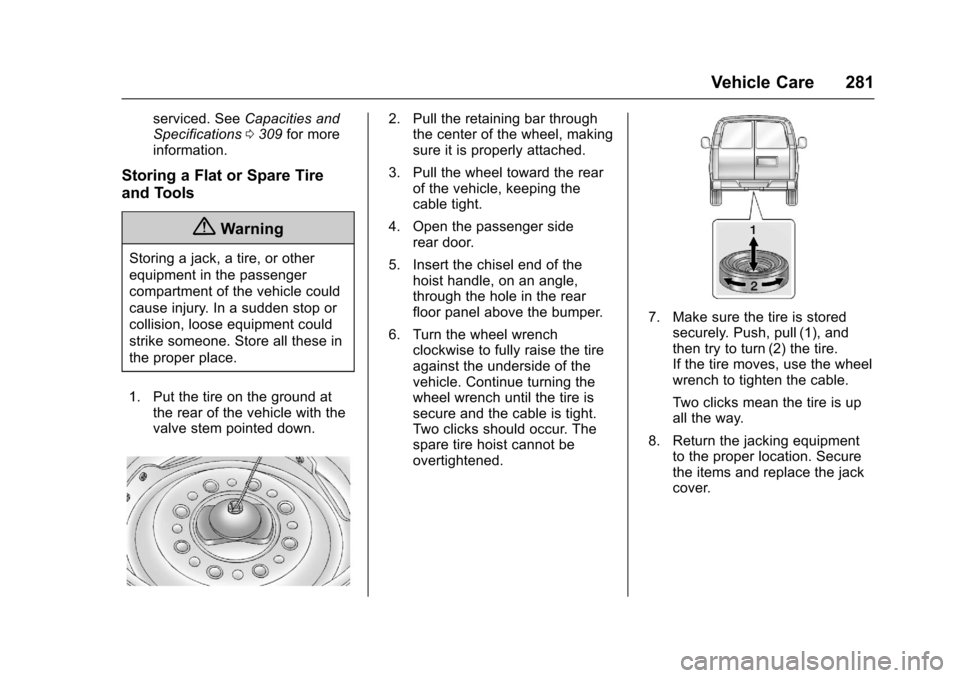
1. Put the tire on the ground atthe rear of the vehicle with thevalve stem pointed down.
2. Pull the retaining bar throughthe center of the wheel, makingsure it is properly attached.
3. Pull the wheel toward the rearof the vehicle, keeping thecable tight.
4. Open the passenger siderear door.
5. Insert the chisel end of thehoist handle, on an angle,through the hole in the rearfloor panel above the bumper.
6. Turn the wheel wrenchclockwise to fully raise the tireagainst the underside of thevehicle. Continue turning thewheel wrench until the tire issecure and the cable is tight.Tw o c l i c k s s h o u l d o c c u r. T h espare tire hoist cannot beovertightened.
7. Make sure the tire is storedsecurely. Push, pull (1), andthen try to turn (2) the tire.If the tire moves, use the wheelwrench to tighten the cable.
Tw o c l i c k s m e a n t h e t i r e i s u pall the way.
8. Return the jacking equipmentto the proper location. Securethe items and replace the jackcover.
Page 287 of 346
Chevrolet Express Owner Manual (GMNA-Localizing-U.S./Canada/Mexico-9967827) - 2017 - crc - 5/2/16
286 Vehicle Care
Towing the Vehicle
Caution
Incorrectly towing a disabled
vehicle may cause damage. The
damage would not be covered by
the vehicle warranty.
Do not lash or hook to
suspension components. Use the
proper straps around the tires to
secure the vehicle.
Use only a flatbed tow truck fortowing a disabled vehicle. Neveruse a sling type lift or damage willoccur. Use ramps to help reduceapproach angles if necessary.Atowedvehicleshouldhaveitsdrive wheels off the ground.
Consult a professional towingservice if the disabled vehicle mustbe towed.
Recreational Vehicle
Towing
Recreational vehicle towing meanstowing the vehicle behind anothervehicle, such as behind a motorhome. The two most common typesof recreational vehicle towing areknown as dinghy towing and dollytowing. Dinghy towing is towing thevehicle with all four wheels on theground. Dolly towing is towing thevehicle with two wheels on theground and two wheels up on adevice known as a dolly.
Here are some important things toconsider before recreational vehicletowing:
.What is the towing capacity ofthe towing vehicle? Be sure toread the tow vehiclemanufacturer'srecommendations.
.What is the distance that will betraveled? Some vehicles haverestrictions on how far and howlong they can tow.
.Is the proper towing equipmentgoing to be used? See yourdealer or trailering professionalfor additional advice andequipment recommendations.
.Is the vehicle ready to betowed? Just as preparing thevehicle for a long trip, make surethe vehicle is prepared to betowed.
Caution
Use of a shield mounted in front
of the vehicle grille could restrict
airflow and cause damage to the
transmission. The repairs would
not be covered by the vehicle
warranty. If using a shield, only
use one that attaches to the
towing vehicle.