2017 CHEVROLET EXPRESS CARGO VAN tow
[x] Cancel search: towPage 36 of 346
Chevrolet Express Owner Manual (GMNA-Localizing-U.S./Canada/Mexico-9967827) - 2017 - crc - 5/2/16
Keys, Doors, and Windows 35
Exterior Mirrors
Convex Mirrors
{Warning
Aconvexmirrorcanmakethings,
like other vehicles, look farther
away than they really are. If you
cut too sharply into the right lane,
you could hit a vehicle on the
right. Check the inside mirror or
glance over your shoulder before
changing lanes.
The passenger side mirror is convexshaped. A convex mirror's surface iscurved so more can be seen fromthe driver seat.
Manual Mirrors
Adjust the mirrors by pressing themirror up and down and left andright.
The mirrors can be manually foldedin or out.
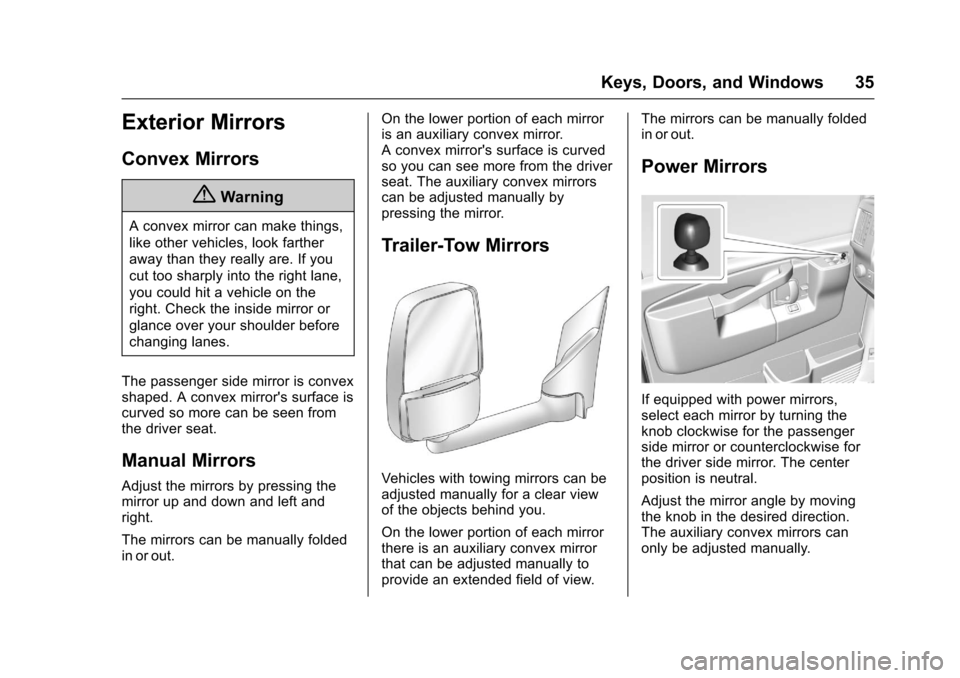
On the lower portion of each mirroris an auxiliary convex mirror.Aconvexmirror'ssurfaceiscurvedso you can see more from the driverseat. The auxiliary convex mirrorscan be adjusted manually bypressing the mirror.
Trailer-Tow Mirrors
Vehicles with towing mirrors can beadjusted manually for a clear viewof the objects behind you.
On the lower portion of each mirrorthere is an auxiliary convex mirrorthat can be adjusted manually toprovide an extended field of view.
The mirrors can be manually foldedin or out.
Power Mirrors
If equipped with power mirrors,select each mirror by turning theknob clockwise for the passengerside mirror or counterclockwise forthe driver side mirror. The centerposition is neutral.
Adjust the mirror angle by movingthe knob in the desired direction.The auxiliary convex mirrors canonly be adjusted manually.
Page 37 of 346

Chevrolet Express Owner Manual (GMNA-Localizing-U.S./Canada/Mexico-9967827) - 2017 - crc - 5/2/16
36 Keys, Doors, and Windows
Heated Mirrors
For vehicles with heated mirrors:
1:Press to heat the mirrors.
An indicator light in the button lightswhen the outside heated mirrors areactivated.
See“Rear Window Defogger”underClimate Control Systems0158.
Interior Mirrors
Interior Rearview Mirrors
Adjust the rearview mirror for a clearview of the area behind the vehicle.
Do not spray glass cleaner directlyon the mirror. Use a soft toweldampened with water.
Manual Rearview Mirror
Push the tab forward for daytimeuse and pull it rearward fornighttime use to avoid glare of theheadlamps from behind.
Cargo vans without rear door glassmay not have an inside rearviewmirror.
Windows
{Warning
Never leave a child, a helpless
adult, or a pet alone in a vehicle,
especially with the windows
closed in warm or hot weather.
They can be overcome by the
extreme heat and suffer
permanent injuries or even death
from heat stroke.
Page 38 of 346
Chevrolet Express Owner Manual (GMNA-Localizing-U.S./Canada/Mexico-9967827) - 2017 - crc - 5/2/16
Keys, Doors, and Windows 37
Manual Windows
Operate the manual windows byturning the hand crank on each doorto raise or lower the side doorwindows.
Power Windows
{Warning
Children could be seriously
injured or killed if caught in the
path of a closing window. Never
leave keys in a vehicle with
children. SeeKeys023.
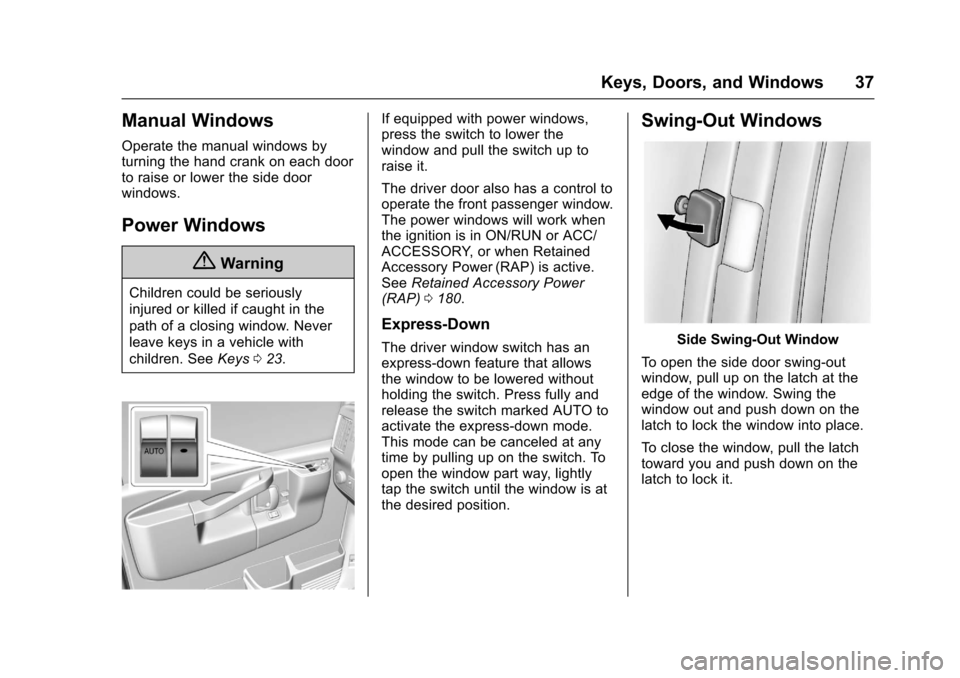
If equipped with power windows,press the switch to lower thewindow and pull the switch up toraise it.
The driver door also has a control tooperate the front passenger window.The power windows will work whenthe ignition is in ON/RUN or ACC/ACCESSORY, or when RetainedAccessory Power (RAP) is active.SeeRetained Accessory Power(RAP)0180.
Express-Down
The driver window switch has anexpress-down feature that allowsthe window to be lowered withoutholding the switch. Press fully andrelease the switch marked AUTO toactivate the express-down mode.This mode can be canceled at anytime by pulling up on the switch. Toopen the window part way, lightlytap the switch until the window is atthe desired position.
Swing-Out Windows
Side Swing-Out Window
To o p e n t h e s i d e d o o r s w i n g - o u twindow, pull up on the latch at theedge of the window. Swing thewindow out and push down on thelatch to lock the window into place.
To c l o s e t h e w i n d o w, p u l l t h e l a t c htoward you and push down on thelatch to lock it.
Page 45 of 346
Chevrolet Express Owner Manual (GMNA-Localizing-U.S./Canada/Mexico-9967827) - 2017 - crc - 5/2/16
44 Seats and Restraints
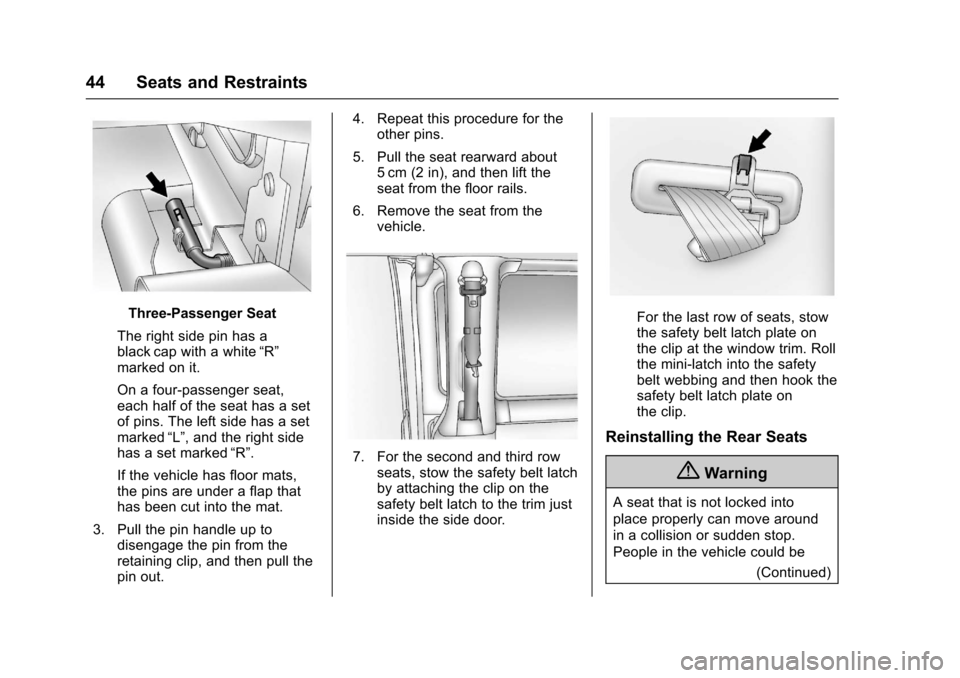
Three-Passenger Seat
The right side pin has ablack cap with a white“R”marked on it.
On a four-passenger seat,each half of the seat has a setof pins. The left side has a setmarked“L”,andtherightsidehas a set marked“R”.
If the vehicle has floor mats,the pins are under a flap thathas been cut into the mat.
3. Pull the pin handle up todisengage the pin from theretaining clip, and then pull thepin out.
4. Repeat this procedure for theother pins.
5. Pull the seat rearward about5cm (2 in), and then lift theseat from the floor rails.
6. Remove the seat from thevehicle.
7. For the second and third rowseats, stow the safety belt latchby attaching the clip on thesafety belt latch to the trim justinside the side door.
For the last row of seats, stowthe safety belt latch plate onthe clip at the window trim. Rollthe mini-latch into the safetybelt webbing and then hook thesafety belt latch plate onthe clip.
Reinstalling the Rear Seats
{Warning
Aseatthatisnotlockedinto
place properly can move around
in a collision or sudden stop.
People in the vehicle could be
(Continued)
Page 50 of 346
Chevrolet Express Owner Manual (GMNA-Localizing-U.S./Canada/Mexico-9967827) - 2017 - crc - 5/2/16
Seats and Restraints 49
If the shoulder portion of apassenger belt is pulled out allthe way, the child restraintlocking feature may beengaged. If this happens, letthe belt go back all the wayand start again.
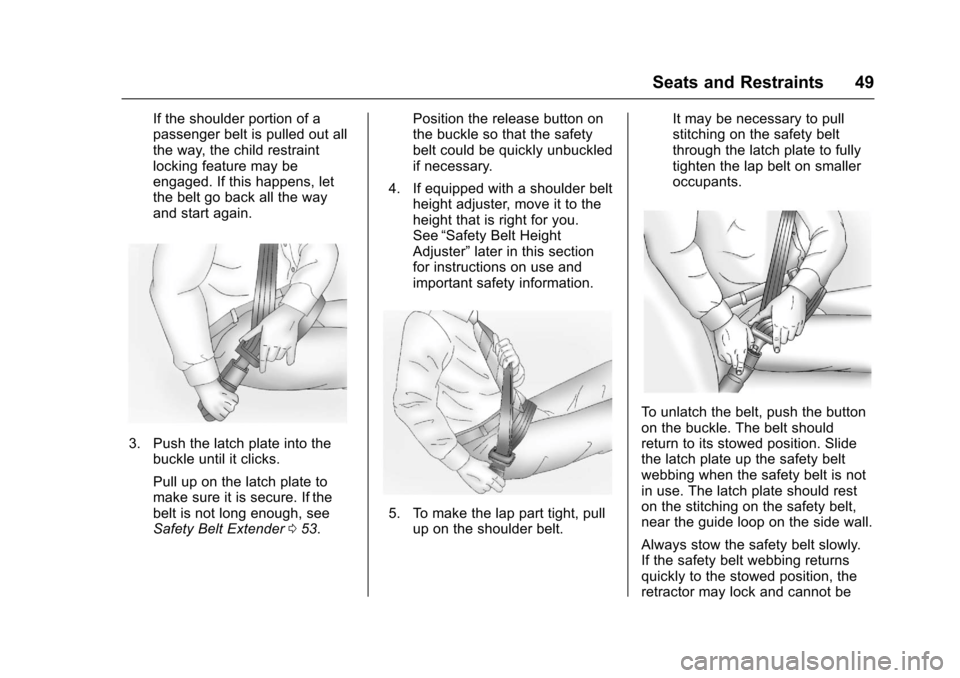
3. Push the latch plate into thebuckle until it clicks.
Pull up on the latch plate tomake sure it is secure. If thebelt is not long enough, seeSafety Belt Extender053.
Position the release button onthe buckle so that the safetybelt could be quickly unbuckledif necessary.
4. If equipped with a shoulder beltheight adjuster, move it to theheight that is right for you.See“Safety Belt HeightAdjuster”later in this sectionfor instructions on use andimportant safety information.
5. To make the lap part tight, pullup on the shoulder belt.
It may be necessary to pullstitching on the safety beltthrough the latch plate to fullytighten the lap belt on smalleroccupants.
To u n l a t c h t h e b e l t , p u s h t h e b u t t o non the buckle. The belt shouldreturn to its stowed position. Slidethe latch plate up the safety beltwebbing when the safety belt is notin use. The latch plate should reston the stitching on the safety belt,near the guide loop on the side wall.
Always stow the safety belt slowly.If the safety belt webbing returnsquickly to the stowed position, theretractor may lock and cannot be
Page 61 of 346
Chevrolet Express Owner Manual (GMNA-Localizing-U.S./Canada/Mexico-9967827) - 2017 - crc - 5/2/16
60 Seats and Restraints
of the impact. In addition, theseroof-rail airbags are designed toinflate during a rollover. Roof-railairbags are not designed to inflate infrontal, near-frontal, or rear impacts.All roof-rail airbags will inflate wheneither side of the vehicle is struck orif the sensing system predicts thatthe vehicle is about to roll over onits side.
In any particular crash, no one cansay whether an airbag should haveinflated simply because of thevehicle damage or repair costs.
What Makes an Airbag
Inflate?
In a deployment event, the sensingsystem sends an electrical signaltriggering a release of gas from theinflator. Gas from the inflator fills theairbag causing the bag to break outof the cover. The inflator, the airbag,and related hardware are all part ofthe airbag module.
For airbag locations, seeWhere Arethe Airbags?057.
How Does an Airbag
Restrain?
In moderate to severe frontal ornear frontal collisions, even beltedoccupants can contact the steeringwheel or the instrument panel. Inmoderate to severe side collisions,even belted occupants can contactthe inside of the vehicle.
Airbags supplement the protectionprovided by safety belts bydistributing the force of the impactmore evenly over theoccupant's body.
Rollover capable roof-rail airbagsare designed to help contain thehead and chest of occupants in theoutboard seating positions in thefirst, second, and third rows,if equipped. The rollover capableroof-rail airbags are designed tohelp reduce the risk of full or partialejection in rollover events, althoughno system can prevent all suchejections.
But airbags would not help in manytypes of collisions, primarilybecause the occupant's motion is
not toward those airbags. SeeWhen Should an AirbagInflate?059.
Airbags should never be regardedas anything more than a supplementto safety belts.
What Will You See after
an Airbag Inflates?
After the frontal airbags andseat-mounted side impact airbags (ifequipped) inflate, they quicklydeflate, so quickly that some peoplemay not even realize an airbaginflated. Roof-rail airbags (ifequipped) may still be at leastpartially inflated for some time afterthey deploy. Some components ofthe airbag module may be hot forseveral minutes. For location of theairbag modules, seeWhere Are theAirbags?057.
The parts of the airbag that comeinto contact with you may be warm,but not too hot to touch. There maybe some smoke and dust comingfrom the vents in the deflatedairbags. Airbag inflation does notprevent the driver from seeing out of
Page 68 of 346
Chevrolet Express Owner Manual (GMNA-Localizing-U.S./Canada/Mexico-9967827) - 2017 - crc - 5/2/16
Seats and Restraints 67
.Can proper safety belt fit bemaintained for the length of thetrip? If yes, continue. If no,return to the booster seat.
Q: What is the proper way towear safety belts?
A:An older child should wear alap-shoulder belt and get theadditional restraint a shoulderbelt can provide. The shoulderbelt should not cross the face orneck. The lap belt should fitsnugly below the hips, justtouching the top of the thighs.This applies belt force to thechild's pelvic bones in a crash.It should never be worn over theabdomen, which could causesevere or even fatal internalinjuries in a crash.
Also see“Rear Safety Belt ComfortGuides”underLap-ShoulderBelt048.
According to accident statistics,children are safer when properlyrestrained in a rear seating position.
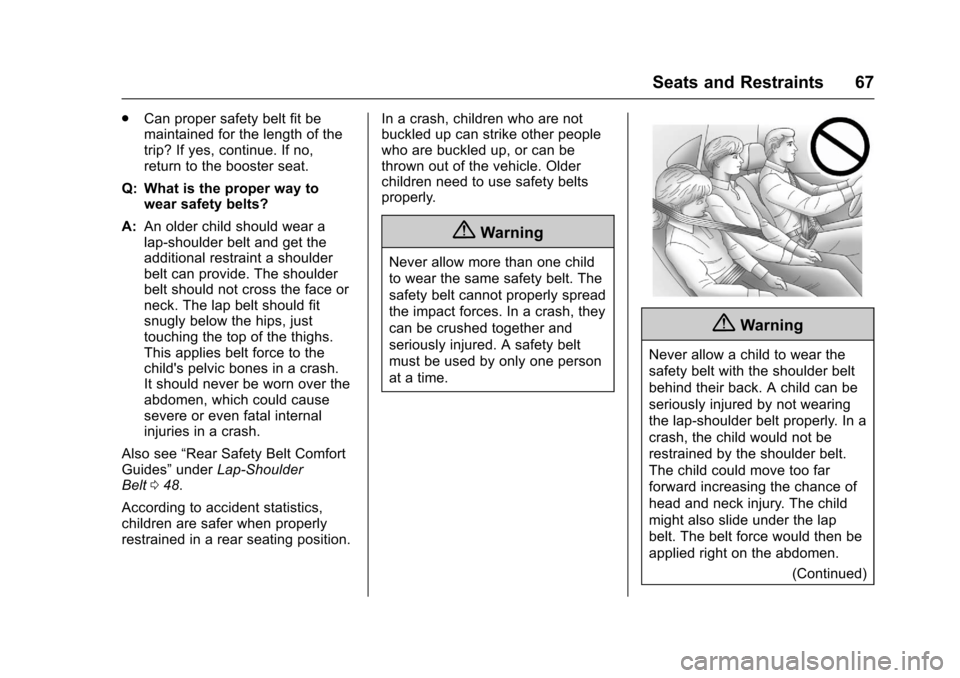
In a crash, children who are notbuckled up can strike other peoplewho are buckled up, or can bethrown out of the vehicle. Olderchildren need to use safety beltsproperly.
{Warning
Never allow more than one child
to wear the same safety belt. The
safety belt cannot properly spread
the impact forces. In a crash, they
can be crushed together and
seriously injured. A safety belt
must be used by only one person
at a time.
{Warning
Never allow a child to wear the
safety belt with the shoulder belt
behind their back. A child can be
seriously injured by not wearing
the lap-shoulder belt properly. In a
crash, the child would not be
restrained by the shoulder belt.
The child could move too far
forward increasing the chance of
head and neck injury. The child
might also slide under the lap
belt. The belt force would then be
applied right on the abdomen.
(Continued)
Page 78 of 346
Chevrolet Express Owner Manual (GMNA-Localizing-U.S./Canada/Mexico-9967827) - 2017 - crc - 5/2/16
Seats and Restraints 77
{Warning
Children can be seriously injured
or strangled if a shoulder belt is
wrapped around their neck. The
shoulder belt can tighten but
cannot be loosened if it is locked.
The shoulder belt locks when it is
pulled all the way out of the
retractor. It unlocks when the
shoulder belt is allowed to go all
the way back into the retractor,
but it cannot do this if it is
wrapped around a child’sneck.
If the shoulder belt is locked and
tightened around a child’sneck,
the only way to loosen the belt is
to cut it.
Buckle any unused safety belts
behind the child restraint so
children cannot reach them. Pull
the shoulder belt all the way out
of the retractor to set the lock,
and tighten the belt behind the
child restraint after the child
restraint has been installed.
Caution
Do not let the LATCH
attachments rub against the
vehicle’ssafetybelts.Thismay
damage these parts. If necessary,
move buckled safety belts to
avoid rubbing the LATCH
attachments.
Do not fold the rear seatback
when the seat is occupied. Do not
fold the empty rear seat with a
safety belt buckled. This could
damage the safety belt or the
seat. Unbuckle and return the
safety belt to its stowed position,
before folding the seat.
If you need to secure more than onechild restraint in the rear seat, seeWhere to Put the Restraint072.
This system is designed to makethe installation of child restraintseasier. When using lower anchors,do not use the vehicle's safety belts.Instead, use the vehicle's anchorsand child restraint attachments to
secure the restraints. Somerestraints also use another vehicleanchor to secure a top tether.
1. Attach and tighten the lowerattachments to the loweranchors. If the child restraintdoes not have lowerattachments or the desiredseating position does not havelower anchors, secure the childrestraint with the top tether andthe safety belts. Refer to yourchild restraint manufacturerinstructions and theinstructions in this manual.
1.1. Find the lower anchorsfor the desired seatingposition.
1.2. Put the child restraint onthe seat.
1.3. Attach and tighten thelower attachments on thechild restraint to the loweranchors.
2. If the child restraintmanufacturer recommends thatthe top tether be attached,attach and tighten the top