2017 CHEVROLET EXPRESS CARGO VAN instrument panel
[x] Cancel search: instrument panelPage 48 of 346
Chevrolet Express Owner Manual (GMNA-Localizing-U.S./Canada/Mexico-9967827) - 2017 - crc - 5/2/16
Seats and Restraints 47
Warning (Continued)
passengers to ride in any area of
the vehicle that is not equipped
with seats and safety belts.
Always wear a safety belt, and
check that all passenger(s) are
restrained properly too.
This vehicle has indicators as areminder to buckle the safety belts.SeeSafety Belt Reminders099.
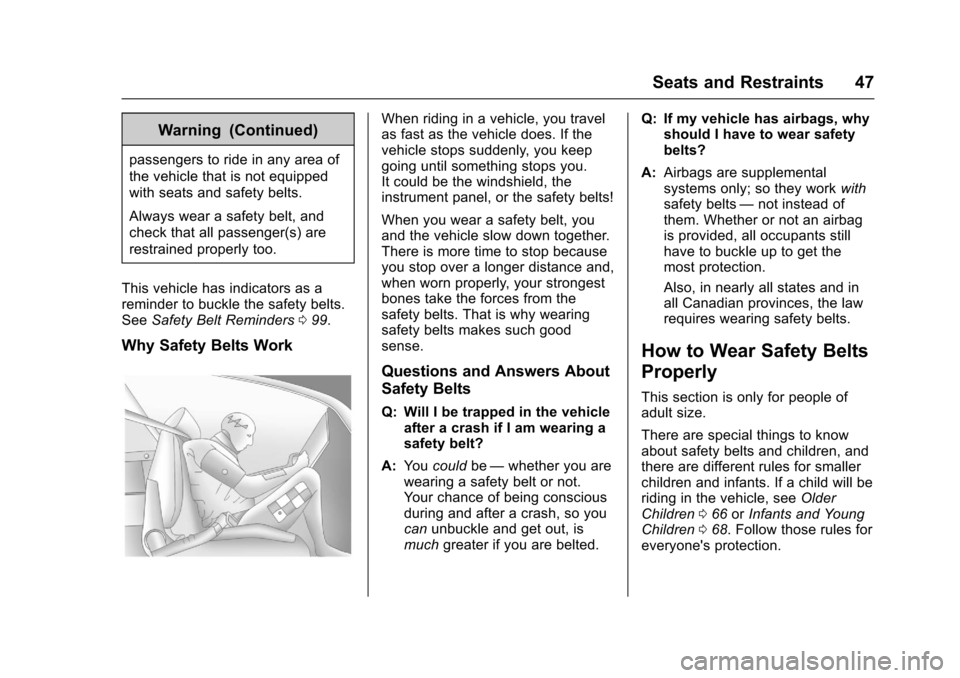
Why Safety Belts Work
When riding in a vehicle, you travelas fast as the vehicle does. If thevehicle stops suddenly, you keepgoing until something stops you.It could be the windshield, theinstrument panel, or the safety belts!
When you wear a safety belt, youand the vehicle slow down together.There is more time to stop becauseyou stop over a longer distance and,when worn properly, your strongestbones take the forces from thesafety belts. That is why wearingsafety belts makes such goodsense.
Questions and Answers About
Safety Belts
Q: Will I be trapped in the vehicleafter a crash if I am wearing asafety belt?
A:Yo ucouldbe—whether you arewearing a safety belt or not.Yo u r c h a n c e o f b e i n g c o n s c i o u sduring and after a crash, so youcanunbuckle and get out, ismuchgreater if you are belted.
Q: If my vehicle has airbags, whyshould I have to wear safetybelts?
A:Airbags are supplementalsystems only; so they workwithsafety belts—not instead ofthem. Whether or not an airbagis provided, all occupants stillhave to buckle up to get themost protection.
Also, in nearly all states and inall Canadian provinces, the lawrequires wearing safety belts.
How to Wear Safety Belts
Properly
This section is only for people ofadult size.
There are special things to knowabout safety belts and children, andthere are different rules for smallerchildren and infants. If a child will beriding in the vehicle, seeOlderChildren066orInfants and YoungChildren068.Followthoserulesforeveryone's protection.
Page 57 of 346
Chevrolet Express Owner Manual (GMNA-Localizing-U.S./Canada/Mexico-9967827) - 2017 - crc - 5/2/16
56 Seats and Restraints
If the van is equipped with asliding door, the roof-rail airbagfor the front outboard passengeris separate from the roof-railairbag for the second and thirdrow passengers seated directlybehind the front outboardpassenger. If the van isequipped with a 60/40 swing-outdoor, a single roof-rail airbagcovers all three seatingpositions.
All vehicle airbags have the wordAIRBAG on the trim or on anattached label near the deploymentopening.
For frontal airbags, the wordAIRBAG is on the center of thesteering wheel for the driver and onthe instrument panel for the frontoutboard passenger.
For seat-mounted side impactairbags, the word AIRBAG is on theside of the seatback closest tothe door.
For roof-rail airbags, the wordAIRBAG is on the ceiling or trim.
Airbags are designed to supplementthe protection provided by safetybelts. Even though today’sairbagsare also designed to help reducethe risk of injury from the force of aninflating airbag, all airbags mustinflate very quickly to do their job.
Here are the most important thingsto know about the airbag system:
{Warning
Yo u c a n b e s e v e r e l y i n j u r e d o r
killed in a crash if you are not
wearing your safety belt, even
with airbags. Airbags are
designed to work with safety
belts, not replace them. Also,
airbags are not designed to inflate
in every crash. In some crashes
safety belts are the only restraint.
SeeWhen Should an Airbag
Inflate?059.
Wearing your safety belt during a
crash helps reduce your chance
of hitting things inside the vehicle
or being ejected from it. Airbags
(Continued)
Warning (Continued)
are“supplemental restraints”to
the safety belts. Everyone in the
vehicle should wear a safety belt
properly, whether or not there is
an airbag for that person.
{Warning
Because airbags inflate with great
force and faster than the blink of
an eye, anyone who is up
against, or very close to any
airbag when it inflates can be
seriously injured or killed. Do not
sit unnecessarily close to any
airbag, as you would be if sitting
on the edge of the seat or leaning
forward. Safety belts help keep
you in position before and during
acrash.Alwayswearasafety
belt, even with airbags. The driver
should sit as far back as possible
while still maintaining control of
the vehicle. The safety belts and
(Continued)
Page 58 of 346
Chevrolet Express Owner Manual (GMNA-Localizing-U.S./Canada/Mexico-9967827) - 2017 - crc - 5/2/16
Seats and Restraints 57
Warning (Continued)
the front outboard passenger
airbags are most effective when
you are sitting well back and
upright in the seat with both feet
on the floor.
Occupants should not lean on or
sleep against the door or side
windows in seating positions with
seat-mounted side impact airbags
and/or roof-rail airbags.
{Warning
Children who are up against,
or very close to, any airbag when
it inflates can be seriously injured
or killed. Always secure children
properly in the vehicle. To read
how, seeOlder Children066or
Infants and Young Children068.
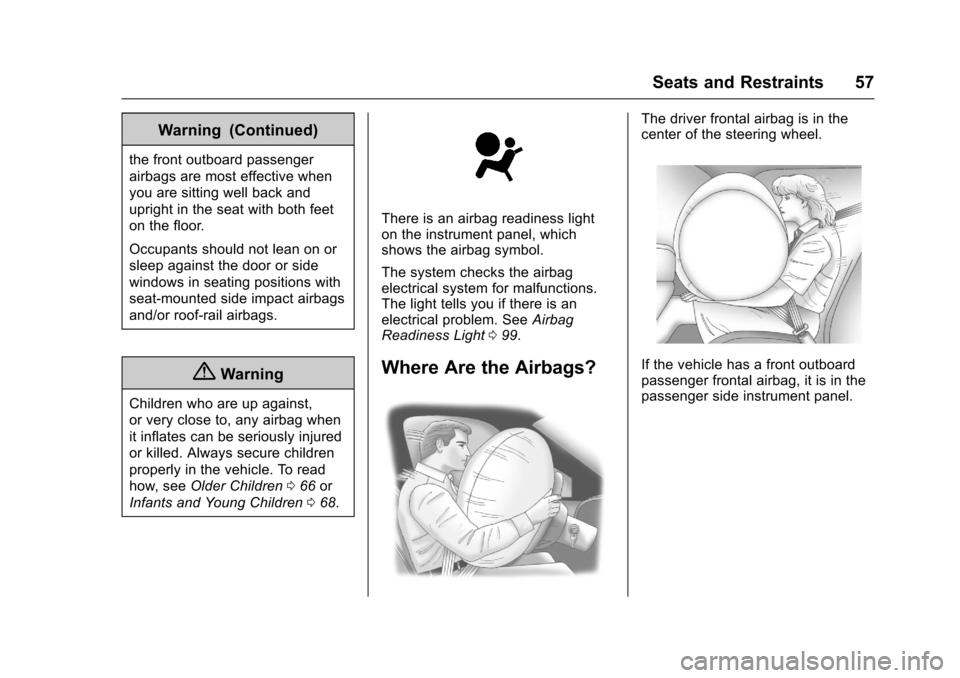
There is an airbag readiness lighton the instrument panel, whichshows the airbag symbol.
The system checks the airbagelectrical system for malfunctions.The light tells you if there is anelectrical problem. SeeAirbagReadiness Light099.
Where Are the Airbags?
The driver frontal airbag is in thecenter of the steering wheel.
If the vehicle has a front outboardpassenger frontal airbag, it is in thepassenger side instrument panel.
Page 61 of 346
Chevrolet Express Owner Manual (GMNA-Localizing-U.S./Canada/Mexico-9967827) - 2017 - crc - 5/2/16
60 Seats and Restraints
of the impact. In addition, theseroof-rail airbags are designed toinflate during a rollover. Roof-railairbags are not designed to inflate infrontal, near-frontal, or rear impacts.All roof-rail airbags will inflate wheneither side of the vehicle is struck orif the sensing system predicts thatthe vehicle is about to roll over onits side.
In any particular crash, no one cansay whether an airbag should haveinflated simply because of thevehicle damage or repair costs.
What Makes an Airbag
Inflate?
In a deployment event, the sensingsystem sends an electrical signaltriggering a release of gas from theinflator. Gas from the inflator fills theairbag causing the bag to break outof the cover. The inflator, the airbag,and related hardware are all part ofthe airbag module.
For airbag locations, seeWhere Arethe Airbags?057.
How Does an Airbag
Restrain?
In moderate to severe frontal ornear frontal collisions, even beltedoccupants can contact the steeringwheel or the instrument panel. Inmoderate to severe side collisions,even belted occupants can contactthe inside of the vehicle.
Airbags supplement the protectionprovided by safety belts bydistributing the force of the impactmore evenly over theoccupant's body.
Rollover capable roof-rail airbagsare designed to help contain thehead and chest of occupants in theoutboard seating positions in thefirst, second, and third rows,if equipped. The rollover capableroof-rail airbags are designed tohelp reduce the risk of full or partialejection in rollover events, althoughno system can prevent all suchejections.
But airbags would not help in manytypes of collisions, primarilybecause the occupant's motion is
not toward those airbags. SeeWhen Should an AirbagInflate?059.
Airbags should never be regardedas anything more than a supplementto safety belts.
What Will You See after
an Airbag Inflates?
After the frontal airbags andseat-mounted side impact airbags (ifequipped) inflate, they quicklydeflate, so quickly that some peoplemay not even realize an airbaginflated. Roof-rail airbags (ifequipped) may still be at leastpartially inflated for some time afterthey deploy. Some components ofthe airbag module may be hot forseveral minutes. For location of theairbag modules, seeWhere Are theAirbags?057.
The parts of the airbag that comeinto contact with you may be warm,but not too hot to touch. There maybe some smoke and dust comingfrom the vents in the deflatedairbags. Airbag inflation does notprevent the driver from seeing out of
Page 63 of 346
Chevrolet Express Owner Manual (GMNA-Localizing-U.S./Canada/Mexico-9967827) - 2017 - crc - 5/2/16
62 Seats and Restraints
Airbag On-Off Switch
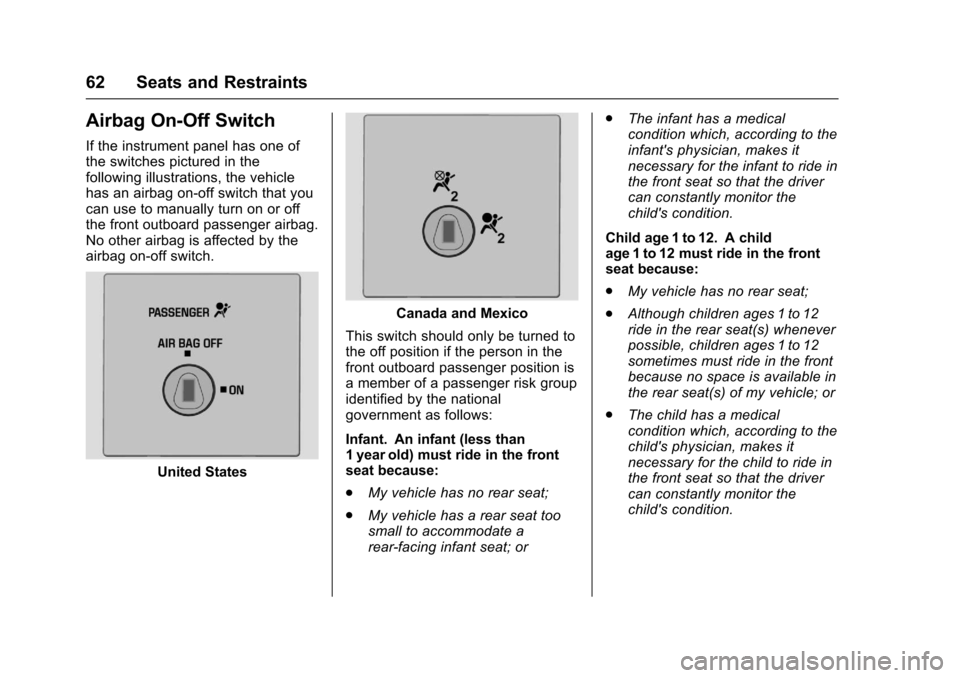
If the instrument panel has one ofthe switches pictured in thefollowing illustrations, the vehiclehas an airbag on-off switch that youcan use to manually turn on or offthe front outboard passenger airbag.No other airbag is affected by theairbag on-off switch.
United States
Canada and Mexico
This switch should only be turned tothe off position if the person in thefront outboard passenger position isamemberofapassengerriskgroupidentified by the nationalgovernment as follows:
Infant. An infant (less than1 year old) must ride in the frontseat because:
.My vehicle has no rear seat;
.My vehicle has a rear seat toosmall to accommodate arear-facing infant seat; or
.The infant has a medicalcondition which, according to theinfant's physician, makes itnecessary for the infant to ride inthe front seat so that the drivercan constantly monitor thechild's condition.
Child age 1 to 12. A childage 1 to 12 must ride in the frontseat because:
.My vehicle has no rear seat;
.Although children ages 1 to 12ride in the rear seat(s) wheneverpossible, children ages 1 to 12sometimes must ride in the frontbecause no space is available inthe rear seat(s) of my vehicle; or
.The child has a medicalcondition which, according to thechild's physician, makes itnecessary for the child to ride inthe front seat so that the drivercan constantly monitor thechild's condition.
Page 64 of 346
Chevrolet Express Owner Manual (GMNA-Localizing-U.S./Canada/Mexico-9967827) - 2017 - crc - 5/2/16
Seats and Restraints 63
Medical Condition. A passengerhas a medical condition which,according to his or her physician:
.Causes the passenger airbag topose a special risk for thepassenger; and
.Makes the potential harm fromthe passenger airbag in a crashgreater than the potential harmfrom turning off the airbag andallowing the passenger, even ifbelted, to hit the instrumentpanel or windshield in a crash.
{Warning
If the front outboard passenger
frontal airbag is turned off for a
person who is not in a risk group
identified by the national
government, that person will not
have the extra protection of an
airbag. In a crash, the airbag will
not be able to inflate and help
protect the person sitting there.
Do not turn off the front outboard
(Continued)
Warning (Continued)
passenger frontal airbag unless
the person sitting there is in a risk
group.
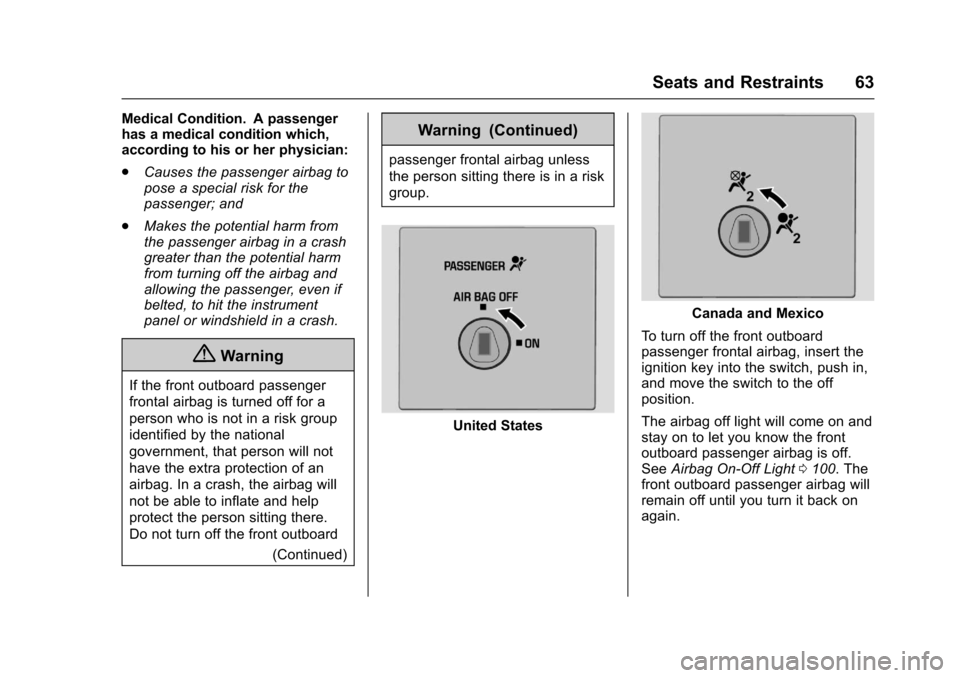
United States
Canada and Mexico
To t u r n o f f t h e f r o n t o u t b o a r dpassenger frontal airbag, insert theignition key into the switch, push in,and move the switch to the offposition.
The airbag off light will come on andstay on to let you know the frontoutboard passenger airbag is off.SeeAirbag On-Off Light0100.Thefront outboard passenger airbag willremain off until you turn it back onagain.
Page 66 of 346
Chevrolet Express Owner Manual (GMNA-Localizing-U.S./Canada/Mexico-9967827) - 2017 - crc - 5/2/16
Seats and Restraints 65
Servicing the
Airbag-Equipped Vehicle
Airbags affect how the vehicleshould be serviced. There are partsof the airbag system in severalplaces around the vehicle. Yourdealer and the service manual haveinformation about servicing thevehicle and the airbag system. Topurchase a service manual, seeService Publications OrderingInformation0321.
{Warning
For up to 10 seconds after the
vehicle is turned off and the
battery is disconnected, an airbag
can still inflate during improper
service. You can be injured if you
are close to an airbag when it
inflates. Avoid yellow connectors.
They are probably part of the
airbag system. Be sure to follow
proper service procedures, and
make sure the person performing
work for you is qualified to do so.
Adding Equipment to the
Airbag-Equipped Vehicle
Adding accessories that change thevehicle's frame, bumper system,height, front end, or side sheetmetal, may keep the airbag systemfrom working properly. Theoperation of the airbag system canalso be affected by changing anyparts of the front seats, safety belts,the airbag sensing and diagnosticmodule, steering wheel, instrumentpanel, any of the airbag modules,ceiling or pillar garnish trim, frontsensors, or airbag wiring.
Yo u r d e a l e r a n d t h e s e r v i c e m a n u a lhave information about the locationof the airbag sensors, sensing anddiagnostic module, and airbagwiring.
If the vehicle has rollover roof-railairbags, seeDifferent Size Tiresand Wheels0269for additionalimportant information.
If you have to modify your vehiclebecause you have a disability andyou have questions about whetherthe modifications will affect the
vehicle's airbag system, or if youhave questions about whether theairbag system will be affected if thevehicle is modified for any otherreason, call Customer Assistance.SeeCustomer AssistanceOffices0314.
Airbag System Check
The airbag system does not needregularly scheduled maintenance orreplacement. Make sure the airbagreadiness light is working. SeeAirbag Readiness Light099.
Caution
If an airbag covering is damaged,
opened, or broken, the airbag
may not work properly. Do not
open or break the airbag
coverings. If there are any
opened or broken airbag
coverings, have the airbag
covering and/or airbag module
replaced. For the location of the
airbags, seeWhere Are the
Airbags?057.Seeyourdealer
for service.
Page 73 of 346
Chevrolet Express Owner Manual (GMNA-Localizing-U.S./Canada/Mexico-9967827) - 2017 - crc - 5/2/16
72 Seats and Restraints
Securing the Child Within the
Child Restraint
{Warning
Achildcanbeseriouslyinjuredor
killed in a crash if the child is not
properly secured in the child
restraint. Secure the child
properly following the instructions
that came with that child restraint.
Where to Put the
Restraint
According to accident statistics,children and infants are safer whenproperly restrained in a childrestraint system or infant restraintsystem secured in a rear seatingposition.
Whenever possible, children age12 and under should be secured inarearseatingposition.
If a child restraint is secured in thefront outboard passenger seat, andthe vehicle has a switch on theinstrument panel to manually turn offthe front outboard passenger airbag,
seeAirbag On-Off Switch062andSecuring Child Restraints (With theSafety Belt in the Rear Seat)079orSecuring Child Restraints (With theSafety Belt in the Front Seat)081for more information, includingimportant safety information.
Never put a rear-facing child seat inthe front. This is because the risk tothe rear-facing child is so great,if the airbag deploys.
{Warning
Achildinarear-facingchild
restraint can be seriously injured
or killed if the front outboard
passenger airbag inflates. This is
because the back of the
rear-facing child restraint would
be very close to the inflating
airbag. A child in a forward-facing
child restraint can be seriously
injured or killed if the front
outboard passenger airbag
inflates and the passenger seat is
in a forward position.
(Continued)
Warning (Continued)
Even if the airbag switch has
turned off the front outboard
passenger frontal airbag, no
system is fail-safe. No one can
guarantee that an airbag will not
deploy under some unusual
circumstance, even though it is
turned off.
Secure rear-facing child restraints
in a rear seat, even if the airbag
is off. If you secure a
forward-facing child restraint in
the front outboard passenger
seat, always move the seat as far
back as it will go. It is better to
secure the child restraint in a
rear seat.
When securing a child restraint in arear seating position, study theinstructions that came with yourchild restraint to make sure it iscompatible with this vehicle.