2017 AUDI TT ROADSTER brakes
[x] Cancel search: brakesPage 91 of 314
CD
CD
.... N
" N ...... 0 r--. V, co
Intelligent Technology
Switching on and off
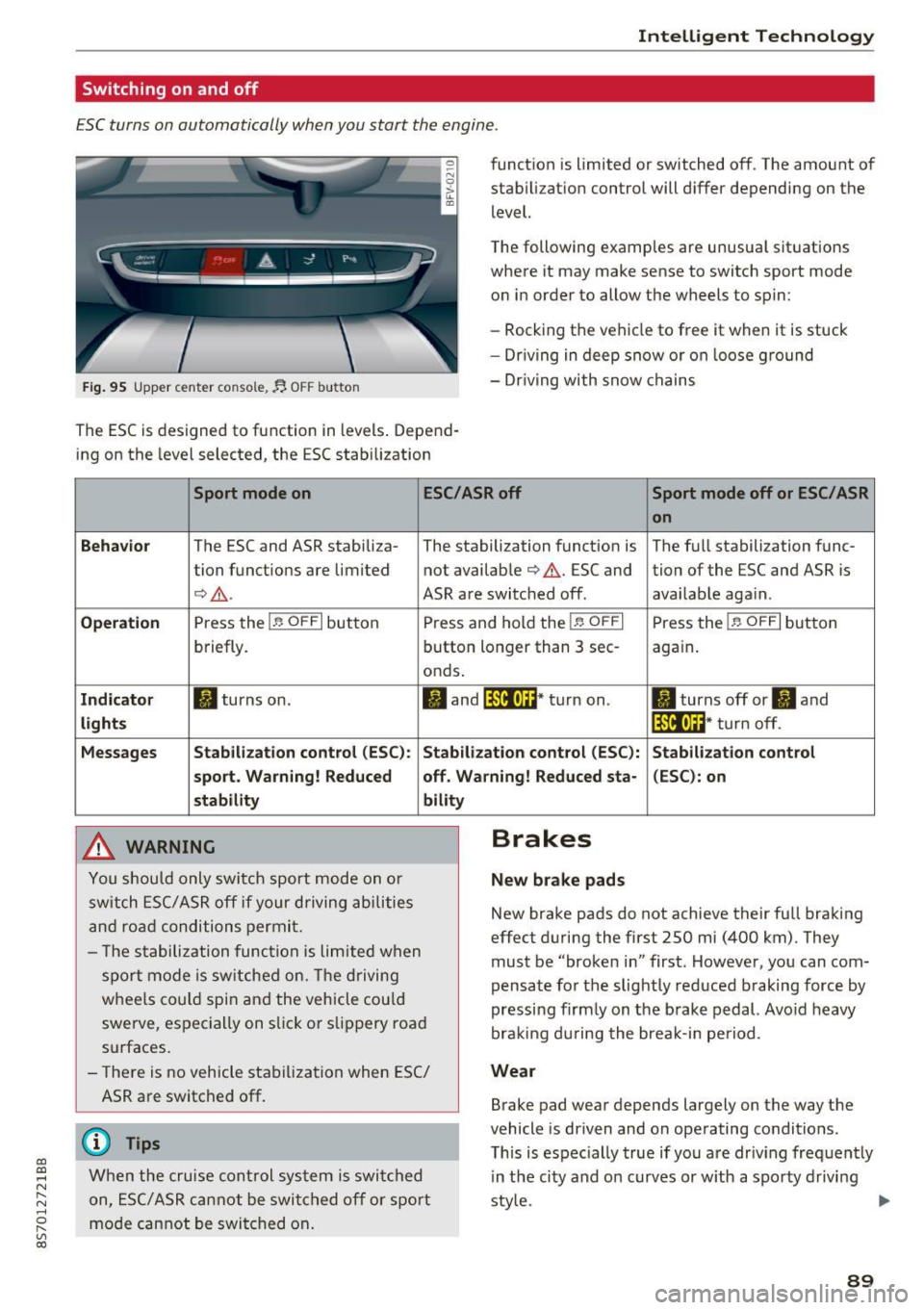
ESC turns on automatically when you start the engine.
Fig. 95 Upper center console, fj. OFF b utton
The ESC is designed to function in levels . Depend
ing on the level selected, the ESC stabilization funct
ion is limited or switched off. The amount of
stab ilizat ion control will d iffer depending on the
level.
T he following examples are unusua l situat ions
where it may make sense to switch sport mode
o n in order to allow the wheels to spin:
- Rocking the vehicle to free it when it is stuck
- Dr iving in deep snow or on loose g round
- Dr iving with snow chains
Sport mode on ESC/ASR off Sport mode off or ESC/ ASR
on
Behavio r
The ESC and ASR stabiliza- The stabilization funct ion is The f ull stabilization func-
tion funct ions are limited not availab le
¢ .&. . ESC and tion of the ESC and ASR is
¢ .&.. ASR are switched off. availab le aga in.
Operation Press the l.e OFFI but ton Press and hold the l.e OFFI Press the l .e OFFI but ton
briefly. button longer than 3 sec- aga in .
onds .
Indicator II turns on. II and l*JJ•U~* tu rn on. II turns off or II and
liil•IH * tu rn off. light s
Messages Stab
ilization control (ESC ): Stab ilization con trol (ESC ): Stab ilization cont rol
sport . Warning! Reduced off. Wa rning! Reduced sta -(ESC): on
stability
A WARNING
Y ou shou ld only swit ch spo rt m ode on or
switch ESC/ ASR off if your driving ab ilities
a n d roa d conditions permi t.
bility
- T he s tabiliz ation func tion is li mite d when
s por t mode is sw itched on. The driving
whee ls co uld spi n and the vehicle cou ld
swerve, espec ially on s lick or s lippery roa d
surfaces.
- There is no vehicle stabi lization when ESC/
ASR are switched off.
(D Tips
Wh en the cruise cont rol sys tem is swi tched
on, ESC/ ASR can not be swi tched o ff or sport
mo de can not be swit ched on .
Brakes
New brake pads
New brake pads do not achieve their fu ll braking
effect duri ng the first 250 mi (400 km) . They
must be "broke n in" first. Howeve r, you can com
pensate fo r th e slightly reduced braking force by
pressing f irm ly on the b rake pedal. Avo id heavy
bra king d urin g the brea k-in pe riod .
Wear
Brake pad wear depends largely on the way the
vehicle is driven and on operating conditions.
T his is espec ially true if yo u are dr iv ing freq uently
in t he ci ty and o n curves or w ith a spo rty d rivi ng
sty le.
IJI,,
89
Page 92 of 314
Intelligent Technology
Operating nois e
Noises may occur when br aking depend ing on the
speed, b raking force and outside cond itions such
as tempe rature and humidity.
Effect of water and road salt
I n ce rtain s ituations, for example after driving
through wa ter, in heavy ra in, afte r ove rnig ht con
densat ion or after washing your car, the braking
effect can be reduced by moisture or ice on the
brake rotors and brake pads. The brakes must be
"dried" first w ith a few careful brake applica
tions.
At highe r speeds and with the windshie ld wipers
turned on, the brake pads press against the brake rotors for a short amount of time . Th is action,
which is not felt by the driver, happens at regular
intervals and ensures a better reaction time for
the brakes in wet weather .
The braking eff ect can also be reduced if you are
driving on salted roads and you do not apply the
brakes for long periods of time. The layer of salt
on the brake rotors and pads must be worn off
first when the brakes are applied .
Corrosion
Leaving the vehicle parked for long periods of
time, low mi leage and avoiding heavy braking
can contribute to corrosion on the brake rotors
and to dirty brake pads .
If you usually avoid heavy braking or if there is
corros ion present, occasional heavy braking at
h igh speeds is recommended to clean the brake
rotors and pads
¢ ,& .
Brake system malfunct ion
if you notice that the brake pedal travel has sud
denly increased, then a brake c ircuit in the dual
circu it brake system may have malfunct ioned.
Drive to an authorized Aud i dea ler or aut horized
Aud i Serv ice Facility immediately to have t he
p roblem co rrected . On the way there, drive with
reduced speed and keep in mi nd that you w ill
need a longer d istance to s top and you w ill need
to p ress the brake pedal har der.
90
Low brake fluid level
When the brake fluid level is low, m alfunc tions in
the b rake system may occur . The brake fluid leve l
i s e lectronically monitored .
Brake booster
The brake booster ampl ifies the press ure you ap
ply to the brake pedal.
_&. WARNING
- New brake pads do no t achieve the ir full
braking effect during the first 2 50 m i
-
(400 km). They m ust be "b roken in" first .
However, you can compensate fo r the
slightly reduced braking force by pressing
firm ly on the brake pedal. Avoid heavy brak
ing during the break-in period .
- On ly app ly the bra kes for the purpose of
cleaning the brake system when road and
traffic conditions permit. You must not en danger other road users . This increases the
ris k of an accident.
- On steep slopes, reduce the speed and se
lect a lower gear o r lower selector leve r po·
si tion. D rive as little as possible while press
ing the bra ke pedal and avoi d pu tting your
left foot on the brake pedal while dr iv ing.
This could cause the bra kes to overhea t and
impair the efficiency of the b rakes.
- Do not let the bra kes "grind" by always
keep ing your foot on the bra ke pe dal. This
can cause the brakes to overheat, inc rease
wear and increase braking distance unneces
sarily .
- Ce rtain weather and operating conditions
such as d riving through water, dr iv ing in
heavy rain or driv ing after wash ing your ve
hicle can impai r the effective ness of the
brakes . In t he win ter, ice may build up o n
the bra ke pa ds, rotors and dr ums. Check
t hese components by b raking carefully. Ap
plyi ng the brakes carefully seve ral times
dries the brakes and removes ice build-up .
- The efficiency o f th e brakes can also be im
p air ed by dr iv ing for long s tretches on roads
covered with sa lt wi thout using the bra kes .
You can remove salt deposits from the ..,.
Page 93 of 314
co
co
.... N
" N .... 0
" "' c:o
brake rotors and pads by caref ull y applying
the brakes several t imes .
-If the front spoiler is damaged or you install
another spoiler, make sure the front wheel
brakes are vent ilated properly. Otherwise,
the brake system could overheat, wh ich re
duces the ir effectiveness .
- Failure of a brake circuit impairs b raking
performance , which increases brak ing dis
tance. Avoid driving the vehicle and have it
towed it to the nearest author ized Audi
dealer or author ized A udi Se rvice Facility.
- Never let the vehicle roll while t he engine is
stopped because this increases the risk of a n
acc iden t.
- If the bra ke booste r is not working, you will
have to press m uch ha rder on the bra ke
ped al to compensate for the lac k of th e
booster.
- Never let the brakes "rub " by pressing the
pedal light ly when bra king is no t actually
ne cessary . T his cause s the brakes to over
hea t and i ncre ases br aking di stance and
ca uses wear.
- B efo re driv ing downh ill a long dis tance on a
steep h ill, decrease your speed and se lec t a
l ower gear . This makes use of the engine
braking effect and relieves the brakes . If
you need to b rake additionally, brake in in
tervals and not continuously.
@ Tips
- If the brake booste r is not working, you
must press the brake pedal with much more
fo rce than normal.
- If you retrofit yo ur vehicle with a front spoil
er, whee l
covers or similar items, make sure
that the air flow to the front whee ls is not
i nterr upted . Otherw ise the brake system
ca n become too hot .
Intelligent Technology
Electromechanical
steering
The electromechanical steering supports the
driver 's steering movements .
Power steering adap ts elec tronically based on
the ve hicle speed.
Indicator light s and message s
• Steering: malfun ction! Please stop vehicle
If this indica to r li ght tur ns on and st ays on and
t hi s message appea rs, the powe r steering may
have failed.
Stop t he vehi cle in a safe location as soon as pos
s ible. Do
not cont inue drivi ng. See an autho riz ed
Audi dealer or authorized A udi Service Fac ility for
assistance .
l;r- ij S teering : malfun ction! You may continue
driving
If the indicator light turns on, the steering wheel
may be more d ifficult to
move or more sensit ive
t h an usua l. Th e steer ing whee l may a lso be at an
angle when d riving s trai ght.
D rive slowly to an a uthorized Audi dea ler or au
t h orized Audi Serv ice Facility to have the mal
funct ion corre cted.
(D Tips
If the . or l;r, ij ind icator light only s tays on
fo r a short time, you may continue d riving.
All wheel drive (quattro)
In all wheel drive, all four wheels are powered.
General information
In all whee l dr ive, the dr iv ing power is divided be
tween all four wheels . This happens automatical
ly depending on you r dr iv ing behav ior as we ll as
t h e cur rent road condi tions. A lso see ~
page 88,
Elec tronic stabilization con trol ( ESC).
T he all whee l dr ive concept is des igned for high
engine power . You r vehicle is except ionally pow
erfu l and has excellent driv ing cha racteristics
bot h unde r normal d rivi ng conditions and o n
91
Page 97 of 314
co
co
.... N
" N .... 0
" "' c:o
for an extremely small period of time. Data that
is recorded in such a case may include vehicle
speed, driving direction, the load on the brakes
and head restraints and performance in the event
of an acc ident or other change in status. The
stored data can only be read or downloaded with
special devices .
Intelligent Technology
95
Page 250 of 314

Wheels
able to provide you with more in
formation.
® Mud and snow capability
"M/S" or "M+S" indicates the tire
has properties making it suitable
to drive in mud or snow.
& indi
cates a w inter t ire.
@ Compos ition of the tire cord
and materials
The number of plies indicates the
number of rubberized fabric lay
ers in the tire . In general: the
more layers, the more weight a
tire can carry. Tire manufacturers must also specify the materia ls
used in the tire. These include
steel, nylon, polyester and other
materials .
@ Maximum permitted load
This number indicates the maxi
mum load in k ilograms and
pounds that the tire can carry.
@ Uniform tire quality grade
standards for treadwear,
traction and temperature
resistance
Tread wear, t raction and temper
ature ranges ¢
page 262.
248
@ Running direction
~ Maximum permitted
inflation pressure
This number indicates the maxi
mum pressure to wh ich a t ire can
be inflated unde r normal operat
ing condit ions .
Glossary of tire and loading
terminology
Accessory weight
means the combined weight (in
excess of those standard items
which may be replaced) of auto
matic transmission , power steer
ing , power brakes , power win
dows, power seats , radio, and
heater, to the extent that these
items a re available as fac tory-in
stalled equipment (whet her in
stalled or no t).
Aspect ratio
means the rat io of the height to
the width of the tire in pe rcent.
Numbers of 55 or lower indicate a
low sidewall fo r imp roved steer
ing response and better overa ll
handling on dry pavement .
Bead
means the part of the tire that is
made of steel wires, wrapped or ...
Page 252 of 314
Wheel s
(c) Vehicle capaci ty weight, and
(d) Production options we ig ht
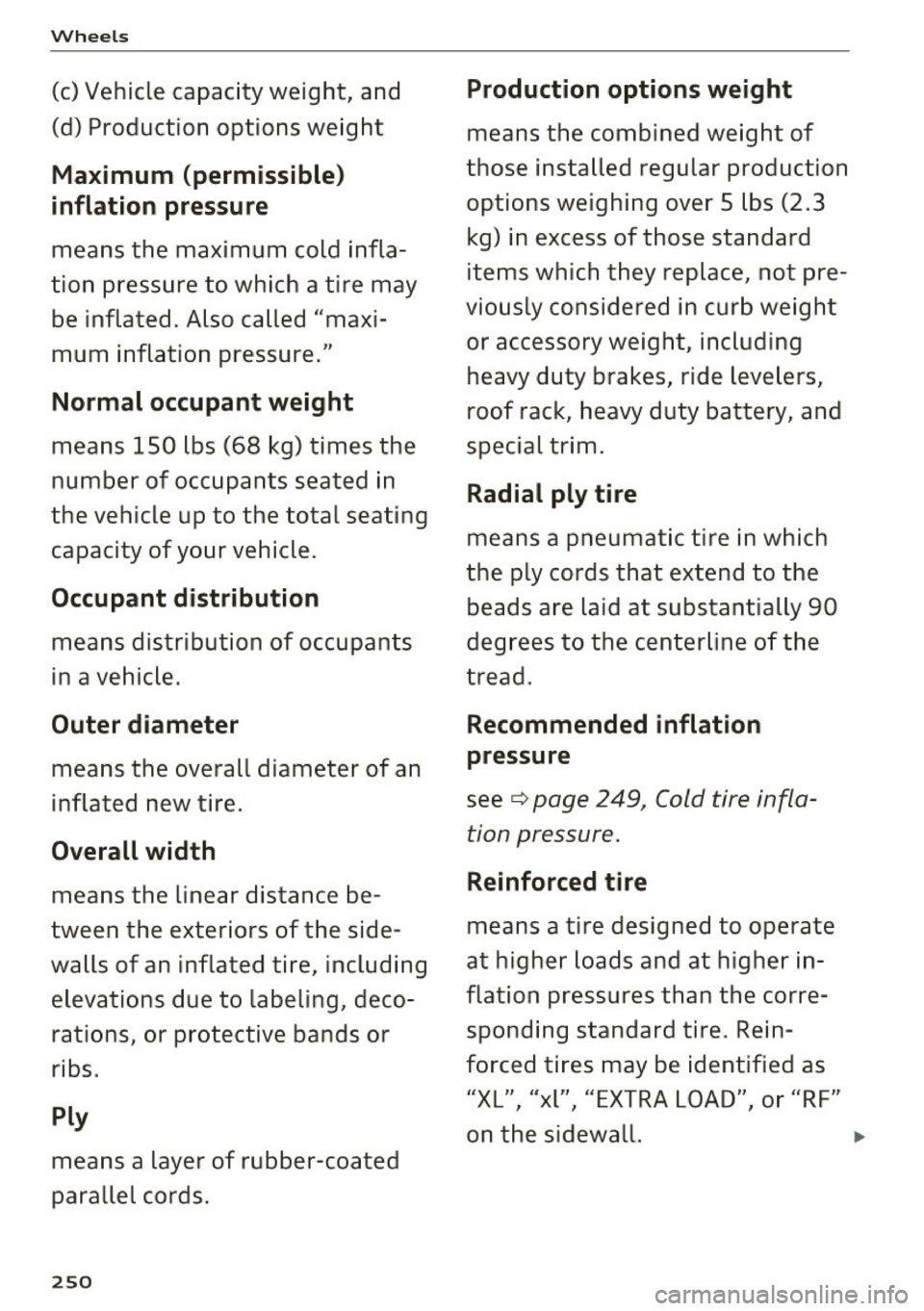
Maximum (permissible)
inflation pressure
means the maximum cold infla
tion pressure to which a tire may be inflated . Also called "max i
mum i nflation pressure ."
Normal occupant weight
means 150 lbs (68 kg) times the
number of occupants seated in
the vehicle up to the to tal seat ing
capacity of your vehicle .
Occupant distribution
means distribution of occupants
in a vehicle.
Outer diameter
means the overall diameter of an
inflated new tire.
Overall width
means the linear distance be
tween the exteriors of the side
walls of an inflated tire, inc luding
e levations due to label ing, deco
rations, or protective bands or
ribs .
Ply
means a layer of rubber-coated
parallel cords .
250
Production options weight
means the combined weight of
those installed regular product ion
options weighing over 5 lbs (2.3 kg) in excess of those standard
items which they replace, not pre
viously considered in curb weight or accessory weight, including
heavy duty brakes , ride levelers,
roof rack, heavy duty ba ttery, a nd
special trim.
Radial ply tire
means a pneumatic tire in which
the ply cords that extend to the
beads are la id at substantially 90
deg rees to the centerline o f the
tread.
Recommended inflation
pressure
see ¢ page 249 , Cold tire infla
tion pressure.
Reinforced tire
means a tire designed to operate
at higher loads and at higher in
flation pressures than the corre
sponding standard tire . Rein
forced tires may be identified as "XL", "xl", "EXTRA LOAD", or "RF"
on the s idewall. ...
Page 261 of 314
a, a, ... N
" N ... 0
" V, a:,
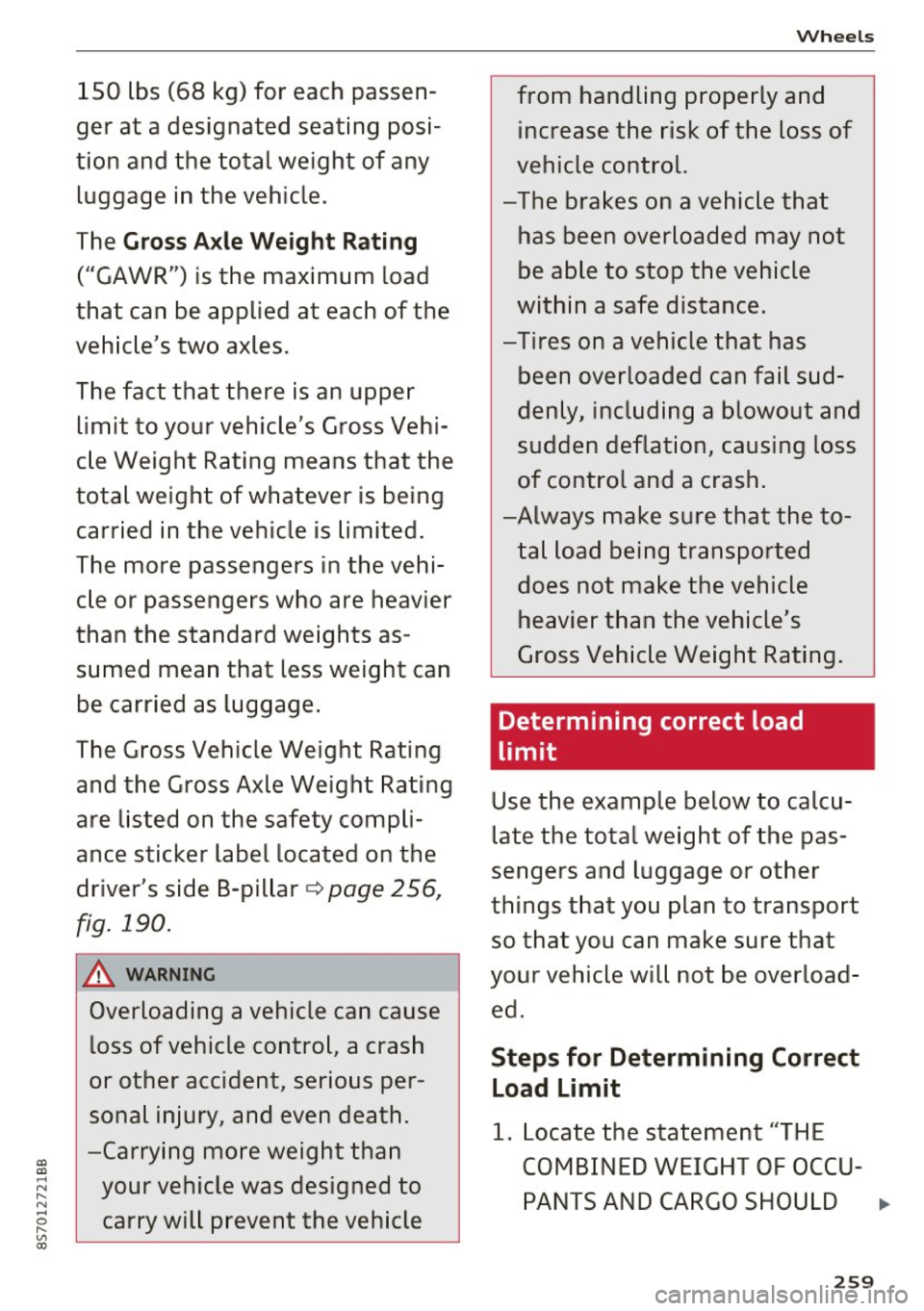
150 lbs (68 kg) for each passen
ger at a designated seating posi
tion and the total weight of any
luggage in the vehicle .
The
Gross Axle Weight Rating
("GAWR") is the maximum load
that can be applied at each of the
vehicle's two axles.
The fact that there is an upper
limit to your vehicle's Gross Vehi
cle Weight Rating means that the
total weight of whatever is being
carried in the vehicle is limited.
The more passengers in the vehi
cle or passengers who are heavier
than the standard weights as
sumed mean that less weight can
be carried as luggage.
The Gross Vehicle Weight Rating
and the Gross Axle Weight Rating
are listed on the safety compli
ance sticker label located on the
driver's side 8-pillar
¢ page 256,
fig. 190.
&_ WARNING
Overloading a vehicle can cause
loss of vehicle control, a crash
or other accident, serious per
sonal injury, and even death.
-Carry ing more weight than
your vehicle was designed to
carry will prevent the vehicle
Wheels
from handling properly and
increase the risk of the loss of
vehicle control.
-The brakes on a vehicle that
has been overloaded may not
be able to stop the vehicle
within a safe distance.
-Tires on a vehicle that has
been overloaded can fail sud
denly, including a blowout and
sudden deflation, causing loss
of control and a crash.
-Always make sure that the to tal load being transported
does not make the vehicle
heavier than the vehicle's
Gross Vehicle Weight Rating.
Determining correct load
limit
Use the example below to calcu
late the total weight of the pas
sengers and luggage or other
things that you plan to transport
so that you can make sure that
your vehicle will not be overload ed.
Steps for Determining Correct Load Limit
1 . Locate the statement "THE
COMBINED WEIGHT OF OCCU-
PANTS AND CARGO SHOULD .,.
259
Page 269 of 314
co
co
.... N
" N .... 0
" "' c:o
wash operator to reduce the risk of accidents.
- To reduce the risk of cuts, protect yourself
from sharp metal components when wash
ing the underbody or the inside of the wheel
housings .
- After washing the vehicle, the brak ing effect
may be delayed due to mo isture on the
brake rotors or ice in the w inter . This in
creases the risk of an acc ident. The brakes
must be d ried fi rst w ith a few careful b rake
applications.
(D Note
- If you wash t he vehicle in an automatic car
wash, yo u m ust retract the extendable rear
spo iler* if necessary, and fold the exter ior
mir rors in to red uce the risk of damage.
Power folding e xte rior m irrors * mus t onl y
be fo lded in and ou t using the power folding
f u nct ion .
- To reduce the risk of pai nt d amage, do no t
wash the vehicle in di rect sunlig ht.
Ca re and cleaning
- To re duce the risk of damage, do not wash
the power top with a pressure washer .
- T o red uce the risk of damage to the surface,
do not use insect removing sponges, kitche n
sponges o r similar items .
- Matte finish painted veh icle components:
- To reduce the risk of damage to the sur-
face, do not use polishing agents or hard
wax.
- Never use protective wax. It can destroy
the matte finish effect .
- Do not place any stickers or magnetic
signs on vehicle parts painted with matte
finish paint . The paint could be damaged
when the stickers or magnets are re
moved.
@ For the sake of the environment
Only wash t he veh icle in facili ties s pec ially de
s igned for that pu rpose . This will reduce the
r isk of dirty wate r contamina ted with o il from
ente ring the sewe r sys tem.
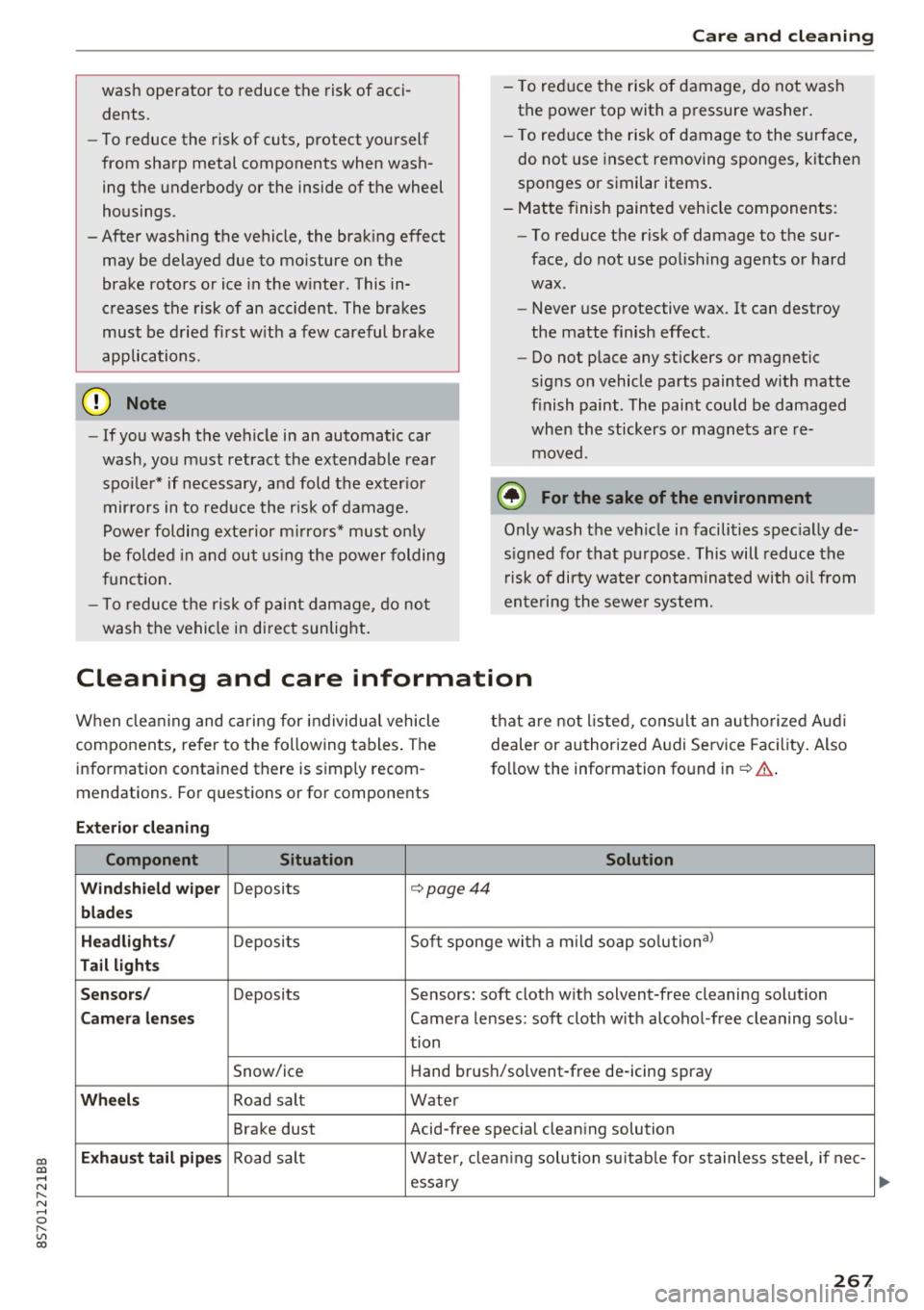
Cleaning and care information
W hen cle aning and ca ring for individua l vehicle
components, refer to the following tables . The
info rmation contained there is simply recom
mendations. Fo r questions or for components t
h at are not l isted, cons ult an autho riz e d Aud i
dealer or au thorized A udi Service Fac ility . Also
fo llow the information found in¢& .
Exterior cleaning
Component Situation Solution
Windshield wiper
Deposits c::- page44
blades
Headlights /
Deposit s So
ft sponge wi th a m il d soap solutiona )
Tail light s
Sensors /
Deposits Sensors: soft cloth with solvent-free cleaning solut ion
Camera lenses Camera lenses: soft cloth w ith alcohol -free cleaning solu -
tion
Snow/ice H
and brus h/solvent-free de-icing spray
Wheels Road salt Water
Brake dust Acid-free special clean ing solution
Exhaust tail pipes Road salt Water, clea ning solution su itab le for stainless stee l, if nee-
essa ry
267