2017 AUDI Q5 seat adjustment
[x] Cancel search: seat adjustmentPage 136 of 296
Driving sa fe ty
-Always keep your feet on the floor in front
of the seat. Never rest them on the seat, in
strument pane l, out of the window, etc. The
airbag system and safety belt will not be
able to protect you properly and can even in
c rease the risk of injury in a crash .
- Never dr ive with the backrest reclined or
t il ted far bac k! The farther the backrests are
t il ted back, the greater the risk of in ju ry due
to incorrect positioning of the safety belt and imp roper seating position.
- Children must always ride in child safety
seats r=;,
page 168 . Special pre caut ions ap
ply when installing a ch ild safety seat on the
front passenger seat r=;,
page 148.
Proper seating positions for passengers in
rear seats
Rear seat passengers must sit upright wi th both
feet on the floor consistent with their physical
size and be properly restrained whenever the ve
hicle is in use.
To reduce the risk of injury caused by an inco rrect
seating position in the event of a sudden braking maneuver or an accident, your passengers on the
rear bench seat must always observe the follow
ing :
~ If there is a passenger on the rear center seat
ing pos it ion, slide the center head restra int up
ward at least to the next notch r=;,
page 64.
~ Make sure that the seatback is securely latched
in the upright pos ition r=;,
page 66.
~ Keep both feet flat in the footwell i n front of
the rear seat.
~ Fasten and wea r safety be lts p roperly
r:=;, page 143.
~ Make s ure that children are always properly re
strained in a c hild rest raint t hat is appropriate
f or their size and age r=;,
page 168.
A WARNING
Passengers who are improperly seated on the
rear seat can be seriously injured in a crash.
- Each passenger must always sit on a seat of their own and properly fasten and wear the
safety belt belonging to that seat.
134
- Safety belts only offer maximum protect ion
when the seatback is securely latched in the upright pos ition and the safety belts are
properly posit ioned on the body . By not sit
ting upright, a rear seat passenger increases
the risk of personal injury from imprope rly
posi tioned safety belts!
- Always ad just the head restra int properly so
that it can give maximum p rotection.
Proper adjustment of head restraints
Correctly adjusted head restraints are an impor
tant part of your vehicle's occupant restraint sys
tem and can help to reduce the risk of injuries in
accident situations.
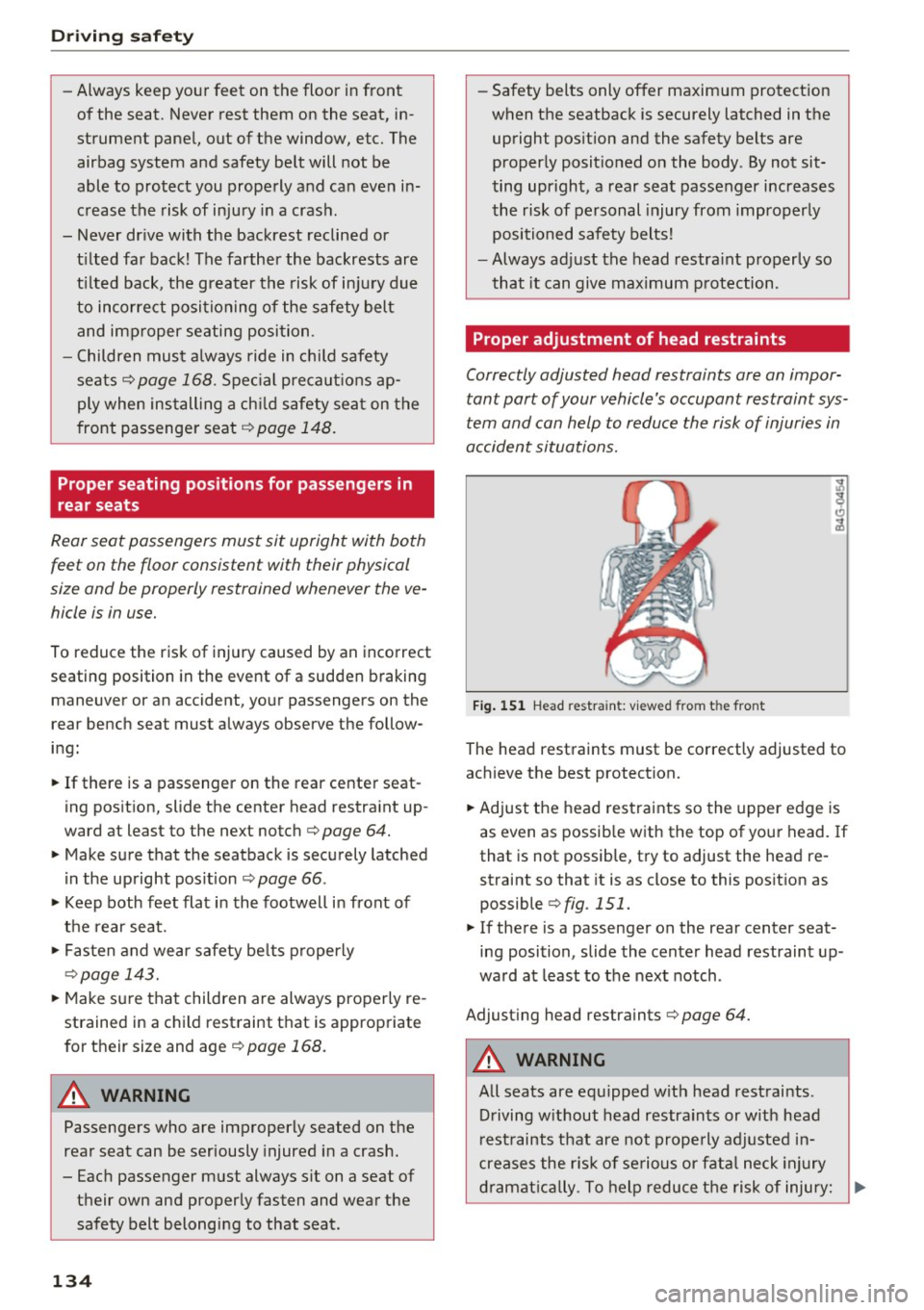
Fi g. 1 51 Head restra int: v iewed from t he front
The head restraints must be correctly adjusted to
achieve the best protection.
~ Adjust the head rest raints so the upper edge is
as even as possib le w ith the top of you r head. If
that is not possible, t ry to adjust the head re
straint so that it is as close to this pos it ion as
possible r=;,
fig. 151.
~ If there is a passenger on the rear center seat
ing position, slide the center head restraint up
wa rd at least to the nex t notch .
Adjust ing head restraints r=;,
page 64.
A WARNING -
All seats are equipped w ith head restraints.
Driving w ithout head restraints or w ith head
rest raints tha t are not prope rly adjusted in
creases the r isk of se rious or fata l neck injury
d ra mat ic al ly. To help reduce t he risk of injury:
Ill-
Page 146 of 296

Safe ty belts
Autom ati c s afet y belt retr actors
Every safety belt is equ ipped with an automa tic
be lt retractor on the shoulder belt. This feature
locks the belt when the belt is pulled out fast,
during hard braking and in a n accident. The belt
may a lso lock when you drive up or down a steep
hill or through a sharp curve. Dur ing normal driv
ing the belt lets you
move freely.
Safety belt p ret en sion ers
The safety belts are equipped with a belt preten
sioner that helps to t ighten the safety belt and
remove slack when the pretensioner is activated.
The function of the pretensioner is mon itored by
a warning light
r:::') page 13.
Swi tc hable l ocking f eature
Every safety belt except the one on the driver
seat is equipped with a switchable locking fea
ture that
must be used when the safety belt is
used to attach a child safety seat. Be sure to read
the impo rtant information about this feature
r=;,page 178.
.&_ WARNING
Improperly pos itioned safety be lts can cause
ser ious injury in an accident
c:> page 144,
Safety belt position.
- Safety belts offer optimum protection only
when the seatback is upright and belts are
properly positioned on the body.
- Always make sure that the rear seat bac k
rest to which the center rea r safety belt is
attached is secure ly latched whenever the
rear center safety belt is being used. If the
backrest is not securely latched, the passen
ger will move forward with the backrest dur
ing sudden braking, in a sudden maneuver
and especially in a crash.
- Never attach the safety belt to the buckle for another seat. Attaching the belt to the
wrong buckle wi ll reduce safety belt effec
t iveness and can cause serious persona l in
jury.
- A passenger who is not properly restrained can be seriously in ju red by the safety be lt it
self when it moves from the stronger parts
144
of the body into critical areas like the abdo men.
- Always lock the convertible locking retractor
when you are securing a child safety seat in
the vehicle
c:> page 180.
Safety belt position
Correct belt position is the key to getting maxi
mum protection from safety belts .
Fig. 160 Safety belt posit ion
-"' .... 9 I ... a,
Standard features on your vehicle help you adjust
the position of the safety belt to match your body
s ize.
- belt height adjustment for the front seats,
- height-adjustab le front seats.
.&_ WARNING
Improperly positioned safety belts can cause
serious pe rsonal injury in an acc ident .
- The shoulder belt should lie as close to the
center of the collar bone as possible and
should fit well on the body. Hold the belt
above the latch tongue and pull it evenly
across the chest so that it s its as low as pos
sib le on the pe lvis and there is no p ressure
on the a bdomen . The belt sho uld a lways f it
snug ly
r:::;, fig. 160. Pull on the belt to tig hten
if necessary .
- The lap be lt portion of the safety belt must
be positioned as low as possible across pel
vis and never over the abdomen. Make sure
the belt lies flat and snug
c:> fig. 160. Pull on
the belt to tighten if necessary.
- A loose-fitting safety belt can cause serious injuries by sh ifting its position on your body ..,_
Page 147 of 296

a,
a,
..... N r-N ..... 0 0
0:
co
from the strong bones to more vulnerable,
soft tissue and cause serious injury.
- Always read and heed all WARNINGS and
other important information
9 page 142.
Pregnant women must also be correctly
restrained
The best way to protect the fetus is to make sure
that expectant mothers always wear safety belts
correctly -throughout the pregnancy .
Fig. 161 Safety belt position during pregnancy
To provide maximum protection, safety belts
must always be positioned correctly on the wear
e r's body
c::> page 144.
• Adjust the front seat and head restraint cor
rectly
c::> page 60, General information .
• Make sure the seatback of the rear seat bench
is in an upright position and securely latched in
place before using the belt.
• Pull the safety belt evenly across the chest so
that it sits as low as possible on the pelvis and
there is no pressure on the abdomen
c::>fig . 161, c::> .&_ .
• Inse rt the tong ue into the correct buckle of
your seat until you hear it latch securely
c::>page 143, fig . 159.
• Pull on the belt to make sure that it is securely
latched in th e buckle.
& WARNING
Improperly positioned safety belts can cause
ser ious personal injury in an accident.
- Expectant mothers must always wear the
lap portion of the safety belt as low as pos
sible across the pelvis and below the round
ing of the abdomen .
Safety belts
-Always read and heed all WARNINGS and
other important information
c::> A in Fasten
ing safety belts on page 144.
Unfastening safety belts
Unbuckle the safety belt with the red release
button only o~er the vehicle has stopped.
Fig. 162 Releasing the tongue from the buckle
.,. Push the red release button on the buckle
c::> fig. 162 . The belt tongue will spring out of
the buckle
c::> ,&..
• Let the belt wind up on the retractor as you
guide the belt tongue to its stowed position.
& WARNING
Never unfasten safety belt while the vehicle is
moving. Doing so will increase your risk of be
ing injured or killed.
Adjusting safety belt height
With the aid of the safety belt height adjust
ment, the three point safety belt strap routing
can be fitted to the shoulder area, according to
body size .
Fig. 163 Safety belt height adjustment for the front seats
... 0 0
0
6 ... a,
-loop-around fittings Ill>
145
Page 148 of 296

Safety belts
The shou lder belt should lie as close to the center
of the collar bone as possib le and should fit well
on the body
c::> A in Safety belt position on
page 144.
"' Push
the loop -around fittings up c::> fig. 163 @,
or
"'squeeze together the (D button, and push the
loop-around fittings down@.
"'Pull the belt to make sure that the upper at
tachment is properly engaged .
A WARNING
Always read and heed all WARNINGS and oth er important informat ion
c::> page 142.
(D Tips
With the front seats, the height adjustment of the seat can also be used to adjust the po
sition of the safety belts.
Improperly worn safety belts
Incorrectly positioned safety belts can cause se
vere injuries.
Wearing safety belts improperly can cause seri
ous injury or death. Safety belts can only work
when they are correctly positioned on the body.
Improper seating positions reduce the effect ive
ness of safety belts and will even inc rease the
risk of injury and death by mov ing the safety belt
to cr it ica l areas of the body. Improper seating
positions a lso increase the risk of serious injury
and death when an airbag deploys and strikes an
occupant who is not in the correct seating pos i
tion. A driver is responsible for the safety of all
veh icle occupants and especially for children.
Therefore:
"' Never permit anyone to assume an incorrect
sitting position in the vehicle while traveling
c>_& .
A WARNING
Improperly worn safety belts increase the risk
of serious personal injury and death whenever
a vehicle is being used.
146
- Always make sure that all vehicle occupants
are correctly restrained and stay in a correct
seating position whenever the vehicle is be
ing used.
- Always read and heed all WARNINGS and
other important informat ion
c::> page 142.
Belt tensioners
How safety belt pretensioners work
In front, side and rear-end collisions above a
particular severity and in a rollover, safety belts ore tensioned automatically.
The safety belts are equipped w ith safety belt
pretensioners . The system is activated by sensors
i n front, side and rear-end collisions of great se
verity and in a rollover. This tightens the belt and
takes up belt slack
c::> & in Service and disposal of
safety belt pretensioner on page 147.
Taking up
the slack helps to reduce forward occupant
movement during a collision.
(D Note
Never let the belt remain over a rear seatback
that has been folded forward .
@ Tips
The safety belt pretensioner can only be acti
vated once.
- Th e safety belt pretensioners do not deploy
in minor frontal, side and rear-end colli
sions.
- When the safety belt pretensioners are acti
vated, a fine dust is released. This is normal
and is not caused by a fire in the vehicle.
- Th e relevant safety requirements must be
observed when the vehicle or components
of the system are scrapped. An authorized
Audi dealer or qualified workshop is familiar
with these regulations and will be pleased
to pass on the information to you.
- Be sure to observe all safety, environmental
and other regulations if the vehicle or indi
vidual parts of the system, particularly the
safety belt or airbag, are to be disposed. We
recommend you have your authorized Aud i
dealer perform this service for you.
Page 150 of 296

Airbag syste m
Airbag system
Important information
Importance of wearing safety belts and
sitting properly
Airbags are only supplemental restraints . For
airbags to do their job, occupants must always
properly wear their safety belts and be in a prop
er seating position.
For your safety and the safety of your passen
ge rs , before driving off, always :
"' Adjust the driver's seat and steering wheel
properly ¢
page 132,
"'Adjust the front passenge r's seat properly
¢ page 61,
"'Wear safety belts p roperly ¢ page 142 ,
"'Always properly use the proper child restraint
to protect children
¢ page 168.
In a coll is io n airbags must inflate wi thin the b link
of an eye and with cons iderable force . The sup
p lemental airbags can cause injuries if the driver
or the front seat passenger is not seated proper·
Ly. T herefore in order to help the airbag to do its
job, it is important, both as a dr iver and as a pas
senger to sit properly at all t imes .
By keeping room between your body and the
steering whee l and the front of the passenger
compartment, the a irbag can inflate fully and
completely and provide supplemental protect ion
in certain frontal collisions¢
page 132, Correct
passenger seating positions .
For details on the
operation of the seat adjustment con trols
¢ page 61.
It's especially important that children are proper
ly restra ined
¢ page 168 .
There is a lot that the driver and the passengers
can and must do to help the ind iv idual safety fea
tures installed in your Audi work together as a
system .
Proper seating posit ion is important so that the
front airbag on the drive r side can do its job. If
you have a physical impairment or cond ition that
prevents you from s itting properly on the driver
seat with the safety be lt properly fastened and
148
reaching the peda ls, special modifications to
your vehicle may be necessary.
Contact yo ur aut ho rized Aud i dea le r, or call A udi
C u stomer Rela tions a t 1-800-822-2834.
When the airbag sys tem dep loys, a gas generator
will fill the airbags, b reak open the padded cov
e rs, and inflate betwee n the steering wheel and
the driver and between the inst rument pa nel and
the front passenger . The a irbags w ill deflate im
mediate ly after dep loyment so t hat the front oc
cupants can see th ro u gh the windsh ie ld again
without interruption.
A ll of th is takes p lace in the blink of an eye, so
fast that many people don't even rea lize that the
airbags have deployed. The airbags a lso inflate
with a great deal of force and nothing should be i n the ir way when they deploy. Front airbags in
combination with properly worn safety belts slow
down and lim it t he occupant's forward move
ment . T ogether they he lp to prevent the driver
and front seat passenger from h itti ng pa rts of
t h e ins ide the veh icle w hile reducing the fo rces
acti ng on the occupant dur ing the cras h. In th is
way they help to reduce the risk of inju ry to the
head and uppe r body i n the crash. Airbags do not
protect the arms or the lower parts of the body.
Both front airbags will not inflate in all frontal
collisions . The trigge ring of the airbag system de
pends on the vehicle deceleration rate caused by
the coll is ion and registered by the electronic con
tro l unit . If this rate is be low the reference value
programmed into the contro l unit, the airbags
will not be triggered, even though the car may be
badly damaged as a resu lt of the co llision. Vehi
cle damage, repa ir costs or even the lack of vehi
cl e damage is not ne cessari ly an indication of
whethe r an a irbag should infla te o r not.
It is not possib le to define a range of vehicle
speeds that w ill cove r every possible k ind and an
gle of impa ct that will always tr igger the airbags ,
s in ce the circumst ances w ill vary cons iderably be
tween one collision and anot her. Important fac
tors include, for examp le, the natu re (hard or
soft) of the object which the car hits, t he angle of
i mpact, vehicle speed, etc . The front airbags will ..,_
Page 153 of 296

CD
CD
.... N ,-... N ..... 0 0 C<'. 00
-The inflating airbag will hit the child safety
seat or infant carrier with great force and
will smash the chi ld safety seat and child
against the backrest, center armrest, door
or roof .
- Always install rear-facing child safety seats
on the rear seat.
- If you must install a rearward fac ing ch ild
safety seat on the front passenger seat be cause of exceptional circumstances and the
PASSENGER AIR BAG OFF light does not
come on and stay on, immed iate ly install
the rear-fac ing ch ild safety seat in a rear
seating pos it ion and have the airbag system
inspected by your a uthorized Audi dea le r.
- Forward-fac ing ch ild safety sea ts installed
on the front passenger's seat may interfere
with the deployment of the airbag and
cause serious personal injury to the child.
~ WARNING
If, in except ional circumstances, you must in
stall a forward-facing chi ld restraint on the
front passenger 's seat:
- Always ma ke sure the forward-fac ing seat
has been designed and certified by its man
ufacturer for use on a front seat with a pas
senger front and s ide a irbag.
- Never put the forward-facing child restraint
up against or very near the instrument pan
el.
-Always move the front passenger seat to
the highest position in the up and down ad
justment range and move it back to the
rea rmost position in the seat's fore and aft
adjustment range, as fa r away from the air
bag as possib le, before insta lling the for
ward- facing child restra int .
- Always ma ke sure tha t the safety belt upper
anchorage is beh ind the child restrain t and
not next to or in front o f the chi ld restraint
so that the safety belt will be properly pos i
tioned.
- Make sure that the
PASSENGER AIR BAG
OFF
light comes on and stays on all the time
whenever the ignition is switched on.
Airb ag sys tem
A WARNING
To reduce the risk of serious injury, make sure
that the
PASSENGER AIR BAG OFF light will
be d isplayed whenever a child restraint is in
stalled on the front passenger seat and the
i gnition is switched on .
-If the PASSENGER AIR BAG OFF light does
not stay on , perform t he checks desc ribed
~ page 158, Monitoring the Advanced Air
bag System.
- Take the child restra int off t he front passen
ge r seat an d install it prope rly at one of the
rear sea t positions i f the
PASSENGER AIR
BAG OFF
light does not stay on .
- Have the air bag system inspec ted by your
author ized Audi dealer immed iate ly .
- Always c are fully follow ins tructions from
child restrain t manufacture rs when instal
ling child restraints .
If, in exceptional c ircumstances, you must in
stall a forward or rearward-facing child re
stra int on the front passenger's seat:
- Imp roper installation of child restraints can
reduce their effectiveness or even prevent
them from providing any protect ion.
- An improperly installed child restra int can
interfere with the airbag as it deploys and
serious ly injure or even kill the chi ld -even
with an Advanced A irbag System.
- Always care fully follow the manufacturer 's
instr uctions provided with the child safety
seat or carr ie r.
- Never p lace add itiona l items on the seat
that can increase the total weight registered by the weight -sensing mat and can cause in
jury in a crash.
151
Page 156 of 296

Airbag syste m
-a small adu lt or teenager is on the front pas
senger seat
- a passenger who is not sitting upright with
their back against a non -reclined backrest with
their feet on the vehicle floor in front of the
seat is on the front passenger seat.
I f the front passenger airbag dep loys, the Feder
al Standard requires the airbag to meet the "low
risk" deployment criteria to help reduce the risk
of injury through interaction with the airbag.
"Low risk" deployment occurs in those crashes
that take place at lower decelerations as def ined
in the electronic control unit.¢
page 158
Alway s remember: Even though your vehicle is
equ ipped w ith Advanced Airbags, the safest place
for children is properly restrained on the back
seat . Please be sure to read the important infor
mat ion in the sections that follow and be sure to
heed a ll of the WARN INGS.
A WARNING
To red uce the risk of inj ury when an ai rbag in
fla tes, a lways wear safety bel ts p roperly.
- If you are unrestrained, leaning fo rwa rd, s it
t ing s ideways or o ut of pos ition in any way,
yo ur risk of in jury is much h igher .
- Yo u will also re ceive serious injur ies and
could even be killed if you are up aga inst the
airbag or too close to it when it inflates -
even with an Advanced Airbag ¢
page 148.
A WARNING
A child in a rearward-facing chi ld safety seat
installed on the front passenger seat wi ll be
ser iously injured and can be killed if the front
airbag inflates - even w ith an Advanced Airbag
System.
- Although the Advanced A irbag System in
your vehicle is designed to turn off the front
airbag when a rearward-facing child re
straint has been installed on the front pas
senger seat, nobody can absolutely g uaran
tee that deployment is impossible in all con
ceivable s ituations that may happen during
the useful life of your vehicle .
- The inflating a irbag w il l hit the child safety
seat or infant c arrier with great force and
154
w ill smash the child safety seat and child
aga inst the back rest, center armrest, door,
or roof.
- Always install rearward-facing child re
straints in the back seat.
- If you must install a rearward facing child
safety seat on the front passenger seat be
cause of exceptional circumstances and the
PASSENGER AIR BAG OFF light does not
come on and stay on, immediately install
the rea r-facing child safety seat in a rear
seating posi tion and have the ai rbag system
inspected by your au thori zed Au di dealer.
A WARNING
If, in exceptional ci rcums tances, you must in
stall a forward-facing child res traint on the
front passenger's seat:
- Always make sure the forward-fa cing sea t
has been des igned and certified by its man
ufacturer for use on a front seat with a pas
senger front and side airbag.
- Never put the fo rward -facing child restraint
up against or very nea r the instrument pan ·
el.
-Always move the front passenger seat to
the highest position in the up and down ad
justment range and move it back to the
rearmost position in the seat's fo re and aft
adjustment range , as far away from the air
bag as poss ible, before install ing the for
ward-facing chi ld restraint.
- Always make sure that the safety be lt upper
anchorage is behind the ch ild restraint and
no t next to o r in front of the child rest raint
so that the safety be lt will be p roperly posi
tioned.
- Ma ke sure that the
PASSENGER AIR BAG
OFF
li ght comes on and stays on a ll the time
wheneve r the ign it ion is swi tched on.
Advanced Airbag System components
The front passenge r sea t in your veh icle has a lot
of ve ry important parts o f the Advanced Airbag
System in it. These parts include the weight
sensing mat, sensors, wiring, brackets, and
more. The function of the system in the front
1111>
Page 171 of 296

CD
CD
.... N ,-... N ..... 0 0 C<'. 00
A WARNING
Child ren on the front seat of any car even w ith
Advanced Airbags can be seriously injured or
even killed when an airbag inflates. A child in
a rearward-facing child safety seat installed
on the front passenger seat will be seriously
injured and can be killed if the front airbag in
flates.
- The inflating airbag will hit the child safety
seat or infant carrier with great force and
will smash the ch ild safety seat and child
against the backrest, center armrest, or
door.
- Always install rear-facing child safety seats
on the rear seat.
- If you must install a rearward fac ing ch ild
safety seat on the front passenger seat in
exceptiona l circumstances and the
PA SSEN
G ER AIR BAG OFF
light does not come on
and stay on, immediately insta ll the rear
facing child safety seat in a rear seating po
sition and have the airbag system inspected
immediately by your Audi dealer.
A WARNING
If, in exceptional circumstances, you must in
stall a forward-facing chi ld restraint on the
front passenger's seat :
- Always make sure the forward-fac ing seat
has been designed and certified by its man
ufacturer for use on a front seat with a pas
senger front and s ide a irbag .
- Always follow the manufacturer's instruc
tions prov ided with the ch ild safety seat or
carrier.
- Always move the front passenger seat to
the highest position in the up and down ad
justment range and move it back to the
rea rmost position in the seat's fore and aft
adjustment range, as fa r away from the air
bag as possib le, before insta lling the for
ward-facing child restraint .
- Always ma ke sure that the safety bel t upper
anchorage is behind the child restraint and
not next to or in front of the chi ld restraint
so that the safety belt will be properly posi
tioned.
Ch ild safety
-Always make sure that the PA SSENGER AIR
BAG OFF
light comes on and stays on all the
time whenever the ignition is switched on.
@ Tips
A lways replace child restraints that were in
stalled in a vehicle during a crash. Damage to
a child restraint that is not v is ible could cause
i t to fai l in another collision situat ion.
Advanced front airbag system and children
Your vehicle is equipped with a front "Advanced
Airbag System" in compliance with Un ited States
Federal Motor Vehicle Safety Standa rd (FMVSS)
208, as we ll as Canada Moto r Vehicle Safety
Standard (CMVSS) 208 as app licab le at the time
your vehicle was manufactured.
T he Advanced A irbag system in you r vehicle has
been certified to meet the "low-risk" require
ments fo r 3- and 6-year old ch ildren on the pas
senger side and sma ll adu lts on the driver side.
T he low risk deployment criter ia are intended to
reduce the risk of injury t hrough interaction with
the airbag that can occur, for example, by being
too close to the steering wheel and instrument
panel when the airbag inflates . In addition, the
system has been cert ified to comply with the
"supp ression" requirements of the Safety Stand
ard, to turn off the front a irbag fo r infants up to
12 months who are restrained on the front pas
senger seat in c hild rest raints t hat are lis ted in
the Standard.
E ven though your veh icle is eq uipped wit h an Ad
vanced Airbag system, all ch ild ren, especially
those 12 yea rs and younger, should a lways ride
in the back seat proper ly restrained for their age
and size . The airbag on the passenger side makes
the front seat a potentially dangerous p lace for a
child to ride. The front seat is not the safest place
for a child in a forward-fac ing ch ild safety seat. It
can be a very dangerous place fo r an infant or a
larger ch ild in a rearward-facing seat .
169