2017 AUDI Q5 seat adjustment
[x] Cancel search: seat adjustmentPage 174 of 296

Child safety
A WARNING
Not using a child safety seat, using the wrong
child safety seat or improperly installing a
child restraint increases the risk of serious
personal injury and death.
- All vehicle occupants and especially children
must always be restrained properly whenev
er riding in a vehicle.
- An unrestrained or improperly restrained
child can be injured or killed by being
thrown against the inside of the vehicle or
by being ejected from it during a sudden
maneuver or impact.
- An unrestrained or improperly restrained
child is at much greater risk of injury or
death by being struck by an inflating air
bag.
- Commercially available child safety seats
are required to comply with U.S. Federal
Motor Vehicle Safety Standard (FMVSS) 213
(in Canada CMVSS 213).
- When buying a child restraint, select one
that fits your child and the vehicle.
- Only use child restraint systems that fully
contact the flat portion of the seat cush ion. The child restraint must not tip or
lean to either side. Audi does not recom
mend using child safety seats that rest on
legs or tube-like frames. They do not pro
vide adequate contact with the seat.
- Always heed all legal requirements per
taining to the installation and use of child
safety seats and carefully follow the in
structions provided by the manufacturer
of the seat you are using.
- Never allow children under 57 inches
(1.45 meters) to wear a normal safety belt.
They must always be restrained by a proper child restraint system. Otherwise, they
could sustain injuries to the abdomen and
neck areas during sudden braking maneu
vers or accidents.
- Never let more than one child occupy a child
safety seat.
- Never let babies or older children ride in a
vehicle while sitting on the lap of another
passenger .
172
-Holding a child in your arms is never a sub
stitute for a child restraint system.
- The strongest person could not hold the
child with the forces that exist in an acci
dent. The child will strike the interior of
the vehicle and can also be struck by the passenger.
- The child and the passenger can also in
jure each other in an accident.
- Never install rear-facing child safety seats
or infant carriers on the front passenger
seat . A child will be seriously injured and
can be killed when the passenger airbag in
flates -even with an Advanced Airbag Sys
tem.
- The inflating airbag will hit the child safety
seat or infant carrier with great force and
will smash the child safety seat and child
against the backrest, center armrest, door
or roof.
- Always install rear-facing child safety seats
or infant carriers on the rear seat.
- Make sure there is enough space in front of
the child in the child seat.
If necessary, ad
just the angle and position of the seat in
front of the child seat.
- Forward-facing child safety seats installed
on the front passenger's seat can interfere
with the airbag when it inflates and cause
serious injury to the child. Always install for
ward-facing child safety seats on the rear
seat.
- If exceptional circumstances require the use
of a forward-facing child restraint on the
front passenger's seat, the child's safety
and well-being require that the following
special precautions be taken:
- Make sure the forward-facing seat has been designed and certified by its manu
facturer for use on a front seat with a pas
senger front and side airbag.
- Always carefully follow the manufacturer's
instructions provided with the child safety
seat or carrier.
- Always move the front passenger seat to
the highest position in the up and down
adjustment range and move it back to the
rearmost position in the seat's fore and
~
Page 175 of 296
a,
a,
..... N ,....
N ..... 0 0
0:
co
aft adjustment range, as far away from
the airbag as possible, before installing
the forward-facing child restraint.
- Always make sure that the safety belt up
per anchorage is behind the child restraint
and not next to or in front of the child re
straint so that the safety belt will be prop
erly positioned.
- Always make sure that nothing prevents
the front passenger's seat from being
moved to the rearmost position in its fore
and aft adjustment range.
- Always make sure that the backrest is in the upright position.
-Always buckle the child safety seat firmly in
place even if a child is not sitting in it. A
loose child safety seat can fly around during
a sudden stop or in a collision.
-Always read and heed all WARNINGS when
ever using a child restrained in a vehi .cle is
being used
~ page 140, Safety belts,
~ page 148, Airbag system and
~ page 168, Child safety.
& WARNING
To reduce the risk of serious injury, make sure
that the
PASSENGER AIR BAG OFF light
comes on and stays on whenever a child re
straint is installed on the front passenger seat
and the ignition is switched on.
- Take the child restraint off the front passen
ger seat and install it properly at one of the
rear seat positions if the
PASSENGER AIR
BAG OFF
light does not stay on.
- Have the airbag system inspected by your
authorized Audi dealer immediately.
Child safety
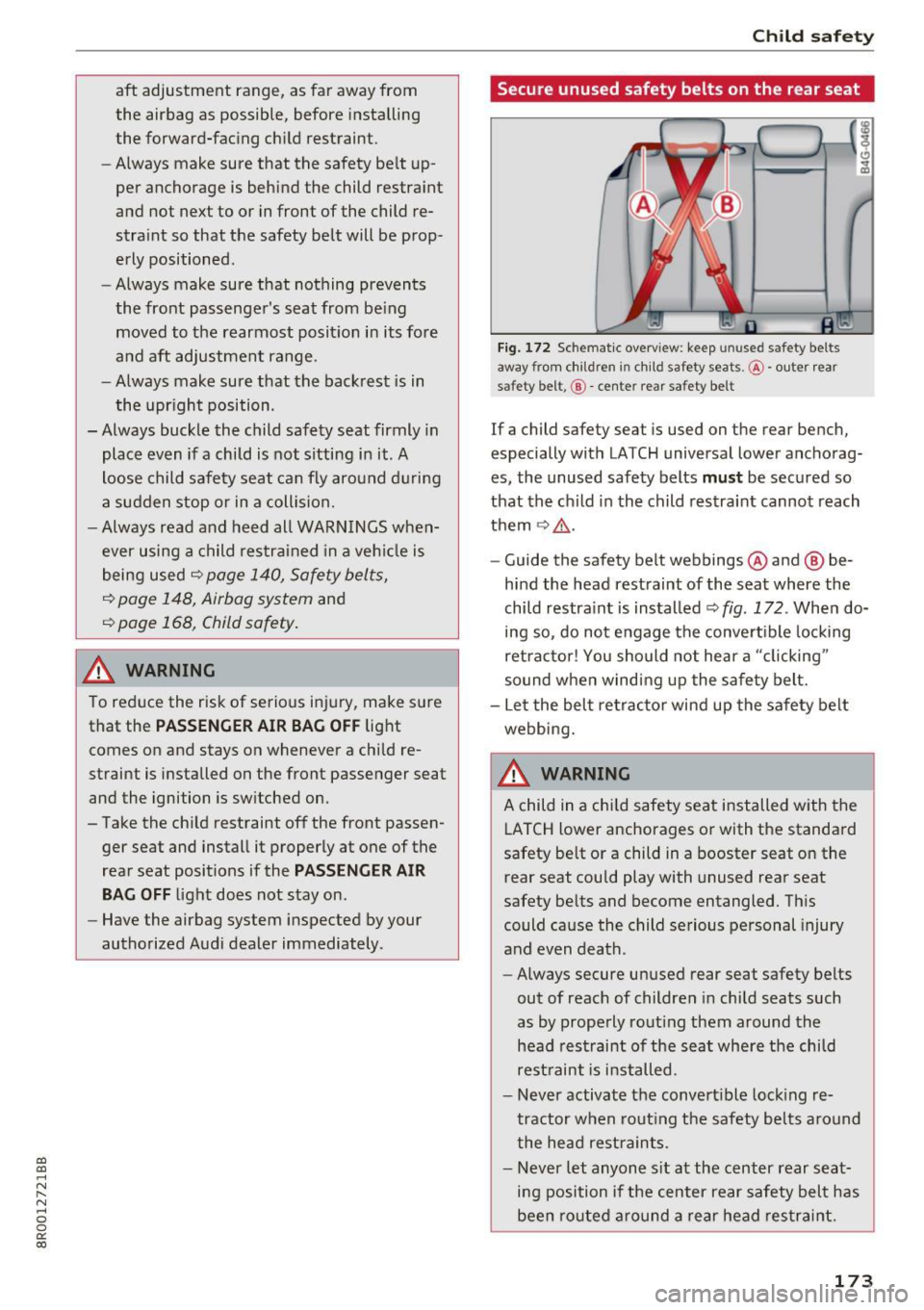
Secure unused safety belts on the rear seat
Fig. 172 Sc hema tic overv iew: keep unused safety belts
away from children in chil d safety seats.@· ou ter rear
safety belt ,@ -center rear safety belt
If a child safety seat is used on the rear bench,
especially with LATCH universal lower anchorag
es, the unused safety belts
must be secured so
that the child in the child restraint cannot reach
them ~.&. -
- Guide the safety belt webbings @ and @ be
hind the head restraint of the seat where the
child restraint is installed
<::) fig. 172 . When do
ing so, do not engage the convertible locking
retractor! You should not hear a "clicking"
sound when winding up the safety belt.
- Let the belt retractor wind up the safety belt
webbing.
A WARNING
-
A child in a child safety seat installed with the LATCH lower anchorages or with the standard
safety belt or a child in a booster seat on the rear seat could play with unused rear seat
safety belts and become entangled. This
could cause the child serious personal injury
and even death.
- Always secure unused rear seat safety belts
out of reach of children in child seats such
as by properly routing them around the head restraint of the seat where the child
restraint is installed .
- Never activate the convertible locking re
tractor when routing the safety belts around
the head restraints.
- Never let anyone sit at the center rear seat
ing position if the center rear safety belt has
been routed around a rear head restraint .
173
Page 178 of 296

Child safety
restraint in place 9 page 64. Install the
head restraint again immediately once the
child seat is removed. Driving without head
restraints or with head restraints that are
not properly adjusted increases the risk of
serious or fatal neck injury dramatically .
- Always read and heed all WARNINGS when
ever using a child restrained in a vehicle is
being used
9 page 140, Safety belts,
9 page 148, Airbag system and
9 page 168, Important information.
_& WARNING
If exceptional circumstances require the use
of a forward-facing child restraint on the
front passenger's seat, the child's safety and
well-being require that the following special precautions be taken:
- Make sure the forward-facing seat has been
designed and certified by its manufacturer
for use on a front seat with a passenger
front and side airbag.
- Always follow the manufacturer's instruc
tions provided with the child safety seat or
infant carrier.
- Always move the front passenger seat to
the highest position in the up and down ad
justment range and move it back to the
rearmost position in the seat's fore and aft
adjustment range, as far away from the air
bag as possible, before installing the for
ward-facing child restraint.
- Always make sure that the safety belt upper
anchorage is behind the child restraint and
not next to or in front of the child restraint
so that the safety belt will be properly posi
tioned.
- Always make sure that nothing prevents the
front passenger's seat from being moved to
the rearmost position in its fore and aft ad
justment range.
- Always make sure the backrest is in an up
right position.
- Make sure that the
PASSENGER AIR BAG
OFF
light comes on and stays on all the time
whenever the ignition is switched on.
176
- If the light does not stay on, perform the
checks
¢ page 158, Monitoring the Ad
vanced Airbag System.
-T ake the child restraint off the front passen
ger seat and install it properly at one of the
rear seat positions if the
PASSENGER AIR
BAG OFF
light does not stay on whenever
the ignition is switched on.
Booster seats and safety belts
Properly used booster seats can help protect
children weighing between about 40 lbs . and 80
lbs. (18 kg and 36 kg) who are less than 4 ft.
9
in . (57 inches/1.45 meters) tall.
Fig. 176 Rear seat: child proper ly restrained in a booster
seat
The vehicle's safety belts alone will not fit most
children until they are at least 4 ft. 9 in. (57 in
ches/1.45 meters) tall and weigh about 80 lbs.
(36 kg). Booster seats raise these children up so
that the safety belt will pass properly over the
stronger parts of their bodies and the safety belt
can help protect them in a crash.
.,. Do not use the convertible locking retractor
when using the vehicle's safety belt to restrain
a child on a booster seat.
.,. The shoulder belt must lie as close to the cen
ter of the child 's collar bone as possible and
must lie flat and snug on the upper body.
It
must never lie across the throat or neck. The
lap belt must lie across the pelvis and never
across the stomach or abdomen . Make sure the
belt lies flat and snug . Pull on the belt to tight
en if necessary.
.,. If you must transport an older child in a boos-
ter seat on the front passenger seat, you can
Ill>-
Page 179 of 296

use the safety belt height adjustment to help
adjust the shoulder portion properly.
~ Secure unused safety belts on the rear seat
¢ page 173.
Children up to at least 8 years old (over 40 lbs. or
18 kg) are best protect ed in child safety s eats de
signed for their age and weight. Experts say that
the skeletal structure, particularly the pelvis, of
these children is not fully developed, and they
must not use the vehicle safety belts without a
suitable child restra int .
It is usually best to put these children in appro priate booster seats . Be sure the booster seat
meets all applicable safety standards .
Booster seats raise the seating position of the
child and reposition both the lap and shoulder
parts of the safety belt so that they pass across
the child's body in the right places. The rout ing of
the belt over the child's body is very important
for the child's protection, whether or not a boos
ter seat is used. Chi ld ren age 12 and unde r must
a lways ride in the rear seat .
Ch ildren who are at least 4 ft . 9 in. (57 inches/
1.45 mete rs) tall ca n genera lly use the veh icle's
three po int lap and shoulder be lts. Neve r use the
l ap belt po rtion of the vehicle 's safety belt alone
to restrain any child, regardless of how big the
chi ld is. A lways remember that children do not
have the pronounced pelvic structure required for
the proper function of lap belt port ion of the ve
h icle 's three point lap and shoulder be lt s. The
chi ld 's safety absolutely requires that a lap belt
port ion of the safety belt be fastened snugly and
as low as possible around the pelvis . Never let
the lap belt portion of the safety belt pass over
the child's stomach or abdomen.
In a crash, a irbags must inflate within a blink of
an eye and wit h considerable force . In order to do
its job, the airbag needs room to inflate so that it
will be there to p rotect the occupant as the occu
pant moves forward into the a irbag.
A vehicle occupant who is out of position and too
~ close to the airbag gets in the way of an inflating ....
~ ai rbag. When an occ upant is too close, he o r she
N 8 will be struck v iolently and will receive ser ious or
~ possibly even fatal injury. 00
Ch ild safety
In order for the a irbag to offer protection, it is
important that a ll vehicle occupants, especially
any ch ildren, who m ust be in the front seat be
cause of exceptiona l circumstances, be properly
restra ined and as far away from the airbag as
poss ible. By keeping room between the child 's
body and the front of the passenger compart
ment, the a irbag can inflate completely and pro
vide s upplementa l protec tion in certain frontal
collisions.
A WARNING
-
Not using a booster seat, using the booster
seat improperly, incorrect ly installing a boos
ter seat or using the vehicle safety belt im
properly increases the risk of serious personal
i njury and death in a collision or other emer
gency situation. To help reduce the risk of se rious personal injury and/or death:
- The shou lder belt must lie as close to the
center of the ch ild's collar bone as possible
and must lie flat and snug on the upper
body. It must never lie across the throat or
neck. The lap belt must lie ac ross the pelvis
and never across the stomach o r abdomen.
Make sure the bel t lies flat and sn ug. Pu ll on
the belt to tighten if necessary.
- Fail ure to properly route safety bel ts over a
child's body w ill cause severe injuries in an
accident or other emergency situation
¢ page 140.
- The rear side of the chi ld safety seat should
be positioned as close as possible to the
backrest on the vehicle seat. Adjust or re
move the rear seat head restraint if it is dif
f icult to insta ll the ch ild seat with the head
restraint in place¢
page 64 . Install the
head restraint again immed iately once the
child seat is removed . Driving without head
rest raints or with head restra ints that a re
not properly adj usted increases the r is k of
serio us or fatal ne ck in jury dramatically .
- Never let a chi ld put the shoulder belt under
the arm or behind the ba ck, because i t could
cause severe inj uries in a crash .
- Ch ild ren on the fron t seat of any car, even
with Advanced Airbags, can be seriously in-
jured or even ki lled when an airbag inflates .
Ill>
177
Page 181 of 296

CD
CD
.... N ,-... N ..... 0 0 C<'. 00
-Always read and heed all WARNINGS when
ever using a child restrained in a vehicle is
being used
c::;, page 168 . Special precautions
apply when installing a child safety seat on
the front passenger seat
c::;, page 149, Child
restraints on the front seat -some impor
tant things to know.
A WARNING
Always take special precaut ions if you must
install a forward or rearward-fac ing ch ild re
straint on the front passenger's seat in excep
tional situations:
- Whenever a forward or rearward-facing
child restraint is installed on the front pas
senger seat, the
PA SSENG ER AIR BAG OFF
light must come on and stay on whenever
the ignition is switched on .
- If the
PASSENGER AIR BAG OFF light does
not come on and stay on, perform the
checks described
c::;, page 158, Monitoring
the Advanced Airbag System.
-
- Take the child restraint off the front passen
ger seat and install it properly at one of the
rear seat positions if the
P ASS ENGER AIR
BA G O FF
light does not stay on whenever
the ignition is switched on .
- Improper installation of child restraints can
reduce their effect iveness or even prevent
them from providing any protection .
-An improperly installed ch ild restraint can
interfere w ith the airbag as it deploys and
seriously injure or even kill the child .
- Always carefully follow the manufacturer's
instructions provided w ith the child safety
seat or car rier.
- Never place additional items on the seat
that can increase the total weight registered by the weight-sensing mat and can cause in
jury in a crash .
A WARNING
Forward-facing child restraints :
- Always ma ke sure the forward-fac ing seat
has been designed and certified by its man
ufact urer for use on a front seat with a pas
senger front and side airbag .
Child safety
-Never put the forward-facing child restraint
up, against or very near the instrument pan
el.
- Always move the front passenger seat to
the highest position in the up and down ad
justment range and move it back to the rearmost posit ion in the seat's fore and aft
adjustment range, as far away from the air bag as possible, before installing the for
ward-facing ch ild restraint.
- Always make sure that the safety be lt upper
anchorage is behind the ch ild rest raint and
not next to o r in front of the child restraint
so that the safety be lt will be properly posi
tioned.
- Make sure that t he
PASSENGER AIR BAG
OFF
li ght comes on and stays on a ll the time
whenever the ignition is switched on .
A WARNING ~
Rearward-facing child restraints:
- A child in a rearward-fac ing ch ild safety seat
installed on the front passenger seat will be
serious ly injured and can be ki lled if the
front airbag inflates - even with an Ad
vanced Airbag System .
- The inflating airbag will hit the child safety
seat or infant carrier with great force and
will smash the child safety seat and child aga inst the backrest, center armrest, door
or roof .
- Always be especially carefu l if you must in
stall a rearward facing child safety seat on
the front passenger seat in except ional cir
cumstances .
- A t ight tether strap on a rearward-facing
child restraint attached to the front passen
ger seat can put too much p ressure on the
weight -mat in the seat and reg ister a heav i
er weight in the Advanced Airbag System.
The heavier weight reg istered can make the
system work as though an adult were on the
seat and deploy the Advanced Airbag when
it must be suppressed causing serious or
even fata l injury to the child .
179
Page 195 of 296
CD
CD
.... N ,-... N ..... 0 0 C<'. 00
ignition switched off, it controls the energy sup
ply to the various electrical components . Data
from battery diagnosis is considered.
Depending on the battery 's state of charge, ind i
vid ual consumers are gradually turned off to pre
ve nt excessive discharge of the battery and thus
maintain starting capability.
Dynamic en ergy management
Wh ile the veh icle is being driven , dynamic energy
management dist ributes the energy ge nerated
according to the needs of the individua l compo
nents . It regulates consumption, so that more
e lectrical energy is not being used than is being
generated and ensures an optimal state of
charge for the battery.
- But even energy management cannot neg
ate the limits of physics. Consider that the power and life of a battery are limited.
- If starting ability is threatened, the indica
tor light (•] appears
¢ page 30 .
What you should know
The highest priority is given to maintaining start
ing capability .
The battery is severely taxed in short-distance
driving, in city traffic and during the co ld time of
year. Abundant electrical energy is required, but only a little is generated . It is also crit ica l if the
engine is not runn ing and electrical components
are turned on . In this instance energy is being
consumed but none is being generated .
It is in precisely these situations that you will no
tice energy management actively regulat ing the
d istr ibution of energy .
Vehicle stands for an extended p eriod
If you do not drive your vehicle over a period of
several days or weeks, electrical components are
gradually cut back or sw itched off. This reduces
energy consumption and ma inta ins starting ca
pability over a longer pe riod . Some of the con
ve nience funct ions may not operate, suc h as the
inte rior ligh ts or the powe r seat adjustment. The
Intellig ent Technology
convenience functions will be availab le aga in
when you switch on the ignition and sta rt the en
gine.
With the engine turn ed off
If you listen to the rad io, for examp le, with the
engi ne turned off or use other
MM I* functions,
the battery is being discharged .
If s tarting capab ility is jeopardized due to energy
consumption, a message appears in the rad io or
MM I* disp lay. The message indica tes that the
system will be switched off automatically in a
moment . If you wish to continue using the func
t ions, you have to start the engine.
With the engine running
Although e lectr ic al energy is generated when t he
vehicle is being driven, the batte ry can become
discharged. This happens mostly when litt le en
ergy is being generated and a great dea l con
sumed and the battery's state of charge is not
optimal.
To bring the energy balance back into equilibr i
um, consumers whic h require especia lly large
amounts of energy are temporari ly cut back or
switched off. Heating systems in particular re
quire a great deal of energy. If you notice, for ex
ample, that the heated seats* or the heated rear
window a re not heati ng, they have bee n tempo
rarily cut bac k or switched off . T hese systems will
be available again as soon as the ene rgy balance
has been restored.
You w ill also notice that engine idle speed has
been increased s light ly. This is no rma l and not a
ca use for concern. By increas ing engine idle
speed the additional energy required is genera t
ed and the battery is charged.
193
Page 285 of 296

Daytime runn ing lights . . . . . . . . . . . . . . . . . 50
Declarat ion of complia nce
Adapt ive cr uise control . . . . . . . . . . . . . . . 2 79
Aud i side assist . . . . . . . . . . . . . . . . . . . . . 279
Ce ll phone package . . . . . . . . . . . . . . . . . . 279
Convenience key . . . . . . . . . . . . . . . . . . . . . 279
Electronic immob ilizer. . . . . . . . . . . . . . . . 279
H omelink universa l remote control . . . . . 279
Remote control key . . . . . . . . . . . . . . . . . . 279
DE F
refer to Ad Bl ue . . . . . . . . . . . . . . . . . . . . . . 2 14
D efective light bulb warning . . . . . . . . . . . . . 29
Defrost ing (windows) . . . . . . . . . . . . . . . . . . . 79
D eter mini ng cor rec t load l imit . . . . . . . . . . 24 4
Diese l Exhaust Fl uid (DEF)
refer to AdBlue ........ ..... ... ... .. . 214
Diese l fue l ... .. .. ... ..... ... .. .. .... . 2 11
D iese l part icu la te filte r ......... .. .. 3 1, 195
Dig ita l clock . . . . . . . . . . . . . . . . . . . . . . . . . . 10
Digita l compass . . . . . . . . . . . . . . . . . . . . . . . 58
Dig ita l speedomete r . . . . . . . . . . . . . . . . . . . . 18
Dimensions . . . . . . . . . . . . . . . . . . . . . . . . . . 273
D imm ing the rea rview mir ror . . . . . . . . . . . . 57
Doors Chi ld safety locks . . . . . . . . . . . . . . . . . . . . . 42
E mergency loc king . . . . . . . . . . . . . . . . . . . . 39
Driver information system . . . . . . . . . . . . . . . 17
Defective light bulb warning . . . . . . . . . . . . 29
Dig ita l speedometer . . . . . . . . . . . . . . . . . . 18
D river info rmation messages . . . . . . . . . . . 24
I ndicator ligh ts . . . . . . . . . . . . . . . . . . . . . 102
M essages . . . . . . . . . . . . . . . . . . . . . . . . . . 10 2
Open doo r or re ar lid w arning . . . . . . . . . . . 18
Outside temperature d isp lay. . . . . . . . . . . . 1 8
Sound system display . . . . . . . . . . . . . . . . . 1 7
D river seat
refer to Sea ting pos ition . . . . . . . . . . . . . . 13 2
Driver 's seat memory
Activating remote control key . . . . . . . . . . . 63
D rive se lect . . . . . . . . . . . . . . . . . . . . . . . . . . 122
Adapt ive dampe rs . . . . . . . . . . . . . . . . . . . 122
Dynamic stee ring . . . . . . . . . . . . . . . . . . . . 122
Sett ing the driving mode . . . . . . . . . . . . . . 123
CD Driving economically . . . . . . . . . . . . . . . . . . 195 CD
;::: Driving lights . . . . . . . . . . . . . . . . . . . . . . . . . 4 9 ,-...
~ Driving messages . . . . . . . . . . . . . . . . . . . . . . 24 0 0 C<'. 00
Index
Driving off road
Driving through water . . . . . . . . . . . . . . . . 199
Driving tips . . . . . . . . . . . . . . . . . . . . . . . . . 198
Rules of behav io r . . . . . . . . . . . . . . . . . . . . 198
Sand and mud . . . . . . . . . . . . . . . . . . . . . . 199
Snow -cove red ground . . . . . . . . . . . . . . . . 199
U npaved roads . . . . . . . . . . . . . . . . . . . . . . 199
Driving safe ly . . . . . . . . . . . . . . . . . . . . . . . . 131
Dr iving thro ugh wa ter . . . . . . . . . . . . . . . . . 199
Drivi ng time . . . . . . . . . . . . . . . . . . . . . . . . . . 19
D uplicate key . . . . . . . . . . . . . . . . . . . . . . . . . 33
D ust filter
refer to Poll utant fi lter (climate cont ro l) . . 7 7
Dynam ic steering . . . . . . . . . . . . . . . . . 122, 186
I n dicator light . . . . . . . . . . . . . . . . . . . . . . 191
E
E85 (Fuel) . . . . . . . . . . . . . . . . . . . . . . . . . . . 210
Eff iciency prog ram . . . . . . . . . . . . . . . . . . . . . 22
Fuel economy messages . . . . . . . . . . . . . . . 2 2
Memory levels . . . . . . . . . . . . . . . . . . . . . . . 20
Other equ ipment . . . . . . . . . . . . . . . . . . . . . 22
El ec tric al acc essories
refer to Soc ket . . . . . . . . . . . . . . . . . . . . . . . 7 4
E lectr ica l seat adj ustment
refer to Sea t adjustment . . . . . . . . . . . . . . . 61
E lectromechanical parking brake
Emergency braking . . . . . . . . . . . . . . . . . . . 88
Malfunction . . . . . . . . . . . . . . . . . . . . . . . . . 88
Operat io n . . . . . . . . . . . . . . . . . . . . . . . . . . . 86
Parki ng . . . . . . . . . . . . . . . . . . . . . . . . . . . . . 87
Releasing and clos ing . . . . . . . . . . . . . . . . . 86
Start ing ass is t . . . . . . . . . . . . . . . . . . . . . . . 8 7
S ta rt ing from rest . . . . . . . . . . . . . . . . . . . . 87
Start ing
off wi th a tra ile r. ...... ... .. .. . 87
War ning/indicato r lights . . . . . . . . . . . . . . . 15
El ectrome chanical power assist...... .. .. 1 91
I n di cator lig ht . . . . . . . . . . . . . . . . . . . . . . 191
E lectron ic Differential Lock . . . . . . . . . . . . . 186
El ectronic differentia l lock (EDL)
War ning/ indicato r lights . . . . . . . . . . . . 13, 14
El ectron ic immobili zer . . . . . . . . . . . . . . . . . . 35
E lectron ic power control
(EPC) warn ing/ indicator light . . . . . . . . . . . 12
E lectronic Stabi lization Contro l . . . . . . . . . . 186
283
Page 290 of 296

Index
Parking system
refer to Audi parking system plus with rear
view camera . . . . . . . . . . . . . . . . . . . . . . . . 125
Particle filter
refer to Diesel particulate filter . . . . . . . . . 31
Parts replacement . . . . . . . . . . . . . . . . . . . . 278
PASSENGER AIR BAG OFF light . . . . . . . . . . 159
Pedals . . . . . . . . . . . . . . . . . . . . . . . . . . . . . . 135
Physical principles of a frontal collision . . . 141
Polishing . . . . . . . . . . . . . . . . . . . . . . . . . . . . 206
Pollen filter
refer to Pollutant filter (climate control) . . 77
Pollutant filter (climate control) . . . . . . . . . . 77
Power Windows . . . . . . . . . . . . . . . . . . . . . . . . . . . 43
Power locking system
E mergency locking . . . . . . . . . . . . . . . . . . . . 39
L ocking and unlocking the vehicle from in-
side . . . . . . . . . . . . . . . . . . . . . . . . . . . . . . . . 39
Rear lid/trunk lid . . . . . . . . . . . . . . . . . . . . . 40
Selective unlock feature . . . . . . . . . . . . . . . 36
Settings . . . . . . . . . . . . . . . . . . . . . . . . . . . . 36
Switch . . . . . . . . . . . . . . . . . . . . . . . . . . . . . . 39
Unlocking and locking vehicle . . . . . . . . . . . 37
Power locks Windows open and closed . . . . . . . . . . . . . . 44
Power meter (hybrid drive) . . . . . . . . . . . . . 101
Power seat adjustment . . . . . . . . . . . . . . . . . 61
Power steering
refer to Electromechanical power assist .. 191
Power window regulators
Convenience opening/closing . . . . . . . . . . . 44
Malfunct ions . . . . . . . . . . . . . . . . . . . . . . . . 44
Pregnant women Special considerations when wearing a safe-
ty belt . . . . . . . . . . . . . . . . . . . . . . . . . . . . . 145
Pressure (tires) . . . . . . . . . . . . . . . . . . . . . . . 248
Proper safety belt position . . . . . . . . . . . . . . 144
Proper seating position Front passenger . . . . . . . . . . . . . . . . . . . . . 133
Occupants . . . . . . . . . . . . . . . . . . . . . . . . . . 132
Rear passengers . . . . . . . . . . . . . . . . . . . . . 134
Protecting . . . . . . . . . . . . . . . . . . . . . . . . . . . 206
Protective tray . . . . . . . . . . . . . . . . . . . . . . . . 68
288
Q
quattro
refer to All-wheel drive
Question What happens to unbelted occupants?
R
192
141
Rain sensor . . . . . . . . . . . . . . . . . . . . . . . . . . . S4
Defect ive . . . . . . . . . . . . . . . . . . . . . . . . . . . 29
Raising the vehicle . . . . . . . . . . . . . . . . . . . . 270
Reading lights . . . . . . . . . . . . . . . . . . . . . . . . . 52
Rear fog lights . . . . . . . . . . . . . . . . . . . . . . . . SO
Rear lid Automatic operation
Opening and closing
Rear light .
. ............. ... 41
40
Defective . . . . . . . . . . . . . . . . . . . . . . . . . . . 29
Rear seats Adjusting seat . . . . . . . . . . . . . . . . . . . . . . . 63
Rearview camera Parking mode 1 . . . . . . . . . . . . . . . . . . . . . 128
Parking mode 2 . . . . . . . . . . . . . . . . . . . . . 129
Rear view mirror . . . . . . . . . . . . . . . . . . . . . . . 57
Rear w indow heating . . . . . . . . . . . . . . . . . . . 79
Recirculation mode (climate control) . . . . . . 78
Red symbols . . . . . . . . . . . . . . . . . . . . . . . . . . 25
Refill engine oil . . . . . . . . . . . . . . . . . . . . . . . . 2 7
Refilling AdBlue With bottle . . . . . . . . . . . . . . . . . . . . . . . . . 215
With canister . ... .. .. ........ ..... .. 216
Refuelling . . . . . . . . . . . . . . . . . . . . . . . . . . . 212
Gasoline inhibitor flap . . . . . . . . . . . . . . . . 212
Release lever for hood . . . . . . . . . . . . . . . . . 217
Remote control key Unlocking and locking . . . . . . . . . . . . . . . . . 37
Remote control operation Garage door opener (Homelink) . . . . . . . . . 45
Remote rear lid release . . . . . . . . . . . . . . . . . 40
Repair manuals . . . . . . . . . . . . . . . . . . . . . . . 276
Repairs Airbag system 161
Replacing Light bu lbs . . . . . . . . . . . . . . . . . . . . . . . . . 264
Replacing wiper blades . . . . . . . . . . . . . . . . . 55
Reporting Safety Defects . . . . . . . . . . . 138, 139