2017 AUDI Q3 warning lights
[x] Cancel search: warning lightsPage 102 of 236

Driving sa fe ty
Driving safety
General notes
Safe driving habits
Please remember -safety first!
This chapter contains important information,
tips, instruct ions and warn ings that you need to
read and observe for your own safety, the safety
of your passengers and others. We have summar ized here what you need to know about safety
be lts, a irbags, child restra ints as well as child
safety. Your safety is for us
priority number 1 . Al
ways observe t he i nfo rmation and wa rn ings in
this section - for your own safety as well as tha t
of yo ur passengers.
The information i n this section applies to all
model ve rsions of your vehicle . Some of the fea
tures descr ibed in t his sec tions may be s tanda rd
eq uipment on some models, or may be optional
equipment on others . If yo u are not sure, ask
your author ized Audi dealer.
A WARNING
- Always make sure that you follow the in
structions and heed the WARNINGS in th is
Manual.
It is in your interest and in the in
te rest of your passengers.
-
- Always keep t he comp lete Owner's Litera
ture in your A udi when you lend or se ll your
vehicle so that this important information
will always be available to the d river and
passenge rs.
- Always keep the Owner 's literature handy so
that you can find it easily if you have ques
t ions.
Safety equipment
The safety features are part of the occupant re
straint system and work together to help reduce
the risk of injury in a wide variety of occident si t
uations.
Your safety and the safety of yo ur passenge rs
should not be left to chan ce. Advan ces in tech
nology have made a var iety of features av ail ab le
to help reduce t he risk of injury in an accident .
100
The following is a list of just a few of the sa fety
features in your Audi :
- sophis tic ated safety be lts fo r dr ive r and all pas-
senge r seat ing pos itions,
- belt fo rce limi ters for the front seats,
- be lt pretensione rs fo r the seats,
- belt height adjustment for the front seats,
- head restraints for each seating position,
- front airbags,
- side airbags in the front seats,
- side curtain airbags with eject io n m it igat io n
features,
- special LA TC H anchorages for ch ild rest rai nts,
- adj ustab le steer ing col umn.
These ind iv idual safety features, can work to
gether as a system to he lp protect you and your
passengers in a wide range of acc idents. These
features cannot wo rk as a system if they are not
a lways cor rec tly ad justed and cor rect ly used.
Safety i s everybody' s responsibil ity!
Important things to do before driving
Safety is everybody 's job! Vehicle and occupant
safety always depends on the informed and care
ful driver .
For your safety and the safety of your passen
gers,
before driving always:
.,. Make sure that a ll lights and signals are operat
ing correctly .
.,. Make sure that the tire pressure is correct .
.,. Make sure that a ll w indows are clean and afford
good vis ibility to the outs ide .
.,. Secure all luggage and othe r items ca refully
~ page 105, ~page 47 .
.,. Ma ke sure that noth ing ca n interfere wi th the
pedals.
.,. Adjust front seat, head restraint and mirrors
correctly for yo ur height.
.,. Instruct passenge rs to adjust the head re
straints according to their he ight.
.,. Make sure to use the rig ht child restraint cor
rectly to protect children
r=> page 13 7, Child
safety . ..,.
Page 111 of 236

00
00
....
"' ,-...
"' .... 0 0 :::,
00
Safety belts
General information
Always wear safety belts!
Wearing safety belts correctly saves lives!
This chapter explains why safety belts are neces
sary, how they work and how to adjust and wear
them correctly.
.. Read all the information that follows and heed
all of the instructions and WARNINGS.
A WARNING
Not wearing safety belts or wearing them im
properly increases the risk of serious personal
injury and death.
- Safety belts are the single most effective
means available to reduce the risk of serious
injury and death in automobile accidents.
For your protection and that of your passen
gers, always correctly wear safety belts
when the vehicle is moving.
- Pregnant women, injured, o r physically im
paired persons must also use safety belts.
Like all vehicle occupants, they are more
likely to be seriously injured if they do not
wear safety belts. The best way to protect a
fetus is to protect the mother -throughout
the entire pregnancy.
Number of seats
Your Audi has a total of five seating positions:
two in the front and three in the rear. Each seat ing position has a safety belt.
A WARNING
Not wearing safety belts or wearing them im
properly increases the risk of serious personal
injury and death.
- Never strap more than one person, includ
ing small children, into any belt.
It is espe
cially dangerous to place a safety belt over a
child sitting on your lap.
- Never let mo re people ride in the vehicle
than there are safety belts available.
Safety belts
-Be sure everyone riding in the vehicle is
properly restrained with a separate safety
belt or child restraint.
Safety belt warning light
Your vehicle has a warning system for the driver
and front seat passenger to remind you about the importance of buckling-up.
Fi g. 104 Safety belt warn ing light in the instrument clus ·
te r -en larged
Before driving off, always:
.. Fasten your safety belt and make sure you are
wearing it properly.
.,. Make sure that your passengers also buckle up
and properly wear their safety belts.
.,. Protect your children with a child restraint sys
tem appropr iate for the size and age of the chil
dren .
The warning light . in the instrument cluster
lights up when the ignit ion is switched on as a re
minder to fasten the safety belts . In addition,
you w ill hear a warn ing tone for a certain period
of time.
Fasten your safety belt now and make sure that
your passengers also properly put on their safe
ty belts.
A WARNING
- Safety belts are the single most effective
means available to red uce the risk of serious
injury and death in automobile accidents.
For your protection and that of your passen
gers, always correctly wear safety belts
when the vehicle is moving.
109
Page 165 of 236

00
00
......
"' ,....
"' ...... 0 0 :::,
00
A udi rec ommend s
@;Cilstrot /Jgjgf ~ f'r,w.~7dr,,'1AJ.
A ud i re commends Longlife high p erform ance
e ngi ne oil from A udi Gen uin e P art s
Using the proper engine oil is important for the
functionality and service life of the engine. Your
engine was factory-filled with a high-quality oil
which can usually be used throughout the entire
year .
Note
Your Limited New Vehicle Warranty does not
cover damage or malfunctions due to failure
to follow recommended maintenance and use
requirements as set fo rth in the Aud i Owner's
Manual a nd Warranty & Mai ntenan ce booklet.
- Use only a high quality eng ine oil that ex-
pressly complies with the Aud i oil q ual ity
standard specified for your vehicle's engine. Using any other oil can cause serious engine
damage .
- Do not mix any l ubricants or othe r addi tives
into the engine oil. Doing so can cause en
gine damage.
(D Tips
If you need to add oil and there is none availa
ble that meets the Audi oil quality standard
your engine requires, you may add a total of
no more than 0 .5 quart/liter of a high-quality
"synthet ic"oil that meets the following speci
fications.
- ACEA A3 or API SM with a viscosity grade of
SAE OW-30, SAE SW-30 or SAE SW-40.
- For more information about engine oi l that
has been approved for your vehicle, please
contact e ither your authorized Audi dea ler
or Audi Customer Relat ions at
1 (800) 822-2834 or vis it our web site at
www.audiusa.com or www.aud icanada .ca.
Ch eck ing and Filling
Engine oil consumption
The engine in your vehicle depends on on ade
quate amount of oil to lubricate and
cool oil of
its moving ports.
In order to provide effect ive lubrication and cool
ing of internal engine components, all internal
combust ion eng ines consume a certa in amount
of oil. Oil consumption varies from eng ine to en
gine and may change s ign ificantly over the life of
the engine. Typ ica lly, engines w ith a specified
break-in period (see
q page 58) consume more
oi l during the break -in period than they consume
after oil consumption has stabilized.
Under normal cond itions, the rate of oil con
sumption depends on the q uality and viscosity o f
the oil, the RPM (revol utions per minute) at
which the engine is operated, the ambient tem perature and road condit ions. Further factors are
the amount of oil dilution from water condensa
tion or fuel residue and the oxidation level of the o il. As any engine is subject to wear as mileage
builds up, the oil consumption may increase over
time unt il replacement of worn components may
become necessary.
With all these variables coming into play, no standard rate of o il consumption can be estab
li shed or spec ified . T he re is no alte rnative to reg
u la r and frequent checking of the oi l level , see
Note .
If the yellow engine o il leve l warning symbo l !I
in the instrument cluster lights up, you sho uld
check the o il level as soon as possible
q page 164. Top off the o il at your earlies t con
venience.
A WARNING ~
Before you check anything in the engine com-
partment, always read and heed all WARN
INGS
q .&. in Working in the engine comport
ment on page 159.
(D Note
Driving with an insufficient oil level is likely to
cause severe damage to the eng ine. ..,.
163
Page 191 of 236

00
00
......
"' ,....
"' ...... 0 0 :::,
00
also reduces fuel e fficiency and tire tread life,
and may affect the vehicle's handling and stop p ing ability .
Pl ease no te that the TPMS is not a substi tute for
p roper tire maintenance, and it is the drive r's re
sponsib ility to maintain cor rect tire pressure,
even if under-inflation has not reached the leve l
to tr igger illum inat ion of the TPMS low tire pres
sure telltale.
Your vehicle has also been eq uipped with a TPMS
mal funct ion indicator to indicate when the sys
tem is not operating properly. The TPMS mal
function indicator is combined w ith the low tire
pressure tellta le. Whe n the system detects a
malfunct ion, the telltale will flash for approx i
mately one min ute and then remai n cont inuo usly
i llum inated. This sequence will continue upon
s ubseq uen t ve hicl e start- ups as long as the m al
f u nction ex ists.
When the malfunct io n in dicator is ill uminated,
the system may not be ab le to detect or signa l
l ow tire press ure as intended . TPM S malfu nctions
may oc cur for a var iety of reasons, incl uding the
installation of replacement or alternate ti res o r
wheels on the vehicle that prevent the TPMS
from functioning properly . Always check the
TPMS malfunction telltale after rep lacing one or
more t ires or whee ls on your ve hicle to ensure
that the replacement or alternate tires and
wheels allow the TPMS to cont inue to funct ion
p roperly.
If the Tire Pressure Monitoring System
ind icator appears
A ppl ies to: ve hicles with Tir e Pressure Moni toring System in
di cato r
The tire pressure indicator in the instrument
cluster informs you if the tire pressure is too low
or if th ere is a system malfunction .
Using the ABS sensors, the tire p ressure mo nitor
i ng system compa res the tire tread circumfer
e n ce and vib ra tion characteristics of the individ u
a l tir es .
If the pressure c hanges in o ne or more
wheels , th is is indica ted in the instrument clus ter
d is p la y with a n
[I] indica to r li ght and a message.
Wh eel s
If only one tire is affected, the location of tha t
t ir e will be indicated.
T he tire press ures mus t be store d in the Infot ain
ment system again each t ime the pressures
c h ange (switching between partia l and full load
pressure) or after changing or replacing a tire on
yo ur vehicle
r::!;> page 190 . The tire pressure mon i
toring system on ly monitors the tire pressure you
have stored . Refer to the t ire pressure label for
the recommended t ire press ure fo r yo ur vehicle
r::!;>page 181, fig . 150 .
Tire tread c ircumfe rence and vibration cha racter
istics can change and cause a tire pressu re warn
i ng if :
- the t ire pressure in one or more tires is too low.
- the t ire has str uctural damage .
- t he t ire w as rep lace d or the t ire pressu re was
changed and it was no t store d
r::!;> page 190.
- t he spare tire* is i nstalled.
Indicator lights
[I] -Loss of pressu re in at leas t one tire r::!;> & .
Check the tires and replace or repair if necessary .
Check/correct the pressures of all fou r tires and
store the pressu re again in the menu disp lay
r::!;>page 190.
ffim (T ire Pressure Moni tor ing Sys tem) Tire
pre ssure: Syst em malfunction!. Ifm appears
after sw itching the ignition on or while d riv in g
and the
[I] i ndic ator ligh t in the i nstru men t clus
te r blinks for approx imately one minute and then
stays on, the re is system ma lf u nction . Try to
store the co rrect tire pressures
r::!;> page 190 . If
the indicator light does turn off or turns on again
after a short period of time, drive to an author
ized Audi dealer or author ized Audi Se rvice Facili
ty immediate ly to have the ma lfunction correct
ed.
_&. WARNING
- I f the tire p ressure in dicator appears in the
d isp lay, redu ce you r speed immedi ately and
a void any h ard stee ring or bra king m aneu
vers . S to p as soon as poss ible and check the
tires an d their pressure .
~
189
Page 196 of 236

Care and cleaning
Component Situation Solution
Te xtil es
Deposits adhering to Vacuum cleaner
artifi cial le ather , the surface
Alcan tara Water-based depos- Absorbent cloth and mild soap
solutional
its such as coffee,
tea, blood, etc.
O il-based deposits Apply a mild soap solution a), blot away the dissolved oil o r
such as oil, make-up, dye, treat afterward with water, if necessary
etc.
Special deposits such Special sta ,in remover, blot with absorbent material, treat
as ink, na il polish, la- afterward with mild soap solution, if necessary al
tex paint, shoe pol-
ish, etc.
Natural leather Fresh stains Wool cloth with a m
ild soap solutional
Water-based depos- Fresh stains: absorbent cloth its such as coffee, dried sta ins: stain remover suitable fo r leather
tea, blood, etc.
Oil-based deposits Fresh stains: absorbent cloth and stain remover suitable for
such as oil, make-up, leather
etc. dried sta
ins: oil clean ing sp ray
Special deposits such Spot remover suitable for leather
as ink, nai l polish, la -
tex paint, shoe pol-
ish, etc.
Ca re Regularly apply cond itioning cream tha t protects from light
a nd penetr ates into the ma ter ial. Use spec ia lly-co lored con -
ditioning cream, i f necessary.
Carbon parts Deposits clean the same way as plastic parts
a) Mild soap sol ution: maxim um two tablesp oons of neutral soap in 1 quart (l liter) of water
_& WARNING
The windshie ld may not be trea ted with w a
ter-repelling windshield coating agents. Un
favorable conditions s uch as wetness, dark
ness, or low sun can result in increased glare .
Wiper blade chatter is also possib le.
(D Note
- Headlights/tail light s
-Never clean headlights or ta il lights with a
dry cloth or sponge.
- Do not use any cleaning p roduct that con
tains alcohol, because they cou ld cause
cracks to form.
- Wheels
194
-
- Never use any paint polish or other abra
sive materials.
- Damage to the protect ive layer on the
rims such as stone chips or scratches must
be repaired immediately.
- Sensors /camera lenses
- N ever use wa rm or ho t wa ter to remove
snow or ice from the camera lens . This
could ca use the lens to crack .
- N eve r use abrasive cleaning m aterials or
a lcohol to clea n the camera lens . This
could cause scratches and c racks .
-Door windows
- Remove snow and ice on windows and ex-
terior mirrors with a plast ic scraper. To
Page 209 of 236

00
00
......
"' ,....
"' ...... 0 0 :::,
00
Engine compartment fuse assignment
The fuse number is stamped into the plastic be
low or above each fuse.
No. Equipment
1 Transmiss ion supply
2 ESC
3 Horn
4 DC/DC
converter
5 BCM, battery data module
6 BCM (right)
7 Washer fluid pump
8 BCM (left)
9 Seat adjustment lumbar support
10 Glow time
control module, fuel pump,
heated oxygen sensor
11 Steering
column lever, multifunction
steer ing whee l controls
1 2 Cell phone adapter
13 En
gine control module
14 Engine control module
15 Gateway
16 Heated oxygen sensor, fuel pump, eng
ine
components
17 Engine components
18 Fue
l pump control module
19 Sound amplifier, DC/DC converter
20 Clutch pedal sensor, brake light sensor
22 Windshield wipers Radiator fan, engine components, coolant
23 recirculation pump, auxiliary
heater, fuel
pump relay coils
24 Ignition coils
25 Driver's door
control module (central lock-
ing, window regulators)
26 Front passenger's door control module
(centra
l locking, window regulators)
27 Term inal 15 supply
29 Power seat adjustment (driver,
front pas-
senger)
30 ESC
Fu ses an d bulb s
Bulbs
Replacing light bulbs
For your safety, we recommend that you have
your authorized Audi dealer replace any bulbs for
you .
It is becoming increasingly more and more diffi
cult to replace vehicle light bulbs since in many
cases, other parts of the car must first be re
moved before you are able to get to the bulb .
T his applies especially to the light bulbs in the
front of your car which you can only reach
through the engine compartment .
Sheet metal and bu lb holders can have sharp
edges that can cause serious cuts, pa rts must be
correctly taken apart and then properly put back
together to help prevent breakage o f parts and
long term damage from water that can enter
housings that have not been properly resealed.
For your safety, we recommend that you have
your authorized Aud i dea ler rep lace any bulbs fo r
you, since your dealer has the proper tools, the
correct bulbs and the expertise.
Gas di schar ge la mps (Xe no n ligh ts):
Due to the high electr ical voltage, have the bulbs
rep laced by a qualified technician. Headlights
with Xenon light are identified by the hig h volt
age st icker.
LED headlights* require no maintenance . Please
contact your authorized Audi dea ler if a bulb
needs to be replaced.
_&. WARNING
Changing Xenon lamps wi thout the necessary
equipment can cause serious personal injury .
- Bulbs are pressu rized and can explode when
be ing changed. Potent ial ris k of injury!
- On veh icles equipped with gas disc harge
bu lbs (Xenon light) life-threatening injuries
can resu lt from improper handling of the
high-vo ltage portions of such lamps!
- Only your authorized A udi dealer or quali
f ied workshop sho uld change the bulbs in
gas discharge lamps. There are parts with
sharp edges on the openings and on the
207
Page 212 of 236
Emergency situations
@ Tips
The discharged battery must be properly con
nected to the vehicle's electrical system .
When jump starting or charging the battery,
never connect the negative ground cable to
the battery negative post because the battery
manager system must be able to detect the
battery's state of charge . Always connect the
negat ive ground cable to the negative ground
pos t of the battery manager control unit.
Use of jumper cables
Make sure to connect the jumper cable clamps in
exactly the order described below!
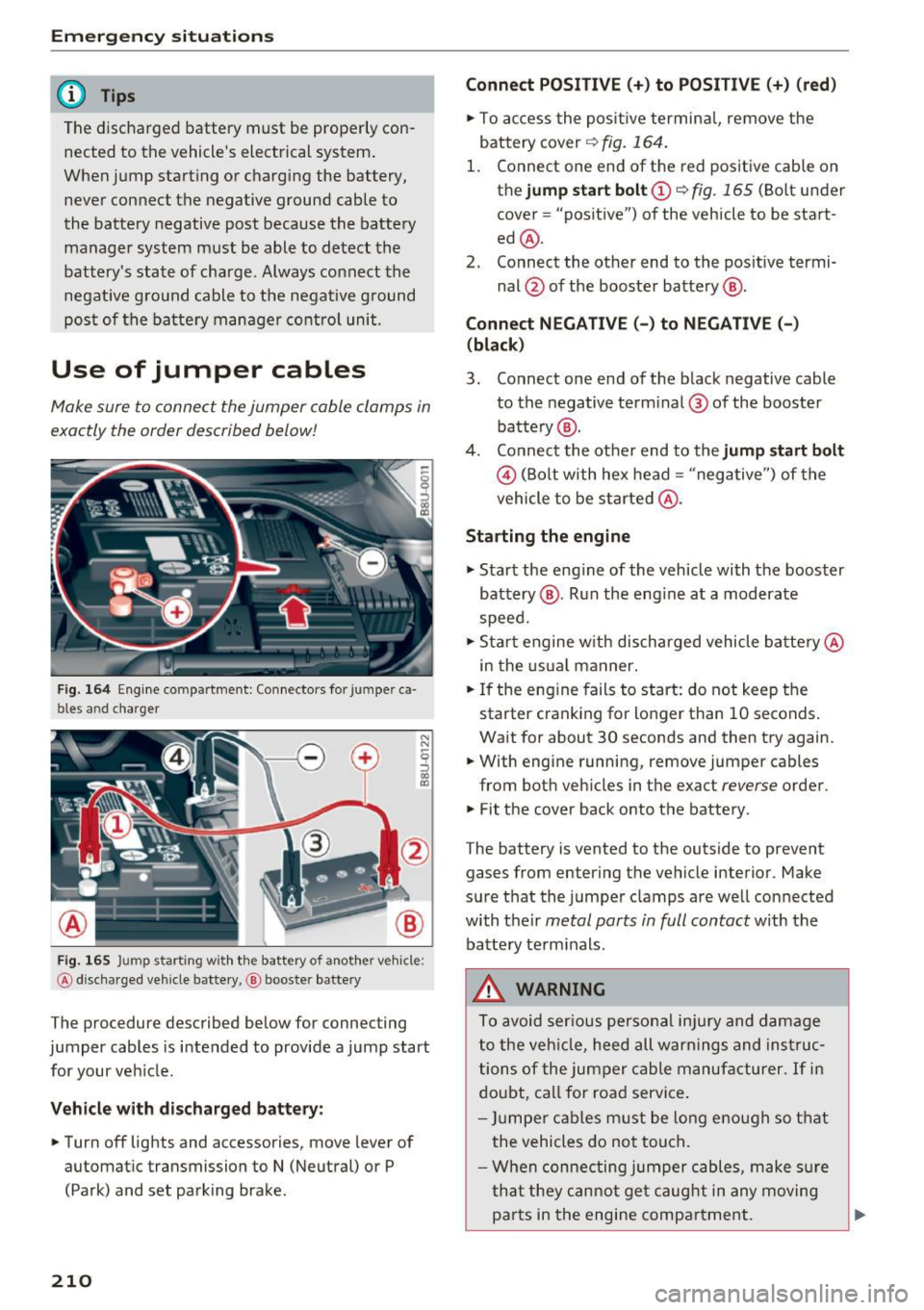
Fig. 164 Engine compartmen t: Connectors fo r ju m pe r ca
bles and charger
Fig. 165 J u mp starting w ith the battery of another vehicle :
@ discha rged vehicle bat te ry, @ booste r battery
The procedure described below for connecting
jumper cables is intended to provide a jump start
for your veh icle.
Vehicle with discharged battery:
.. Turn off lights and accessories, move lever of
automatic transmission to
N (Neutral) or P
(Park) and set park ing brake .
210
Connect POSITIVE(+) to POSITIVE (+) (red)
.. To access the positive terminal, remove the
battery cover
r:!) fig. 164.
1. Connect one end of the red positive cable on
the
jump start bolt (D ~ fig. 165 (Bolt under
cover= "positive") of the vehicle to be start
ed @.
2. Connect the other end to the positive termi-
nal@ of the booster battery @.
Connect NEGATIVE(-) to NEGATIVE(-)
(black)
3. Connect one end of the black negative cable
to the negative terminal ® of the booster
battery @.
4. Connect the other end to the
jump start bolt
© (Bolt with hex head= "negative") of the
vehicle to be started @.
Starting the engine
.,. Start the eng ine of the vehicle with the booster
battery @. Run the eng ine at a moderate
speed .
.,. Start engine w ith discharged vehicle battery@
in the usual manner.
.. If the engine fails to start: do not keep the
starter cranking for longer than 10 seconds.
Wait for about 30 seconds and then try again .
.. With engine running, remove jumper cables
from both vehicles in the exact
reverse order .
.,. Fit the cover back onto the battery .
The battery is vented to the outside to prevent gases from entering the vehicle interior . Make
sure that the jumper clamps are well connected
with their
metal parts in full contact with the
batte ry terminals.
A WARNING
To avoid serious personal inju ry and damage
to the veh icle, heed all warnings and instruc
tions of the jumper cable manufacturer.
If in
doubt, call for road service.
- Jumper cables must be long enough so that
the vehicles do not touch .
- When connecting jumper cables, make sur e
that they cannot get caug ht in any moving
pa rts in the engine compartment. ..,.
Page 230 of 236

Index
With the central locking switch . . . . . . . . . 27
With the convenience key . . . . . . . . . . . . . . 26
Low beam
I ndicator l ight . . . . . . . . . . . . . . . . . . . . . . . 16
Low beams . . . . . . . . . . . . . . . . . . . . . . . . . . . 35
Lower universal anchorages (Canada) . . . . . 150
Luggage compartment . . . . . . . . . . . . . . . . . . 48
Cargo floor . . . . . . . . . . . . . . . . . . . . . . . . . . 51
Cargo net . . . . . . . . . . . . . . . . . . . . . . . . . . . 50
Cover... ..... .................. ..... 48
Increasing the size . . . . . . . . . . . . . . . . . . . . 49
Reversible mat . . . . . . . . . . . . . . . . . . . . . . . 50
Ski bag . . . . . . . . . . . . . . . . . . . . . . . . . . . . . 50
Storing cargo correctly . . . . . . . . . . . . . . . 105
Tie-downs . . . . . . . . . . . . . . . . . . . . . . . . . . . 50
also refer to Loading the luggage compart-
ment .. .. .. .... .......... ...... ... . 105
Luggage compartment lid Closing button . . . . . . . . . . . . . . . . . . . . . . . 29
Emergency release . . . . . . . . . . . . . . . . . . . . 31
Opening/closing . . . . . . . . . . . . . . . . . . . 28, 29
Luggage rack . . . . . . . . . . . . . . . . . . . . . . . . . . 51
Lumbar support . . . . . . . . . . . . . . . . . . . . . . . 44
M
Maintenance . . . . . . . . . . . . . . . . . . . . . . . . . 218
Maintenance intervals . . . . . . . . . . . . . . . . . 170
Malfunct ion indicator lamp (MIL) . . . . . . . . . 17
Indicator light . . . . . . . . . . . . . . . . . . . . . . . 15
Mirror Dimming ... .. .. .. . .. .. ... ... .. .. .. .. 38
Van ity m irror . . . . . . . . . . . . . . . . . . . . . . . . 39
Mirror compass . . . . . . . . . . . . . . . . . . . . . . . . 42
Mirrors Adjusting the exterior mirrors. . . . . . . . . . . 38
Model plate . . . . . . . . . . . . . . . . . . . . . . . . . . 215
Monitoring the Advanced Airbag System . . 127
Multifunction steering wheel . . . . . . . . . . . . . 20
N
Natura l leather care/cleaning . . . . . . . . . . . 194
Net . . . . . . . . . . . . . . . . . . . . . . . . . . . . . . . . . 48
NHTSA Contacting . . . . . . . . . . . . . . . . . . . . . . . . . 107
Number of seats . . . . . . . . . . . . . . . . . . . . . . 109
228
0
Occupant seating positions
Octane rating ... .. .. .. ........ ..... . .
Odometer .... .. . ... .. .. ........... .. .
Oil 101
1S5
10
Ind icator light . . . . . . . . . . . . . . . . . . . . . . . lS
also refer to Engine oil . . . . . . . . . . . 162, 164
Oil change interval . . . . . . . . . . . . . . . . . . . . 170
On -Board-Diagnostic System (OBD)
Malfunction indicator lamp (MIL) . . . . . . . . 17
On-board computer . . . . . . . . . . . . . . . . . . . . 20
On-Board Diagnostic System (OBD) Data Link Connector (D LC) . . . . . . . . . . . . . . 17
Electronic speed limiter . . . . . . . . . . . . . . . . 18
Opening.... .. .. .. .. .. ............. ... 23
Fuel filler door . . . . . . . . . . . . . . . . . . . . . . 157
Hood . . . . . . . . . . . . . . . . . . . . . . . . . . . . . . 161
Luggage compartment lid . . . . . . . . . . . . . . 29
Panorama glass roof . . . . . . . . . . . . . . . . . . 33
Windows . .... .. .. .. .. ........... .. . 32
Opening/closing On the door lock . . . . . . . . . . . . . . . . . . . . . . 28
With the central locking switch . . . . . . . . . 27
With the convenience key . . . . . . . . . . . . . . 26
Other equipment (efficiency program) . . . . . 21
Outside temperature display . . . . . . . . . . . . . . 9
Overview (Cockpit) . . . . . . . . . . . . . . . . . . . . . . 6
p
Paint damage . . . . . . . . . . . . . . . . . . . . . . . . 193
Paint number . . . . . . . . . . . . . . . . . . . . . . . . 215
Panorama glass roof . . . . . . . . . . . . . . . . . . . . 33
Panorama roof
Convenience opening/closing . . . . . . . . . . . 32
Emergency closing . . . . . . . . . . . . . . . . . . . . 34
Parking aid Cleaning sensors/camera lenses . . . . . . . . 192
Parking brake Ind icator light . . . . . . . . . . . . . . . . . . . . . . . 12
also refer to Electromechanical
parking brake . . . . . . . . . . . . . . . . . . . . . . . . 64
Parking lights . . . . . . . . . . . . . . . . . . . . . . . . . 35
Parking system Adjusting the display/warning tone . . . . . . 90
Cleaning the rearview camera . . . . . . . . . . . 87