2017 AUDI Q3 light
[x] Cancel search: lightPage 204 of 236

Emergency assistance
After you have loosened a ll wheel bo lts and
raised the vehicle off the ground, remove and re
p lace the whee l as fo llows:
Removing the wheel
.,. Remove the topmost wheel bol t comp letely
with the
he xagonal socket in t he screwd river
hand le (vehicle tool kit)
¢ fig. 158 and set it
aside on a
clean s ur face.
.,. Screw the threaded end of the
alignment pin
from the tool k it hand-tight into the empty bolt
hole¢
fig. 159 .
.,. The n remove the other wheel bolts as described
above.
.,. Take off the wheel leav ing the a lignment pin in
the bo lt hole ¢ 0.
Putting on the spare tire
.,. Push the spare tire over the alig nment pin
¢ (D .
.,. Screw on the wheel bo lts and tighten them
slightly using the hex agonal socke t.
.,. Remove the a lignment pi n an d in se rt an d tight
en t he rem aining wheel bol t slightly like the
res t.
.,. Turn the jack handle counter-clockwise to lower
the ve hicle until the jack is fully re leased .
.,. Use the wheel bolt wrench to tighten all wheel
bolts firmly. Tighten them
in a crisscross pat
tern,
from one bol t to the (app roximately) op
pos ite one, to keep the whee l cente red .
.,. Perfo rm the steps req uire d afte r changing the
whee l ¢
page 199, After changing a wheel.
&, WARNING
Do not us e the he xagon al so cke t in t he screw
dr iver han dle to tig hten the wheel bol ts . I t is
not poss ib le to tighten t he bo lts to the re
quired torque usin g t he he xagonal socket -
r is k of accident!
(D Note
W hen removi ng or inst alling the whee l, the
r im cou ld hit the brake roto r and dama ge t he
rotor . Work ca ref ull y and have a seco nd per
son to help you.
202
(D Tips
- When mo unting tires with unidirectional
tread design
make sure the trea d pattern is
pointed the right way¢
page 202.
-The wheel bolts s hould be clean an d easy to
t u rn. Check fo r dirt and corrosion on the
matin g surfaces of both the wheel and the
hub. Remove all dirt from these s urfaces be
fore remounting the whee l.
Tires with unidirectional tread design
Tires with unidirectional tread design mus t be
mounted with their tread pattern pointed in the
right direction .
Using a spare tire with a tread pattern
intended for use in a specific direction
When using a s pare tire w ith a t read patter n in
te nded for use in a specif ic direct ion, please note
t h e followi ng :
- The d irection of rotation is marked by an
arrow
on the side of the tire .
-If the spare tire has to be installed in the incor
rect direction, use the spare tire on ly tempora
r il y since the tire will not be able to ac hieve its
op timum performa nce characterist ics w ith re
gard to aquap la ni ng, no ise a nd wear.
- W e recommend that you pay part icu lar atten
t ion to th is fact d urin g we t wea ther an d that
you a djust your spee d to matc h road cond i
tion s.
- Rep lace the flat tire w it h a new one an d have it
inst alled o n your ve hicle as soon as possib le to
res tore the h andlin g advan tage s of a unidir ec
tional tire .
Notes on wheel changing
Please read t he informat ion ¢ pa ge 17 8, New
tires or wheels
if yo u ar e go ing to use a spare tire
which is d ifferent from the t ires o n your ve hicle.
A ft er yo u ch an ge a tire:
- Check the tire pressure on the spare immedi-
ately after installation. .,.
Page 207 of 236

Fuses and bulbs
Electrical fuses
Replacing fuses
A fuse that has blown will have metal strips that
have burned through .
Fig. 162 Dr iver's side of th e cockpit: fold ing the storage
co mpartme nt down
Fig . 16 3 Engine compar tmen t: removing the fuse pane l
cover
The fuses are located in the driver 's side foo twell
be hind the storage compartment and in the en
g ine compartment .
Preparations
.. Switch the ign ition and all e lectr ica l equi pment
off.
.. Check the following table to see which fuse be -
l ongs to the equipment .
Fuses behind the storage compartment
.. Open the storage compartmen t.
.. Press t he left and r igh t re tainers inward and
fold the compartment all the way dow n
oo ¢fig. 162. a:, ...... N ~ Fuses in the engine compartment
'"' 0 g .. Open the hood ¢ page 159.
a:,
Fuses and bulbs
.. To re lease the fuse panel cove r, slide both s lid
ing retainers at the left and right forward
¢fig . 163 .
.. Remove the fuse panel cover.
Replacing fuses
T he clamp is loca ted below the f uses beh ind the
storage compartment (d river's side) .
.. Fold t his compa rtme nt all the way down a nd
remove t he cl amp from the ho lder .
.. Remove the co lored plas tic clip from the fuse
pane l, if necessary . You can d ispose o f the p las
tic clip .
.. Remove the fuse using the clamp .
.. Rep lace the blown fuse only with an identical
new one .
.. Insta ll the cover.
Fuse color identifi cation
Color Current rating
in amps
Black 1
P urple 3
Light brown 5
Brown 7.5
Red 10
Blue 15
Ye llow 20
W hite or transpa rent 25
Green 30
O range 40
A WARNING
Do not repair fuses and never rep lace a blown
f u se wit h one that has a hig her amp rat ing .
This can cause damage to the e lectr ica l sys
tem and a fir e.
(D Note
If a new fuse burns out again shortly after you
have insta lled it, have the electrical system
checked as soon as poss ible by an author ized
A udi dealer or au tho rized Aud i Service Fac ili
ty.
205
Page 208 of 236

Fuses and bulbs
(D Tips
- The following table does not list fuse loca
tions that are not used.
- Some of the equipment listed in the follow
ing tables applies only to certain model ver
sions or certain optional equipment.
Cockpit fuse assignment
The fuse number is stamped into the plastic be
low or above each fuse.
No. Equipment
1 LED headlight (left)
2 LED headlight ( right)
5 LED headlight (left)
6 LED headlight (right)
7 Steering lock
8 Convenience access contro l module
9
Airbag control module, AIRBAG OFF indi-
cator light
12
Transmission control module, selector
mechanism
Air quality sensor for cl imate control sys-
tern, heated w indow washer nozzles ,
lj]
button, reverse light button<®>, oi l level
13 sensor, climate contro l system, seat occu-
pant detection system, seat heating, but-
tons in the center console, automatic dim-
ming mirror
Engine control module, quattro control
modu le, transmission control module,
14
brake lights, electromechanica l steering,
Gateway control module, trai ler hitch con-
trol module, ESC contro l module, light
switch, damping control module
Headlight range control module , instru-
ment illumination, headlights (left, right),
15 diagnostic connector, crankcase housing
heater, a ir flow sensor, socket relay, DC/
DC converter
16 Park ing aid
17 Parking system rearview camera
18 TV tuner
19 Engine starter control, DC/DC converter
206
No . Equipment
20
ESC contro l module, climate/heating con-
trol, special functions interface
21 Selector mechanism power supply
22 Interior monitoring
© button, front interior lighting buttons,
23 diagnostic connector, light switch, light/
rain sensor, humidity sensor
25 Headlight power supply
26 Rear window wiper
27 Starter system
28 Infotainment system
29
Supply for the parking system rearv iew
camera and TV tuner
30 Infotainment system
31 Infotainment system
32 Instrument cluster
33 A utomat ic dimming rearview mirror
36
Cigarette lighter, cockpit/luggage com-
partment socket
37 Cockpit/rear socket
38 Transmission control module
40 Trailer hitch control module
41 Tra iler hitch control module
42 Trailer hitch control module
44 Rear window defogger
45
Electromechanical parking brake control
module
46 Trailer hitch control module
47 quattro control module
48 Aut omat ic lu ggage compartment lid con-
tro l module
so Blower
51
Electromechanical parking brake control
module
52 BCM
53 Fr ont seat heating
54 Panorama roof
SS Sun shade on the panorama
roof
56 Adaptive dampers control module
Page 209 of 236

00
00
......
"' ,....
"' ...... 0 0 :::,
00
Engine compartment fuse assignment
The fuse number is stamped into the plastic be
low or above each fuse.
No. Equipment
1 Transmiss ion supply
2 ESC
3 Horn
4 DC/DC
converter
5 BCM, battery data module
6 BCM (right)
7 Washer fluid pump
8 BCM (left)
9 Seat adjustment lumbar support
10 Glow time
control module, fuel pump,
heated oxygen sensor
11 Steering
column lever, multifunction
steer ing whee l controls
1 2 Cell phone adapter
13 En
gine control module
14 Engine control module
15 Gateway
16 Heated oxygen sensor, fuel pump, eng
ine
components
17 Engine components
18 Fue
l pump control module
19 Sound amplifier, DC/DC converter
20 Clutch pedal sensor, brake light sensor
22 Windshield wipers Radiator fan, engine components, coolant
23 recirculation pump, auxiliary
heater, fuel
pump relay coils
24 Ignition coils
25 Driver's door
control module (central lock-
ing, window regulators)
26 Front passenger's door control module
(centra
l locking, window regulators)
27 Term inal 15 supply
29 Power seat adjustment (driver,
front pas-
senger)
30 ESC
Fu ses an d bulb s
Bulbs
Replacing light bulbs
For your safety, we recommend that you have
your authorized Audi dealer replace any bulbs for
you .
It is becoming increasingly more and more diffi
cult to replace vehicle light bulbs since in many
cases, other parts of the car must first be re
moved before you are able to get to the bulb .
T his applies especially to the light bulbs in the
front of your car which you can only reach
through the engine compartment .
Sheet metal and bu lb holders can have sharp
edges that can cause serious cuts, pa rts must be
correctly taken apart and then properly put back
together to help prevent breakage o f parts and
long term damage from water that can enter
housings that have not been properly resealed.
For your safety, we recommend that you have
your authorized Aud i dea ler rep lace any bulbs fo r
you, since your dealer has the proper tools, the
correct bulbs and the expertise.
Gas di schar ge la mps (Xe no n ligh ts):
Due to the high electr ical voltage, have the bulbs
rep laced by a qualified technician. Headlights
with Xenon light are identified by the hig h volt
age st icker.
LED headlights* require no maintenance . Please
contact your authorized Audi dea ler if a bulb
needs to be replaced.
_&. WARNING
Changing Xenon lamps wi thout the necessary
equipment can cause serious personal injury .
- Bulbs are pressu rized and can explode when
be ing changed. Potent ial ris k of injury!
- On veh icles equipped with gas disc harge
bu lbs (Xenon light) life-threatening injuries
can resu lt from improper handling of the
high-vo ltage portions of such lamps!
- Only your authorized A udi dealer or quali
f ied workshop sho uld change the bulbs in
gas discharge lamps. There are parts with
sharp edges on the openings and on the
207
Page 210 of 236

Fuses and bulbs
bulb holders that can cause serious cuts. If
you are uncertain about what to do, have
the work performed by an authorized Audi dealer or qualified workshop . Serious per
sonal injury may result from improperly per·
formed work .
@ Tips
-If you still prefer to replace the light bulbs
yourself, be aware that the engine compart ment is a hazardous area to work in~.&.
in
Working in the engine compartment on
page 159 .
-It is best to ask your authorized Audi dealer
whenever you want to change a bulb.
208
Page 211 of 236

00
00
......
"' ,....
"' ...... 0 0 :::,
00
Emergency situations
General
This chapter is intended for trained emergency
crews and working personnel who have the nec
essary tools and equipment to perform these
operations.
Starting by pushing or
towing
CD Note
Vehicles with an automatic transmission
cannot be started by pushing or towing.
Starting with jumper
cables
If necessary, the engine can be started by con
necting it to the battery of another vehicle.
If the engine should fail to start because of a dis
charged or weak battery, the battery can be con
nected to the battery of
another vehicle, using a
pair of jumper cables to start the engine.
Jumper cables
Use only jumper cables of sufficiently large cross
section
to carry the starter current safely. Refer
to the manufacturer's specifications.
Use only jumper cables with
insulated terminal
clamps which are distinctly marked:
plus(+) cable in most cases colored red
minus(·) cable
in most cases colored black.
A WARNING
Batteries contain electricity, acid, and gas.
Any of these can cause very serious or fatal in
jury. Follow the instructions below for safe
handling of your vehicle's battery.
-Always shield your eyes and avoid leaning
over the battery whenever possible.
-A dead battery can freeze at temperatures
around 32 °F (0 °C). If the vehicle battery is
frozen, you must thaw it before connecting
the jump start cables. If you do not, this in-
Emergency situations
creases the risk of an explosion and chemi
cal burns. After jump starting the vehicle,
drive to an authorized Audi dealer or author
ized Audi Service Facility immediately to
have the vehicle battery checked.
- Do not allow battery acid to contact eyes or
skin . Flush any contacted area with water
immediately.
- Improper use of a booster battery to start a
vehicle may cause an explosion .
- Vehicle batteries generate explosive gases.
Keep sparks, flame and lighted cigarettes
away from batteries.
- Do not try to jump start any vehicle with a
low acid level in the battery .
- The voltage of the booster battery must also
have a 12-Volt rating. The capacity (Ah) of
the booster battery should not be lower
than that of the discharged battery. Use of
batteries of different voltage or substantial
ly different "Ah" rating may cause an explo
sion and personal injury.
- Never charge a frozen battery. Gas trapped
in the ice may cause an explosion.
- Never charge or use a battery that has been
frozen . The battery case may have be weak
ened.
- Use of batteries of different voltage or sub
stantially different capacity (Ah) rating may
cause an explosion and injury. The capacity (Ah) of the booster battery should not be
lower than that of the discharged battery.
- Before you check anything in the engine
compartment, always read and heed all
WARNINGS
qpage 159.
CD Note
-Applying a higher voltage booster battery
will cause expensive damage to sensitive electronic components, such as control
units, relays, radio, etc.
- There must be no electrical contact between
the vehicles as otherwise current could al
ready start to flow as soon as the positive
(+) terminals are connected.
209
Page 212 of 236
Emergency situations
@ Tips
The discharged battery must be properly con
nected to the vehicle's electrical system .
When jump starting or charging the battery,
never connect the negative ground cable to
the battery negative post because the battery
manager system must be able to detect the
battery's state of charge . Always connect the
negat ive ground cable to the negative ground
pos t of the battery manager control unit.
Use of jumper cables
Make sure to connect the jumper cable clamps in
exactly the order described below!
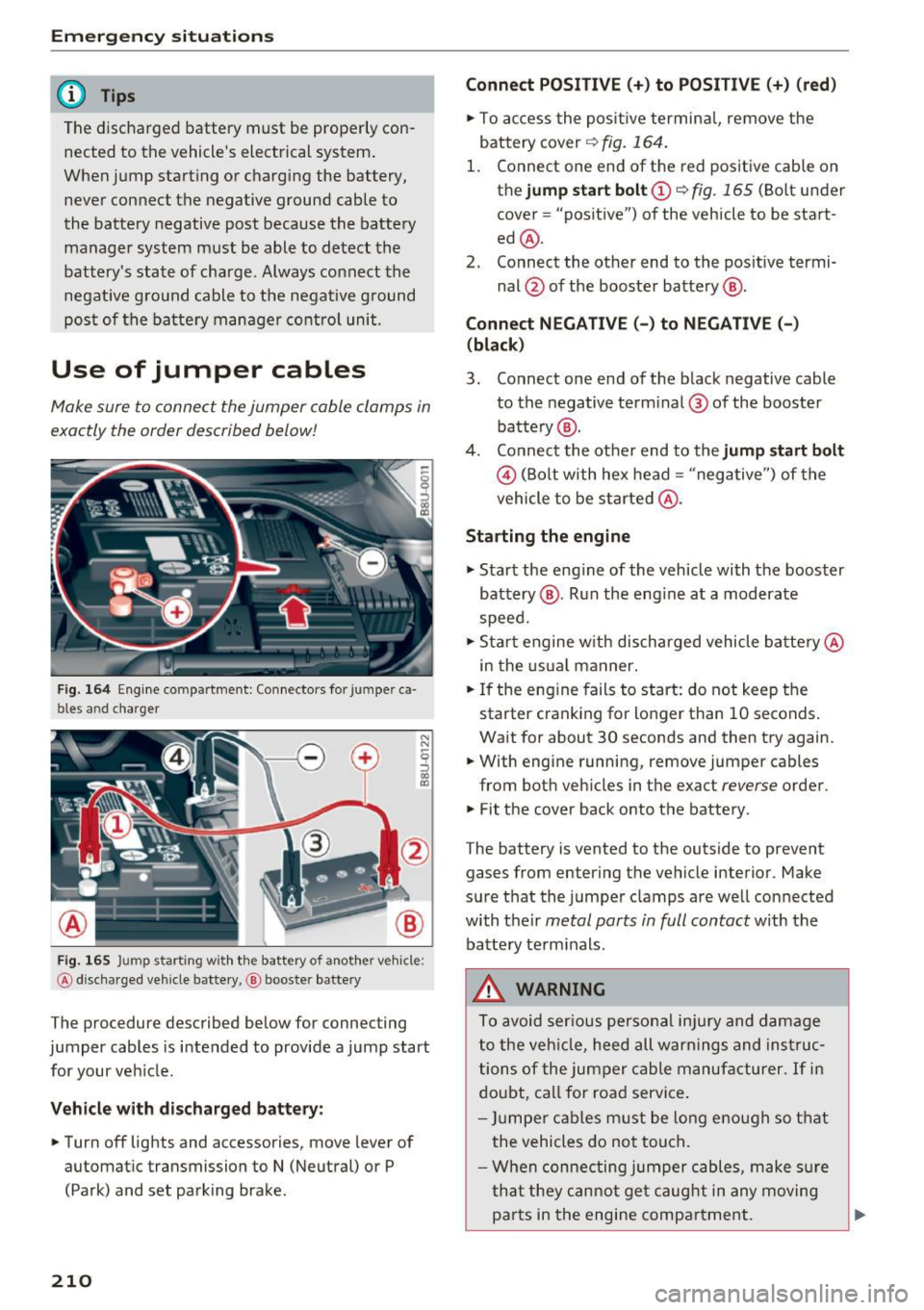
Fig. 164 Engine compartmen t: Connectors fo r ju m pe r ca
bles and charger
Fig. 165 J u mp starting w ith the battery of another vehicle :
@ discha rged vehicle bat te ry, @ booste r battery
The procedure described below for connecting
jumper cables is intended to provide a jump start
for your veh icle.
Vehicle with discharged battery:
.. Turn off lights and accessories, move lever of
automatic transmission to
N (Neutral) or P
(Park) and set park ing brake .
210
Connect POSITIVE(+) to POSITIVE (+) (red)
.. To access the positive terminal, remove the
battery cover
r:!) fig. 164.
1. Connect one end of the red positive cable on
the
jump start bolt (D ~ fig. 165 (Bolt under
cover= "positive") of the vehicle to be start
ed @.
2. Connect the other end to the positive termi-
nal@ of the booster battery @.
Connect NEGATIVE(-) to NEGATIVE(-)
(black)
3. Connect one end of the black negative cable
to the negative terminal ® of the booster
battery @.
4. Connect the other end to the
jump start bolt
© (Bolt with hex head= "negative") of the
vehicle to be started @.
Starting the engine
.,. Start the eng ine of the vehicle with the booster
battery @. Run the eng ine at a moderate
speed .
.,. Start engine w ith discharged vehicle battery@
in the usual manner.
.. If the engine fails to start: do not keep the
starter cranking for longer than 10 seconds.
Wait for about 30 seconds and then try again .
.. With engine running, remove jumper cables
from both vehicles in the exact
reverse order .
.,. Fit the cover back onto the battery .
The battery is vented to the outside to prevent gases from entering the vehicle interior . Make
sure that the jumper clamps are well connected
with their
metal parts in full contact with the
batte ry terminals.
A WARNING
To avoid serious personal inju ry and damage
to the veh icle, heed all warnings and instruc
tions of the jumper cable manufacturer.
If in
doubt, call for road service.
- Jumper cables must be long enough so that
the vehicles do not touch .
- When connecting jumper cables, make sur e
that they cannot get caug ht in any moving
pa rts in the engine compartment. ..,.
Page 218 of 236

Tech nical data
A WARNING
- The actual Gross Axle Weight Rating at the
front and rear axles should not exceed the
permissible weights, and their comb inat ion
must not exceed the Gross Veh icle Weight
Rating .
- Exceeding pe rm iss ible weight ratings can
resu lt in ve hicle damage, acc idents a nd per
so nal inj ury.
([) Note
- The vehicle capacity weight figures app ly
when the load is distributed evenly in the
vehicle (passe ngers and luggage). When
transporting a heavy load in the lugg age
compartment, carry the load as near to the
rear axle as possible so that the vehicle's
handling is not impaire d.
- Do not exceed the maximum permissib le
axle loads o r the maximum gross vehicle
Dimensions
we ight . A lways remember that the vehi cle's
hand ling will be affected by the extra load.
Therefore, adjust your speed according ly .
- Always observe local regulations .
Notes about technical
data
The values may differ for some markets depend
i ng on equ ipment installed in certain markets
and the measur ing methods .
P lease note that the specifications listed in the
vehicle documentat ion a lways take precedence.
(D Tips
Missing technical data was not ava ilable at
the time of pr int ing.
Length (in (mm)) Width (in (mm )) Width across the Height at curb
Q3 172.8 (4,388)
When driving on poor roads, by c urbs and on
steep ramps, make s ure that low -hanging com
ponents such as the spo ile r and exha ust system
Capacities
Fuel tank
Winds hield and headlight washe r system
216
mirrors (in (mm )) weight (in (mm))
72 .0 (1,831) 79.4 (2,019) 62.5 (1,590)
do not come into contact with these or they cou ld
be damaged. This especially applies to vehicles
with a f ull load.
Approximate capaci-
ties
16.9 (64.0) qt (l)
4.8 (4.5) qt ( l)