2017 AUDI A5 CABRIOLET instrument panel
[x] Cancel search: instrument panelPage 146 of 266

Airbag system
@ For the sake of the environment
Undeployed airbag modu les and pretension
ers might be classified as Perchlorate Materi
al -special handling may apply, see
www.dtsc.ca.gov/hazardouswaste/perchlo rate . When the vehicle or parts of the re
straint system including airbag modules safe
ty belts with pretens ioners are scrapped, all
applicable laws and regulat ions must be ob
served. Your authorized Audi dealer is familiar
with these requirements and we recommend
that you have your dealer perform this service
for you.
Other things that can affect Advanced
Airbag performance
Changing the vehicle's suspension system can
cha nge the way that the Advanced Airbag System
pe rforms in a crash. For example, using tire-r im
comb inat ions not approved by Audi, lower ing the
veh icle, changing the stiffness of the suspens ion,
including the spr ings, suspension struts, shock
absorbers etc . can change the forces that are
measured by the airbag sensors and sent to the
electronic control unit . Some suspens ion changes
can, for example, increase the force levels meas
ured by the sensors and make the airbag system
deploy in crashes in wh ich it would not deploy if
the changes had not been made. Other ki nds of
changes may reduce the force levels measured by
the sensors and preven t the airbag from deploy
ing when it should .
A WARNING
Changing the vehicle's suspension including
use of unapproved tire-rim combinations can
change Advanced A irbag performance and in
crease the risk of serious personal injury in a
crash.
- Never install suspension components that
do not have the same performance charac
teristics as the components originally insta l
led on your veh icle .
- Never use tire-rim comb inations that have
not been approved by Audi.
144
A WARNING
Items stored between the safety belt buckle
and the center console can cause the sensors in the buckle to send the wrong information
to the electronic control module and prevent
the Advanced A irbag System from working
properly.
- Always make sure that nothing can inte rfe re
w ith the safety belt buckles and that they
are not obstructed.
Knee airbags
Description of knee airbags
Applies to: vehicles with knee airbags
The knee airbag system can provide supplemen
tal protection to properly restrained front seat
occupants.
Fig. 150 Driver's knee a irbag
The driver knee airbag is in the instrument panel
underneath the steering whee l~
fig. 150, the
knee airbag for the passenger is at about the
same height in the instrument panel underneath
the g love compartment.
The knee airbag offers additional protection to
the driver's and passenger's knees and uppe r and
l ower thigh areas and supp lements the protec
tion provided by the safety belts .
If the front airbags deploy, the knee airbags also
deploy in frontal collis ion s when the deployment
th reshold stored in the control unit is met
~ page 138, More important things to know
about front airbags.
In addition to their normal safety funct ion, safe-
ty belts help keep the driver or front passenger in
IJJ>
Page 147 of 266

position in a frontal collision so that the airbags
can provide supplemental protection.
The airbag system is not a s ubst itute for yo ur
safety belt. Rather, it is part of the overa ll occu
pant restraint system in your vehicle. Always re
member that the airbag system can only help to
protect you if you are wearing your safety belt
and wear ing it properly . This is why you should
always wear your safety belt, not just because
the law requires you to do soc::,
page 122, Gener
al information.
Remember too, airbags will deploy only once and
only in certain k inds of accidents -your safety
be lts
a re always there to offer protection in those
accidents in which airbags are not supposed to
deploy or when they have a lready dep loyed, for
examp le when yo ur vehicle str ikes or is str uck by
anothe r afte r the f irst collis ion.
This is just one of the reasons why an airbag is
not a substitute for the safety belt. The a irbag
sys tem wo rks most effec tively when used with
the safety belts. Therefore , al ways wear your
safety bel ts cor rect ly .
It is important to remember that while the sup
p lemental knee a irbag sys tem is designed to re
d uce the like lihood of serious injur ies, other inju
ries, fo r example, swell ing, b ruising, and m inor
abrasions and fr iction burns can also occu r when
an airbag inflates.
The kne e airbag system basically consists of:
- The electronic contro l modu le
- Two inf latab le airbags (airbag and gas genera-
tor), one for the dr ive r and one fo r the front
passenge r
- T he airbag ind icator light in the instrument
pane l
The knee airbag system will not deploy:
-when the ignition is turned off
- in frontal collisions when the deceleration
measured by the control unit is too low
- in side collisions
~ -in rear-end collisions ......
~ -in rollovers N ...... 0
0
LL co
Airb ag sys tem
-in the event of a system malfunction (warning/
indicator light is on)
c::, poge 17.
A WARNING
-
-Safety belts and the airbag system can only
provide protect ion when occupants are in
the proper seat ing pos ition c::,
page 138.
-If the airbag indicator light c::, page 17
comes w hen the veh icle is being used, have
the system inspected immediately by your
author ized Audi dealer. It is possible that
the airbag will inflate when it is not sup
posed to, or w ill not inflate w hen it should.
How knee airbags work
Applies to: vehicles with knee airbags
The risk of injury to the leg area can be reduced
by fully deployed knee airbags.
F ig . 15 1 Inflated ai rbags protecting in a fronta l co llision
T he knee air bag system has been designed so
t h at the airbags fo r the driver and front passen
ger dep loy in certain but not all fronta l co llisions.
If t he front airbags deploy, the knee a irbags also
deploy in frontal coll is ions when t he deploy ment
th reshold stored in the cont rol unit is met .
When the system deploys, the a irbags fi ll with a
prope llant gas, and infla te between the lower
part o f the instrument panel and t he driver an d
the lowe r part of the instrument panel and the
front passenger
c::, page 138, fig . 148 .
Although they are not a soft pillow, they can
cush io n the impact and in th is way they can help
to red uce the risk of in jury to the lower extremi-
ties . ""
145
Page 148 of 266

Airbag syste m
All of this takes place in the blink of an eye, so
fast that many people don't even realize that the
airbags have deployed. The a irbags also inflate
with a great deal of force and it is important for
occupant safety that nothing should be in their
way when they deploy .
Fully inflated airbags in comb ination with proper
ly worn safety belts slow down and limit the oc
cupant 's forward movement and help to reduce
the risk of inju ry .
Important safety instructions on the knee
airbag system
App lies to : ve hicles w ith knee a irbags
Airbags are only supplemental restraints . Always
wear safety belts correctly and ride in a proper
seating position.
There is a lot that you and your passengers must
know and do to help the safety belts and airbags
to provide supplemental protection .
,&. WARNING
An inflating knee airbag can cause ser ious in
jury. Wea ring safety bel ts incorrectly and im
proper seating positions increase the r isk of
serious personal injury and death whenever a
vehicle is being used.
- The knee airbag system cannot protect you properly if you are seated too close to any of
the airbag locat ions. When adjusting their
seat positions, it is important that both the driver and the front passenger keep their
upper bod ies and knees at the following
min imum safe distances:
- at least 10 inches (25 cm) between the
chest and the steering wheel/instrument panel.
- at least 4 inches (10 cm) between the
knees and the lower part of the instru ment panel.
- The risk of persona l injury increases if you
lean forward or to the s ide, or if the seat is
improperly positioned and you are not wear
ing your safety belt. The risk increases even
more should the airbag deploy .
146
-Always make sure that the knee a irbag can
inflate w ithout interference. Objects be
tween you and the airbag can increase the
r isk of injury in an accident by interfering
w ith the way the airbag deploys or by being
pushed into you as the a irbag deploys .
- Never let anybody, especially children or anima ls ride in the footwell in front of the
passenger seat. If the airbag deploys, this
can result in serious or fatal injuries .
- Never carry objects of any kind in the foot
well area in front of the driver's or pas
senger's seat. Bulky objects (shopp ing
bags, for example) can interfere with or
prevent proper deployment of the a irbag.
Small objects can be thrown through the
vehicle if the airbag deploys and injure you
or your passengers.
- Make sure there are no crac ks, deep scratch
es o r othe r damage in the area of the inst ru
ment panel where the knee airbags are lo
cated.
- I f ch ildren are i ncorrectly se ated, their risk
of injury i ncreases in a col lision
~ page 150, Child safety.
Side airbags
Description of side airbags
The a irbag system con provide supplemental
protec tion to properly restrained occupants .
Fig. 152 S ide a irbag locat io n in th e dri ver's seat
The side airbags a re located in the s ides of the
front seat backrests
Q fig . 152. They a re identi
fied by the word "AIRBAG".
The side airbag sy ste m ba sically con sis t s of: IJII>
Page 153 of 266

a:,
a:,
...... N r--. N ...... 0
0
LL 00
exceptional circumstances and the PASSEN·
GER AIR BAG OFF
light does not come on
and stay on, immediately insta ll the rear
ward-facing child safety seat in a rear seat
ing posit ion and have the airbag system in
spected immediately by your authorized
Audi dealer.
A WARNING
If, in except ional circumstances, you must in
stall a forward-facing chi ld restraint on the
front passenger's seat :
- Always make sure the forward-fac ing seat
has been designed and certified by its man
ufacturer for use on a front seat with a pas
senger front and s ide airbag .
- Always follow the manufac turer 's instruc
tions provided with the chi ld safety seat or
carrier.
- Always move the passenger seat into its
rearmost position in the seat's fore and aft
adjustment range, as far away from the air
bag as possib le before installing the child
restra int. The backrest must be adjusted to
an upr ight position.
-Always make sure that the
PA SSENGER AIR
B AG OFF
light comes on and stays on all the
t ime whenever the ignition is switched on.
Always replace ch ild restraints that were in
stalled in a vehicle dur ing a crash. Damage to
a child restraint that is not visib le could cause
it to fail in another collision situation.
Advanced front airbag system and children
Your veh icle is equipped with a front "Advanced
A irbag System" i n compliance w ith United States
F edera l Moto r Vehicle Safety Standard ( FMVSS)
208, as well as Canada Motor Ve hicle Safety
Standard (CMVSS) 208 as applicable at the time
your vehicle was manufactured .
The Advanced Airbag system in your ve hicle has
been ce rtified to meet the " low-risk" requ ire
ments for 3 -and 6-yea r old children on the pas
senger side and sma ll adults on the driver side .
Child safety
The low risk deployment criteria a re intended to
reduce the risk of injury through interaction with
the a irbag that can occur, for example, by be ing
too close to the steering wheel and instrument panel when the airbag inflates. In addition, the
system has been certified to comply with the "suppression" requirements of the Safety Stand·
ard, to turn off the front airbag for infants up to
12 months who are restrained on the front pas
senger seat in ch ild rest raints that are listed in
the Standard.
Even though your veh icle is equipped with an Ad·
vanced Airbag system, all ch ild ren, especially
those 12 yea rs and you nger, sho uld a lways ride
in the back seat proper ly restrained for their age
and size . The airbag on the passenger side makes
the front seat a potentially dangerous p lace for a
child to ride. The front seat is not the safest place
for a ch ild in a forward-fac ing ch ild safety seat. It
can be a very dangerous place for an infant or a
larger ch ild in a rearward-facing seat .
' Advanced Airbags and the weight-sensing
mat in the front seat
The Advanced A irbag System in your vehicle de
tects the presence of an infant or chi ld in a chi ld
restraint on the front passenger seat using the
weight -sensing mat in the seat cushion and the
sensor below the safety belt latch on the front
passenger seat that measures the tens ion on the
safety belt.
The weight-sensing mat measures total weight of the child and the chi ld safety seat and a child
blanket on the front passenger seat . The weight
on the front passenger seat is related to the de
s ign of the child restra int and its "footprint", the
s ize and shape of the bottom of the ch ild re-
straint as it sits on the seat. The weight of a ch ild
restra int and its "footprint" va ry for different
k inds of child restra ints and for the different
models of the same kind o f chi ld rest raint of -
fered by chi ld restraint manufacturers.
T he we igh t ranges for the indiv id ual types,
makes and mode ls of ch ild restraints that the
NH TSA has specified in the Safety Standard to
gether with the weight ranges of typical infants .,.
15 1
Page 174 of 266

Intelligent Technology
Do not contin ue driving . See yo ur authori zed
Aud i dea ler or a qua lified repair facility for assis
tance.
'I@ Dynamic steering : Sy stem fault! You can
cont inue d riv ing
If the indi cator lig ht t urns on and the message
appears, the steering m ay be more difficul t to
move or mo re sensit ive than usual. The steering
wheel may also be at an angle when dr iving
straight .
Dr ive s low ly to your author ized A udi dealer or
qu alified wor kshop to have the ma lfunction co r
rected .
l;:r-ij Dynamic steering : initializing
If th is driver message appears and the ind icator
light is flas hing on the instrument panel, dynam
ic stee ring* is be ing rein itia lized . Afte r start ing
the engine , the steer ing wheel will move s light ly.
Re-i nitializ ation m igh t b e necessa ry if the s teer
i n g wheel was moved hard to the left and r igh t
while the veh icle was not moving. The disp lay
goes out as soon as initia lization is complete.
A WARNING
Have the dynamic steering* system malfunc
tion repaired as soon as possible by an au
thorized Audi dealer or qualified workshop -
r isk of accident!
(D Tips
- If the . or l;pij indicator light only stays on
fo r a short time, you may continue driving.
- The dynamic steering* stability systems are
not available in the event of a system mal
funct ion.
- Fo r additional informat ion on dynamic
steering*, refer to
¢ page 101.
172
-
Driving with your
quattro
App lies to : vehicles wit h all -w hee l drive
With all-wheel drive , all four wheels ore driven .
General information
With a ll-wheel d rive, power is distrib uted to a ll
fo ur wheels. Th is happens automat ica lly depend
i ng on your driving style and the road conditions
at the t ime . See also
¢ page 167.
A center d ifferential distributes the driving powe r
variably to the front and rear axle. It works to
gether w ith select ive whee l torque contro l, wh ic h
activates when d rivi ng through curves
¢ page 167. With the spor t different ial*, power
dist ribution to the rear wheels is var iable and can
be adjusted wi th d rive select ¢
page 101 .
The all-whee l dr ive concept is designed for hig h
engine powe r. Your vehicle is except ionally pow
e rfu l an d has excellent driving cha racteristics
bot h unde r no rmal d riving condi tions and o n
snow and i ce. A lways read and follow safety pre
ca utions
~ ..&. .
Winter tires
When dr iving in the winter, yo ur vehicle with all
whee l dr ive has a n advantage, even with regu la r
t ir es. In w inte r road cond it ions i t may be advisa
ble to mo unt win ter tires (o r all-se ason tires) for
i mproved driveability an d braking: these ti res
must be mo unted on
all four whee ls. See also
¢ page 2 22, Winter tires.
Tire chains
Where tire ch ains are mandatory on certain
r oads, t his normally also applies to vehicles wi th
a ll- wheel drive ¢
page 222, Snow chains .
Replacing wheels/tires
Vehicles with all-w heel d rive mus t always have
ti res of the same size. Also avoid tires with diffe r
en t tread dep ths. Fo r d eta ils see page
¢ page 21 4, New tires or wheels. liJJ>
Page 195 of 266

a:,
a:,
...... N
" N ...... 0
0
LL co
Checking and Filling Hood
Releasing and opening the engine hood
The engine hood is released from inside the vehi
cle.
Fig. 169 Driver's side footwell: engine hood re lea se lever
Fig. 170 Release lever under the engine hood
Before opening the engine hood, make sure that
the windshield wipers are flat against the wind
shield. Otherwise, they could damage the paint
on the hood.
.. With the driver's door open, pull the lever un
der the instrument panel in the direction of the
arrow
¢ fig. 169.
.. Raise the hood slightly¢&.
.. Press the rocker switch under the hood upward
¢
fig . 170. This releases the catch.
.. Open the hood.
A WARNING
Hot engine coolant can burn you.
- To reduce the risk of being burned, never
open the hood if you see or hear steam or
coolant escaping from the engine compart
ment. Wait until no steam or coolant can be
Checking and Filling
seen or heard before carefully opening the
hood.
Closing the engine hood
.. Pull the hood down until the pressure from the
struts is reduced.
"' Le t the hood
drop down and latch in place. Do
not try to push it shut;
it may fail to engage
¢&, .
A WARNING
A hood that is not completely latched could
fly up and block your view while driving.
- When you close the engine hood, check it to
make sure the safety catch has properly en
gaged. The hood should be flush with the
surrounding vehicle body parts.
- If you notice while driving that the hood is
not secured properly, stop at once and close
it.
Working in the engine compartment
Be especially careful whenever you work in the
engine compartment.
-
Whenever you must perform any work in the
engine compartment, for example checking and
filling different fluids, there is a risk of injury, burns and accidents. To prevent personal injury
always observe the following WARNINGS. The
engine compartment of any vehicle is a hazard
ous area
¢ .&. .
A WARNING
-~
To help avoid injury, before you check any
thing under the hood:
- Turn off the engine.
- Remove the ignition key .
- Apply the parking brake.
- Move selector lever of automatic transmis-
sion to "P" (Park).
-Always let the engine cool down. Hot com
ponents will burn skin on contact.
- To reduce the risk of being burned, never
open the hood if you see or hear steam or
coolant escaping from the engine
193
Page 237 of 266

a:,
a:,
...... N
" N ...... 0
0
LL co
Fuse panel @ (black)
No . Consumer
1 Dynamic steering
2 Electronic Stabilization Cont rol (mod ule)
A/C system press ure sensor, elect rome -
chan ica l park ing brake , Homelink, auto-
3 mat
ic dimming interior rear v iew mirror,
air q uality/outside a ir sensor, Electronic
Stabili zation Cont rol (button)
5 Sound actuator
6 Headlight range control/
headlight (cor-
ne ring light)
7 Headlight (cornering light)
Con trol modules (e lectrom echan ica l par k-
8 ing brake, s hock ab so rbe r, q uattro s port),
DCDC converter
9 Adapt ive cru ise control
1 0 Shift ga te/clu tch se nsor
1 1 Side assist
12 Headlight range control
, p arkin g sys tem
13 Airbag
14 Rear wiper (a
llroad)
1 5 Auxiliary fuse (instrument panel)
1 6 Auxiliary fuse terminal 15 (engine area
)
Fuse panel@ (brown)
No . Consumer
2 Brake light senso r
3 Fuel pump
4 Clutch sensor
5
Left seat heating w it h /w it h out seat venti-
l a tion
6 Electronic Stabili zation Cont rol (e lectr ic)
7 Ho rn
8
Front left door (window regulator, central
locki ng, mirror, switch, lig hting)
9 Windshield wiper moto r
10 Electronic Stabilization Cont rol (va lves)
Fuses and bulbs
No . Consumer
Two-door mode ls: rear left w indow reg ula-
1 1 tor; Four-door mode
ls: rear left door (w in-
dow regu lator, central locking, switch,
li ght ing)
1 2 Rain and
light sensor
Fuse panel © (red)
No . Consumer
3 Lumbar support
4 Dynam ic steering
5 Inter
io r ligh ting ( Cabr io let)
6 W
indshie ld washer system, headlight
wash er system
7 Vehicle e lectrica l system control module 1
8 Ve hicl e e lec trica l sy stem con trol module 1
9
Left rear window regu lator motor (Cabr io-
l et)/s unroof
1 0 Vehicle e lec tric al system con trol module 1
1 1 R
ight rear window regulator (Cabriolet)/
su n shade motor
1 2 A
nti- theft alarm warning system
Right cockpit fuse assignment
Fig. 194 R ig h t cockp it : f use pane l wit h plast ic cl ip
235
Page 238 of 266
Fuses and bulbs
Fuse panel @ (black)
No. Consumer
5 Steering column switch module
7 Terminal 15 diagnostic connector
8 Gateway (Databus diagnostic interface)
9 Supplementary heater
Fuse panel @ (brown)
No. Consumer
1 CD/DVD player
2 Wi-Fi
3 MMI/Radio
4 Instrument cluster
5
Gateway (instrument cluster control mod-
ule)
6 Ignition lock
7 Light switch
8 Climate control system blower
9 Steering column lock
10 Climate control system
11 Terminal 30 diagnostic connector
12 Steering column switch module
236
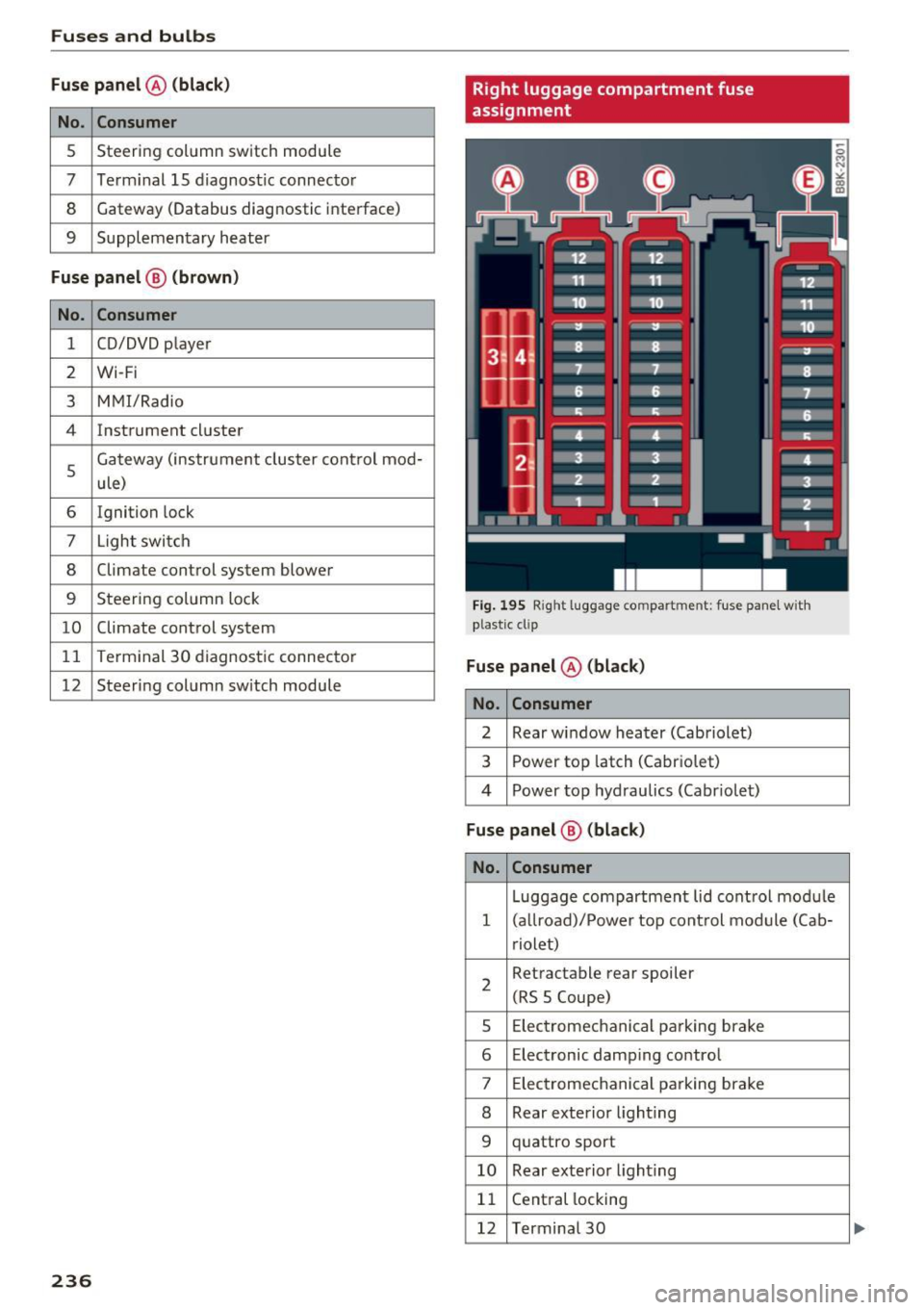
Right luggage compartment fuse
assignment
Fig. 195 Right lugg age compartment: fuse panel wit h
plastic cl ip
Fuse panel @ (black)
No. Consumer
2 Rear window heater (Cabriolet)
3 Power top latch (Cabriolet)
4 Power top hydraulics (Cabriolet)
Fuse panel @ (black)
No. Consumer
Luggage compartment lid control module
1 (allroad)/Power top control module (Cab- riolet)
2 Retractable rear
spoiler
(RS 5 Coupe)
5 Electromechanical
parking brake
6 Electronic damping control
7 Electromechan ical park ing brake
8 Rear exterior lighting
9 quattro sport
10 Rear exterior lighting
11 Central
locking
12 Terminal 30
...