2017 AUDI A3 SEDAN seats
[x] Cancel search: seatsPage 249 of 400
CXl CXl .... N ,.__
N .... 0 N > 00
Driving safety
Basics
Safe driving habits
Please remember -safety first!
This chapter contains important information,
tips, instructions and warnings that you need to
read and observe for your own safety, the safety
of your passengers and others . We have summar
ized here what you need to know about safety
belts, airbags, child restraints as well as child
safety. Your safety is for us
priority number 1. Al
ways observe the information and warnings in
this section - for your own safety as well as that
of your passengers.
The information in this section applies to all
model versions of your vehicle. Some of the fea
tures descr ibed in this sections may be standard
equipment on some models, or may be optional
equipment on others. If you are not sure, ask
your authorized Audi dealer.
A WARNING
- Always make sure that you follow the in
structions and heed the WARNINGS in this
Manual. It is in your interest and in the in
terest of your passengers .
-
-Always keep the complete Owner's Litera
ture in your Audi when you lend or sell your
vehicle so that this important information
will always be available to the driver and
passengers.
- Always keep the Owner's literature handy so
that you can find it easily if you have ques
tions.
Safety equipment
The safety features are part of the occupant re
straint system and work together to help reduce the risk of injury in a wide variety of accident sit
uations.
Your safety and the safety of your passengers
should not be left to chance. Advances in tech
nology have made a var iety of features available
to help reduce the risk of injury in an accident.
Driving safety
The following is a list of just a few of the safety
features in your Audi:
- sophisticated safety belts for driver and all pas
senger seat ing pos itions,
- safety belt pretensioners,
- safety belt height adjustment systems for the
front seats*,
- front airbags,
- knee airbags for the front seats*
- side airbags in the front seats and outer rear seats*,
- side curtain airbags with ejection mitigation features*,
- special LATCH anchorages for child restraints,
- head restraints for each seating position,
- adjustable steering column.
- pre sense* (preventat ive passenger protection)
These individual safety features, can work to gether as a system to help protect you and your
passengers in a wide range of accidents . These
features cannot work as a system if they are not
always correctly adjusted and correctly used.
Safety is everybody's responsibility!
Important things to do before driving
Safety is everybody 's job! Vehicle and occupant
safety always depends on the informed and care
ful driver .
For your safety and the safety of your passen
gers,
before driving always:
.,. Make sure that all lights and signals are operat
ing correctly .
.,. Make sure that the tire pressure is correct.
.,. Make sure that all windows are clean and afford
good visibility to the outside .
.,. Secure all luggage and other items carefully
¢ page 66, ¢ page 65.
.,. Make sure that nothing can interfere with the
pedals.
.,. Adjust front seat, head restraint and mirrors correctly for your height .
.,. Instruct passengers to adjust the head re
straints according to their height .
247
Page 250 of 400
Driving safety
• Make sure to use the right child restraint cor
rectly to protect children
c::> page 292, Child
saf ety .
• Sit properly in your seat and make sure that
your passengers do the same
c::> page 61, Fron t
seats .
• Fasten your safety belt and wear it properly . Al
so instruct your passengers to fasten their safe
ty belts properly
c::> page 258 .
What impairs driving safety?
Safe driving is directly related to the condition of
the vehicle, the driver as well as the driver 's abili
ty to concentrate on the road without being dis
tracted .
The driver is responsible for the safety of the ve
hicle and all of its occupants. If your ability to
drive is impaired, safety risks for everybody in the
veh icle increase and you also become a hazard to
everyone else on the road
c::> ,&. . Therefore :
• Do not let yourself be distracted by passengers
or by using a cellular telephone .
• NEVER drive when your driv ing ability is im
pa ired (by med ications, alcohol, drugs, etc .).
• Observ e all traffic laws, rules of the road and
speed limits and plain common sense .
• ALWAYS adjust your speed to road, traffic and
weather conditions .
• Take frequent breaks on long trips . Do not drive
for more than two hours at a stretch .
• Do NOT drive when you are tired, under pres
sure or when you are stressed .
.&, WARNING
Impaired driving safety increases the risk of
serious personal injury and death whenever a
vehicle is being used.
248
.
Correct passenger
seating positions
Proper seating position for the driver
The proper driver seating position is important
for safe, relaxed driving.
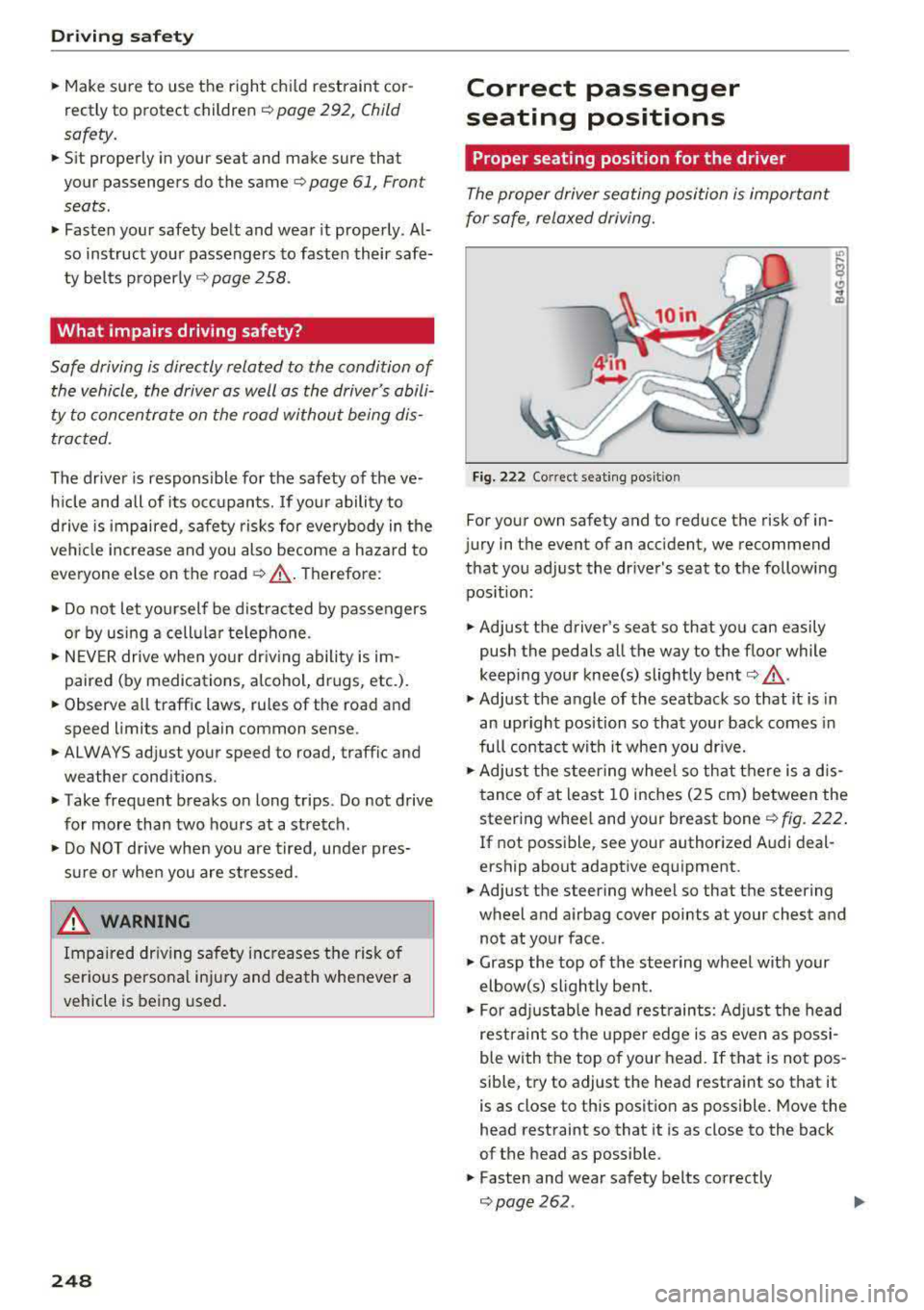
Fig. 222 Correct seating pos it ion
For your own safety and to reduce the risk of in
jury in the event of an ac cident, we recommend
that you adjust the driver's seat to the following position :
• Adjust the driver's seat so that you can easily
push the pedals all the way to the floo r while
keeping your knee(s) slightly bent
c:> .&_ .
• Adjust the angle of the seatback so that it is in
an upright position so that your back comes in
full contact with it when you dr ive.
• Adjust the steering wheel so that there is a d is
tance of at least 10 inches (25 cm) between the
steering wheel and your breast bone
r::!) fig. 222.
If not possible, see your authorized Audi deal
e rship about adaptive equipment.
• Adjust the steering wheel so that the steering
wheel and airbag cover points at your chest and
not at your face .
• Grasp the top of the steering wheel with your
elbow(s) slightly bent.
• For adjustable head restraints: Adjust the head
restraint so the upper edge is as even as possi
ble with the top of your head. If that is not pos
sible, try to adjust the head restraint so that it
is as close to this position as possible. Move the
head restraint so that it is as close to the back
of the head as possible .
• Fasten and wear safety belts correctly
c::> page 262 . .,.
Page 251 of 400

CXl CXl .... N ,.__
N .... 0 N > 00
~ Always keep both feet in the footwell so that
you are in control of the vehicle at all times.
F or detailed information on how to adjust the
driver's seat, see
¢ page 61.
A WARNING
Drivers who are unbelted, out of position or
too close to the airbag can be seriously in
jured by an airbag as it unfolds. To help re
duce the risk of serious personal injury:
-Always adjust the driver's seat and the
steering wheel so that there are at least
10 inches (25 cm) between your breastbone
and the steering wheel.
-Always adjust the driver's seat and the
steering wheel so that there are at least
4 inches (10 cm) between the knees and the
lower part of the instrument panel.
-Always hold the steering wheel on the out
side of the steering wheel rim with your
hands at the 9 o'clock and 3 o'clock posi
tions to help reduce the risk of personal in
jury if the driver's airbag inflates.
-Never hold the steer ing wheel at the
12 o'clock posit ion or with your hands at
other positions inside the steering wheel
rim or on the steering wheel hub. Holding
the steering wheel the wrong way can cause
serious injuries to the hands, arms and head if the driver 's airbag inflates.
-Pointing the steering wheel toward your
face decreases the ability of the supplemen
tal driver's airbag to protect you in a colli sion.
-Always sit in an upright position and never lean against or place any part of your body
too close to the area where the airbags are
located.
-Before driving, always adjust the front seats
properly and make sure that all passengers
are properly restrained.
-For adjustable head restraints: before driv
ing, always also adjust the head restraints
properly .
-Never adjust the seats while the vehicle is
moving. Your seat may move unexpectedly
and you could lose control of the vehicle.
-
Driving safety
-Never drive with the backrest reclined or
tilted far back! The farther the backrests are
tilted back, the greater the risk of injury due
to incorrect positioning of the safety belt
and improper seating position.
-Children must always ride in child safety
seats
c::;, page 292. Special precautions ap
ply when installing a child safety seat on the
front passenger seat
c::;, page 267.
Proper seating position for the front
passenger
The proper front passenger seating position is
important for safe, relaxed driving.
For your own safety and to reduce the risk of in
jury in the event of an accident, we recommend
that you adjust the seat for the front passenger
to the fol lowing position:
~ Adjust the angle of the seatback so that it is in
an upright position and your back comes in full
contact with it whenever the vehicle is moving.
~ For adjustable head restraints: adjust the head
restraint so the upper edge is as even as possi
ble with the top of your head. If that is not pos
sible, try to adjust the head restraint so that it is as close to this position as possible
c::;, page 63. Move the head restraint so that it is
as close to the back of the head as possible .
~ Keep both feet flat on the floor in front of the
front passenger seat.
~ Fasten and wear safety belts correctly
c::;, page 2 62 .
For detailed information on how to adjust the
front passenger's seat, see
c::;, page 61 .
A WARNING
Front seat passengers who are unbe lted, out
of position or too close to the airbag can be
seriously injured or killed by the airbag as it
unfolds . To help reduce the risk of serious
personal injury:
-Passengers must always sit in an upright po
sition and never lean against or place any pa rt of their body too close to the area
where the airbags are located.
.,,.
249
Page 252 of 400
Driving safety
-Passengers who are unbelted , out of posi
tion or too close to the airbag can be seri
ously injured by an airbag as it unfolds with
great force in the blink of an eye .
-Always make sure that there are at least
10 inches (25 cm) between the front pas
senger 's breastbone and the instrument
panel.
-Always make sure that there are at least
4 inches (10 cm) between the front passen ger's knees and the lower part of the instru
ment panel.
-Each passenger must always sit on a seat of
their own and properly fasten and wear the
safety belt belonging to that seat.
-Before dr iving, always adjust the front pas
senger seat properly .
-For adjustable head restraints: before driv
ing, always also adjust the head restraints
properly .
- Always keep your feet on the floor in front
of the seat. Never rest them on the seat, in
strument pane l, out of the window, etc. The
airbag system and safety be lt will not be
able to protect you properly and can even in
crease the risk of injury in a crash .
-Never dr ive with the backrest reclined or
ti lted far back! The farther the backrests are
ti lted back , the greater the risk of injury due
to incorrect positioning of the safety belt
and improper seating position.
-Children must always ride in child safety
seats
c::> page 292 . Special precautions ap
ply when installing a child safety seat on the
front passenger seat
c::> page 267 .
Proper seating positions for passengers in
rear seats
Rear seat passengers must sit upright with both
feet on the floor consistent with their physical
size and be properly restrained whenever the ve
hicle is in use.
To reduce the r isk of injury caused by an incorrect
seating position in the event of a sudden braking
maneuver or an accident, you r passengers on the
rear bench seat must always observe the follow
ing:
250
.,. For adjustab le head restraints: adjust the head
restraint so the upper edge is as even as possi
ble with the top of your head. If that is not pos
sible, try to adjust the head restraint so that it
is as close to this position as possible
c::> page 63.
.,. Keep both feet flat in the footwell in front of
the rear seat .
.,. Fasten and wear safety belts properly
c::> page 2 62.
.,. Make sure that children are always properly re
strained in a child restraint that is appropriate
for their size and age
c::> page 292.
A WARNING
Passengers who are improperly seated on the
rear seat can be seriously injured in a crash.
-E ach passenger must always sit on a seat of
their own and properly fasten and wear the safety belt belonging to that seat .
-Safety belts only offer maximum protection
when the safety belts are properly posi
tioned on the body and securely latched . By
not sitting upright, a rear seat passenger in
creases the risk of personal injury from im
properly positioned safety belts!
-For adjustable head restraints: always ad
just the head restraint properly so that it
can give maximum protection.
Proper adjustment of head restraints
Applies to: vehicles with adjustable head restraints
Correctly adjusted head restraints ore on impor
tant port of your
vehicle's occupant restraint sys
tem and con help to reduce the risk of injuries in
occident situations.
Fig. 223 Head restraint : viewed from t he front
Page 253 of 400

CXl CXl .... N ,.__
N .... 0 N > 00
The head restraints must be correctly adjusted to
achieve the best protection.
.,. Adjust the head restraint so the upper edge is
as even as possible with the top of your head. If
that is not possible, try to adjust the head re
straint so that it is as close to this position as
poss ible
¢ fig. 223.
... Applies to: forward/back adjustable head re
straints: Move the head restraint so that it is as
close to the back of the head as possible .
... If there is a passenger on the rear center seat
ing position, slide the center head restraint up
ward at least to the next notch.
Adjusting head restraints
<=>page 63 .
A WARNING
-
All seats are equipped with head restraints.
Driv ing without head restraints or with head
restraints that are not properly adjusted in
creases the risk of serious or fatal neck injury
dramatically. To help reduce the risk of injury:
- Always dr ive with the head restraints in
place and properly adjusted.
- Every person in the vehicle must have a
properly adjusted head restraint.
- Always make sure each person in the vehicle
properly adjusts their head restraint. Adjust
the head restraint so the upper edge is as
even as possible with the top of your head.
If that is not possible, try to adjust the head
restraint so that it is as close to this position
as possible.
- App lies to: forward/back adjustable head
restra ints: Move the head restraint so that it
is as close to the back of the head as possi
ble.
- Never attempt to adjust head restraint
while driving. If you have driven off and
must adjust the driver headrest for any rea
son, first stop the vehicle safely before at
tempting to adjust the head restraint.
- Children must always be properly restrained in a child restraint that is appropriate for
their age and size
r=;, page 292.
Driving safety
Examples of improper seating positions
The occupant restraint system can only reduce
the risk of injury if vehicle occupants are properly
seated.
Improper seating positions can cause serious in
jury or death . Safety belts can only work when
they are properly positioned on the body . Im
proper seat ing positions reduce the effectiveness
of safety belts and will even increase the risk of
injury and death by moving the safety belt to cr it
ical areas of the body. Improper seating positions
also increase the risk of serious injury and death
when an airbag deploys and strikes an occupant
who is not in the proper seating position. A driver
is responsible for the safety of all vehicle occu
pants and especially for children . Therefore:
... Never allow anyone to assume an incorrect
seating position when the vehicle is being used
0 _& .
The following list contains exxamples of some
positions that will increase the risk of serious in
jury and death. Our hope is that these examples
will make you more aware of seating positions
that are dangerous .
Therefore, whenever the vehicle is moving:
-never stand up in the vehicle
- never stand on the seats
- never kneel on the seats
- never ride with the seatback recl ined
- never lie down on the rear seat
- never lean up against the instrument panel
- never sit on the edge of the seat
- never sit sideways
- never lean out the window
- never put your feet out the window
- never put your feet on the instrument panel
- never rest your feet on the seat cushion or back
of the seat
- never ride in the footwell
- never ride in the cargo area
251
Page 258 of 400

Driving safety
Tran sp ort Canad a
M oto r V eh icle Saf ety Investiga
ti ons La bor atory
80 No el Stre et
G atin eau, QC
J8Z OAl
For additional ro ad safet y infor
m ation, pl eas e vi sit th e Road
S afet y web site at:
http: / /www .t c. gc .ca /e ng /
r oad safe ty/ menu .htm
Active rollover
protection system
Function
Applies to : vehicles with power top
The rollover protection system protects vehicle
occupants in the event of a rollover.
, ...... ----. • r-. 1 r I r
f i
F ig . 2 25 Rear seats : rollbar deployment range
----Fig. 2 26 Rear seats: deployed ro llbar
The active rollover protection system consists of:
256
-two rollbars
-the safety belts with bel t tensione rs
-the windshield frame
-the rollover sensors
The act ive rollover protection system provides
additional safety in the event of a rollover. With
i n milliseco nds, sensors deploy two rollbars lo
cated behind the head restra ints in the rear seats
¢fig. 226.
The rollbars, reinforced windshie ld frame and
belt tensioners help protect front and rear pas
sengers in the event of a rollover .
The rollover protection system functions when
the power top is both open and closed .
A WARNING
Do not use the area behind the rear seat head
rest raints
¢fig. 225 as a storage a rea. This is
the area where the rollbars deploy. If the roll
ove r prote ction system is tr iggered, objects
p la ce there can be prope lled through the ve
hi cle and make it more diffic ult for the roll
bars to deploy. This increases the risk for seri
ous or life-threateni ng inj uries.
When is rollover protection deployed?
Applies to: vehicles with power top
Rollover protection deploys in a collision or roll
over.
Depend ing o n the collision, sensors thro ughout
the ve hicle and the co ntrol modu le trigger the
rollover system to deploy .
Fo r safety reasons, ro llover protection also de
ploys dur ing front, s ide and rear coll isions above
a certa in leve l of sever ity.
Page 260 of 400
Safety belt s
Safety belts
General notes
Always wear safety belts!
Wearing safety belts correctly saves lives!
This chapter explains why safety be lts are neces
sary, how they work and how to adjust and wear
them correctly .
.. Read all the information that follows and heed
all of the instructions and WARNINGS.
&_ WARNING
Not wearing safety belts or wearing them im
properly increases the risk of serious personal
injury and death.
- Safety belts are the s ingle most effective
means ava ilable to reduce the risk of serious
injury and death in automobile acc idents.
For your protect ion and that of your passe n
gers, always co rre ctly wea r safety be lts
when the vehicle is moving.
- Pregnant wome n, injured, o r physically im
paired persons mus t also use safety be lts.
L ik e all vehicle occ upants, they are mo re
likely to be serio usly injured i f they do not
wea r safety be lts. The best way to protect a
fetus is to protect the mother
-throughout
the ent ire pregnancy .
Number of seats
Applies to: veh icles w ithout power top: Your Audi
has a total of five seating positions: two in the
front and three in the rear . Each seating position
has a safety belt .
App lies to: veh icles w ith powe r top: Your Audi
has a total of four seating positions: two in the
front and two in the rear . Each seat ing pos ition
has a safety belt .
&_ WARNING
Not wearing safety belts or wearing them im
properly in creases the risk of ser io us personal
injury and dea th.
258
- Never strap more than one person, includ
ing sma ll children, into any belt. It is espe
cially dangerous to place a safety be lt over a
child sitting on your lap .
- Never let more people r ide in the vehicle
than there are safety be lts available.
- Be sure everyone riding in the vehicle is
proper ly restrained with a separate safety
be lt o r ch ild restraint .
Safety belt warning light
Your vehicle has a warning system for the driver
and front seat passenger to remind you about the importance of buckling-up.
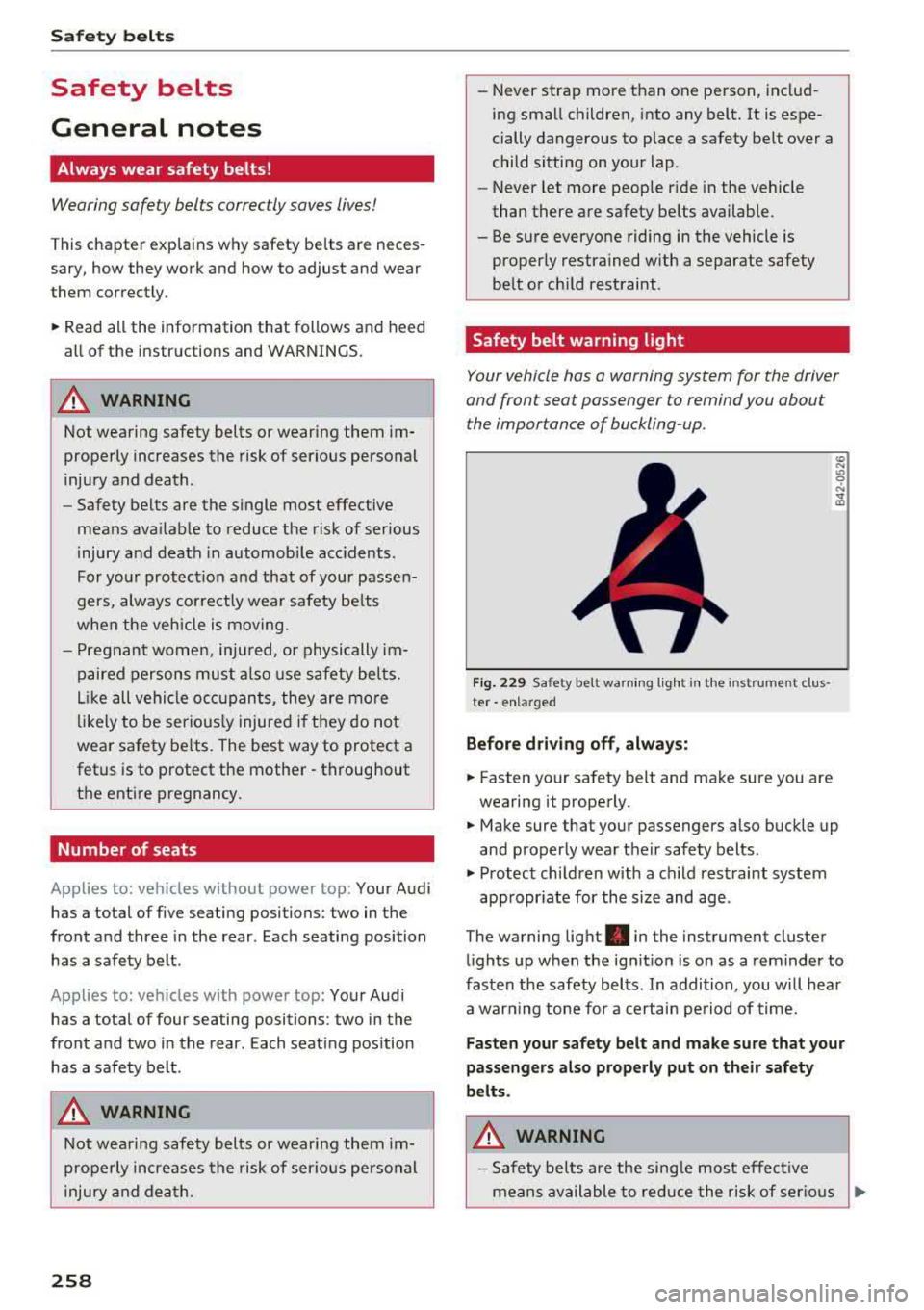
Fi g. 229 Safety belt warn ing lig ht in th e in st rument clus
ter -enlarged
Befor e dri ving off, alway s:
.. Fasten your safety belt and make sure you are
wearing it properly .
and properly wear t heir safety belts .
.. Protect children with a ch ild rest raint system
app ropr iate for the size and age .
The warning light . in the instrument cluster
li ghts up when the ig nition is o n as a rem inder to
fasten the safety belts . In addition, you wi ll hear
a war ning tone for a certain period of time.
Fasten your safety bel t and make sure that your
passengers al so prop erly put on th eir safety
belts .
&_ WARNING
-
-Safety belts are the sing le most effective
means available to red uce the risk of ser io us
.,,.
Page 262 of 400
Safe ty belts
Unbelted occupants are not able to resist the tre
mendous fo rces of impact by holding tight or
bracing themselves. Without the benefit of safe
ty restra int systems, the unrestrained occupant
will slam violently into the steering whee l, in
strument panel, windsh ield, or whatever else is
i n the way
¢ fig . 232. This impact with t he ve hi
cle interior has all the ene rgy they had just be
fore the crash.
Never rely on airbags alone for protection . Even
when they deploy, airbags provide only add itional
protection . Airbags are not supposed to dep loy in
all kinds of accidents. A lthough your Audi is
eq uipped w ith airbags, all veh icle occupants, in
cluding the dr iver, must wear safety belts cor
rectly in order to minimize the risk of severe in
jury or death in a crash.
Remember too, that ai rbags will deploy on ly
once and that your safety belts are a lways there
to offer protection in those accidents in which
airbags are not supposed to deploy or when they
have a lready deployed. Unbelted occupants can
also be thrown out of the ve hicle where eve n
more severe or fatal injuries can occur.
It is also important for the rear passengers to
wear safety belts correctly . U nbelted passengers
in the rear seats endanger not only themselves
but also the driver and other passengers
¢ fig . 233 . In a frontal collision they will be
thrown fo rward violently, where they can hit a nd
inj ure the driver and/or front seat passenge r.
260
Safety belts protect
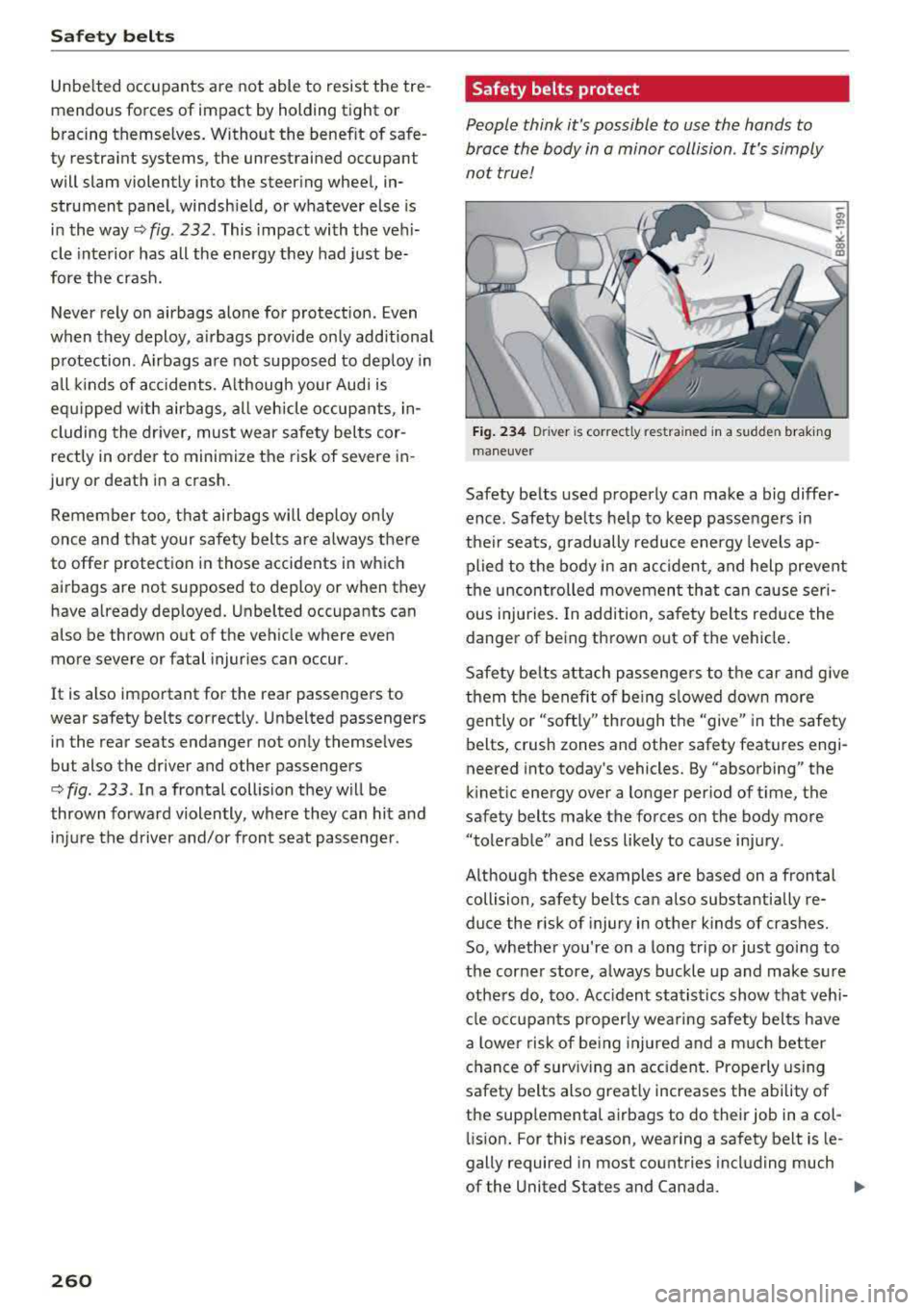
People think it 's possible to use the hands to
brace the body in a minor collision . It's simply
not true!
Fi g. 234 D river is corre ctly res trained in a sudde n brak ing
maneuver
Safety belts used properly can make a big differ
ence . Safety belts help to keep passengers in
thei r seats, gradually reduce energy levels ap
plied to the body in an accident, and help prevent
the u ncon trolled movemen t that can cause ser i
ous injuries. In add ition, sa fe ty belts reduce the
danger of being thrown out of the vehicle .
Safety be lts attach passenge rs to the car a nd g ive
them the benefit of be ing s lowed down more
gently or "soft ly" th rough the "give" in the safety
belts, crush zones and other safety features engi
neered into today's vehicles. By "absorbing" the
k inet ic energy over a longer per iod of t ime, the
safety belts make the forces on the body more
"tole rab le" and less likely to cause injury .
Although these examples are based on a frontal collision, safety be lts can also substantially re
duce the r isk of injury in other kinds of crashes.
So, whether you're on a long trip or just going to
the cor ner store, a lways buckle up and make s ure
others do, too . Acc ident sta tist ics show that veh i
cle occupants properly wea ring safety bel ts have
a lowe r risk of be ing injured and a m uch better
c h ance of surviv ing an accident . Properly us ing
safety belts also great ly increases the ability of
the supp lemental airbags to do their job in a col
li sion. For this reason, wearing a safety belt is
le
gally required in most countries including much
of the United States and Canada.
liJI,