2017 AUDI A3 SEDAN lock
[x] Cancel search: lockPage 315 of 400
CXl CXl .... N r--N .... 0 N > 00
-If you are unable to determine whether or
not a particular fuel blend meets the speci
ficat ions, ask your service station or its fuel
supplier.
-Do not use fuel for which the contents can
not be identified.
-Fuel system damage and performance prob
l ems resulting from the use of fue ls diffe r
ent from those specified are not the respon
s ibility of Audi and are not covered under
the New Veh icle or the Emiss ion Control
System Warrant ies .
-If you experience a loss of fue l economy or
driveability and pe rformance problems due
to the use of one of these fuel blends, we r ecommend that you switch to unblended
fuel.
Gasoline additives
A ma jor concern among many auto manufactur
ers is carbon deposit build-up ca used by the type
of gasoline yo u use.
A lt hough gasoline grades d iffer from one manu
facturer to another, they have cer tain things in
common . A ll gasoline grades contain substances
that can cause deposits to collect on vita l engine
parts, such as fue l injectors and intake valves.
Al
though most gasoline brands include additives to
keep engine and fuel systems clean, they are not
equally effective .
Aud i recommends using TOP TIER Detergent Gas
oline. For more informat ion on TOP TIER Dete r
gent Gasoline, please go to the official website
(www.toptiergas .com) .
After an extended period of using inadequate
fuels, carbon deposit build-ups can rob your
en
g ine of peak performance.
CD Note
Damage or malfunction due to poor fuel q ual
ity is not covered by the Aud i New Vehicle
Limited Warranty.
Ch eck ing and Filling
Refueling
Fuel filler neck
The fue l filler neck is located on the rig ht rea r
s ide panel behind the fuel fille r flap .
If the power lock ing system shou ld fail, yo u can
st ill open the flap manually
-fo r detailed instruc
tio ns see
9 page 315.
You can find the fuel tank capacity of your vehicle
i n
c::;, page 375 .
The label on the inside of the f uel fi ller flap tells
you the correct fuel for your vehicle. For more in
f ormat ion about fuel spec ificat ions, see
9 page 312.
Your vehicle fuel tank has an onboard refue lling
vapor recovery system. This feature helps to pre
vent fuel vapors from escaping from the tank and polluting the environme nt wh ile you refue l yo ur
vehicle . In order to fill the tank p roper ly w hile
pro tect ing t he e nvir onment, p lease follow t his
r efue ling p rocedure ca refully.
_& WARNING
Un der normal opera ting co nd it io ns, neve r car
ry additional f uel con tainers in your car. Gas
canisters and other containers used to trans
port fue l can be dange rous. Such containe rs,
f ull or empty, may leak and could cause a fire
i n a co llision. If you must transpo rt fuel to
use for your lawn mower, snow blower, etc .,
be ve ry careful and always observe local and
sta te laws rega rding the use, transportation
and storage of su ch f uel con tainers. Make cer
t ai n t he co ntain er meets industry standards
(ANSI/AS TM F8S2
-86).
CD Note
Never drive your veh icle until the fue l tank is
complete ly empty. The irreg ular s upply of
f u el can cause misfiring. Gaso lin e c ould enter
the e xhaust sys tem an d damage the cat aly tic
conve rter.
313
Page 316 of 400

Checking and Filling
Fueling
Fig . 265 -Applies to: veh icles wi tho ut p lug -in hybrid dr ive
ri ght rea r side of t he veh icle: ope nin g the fuel filter door
Fig. 266 Fue l fi ll er doo r w it h attached fuel cap
Plug-in hybrid drive* : Please a lso read the infor
matio n under
¢page 105, Refueling.
The fuel filler door is unlocked or locked by the
central locking system.
Op en ing th e fuel cap
"' Applies to : vehicles with p lug-in hybri d drive :
Also read the information found
in c> page 105,
Opening the fuel filler door .
"'Applies to : vehicles wi tho ut plug-in hybrid
dr ive: Press the left side of the fuel filler door
to open it-arrow-
¢ fig . 265.
"' Unscrew the tank cap counterclockw ise.
"' Place the cap from above on the open fue l filler
door ¢ fig. 266.
Closing th e fu el cap
"' Turn the fuel cap clockwise until you hear it
lock.
"' Close the fuel fille r door unt il it l atches.
Once the pump nozzle sw itches off, the fuel tank
is
" full" . Do not fi ll the tank more . Otherw ise the
expansion space in the tank will be f illed.
314
The correct fuel type for your vehicle can be
found on a label located on the inside of the fuel
filler door. For additional informat ion on fuel,
see
¢ page 312.
The fuel tank capacity of your ve hicle is listed in
the
T echn ical Dat a section ¢ page 375.
To avoid fuel spilling or evaporat ing from the fuel
tank always close fue l fi ller cap properly and
completely . An improperly closed fuel fi ller cap
may also cause the MIL
l amp ¢ page 23 to come
on .
_& WARNING
Not pay ing attention when fueling or han
dling fuel incorrectly can lead to fires, explo
sions or serious injur ies.
-Fue l ignites easily and can cause serious
burns and other injur ies.
-
-If you do not switch the engine off when fu
eling and/or do not insert the fuel nozzle
completely into the tank open ing, fuel can
leak out or run over . Leaked fuel ca n ign ite
and start a fire.
-Do not use the telephone while f ueling. The
elec tromagnetic rays ca n cause sparks,
which can ignite fue l vapors and start a fire.
- Do not sit in your vehicle wh ile fue ling. If
you must make an exception and ente r your
veh icle agai n while fueling, close the door
an d touch me tal to d ischarge stat ic elect ric
ity before to uching the f uel nozz le . Static
electricity can create spa rks, which can ig
nite vapors when fueling.
-Do not smoke or have an open flame in the
area when fueling your vehicle or fi lling a
fue l container because this increases the
risk of an explosion.
-For your safety, carrying fuel containers in
your vehicle is not recommended. W hether
fu ll or empty, the container can leak and
cause a fire in the event of an acc ident.
- If you must make an exception and trans- port a fuel container, note the fo llow ing:
- Never fill the fuel container with fuel
while i t is in o r on the vehicle. Static e lec
tricity is discharged whe n filling w hich can
.,._
Page 317 of 400

a, co ..... N
" N ..... 0 N > 00
cause the fuel vapors to ignite and
increases the risk of an explosion.
- Always place a fuel container on the
ground before filling.
- Always hold the fuel nozzle completely in
the fuel container when filling.
- If the fuel container is made of metal, the
fuel nozzle must always be in contact with
the container when filling it with fuel. This
prevents static electricity from discharg
ing.
- Never spill fuel in the vehicle or the lug
gage compartment. Evaporated fuel is ex
plosive and increases the risk of serious in
jury or death.
- Follow legal requirements when using,
storing and transporting fuel containers .
- Make sure the fuel container conforms to
industry standards (ANSI/ASTM F852-86).
(D Note
- Remove spilled fuel from vehicle paint im
mediately, because it can damage paint.
- Never drive until the fuel tank is comp letely
empty. The irregular supply of fuel that re
sults from that can cause engine misfires. Uncombusted fuel will enter the exhaust
system and increase the risk of damage to
the catalytic converter .
@.) For the sake of the environment
Do not overfill the fuel tank, otherwise fuel
can leak out when the vehicle is warming up.
@ Tips
Fuel can age and may lead to problems when
starting. Audi recommends replacing the fuel
in your vehicle within six months.
(D Tips
The fuel filler door on your vehicle does not
lock if you lock the vehicle from the inside.
Checking and Filling
Fuel filler door emergency release
If the central locking system is faulty, the fuel
filler door can be unlocked manually.
Applies to: ve rs ion 1
Fig. 267 Right rear luggage compartment : emergency re
leas e (examp le)
Applies to : ve rs ion 2
Fig. 268 Rear of the vehicle: right rear seat folded forward
Emergency release in the luggage
compartment
Applies to: vers ion l
The emergency release mechanism is located be
hind the right side trim panel in the luggage
compartment .
.. Remove the cover in the side panel.
.. Loosen the loop from the retainer and then pull
on the loop carefully -arrow-¢
fig. 267 ¢Q) .
The fuel filler door is released.
.. Press on the left side of the fuel filler door to
open
it¢page314, fig. 265.
Plug-in hybrid drive*: Also read the information
found in
¢ page 105 .
Emergency release behind the rear seat
backrest
Applies to : vers ion 2
The emergency release is located behind the
right rear seat .
315
Page 326 of 400

Checking and Filling
When the engine is warm it can be slightly above the upper marking.
Adding coolant
Plug-in hybrid drive* : Your vehicle has two cool
ant expansion tanks that are separate from each
other. The smaller of the two expansion tanks
must not be opened
¢ page 104. Read and fol
low the important safety precautions ¢
A in
Coolant on page 105 .
Requirement: there must be a residual amount of
coolant in the expansion tank
¢ (D .
~ Let the engine cool down.
~ Place a cloth over the coolant expansion tank
cap and unscrew the cap counterclockwise
¢_&. .
~ Add coolant mixed in the correct ratio
¢page 323 up to the upper marking.
~ Make sure that the fluid level remains stable.
Add more coolant if necessary.
~ Close the cap securely.
Coolant loss usually indicates there is a leak . Im
mediately drive your vehicle to an authorized
Audi dealer or authorized Audi Service Facility
and have the cooling system inspected.
If the
cooling system is not leaking, a loss can come
from the coolant boiling through overheating
and being pushed out of the cooling system.
.,&. WARNING
The cooling system is pressurized and can be
come very hot. To reduce the risk of burns
from hot coolant:
- Do not open the coolant expansion tank cap
when the engine is hot. This increases the
risk of burns.
- Stop the engine and allow it to cool.
- Protect your face, hands and arms from es-
caping coolant and steam by covering the
coolant tank cap with a large, thick cloth.
- Turn the coolant tank cap counterclockwise
slowly and keep light pressure on the cap.
- To reduce the risk of burns, do not allow any
antifreeze or coolant to drip onto the ex
haust system or hot engine components.
324
The ethylene glycol in engine coolant can
catch fire under certain circumstances.
- The coolant additive and the coolant can be
dangerous to your health. For this reason,
keep the coolant in the original container
and away from children . There is a risk of
poisoning.
- When working in the engine compartment,
remember that the radiator fan can switch
on even if the ignition is switched off, which
increases the risk of injury.
(D Note
Do not add coolant if the expansion tank is
empty . Air could enter the cooling system and
damage the engine . If this is the case, do not
continue driving . See an authorized Audi deal
er or authorized Audi Service Facility for assis
tance.
- Before the start of winter, have an author
ized Audi dealer or authorized Audi Service
Facility check if the coolant additive in your
vehicle matches the percentage appropriate
for the climate. This is especially important
when driving in colder climates.
- If the appropriate coolant additive is not
available in an emergency, do not add any
other additive. You could damage the en
gine. If this happens, only use water and re
store the correct mixture ratio with the
specified coolant additive as soon as possi
ble .
- Only refill with new coolant.
- Radiator sealant must not be mixed with the coolant.
· Radiator fan
The radiator fan switches on automatically by it
self
An auxiliary electric radiator fan switches on and
off depending on coolant temperature and other
vehicle operating conditions.
After you switch the engine off, the auxiliary fan
can continue running for up to 10 minutes
-even
with the ignition off.
It can even switch on again
later by
itself ¢.& , if .,..
Page 345 of 400

CXl CXl .... N ,.__
N .... 0 N > 00
Check with an authorized Audi dealer or author
ized Audi Service Facility to see if you may use
snow chains .
Use
fine-mesh snow chains . They must not add
more than 0.53 inch (13 .5 mm) in height, includ
ing the chain lock.
You must remove the snow chains on roads with
out snow. Otherw ise, you could impair driving
ability and damage the tires.
~ WARNING
Using incorrect snow chains or installing snow
chains incorrectly can result in loss of vehicle
control, which increases the risk of an acc i
dent.
0 Note
Snow chains can damage the rims/wheel cov
ers * if the chains come into direct contact
w ith them. Remove the wheel covers * first.
Use coated snow chains.
(D Tips
When using snow cha ins, it may be useful to
sw itch on sport mode
¢page 152.
Low aspect ratio tires
Your Aud i is factory-equipped with low aspect ra
tio tires. These t ires have been thoroughly tested
and been selected specifically for you r model for
their superb performance, road feel and handling
under a va riety of driving conditions. As k your au
thorized Audi dealer for mo re de tails.
The low aspect ratio of these tires is indicated by
a numera l of
55 or less in the tire's size designa
tion . The numeral represents the ratio of the
tire's sidewall height in relation to its tread width
expressed in percentage. Conventional tires have
a height/w idth rat io of 60 or more .
The performance of low-aspect-ratio tires is par
ticularly sensitive to improper inflation pres
sure. It is therefore important that low aspect
ratio tires are inflated to the specified pressure
and that the inflation pressure is regularly
checked and maintained. Tire pressures should
Wheels
be checked at least once a month and always
before a long trip
¢ page 336 .
What you can do to avoid tire and rim
damage
Low aspect ratio tires can be damaged more easi
ly by impact w ith potholes, curbs, gullies or
ridges on the road, particularly if the tire is un
der inflated.
In order to minimize the occurrence o f impact
damage to the tires of your vehicle, we recom
mend that you observe the following precau
t ions:
-Always maintain recommended inflation pres
sures . Check your tire pressure every
2,000 miles (3,000 km) and add air if necessa
ry.
-Drive carefully on roads with potholes, deep
gullies or ridges. The impact from driving
through or over such obstacles can damage
your tires. Impact with a curb may also cause damage to your tires.
-After any impact, immediate ly inspect your
tires or have them inspected by the nearest au
thorized Audi dealer . Replace a damaged tire as
soon as possible .
-Inspect your tires every 2,000 m iles (3,000 km)
for damage and wear . Damage is not a lways
easy to see. Damage can lead to loss of air and
unde rinflation, w hich could even tually cause
t ire fa ilure.
If yo u bel ieve that a tire may have
been damaged, replace the tire as soon as pos
sible.
-These tires may wear more quickly than others.
-Please also remember that, while these tires
deliver responsive handlin g, they may ride less
comfortably and make more noise than other
choices.
Reduced performance in winter/cold season
conditions
All tires are designed for certain purposes. The
low aspect ratio, ultra high performance tires
origina lly installed on your vehicle are intended
for maximum dry and wet road performance and
handling. They are not suitable for cold, snowy or
icy weather conditions. If you drive under those
c ir cumstances, you should equip your vehicle
..,.
343
Page 351 of 400
CXl CXl .... N r--N .... 0 N > 00
Care and cleaning
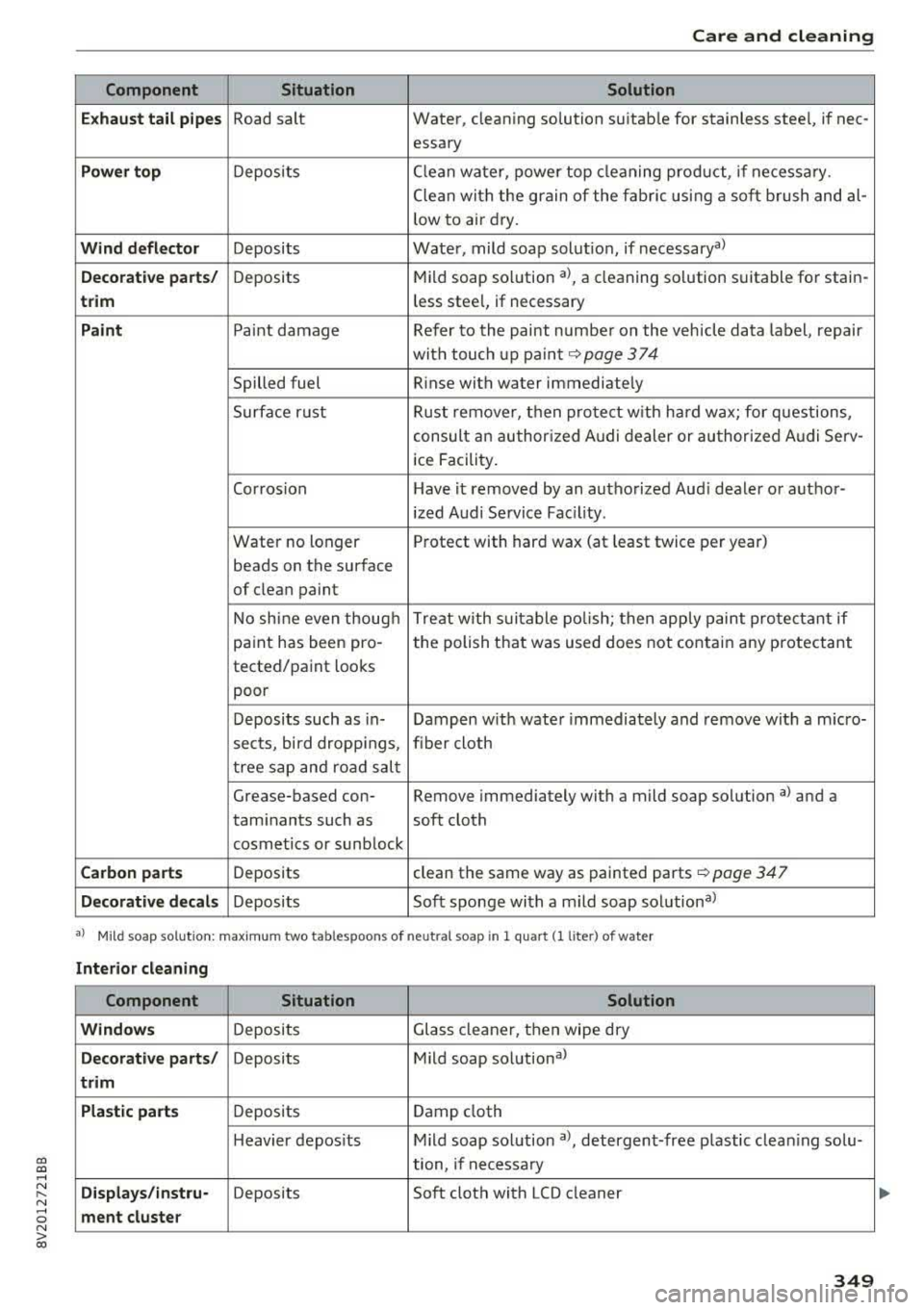
Component Situation Solution
Ex haust t ail p ip es
Road salt Water, cleaning solution suitab le for stainless steel, if nee-
essary
Po we r top Deposits Clean water, power top cleaning product, if necessa ry.
C lean with the grain of the fabric us ing a so ft brush and al-
l ow to air dry.
Wind defl ecto r Deposits Water, mild soap solut ion, if necessaryal
D ecor ativ e part s/ Deposits Mild soap solution al, a cleaning so
lution suitable for stain-
trim less stee l, if necessary
P aint Pa int damage Refer to the paint numbe r on the vehicle data label, repair
with touch up paint
~page 374
Spilled fuel Rinse with water immediately
Surface rust Rust remover, then prote ct w ith ha rd wax; for questions,
consult an author ized Audi dealer or authorized Audi Serv-
ice Facility .
Corrosion Have it removed by an authorized Aud i dealer or author-
i zed Audi Service Facility.
Water no longer Protect with hard wax (at least twice per year)
beads on the surface
of clean paint
No sh ine even thoug h Treat w ith suitable po lish; then apply paint protectant if
paint has been pro -the polish that was used does not contain any protectant
tected/paint looks poor
Deposits such as in- Dampen w ith water immediately and remove with a m icro-
sects, bi rd dropp ings, fiber cloth
tree sap and road sal t
Grease-based con-Remove immediately with a mild soap solution al and a
tam inants such as soft cloth
cosmetics or sunblock
C ar bon p art s Deposits clean
the same way as painted parts ~ page 347
Dec orati ve d ecals
Deposits Soft sponge with a mild soap solutional
a) Mild soap solution: maximum two tablespoons of neutral soap in 1 quart (1 liter l of water
Interio r cl ea ning
Component Situation Solution
Window s
Deposits Glass cleaner, then wipe dry
D
ecor ati ve part s/ Deposits Mild soap solutional
trim
Pla stic pa rts
Deposits Damp cloth
Heavier depos its Mild soap solution
al, detergent-free plastic clean ing solu-
tion, if necessary
Di spl ays/in stru· Deposits Soft cloth with LCD cleaner
ment clus te r
349
Page 355 of 400
a, a, ..... N
" N ..... 0 N > 00
Emergency assistance
Trunk escape latch
Applies to: vehicles with trunk escape latch (Sedan and Cab
rio let)
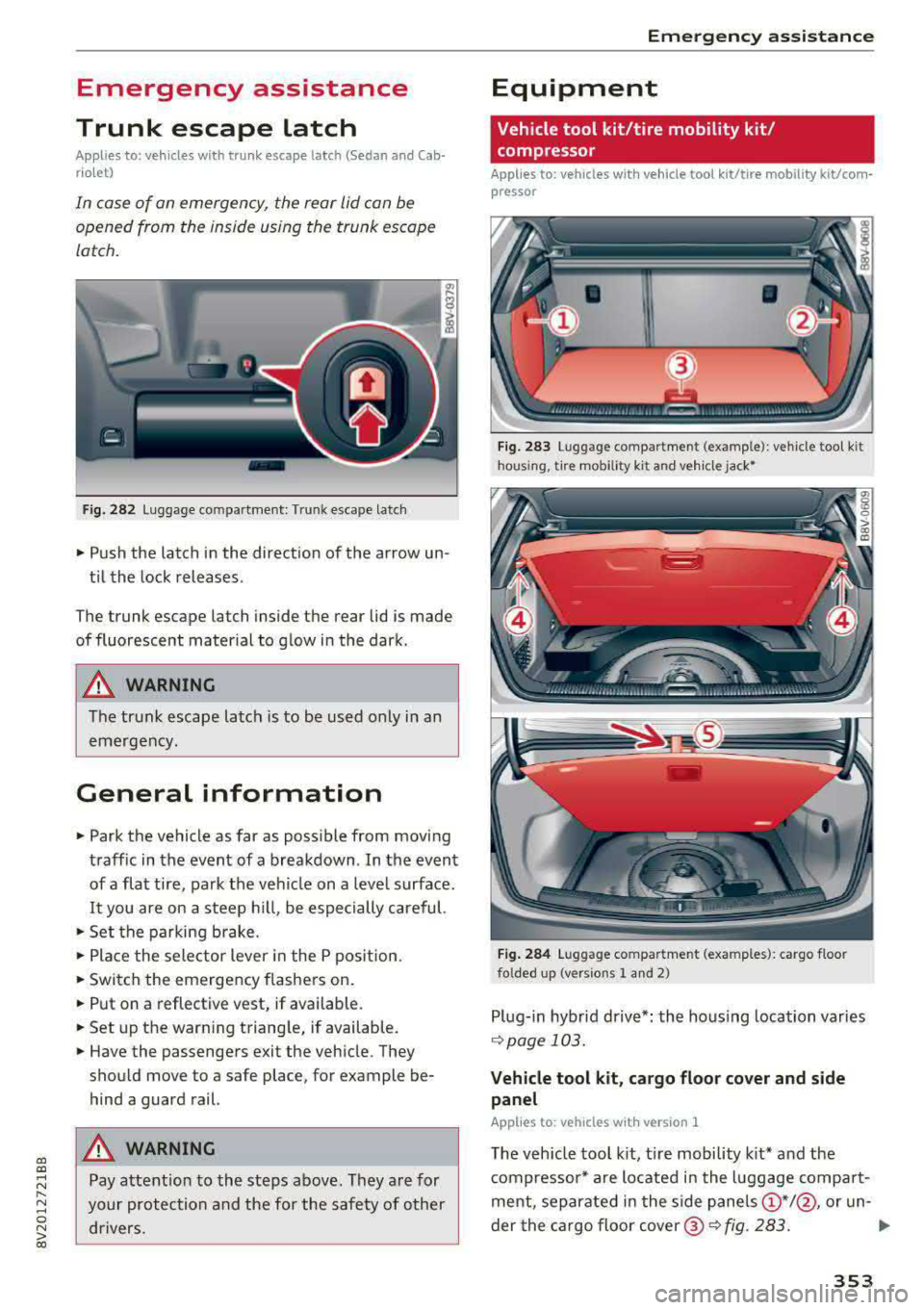
In case of an emergency, the rear lid can be
opened from th e inside using th e trunk escape
latch.
Fig. 282 Luggage co m partment: T runk escape latch
• Push the latch in the direction of the arrow un
t il the lock releases .
T he trunk escape latch inside the rear lid is made
of fluorescent mater ial to g low in the dark .
A WARNING
The trunk escape latch is to be used only in an
emergency .
General information
• Park the vehicle as far as possible from moving
traff ic in the event of a breakdown . In the event
of a flat tire, park the vehicle on a leve l surface .
It you are on a steep h ill, be especially careful.
• Set the parking b rake .
• Place the sele ctor lever in the P pos ition.
• Switch the emergency flashers on .
• Put on a reflective vest, if available.
•Setup th e warn ing triang le, if available.
• Have the passengers exit the vehicle . They
shou ld move to a safe place, for example be
hind a guard rail.
A WARNING
Pay attent ion to the steps above . They a re for
your protection and the for the safety of other drivers.
Em ergen cy a ssis tanc e
Equipment
' Vehicle tool kit/tire mobility kit /
compressor
Applies to: vehicles with vehicle tool kit/tire mobility kit/com
pressor
Fi g. 283 Lugg age compartme nt (ex ample): ve hicle too l kit
h o u sin g, tire mobili ty k it and vehicle
jac k*
F ig . 284 Luggage compar tmen t (exa mples ): cargo floor
fo lded up (ve rs ion s 1 and 2)
Plug- in hybr id drive*: the housing location var ies
~ page 103.
Vehicle t ool k it , ca rgo floor cover and s ide
panel
Applies to: vehicles with version 1
The vehicle tool k it, t ire mobility k it * an d the
compressor* are located in the l uggage compart
ment, separate d in the side
panels @*/@ , or un-
der the cargo floor
cover @~ fig. 283. ..,.
353
Page 356 of 400

Emergency assistance
• To open the side pane l, turn the lock and re
move the
cover @*/ @ ¢ fig. 283.
• Lift the cargo floor using the plastic handle @
un til the cargo floor engages behind the tabs
© in both side panels¢ fig. 284 (upper im
age) .
• Fold the cargo floor back before closing the
luggage compartment lid.
Vehicle tool kit and cargo floor cover
App lies to: ve hicles w ith versio n 2
The vehicle too l kit, tire mobility kit* and com
pressor* are stored in the luggage compartment
under the cargo floor
cover @¢ fig. 283 .
• Engage the plastic hook® in the luggage com
partment
seal ¢ fig. 284.
• Fold the cargo floor back before closing the
luggage compartment lid .
.&_ WARNING
Improper use of the vehicle jack can cause se
r ious personal injuries.
- Never use the screw driver hex head to
tighten wheel bolts, since the bolts cannot
attain the necessary tightening torque if you
use the hex head, potentially causing an ac
cident.
- T he factory-supplied jack is intended only
for your vehicle model. Under no circum
stances should it be used to lift heavy
vehicles or other loads; you risk injuring
yourself.
- Never start the engine when the vehicle is
raised, which could cause an accident.
- Support the vehicle securely with appropri
ate stands if work is to be performed under
neath the vehicle; otherwise, there is a po
tent ial risk for injury.
- Never use the jack supplied with your Audi
on another vehicle, particularly on a heavier
one. The jack is only suitable for use on the
vehicle it came w ith.
@ Tips
The vehicle jack* in your vehicle is mainte
nance-free.
354
Tire mobility kit
Preparation
App lies to: vehicles with tire mobility kit
• Read and fo llow the important safety precau-
tions
in ¢ page 353.
• Set the parking brake.
• Move the selector lever into the P position.
• Check if a repair with the tire mobility kit is pos
sible
¢ page 354.
Using the tire mobility kit
Applies to: vehicles wit h tire mobility kit
Fig. 285
Tire: t ir e damage that cannot be repaired
The tire repair is only meant for temporary use .
Change the spare tire as soon as possible
c:;> .&..
If the tire is pierced by an object such as a nail ,
do not remove the object from the tire.
..... N
0
> 00 m
The tire repair set is able to be used at tempera
tures as low as -4 °F ( -20 °C).
The tire mobility kit may not be used :
-if the tire has cuts or punctures that are larger
than
0.16 in (4 mm) (!)¢ fig. 285.
-if the rim is damaged @.
- if you drove with very low tire pressure or with-
out air in the tire @.
In this case, see an authorized Aud i dea ler or au
thorized Audi Service Facility for assistance.
~ WARNING
-Please note that the tire mobility kit cannot
be used in all situations, and that it may on
ly be used temporarily.
-The tire sealant must not come in contact
with skin, eyes, or clothes.