2016 SUBARU OUTBACK Acc switch
[x] Cancel search: Acc switchPage 369 of 572

event that a transmitter is lost, stolen,
damaged or additional transmitters are
desired (the system will accept up to eight
transmitters). New remote engine start
transmitters can be programmed accord-
ing to the following procedure.
1. Open the driver’s door (the driver’s
door must remain opened throughout the
entire process).
2. Depress and hold the brake pedal.
3. Turn the ignition switch to“ON”then
“LOCK”, back to“ON”then“LOCK”, back
to“ON”then“LOCK”, then back to“ON”
again and leave the ignition“ON”through-
out the programming process.
4. The system will flash the side marker
lights, tail lights and parking lights and
honk the horn three times, indicating that
the system has entered the transmitter
learn mode.
5. Press and release the“
”button on
the transmitter that you want to program.
6. The system will flash the side marker
lights, tail lights and parking lights and
honk the horn one time, indicating that the
system has learned the transmitter. Upon
successful programming, the remote start
confirmation transmitter button will flash
one time.
7. Repeat step 5 for any additional
transmitters (the system will accept up toeight transmitters).
8. The system will exit the transmitter
learn mode if the key is turned to the
“LOCK”position, the door is closed or
after 2 minutes.
&System maintenance
NOTE
For models without“keyless access
with push-button start system”:
In the event that the vehicle’s battery is
replaced, discharged or disconnected,
it will be necessary to start the vehicle
a minimum of one time using the key
prior to activating the remote engine
start system. This is required to allow
the vehicle electronic systems to re-
synchronize.
!Changing the batteries
CAUTION
.Do not let dust, oil or water get on
or in the remote engine start
transmitter when replacing the
battery.
.Be careful not to damage the
printed circuit board in the re-
mote engine start transmitter
when replacing the battery..Be careful not to allow children to
touch the battery and any re-
moved parts; children could
swallow them.
.There is a danger of explosion if
an incorrect replacement battery
is used. Replace only with the
same or equivalent type of bat-
tery.
.Batteries should not be exposed
to excessive heat such as sun-
shine, fire or the like.
For models with“keyless access with
push-button start system:
Perform the procedure described in“Re-
placing battery of access key”F11-50.
For models without“keyless access
with push-button start system”:
The 3-volt lithium battery (model CR-
2032) supplied in your remote engine start
transmitter should last approximately one
year, depending on usage. When the
battery begins to weaken, you will notice
a decrease in range (distance from the
vehicle that your remote control operates).
Follow the instructions below to change
the remote engine start transmitter battery.
Starting and operating/Remote engine start system (dealer option)
–CONTINUED–7-21
Page 374 of 572
Starting and operating/Continuously variable transmission
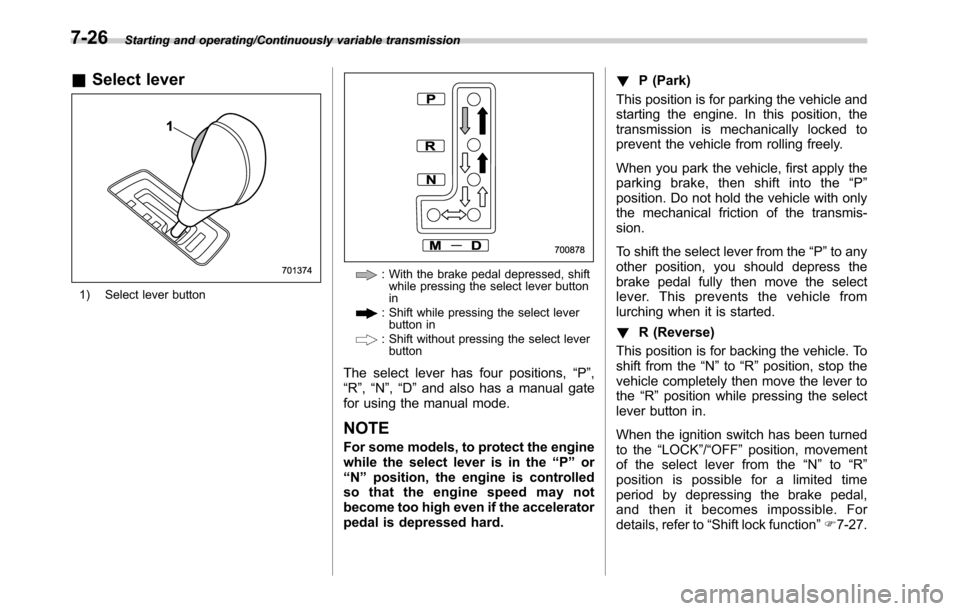
&Select lever
1) Select lever button
: With the brake pedal depressed, shift
while pressing the select lever button
in
: Shift while pressing the select lever
button in
: Shift without pressing the select lever
button
The select lever has four positions,“P”,
“R”,“N”,“D”and also has a manual gate
for using the manual mode.
NOTE
For some models, to protect the engine
while the select lever is in the“P”or
“N”position, the engine is controlled
so that the engine speed may not
become too high even if the accelerator
pedal is depressed hard.!P (Park)
This position is for parking the vehicle and
starting the engine. In this position, the
transmission is mechanically locked to
prevent the vehicle from rolling freely.
When you park the vehicle, first apply the
parking brake, then shift into the“P”
position. Do not hold the vehicle with only
the mechanical friction of the transmis-
sion.
To shift the select lever from the“P”to any
other position, you should depress the
brake pedal fully then move the select
lever. This prevents the vehicle from
lurching when it is started.
!R (Reverse)
This position is for backing the vehicle. To
shift from the“N”to“R”position, stop the
vehicle completely then move the lever to
the“R”position while pressing the select
lever button in.
When the ignition switch has been turned
to the“LOCK”/“OFF”position, movement
of the select lever from the“N”to“R”
position is possible for a limited time
period by depressing the brake pedal,
and then it becomes impossible. For
details, refer to“Shift lock function”F7-27.
7-26
Page 375 of 572
!N (Neutral)
This position is for restarting a stalled
engine. In this position, the transmission is
neutral, meaning that the wheels and
transmission are not locked. Therefore,
the vehicle will roll freely, even on the
slightest incline unless the parking brake
or foot brake is applied.
Avoid coasting with the transmission in
neutral. Engine braking has no effect in
this condition.
WARNING
Do not drive the vehicle with the
select lever in the“N”(neutral)
position. Engine braking has no
effect in this condition and the risk
of an accident is consequently in-
creased.
NOTE
If the select lever is in the“N”position
when you stop the engine for parking,
you may not subsequently be able to
move it to the“R”and“P”positions. If
this happens, turn the ignition switch to
the“ON”position. You will then be able
to move the select lever to the“P”
position.!D (Drive)
This position is for normal driving. The
transmission shifts automatically and con-
tinuously into a suitable gear according to
the vehicle speed and the acceleration
you require. Also, while driving up and
down a hill, the transmission assists and
controls the driving performance and
engine braking while corresponding to
the road grade.
When more acceleration is required in“D”
position, depress the accelerator pedal
fully to the floor and hold that position. The
transmission will automatically downshift.
In this case, the transmission will operate
like a conventional automatic transmis-
sion. When you release the pedal, the
transmission will return to the original gear
position.
To use the manual mode, move the lever
from this position into the manual gate.
!While climbing a grade
When driving up a hill, undesired upshift is
prevented from taking place when the
accelerator is released. This minimizes
the chance of subsequent downshifting to
a lower gear when accelerating again.
This prevents repeated upshifting and
downshifting resulting in a smoother op-
eration of the vehicle.
NOTE
The transmission may downshift, de-
pending on the way the accelerator
pedal is depressed to accelerate the
vehicle again.
&Shift lock function
The shift lock function helps prevent the
improper operation of the select lever.
.The select lever cannot be operated
unless the ignition switch is turned to the
“ON”position and the brake pedal is
depressed.
.The select lever cannot be moved from
the“P”position to any other position
before the brake pedal is depressed.
Depress the brake pedal first, and then
operate the select lever.
.Only the“P”position allows you to turn
the key from the“ACC”position to the
“LOCK”position and remove the key from
the ignition key cylinder (models without
“keyless access with push-button start
system”).
.Only the“P”position allows you to turn
the push-button ignition switch to the
“OFF”position (models with“keyless
access with push-button start system”).
.If the ignition switch is turned to the
“LOCK”/“OFF”position while the select
lever is in the“N”position, the select lever
Starting and operating/Continuously variable transmission
–CONTINUED–7-27
Page 376 of 572

Starting and operating/Continuously variable transmission
may not be moved to the“P”position after
a period of time. Therefore, move the
select lever to the“P”position with the
brake pedal depressed soon after the
ignition switch is turned to the“LOCK”/
“OFF”position.
!Shift lock release
If the select lever cannot be operated, turn
the ignition switch back to the“ON”
position then move the select lever to the
“P”position with the select lever button
pressed and brake pedal depressed.
If the select lever does not move after
performing the above procedure, perform
the following steps.
.When the select lever cannot be
shifted from“P”to“N”:
Refer to“Shift lock release using the shift
lock release portion”F7-28.
.When the select lever cannot be
shifted from“N”to“R”,“P”:
Within 60 seconds after placing the igni-
tion switch in the“ACC”position, move the
select lever to the“P”position with the
select lever button pressed and brake
pedal depressed.
If you must perform the above procedure,
the shift lock system (or the vehicle control
system) may be malfunctioning. Contact aSUBARU dealer for an inspection as soon
as possible.
If the select lever does not move after
performing the above procedure, refer to
“Shift lock release using the shift lock
release portion”F7-28.
!Shift lock release using the shift
lock release portion
Perform the following procedure to release
the shift lock.
1. Apply the parking brake and stop the
engine.
2. Open the lid of the pocket.
1) Hole
3. Turn over the inner trim of the pocket.
4. Remove the grip portion of the screw-
driver.
7-28
Page 390 of 572
Starting and operating/Parking your vehicle
CAUTION
Do not place metal film or any metal
parts under the driver’s seat. This
may cause poor reception of the
signals from the tire pressure sen-
sors, and the tire pressure monitor-
ing system will not function prop-
erly.
FCC ID: CWTWD1U848
NOTE
This device complies with Part 15 of
the FCC Rules. Operation is subject to
the following two conditions: (1) This
device may not cause harmful inter-
ference, and (2) this device must
accept any interference received, in-
cluding interference that may cause
undesired operation.
FCC CAUTION
Changes or modifications not ex-
pressly approved by the party respon-
sible for compliance could void the
user’s authority to operate the equip-
ment.
Parking your vehicle
WARNING
.Never leave unattended children
or pets in the vehicle. They could
accidentally injure themselves or
others through inadvertent op-
eration of the vehicle. Also, on
hot or sunny days, the tempera-
ture in a closed vehicle could
quickly become high enough to
cause severe or possibly fatal
injuries to them.
.Do not park the vehicle over
flammable materials such as dry
grass, waste paper or rags, as
they may burn easily if they come
near hot engine or exhaust sys-
tem parts.
.Be sure to stop the engine if you
take a nap in the vehicle. If
engine exhaust gas enters the
passenger compartment, occu-
pants in the vehicle could die
from carbon monoxide (CO) con-
tained in the exhaust gas.
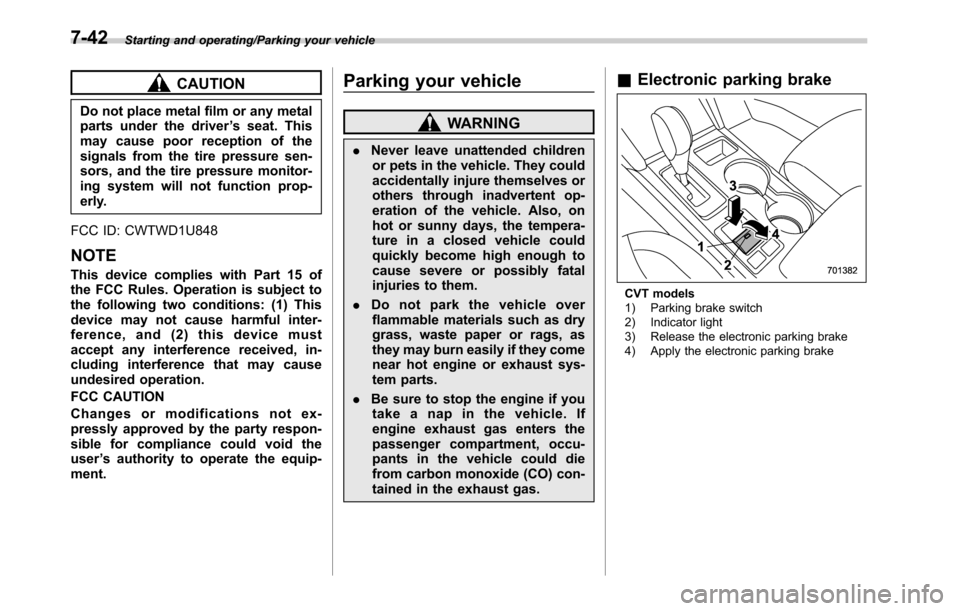
&Electronic parking brake
CVT models
1) Parking brake switch
2) Indicator light
3) Release the electronic parking brake
4) Apply the electronic parking brake
7-42
Page 391 of 572
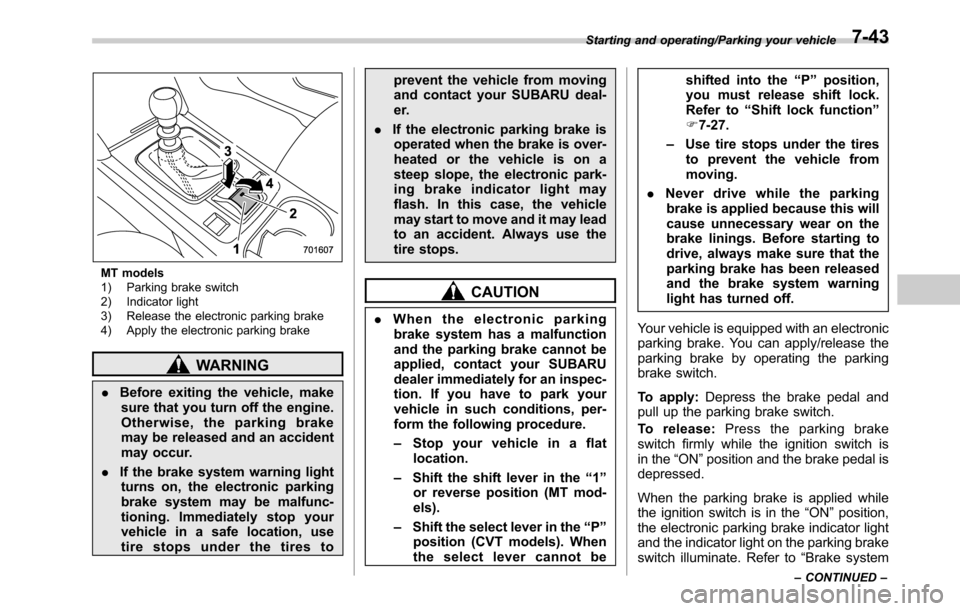
MT models
1) Parking brake switch
2) Indicator light
3) Release the electronic parking brake
4) Apply the electronic parking brake
WARNING
.Before exiting the vehicle, make
sure that you turn off the engine.
Otherwise, the parking brake
may be released and an accident
may occur.
.If the brake system warning light
turns on, the electronic parking
brake system may be malfunc-
tioning. Immediately stop your
vehicle in a safe location, use
tire stops under the tires toprevent the vehicle from moving
and contact your SUBARU deal-
er.
.If the electronic parking brake is
operated when the brake is over-
heated or the vehicle is on a
steep slope, the electronic park-
ing brake indicator light may
flash. In this case, the vehicle
may start to move and it may lead
to an accident. Always use the
tire stops.
CAUTION
.When the electronic parking
brake system has a malfunction
and the parking brake cannot be
applied, contact your SUBARU
dealer immediately for an inspec-
tion. If you have to park your
vehicle in such conditions, per-
form the following procedure.
–Stop your vehicle in a flat
location.
–Shift the shift lever in the“1”
or reverse position (MT mod-
els).
–Shift the select lever in the“P”
position (CVT models). When
the select lever cannot beshifted into the“P”position,
you must release shift lock.
Refer to“Shift lock function”
F7-27.
–Use tire stops under the tires
to prevent the vehicle from
moving.
.Never drive while the parking
brake is applied because this will
cause unnecessary wear on the
brake linings. Before starting to
drive, always make sure that the
parking brake has been released
and the brake system warning
light has turned off.
Your vehicle is equipped with an electronic
parking brake. You can apply/release the
parking brake by operating the parking
brake switch.
To apply:Depress the brake pedal and
pull up the parking brake switch.
To release:Press the parking brake
switch firmly while the ignition switch is
in the“ON”position and the brake pedal is
depressed.
When the parking brake is applied while
the ignition switch is in the“ON”position,
the electronic parking brake indicator light
and the indicator light on the parking brake
switch illuminate. Refer to“Brake system
Starting and operating/Parking your vehicle
–CONTINUED–7-43
Page 392 of 572

Starting and operating/Parking your vehicle
warning light”F3-18.
NOTE
.If the parking brake switch is
pressed with the ignition switch in the
“ACC”or“LOCK”/“OFF”position, the
parking brake is not released.
.If the parking brake switch is
pressed without depressing the brake
pedal (all models) and/or clutch pedal
(MT models), the parking brake is not
released.
.The electronic parking brake system
uses motors to apply the parking
brake. Therefore, operating sounds
from the motors will be heard when
applying or releasing the parking
brake. Make sure that the motor
sounds are heard when applying or
releasing the parking brake.
.When the electronic parking brake
system has a malfunction or the elec-
tronic parking brake operation is pro-
hibited temporarily, if the parking brake
switch is operated, a chirp sound is
heard and the electronic parking brake
indicator light flashes.
.When you cannot release the park-
ing brake due to, for example, a system
malfunction, contact your SUBARU
dealer and have your SUBARU dealer
release the parking brake.
.If the operation of the electronicparking brake switch is stopped mid-
way or performed extremely slowly, the
system may detect an error and turn on
the brake system warning light. How-
ever, this does not indicate a malfunc-
tion if the warning light turns off after
operating the switch.
.When the electronic parking brake
has not been used for a long period of
time, the electronic parking brake may
operate automatically after the ignition
switch is turned to the“LOCK”/“OFF”
position. This occurs due to checking
the proper operation of the electronic
parking brake and does not indicate a
malfunction.
.If the electronic parking brake
switch is malfunctioning and the elec-
tronic parking brake cannot be re-
leased, refer to the instructions de-
scribed in“Automatic release function
by accelerator pedal”F7-44.
After activating the EPB, you may hear
a short sound several minutes after the
indicator lamp illuminates as the sys-
tem confirms proper engagement. This
sound is different from the apply and
release sound.
This can occur:
–If the brakes are extremely hot.
–If the car is parked on a steep
incline.–If the electronic parking brake is
applied after the ignition switch is
turned OFF.
This is a normal operating sound under
any of these conditions.
!Automatic release function by ac-
celerator pedal
The electronic parking brake system has
an automatic release function. The park-
ing brake will be automatically released by
depressing the accelerator pedal. How-
ever, the automatic release function does
not operate under the following conditions.
.Any door (other than the trunk lid or
rear gate) is open.
.The driver’s seatbelt is not fastened.
.The clutch pedal is released from the
fully depressed position to partially en-
gaged position (MT models).
If the parking brake is automatically
released, the electronic parking brake
indicator light and the indicator light on
the parking brake switch turn off.
NOTE
Even if you have applied the parking
brake, the parking brake will be auto-
matically released when the accelera-
tor pedal is depressed.
7-44
Page 393 of 572
!Hill Holder function
The electronic parking brake system has a
Hill Holder function. If the Hill Holder
function is activated, the parking brake
will be automatically applied when stop-
ping on an uphill slope with the brake
pedal depressed. In this case, the electro-
nic parking brake indicator light and the
indicator light on the parking brake switch
illuminate.
NOTE
.The Hill Holder function may not
activate on a gentle uphill slope. In this
case, manually apply the electronic
parking brake.
.If you do not depress the brake
pedal sufficiently, the Hill Holder func-
tion may not operate properly. How-
ever, this is not a malfunction. When
stopping on an uphill slope, depress
the brake pedal firmly and release it
after the electronic parking brake in-
dicator light illuminates.
.Depending on the condition of the
road surface and braking force, the
brakes operate temporarily and feel
different than usual.
.When the electronic parking brake
system has a malfunction while the Hill
Holder function is activated, a chirp
sound is heard, the Hill Holder indica-
tor light turns off and the brake systemwarning light turns on.
.When the hill holder activates on a
slope, the electronic parking brake is
engaged. The electronic parking brake
will release when you accelerate from
the stop. If you manually release the
electronic parking brake while the hill
holder is activated, the hill holder
function is cancelled and will not re-
engage until the vehicle has moved
some distance. In that case, you will
need to manually engage the electronic
parking brake if needed.
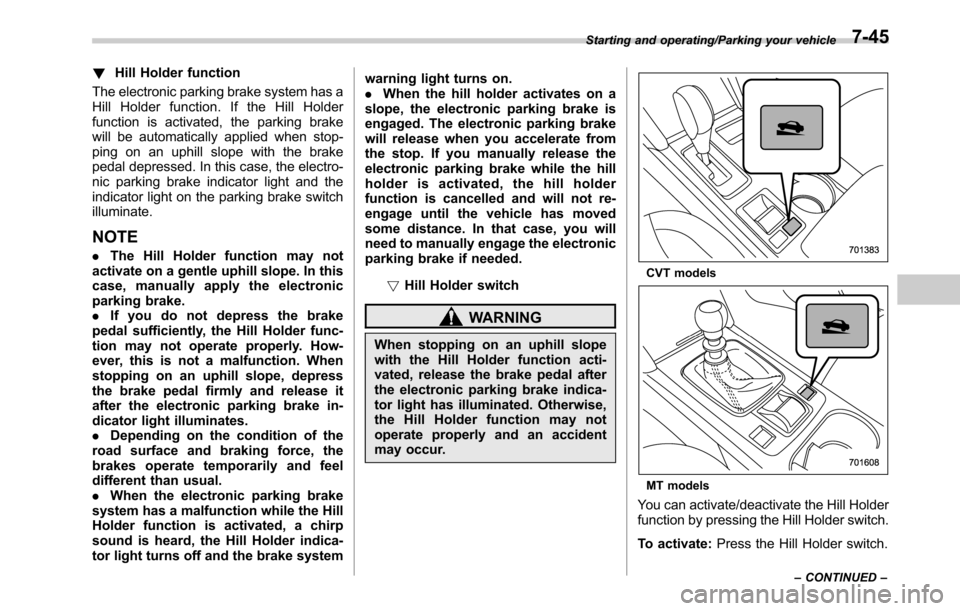
!Hill Holder switch
WARNING
When stopping on an uphill slope
with the Hill Holder function acti-
vated, release the brake pedal after
the electronic parking brake indica-
tor light has illuminated. Otherwise,
the Hill Holder function may not
operate properly and an accident
may occur.
CVT models
MT models
You can activate/deactivate the Hill Holder
function by pressing the Hill Holder switch.
To activate:Press the Hill Holder switch.
Starting and operating/Parking your vehicle
–CONTINUED–7-45