2016 NISSAN NOTE sensor
[x] Cancel search: sensorPage 1778 of 3641
SYSTEMEXT-11
< SYSTEM DESCRIPTION >
C
DE
F
G H
I
J
L
M A
B
EXT
N
O P
SYSTEM
ACTIVE GRILLE SHUTTER SYSTEM
ACTIVE GRILLE SHUTTER SYSTEM : System DiagramINFOID:0000000012432159
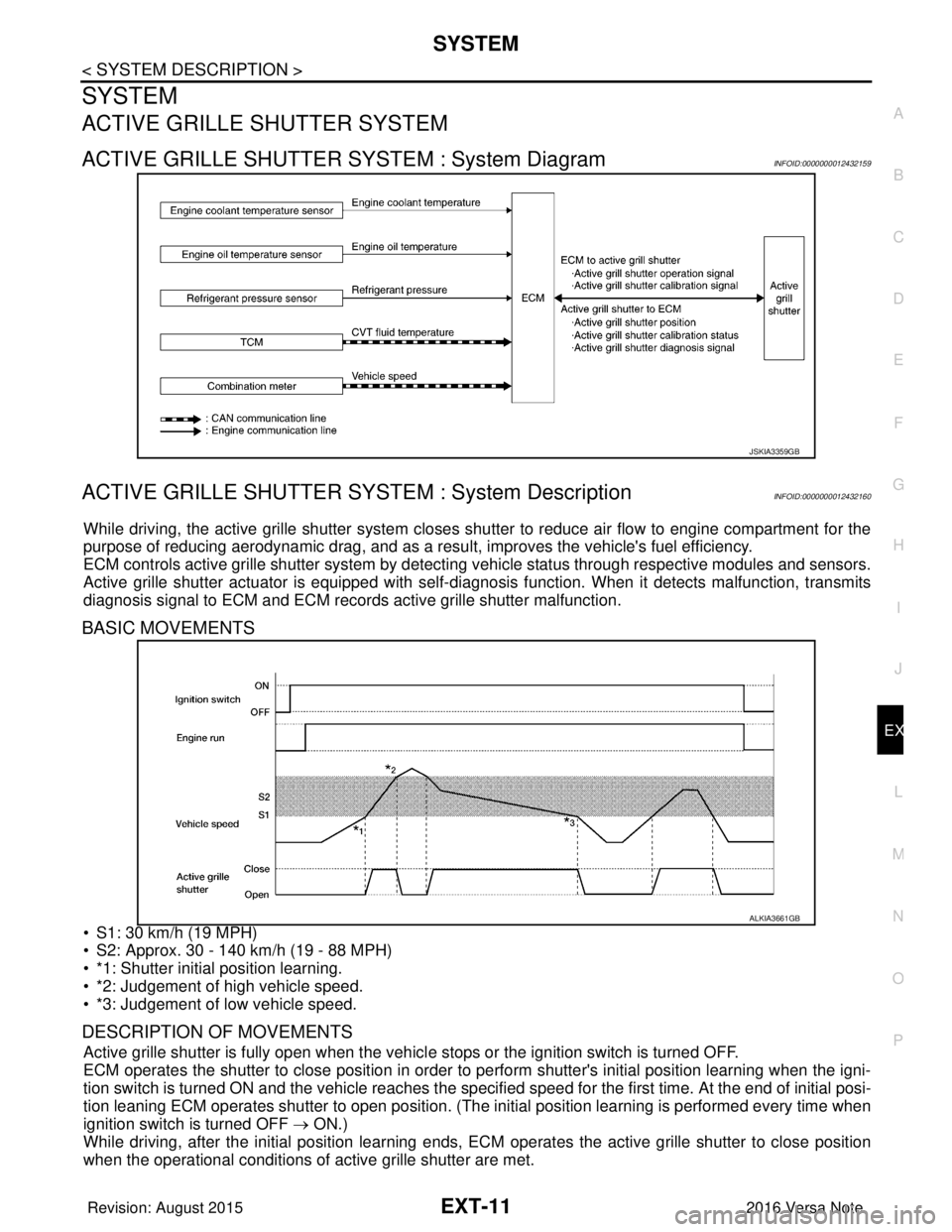
ACTIVE GRILLE SHUTTER SYSTEM : System DescriptionINFOID:0000000012432160
While driving, the active grille shutter system closes shutter to reduce air flow to engine compartment for the
purpose of reducing aerodynamic drag, and as a resu lt, improves the vehicle's fuel efficiency.
ECM controls active grille shutter system by detecting vehicle status through respective modules and sensors.
Active grille shutter actuator is equipped with self-d iagnosis function. When it detects malfunction, transmits
diagnosis signal to ECM and ECM records active grille shutter malfunction.
BASIC MOVEMENTS
• S1: 30 km/h (19 MPH)
• S2: Approx. 30 - 140 km/h (19 - 88 MPH)
• *1: Shutter initial position learning.
• *2: Judgement of high vehicle speed.
• *3: Judgement of low vehicle speed.
DESCRIPTION OF MOVEMENTS
Active grille shutter is fully open when the vehicl e stops or the ignition switch is turned OFF.
ECM operates the shutter to close position in order to perform shutter's initial position learning when the igni-
tion switch is turned ON and the vehicle reaches the specified speed for the first time. At the end of initial posi-
tion leaning ECM operates shutter to open position. (The in itial position learning is performed every time when
ignition switch is turned OFF → ON.)
While driving, after the initial position learning ends, EC M operates the active grille shutter to close position
when the operational conditions of active grille shutter are met.
JSKIA3359GB
ALKIA3661GB
Revision: August 2015 2016 Versa Note
cardiagn.com
Page 1779 of 3641

EXT-12
< SYSTEM DESCRIPTION >
SYSTEM
While driving at high speed, ECM operates the shutter to open position when the vehicle reaches the specified
speed in order to prevent the shutte r from shutting up by wind resistance.
When the vehicle speed is reduced below the specified speed ECM operates active grille shutter to open posi-
tion.
ACTIVE GRILLE SHUTTER OPERATIONAL CONDITIONS
ECM operates active grille shutter to close position when following a ll conditions are met.
ECM operates active grille shutter to open positi on when one of the following conditions is met.
Item Status
Active grille shutter initial position learning Complete
Vehicle speed Approx. 30 - 140 km/h (19 - 88 MPH)
Engine coolant temperature Approx. less than 95°C (203 °F)
Engine oil temperature Approx. less than 140°C (284 °F)
CVT fluid temperature Approx. less than 135°C (275 °F)
Cooling fan OFF
Refrigerant pressure 0.78 MPa (7.95 kg/cm
2, 113.1 psi) or less
Malfunction of engine coolant temperature sensor system Not detected
Malfunction of engine oil temperature sensor system Not detected
Malfunction of vehicle speed sensor system Not detected
Malfunction of CAN communication system Not detected
ItemStatus
Vehicle speed • 22 km/h (14 MPH) or less
• 140 km/h (88 MPH) or more
Engine coolant temperature Approx. 95°C (203 °F) or more
Engine oil temperature Approx. 140°C (284 °F) or more
CVT fluid temperature Approx. 135°C (275 °F) or more
Cooling fan ON
Refrigerant pressure 1.18 MPa (12.04 kg/cm
2, 171.1 psi) or more
Malfunction of engine coolant temperature sensor system Detected
Malfunction of engine oil temperature sensor system Detected
Malfunction of vehicle speed sensor system Detected
Malfunction of CAN communication system Detected
Revision: August 2015 2016 Versa Note
cardiagn.com
Page 1819 of 3641

FAX-2
< PRECAUTION >
PRECAUTIONS
PRECAUTION
PRECAUTIONS
Precaution for Supplemental Restraint System (SRS) "AIR BAG" and "SEAT BELT
PRE-TENSIONER"
INFOID:0000000012431882
The Supplemental Restraint System such as “A IR BAG” and “SEAT BELT PRE-TENSIONER”, used along
with a front seat belt, helps to reduce the risk or severity of injury to the driver and front passenger for certain
types of collision. Information necessary to service the system safely is included in the SR and SB section of
this Service Manual.
WARNING:
• To avoid rendering the SRS inopera tive, which could increase the risk of personal injury or death in
the event of a collision which would result in air bag inflation, all maintenance must be performed by
an authorized NISSAN/INFINITI dealer.
• Improper maintenance, including in correct removal and installation of the SRS, can lead to personal
injury caused by unintent ional activation of the system. For re moval of Spiral Cable and Air Bag
Module, see the SR section.
• Do not use electrical test equipmen t on any circuit related to the SRS unless instructed to in this
Service Manual. SRS wiring harn esses can be identified by yellow and/or orange harnesses or har-
ness connectors.
PRECAUTIONS WHEN USING POWER TOOLS (AIR OR ELECTRIC) AND HAMMERS
WARNING:
• When working near the Airbag Diagnosis Sensor Unit or other Airbag System sensors with the Igni-
tion ON or engine running, DO NOT use air or electri c power tools or strike near the sensor(s) with a
hammer. Heavy vibration could activate the sensor( s) and deploy the air bag(s), possibly causing
serious injury.
• When using air or electric power tools or hammers , always switch the Ignition OFF, disconnect the
battery and wait at least three minutes before performing any service.
Precaution for Drive ShaftINFOID:0000000012431883
Observe the following precautions when disassembling and assembling drive shaft.
• Do not disassemble joint sub-assembly because it is non-overhaul parts.
• Perform work in a location which is as dust-free as possible.
• Clean the parts, before disassembling and assembling.
• Prevent the entry of foreign objects dur ing disassembly of the service location.
• Reassemble disassembled parts carefully in the correct order. If work is interrupted, a clean cover must be placed over parts.
• Use paper waste. Fabric shop cloths must not be used because of the danger of lint adhering to parts.
• Clean disassembled parts (except for rubber parts) with kerosene which shall be removed by blowing with air or wiping with paper waste.
Precautions for Wheel Hub and KnuckleINFOID:0000000012431884
Observe the following precautions when assembling wheel hub and knuckle.
• Perform work in a location which is as dust-free as possible.
• Use paper waste. Fabric shop cloths must not be used because of the danger of lint adhering to parts.
• If any of wheel hub, steering knuckle, wheel bearing, and wheel hub lock nut is dropped, it must not be used.
• Always check that the tools used for press-fit work of wheel hub and wheel bearing have no wear and defor- mation so that a pressure can be applied vertically.
Revision: August 2015 2016 Versa Note
cardiagn.com
Page 1826 of 3641
FRONT WHEEL HUB AND KNUCKLEFAX-9
< REMOVAL AND INSTALLATION >
CEF
G H
I
J
K L
M A
B
FA X
N
O P
REMOVAL AND INSTALLATION
FRONT WHEEL HUB AND KNUCKLE
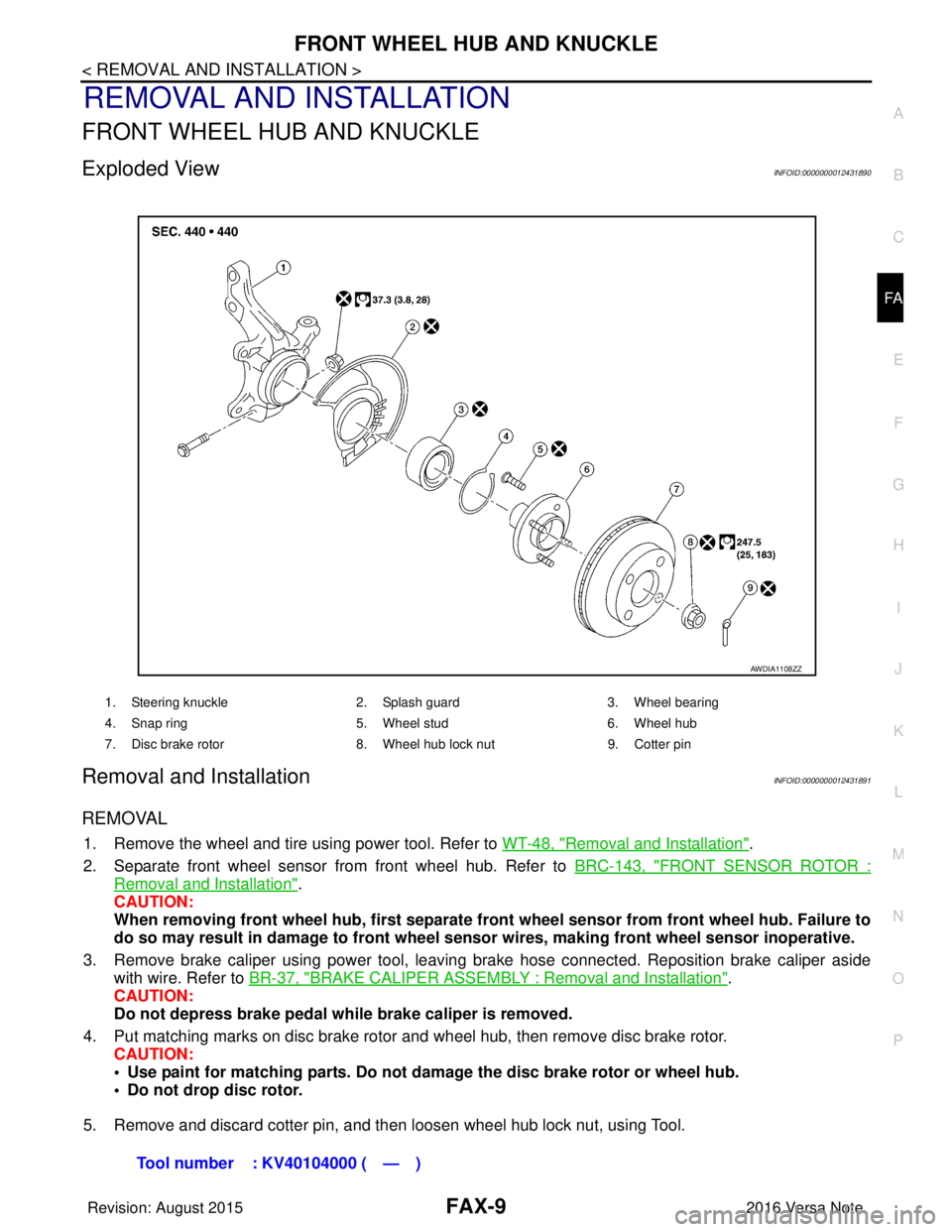
Exploded ViewINFOID:0000000012431890
Removal and InstallationINFOID:0000000012431891
REMOVAL
1. Remove the wheel and tire using power tool. Refer to WT-48, "Removal and Installation".
2. Separate front wheel sensor from front wheel hub. Refer to BRC-143, "
FRONT SENSOR ROTOR :
Removal and Installation".
CAUTION:
When removing front wheel hub, first separate front wheel sensor from front wheel hub. Failure to
do so may result in damage to front wheel sensor wires, making front wheel sensor inoperative.
3. Remove brake caliper using power tool, leaving brake hose connected. Reposition brake caliper aside with wire. Refer to BR-37, "
BRAKE CALIPER ASSEMBLY : Removal and Installation".
CAUTION:
Do not depress brake pedal while brake caliper is removed.
4. Put matching marks on disc brake rotor and wheel hub, then remove disc brake rotor. CAUTION:
• Use paint for matching parts. Do not damage the disc brake rotor or wheel hub.
• Do not drop disc rotor.
5. Remove and discard cotter pin, and then loosen wheel hub lock nut, using Tool.
1. Steering knuckle 2. Splash guard3. Wheel bearing
4. Snap ring 5. Wheel stud6. Wheel hub
7. Disc brake rotor 8. Wheel hub lock nut9. Cotter pin
AWDIA1108ZZ
Tool number : KV40104000 ( — )
Revision: August 2015 2016 Versa Note
cardiagn.com
Page 1829 of 3641
FAX-12
< REMOVAL AND INSTALLATION >
FRONT WHEEL HUB AND KNUCKLE
6. Perform inspection after disassembly. Refer to FAX-13, "Inspection".
ASSEMBLY
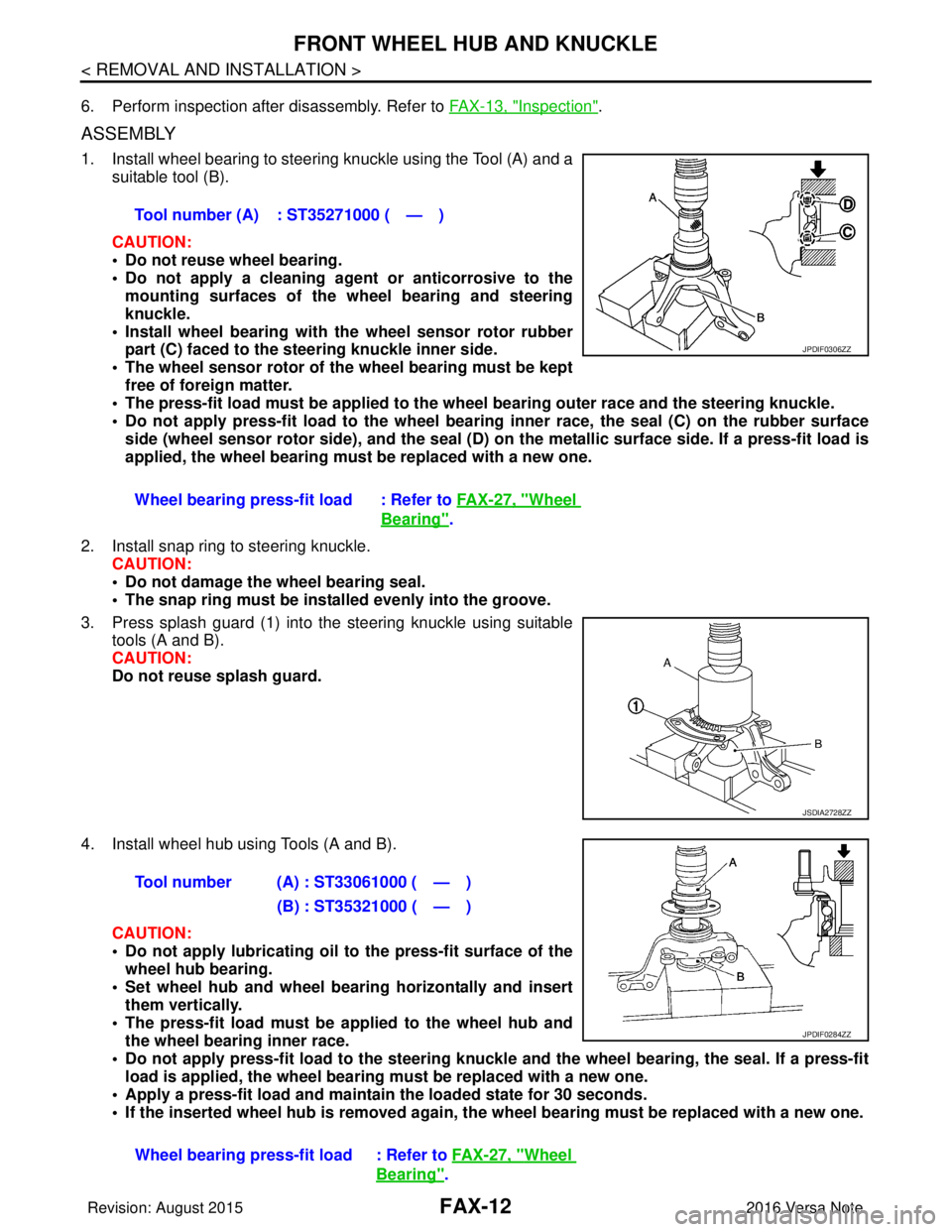
1. Install wheel bearing to steering knuckle using the Tool (A) and a
suitable tool (B).
CAUTION:
• Do not reuse wheel bearing.
• Do not apply a cleaning agen t or anticorrosive to the
mounting surfaces of the wh eel bearing and steering
knuckle.
• Install wheel bearing with the wheel sensor rotor rubber
part (C) faced to the st eering knuckle inner side.
• The wheel sensor rotor of th e wheel bearing must be kept
free of foreign matter.
• The press-fit load must be applied to the wh eel bearing outer race and the steering knuckle.
• Do not apply press-fit load to the wheel beari ng inner race, the seal (C) on the rubber surface
side (wheel sensor rotor side), and the seal (D) on the metallic surface side. If a press-fit load is
applied, the wheel bearing must be replaced with a new one.
2. Install snap ring to steering knuckle. CAUTION:
• Do not damage the wheel bearing seal.
• The snap ring must be inst alled evenly into the groove.
3. Press splash guard (1) into the steering knuckle using suitable tools (A and B).
CAUTION:
Do not reuse splash guard.
4. Install wheel hub using Tools (A and B). CAUTION:
• Do not apply lubri cating oil to the press-fit surface of the
wheel hub bearing.
• Set wheel hub and wheel bearing horizontally and insert them vertically.
• The press-fit load must be applied to the wheel hub and
the wheel bearing inner race.
• Do not apply press-fit load to the steering knuckle and the wheel b earing, the seal. If a press-fit
load is applied, the wheel bearin g must be replaced with a new one.
• Apply a press-fit load and maintain the loaded state for 30 seconds.
• If the inserted wheel hub is removed again, the wheel bearing must be replaced with a new one.
Tool number (A) : ST35271000 ( — )
Wheel bearing press-fit load : Refer to
FAX-27, "
Wheel
Bearing".
JPDIF0306ZZ
JSDIA2728ZZ
Tool number (A) : ST33061000 ( — )
(B) : ST35321000 ( — )
Wheel bearing press-fit load : Refer to FAX-27, "
Wheel
Bearing".
JPDIF0284ZZ
Revision: August 2015 2016 Versa Note
cardiagn.com
Page 1830 of 3641
FRONT WHEEL HUB AND KNUCKLEFAX-13
< REMOVAL AND INSTALLATION >
CEF
G H
I
J
K L
M A
B
FA X
N
O P
5. Perform inspection after assembly. Refer to FAX-13, "Inspection".
InspectionINFOID:0000000012431893
INSPECTION AFTER REMOVAL
Check the following items, and replace the part if necessary.
• Check components for deformation, cracks, and other damage.
• Check boots of transverse link and steering outer so cket ball joint for breakage, axial end play, and swing
torque. Refer to FSU-10, "
Inspection" and FSU-20, "Ball Joint".
INSPECTION AFTER DISASSEMBLY
Wheel Hub
• Check wheel hub for cracks (with magnetic exploration or dye testing). Replace if necessary.
Steering Knuckle
• Check steering knuckle for deformation, cracks, and other damage. Replace if any non-standard conditions
are found.
Snap Rings
• Check snap ring for wear or cracks. Replace if necessary.
INSPECTION AFTER ASSEMBLY
Check wheel bearing rotating torque as per the following instructions.
NOTE:
The adequacy of turning torque can be judged from a measurement value by a spring balancer.
1. For a proper fit of the bearing, turn the wheel hub clockwise and counterclockwise, respectively, 10 times
or more with a press-fit load applied.
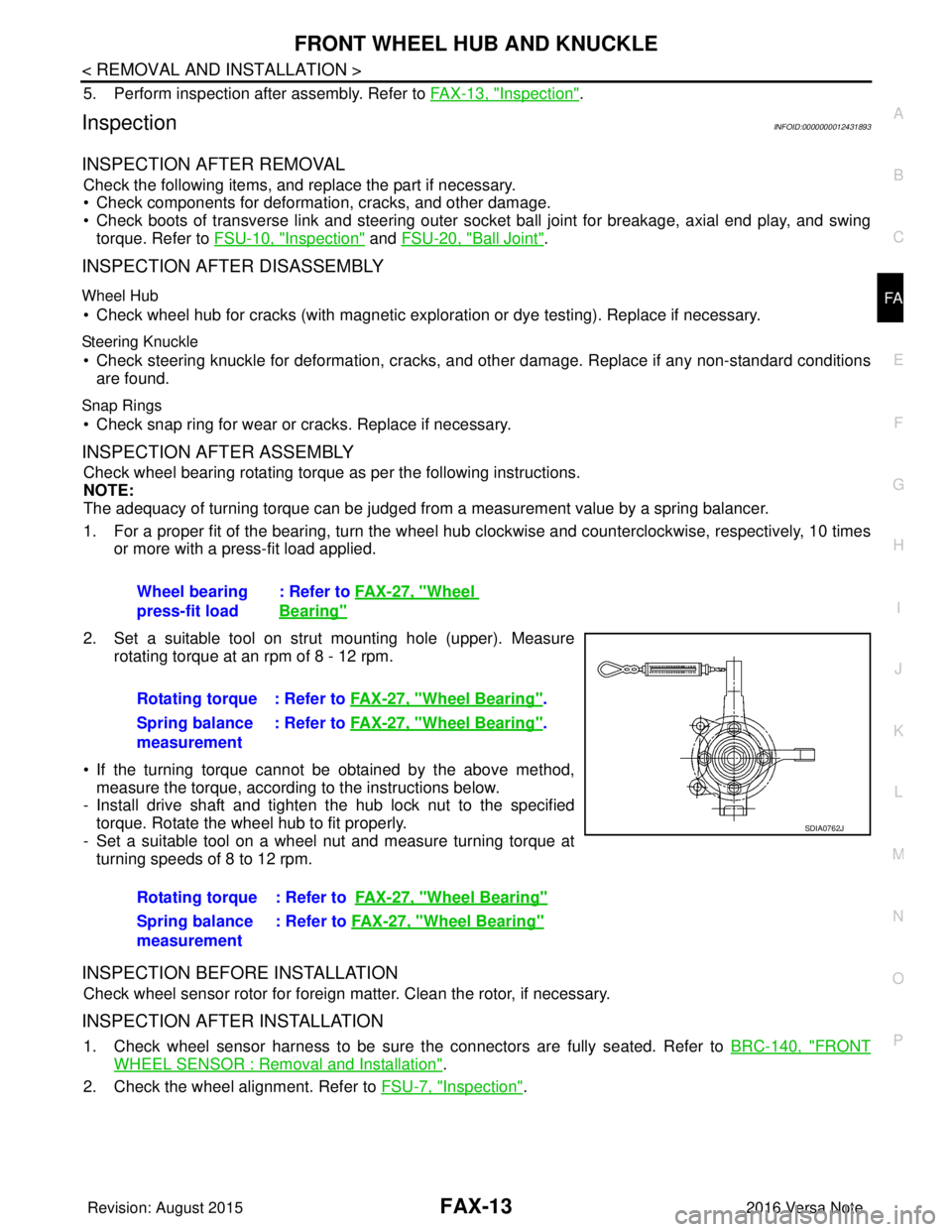
2. Set a suitable tool on strut mounting hole (upper). Measure rotating torque at an rpm of 8 - 12 rpm.
• If the turning torque cannot be obtained by the above method, measure the torque, according to the instructions below.
- Install drive shaft and tighten the hub lock nut to the specified
torque. Rotate the wheel hub to fit properly.
- Set a suitable tool on a wheel nut and measure turning torque at turning speeds of 8 to 12 rpm.
INSPECTION BEFORE INSTALLATION
Check wheel sensor rotor for foreign matter. Clean the rotor, if necessary.
INSPECTION AFTER INSTALLATION
1. Check wheel sensor harness to be sure the connectors are fully seated. Refer to BRC-140, "FRONT
WHEEL SENSOR : Removal and Installation".
2. Check the wheel alignment. Refer to FSU-7, "
Inspection".
Wheel bearing
press-fit load
: Refer to
FAX-27, "
Wheel
Bearing"
Rotating torque : Refer to FAX-27, "Wheel Bearing".
Spring balance
measurement : Refer to
FAX-27, "
Wheel Bearing".
Rotating torque : Refer to FAX-27, "
Wheel Bearing"
Spring balance
measurement: Refer to
FAX-27, "Wheel Bearing"
SDIA0762J
Revision: August 2015 2016 Versa Note
cardiagn.com
Page 1832 of 3641

FRONT DRIVE SHAFT BOOTFAX-15
< REMOVAL AND INSTALLATION >
CEF
G H
I
J
K L
M A
B
FA X
N
O P
WHEEL SIDE : Removal and InstallationINFOID:0000000012431895
REMOVAL
1. Remove the wheel and tire using power tool. Refer to WT-48, "Removal and Installation".
2. Remove the brake caliper torque member bolts, leav ing the brake hose attached. Position the brake cali-
per aside with wire. Refer to BR-37, "
BRAKE CALIPER ASSEMBLY : Removal and Installation".
CAUTION:
Do not depress the brake pedal while the brake caliper is removed.
3. Put alignment marks on the disc brake rotor and on the wheel hub. Remove the disc brake rotor.
CAUTION:
Do not drop the disc brake rotor.
4. Remove the wheel sensor bolt. Position the wheel sensor and the wheel sensor harness aside. Refer to
BRC-140, "
FRONT WHEEL SENSOR : Removal and Installation".
5. Remove the cotter pin from the drive shaft.
6. Hold the wheel hub using Tool. Loosen the wheel hub lock nut.
7. Using a piece of wood and a suitable tool, tap on the wheel hub lock nut to disengage the drive shaft from the wheel hub.
CAUTION:
• Do not place the drive shaft joint at an extreme angle. Also be careful not to overextend slide
joint.
• Do not allow the drive shaft to hang down without support.
NOTE:
Use a suitable puller if the drive shaft cannot be separated from the wheel hub even after performing the
above procedure.
8. Remove the wheel hub lock nut.
9. Remove the nut and bolt from the lower ball joint. Disconnect the steering knuckle from the transverse
link.
10. Remove the drive shaft from the wheel hub.
11. Remove the boot bands.
12. Separate the boot from the joint sub-assembly.
13. Screw a suitable tool (A) into the joint sub-assembly screw part to a length of 30 mm (1.18 in) or more. Support the drive shaft
with one hand and pull out the joint sub-assembly from the shaft.
CAUTION:
• Align the suitable tool an d the drive shaft. Remove the
joint sub-assembly by pull ing firmly and uniformly.
• If the joint sub-assembly cannot be pulled out, try after removing the drive shaft from the vehicle. Refer to FA X -
22, "Disassembly and Assembly".
14. Remove the circular clip (1) from the shaft.
15. Remove the outer boot from the shaft. Tool number : KV4010104000 ( — )
JPDIF0258ZZ
JPDIF0007ZZ
Revision: August 2015
2016 Versa Note
cardiagn.com
Page 1835 of 3641
FAX-18
< REMOVAL AND INSTALLATION >
FRONT DRIVE SHAFT BOOT
• Check each mating surface for water and foreign matter. If there is any water or foreign matter,
clean the mating surface.
17. Install the transverse link to the steering knuckle with the nut and bolt. Refer to FSU-10, "
Exploded View".
18. Hold the wheel hub using a Tool. Tighten the wheel hub lock nut. CAUTION:
• Since the drive shaft is assembled by press-fitting, use a torque wrench to tighten the wheel hub
lock nut. Do not use a power tool.
• Too much torque causes axle noise. Too little torque causes wheel bearing looseness. Tighten the wheel hub lock nut to the specification.
19. Install the cotter pin. Securely bend the cotter pin to prevent rattles. CAUTION:
Do not reuse the cotter pin.
20. Install the wheel sensor, the wheel sensor bolt, and the wheel sensor harness. Refer to BRC-140,
"FRONT WHEEL SENSOR : Removal and Installation".
21. Align the matching marks on the disc brake roto r and on the wheel hub. Install the disc brake rotor.
CAUTION:
Do not drop the disc brake rotor.
22. Remove the wire from the brake caliper. Install the brake caliper and the brake caliper torque member
bolts. Refer to BR-37, "
BRAKE CALIPER ASSEMBLY : Removal and Installation".
CAUTION:
Do not twist the brake hose.
23. Install the wheel and tire. Refer to WT-48, "
Removal and Installation".
24. Complete the inspection. Refer to FAX-18, "
Inspection".
TRANSAXLE SIDE
TRANSAXLE SIDE : Removal and InstallationINFOID:0000000012431896
Remove boot after drive shaft is removed from the vehicle.
• For drive shaft removal and installation, refer to FAX-19, "
Removal and Installation".
• For drive shaft disassembly and assembly, refer to FAX-22, "
Disassembly and Assembly".
InspectionINFOID:0000000012431897
INSPECTION AFTER INSTALLATION
1. Check the wheel sensor harness to be sure the connectors are fully seated.
2. Check the wheel alignment. Refer to FSU-7, "
Inspection".
Tool number : KV4010104000 ( — )
Revision: August 2015
2016 Versa Note
cardiagn.com