2016 MITSUBISHI LANCER lock
[x] Cancel search: lockPage 35 of 392

Seat
belts
Seat and restraint systems
4-11
4
tion
switch
was
turned
on,
the
warning
light
will
come
on
and
blink
repeatedly
and
the
tone
will
sound
intermittentl
y.
The
warning
light
and
the
tone
will
stop
after
approximately 90 seconds.If
you
then
repeatedly
stop
and
start
your
vehicle
with
the
seat
belt
unfastened,
the
warning
light/display
and
tone
will
remind
you
to
fasten
your
seat
belt
every
time
the
vehicle
starts
moving.
You
will
also
be
reminded
to fasten
your
seat
belt
in this
way
when
you
remove
your
seat
belt
while
driv-
ing.
The
warning
light
and
the
tone
go
off
when
the
seat
belt
is fastened.
N00418300
165
The
front
passenger
seat
belt
warning
light
is
located in the instrument panel.When
the
key
is turned
to the
“ON”
position,
this
indicator
normally
comes
on
and
goes
off
a few seconds later
.
The
light
comes
on
when
a person
sits
on
the
front
passenger
seat
but
does
not
fasten
the
seat
belt.
It goes
off when
the
seat
belt
is sub-
sequently fastened.
N00406300
315
To move
the
anchor
down,
press
the
lock
knob
(A)
and
slide
the
anchor
down
to
the
desired position. To move
the
anchor
up,
slide
the
anchor
up
to
the desired position.
W
AR
NING
In
order
to
reduce
the
risk
of
serious
injury
or
death
in
an
accident,
always
wear
your own
seat belt. Do
not
allow
any-
one to ride in your vehicle unless he or she is also
seate
d and
wearing
a seat
belt.
Child
ren sho
uld addition
ally
be restrain
ed
in a secu
re child
restraint syste
m.
NOTE
At the same
time,
“FASTEN
SEAT BELT”
will be display
ed on
the information
screen
in the multi-information
display
.
Fr
ont passenger seat belt warn-
ing light
W
AR
NING
Do not install
any accessory
or stick
er that
makes the light difficult to see.
Adjustable seat belt shoulder anchor (fr
ont seats)
W
AR
NING
Always
adjust
the
shoulder
belt
anchor
so
that
the
shoul
der belt is posi
tione
d across
the
center
of your
shoul
der without
touc
h-
ing
your
neck.
The
shoul
der
belt shoul
d
not
be able
to fall
off
your
shoul
der. Fail-
ure to follow
this instr
uction
can
advers
ely
affect
seat belt perfor
mance
and
increase
the
risk
of serious
injur
y or death
in the
event of an accident.Anchor
down
Anchor
up
Page 36 of 392

Seat belt use during pregnancy4-12
Seat and restraint systems
4
N0040670
1215
When
your
seat
belt,
even
fully
extended,
is
not
long
enough,
a seat
belt
extender
must
be
obtained.
The
extender
may
be
used
for
either
of the
front
seats.
N0040680
0121
Seat
belts
work
for
everyone,
including
preg-
nant
women.
Like
all
occupants,
pregnant
women
are
more
likely
to be
seriously
injured
or
killed
in
an
accident
if they
do
not
wear
seat
belts.
N0041770
0609
The
driver
’s and
front
passenger
’s seats
each
have a seat belt equipped with a pre-tensioner system.
The
driver
and
front
passenger
seat
belts
are
equipped
with
a seat
belt
pre-tensioner
sys-
tem.
In
a moderate-to-severe
frontal
or
side
collision,
the
pre-tensioner
system
operates
simultaneously
with
the
deployment
of
the
front
airbags
or
side
airbags
and
curtain
air-
bags.The
seat
belt
pre-tensioners
are
located
within
the
seat
belt
retractors
(A).
When
activated,
the
pre-tensioners
quickly
draw
back
seat
belt
webbing and increase seat belt performance. The
seat
belt
pre-tensioner
system
includes
the following components:
Adjust
the
shoulder
belt
anchor
only
when
the
vehicle
is not
in motion.
Mak
e sur
e the anchor is secu
rely
lock
ed in
position
after
adjusting
it.
Seat belt extender
W
AR
NING
The
extender
should
only
be
used
if the
exis
ting belt
is not
lon
g enough. Anyon
e
who
can
use
the
standar
d seat belt shoul
d
not
use
an
exte
nde
r. Unnecessar
y use
of an
exte
nder
can
advers
ely
affect
seat
belt
performance
in an
accident.
W
AR
NING
When not requi
red, the extender
must
be
removed
and
stow
ed.
Seat belt use during pr
eg-
nancy
W
AR
NING
To reduce
the
risk
of
serious
injur
y or
death
to
pregn
ant women
and
unborn
children in an
accid
ent,
pregnant
wome
n
sho
uld alw
ays
wear
a seat
belt.
The lap
por
tion
of
the
seat
belt shoul
d be wor
n
snug
and
low
acr
oss
the
hips
and
below
the
rounding.
Consult
your
doctor
if you
have any
addi
tional
que
stions
or con
cerns.
Seat belt pr
e-tensioner and
for
ce limiter systems W
AR
NING
Pr
e-tensioner system
Page 42 of 392
Child
restraint
systems
4-18
Seat and restraint systems
4
N0040730
1508
With
the
exception
of
the
driver
, the
seat
belt
in all other
seating
positions
can
be
converted
from
normal
Eme
rgency
Locking
Retractor
(ELR)
mode
to Automatic
Locking
Retractor
(ALR)
mode.
This
means
that
when
you
pull
the
seat
belt
fully
out
of
the
retractor
, the
retractor
will
switch
to its
ALR
child
restraint
installation
function.
Always
use
the
ALR
child
restraint
installation
function
when
you
install
a child
restraint
system
using
the
seat
bel
t.
Children
12
years
old
and
under
should
always
be
restrained
in
the
rear
seat,
when-
ever
possible,
although
the
front
passenger
seat belt can also be converted to ALR mode.
1.Place
the
child
restraint
system
on
the
seat
where you wish to install it.To help
assure
proper
fitting
of
the
child
restraint
system,
always
remove
the
head
restraint.2.Route
the
seat
belt
through
the
child
restraint
system
according
to
the
instruc-
tions
provided
by
the
child
restraint
sys-
tem
manufacturer
. Then
insert
the
seat
belt
latch
plate
into
the
buckle.
Make
sure
you
hear
a “click”
when
you
insert
the
latch plate into the buckle.
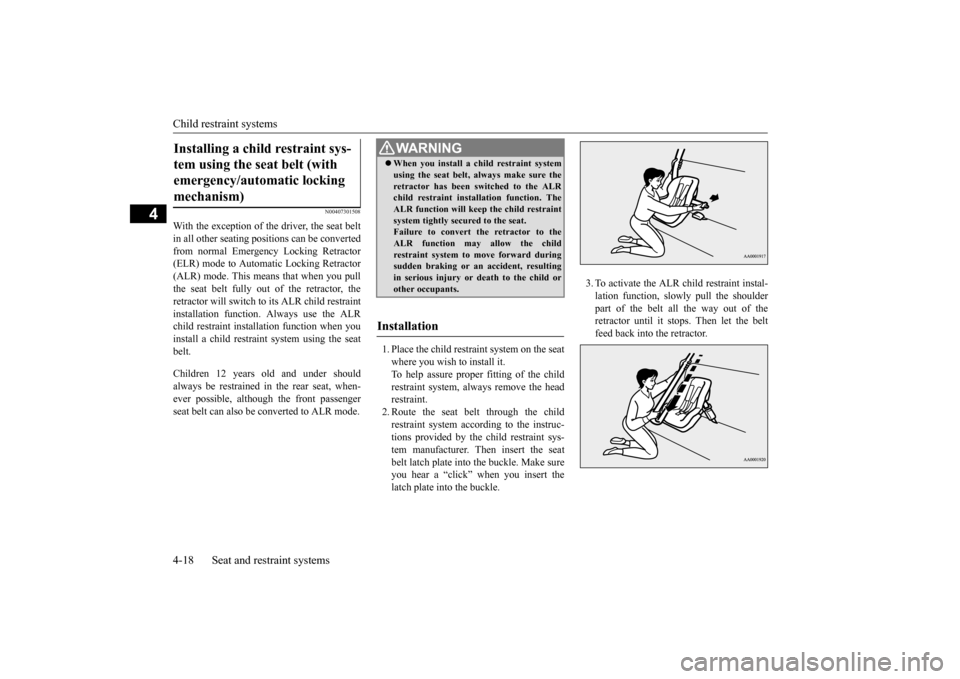
3.To activate
the
ALR
child
restraint
instal-
lation
function,
slow
ly
pull
the
shoulder
part
of
the
belt
all
the
way
out
of
the
retractor
until
it stops.
Then
let
the
belt
feed back into the retractor
.
Installing a child r
estraint sys-
tem using the seat belt (with emergency/automatic locking mechanism)
W
AR
NING
Whe
n you
install
a child restraint
syste
m
usi
ng
the
seat belt,
always
make
sur
e the
retractor
has
been
swi
tched to
the
ALR
child restraint
installati
on
func
tion.
The
ALR
func
tion
will keep
the
child restraint
system
tightly
secur
ed to the
seat.
Failur
e to
convert
the
retractor
to
the
ALR func
tion
may allow
the
child
restraint
system to move
for
war
d durin
g
sudden
braking
or
an
accident,
resulting
in serious
injury
or
death
to the
child
or
other
occupa
nts.
Installation
Page 43 of 392

Child restraint systems
Seat and restraint systems
4-19
4
4.After
the
belt
has
retracted,
tug
on
it.
If
the
belt
is in
the
ALR
function,
you
will
not
be
able
to
pull
it out.
If the
webbing
can
be
pulled
out
from
retracto
r, the
ALR
function
has
not
been
activated
and
you
will need to repeat steps 3 and 4.5.After
confirming
that
the
belt
is locked,
grab
the
shoulder
part
of
the
belt
near
the
buckle
and
pull
up
to
remove
any
slack
from
the
lap
part
of
the
belt
allowing
the
slack
to feed
into
the
retractor
. Remember
,
if the
lap
belt
portion
is not
tight,
the
child
restraint
system
will
not
be
secure.
It may
help
to
put
your
weight
on
the
child
restraint
system
and/or
push
on
its
seat-
back
while
pulling
up
on
the
belt
(see
illustration).
6.Open
the
cover
from
the
tether
anchor
installation
point
by
pulling
it back
with
your hand as illustrated below (6).7.Latch
the
tether
strap
hook
(A)
of
the
child
restraint
system
to the
tether
anchor
(B)
as illustrated
below
(7)
and
tighten
the
top tether strap so it is securely fastened.
8.Before
putting
your
child
in the
restraint,
push
and
pull
the
restraint
in all directions
to
be
sure
it is
firmly
secured.
Do
this
before
each
use.
If the
child
restraint
sys-
tem
is
not
firmly
secure,
repeat
steps
1
through 7.9.To remove
a child
restraint
system
from
the
vehicle
and
deactivate
the
ALR
mode,
remove
the
child
from
the
restraint.
Unlatch
the
buckle.
Then
remove
the
belt
from
the
restraint
and
let
the
belt
fully
retract.
10.
Reinstall the head restraint.Refer to “Head restraints” on page 4-6.
N00407601
644
Children
who
have
outgrown
a child
restraint
system
should
be
seated
in
the
rear
seat
and
wear
the
seat
belt.
If the
shoulder
belt
crosses
their
face
or
neck,
and/or
the
lap
belt
crosses
their
stomach,
a
commercially
available
booster
seat
must
be
used,
to raise
the
child
so
that
the
shoulder
belt
crosses
their
shoulder
and
the
lap
belt
remains
positioned
low
across
their
hips.
The
booster
seat
should
fit
the
vehicle
seat
and
have
a label
certifying
compliance
with
Federal
Motor
Vehicle
Safety
Standards
or
Motor
Vehicle
Restraint
If your
child
restraint
system
requires
the
use
of
a tether
strap,
fasten
the
tether
strap
in
accordance with the following procedures.
W
AR
NING
Child
restraint
syste
m tether
anc
hors
are
designed
only
to withstand
loads
from
cor
-
rectly fitted child r
estraint systems. Under
no circumsta
nces
are the
y to be use
d for
adul
t seat
belts,
or
har
nesses,
or for
attach
ing
other
items
or
equi
pme
nt to the
vehicle.
Childr
en who have outg
rown
child r
estraint systems
Page 44 of 392

Maintenance and inspection of seat belts4-20
Seat and restraint systems
4
Systems
and
Booster
Seats
Safety
Regula-
tions.
N0040700
0221
The
seat
belt
webbing
may
be
cleaned
with
mild
soap
or deter
gent
solution.
Do
not
use
an
organic
solvent.
Allow
the
belts
to dry
in the
shade.
Do
not
allow
them
to retract
until
com-
pletely
dry
. Do
not
attempt
to
bleach
or
re-
dye
the
belts.
The
color
may
rub
off and
the
webbing strength may be a
ffected.
Regularly
check
your
seat
belt
buckles
and
their
release
mechanisms
for
positive
engage-
ment
and
release
of the
latch
plate.
Check
the
retractors
for
automatic
locking
when
in
the
Automatic
Locking
Retractor
function.
The
entire
seat
belt
assembly
should
be
replaced
if the
webbing
shows
any
obvious
cuts,
tears,
increase
in
thickness
in
any
sec-
tion
of
the
webbing
from
broken
fibers,
or
severe
fading
from
sunlight.
All
of these
con-
ditions
indicate
a weakening
of
the
belt,
which
may
adversely
affect
seat
belt
perfor
-
mance
in an
accident.
N0040770
1805
This
vehicle
is equipped
with
a Supplemental
Restraint
System
(SRS),
which
includes
air-
bags for the driver and passengers.The
SRS
front
airbags
are
designed
to supple-
ment
the
primary
protection
of
the
driver
and
front
passenger
seat
belt
systems
by
provid-
ing
those
occupants
with
protection
against
head
and
chest
injuries
in certain
moderate
to
severe frontal collisions. The
SRS
front
airbags,
together
with
sensors
at
the
front
of
the
vehicle
and
sensors
attached
to the
front
seats,
form
an
advanced
airbag system.The
SRS
driver
’s knee
airbag
is designed
to
supplement
the
primary
protection
of
the
driver
’s seat
belt
system.
It can
reduce
the
forward
movement
of
the
driver
’s lower
legs
and
provide
increased
overall
body
protection
in
certain
moderate
to
severe
frontal
colli-
sions. The
SRS
side
airbags
(if so
equipped)
and
the
curtain
airbags
(if
so
equipped)
are
also
designed
to
supplement
the
seat
belts.
The
SRS
side
airbags
provide
the
driver
and
front
passenger
with
protection
against
chest
inju-
ries
by
deploying
the
bag
on
the
side
W
AR
NING
Any
child
who
is too
small
to
properly
wear
a seat
belt
must
be properly
restrain
ed in an appr
opriate
child
restrain
t system,
to
reduce
their
risk
of
serious
injury or d
eath
in an accid
ent.
A child should never be left unattended in,or
unsupervised,
around
your
vehicle.
When you
leave
the veh
icle
alw
ays
tak
e
the ch
ild out
as well.
Childr
en can die f
rom heat str
oke if left o
r
trapped
inside
the
vehicle,
especially
on
hot
days
.
Keep
you
r veh
icle
lock
ed and
the trunk
lid
close
d whe
n not
in use
. Keep
your
vehicle
keys
away
from
children.
Never
allow
children to play
in the
trunk
of you
r vehicle.
Maintenance
and
inspection
of seat belts
W
AR
NING
Do
not
attempt
to
repair
or
replace
any
part
of the
seat
belt
assemblies.
This
work
shoul
d be done
by an
authorized
Mitsubishi
Motors
dealer
. Failur
e to have
an
authorized
Mitsubishi
Motors
dealer
perform
the
wor
k coul
d reduce
the
effec-
tiveness
of the
belts
and
could
result
in a
serious
injury o
r death
in an accid
ent.
Supplemental Restraint Sys-tem (SRS) - airbag
Page 63 of 392

5
Features and controlsBreak-in recommendation
s ..............................................................
5-3
Keys
..........................................
.......................................................
5-3
Electronic
immobilizer
(Anti-thef
t starting system)
........................
5-4
Keyless entry system (if so equipped)
..............................................
5-7
Free-hand Advanced Security T
ransmitter
(F.A.S.T
.-key)
(if
so
equipped
)..................................................
5-12
Door locks
.......................
...............................................................
5-34
Power door locks
............
...............................................................
5-37
“Child safety locks” for
rear door
..................................................
5-38
Trunk lid
...................................
.....................................................
5-39
Inside emer
gency trunk lid
release
................................................
5-40
Theft-alarm system
................................................
........................
5-41
Power windows
...............
...............................................................
5-43
Sunroof (if so equipped
).........................................
........................
5-46
Parking brake
..................
...............................................................
5-48
Steering wheel tilt lock lever
.........................................................
5-49
Inside
day/night
rearview
mirror
...................................................
5-50
Outside
rearview
mirr
ors
...............................................................
5-51
Ignition switch
......
.................................................
........................
5-52
Steering wheel lock
................................................
........................
5-54
Starting
and
stopping
the
engine
....................................................
5-55
Manual transaxle (if so equipped)
..................................................
5-57
Continuously variable transmissi
on
(CVT)
(if
so
equipped)
..........
5-59
Electronically controlled 4WD system (if so equipped)
.................
5-68
All-wheel driving opera
tion
...........................................................
5-70
Cautions on handling of all-wheel drive vehicles
..........................
5-71
Service brake
..................
...............................................................
5-72
Brake assist system
................................................
........................
5-73
Anti-lock
braking
syst
em
.....................................
.........................
5-74
Active
Stability Control (ASC
) (if
so
equipped
)............................
5-76
Power
steering
system
..........................................
.........................
5-79
Cruise control (if so eq
uipped)
.......................................................
5-80
Tire pressure monitoring
system
...................................................
5-84
Rear
-view camera (if so
equipped
)..............
...................................
5-88
Instrument cluster
.................................................
.........................
5-90
Multi-information
disp
lay
....................................
.........................
5-91
Indicator light, warning light, and information screen display list
.................................................
..........................................
5-1
12
Indicators
.................................
....................................................
5-123
Warning lights
................
.................................................
.............
5-124
Information screen disp
lay
...................................
.......................
5-125
Combination headlights and dimmer switch
...............................
5-127
Headlight leveling switch (if
so equipped)
...................................
5-132
Turn signal lever
...................................................
.......................
5-133
Hazard warning flasher
switch
....................................................
5-133
Front fog light switch (if so
equipped)
.........................................
5-134
Wiper and washer swit
ch
......................................
.......................
5-134
Electric rear window def
ogger switch
.........................................
5-138
Horn switch
.............................
....................................................
5-139
Link System (if so equi
pped)
.......................................................
5-139
Bluetooth
® 2.0 interface (if so
equipped)
.....................................
5-139
USB input terminal
...............................................
.......................
5-162
Sun visors
......................
.................................................
.............
5-166
12 V power outlet
..........
.................................................
.............
5-166
Interior
lights
.................
.................................................
.............
5-167
Storage spaces ................
.................................................
.............
5-169
Page 65 of 392

Break-in recommendations
Features and controls
5-3
5
N00508700
297
Advanced
automobile
manufacturing
tech-
niques
permit
you
to operate
your
new
vehi-
cle
without
requiring
a long
break-in
period
of low-speed driving.However
, you
can
add
to
the
future
perfor
-
mance
and
economy
of
your
vehicle
by
observing
the
following
precautions
during
the first 300 miles (500 km). Drive
your
vehicle
at moderate
speeds
during
the break-in period. Avoid
revving
the
engine.
For
vehicles
with
turbochar
ger
, do
not
exceed
5,000
rpm for the first 600 miles (1,000 km).Avoid
rough
driving
such
as
fast
starts,
sudden
acceleration,
prolonged
high-
speed
driving
and
sudden
braking.
These
would
have
a detrimental
effect
on
the
engine
and
also
cause
increased
fuel
and
oil
consumption,
which
could
result
in
malfunction
of the
engine
components.
Be
particularly
careful
to avoid
full
accelera-
tion
while
in low
gear
.
Do
not
overload
the
vehicle.
Observe
the
seating
capacity
(See
“Car
go
load
precau-
tions”
on
page
6-10).
Do not use this vehicle for trailer towing.
N00508801
657
Two keys are provided. The keys fit all locks.
Keep one in a safe place as a spare key
.
Two keys are provided. The keys fit all locks.
Keep one in a safe place as a spare key
.
Two Free-hand
Advanced
Security
Transmit-
ter
(F.A.S.T
.-key)
and
two
emer
gency
keys
are provided.Keep
one
F.A.S.T
.-key
and
one
emer
gency
key
in a safe
place
together
as
a set
of
spare
keys.
Br
eak-in r
ecommendations
Keys Type 1 1-
Key for the electronic immobilizer
2-
Key number plate
Type 2
1-
Key
for
the
electronic
immobilizer
and
keyless entry system
2-
Key number plate
Type 3
Page 67 of 392
Electronic
immobilizer
(Ant
i-theft starting system)
Features and controls
5-5
5
Only
keys
that
have
been
programmed
to the
vehicle
’s electronics
can
be
used
to
start
the
veh
icle.
If you
lose
the
key
, you
can
order
a key
from
your
authorized
Mitsubishi
Motors
dealer
by
referring
to the
key
number
.
To prevent
vehicle
theft,
the
ID
code
for
the
vehicle keys must be changed. Take
your
vehicle
and
all
remaining
keys
to
your
authorized
Mitsubishi
Motors
dealer
to
have your ID code changed. To add
a key
, you
need
to register
the
ID
code
to the vehicle.Registering
the
ID
code
can
be
done
by
your
authorized
Mitsubishi
Motors
dealer
. Or
it
can
be
done
by
yourself
(except
for
vehicles
sold in Canada).
NOTE
Do
not
attach
additional
keys or accessories
to the ignition
key. Suc
h objects
coul
d pre
-
vent the driver’s knee
airba
g from
inflatin
g
normally
. Refer
to “Deployment
of front
air-
bags
” on
page
4-28.
In the
follow
ing
cas
es, the
vehicle
may
not
be
able
to recognize
the
registered
ID
code
from
the key. This means
the engi
ne will not
start
even
when
the
key
is turned
to
the
“ST
ART” position.
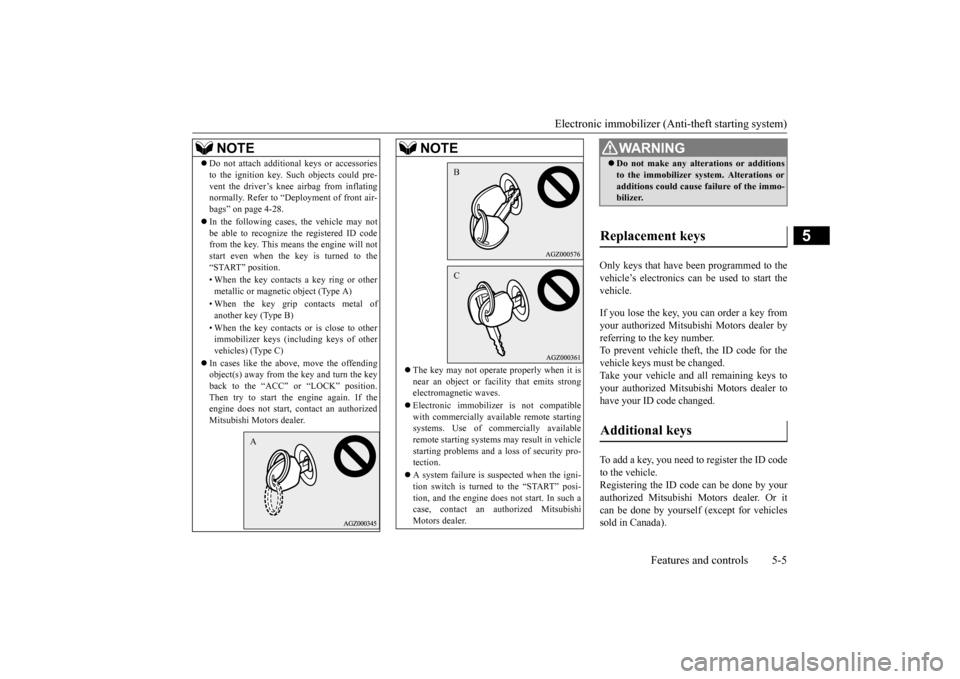
•When
the
key
contacts
a key
ring
or other
metallic or magnetic object (T
ype A)
•When
the
key
grip
contacts
metal
of
another
key
(Type
B)
•When
the
key
contacts
or is close
to other
immobilizer
keys
(including
keys
of
other
vehicles)
(Type
C)
In cas
es like the above
, move
the offendi
ng
object(s)
away from
the key and
turn
the key
back
to the “ACC”
or
“LOCK”
position.
Then
try
to
start
the
engine
again.
If the
engin
e does not start, con
tact
an author
ized
Mitsubishi
Motors
dealer
.
A
The
key
may
not
operate
properly
when
it is
near an object
or
facility
that emits
strong
electromagnetic
waves.
Electronic
immobilizer
is not
compatib
le
with commer
cially
availab
le remo
te starting
systems.
Use
of
commer
cially
availab
le
remo
te starting
systems
may
result
in vehicle
starting
problems
and
a loss of security
pro-
tection.A system
failure
is suspected
when
the
igni-
tion
switch
is turned
to the
“START” pos
i-
tion,
and
the
engine
does
not
start.
In such
a
cas
e,
contact
an
authorized
Mitsubis
hi
Mot
ors
dealer
.
NOTE
BC
W
AR
NING
Do not mak
e any alterations
or
addition
s
to the
immobilizer
system.
Alterations
or
addi
tions
coul
d cause
failu
re of the
immo
-
bilizer
.
Replacement keys Additional keys