Page 396 of 587
NOTE:Passengers should not remain in the vehicle
when the vehicle is being jacked.
Jacking Instructions
WARNING!
Carefully follow these tire changing warnings to
help prevent personal injury or damage to your
vehicle:
• Always park on a firm, level surface as far from the
edge of the roadway as possible before raising the
vehicle.
• Turn on the Hazard Warning flasher.
• Chock the wheel diagonally opposite the wheel to
be raised.
• Apply the parking brake and place an automatic
transmission in PARK.
(Continued)
WARNING! (Continued)
•Never start or run the engine with the vehicle on a
jack.
• Do not let anyone sit in the vehicle when it is on a
jack.
• Do not get under the vehicle when it is on a jack. If
you need to get under a raised vehicle, take it to a
service center where it can be raised on a lift.
• Only use the jack in the positions indicated and for
lifting this vehicle during a tire change.
• If working on or near a roadway, be extremely
careful of motor traffic.
• To assure that spare tires, flat or inflated, are
securely stowed, spares must be stowed with the
valve stem facing the ground.
394 IN CASE OF EMERGENCY
Page 410 of 587
Proceed as follows:
1. Set the Electric Park Brake, shift the automatic trans-mission into PARK (manual transmission in NEU-
TRAL) and turn the ignition to STOP/OFF.
2. Turn off the heater, radio, and all unnecessary electri- cal accessories.
3. If using another vehicle to jump start the battery, park the vehicle within the jumper cables reach, set the
parking brake and make sure the ignition is STOP/
OFF.
WARNING!
Do not allow vehicles to touch each other as this
could establish a ground connection and personal
injury could result.
Jump Starting Procedure
WARNING!
Failure to follow this jump-starting procedure could
result in personal injury or property damage due to
battery explosion.
CAUTION!
Failure to follow these procedures could result in
damage to the charging system of the booster vehicle
or the discharged vehicle.
Connecting The Jumper Cables
1. Connect the positive (+)end of the jumper cable to the
positive (+)post of the discharged vehicle.
2. Connect the opposite end of the positive (+)jumper
cable to the positive (+)post of the booster battery.
408 IN CASE OF EMERGENCY
Page 420 of 587
FREEING A STUCK VEHICLE
If your vehicle becomes stuck in mud, sand or snow, it
can often be moved using a rocking motion. Turn the
steering wheel right and left to clear the area around the
front wheels. For vehicles with automatic transmission,
push and hold the lock button on the shift lever. Then
shift back and forth between DRIVE and REVERSE (with
automatic transmission) or 2ND GEAR and REVERSE
(with manual transmission), while gently pressing the
accelerator.
Use the least amount of accelerator pedal pressure that
will maintain the rocking motion without spinning the
wheels or racing the engine.
For Vehicles With Automatic Transmission:
Shifts between DRIVE and REVERSE can only be
achieved at wheel speeds of 5 mph (8 km/h) or less.Whenever the transmission remains in NEUTRAL for
more than two seconds, you must push the brake pedal
to engage DRIVE or REVERSE.
NOTE:
Push the �ESC Off� switch (if necessary), to place
the Electronic Stability Control (ESC) system in �Partial
Off� mode, before rocking the vehicle. Refer to “Elec-
tronic Brake Control” in “Starting And Operating” for
further information. Once the vehicle has been freed,
push the �ESC Off� switch again to restore �ESC On�
mode.
CAUTION!
• Racing the engine or spinning the wheels may lead
to transmission overheating and failure. Allow the
engine to idle with the transmission in NEUTRAL
for at least one minute after every five rocking-
motion cycles. This will minimize overheating and
(Continued)
418 IN CASE OF EMERGENCY
Page 422 of 587
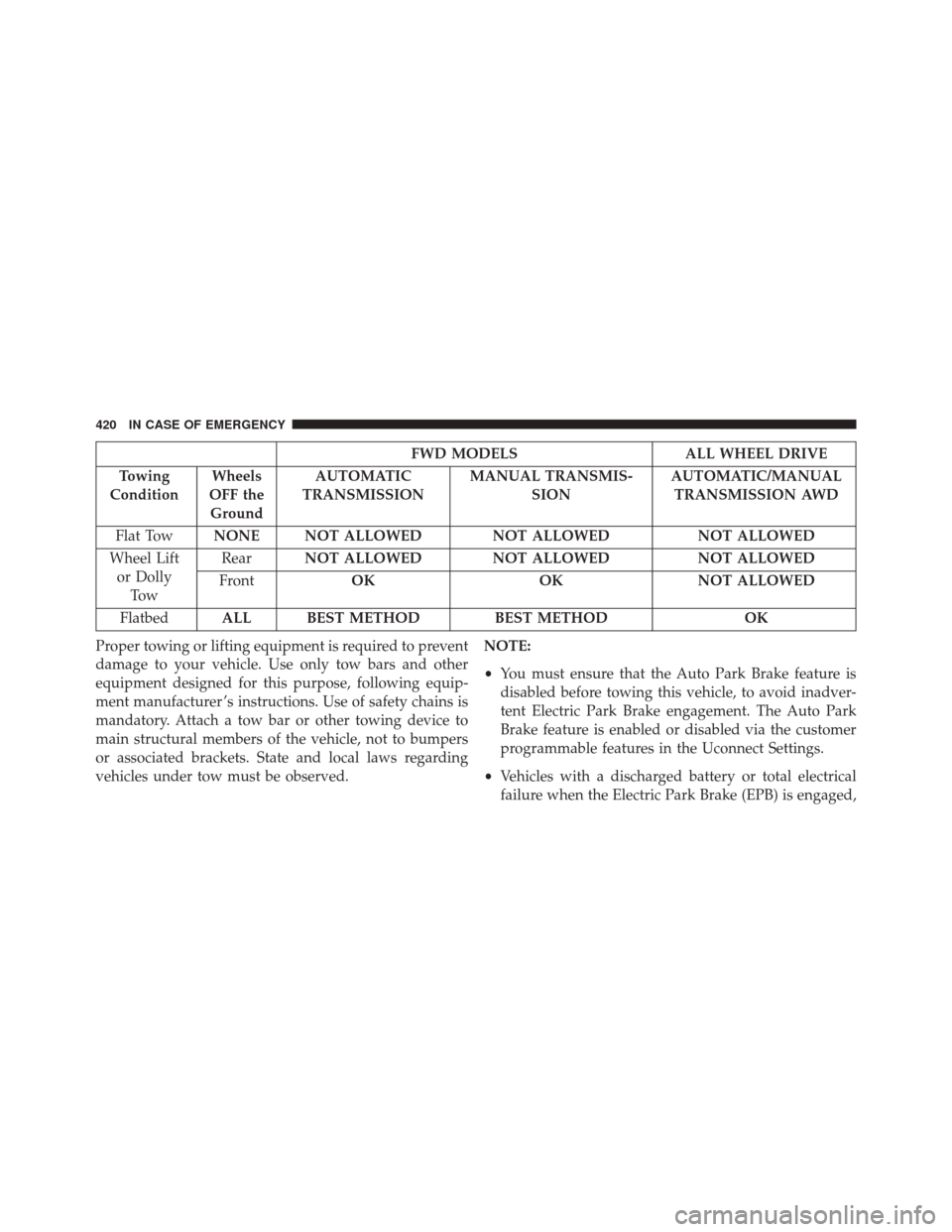
FWD MODELSALL WHEEL DRIVE
Towing
Condition Wheels
OFF the Ground AUTOMATIC
TRANSMISSION MANUAL TRANSMIS-
SION AUTOMATIC/MANUAL
TRANSMISSION AWD
Flat Tow NONE NOT ALLOWED NOT ALLOWED NOT ALLOWED
Wheel Lift or Dolly To w Rear
NOT ALLOWED NOT ALLOWED NOT ALLOWED
Front OK OKNOT ALLOWED
Flatbed ALL BEST METHOD BEST METHODOK
Proper towing or lifting equipment is required to prevent
damage to your vehicle. Use only tow bars and other
equipment designed for this purpose, following equip-
ment manufacturer ’s instructions. Use of safety chains is
mandatory. Attach a tow bar or other towing device to
main structural members of the vehicle, not to bumpers
or associated brackets. State and local laws regarding
vehicles under tow must be observed. NOTE:
•
You must ensure that the Auto Park Brake feature is
disabled before towing this vehicle, to avoid inadver-
tent Electric Park Brake engagement. The Auto Park
Brake feature is enabled or disabled via the customer
programmable features in the Uconnect Settings.
• Vehicles with a discharged battery or total electrical
failure when the Electric Park Brake (EPB) is engaged,
420 IN CASE OF EMERGENCY
Page 432 of 587
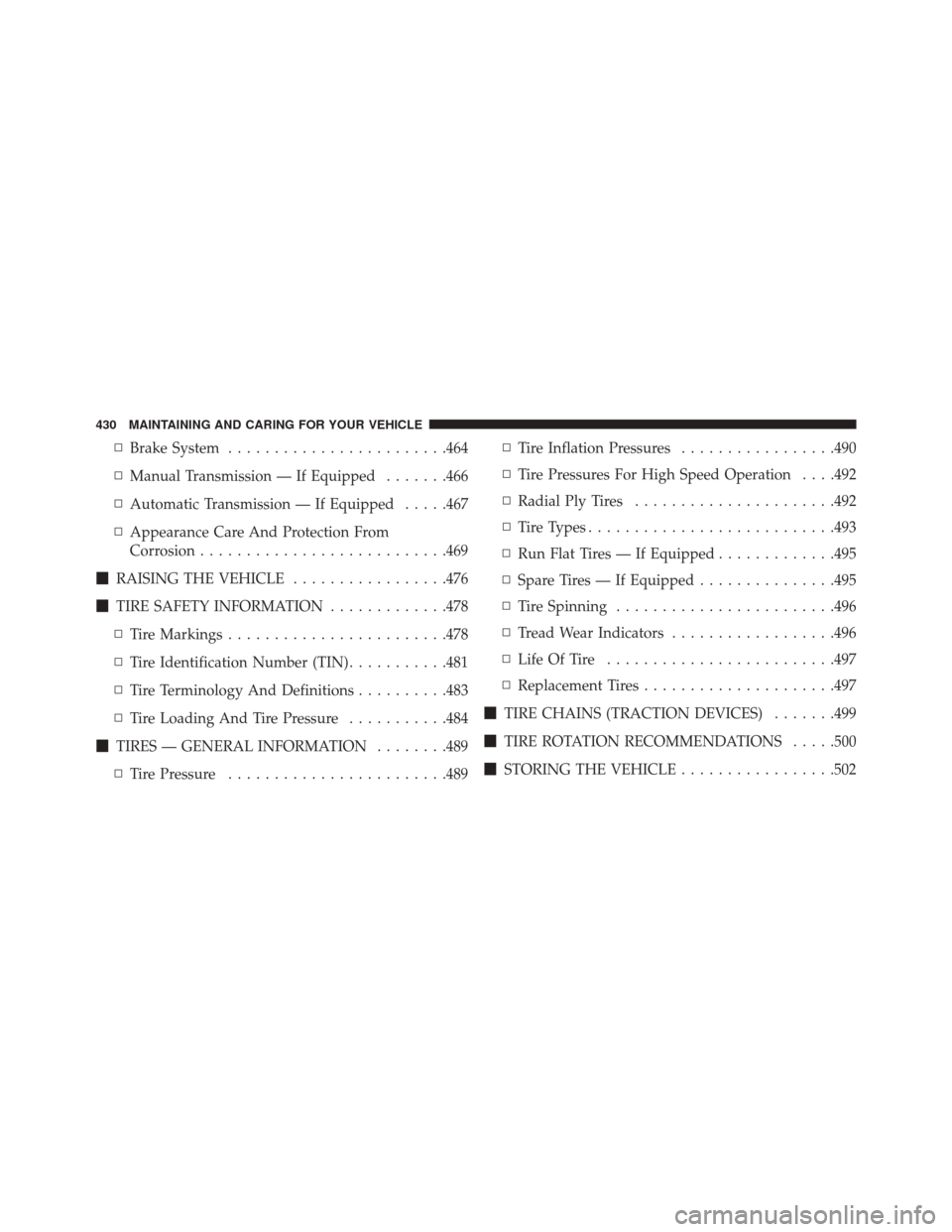
▫Brake System ....................... .464
▫ Manual Transmission — If Equipped .......466
▫ Automatic Transmission — If Equipped .....467
▫ Appearance Care And Protection From
Corrosion .......................... .469
� RAISING THE VEHICLE .................476
� TIRE SAFETY INFORMATION .............478
▫ Tire Markings ....................... .478
▫ Tire Identification Number (TIN) ...........481
▫ Tire Terminology And Definitions ..........483
▫ Tire Loading And Tire Pressure ...........484
� TIRES — GENERAL INFORMATION ........489
▫ Tire Pressure ....................... .489▫
Tire Inflation Pressures .................490
▫ Tire Pressures For High Speed Operation . . . .492
▫ Radial Ply Tires ..................... .492
▫ Tire Types .......................... .493
▫ Run Flat Tires — If Equipped .............495
▫ Spare Tires — If Equipped ...............495
▫ Tire Spinning ....................... .496
▫ Tread Wear Indicators ..................496
▫ Life Of Tire ........................ .497
▫ Replacement Tires .....................497
� TIRE CHAINS (TRACTION DEVICES) .......499
� TIRE ROTATION RECOMMENDATIONS .....500
� STORING THE VEHICLE .................502
430 MAINTAINING AND CARING FOR YOUR VEHICLE
Page 435 of 587
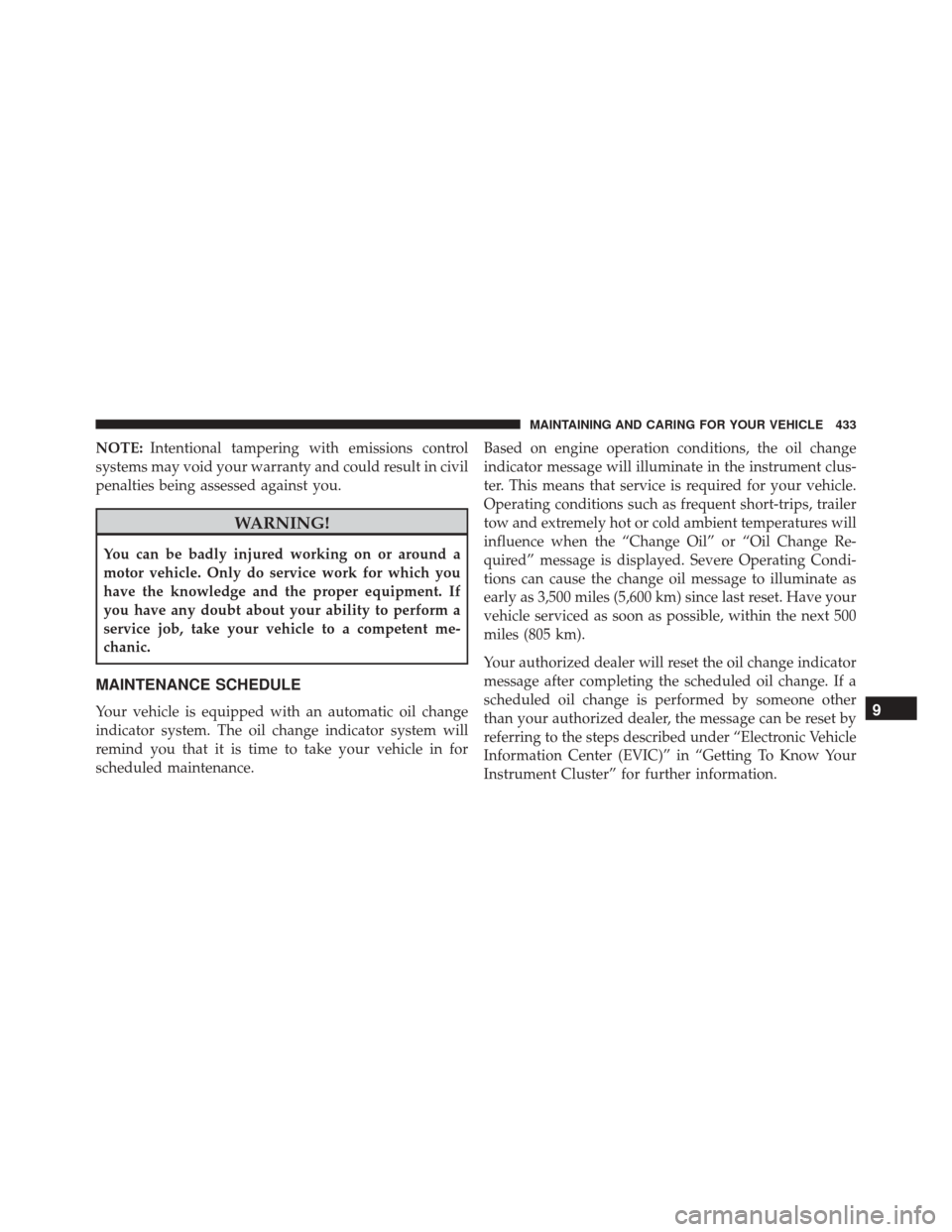
NOTE:Intentional tampering with emissions control
systems may void your warranty and could result in civil
penalties being assessed against you.
WARNING!
You can be badly injured working on or around a
motor vehicle. Only do service work for which you
have the knowledge and the proper equipment. If
you have any doubt about your ability to perform a
service job, take your vehicle to a competent me-
chanic.
MAINTENANCE SCHEDULE
Your vehicle is equipped with an automatic oil change
indicator system. The oil change indicator system will
remind you that it is time to take your vehicle in for
scheduled maintenance. Based on engine operation conditions, the oil change
indicator message will illuminate in the instrument clus-
ter. This means that service is required for your vehicle.
Operating conditions such as frequent short-trips, trailer
tow and extremely hot or cold ambient temperatures will
influence when the “Change Oil” or “Oil Change Re-
quired” message is displayed. Severe Operating Condi-
tions can cause the change oil message to illuminate as
early as 3,500 miles (5,600 km) since last reset. Have your
vehicle serviced as soon as possible, within the next 500
miles (805 km).
Your authorized dealer will reset the oil change indicator
message after completing the scheduled oil change. If a
scheduled oil change is performed by someone other
than your authorized dealer, the message can be reset by
referring to the steps described under “Electronic Vehicle
Information Center (EVIC)” in “Getting To Know Your
Instrument Cluster” for further information.9
MAINTAINING AND CARING FOR YOUR VEHICLE 433
Page 469 of 587

Fluid Level Check
Check the fluid level by removing the fill plug. The fluid
level should be between the bottom of the fill hole and a
point not more than 3/16 inch (4.7 mm) below the bottom
of the hole.
Add fluid, if necessary, to maintain the proper level.
Please see your authorized dealer for service.
Frequency Of Fluid Change
Under normal operating conditions, the fluid installed at
the factory will give satisfactory lubrication for the life of
the vehicle. Fluid changes are not necessary unless lubri-
cant has become contaminated with water.
NOTE:If contaminated with water, the fluid should be
changed immediately.
Automatic Transmission — If Equipped
Selection Of Lubricant
It is important to use the proper transmission fluid to
ensure optimum transmission performance and life. Use
only the manufacturer ’s specified transmission fluid.
Refer to “Fluids, Lubricants, And Genuine Parts” in
“Technical Data” for fluid specifications. It is important
to maintain the transmission fluid at the correct level
using the recommended fluid.
NOTE: No chemical flushes should be used in any
transmission; only the approved lubricant should be
used.
9
MAINTAINING AND CARING FOR YOUR VEHICLE 467
Page 470 of 587

CAUTION!
Using a transmission fluid other than the manufac-
turer ’s recommended fluid may cause deterioration
in transmission shift quality and/or torque converter
shudder. Refer to “Fluids, Lubricants, And Genuine
Parts” in “Technical Data” for fluid specifications.
Special Additives
The manufacturer strongly recommends against using
any special additives in the transmission. Automatic
Transmission Fluid (ATF) is an engineered product and
its performance may be impaired by supplemental addi-
tives. Therefore, do not add any fluid additives to the
transmission. Avoid using transmission sealers as they
may adversely affect seals.
CAUTION!
Do not use chemical flushes in your transmission as
the chemicals can damage your transmission compo-
nents. Such damage is not covered by the New
Vehicle Limited Warranty.
Fluid Level Check
The fluid level is preset at the factory and does not
require adjustment under normal operating conditions.
Routine fluid level checks are not required, therefore the
transmission has no dipstick. Your authorized dealer can
check your transmission fluid level using special service
tools. If you notice fluid leakage or transmission malfunc-
tion, visit your authorized dealer immediately to have
the transmission fluid level checked. Operating the ve-
hicle with an improper fluid level can cause severe
transmission damage.
468 MAINTAINING AND CARING FOR YOUR VEHICLE