2016 BMW M4 ESP
[x] Cancel search: ESPPage 127 of 228
Setting is immediately accepted with ac‐
tive M Drive.
To activate the desired M Drive with the selec‐
ted settings, press the corresponding button
on the steering wheel:
▷▷
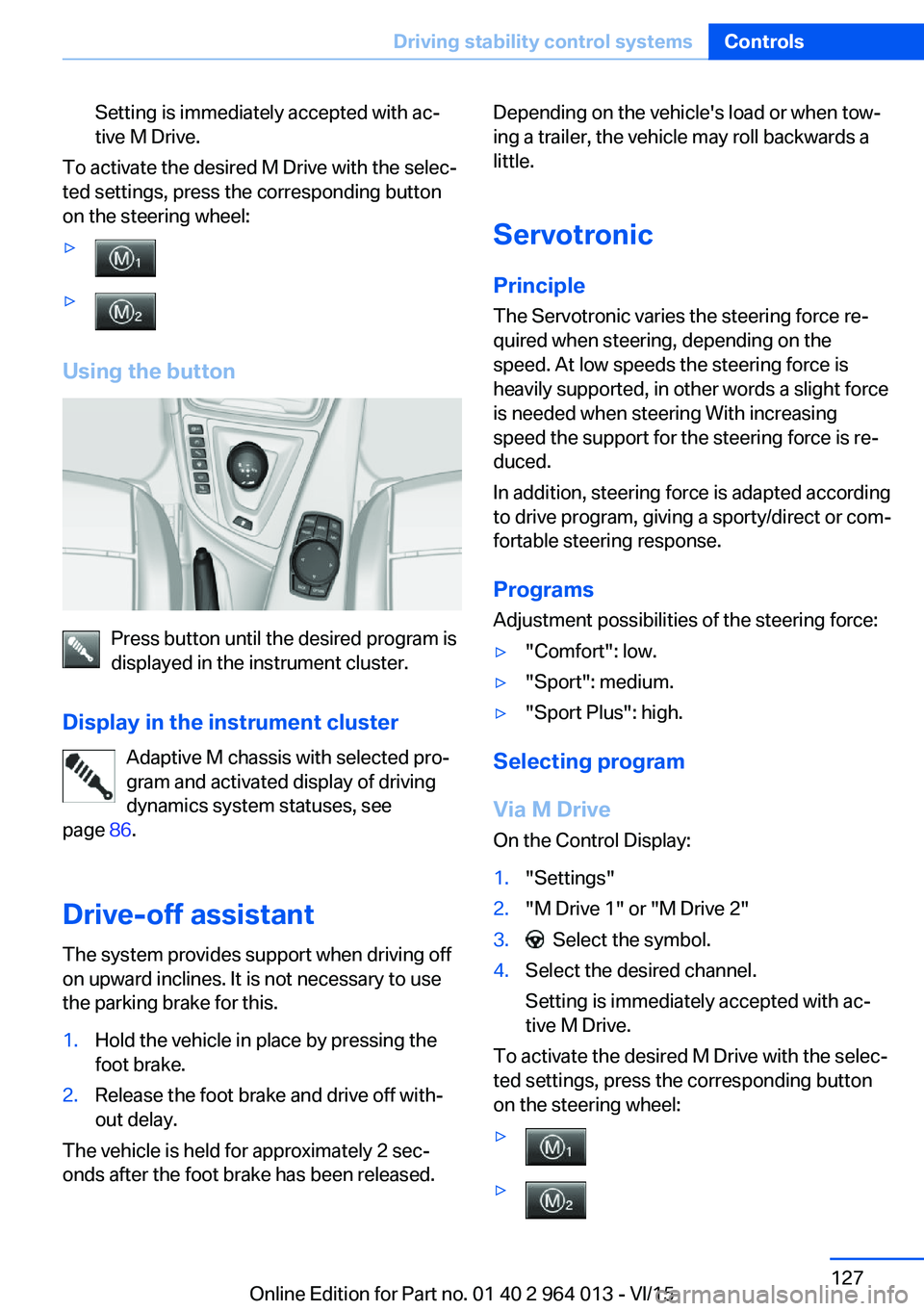
Using the button
Press button until the desired program is
displayed in the instrument cluster.
Display in the instrument cluster Adaptive M chassis with selected pro‐
gram and activated display of driving
dynamics system statuses, see
page 86.
Drive-off assistant The system provides support when driving off
on upward inclines. It is not necessary to use
the parking brake for this.
1.Hold the vehicle in place by pressing the
foot brake.2.Release the foot brake and drive off with‐
out delay.
The vehicle is held for approximately 2 sec‐
onds after the foot brake has been released.
Depending on the vehicle's load or when tow‐
ing a trailer, the vehicle may roll backwards a
little.
Servotronic
Principle The Servotronic varies the steering force re‐
quired when steering, depending on the
speed. At low speeds the steering force is
heavily supported, in other words a slight force
is needed when steering With increasing
speed the support for the steering force is re‐
duced.
In addition, steering force is adapted according
to drive program, giving a sporty/direct or com‐
fortable steering response.
Programs Adjustment possibilities of the steering force:▷"Comfort": low.▷"Sport": medium.▷"Sport Plus": high.
Selecting program
Via M Drive On the Control Display:
1."Settings"2."M Drive 1" or "M Drive 2"3. Select the symbol.4.Select the desired channel.
Setting is immediately accepted with ac‐
tive M Drive.
To activate the desired M Drive with the selec‐
ted settings, press the corresponding button
on the steering wheel:
▷▷Seite 127Driving stability control systemsControls127
Online Edition for Part no. 01 40 2 964 013 - VI/15
Page 129 of 228
Driving comfortVehicle equipment
This chapter describes all standard, national
and special equipment provided in the model
series. Equipment not available in the vehicle is
therefore also described, for example the se‐
lected special equipment or national version.
This also applies to safety-relevant functions
and systems. Comply with the relevant na‐
tional regulations when using the correspond‐
ing functions and systems.
Cruise Control
Principle System keeps to speed set using buttons on
steering wheel. On downhill gradients, the sys‐
tem will brake the vehicle if the braking action
of the engine alone is insufficient.
General Characteristics of Cruise Control may change
in certain areas depending on vehicle setting.
Information WARNING
Using the system in the following situa‐
tions can lead to an increased danger of acci‐
dent:▷On stretches with many corners and
bends.▷In heavy traffic.▷If the road is icy, if there is fog, snow, rain
or a loose road surface.
Danger of accident or damage to property.
Only use the system if it is possible to drive at
a constant speed.◀
Overview
Buttons on the steering wheelPress the
buttonFunctionCruise Control on, off, inter‐
rupt, see page 129.Resume speed, see
page 130.Rocker switch: change, hold
or set speed, see page 130.
Controls
Switching on Press the button on the steering
wheel.
The speedometer marker is set to the current
speed.
Cruise Control can be used.
If necessary, Dynamic Stability Control DSC
will be switched on.
Switching off WARNING
The system does not take your personal
responsibility from you when you are estimat‐
ing the traffic situation. Due to limits of the sys‐
tem, it cannot respond independently in a rea‐
sonable way in all traffic conditions. Danger of
accidents. Adapt driving style to the driving
conditions. Observe the traffic situation and in‐
tervene actively if the situation warrants it.◀
Press the button on the steering
wheel.
▷When activated: press twice.Seite 129Driving comfortControls129
Online Edition for Part no. 01 40 2 964 013 - VI/15
Page 131 of 228

shows whether the system is switched on.Desired speed▷Marker illuminates green:
the system is active.▷Marker illuminates orange:
the system is interrupted.▷Marker does not illuminate:
the system is inactive.
Brief status display
Selected desired speed.
If no speed is displayed, the conditions re‐
quired for operation may not be fulfilled at the
moment.
Displays on the Head-Up Display Some information from the system can also be
shown on Head-Up Display.
Park Distance Control PDC
Principle PDC supports you with parking. Slowly ap‐
proaching an object in behind, or with front
PDC, in front of, your vehicle is signalled by
means of:
▷Acoustic signals.▷Visual display.
General
Ultrasonic sensors in each bumper measure
the distance.
The range is approximately 2 m, 6 ft depending on obstacle and environment.
An acoustic warning is only issued under the
following circumstances:
▷At the front sensors and at the two corner
sensors at the rear at approx. 60 cm, 24 in.▷At the central sensors at the rear at ap‐
prox. 1.5 m, 5 ft.▷If there is a collision risk.
Notes
WARNING
The system does not take your personal
responsibility from you when you are estimat‐
ing the traffic situation. Due to limits of the sys‐
tem, it cannot respond independently in a rea‐
sonable way in all traffic conditions. Danger of accidents. Adapt driving style to the driving
conditions. Observe the traffic situation and in‐
tervene actively if the situation warrants it.◀
WARNING
If the vehicle is travelling at high speed
when PDC is activated, there may be a delayed
warning because of physical conditions. Dan‐
ger of injury or damage to property. Avoid ap‐
proaching an object at speed. Avoid moving off at speed while PDC is not yet active.◀
Overview
With front PDC: button in vehicle
Park Distance Control PDC
Ultrasonic sensors PDC sensors on the vehicle.
Seite 131Driving comfortControls131
Online Edition for Part no. 01 40 2 964 013 - VI/15
Page 133 of 228

▷With persons with certain clothing, for ex‐
ample a coat.▷With external disruption to the ultrasound,
for example by passing vehicles or loud
machines.▷If the sensors are dirty, iced-up, damaged
or incorrectly adjusted.▷In certain weather conditions, for example
high humidity, rain, snowfall, extreme heat
or strong wind.▷With trailer noses and tow hitches of other
vehicles.▷With thin or wedge-shaped objects.▷With moving objects.▷For higher, protruding objects, for example
projecting walls or loads.▷For objects with corners and sharp edges.▷For objects with fine surfaces or struc‐
tures, for example fences.▷For objects with porous surfaces.
Low objects already indicated, such as kerbs,
may enter the sensors' blind areas before or
after a continuous tone is given.
False alarms
Under the following conditions, PDC can issue
a warning although there is no obstacle in the
detection range:
▷In heavy rain.▷If the sensors are very dirty or covered with
ice.▷If the sensors are covered with snow.▷On rough road surfaces.▷On uneven ground, for example speed
bumps.▷In large, rectangular buildings with smooth
walls, for example underground car parks.▷In car washes.▷Due to dense exhaust gas.▷Due to other ultrasonic sources, for exam‐
ple sweeping machines, steam-jet cleaners
or neon lights.
The functional disruption is reported by an
alternating continuous tone between the
front and rear loudspeakers. As soon as
the disruption by other ultrasound sources
is no longer present, the system is fully
functional again.
Malfunction
A Check Control message is shown.
The recording area of the sensors is shown
hatched on the Control Display.
PDC has failed. Have the system checked.
Surround view Principle
Surround view contains various camera assis‐
tance systems, providing support when park‐
ing, manoeuvring and exits and junctions with
poor visibility.
▷Rear-view camera, see page 133.▷Side view, see page 136.▷Top view, see page 137.
Rear-view camera
Principle The rear-view camera offers assistance when
reversing into a parking space or manoeuvring.
To achieve this, the area behind the vehicle is
displayed on the Control Display.
Notes WARNING
The system does not take your personal
responsibility from you when you are estimat‐
ing the traffic situation. Danger of accidents.
Adapt driving style to the driving conditions.
Seite 133Driving comfortControls133
Online Edition for Part no. 01 40 2 964 013 - VI/15
Page 134 of 228

Additionally, look directly to check the traffic
situation and the area around the vehicle and
intervene actively in the corresponding situa‐
tions.◀
Overview
Button in the vehicle
Rear-view camera
Camera
The camera lens is located in the handle strip
of the boot lid. Dirt can impair the quality of the
picture.
Clean the lens of the camera, see page 211.
Switching on/off Automatic activation While the engine is running, engage selector
lever position R.
The image from the rear-view camera is dis‐
played if the system was switched on using the
iDrive.
Automatic switching off when moving
forwards
The system switches off when a certain dis‐
tance or speed is exceeded.
Switch the system back on if necessary.
Switching on/off manually Press the button.▷On: LED is illuminated.▷Off: LED turns off.
PDC is displayed on the Control Display.
Switching the view via iDrive With activated PDC or Top View switched on:
"Rear view camera"
The image from the rear-view camera is dis‐
played.
Display on the Control Display
Operating requirements
▷The rear-view camera is switched on.▷The boot lid is completely closed.
Activating assistance functions
A number of assistance functions can be ac‐
tive simultaneously.
▷Parking aid lines.
"Parking guidance lines"
Driving lane and turning circle lines are dis‐
played.
▷Obstacle marking.
"Obstacle marking"
Spatially shaped markings are displayed.
Seite 134ControlsDriving comfort134
Online Edition for Part no. 01 40 2 964 013 - VI/15
Page 135 of 228
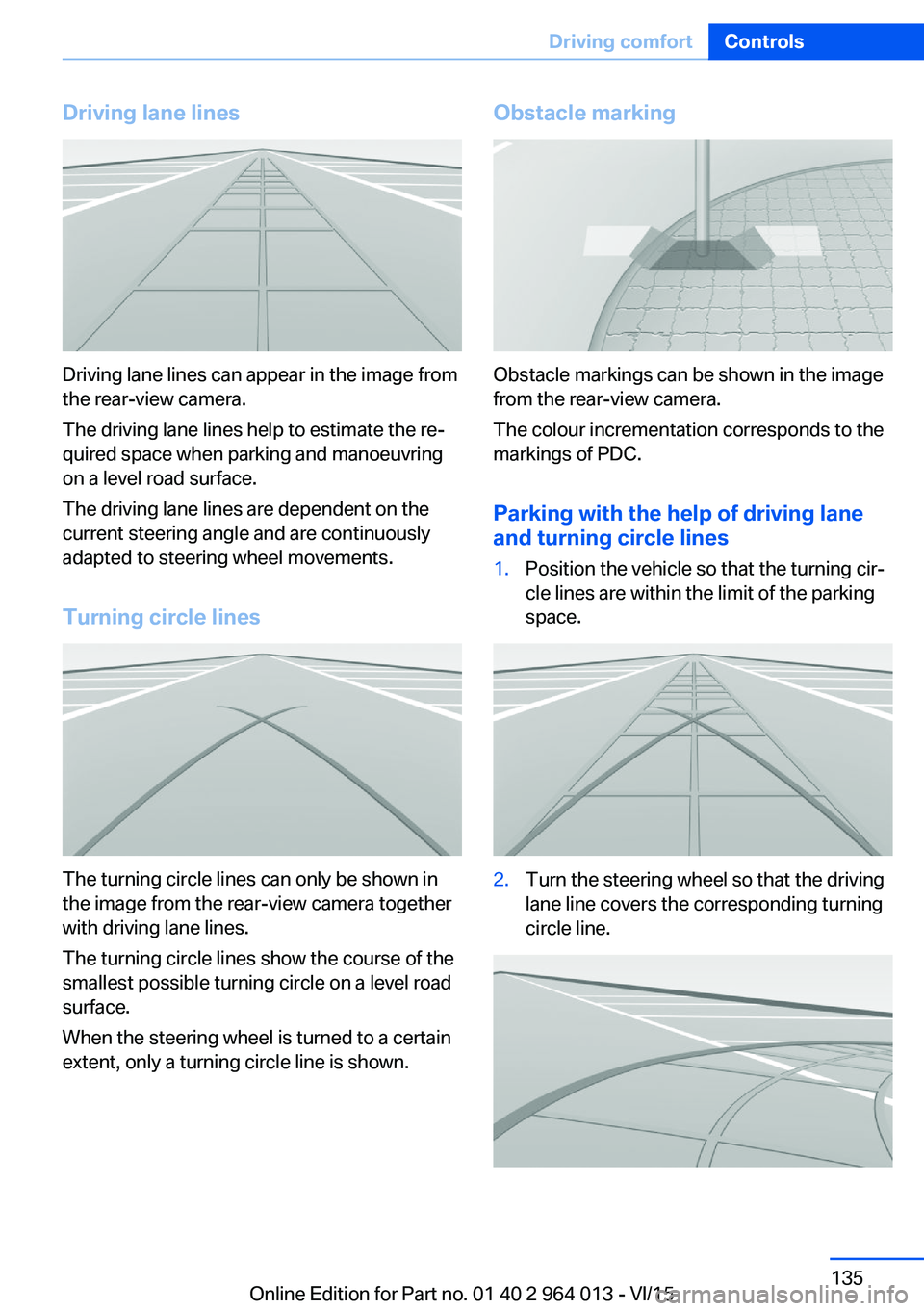
Driving lane lines
Driving lane lines can appear in the image from
the rear-view camera.
The driving lane lines help to estimate the re‐
quired space when parking and manoeuvring
on a level road surface.
The driving lane lines are dependent on the
current steering angle and are continuously
adapted to steering wheel movements.
Turning circle lines
The turning circle lines can only be shown in
the image from the rear-view camera together
with driving lane lines.
The turning circle lines show the course of the
smallest possible turning circle on a level road
surface.
When the steering wheel is turned to a certain
extent, only a turning circle line is shown.
Obstacle marking
Obstacle markings can be shown in the image
from the rear-view camera.
The colour incrementation corresponds to the
markings of PDC.
Parking with the help of driving lane
and turning circle lines
1.Position the vehicle so that the turning cir‐
cle lines are within the limit of the parking
space.2.Turn the steering wheel so that the driving
lane line covers the corresponding turning
circle line.Seite 135Driving comfortControls135
Online Edition for Part no. 01 40 2 964 013 - VI/15
Page 136 of 228
Display settings
Brightness
With rear-view camera switched on:1. Select the symbol.2.Turn the controller until the desired setting
is reached and press the controller.
Contrast
With rear-view camera switched on:
1. Select the symbol.2.Turn the controller until the desired setting
is reached and press the controller.
System limits
Detection of objects
Very low obstacles and higher, protruding ob‐
jects such as ledges cannot be detected by
the system.
Assistance functions also consider data from
the PDC.
Follow notes in the PDC chapter, see
page 131.
The objects shown on the Control Display may
be closer than they appear. Do not estimate
the distance to objects on the display.
Side View
Principle Side View provides you with an advance view
of crossing traffic at blind entrances. Road users hidden by obstacles at the side are only
detected very late from the driver's seat. In or‐
der to improve the view, two cameras in the
front area of the vehicle scan the area to the
side.
Notes
The camera pictures are shown simultane‐ ously on the Control Display.
WARNING
The system does not take your personal
responsibility from you when you are estimat‐
ing the traffic situation. Danger of accidents. Adapt driving style to the driving conditions.
Additionally, look directly to check the traffic
situation and the area around the vehicle and
intervene actively in the corresponding situa‐ tions.◀
Overview
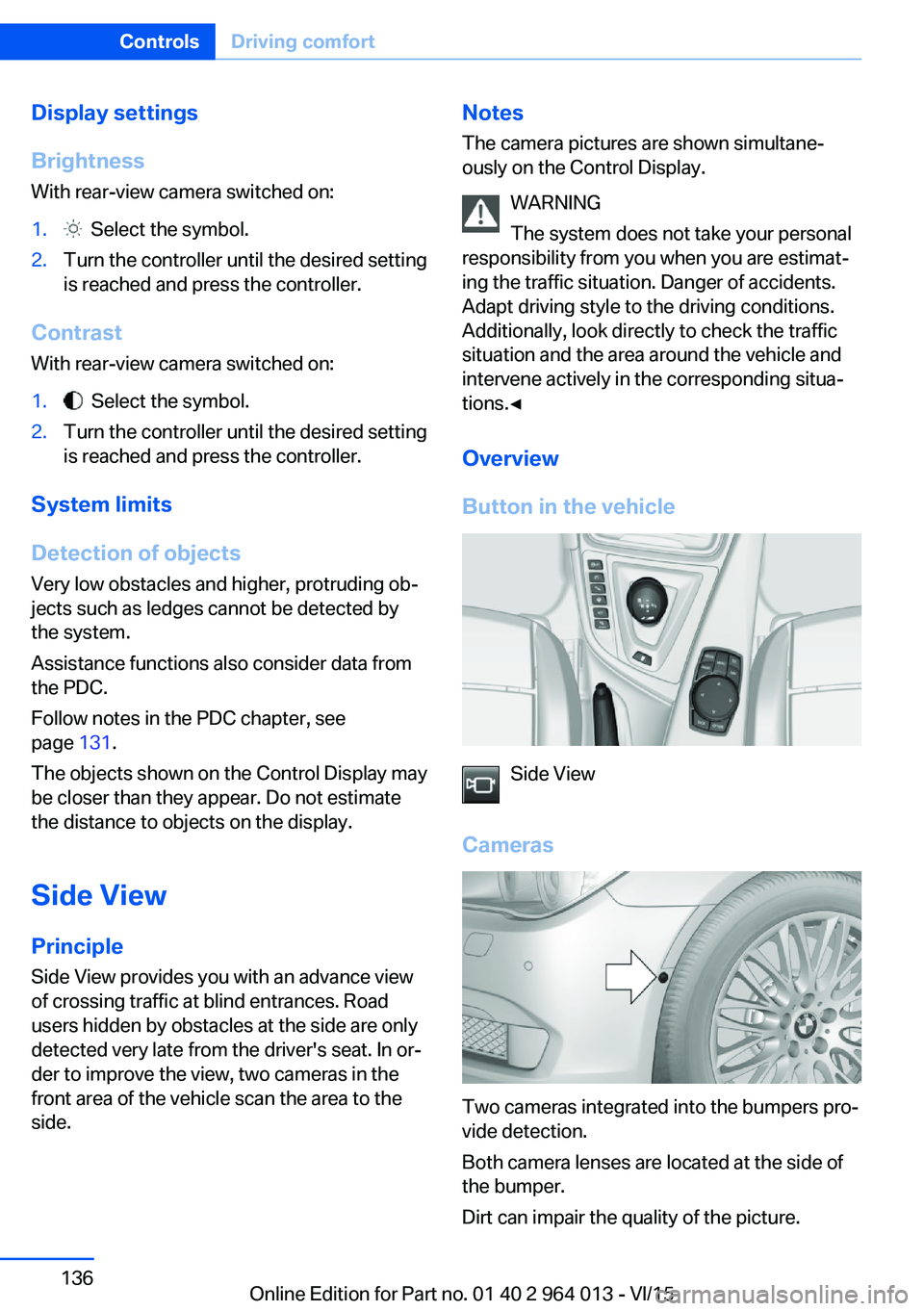
Button in the vehicle
Side View
Cameras
Two cameras integrated into the bumpers pro‐
vide detection.
Both camera lenses are located at the side of
the bumper.
Dirt can impair the quality of the picture.
Seite 136ControlsDriving comfort136
Online Edition for Part no. 01 40 2 964 013 - VI/15
Page 137 of 228
Cleaning camera lenses, see page 211.
Switching on/off Switching on/off manually Press the button.
Automatic switching off when moving
forwards
The system switches off when a certain dis‐
tance or speed is exceeded.
Switch the system back on if necessary.
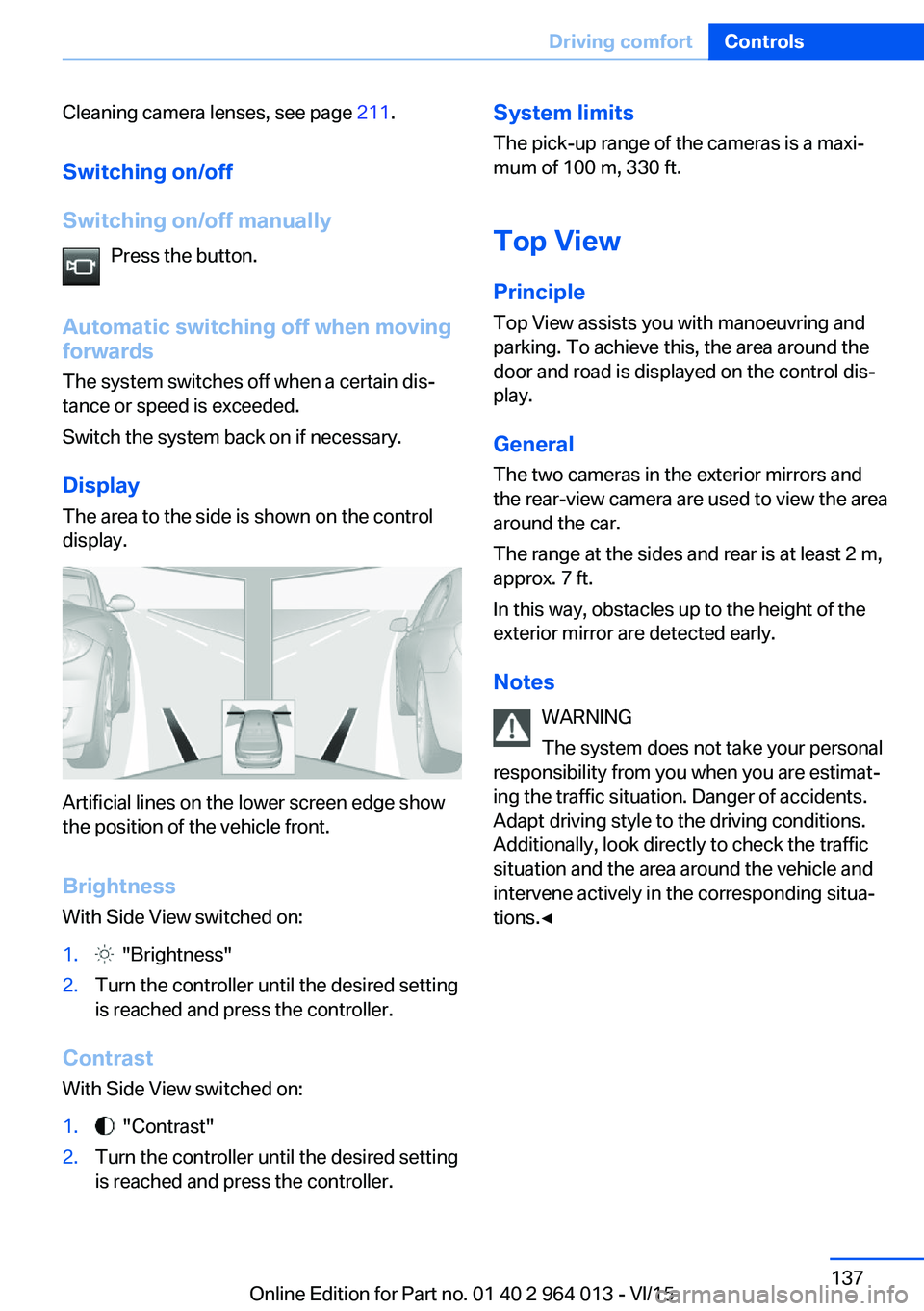
Display
The area to the side is shown on the control
display.
Artificial lines on the lower screen edge show
the position of the vehicle front.
Brightness
With Side View switched on:
1. "Brightness"2.Turn the controller until the desired setting
is reached and press the controller.
Contrast
With Side View switched on:
1. "Contrast"2.Turn the controller until the desired setting
is reached and press the controller.System limits
The pick-up range of the cameras is a maxi‐
mum of 100 m, 330 ft.
Top View
Principle Top View assists you with manoeuvring and
parking. To achieve this, the area around the
door and road is displayed on the control dis‐
play.
General
The two cameras in the exterior mirrors and
the rear-view camera are used to view the area
around the car.
The range at the sides and rear is at least 2 m,
approx. 7 ft.
In this way, obstacles up to the height of the
exterior mirror are detected early.
Notes WARNING
The system does not take your personal
responsibility from you when you are estimat‐
ing the traffic situation. Danger of accidents.
Adapt driving style to the driving conditions.
Additionally, look directly to check the traffic
situation and the area around the vehicle and
intervene actively in the corresponding situa‐
tions.◀Seite 137Driving comfortControls137
Online Edition for Part no. 01 40 2 964 013 - VI/15