2015 PEUGEOT 2008 ESP
[x] Cancel search: ESPPage 130 of 340
128
2008_en_Chap07_securite_ed01-2015
Direction
indicators
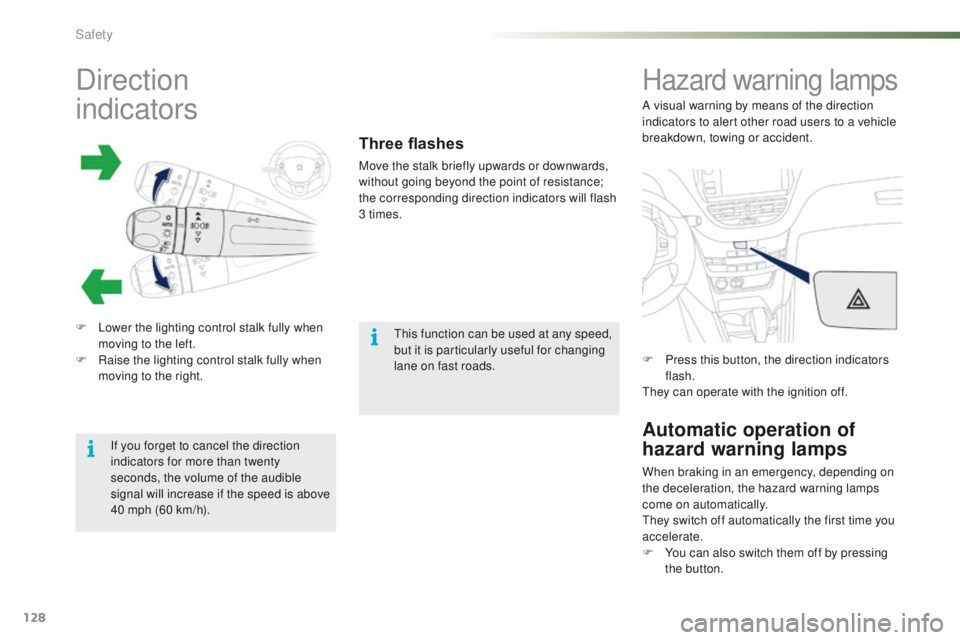
F Lower the lighting control stalk fully when moving to the left.
F
R
aise the lighting control stalk fully when
moving to the right.
Three flashes
Move the stalk briefly upwards or downwards,
without going beyond the point of resistance;
the corresponding direction indicators will flash
3 times.
If you forget to cancel the direction
indicators for more than twenty
seconds, the volume of the audible
signal will increase if the speed is above
40 mph (60 km/h).
Hazard warning lamps
F Press this button, the direction indicators flash.
They can operate with the ignition off.
This function can be used at any speed,
but it is particularly useful for changing
lane on fast roads. A visual warning by means of the direction
indicators to alert other road users to a vehicle
breakdown, towing or accident.
Automatic operation of
hazard warning lamps
When braking in an emergency, depending on
the deceleration, the hazard warning lamps
come on automatically.
They switch off automatically the first time you
accelerate.
F
Y
ou can also switch them off by pressing
the button.
Safety
Page 132 of 340

130
2008_en_Chap07_securite_ed01-2015
The under-inflation detection system
does not replace the vigilance or the
responsibility of the driver.
This system does not avoid the need to
check the tyre pressures (including the
spare wheel) every month as well as
before a long journey.
Driving with under-inflated tyres impairs
road holding, extends braking distances
and causes premature tyre wear,
particularly under arduous condition
(high loading, high speed, long journey).The inflation pressures defined for
your vehicle can be found on the tyre
pressure label.
See the "Identification markings"
section.
Tyre pressures should be checked
when the tyres are "cold" (vehicle
stopped for 1 hour or after a journey of
less than 6 miles (10 km) at moderate
speeds).
Other wise (when hot), add 0.3 bar to
the pressures shown on the label.
Driving with under-inflated tyres
increases fuel consumption.
Tyre under-inflation detection
System which automatically checks the pressure of the tyres while driving.
The system monitors the pressures on the four
tyres, once the vehicle is moving.
It compares the information given by the four
wheel speed sensors with reference values,
which must be reinitialised ever y time the
tyre pressures are adjusted or a wheel
changed
.
The system triggers an alert as soon as it
detects a drop in the inflation pressure of one
or more tyres.
Safety
Page 139 of 340
137
2008_en_Chap07_securite_ed01-2015
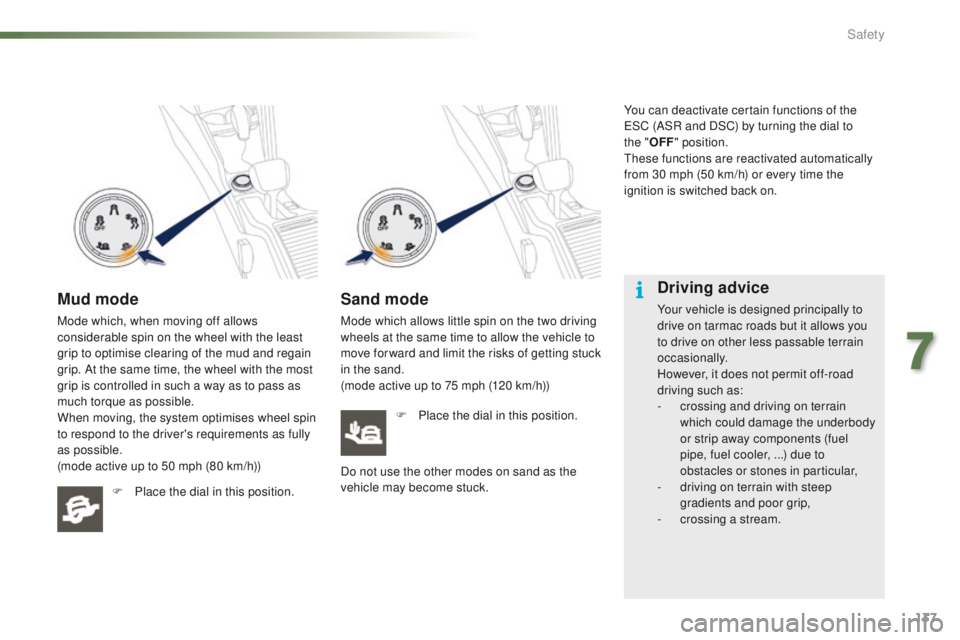
Mud mode
Mode which, when moving off allows
considerable spin on the wheel with the least
grip to optimise clearing of the mud and regain
grip. At the same time, the wheel with the most
grip is controlled in such a way as to pass as
much torque as possible.
When moving, the system optimises wheel spin
to respond to the driver's requirements as fully
as possible.
(mode active up to 50 mph (80 km/h))F
P
lace the dial in this position.
Sand mode
Mode which allows little spin on the two driving
wheels at the same time to allow the vehicle to
move for ward and limit the risks of getting stuck
in the sand.
(mode active up to 75 mph (120 km/h))F
P
lace the dial in this position.
Do not use the other modes on sand as the
vehicle may become stuck. You can deactivate certain functions of the
ESC (ASR and DSC) by turning the dial to
the "
OFF" position.
These functions are reactivated automatically
from 30 mph (50 km/h) or every time the
ignition is switched back on.
Driving advice
Your vehicle is designed principally to
drive on tarmac roads but it allows you
to drive on other less passable terrain
occasionally.
However, it does not permit off-road
driving such as:
-
c
rossing and driving on terrain
which could damage the underbody
or strip away components (fuel
pipe, fuel cooler, ...) due to
obstacles or stones in particular,
-
d
riving on terrain with steep
gradients and poor grip,
-
c
rossing a stream.
7
Safety
Page 145 of 340
143
2008_en_Chap07_securite_ed01-2015
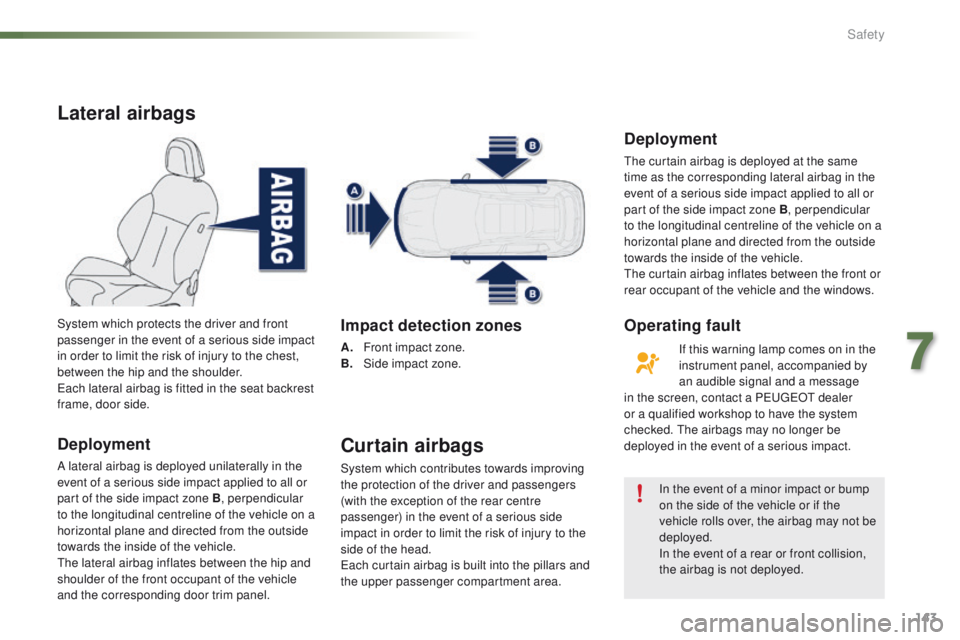
Lateral airbags
Deployment
A lateral airbag is deployed unilaterally in the
event of a serious side impact applied to all or
part of the side impact zone B, perpendicular
to the longitudinal centreline of the vehicle on a
horizontal plane and directed from the outside
towards the inside of the vehicle.
The lateral airbag inflates between the hip and
shoulder of the front occupant of the vehicle
and the corresponding door trim panel. System which protects the driver and front
passenger in the event of a serious side impact
in order to limit the risk of injury to the chest,
between the hip and the shoulder.
Each lateral airbag is fitted in the seat backrest
frame, door side.
Impact detection zones
A. Front impact zone.
B. Side impact zone.
Curtain airbags
System which contributes towards improving
the protection of the driver and passengers
(with the exception of the rear centre
passenger) in the event of a serious side
impact in order to limit the risk of injury to the
side of the head.
Each curtain airbag is built into the pillars and
the upper passenger compartment area. In the event of a minor impact or bump
on the side of the vehicle or if the
vehicle rolls over, the airbag may not be
deployed.
In the event of a rear or front collision,
the airbag is not deployed.
Deployment
The curtain airbag is deployed at the same
time as the corresponding lateral airbag in the
event of a serious side impact applied to all or
part of the side impact zone B, perpendicular
to the longitudinal centreline of the vehicle on a
horizontal plane and directed from the outside
towards the inside of the vehicle.
The curtain airbag inflates between the front or
rear occupant of the vehicle and the windows.
If this warning lamp comes on in the
instrument panel, accompanied by
an audible signal and a message
in the screen, contact a PEUGEOT dealer
or a qualified workshop to have the system
checked. The airbags may no longer be
deployed in the event of a serious impact.
Operating fault
7
Safety
Page 150 of 340
148
AR
BG
НИКОГА НЕ инсталирайте детско столче на седалка с АКТИВИРАНА предна ВЪЗДУШНА ВЪЗГЛАВНИЦ А. Това може да причини
СМЪРТ или СЕРИОЗНО НАРАНЯВАНЕ на детето.
CSNIKDY neumisťujte dětské zádržné zařízení orientované směrem dozadu na sedadlo chráněné AKTIVOVANÝM čelním AIRBAGEM. Hrozí
nebezpečí SMRTI DÍTĚTE nebo VÁ ŽNÉHO ZR ANĚNÍ.
DABrug ALDRIG en bagudvendt barnestol på et sæde, der er beskyttet af en AKTIV AIRBAG. BARNET risikerer at blive ALVORLIGT
K VÆSTET eller DR ÆBT.
DEMontieren Sie auf einem Sitz mit AKTIVIERTEM Front-Airbag NIEMALS einen Kindersitz oder eine Babyschale entgegen der Fahr trichtung,
das Kind könnte schwere oder sogar tödliche Verletzungen erleiden.
ELΜη χρησιμοποιείτε ΠΟΤΕ παιδικό κάθισμα με την πλάτη του προς το εμπρός μέρος του αυτοκινήτου, σε μια θέση που προστατεύεται από
ΜΕΤΩΠΙΚΟ αερόσακο που είναι ΕΝΕΡΓΟΣ. Αυτό μπορεί να έχει σαν συνέπεια το ΘΑΝΑΤΟ ή το ΣΟΒΑΡΟ ΤΡΑΥΜΑΤΙΣΜΟ του ΠΑΙΔΙΟΥ
ENNEVER use a rear ward facing child restraint on a seat protected by an ACTIVE AIRBAG in front of it, DEATH or SERIOUS INJURY to the
CHILD can occur
ESNO INSTALAR NUNCA un sistema de retención para niños de espaldas al sentido de la marcha en un asiento protegido mediante un
AIRBAG frontal ACTIVADO, ya que podría causar lesiones GR AVES o incluso la MUERTE del niño.
ETÄrge MITTE KUNAGI paigaldage "seljaga sõidusuunas" lapseistet juhi kõrvalistmele, mille ESITURVAPADI on AKTIVEERITUD. Turvapadja
avanemine võib last TÕSISELT või ELUOHTLIKULT vigastada.
FIÄLÄ KOSK A AN aseta lapsen tur vaistuinta selkä ajosuuntaan istuimelle, jonka edessä suojana on käyttöön aktivoitu TURVAT Y YNY. Sen
laukeaminen voi aiheuttaa LAPSEN KUOLEMAN tai VAK AVAN LOUKK A ANTUMISEN.
FRNE JAMAIS installer de système de retenue pour enfants faisant face vers l’arrière sur un siège protégé par un COUSSIN GONFLABLE
frontal ACTIVÉ.
Cela peut provoquer la MORT de l’ENFANT ou le BLESSER GR AVEMENT
HRNIK ADA ne postavljati dječju sjedalicu leđima u smjeru vožnje na sjedalo zaštićeno UKLJUČENIM prednjim ZR AČNIM JASTUKOM. To bi
moglo uzrokovati SMRT ili TEŠKU OZLJEDU djeteta.
HUSOHA ne használjon menetiránynak háttal beszerelt gyermekülést AKTIVÁLT (BEK APCSOLT) FRONTLÉGZSÁKK AL védett ülésen. Ez a
gyermek HALÁLÁT vagy SÚLYOS SÉRÜLÉSÉT okozhatja.
ITNON installare MAI seggiolini per bambini posizionati in senso contrario a quello di marcia su un sedile protetto da un AIRBAG frontale
ATTIVATO. Ciò potrebbe provocare la MORTE o FERITE GR AVI al bambino.
LTNIEK ADA neįrenkite vaiko prilaikymo priemonės su atgal atgręžtu vaiku ant sėdynės, kuri saugoma VEIKIANČIOS priekinės ORO
PAGALVĖS. Išsiskleidus oro pagalvei vaikas gali būti MIRTINAI arba SUNKIAI TR AUMUOTAS.
LVNEK AD NEuzstādiet uz aizmuguri vērstu bērnu sēdeklīti priekšējā pasažiera sēdvietā, kurā ir AKTIVIZĒTS priekšējais DROŠĪBAS GAISA
S P I LV E N S .
Tas var izraisīt BĒRNA NĀVI vai radīt NOPIETNUS IEVAINOJUMUS.
2008_en_Chap08_securite-enfants_ed01-2015
Child safety
Page 165 of 340
163
2008_en_Chap09_info-pratiques_ed01-2015
On vehicle fitted with HDi engines, the fuel
system must be primed if you run out of fuel;
refer to the engine compartment view on the
"Diesel engine" section.
If the tank on your vehicle is fitted with
a misfuel prevention device, refer to the
corresponding section.
Running out of fuel (Diesel)
If the engine does not start first time,
don't keep trying. Start the procedure
again from the beginning.F
A
dd at least five litres of Diesel fuel to
the
tank.
F
O
pen the bonnet.
F
P
ress and release the priming pump until
resistance is felt (there may be resistance
on the first press).
F
O
perate the starter motor to start the
engine.
F
C
lose the bonnet.
1.4 litre HDi 68 engine
F Add at least five litres of Diesel fuel to
the tank.
F
O
pen the bonnet.
F
I
f necessary, unclip the styling cover for
access to the priming pump.
F
S
queeze and release the priming pump
repeatedly until resistance is felt (there
may be resistance at the first press).
F
O
perate the starter to start the engine
(if the engine does not start at the first
attempt, wait around 15 seconds before
trying again).
F
I
f the engine does not start after a few
attempts, operate the priming pump again
then start the engine.
F
R
efit the styling cover and clip it in place.
F
C
lose the bonnet.
1.6 litre e-HDi 92 engine
1.6 litre BlueHDi engines
F Add at least five litres of Diesel fuel to the tank.
F
S
witch the ignition on (without starting the
engine).
F
W
ait around 6 seconds and switch off the
ignition.
F
R
epeat the operation 10 times.
F
O
perate the starter motor to start
the
engine.
9
Practical information
Page 166 of 340
164
2008_en_Chap09_info-pratiques_ed01-2015
AdBlue® additive and SCR system
for BlueHDi Diesel engines
To assure respect for the environment and
conformity with the new Euro 6 emissions
standard, without adversely affecting the
per formance or fuel consumption of Diesel
engines, PEUGEOT has taken the decision to
equip its vehicles with an effective system that
associates SCR (Selective Catalytic Reduction)
with a particle filter (FAP) for the treatment of
exhaust gases.
Presentation of the SCR system
Using an additive called AdBlue® containing
urea, a catalytic converter turns up to 85%
of nitrous oxides (NOx) into nitrogen and
water, which are harmless to health and the
environment. The AdBlue
® additive is held in a special
tank located under the boot at the rear of
the vehicle. It has a capacity of 17 litres: this
provides a driving range of about 12 500 miles
(20 000 km), after which an alert is triggered
warning you when the reserve remaining is
enough for just 1 500 miles (2 400 km).
During each scheduled service of your vehicle
by a PEUGEOT dealer or a qualified workshop,
the AdBlue
® additive tank is refilled in order to
allow normal operation of the SCR system.
If the estimated mileage between two services
is greater than 12 500 miles (20 000 km), we
recommend that you go to a PEUGEOT dealer
or a qualified workshop to have the necessary
top-up carried out. Once the AdBlue
® tank is empty, a
s
ystem required by regulations prevents
starting of the engine.
If the SCR is faulty, the level of
emissions from your vehicle will no
longer meet the Euro 6 standard: you
vehicle becomes polluting.
In the event of a confirmed fault
with the SCR system, you must go
to a PEUGEOT dealer or a qualified
workshop as soon as possible: after
a running distance of 650 miles
(1
100 km), a system will be triggered
automatically to prevent engine starting.
Practical information
Page 192 of 340
190
2008_en_Chap09_info-pratiques_ed01-2015
Changing brake lamp and
direction indicator bulbs
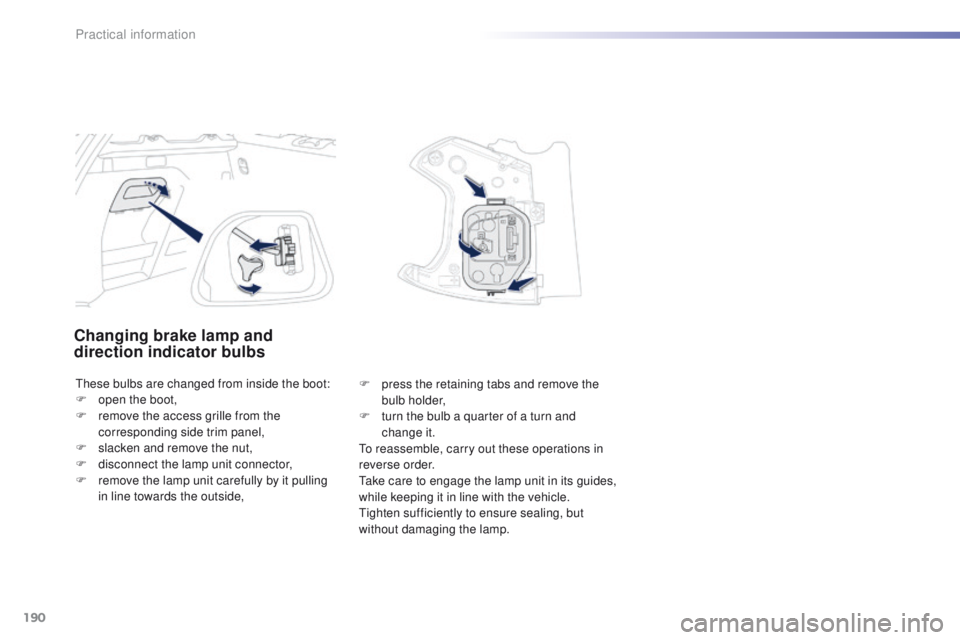
These bulbs are changed from inside the boot:
F o pen the boot,
F
r
emove the access grille from the
corresponding side trim panel,
F
s
lacken and remove the nut,
F
d
isconnect the lamp unit connector,
F
r
emove the lamp unit carefully by it pulling
in line towards the outside, F
p ress the retaining tabs and remove the
bulb holder,
F
t
urn the bulb a quarter of a turn and
change
it.
To reassemble, carry out these operations in
reverse order.
Take care to engage the lamp unit in its guides,
while keeping it in line with the vehicle.
Tighten sufficiently to ensure sealing, but
without damaging the lamp.
Practical information