2015 PEUGEOT 2008 ESP
[x] Cancel search: ESPPage 38 of 340
36
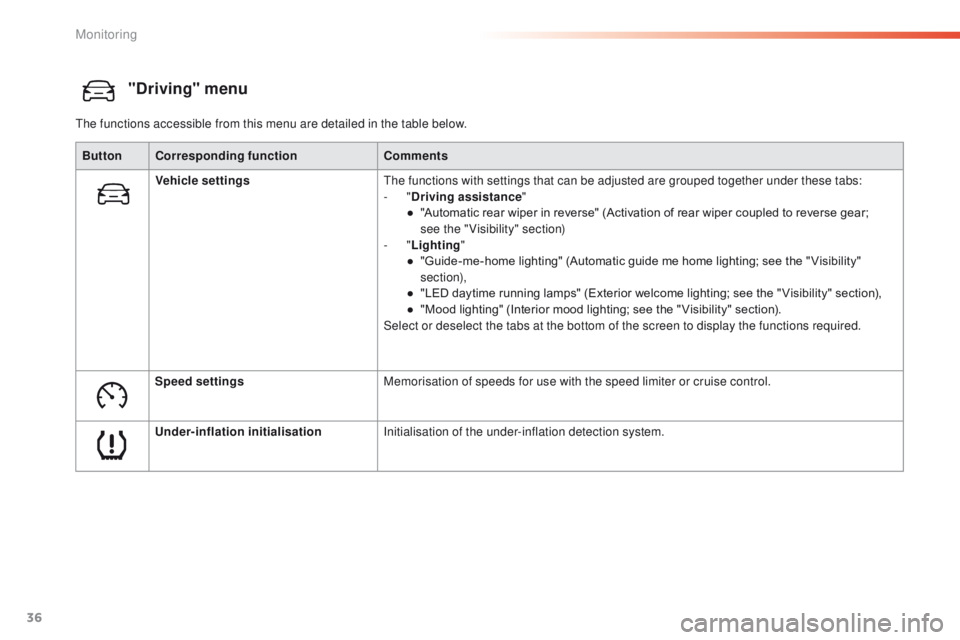
"Driving" menu
The functions accessible from this menu are detailed in the table below.Button Corresponding function Comments
Vehicle settings The functions with settings that can be adjusted are grouped together under these tabs:
-
"Driving assistance "
●
"
Automatic rear wiper in reverse" (Activation of rear wiper coupled to reverse gear;
see
the "Visibility" section)
-
"Lighting "
●
"
Guide-me-home lighting" (Automatic guide me home lighting; see the " Visibility"
section),
●
"
LED daytime running lamps" (Exterior welcome lighting; see the " Visibility" section),
●
"
Mood lighting" (Interior mood lighting; see the " Visibility" section).
Select or deselect the tabs at the bottom of the screen to display the functions required.
Speed settings Memorisation of speeds for use with the speed limiter or cruise control.
Under-inflation initialisation Initialisation of the under-inflation detection system.
Monitoring
Page 55 of 340
53
2008_en_Chap02_ouvertures_ed01-2015
Electric windows
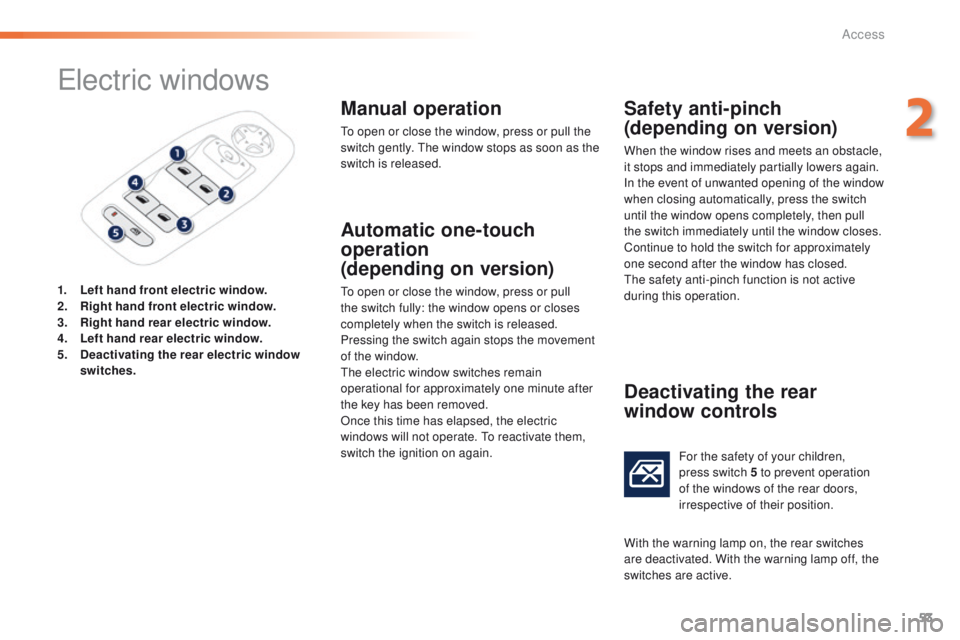
1. Left hand front electric window.
2. Right hand front electric window.
3.
R
ight hand rear electric window.
4.
Le
ft hand rear electric window.
5.
D
eactivating the rear electric window
switches .
Manual operation
To open or close the window, press or pull the
switch gently. The window stops as soon as the
switch is released.
Automatic one-touch
operation
(depending on version)
To open or close the window, press or pull
the switch fully: the window opens or closes
completely when the switch is released.
Pressing the switch again stops the movement
of the window.
The electric window switches remain
operational for approximately one minute after
the key has been removed.
Once this time has elapsed, the electric
windows will not operate. To reactivate them,
switch the ignition on again.
Safety anti-pinch
(depending on version)
When the window rises and meets an obstacle,
it stops and immediately partially lowers again.
In the event of unwanted opening of the window
when closing automatically, press the switch
until the window opens completely, then pull
the switch immediately until the window closes.
Continue to hold the switch for approximately
one second after the window has closed.
The safety anti-pinch function is not active
during this operation.
Deactivating the rear
window controls
For the safety of your children,
press switch 5 to prevent operation
of the windows of the rear doors,
irrespective of their position.
With the warning lamp on, the rear switches
are deactivated. With the warning lamp off, the
switches are active.
2
Access
Page 59 of 340
57
2008_en_Chap03_confort_ed01-2015
Rear seats
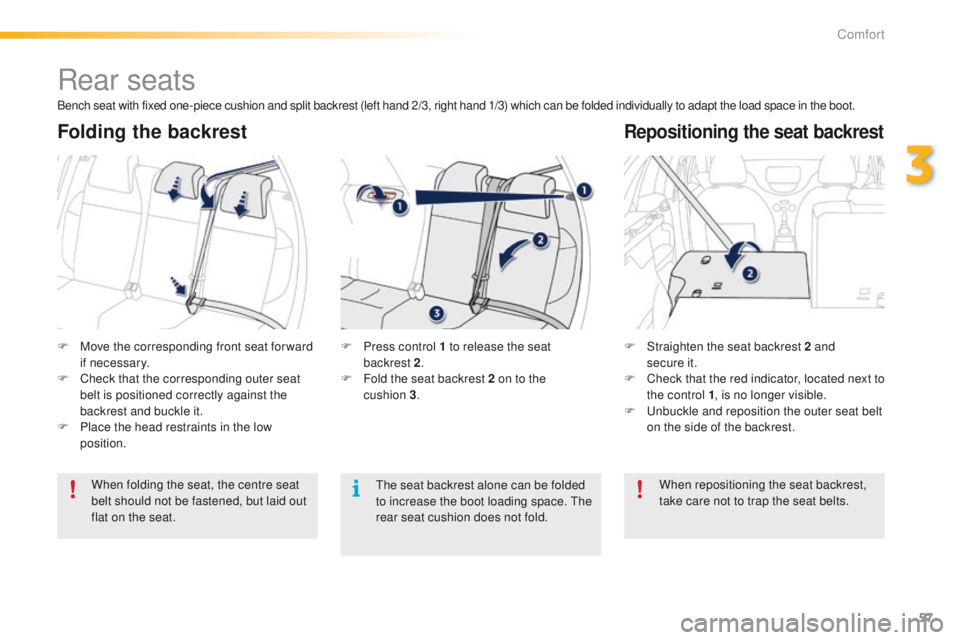
F Move the corresponding front seat for ward if necessary.
F
C
heck that the corresponding outer seat
belt is positioned correctly against the
backrest and buckle it.
F
P
lace the head restraints in the low
position. F
S traighten the seat backrest 2 and
secure it.
F
C
heck that the red indicator, located next to
the control 1 , is no longer visible.
F
U
nbuckle and reposition the outer seat belt
on the side of the backrest.
When folding the seat, the centre seat
belt should not be fastened, but laid out
flat on the seat. F
P ress control 1 to release the seat
backrest 2.
F
F
old the seat backrest 2 on to the
cushion
3.
Folding the backrestRepositioning the seat backrest
Bench seat with fixed one-piece cushion and split backrest (left hand 2/3, right hand 1/3) which can be folded individually to adapt the load space in the boot.
When repositioning the seat backrest,
take care not to trap the seat belts.
The seat backrest alone can be folded
to increase the boot loading space. The
rear seat cushion does not fold.
3
Comfort
Page 61 of 340
59
2008_en_Chap03_confort_ed01-2015
Mirrors
Each fitted with an adjustable mirror glass
providing the lateral rear ward vision necessary
for overtaking or parking. They can also be
folded for parking in confined spaces.
Door mirrors
The objects observed are, in reality,
closer than they appear.
Take this into account in order to
correctly judge the distance of vehicles
approaching from behind.
Demisting - DefrostingAdjustment
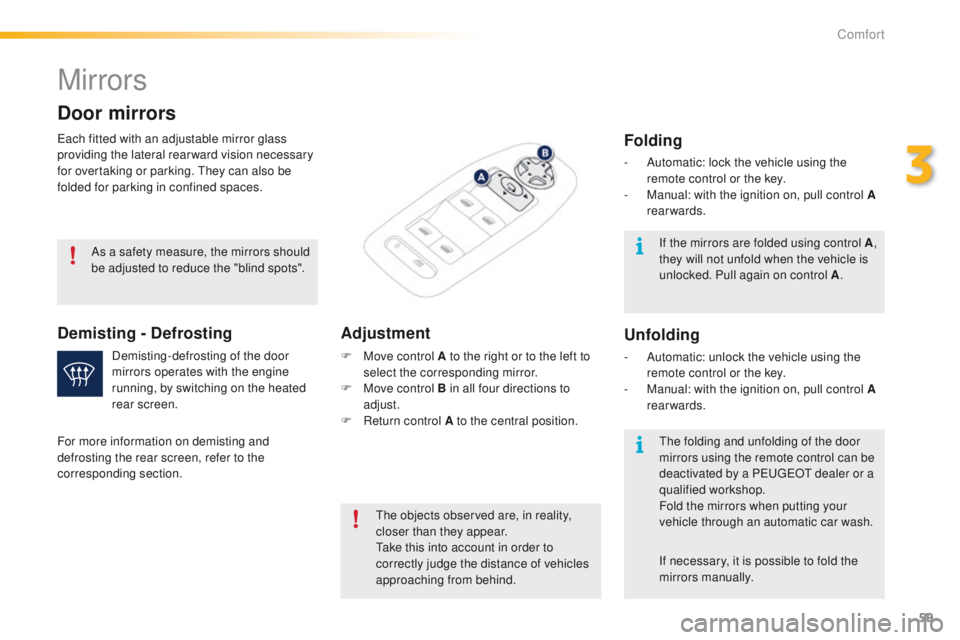
F Move control A to the right or to the left to
select the corresponding mirror.
F
M
ove control B in all four directions to
adjust.
F
R
eturn control A to the central position.
Demisting-defrosting of the door
mirrors operates with the engine
running, by switching on the heated
rear screen.
As a safety measure, the mirrors should
be adjusted to reduce the "blind spots".
For more information on demisting and
defrosting the rear screen, refer to the
corresponding section. If the mirrors are folded using control A
,
they will not unfold when the vehicle is
unlocked. Pull again on control A .
The folding and unfolding of the door
mirrors using the remote control can be
deactivated by a PEUGEOT dealer or a
qualified workshop.
Fold the mirrors when putting your
vehicle through an automatic car wash.
Folding
- Automatic: lock the vehicle using the remote control or the key.
-
M
anual: with the ignition on, pull control A
rearwards.
Unfolding
- Automatic: unlock the vehicle using the remote control or the key.
-
M
anual: with the ignition on, pull control A
rearwards.
If necessary, it is possible to fold the
mirrors manually.
3
Comfort
Page 64 of 340

62
2008_en_Chap03_confort_ed01-2015
In order for these systems to be fully effective, follow the operation and maintenance
guidelines below:
F
T
o obtain an even air distribution, take care not to obstruct the exterior air intake grilles
located at the base of the windscreen, the nozzles, the vents and the air outlets, as well
as the air extractor located in the boot.
F
D
o not cover the sunshine sensor, located on the dashboard; this is used for regulation
of the air conditioning system.
F
O
perate the air conditioning system for at least 5 to 10 minutes, once or twice a month
to keep it in per fect working order.
F
E
nsure that the passenger compartment filter is in good condition and have the filter
elements replaced regularly.
W
e recommend the use of a combined passenger compartment filter. Thanks to its
special active additive, it contributes to the purification of the air breathed by the
occupants and the cleanliness of the passenger compartment (reduction of allergic
symptoms, bad odours and greasy deposits).
F
T
o ensure correct operation of the air conditioning system, you are also advised to have
it checked regularly as recommended in the warranty and maintenance record.
F
I
f the system does not produce cold air, switch it off and contact a PEUGEOT dealer or
a qualified workshop.
When towing the maximum load on a steep gradient in high temperatures, switching off the
air conditioning increases the available engine power and so improves the towing ability.
Recommendations for ventilation and air conditioning
If after an extended stop in sunshine,
the interior temperature is very high, first
ventilate the passenger compartment for
a few moments.
Put the air flow control at a setting high
enough to quickly change the air in the
passenger compartment.
The air conditioning system does not
contain chlorine and does not present
any danger to the ozone layer.
The condensation created by the air
conditioning results in a discharge
of water under the vehicle which is
perfectly normal.
Stop & Start
The heating and air conditioning systems only work when the engine is running. To maintain
a comfortable temperature in the passenger compartment, you can temporarily deactivate
the Stop & Start system (see the corresponding section).
Comfort
Page 69 of 340
67
2008_en_Chap03_confort_ed01-2015
A setting around 21 enables you to obtain an
optimum level of comfort. Depending on your
requirements, a setting between 18 and 24 is usual.
In addition, it is recommended that you avoid a left /
right setting difference of more than 3.
On entering the vehicle, if the interior
temperature is much colder or warmer
than the comfort value, there is no need
to alter the value displayed in order to
obtain the required level of comfort.
The system corrects the temperature
difference automatically and as quickly
as possible.
Automatic visibility
programme
For maximum cooling or heating of
the passenger compartment, you can
exceed the minimum value of 14 or the
maximum value of 28.
F
P
ush the switch 2 or 3 down
until
"LO" is displayed or up
until
"HI" is displayed.
See the "Front demisting-defrosting"
section.
Depending on your requirements, you can
make a different selection from that offered by
the system by changing a setting. The other
functions will still be controlled automatically.
Resuming manual control
The air conditioning is designed to
operate efficiently in all seasons, with
the windows closed.
Air conditioning On/Off
It allows you:
- i n summer, to lower the temperature,
-
i
n winter, above 3 °C, to improve demisting.
Switching on
F
P
ress the " A/C" button, the associated
indicator lamp comes on.
The air conditioning cannot operate when the
air flow is set to off.
Switching off
F
P
ress the "A /C " button again; the
associated indicator lamp goes off.
Switching off may cause some problems
(humidity, misting).
When you modify a setting, the indicator
lamp in the "AUTO"
button goes off.
F
P
ress the "AUTO" button again
to return to the automatic comfort
programme.
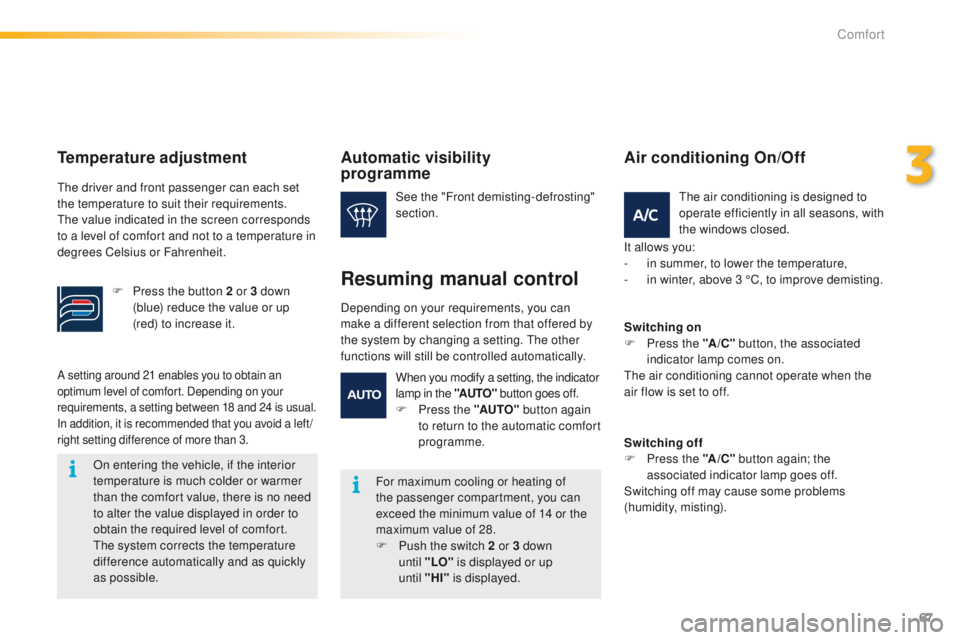
Temperature adjustment
The driver and front passenger can each set
the temperature to suit their requirements.
The value indicated in the screen corresponds
to a level of comfort and not to a temperature in
degrees Celsius or Fahrenheit.
F
P
ress the button 2 or 3 down
(blue) reduce the value or up
(red) to increase it.
3
Comfort
Page 77 of 340
75
2008_en_Chap04_amenagements_ed01-2015
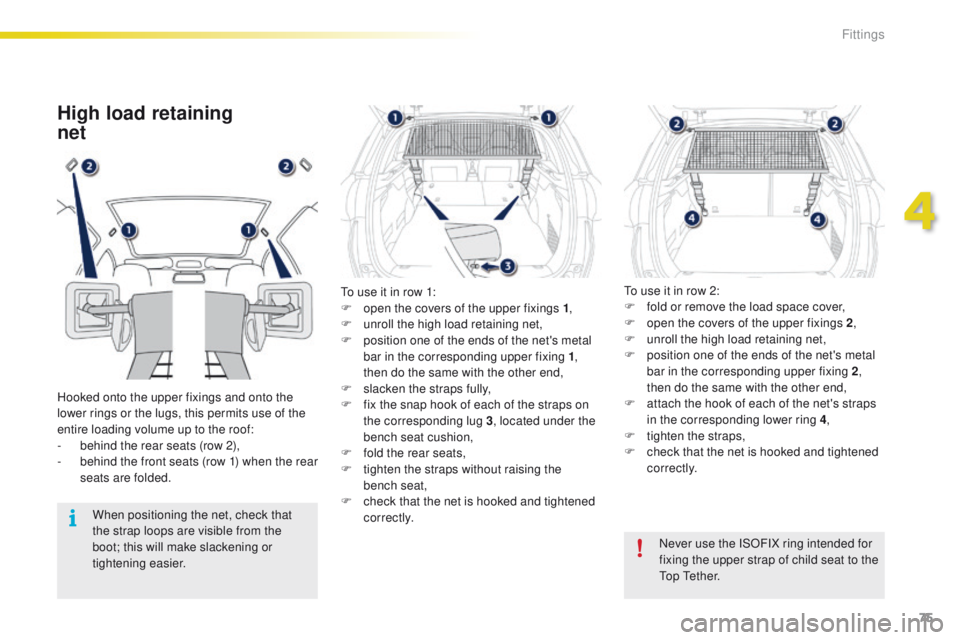
High load retaining
net
Hooked onto the upper fixings and onto the
lower rings or the lugs, this permits use of the
entire loading volume up to the roof:
-
b
ehind the rear seats (row 2),
-
b
ehind the front seats (row 1) when the rear
seats are folded.
When positioning the net, check that
the strap loops are visible from the
boot; this will make slackening or
tightening easier. Never use the ISOFIX ring intended for
fixing the upper strap of child seat to the
Top Tether.
To use it in row 1:
F
o
pen the covers of the upper fixings 1
,
F
u
nroll the high load retaining net,
F
p
osition one of the ends of the net's metal
bar in the corresponding upper fixing 1 ,
then do the same with the other end,
F s lacken the straps fully,
F f ix the snap hook of each of the straps on
the corresponding lug 3 , located under the
bench seat cushion,
F
f
old the rear seats,
F
t
ighten the straps without raising the
bench
seat,
F
c
heck that the net is hooked and tightened
c o r r e c t l y. To use it in row 2:
F
f
old or remove the load space cover,
F
o
pen the covers of the upper fixings 2
,
F
u
nroll the high load retaining net,
F
p
osition one of the ends of the net's metal
bar in the corresponding upper fixing 2 ,
then do the same with the other end,
F a ttach the hook of each of the net's straps
in the corresponding lower ring 4 ,
F
t
ighten the straps,
F
c
heck that the net is hooked and tightened
c o r r e c t l y.
4
Fittings
Page 92 of 340
90
2008_en_Chap05_conduite_ed01-2015
Four-speed automatic gearbox which offers a
choice between the comfort of fully automatic
operation, enhanced by sport and snow
programmes, or manual gear changing.
There are therefore four driving modes:
-
a
utomatic operation for electronic
management of the gears by the gearbox,
-
sp
ort programme for a more dynamic style
of driving,
-
s
now programme to improve driving when
traction is poor,
-
s
equential operation for manual changing
of the gears by the driver.
Automatic gearbox
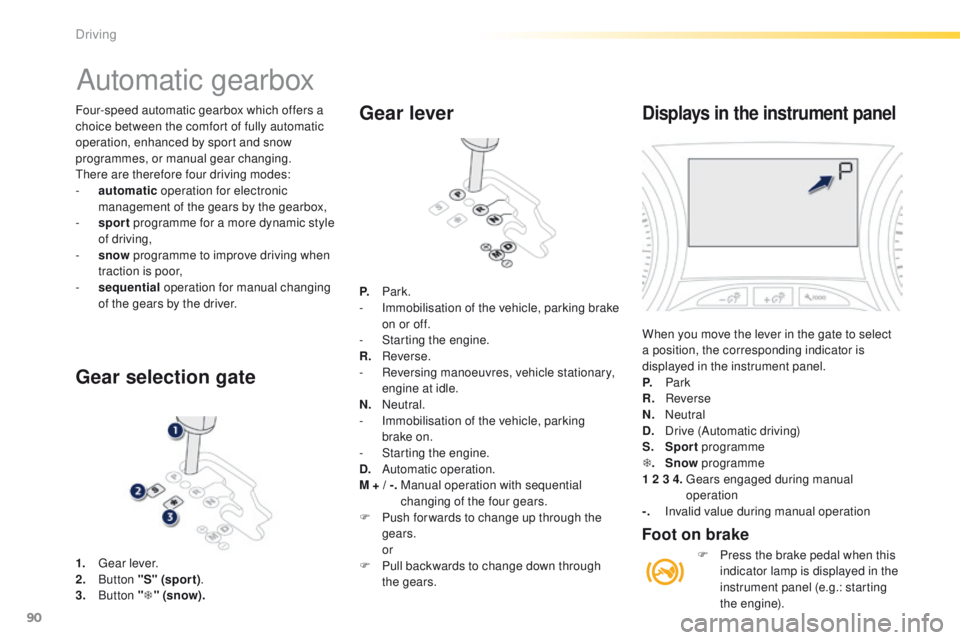
1. Gear lever.
2. B utton "S" (spor t) .
3.
Button "T " (snow).
Gear selection gate Gear lever
P.
Park.
- I mmobilisation of the vehicle, parking brake
on or off.
-
S
tarting the engine.
R.
R
everse.
-
R
eversing manoeuvres, vehicle stationary,
engine at idle.
N.
N
eutral.
-
I
mmobilisation of the vehicle, parking
brake on.
-
S
tarting the engine.
D.
A
utomatic operation.
M + / -.
M
anual operation with sequential
changing of the four gears.
F
P
ush for wards to change up through the
gears.
or
F
P
ull backwards to change down through
the gears.
Displays in the instrument panel
When you move the lever in the gate to select
a position, the corresponding indicator is
displayed in the instrument panel.
P.
Park
R.
Reverse
N.
N
eutral
D.
D
rive (Automatic driving)
S.
Sport programme
T .
Snow programme
1 2 3 4.
G
ears engaged during manual
operation
-.
I
nvalid value during manual operation
Foot on brake
F Press the brake pedal when this indicator lamp is displayed in the
instrument panel (e.g.: starting
the engine).
Driving