Page 79 of 340
77
2008_en_Chap04_amenagements_ed01-2015
Warning triangle (stowing)
Before leaving your vehicle to set up
and install the triangle, switch on the
hazard warning lamps and put on your
high visibility vest.
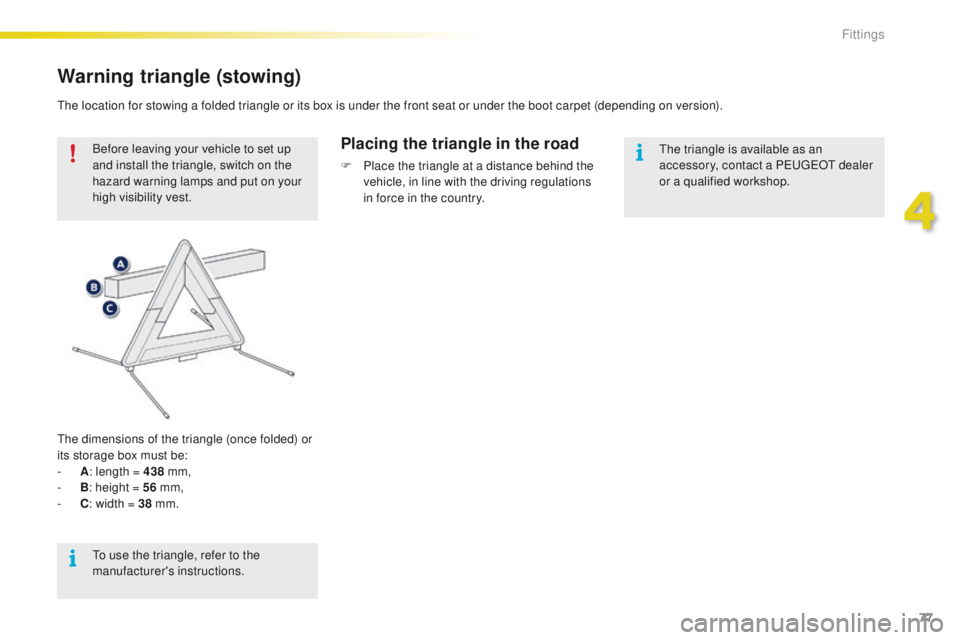
The dimensions of the triangle (once folded) or
its storage box must be:
-
A : l
ength = 438 mm,
-
B : h
eight = 56 mm,
-
C : w
idth = 38 mm.Placing the triangle in the road
F Place the triangle at a distance behind the
vehicle, in line with the driving regulations
in force in the country.
The location for stowing a folded triangle or its box is under the front seat or under the boot carpet (depending on version).
The triangle is available as an
accessory, contact a PEUGEOT dealer
or a qualified workshop.
To use the triangle, refer to the
manufacturer's instructions.
4
Fittings
Page 123 of 340
121
2008_en_Chap06_visibilite_ed01-2015
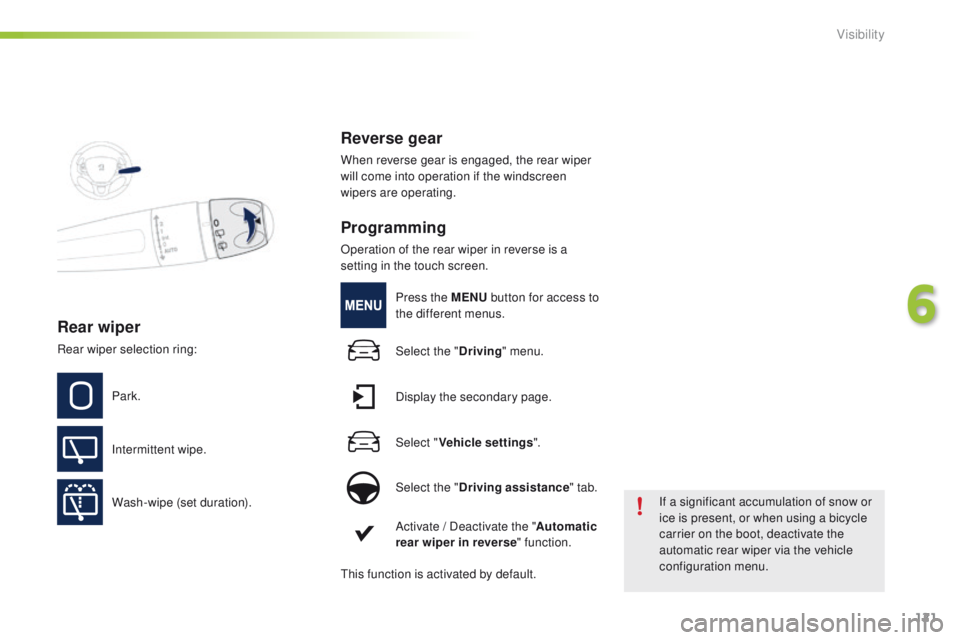
Rear wiper
Park.
Intermittent wipe.
Wash-wipe (set duration).
Reverse gear
When reverse gear is engaged, the rear wiper
will come into operation if the windscreen
wipers are operating.
Programming
Operation of the rear wiper in reverse is a
setting in the touch screen.If a significant accumulation of snow or
ice is present, or when using a bicycle
carrier on the boot, deactivate the
automatic rear wiper via the vehicle
configuration menu.
Rear wiper selection ring:
Press the MENU
button for access to
the different menus.
Select the " Driving" menu.
Display the secondary page.
Select " Vehicle settings ".
Select the " Driving assistance " tab.
Activate / Deactivate the " Automatic
rear wiper in reverse " function.
This function is activated by default.
6
Visibility
Page 166 of 340
164
2008_en_Chap09_info-pratiques_ed01-2015
AdBlue® additive and SCR system
for BlueHDi Diesel engines
To assure respect for the environment and
conformity with the new Euro 6 emissions
standard, without adversely affecting the
per formance or fuel consumption of Diesel
engines, PEUGEOT has taken the decision to
equip its vehicles with an effective system that
associates SCR (Selective Catalytic Reduction)
with a particle filter (FAP) for the treatment of
exhaust gases.
Presentation of the SCR system
Using an additive called AdBlue® containing
urea, a catalytic converter turns up to 85%
of nitrous oxides (NOx) into nitrogen and
water, which are harmless to health and the
environment. The AdBlue
® additive is held in a special
tank located under the boot at the rear of
the vehicle. It has a capacity of 17 litres: this
provides a driving range of about 12 500 miles
(20 000 km), after which an alert is triggered
warning you when the reserve remaining is
enough for just 1 500 miles (2 400 km).
During each scheduled service of your vehicle
by a PEUGEOT dealer or a qualified workshop,
the AdBlue
® additive tank is refilled in order to
allow normal operation of the SCR system.
If the estimated mileage between two services
is greater than 12 500 miles (20 000 km), we
recommend that you go to a PEUGEOT dealer
or a qualified workshop to have the necessary
top-up carried out. Once the AdBlue
® tank is empty, a
s
ystem required by regulations prevents
starting of the engine.
If the SCR is faulty, the level of
emissions from your vehicle will no
longer meet the Euro 6 standard: you
vehicle becomes polluting.
In the event of a confirmed fault
with the SCR system, you must go
to a PEUGEOT dealer or a qualified
workshop as soon as possible: after
a running distance of 650 miles
(1
100 km), a system will be triggered
automatically to prevent engine starting.
Practical information
Page 172 of 340
170
2008_en_Chap09_info-pratiques_ed01-2015
Never store bottles of AdBlue® in your
vehicle.
Recommendations on storage
AdBlue® freezes at about -11°C and
deteriorates above 25°C. It is recommended
that bottles be stored in a cool area and
protected from direct sunlight.
Under these conditions, the additive can be
kept for at least a year.
If the additive has frozen, it can be used once it
has completely thawed out.
Procedure
Before topping-up, ensure that the vehicle is
parked on a flat and level sur face.
In wintry conditions, ensure that the
temperature of the vehicle is above -11°C.
Otherwise, by freezing, the AdBlue
® cannot
be poured into its tank. Park your vehicle in a
warmer area for a few hours to allow the top-up
to be carried out.
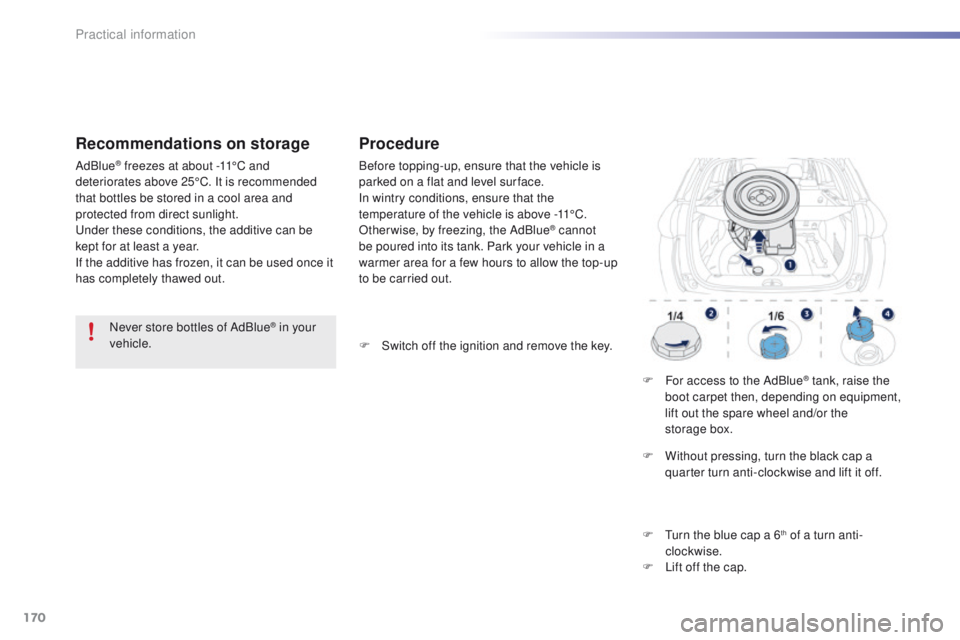
F
F
or access to the AdBlue
® tank, raise the
boot carpet then, depending on equipment,
lift out the spare wheel and/or the
storage
box.
F
S
witch off the ignition and remove the key.
F
W
ithout pressing, turn the black cap a
quarter turn anti-clockwise and lift it off.
F
T
urn the blue cap a 6
th of a turn anti-
clockwise.
F
L
ift off the cap.
Practical information
Page 173 of 340
171
2008_en_Chap09_info-pratiques_ed01-2015
Important: if your vehicle's AdBlue®
tank is completely empty - which is
confirmed by the alert messages and
the impossibility of starting the engine,
you must add at least 3.8 litres
(so two 1.89 litre bottles). If any additive is split or splashed, wash
immediately with cold water or wipe with
a damp cloth.
If the additive has crystallised, clean it
off using a sponge and hot water.
Important:
in the event of a top-up
after a breakdown because of a lack
of additive , signalled by the message
"Top up emissions additive: Starting
prevented", you must wait around
5 minutes before switching on the ignition,
without opening the driver's door,
locking the vehicle or introducing the
key into the ignition switch .
Switch on the ignition, then, after
10
seconds, start the engine.
Never dispose of AdBlue® additive
bottles in the household waste. Place
them in a special container provided
this purpose or take them to your
dealer.
F
O
btain a bottle of AdBlue
®. After first
checking the use-by date, read carefully
the instructions on use on the label before
pouring the contents of the bottle into your
vehicle's AdBlue
® tank. F
A
fter emptying the bottle, wipe away any
spillage around the tank filler using a damp
cloth.
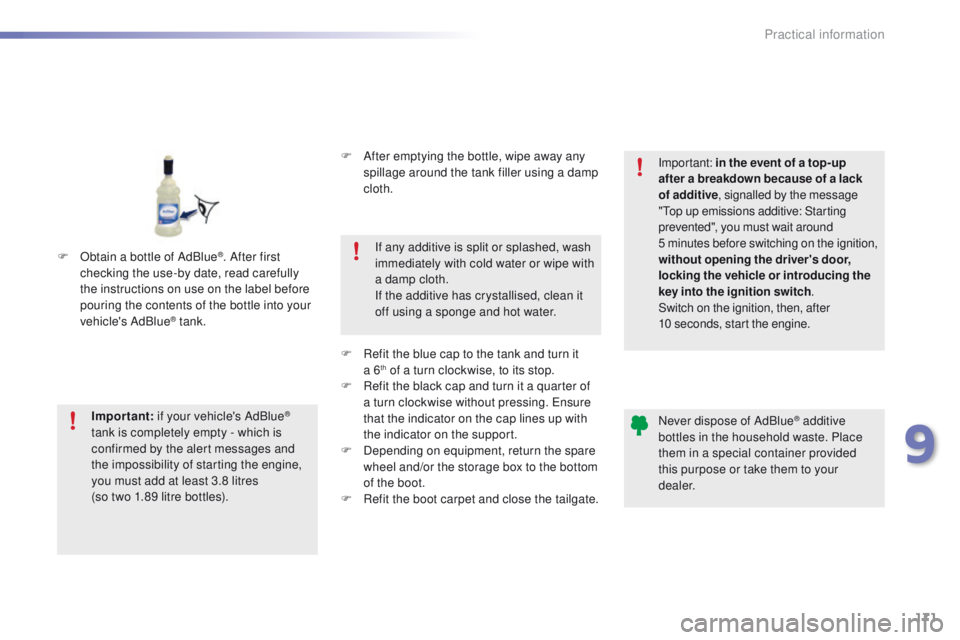
F
R
efit the blue cap to the tank and turn it
a 6
th of a turn clockwise, to its stop.
F
R
efit the black cap and turn it a quarter of
a turn clockwise without pressing. Ensure
that the indicator on the cap lines up with
the indicator on the support.
F
D
epending on equipment, return the spare
wheel and/or the storage box to the bottom
of the boot.
F
R
efit the boot carpet and close the tailgate.
9
Practical information
Page 174 of 340
172
2008_en_Chap09_info-pratiques_ed01-2015
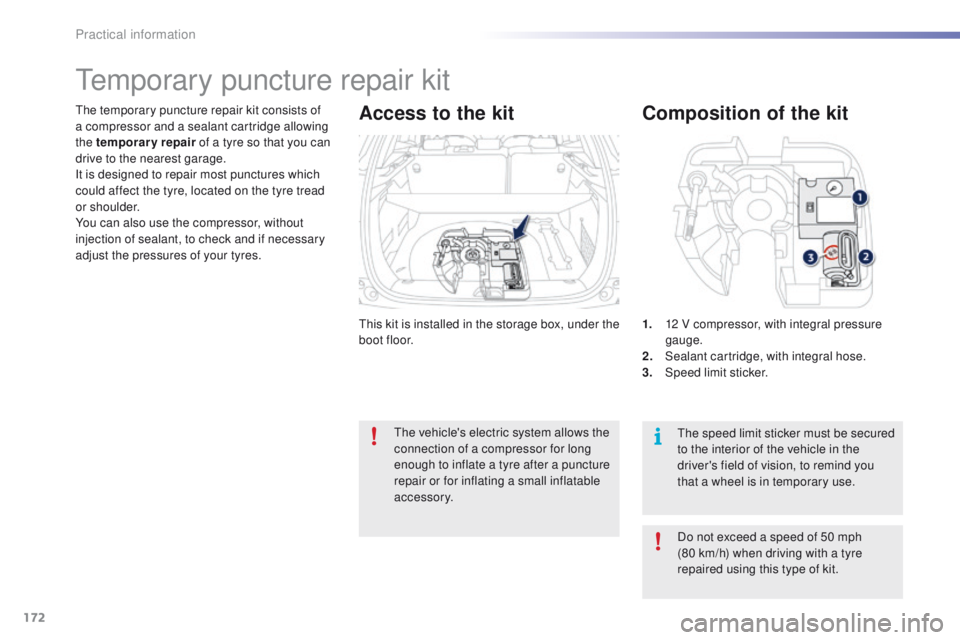
This kit is installed in the storage box, under the
boot floor.
The temporary puncture repair kit consists of
a compressor and a sealant cartridge allowing
the temporary repair
of a tyre so that you can
drive to the nearest garage.
It is designed to repair most punctures which
could affect the tyre, located on the tyre tread
or shoulder.
You can also use the compressor, without
injection of sealant, to check and if necessary
adjust the pressures of your tyres.
Temporary puncture repair kit
Access to the kit
Do not exceed a speed of 50 mph
(80 km/h) when driving with a tyre
repaired using this type of kit.
The vehicle's electric system allows the
connection of a compressor for long
enough to inflate a tyre after a puncture
repair or for inflating a small inflatable
accessory.
The speed limit sticker must be secured
to the interior of the vehicle in the
driver's field of vision, to remind you
that a wheel is in temporary use.
Composition of the kit
1. 12 V compressor, with integral pressure
gauge.
2.
S
ealant cartridge, with integral hose.
3.
Spe
ed limit sticker.
Practical information
Page 179 of 340
177
2008_en_Chap09_info-pratiques_ed01-2015
Changing a wheel
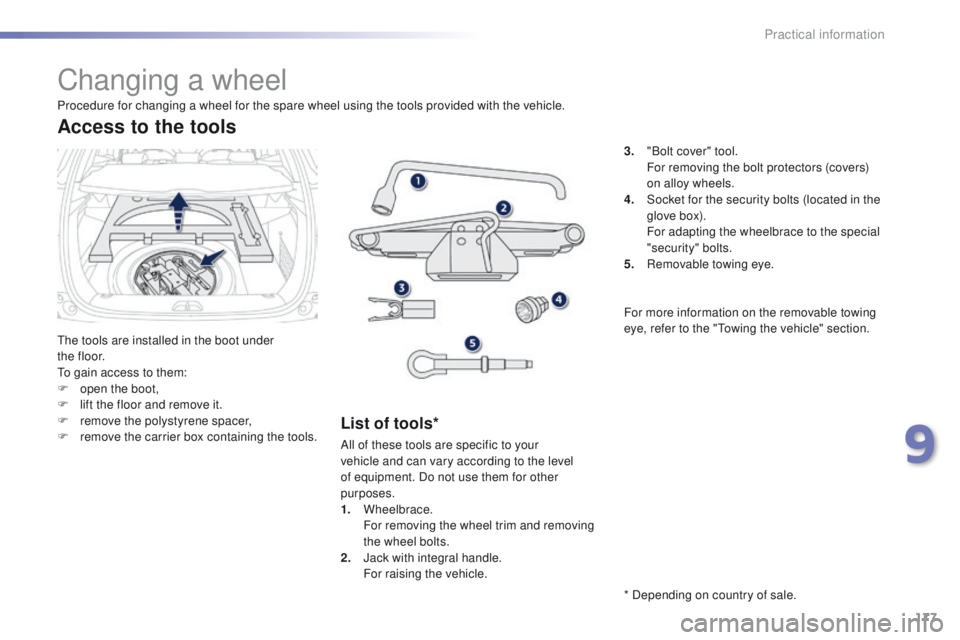
The tools are installed in the boot under
t h e f l o o r.
To gain access to them:
F
o
pen the boot,
F
l
ift the floor and remove it.
F
r
emove the polystyrene spacer,
F
r
emove the carrier box containing the tools.
Access to the tools
List of tools*
3. "Bolt cover" tool. F or removing the bolt protectors (covers)
on alloy wheels.
4.
S
ocket for the security bolts (located in the
glove box).
F
or adapting the wheelbrace to the special
"security" bolts.
5.
R
emovable towing eye.
Procedure for changing a wheel for the spare wheel using the tools provided with the vehicle.
All of these tools are specific to your
vehicle and can vary according to the level
of equipment. Do not use them for other
purposes.
1.
Wheelbrace.
F
or removing the wheel trim and removing
the wheel bolts.
2.
J
ack with integral handle.
F
or raising the vehicle. * Depending on country of sale. For more information on the removable towing
eye, refer to the "Towing the vehicle" section.
9
Practical information
Page 180 of 340
178
2008_en_Chap09_info-pratiques_ed01-2015
Wheel with trim
When refitting the wheel, refit the trim
starting by placing its notch facing the
valve and press around its edge with
the palm of your hand.
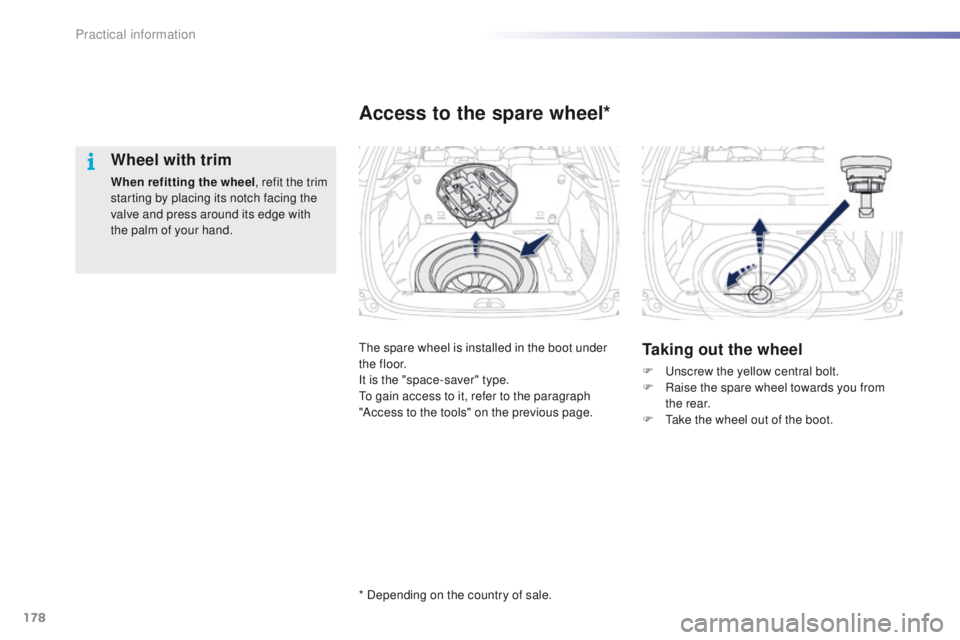
The spare wheel is installed in the boot under
t h e f l o o r.
It is the "space-saver" type.
To gain access to it, refer to the paragraph
"Access to the tools" on the previous page.
Access to the spare wheel*
Taking out the wheel
F Unscrew the yellow central bolt.
F R aise the spare wheel towards you from
the rear.
F
T
ake the wheel out of the boot.
* Depending on the country of sale.
Practical information