2015 MERCEDES-BENZ GLK-CLASS SUV width
[x] Cancel search: widthPage 335 of 386

signs of damage, have the tires and wheelschecked at a qualified specialist workshop.
R When parking your vehicle, make sure that
the tires do not get deformed by the curb or other obstacles. If it is necessary to drive
over curbs, speed humps or similar eleva-
tions, try to do so slowly and at an obtuse
angle. Otherwise, the tires, particularly the
sidewalls, may be damaged.
Regular checking of wheels and tires
GWARNING
Damaged tires can cause tire inflation pres-
sure loss. As a result, you could lose control ofyour vehicle. There is a risk of accident.
Check the tires regularly for signs of damage
and replace any damaged tires immediately.
R Regularly check the wheels and tires of
your vehicle for damage at least once a
month, as well as after driving off-road or
on rough roads. Damaged wheels can
cause a loss of tire pressure. Pay particular
attention to damage such as:
- cuts in the tires
- punctures
- tears in the tires
- bulges on tires
- deformation or severe corrosion on
wheels
R Regularly check the tire tread depth and
the condition of the tread across the whole
width of the tire ( Y page 333). If necessary,
turn the front wheels to full lock in order to inspect the inner side of the tire surface.
R All wheels must have a valve cap to protect
the valve against dirt and moisture. Do notmount anything onto the valve other than
the standard valve cap or other valve caps
approved by Mercedes-Benz for your vehi-
cle. Do not use any other valve caps or sys- tems, e.g. tire pressure monitoring sys-
tems.
R Regularly check the pressure of all the tires
particularly prior to long trips. Adjust the
tire pressure as necessary ( Y page 336).
Observe the notes on the emergency spare
wheel ( Y page 366).
The service life of tires depends, among other things, on the following factors:
R Driving style
R Tire pressure
R Distance covered
Notes on tire tread
GWARNING
Insufficient tire tread will reduce tire traction.
The tire is no longer able to dissipate water.
This means that on wet road surfaces, the risk
of hydroplaning increases, in particular where speed is not adapted to suit the driving con-
ditions. There is a risk of accident.
If the tire pressure is too high or too low, tires
may exhibit different levels of wear at differ-
ent locations on the tire tread. Thus, you
should regularly check the tread depth and
the condition of the tread across the entire
width of all tires.
Minimum tire tread depth for:
R Summer tires: â in (3 mm)
R M+S tires: ã in (4 mm)
For safety reasons, replace the tires before
the legally prescribed limit for the minimum
tire tread depth is reached.
Operation333
Wheels and tires
Z
Page 349 of 386
Uniform Tire Quality Grading Stand-
ards
Overview of Tire Quality Grading
Standards
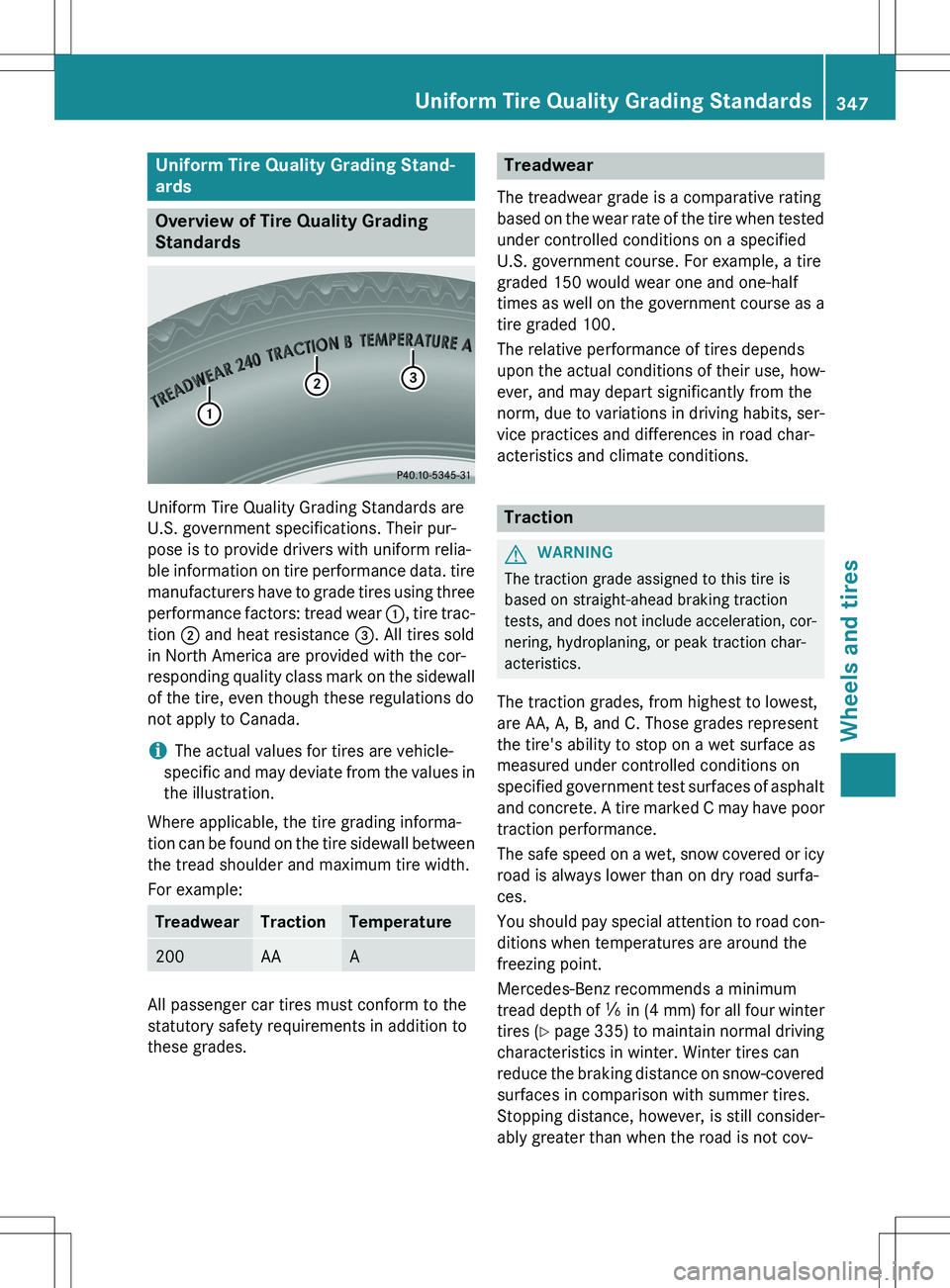
Uniform Tire Quality Grading Standards are
U.S. government specifications. Their pur-
pose is to provide drivers with uniform relia-
ble information on tire performance data. tiremanufacturers have to grade tires using three
performance factors: tread wear :, tire trac-
tion ; and heat resistance =. All tires sold
in North America are provided with the cor-
responding quality class mark on the sidewall of the tire, even though these regulations do
not apply to Canada.
iThe actual values for tires are vehicle-
specific and may deviate from the values in
the illustration.
Where applicable, the tire grading informa-
tion can be found on the tire sidewall between
the tread shoulder and maximum tire width.
For example:
TreadwearTractionTemperature
200AAA
All passenger car tires must conform to the
statutory safety requirements in addition to
these grades.
Treadwear
The treadwear grade is a comparative rating
based on the wear rate of the tire when tested under controlled conditions on a specified
U.S. government course. For example, a tire
graded 150 would wear one and one-half
times as well on the government course as a tire graded 100.
The relative performance of tires depends
upon the actual conditions of their use, how-
ever, and may depart significantly from the
norm, due to variations in driving habits, ser-
vice practices and differences in road char-
acteristics and climate conditions.
Traction
GWARNING
The traction grade assigned to this tire is
based on straight-ahead braking traction
tests, and does not include acceleration, cor- nering, hydroplaning, or peak traction char-
acteristics.
The traction grades, from highest to lowest,
are AA, A, B, and C. Those grades represent
the tire's ability to stop on a wet surface as
measured under controlled conditions on
specified government test surfaces of asphalt
and concrete. A tire marked C may have poor
traction performance.
The safe speed on a wet, snow covered or icy road is always lower than on dry road surfa-
ces.
You should pay special attention to road con-
ditions when temperatures are around the
freezing point.
Mercedes-Benz recommends a minimum
tread depth of ã in (4 mm) for all four winter
tires ( Y page 335) to maintain normal driving
characteristics in winter. Winter tires can
reduce the braking distance on snow-covered surfaces in comparison with summer tires.
Stopping distance, however, is still consider-
ably greater than when the road is not cov-
Uniform Tire Quality Grading Standards347
Wheels and tires
Z
Page 351 of 386
Tire size designation, load-bearing
capacity and speed rating
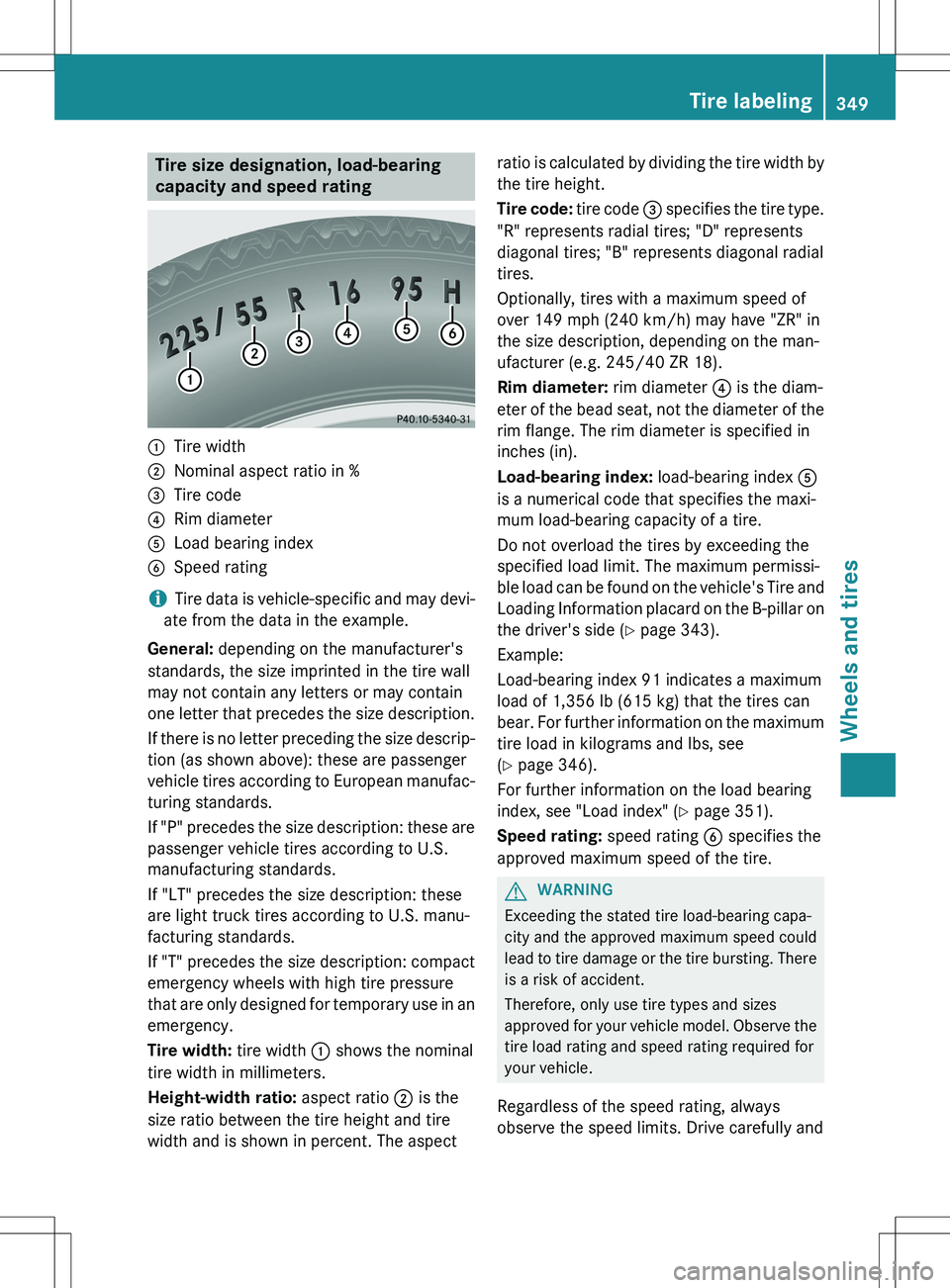
:Tire width
;Nominal aspect ratio in %
=Tire code
?Rim diameter
ALoad bearing index
BSpeed rating
iTire data is vehicle-specific and may devi-
ate from the data in the example.
General: depending on the manufacturer's
standards, the size imprinted in the tire wall
may not contain any letters or may contain
one letter that precedes the size description.
If there is no letter preceding the size descrip-
tion (as shown above): these are passenger
vehicle tires according to European manufac-
turing standards.
If "P" precedes the size description: these are passenger vehicle tires according to U.S.
manufacturing standards.
If "LT" precedes the size description: these
are light truck tires according to U.S. manu-
facturing standards.
If "T" precedes the size description: compact
emergency wheels with high tire pressure
that are only designed for temporary use in an
emergency.
Tire width: tire width : shows the nominal
tire width in millimeters.
Height-width ratio: aspect ratio ; is the
size ratio between the tire height and tire
width and is shown in percent. The aspect ratio is calculated by dividing the tire width by
the tire height.
Tire code: tire code = specifies the tire type.
"R" represents radial tires; "D" represents
diagonal tires; "B" represents diagonal radial
tires.
Optionally, tires with a maximum speed of
over 149 mph (240 km/h) may have "ZR" in
the size description, depending on the man-
ufacturer (e.g. 245/40 ZR 18).
Rim diameter: rim diameter ? is the diam-
eter of the bead seat, not the diameter of the
rim flange. The rim diameter is specified in
inches (in).
Load-bearing index: load-bearing index A
is a numerical code that specifies the maxi-
mum load-bearing capacity of a tire.
Do not overload the tires by exceeding the
specified load limit. The maximum permissi-
ble load can be found on the vehicle's Tire and Loading Information placard on the B-pillar on the driver's side ( Y page 343).
Example:
Load-bearing index 91 indicates a maximum
load of 1,356 lb (615 kg) that the tires can
bear. For further information on the maximum tire load in kilograms and lbs, see
( Y page 346).
For further information on the load bearing
index, see "Load index" ( Y page 351).
Speed rating: speed rating B specifies the
approved maximum speed of the tire.
GWARNING
Exceeding the stated tire load-bearing capa-
city and the approved maximum speed could
lead to tire damage or the tire bursting. There is a risk of accident.
Therefore, only use tire types and sizes
approved for your vehicle model. Observe the
tire load rating and speed rating required for
your vehicle.
Regardless of the speed rating, always
observe the speed limits. Drive carefully and
Tire labeling349
Wheels and tires
Z
Page 356 of 386
Maximum load on one tire
Maximum load on one tire. This is calculated
by dividing the maximum axle load of one axleby two.
PSI (pounds per square inch)
A standard unit of measure for tire pressure.
Aspect ratio
Relationship between tire height and tire
width in percent.
Tire pressure
This is pressure inside the tire applying an
outward force to each square inch of the tire's surface. The tire pressure is specified in
pounds per square inch (psi), in kilopascal
(kPa) or in bar. The tire pressure should only
be corrected when the tires are cold.
Tire pressure of cold tires
The tires are cold:
R if the vehicle has been parked without
direct sunlight on the tires for at least three
hours and
R if the vehicle has not been driven further
than 1 mile (1.6 km)
Tread
The part of the tire that comes into contact
with the road.
Bead
The tire bead ensures that the tire sits
securely on the wheel. There are several steel
wires in the bead to prevent the tire from
coming loose from the wheel rim.
Sidewall
The part of the tire between the tread and the
bead.
Weight of optional extras
The combined weight of those optional extras that weigh more than the replaced standard
parts and more than 2.3 kg (5 lbs). These
optional extras, such as high-performance
brakes, level control, a roof rack or a high-
performance battery, are not included in the
curb weight and the weight of the accesso-
ries.
TIN (Tire Identification Number)
This is a unique identifier which can be used
by a tire manufacturer to identify tires, for
example for a product recall, and thus identifythe purchasers. The TIN is made up of the
manufacturer's identity code, tire size, tire
type code and the manufacturing date.
Load bearing index
The load bearing index (also load index) is a
code that contains the maximum load bearing
capacity of a tire.
Traction
Traction is the result of friction between the
tires and the road surface.
TWR (Tongue Weight Rating)
The TWR specifies the maximum permissible
weight that the ball coupling of the trailer tow
hitch can support.
354Definition of terms for tires and loading
Wheels and tires
Page 382 of 386

Refrigerant instruction label
Example: refrigerant instruction label :
Warning symbol
;Refrigerant filling capacity
=Applicable standards
?PAG oil part number
AType of refrigerant
Warning symbol : advises you about:
R possible dangers
R having service work carried out at a quali-
fied specialist workshop
Filling capacities
All modelsCapacity
Refrigerant20.8 ± 0.4 oz
(590 ± 10 g)
PAG oil4.2 oz
(120 g)
Vehicle data
General notes
Please note that for the specified vehicle
data:
R the heights specified may vary as a result
of:
- tires
- load
- condition of the suspension
- optional equipment
R optional equipment reduces the maximum
payload.
Dimensions and weights
Model:
Opening
height
;
Max.
headroom
GLK 250 Blue-
TEC 4MATIC82.2 in
(2087 mm)77.0 in
(1955 mm)
All other mod-
els82.1 in
(2086 mm)76.9 in
(1954 mm)
All models
Vehicle length178.6 in (4536 mm)
Vehicle width
including exterior
mirrors79.4 in (2016 mm)
Wheelbase108.5 in (2755 mm)
380Vehicle data
Technical data