2015 MERCEDES-BENZ E-CLASS SALOON warning light
[x] Cancel search: warning lightPage 338 of 497

Problem
Possible causes/consequences and
M
MSolutions ֌
The yellow ESP
®
and
ESP ®
OFF warning
lamps are lit while the
engine is running. ESP
®
,B AS ,BAS PLUS with Cross-Traffic Assist ,COLLISION PRE-
VENTION ASSIST PLUS, PRE-SAFE ®
,P RE-SAFE ®
PLUS,
PRE‑SA FE®
Brake, the HOLD function, hill start assist, ESP ®
trailer
stabilisation and the adaptive brake lights are unavailabl edue to a
malfunction.
ATTENTION ASSIST is deactivated.
G WARNING
The brake system continues to function normally, but without the functions listed above.
The braking distanc emay thus increase in an emergenc ybraking
situation.
If ESP ®
is not operational, ESP ®
is unable to stabilise the vehicle.
There is an increased danger of skidding and risk of an accident.
X Observe the additional display messages in the multifunction
display.
X Drive on carefully.
X Consult aqualified specialist workshop. 6
The red restraint sys-
tem warning lamp is lit
while the engine is run-
ning.
The restraint system is faulty.
G WARNING
The airbags or belt tensioners may either be triggered uninten-
tionally or, in the event of an accident ,may not be triggered.
This poses an increased risk of injury.
X Observe the additional display messages in the multifunction
display.
X Drive on carefully.
X Have the restraint system checked immediately at aqualified
specialist workshop.
Observe the additional information on the restraint system
(Y page 44). Warning and indicator lampsint
he instrument cluster
335On-board computer and displays Z
Page 339 of 497

Engine
Problem
Possible causes/consequences and
M
MSolutions ;
The yellow engin
ediag-
nostics warning lamp
light supw hile the
engin eisrunning. Ther
emay be afault ,for example:
R in th eenginem anagement
R in th efuel injection system
R in th eexhaust system
R in th eignition system (for vehicle swith petrol engines)
R in th efuel system
The emission limit values may be exceeded and th eenginem ay be
runnin ginemergency mode.
X Hav ethe vehicle checked as soon as possible at aqualified
specialist workshop. Vehicle
swithadiese leng ine: th efuel tan khas been run dry
(Y page 204).
X Afte rrefuellin gstart th eenginet hree to four times.
If th eyellow engin ediagnostics warning lamp goes out ,emer-
gency runnin gmode is cancelled. The vehicle need no tbe
checked. 8
The yellow reserv
efuel
warning lamp is on
while th eengineisr un-
ning. The fuel leve
lhas dropped int othe reserv erange.
Operatio noftheauxiliar yheating is deactivate difthefuel level
drops int othe reserv erange.
X Refuel at th eneares tfillin gstation. ?
The red coolant warn-
ing lamp light
supwhile
th ee ngineisr unning
and th ecoolant tem-
perature gauge is at the start of th escale. The temperatur
esensor for th ecoolant temperatur egauge is
faulty.
The coolant temperatur eisnolonger bein gmonitored. Ther eisa
risk of engin edamage if th ecoolant temperatur eistoohigh.
X Stop th evehicle immediately, paying attentio ntoroad and traf-
fic conditions, and switch off th eengine. Do no tcontinue driving
unde rany circumstances.
X Safeguard th evehicle against rolling away (Y page 205).
X Consult aqualifie dspecialist workshop. 336
Warning and indicator lamps in th
einstrumen tclusterOn-boar dcomputer and displays
Page 341 of 497

Problem
Possible causes/consequences and
M
MSolutions X
Leave the vehicle and keep asafe distance from the vehicle until
the engine has cooled down.
X Check the coolant level and top up the coolant, observing the
warning notes (Y page 382).
X If you have to top up the coolant frequently, have the engine
cooling system checked.
X Make sure that the air supply to the engine radiator is not
blocked, e.g. by frozen slush.
X If the coolant temperature is below 120 †, you can continue
driving to the nearest qualified specialist workshop.
X Avoid putting the engine under heavy load as you do so, e.g.
driving in mountainous terrain and stop-start traffic. Driving systems
Problem
Possible causes/consequences and
M MSolutions ·
The red distance warn-
ing lamp lights up while
the vehicle is in motion. The distance to the vehicle in front is too small for the speed
selected.
X Increase the distance. ·
The red distance warn-
ing lamp lights up while
the vehicle is in motion. Aw arning tone also
sounds. You are approaching
avehicle, apedestrian or astationary obsta-
cle in your line of travel at too high aspeed.
X Be prepared to brake immediately.
X Pay careful attention to the traffic situation. You may have to
brake or take evasive action.
Observe the additional information on PRE‑ SAFE®
Brake
(Y page 87).
Observe the additional information on the distance warning func-
tion of COLLISION PREVENTION ASSIST PLUS (Y page 80).338
Warning and indicator lampsint
he instrument clusterOn-board computer and displays
Page 351 of 497
X
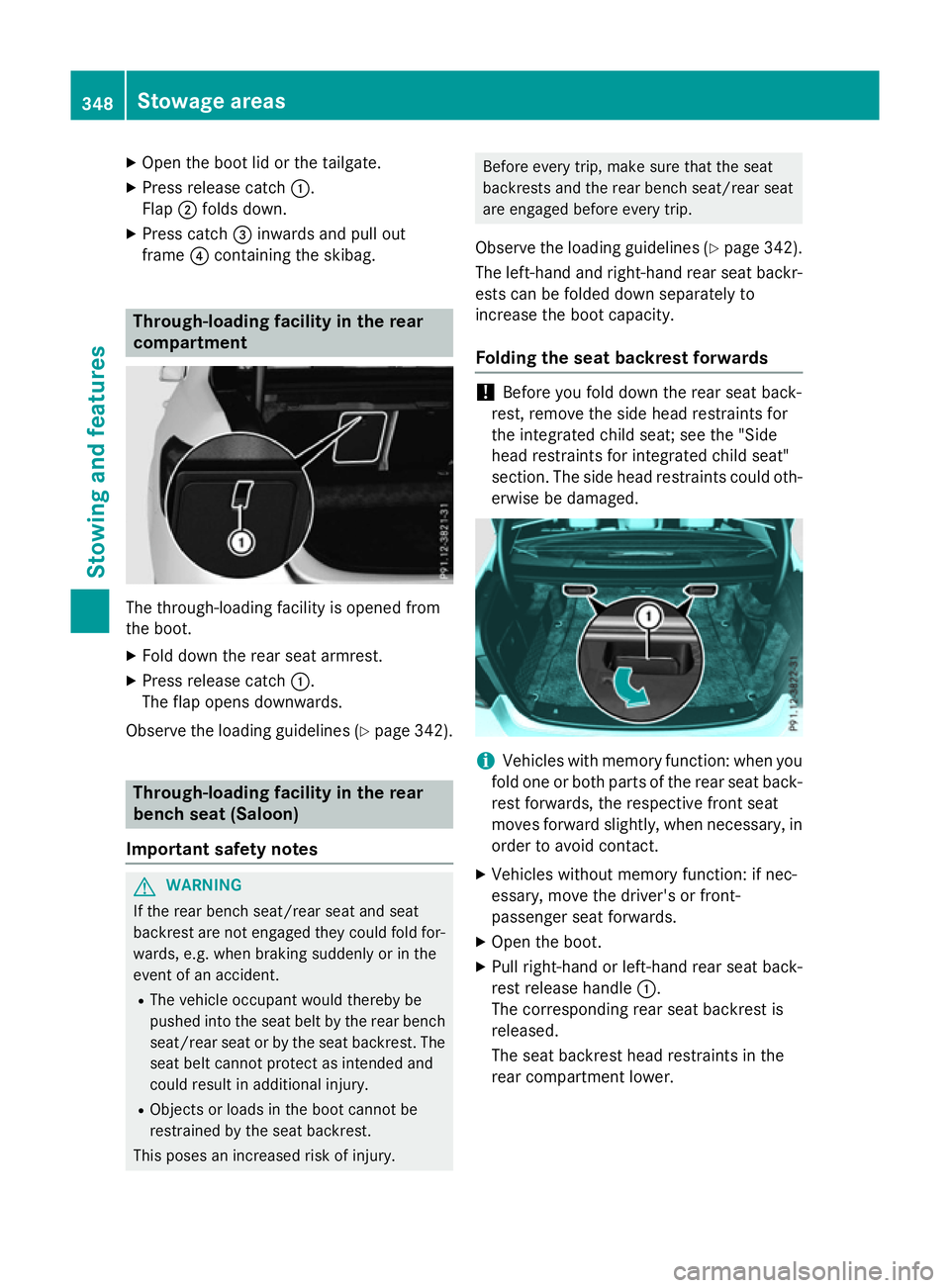
Open the boot lid or the tailgate.
X Press release catch :.
Flap ;folds down.
X Press catch =inwards and pull out
frame ?containing the skibag. Through-loading facility in the rear
compartment The through-loading facility is opened from
the boot.
X Fold down the rear seat armrest.
X Press release catch :.
The flap opens downwards.
Observe the loading guidelines (Y page 342).Through-loading facility in the rear
benchs eat (Saloon)
Important safety notes G
WARNING
If the rear bench seat/rear seat and seat
backrest are not engaged they could fold for- wards, e.g. when braking suddenly or in the
event of an accident.
R The vehicle occupant wouldt hereby be
pushed into the seat belt by the rear bench
seat/rear seat or by the seat backrest. The
seat belt cannot protect as intended and
could result in additional injury.
R Objects or loads in the boot cannot be
restrained by the seat backrest.
This poses an increased risk of injury. Before every trip, make sure that the seat
backrests and the rear bench seat/rear seat
are engaged before every trip.
Observe the loading guidelines (Y page 342).
The left-hand and right-hand rear seat backr- ests can be folded down separately to
increase the boot capacity.
Folding the seat backrest forwards !
Before you fold down the rear seat back-
rest, remove the side head restraints for
the integrated child seat; see the "Side
head restraints for integrated child seat"
section. The side head restraints could oth-
erwise be damaged. i
Vehicles with memory function: when you
fold one or both parts of the rear seat back- rest forwards, the respective front seat
moves forward slightly, when necessary, inorder to avoid contact.
X Vehicles without memory function: if nec-
essary, move the driver's or front-
passenger seat forwards.
X Open the boot.
X Pull right-hand or left-hand rear seat back-
rest release handle :.
The corresponding rear seat backrest is
released.
The seat backrest head restraints in the
rear compartment lower. 348
Stowage areasStowinga
nd features
Page 353 of 497
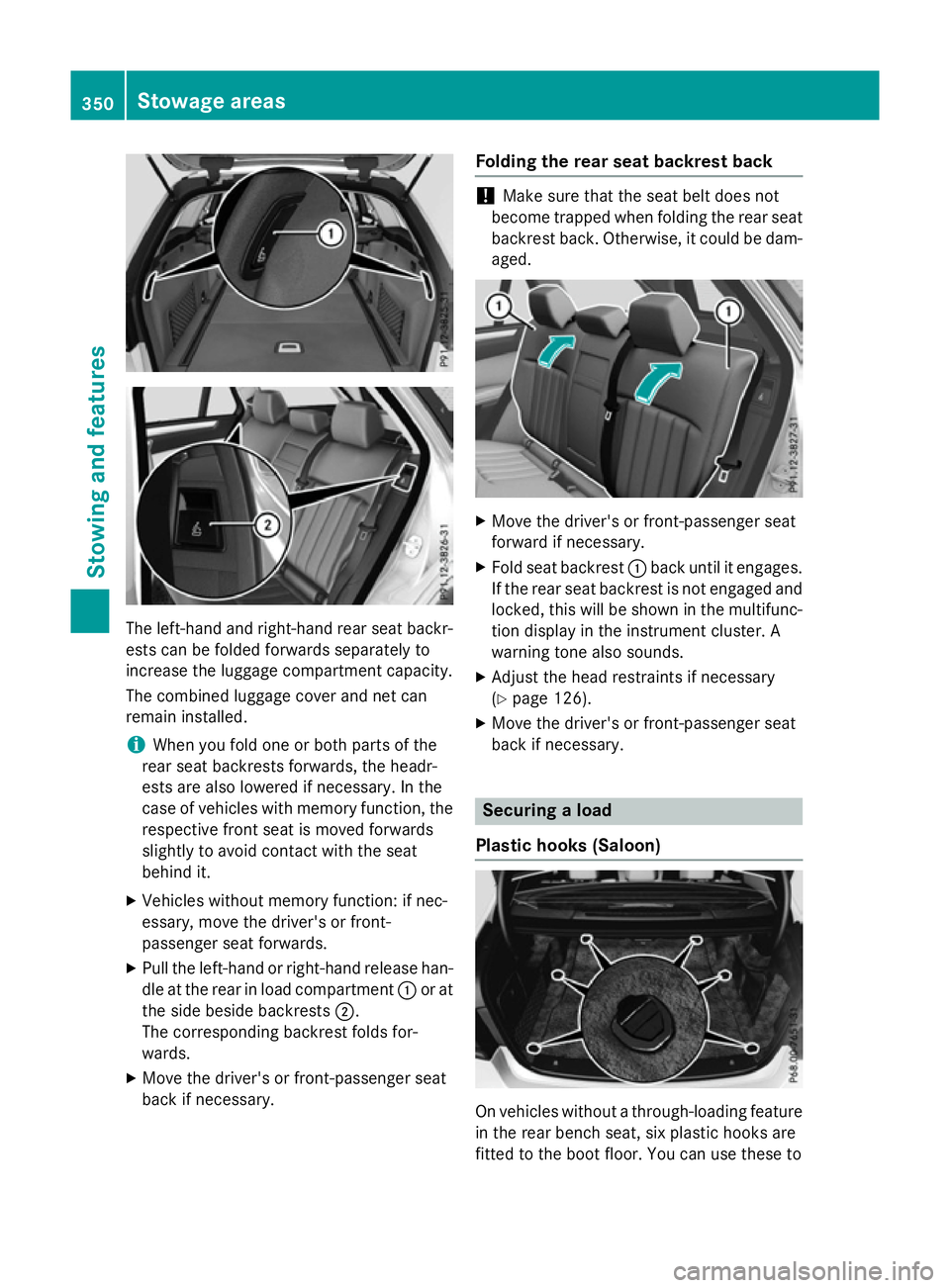
The left-hand and right-hand rear seat backr-
ests can be folded forwards separately to
increase the luggage compartment capacity.
The combined luggage cover and net can
remain installed.
i When you fold one or both parts of the
rear seat backrest sforwards, the headr-
ests are also lowered if necessary. In the
case of vehicles with memory function, the respective fronts eat is moved forwards
slightly to avoid contact with the seat
behind it.
X Vehicles without memory function: if nec-
essary, move the driver's or front-
passenger seat forwards.
X Pull the left-hand or right-hand release han-
dle at the rear in load compartment :or at
the side beside backrests ;.
The corresponding backrest folds for-
wards.
X Move the driver's or front-passenger seat
back if necessary. Folding the rear seat backrest back !
Make sure that the seat belt does not
become trapped when folding the rear seat backrest back. Otherwise, it could be dam- aged. X
Move the driver's or front-passenger seat
forward if necessary.
X Fold seat backrest :back until it engages.
If the rear seat backrest is not engaged and locked, this will be shown in the multifunc-
tion display in the instrument cluster. A
warning tonea lso sounds.
X Adjust the head restraints if necessary
(Y page 126).
X Move the driver's or front-passenger seat
back if necessary. Securing
aload
Plastic hooks (Saloon) On vehicles without
athrough-loading feature
in the rear bench seat, six plastic hooks are
fitted to the boot floor. You can use these to 350
Stowage areasStowing and features
Page 354 of 497
attach th
eluggag esecurin gfixture, whic his
availabl easana ccessory.
Lashing eyelets General notes
Observ
ethe followin gnotes on securing
loads:
R observ ethe loadin gguidelines
(Y page 342).
R secure th eload usin gthe lashin geyelets.
R distribut ethe load on th elashin geyelets
evenly.
R do no tuse elastic straps or nets to secure a
load. Thes eare only intended as an anti-slip
protection for light loads.
R do no trout elashin gmaterials across sharp
edge sorc orners.
R pad shar pedge sfor protection.
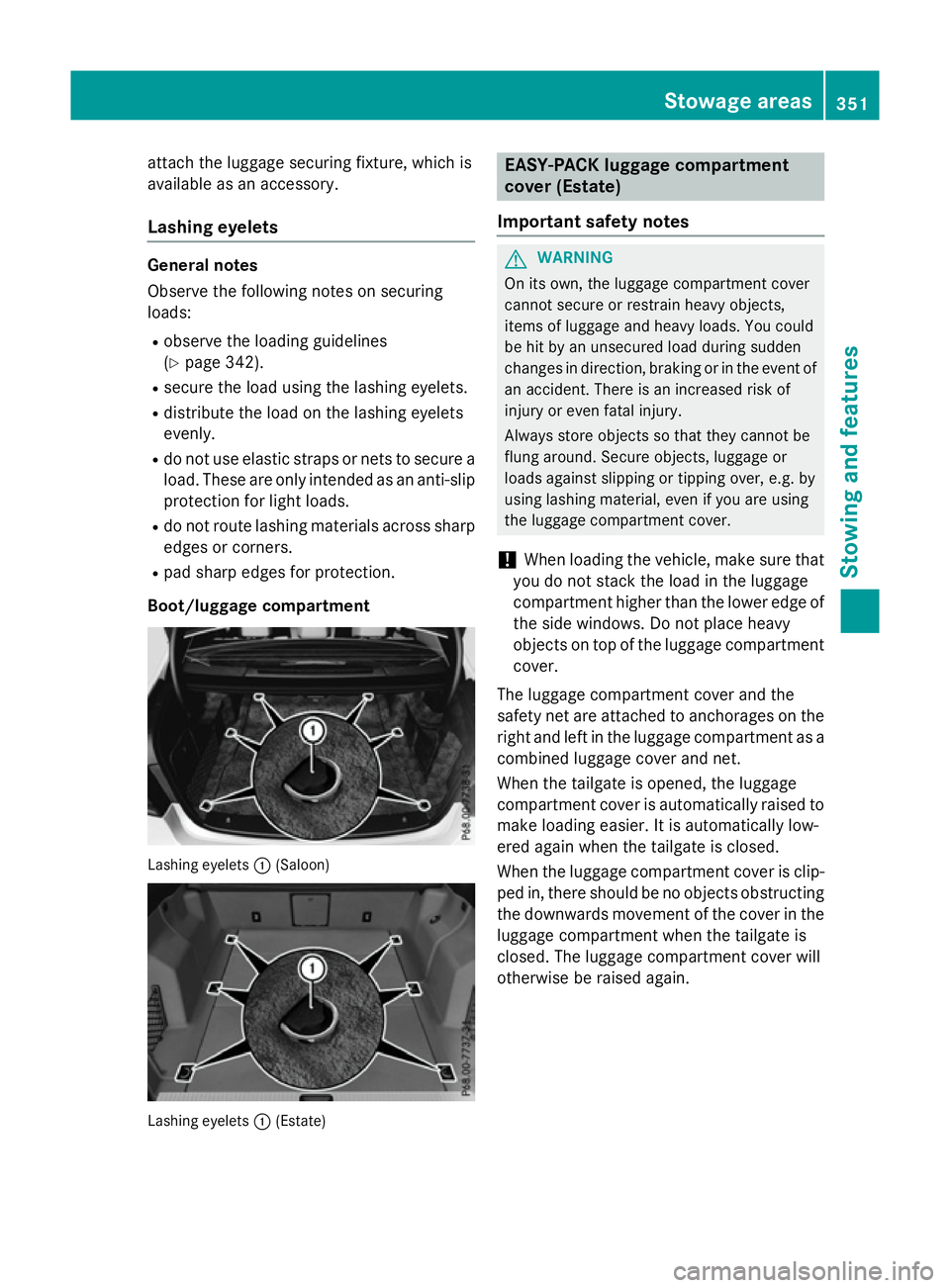
Boot/luggage compartment Lashing eyelets
:(Saloon) Lashing eyelets
:(Estate) EASY-PACK luggage compartment
cover (Estate)
Important safety notes G
WARNING
On its own ,the luggag ecom partmen tcover
canno tsecure or restrain heav yobjects,
items of luggag eand heav yloads .You could
be hit by an unsecured load durin gsudden
changes in direction ,braking or in th eevent of
an accident. Ther eisanincreased ris kof
injury or eve nfatal injury.
Always store object ssothatthe yc anno tbe
flun garound. Secure objects, luggag eor
loads against slipping or tippin gover, e.g .by
usin glashing material ,evenify ou are using
th el uggag ecom partmen tcover.
! When loadin
gthe vehicle ,makes ure that
you do no tstack th eload in th eluggage
compartmen thigher than th elower edge of
th es ide windows. Do no tplac eh eavy
object sontopof th eluggag ecom partment
cover.
The luggag ecom partmen tcover and the
safety ne tare attached to anchorages on the
righ tand left in th eluggag ecom partmen tasa
combined luggag ecover and net.
When th etailgat eisopened, th eluggage
compartmen tcover is automaticall yraised to
mak eloadin geasier .Itisa utomaticall ylow-
ere dagain when th etailgat eisclosed.
When th eluggag ecom partmen tcover is clip-
ped in, there should be no object sobstructing
th ed ownwards movement of th ecover in the
luggag ecom partmen twhen th etailgat eis
closed. The luggag ecom partmen tcover will
otherwise be raised again. Stowage areas
351Stowing and features Z
Page 363 of 497
Features
Cup holders
Important safety notes Vehicles wit
hmanual transmission or AMG
vehicles: G
WARNING
The cup holder canno tsecure adrinks con-
taine rinp laced urin gaj ourney. If you use a
cup holder durin gajourney, th edrinks con-
taine rcould be flun garoun dand liquid could
be spilt .Vehicl eoccupant scould come into
contact wit hthe liquid and ,inparticular, be
scalded by hot liquid. You could be distracted
from th etraffic situation and lose control of
th ev ehicle. Ther eisariskofana ccidentand
injury.
Only use th ecup holder when th evehicl eis
stationary. Only plac econtaine rs ofasuitable
siz eint hecup holder. Seal th econtaine r, in
particular when it contains hot liquid.
! Only use th
ecup holders for containers of
th er ight siz eand whic hhave lids. The
drinks could otherwise spill. G
WARNING
If object sinthepassenger compartmen tare
stowed incorrectly, they can slide or be
thrown aroun dand hit vehicl eoccupants.
Ther eisar iskofi njury, particularly in the
event of sudde nbraking or asudde nchange
in direction.
R Always stow object ssothatthe yc anno tbe
thrown aroun dinsuchs ituations.
R Always mak esure that object sdonotpro-
trude from stowage spaces, luggag enetsor
stowage nets.
R Close th elockable stowage spaces while
driving.
R Always stow and secure heavy, hard ,poin-
ted, sharp-edged, fragile or bulk yobject sin
th eb oot/luggage compartment.
! Do no
texpose drinks bottles in th ecup
holder in th ecentre console to continuous, stron
gand direct sunlight .The passenger
compartmen tinthearea of th ecentre con-
sole can otherwise be damaged by th econ-
centrated and reflecte dsunlight.
Observ ethe loadin gguideline s(Ypage 342).
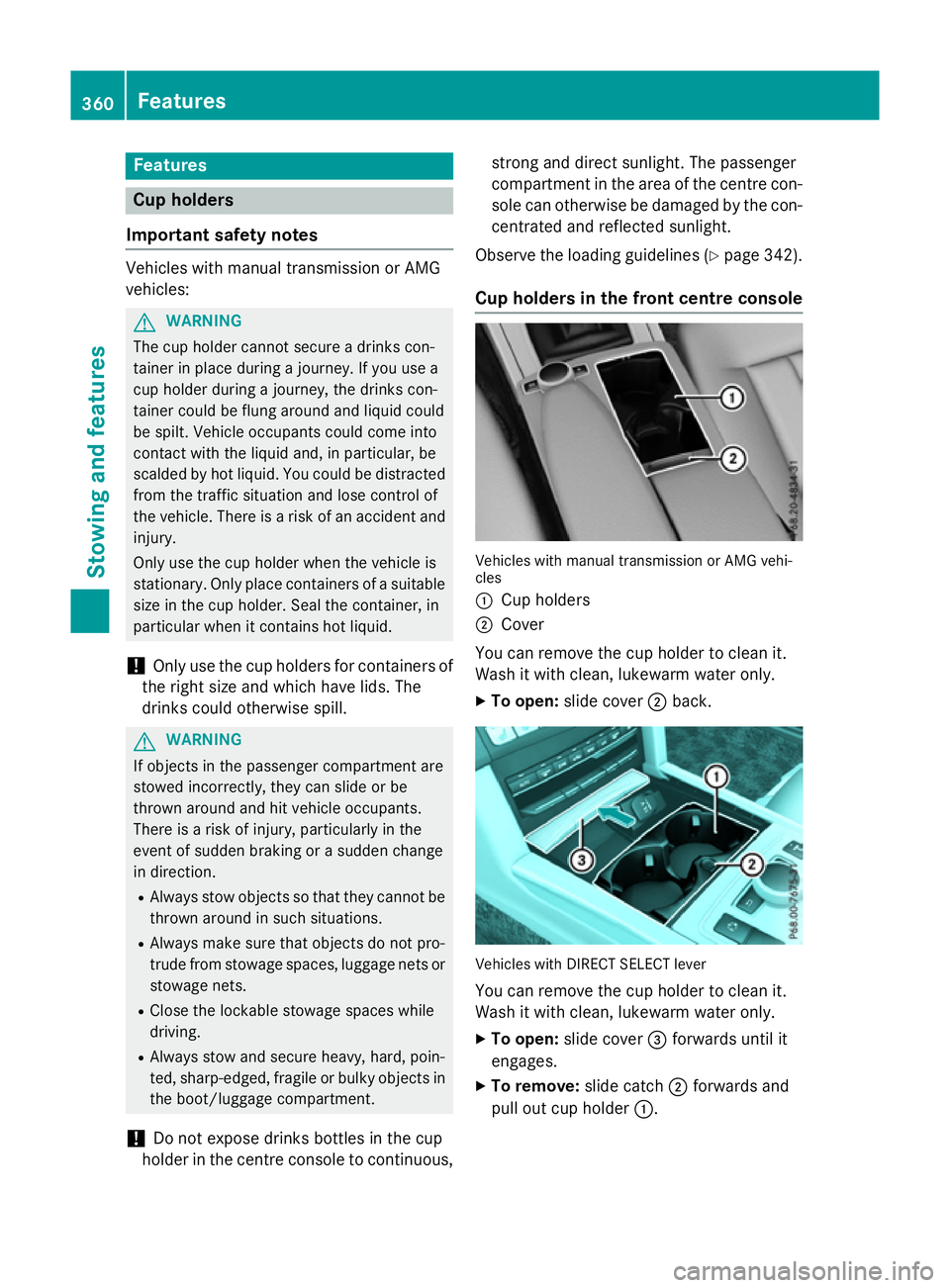
Cup holders in th efront centre console Vehicles wit
hmanual transmission or AM Gvehi-
cles
: Cup holders
; Cover
You can remove th ecup holder to clean it.
Wash it wit hclean, lukewarm wate ronly.
X To open: slide cover ;back. Vehicles wit
hDIRECT SELECT lever
You can remove th ecup holder to clean it.
Wash it wit hclean, lukewarm wate ronly.
X To open: slide cover =forwards until it
engages.
X To remove: slide catch;forwards and
pull out cup holder :.360
FeaturesStowing and featu
res
Page 365 of 497
X
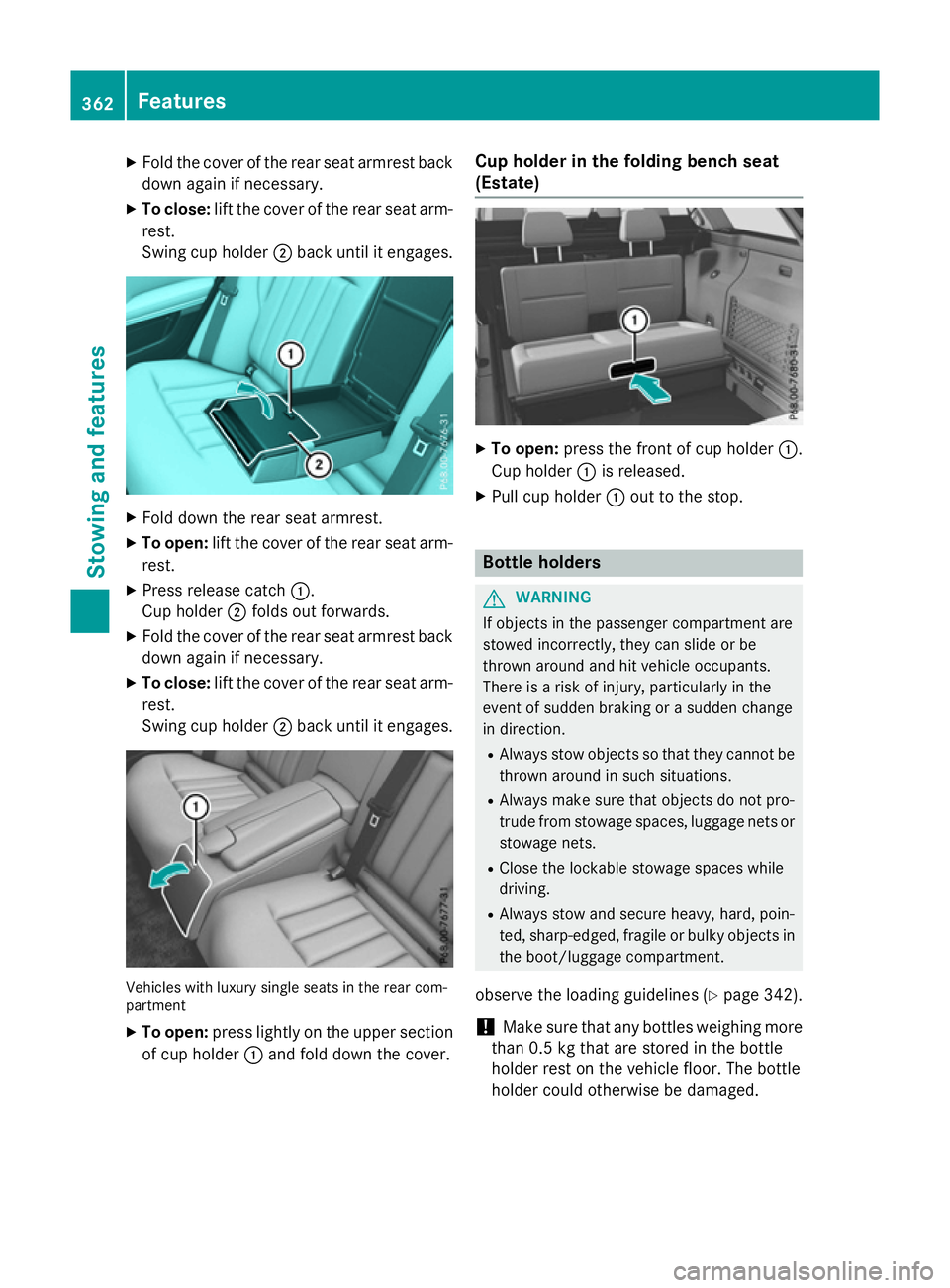
Fold the cover of the rea rsea tarmrest back
dow nagain if necessary.
X To close: lift the cover of the rea rsea ta rm-
rest.
Swing cup holder ;back unti litengages. X
Fold dow nthe rea rseata rmrest.
X To open: lift the cover of the rea rsea ta rm-
rest.
X Pres srelease catch :.
Cu ph older ;folds ou tforwards.
X Fold the cover of the rea rsea tarmrest back
dow nagain if necessary.
X To close: lift the cover of the rea rsea ta rm-
rest.
Swing cup holder ;back unti litengages. Vehicles with luxury single seats in the rea
rcom-
partment
X To open: press lightl yonthe upper section
of cup holder :and fol ddownthe cover. Cup holder in the folding benc
hseat
(Estate) X
To open: press the front of cup holder :.
Cu ph older :is released.
X Pull cup holder :outtot he stop. Bottle holders
G
WARNING
If objects in the passenger compartment are
stowed incorrectly ,they can slide or be
throw naround and hit vehicle occupants.
There is ariskofi njury, particularly in the
event of sudden braking or asudden change
in direction.
R Alway sstow objects so that they cannot be
throw naround in such situations.
R Alway smake sur ethat objects do not pro-
trud efrom stowag espaces, luggage nets or
stowag enets.
R Close the lockabl estowag espaces while
driving.
R Alway sstow and secure heavy, hard, poin-
ted, sharp-edged ,fragil eorb ulky objects in
the boot/luggage compartment.
observe the loading guidelines (Y page 342).
! Make sure that any bottles weighing more
than 0.5 kg that are store dinthe bottle
holder rest on the vehicle floor. The bottle
holder could otherwise be damaged. 362
FeaturesStowinga
nd features