2015 MERCEDES-BENZ E-CLASS ESTATE ESP
[x] Cancel search: ESPPage 57 of 497
Depending on the perso
ninthe front-
passenge rsea t, the front-passenge rfront air-
ba gise ithe rd isable dorenabled .The front-
passenge rfront airba gcan onl ybedeployed
in an accident if the PASSENGER AIR BAG OFF indicator lamp is off .Obser ve the information
on the PASSENGER AIR BAG OFF indicator
lamp (Y page 45).
Your vehicl ehastwo-stage front airbags. In
the first deployment stage ,the front airba gis
fille dwithp ropellant ga storeduce the risk of
injuries .The front airba gisfullydeployed if
the second deployment stage is activated
withi nafew milliseconds.
Th ea ctivatio nthreshold for the seat belt ten-
sioners and airbags is determine dbased on
the evaluation of the vehicle' srateofd ecel-
eratio noracceleratio natvarious points in the
vehicle. This proces sispre-emptiv einnature.
Th et riggering/deployment proces sshould
take place in good tim eatthe start of the
collision.
Th er ateofv ehicledeceleratio noraccelera-
tio na nd the directio nofthe force ar eessen-
tiall ydetermine dby:
R the distributio nofforces during the colli-
sion
R the collision angle
R the deformatio ncharacteristics of the vehi-
cle
R the characteristics of the object with which
the vehicl ehascollided
Factors which can onl ybeseena nd measured
after acollision ha soccurre ddonot play a
decisiv eroleint he deployment of an airbag,
nor do the yprovide an indicatio nofairbag
deployment.
Th ev ehicl emaybe deformed significantly
without an airba gbeing deployed .Thisist he
cas eifo nlyp arts which ar erelativel yeasily
deformed ar eaffecte dand the rate of decel-
eratio nisn ot high .Conversely ,anairba gm ay
be deployed eve nthoug hthe vehicl esuffers
onl ym inor deformation. This is the cas eif, for
example, ver yrigid vehicl eparts such as lon- gitudina
lbod ym embers ar ehit,a nd sufficient
deceleratio noccurs as aresult.
If the restraint syste mcontro lunitd etects a
side impact or if the vehicl eoverturns, the
applicabl ecomponents of the restraint sys-
tem ar eactivated independentl yofeach
other depending on the apparent typ eofacci-
dent.
R Sidebag sand pelvisba gonthe side on
which an impact occurs, independent from the seat belt tensioner and seat belt usage
Vehicle switht he automatic child seat rec-
ognition on the front-passenge rseat: the
sideba gand pelvisba gonthe front-
passenge rside( front) deploy under the fol-
lowing conditions:
- an occupant is detecte donthe front-
passenge rseator
- the belt tongue is engaged in the belt
buckle of the front-passenge rseat
R Windowbag on the side on which an impact
occurs, independent of seat belt usag eand
regardles sofwhether the front-passenger
seat is occupied
R Sea tbeltt ensioners ,ifthe syste mdeter-
mines tha tdeployme nt can offer additional
protection for the vehicl eoccupants in this
situation
R Windowbag sonthe driver's and front-
passenge rsideinc ertainsituations if the
vehicl eoverturns and if the syste mdeter-
mines tha tdeployme nt can offer additional
protection to tha tprovide dbythe seat belt
i Not al
lairbags ar edeployed in an acci-
dent. Th edifferent airba gsystems work
independentl yofeacho ther.
How the airba gsystemw orks is deter-
mined by the severity of the accident detec- ted ,especially the vehicl edeceleratio nor
acceleration, and the apparent typ eofacci-
dent:
R frontal collision
R side impact
R overturn 54
Occupant safetySafety
Page 66 of 497
of injury to the head and neck in the event of
an accident or sudden braking, for example.
Always drive with the head restraint sfitted.
Ensure that the centre of the head restraints
support the back of each vehicle occupant's
head at eye level before driving off.
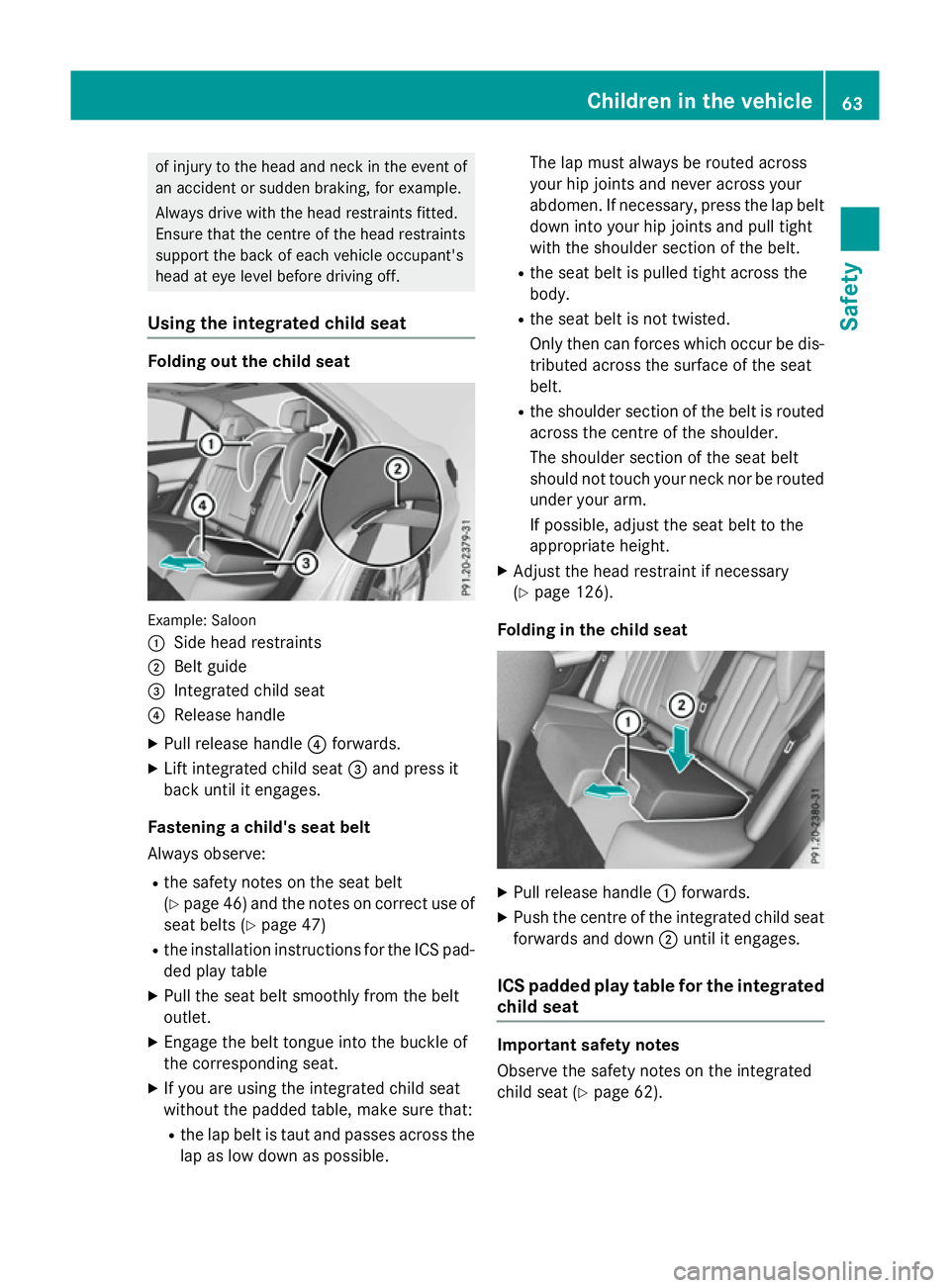
Using the integrated child seat Folding out the child seat
Example: Saloon
:
Side head restraints
; Belt guide
= Integrated child seat
? Release handle
X Pull release handle ?forwards.
X Lift integrated child seat =and press it
back until it engages.
Fastening achild's seat belt
Always observe:
R the safety notes on the seat belt
(Y page 46) and the notes on correc tuse of
seat belts (Y page 47)
R the installation instructions for the ICS pad-
ded play table
X Pull the seat belt smoothly from the belt
outlet.
X Engage the belt tongue into the buckle of
the corresponding seat.
X If you are using the integrated child seat
without the padded table, make sure that:
R the lap belt is taut and passes across the
lap as low down as possible. The lap must always be routed across
your hip jointsa nd never across your
abdomen. If necessary, press the lap belt down into your hip jointsa nd pull tight
with the shoulder section of the belt.
R the seat belt is pulled tight across the
body.
R the seat belt is not twisted.
Only then can forces which occur be dis-
tributed across the surface of the seat
belt.
R the shoulder section of the belt is routed
across the centre of the shoulder.
The shoulder section of the seat belt
should not touch your neck nor be routed
under your arm.
If possible, adjust the seat belt to the
appropriate height.
X Adjust the head restraint if necessary
(Y page 126).
Folding in the child seat X
Pull release handle :forwards.
X Push the centre of the integrated child seat
forwards and down ;until it engages.
ICS padded play table for the integrated
child seat Important safety notes
Observe the safety notes on the integrated
child seat (Y
page 62). Children in the vehicle
63Safety Z
Page 67 of 497
G
WARNING
If the ICS padded playt able has been incor-
rectly fitted to the integrated child seat, it
cannot perform its intended protective func-
tion. Achild therefore cannot be restrained in
the event of an accident, heavy braking or a
sudden change of direction. In addition, the
ICS padded playt able couldbecome loose
and be thrown around, endangering vehicle
occupants. This pose sanincreased risk of
injury or even fatal injury.
Fit the ICS padded playt able as described.
After fitting the ICS padded playt able,make
sure that it is secure dcorrectly. For safety
reasons, only use the ICS padded playt able
that has been tested and approved for your
vehicle.
The ICS padded playt able is only suitable for
use with the folded-out integrated child seat.
On the rear seats with an integrated child
seat, only use the ICS padded playt able that
is recommende dfor Mercedes-Benz vehicles.
Only use the ICS padded playt able with its
original cover. Withou tthe original cover, the
officia lapproval is invalidated.
Use the ICS padded playt able in accordance
with the instructions in the table in the "Inte-
grated child seat( ICS)"section (Y page62).
Note that children under two years old and
children who weigh less than 12.5 kg require ad ifferent and suitable child restraint system.
Information about other child restraint sys-
tems is available at any Mercedes-Benz Ser-
vice Centre.
You must not use the integrated child seat
with ICS padded playt able asadirect attach-
ment to ababyc ar seatf or which abody
weight of up to 10 kg is permissible. Note that
children younger than 24 months old require
ad ifferent child restraint system
(Y page7 4).
If you are not using the ICS padded playt able,
stow it in an appropriate place, e.g. in the
boot/luggage compartment. You willf ind fur-
ther information on stowing objects, luggage and loads securely under "Loading guide-
lines".
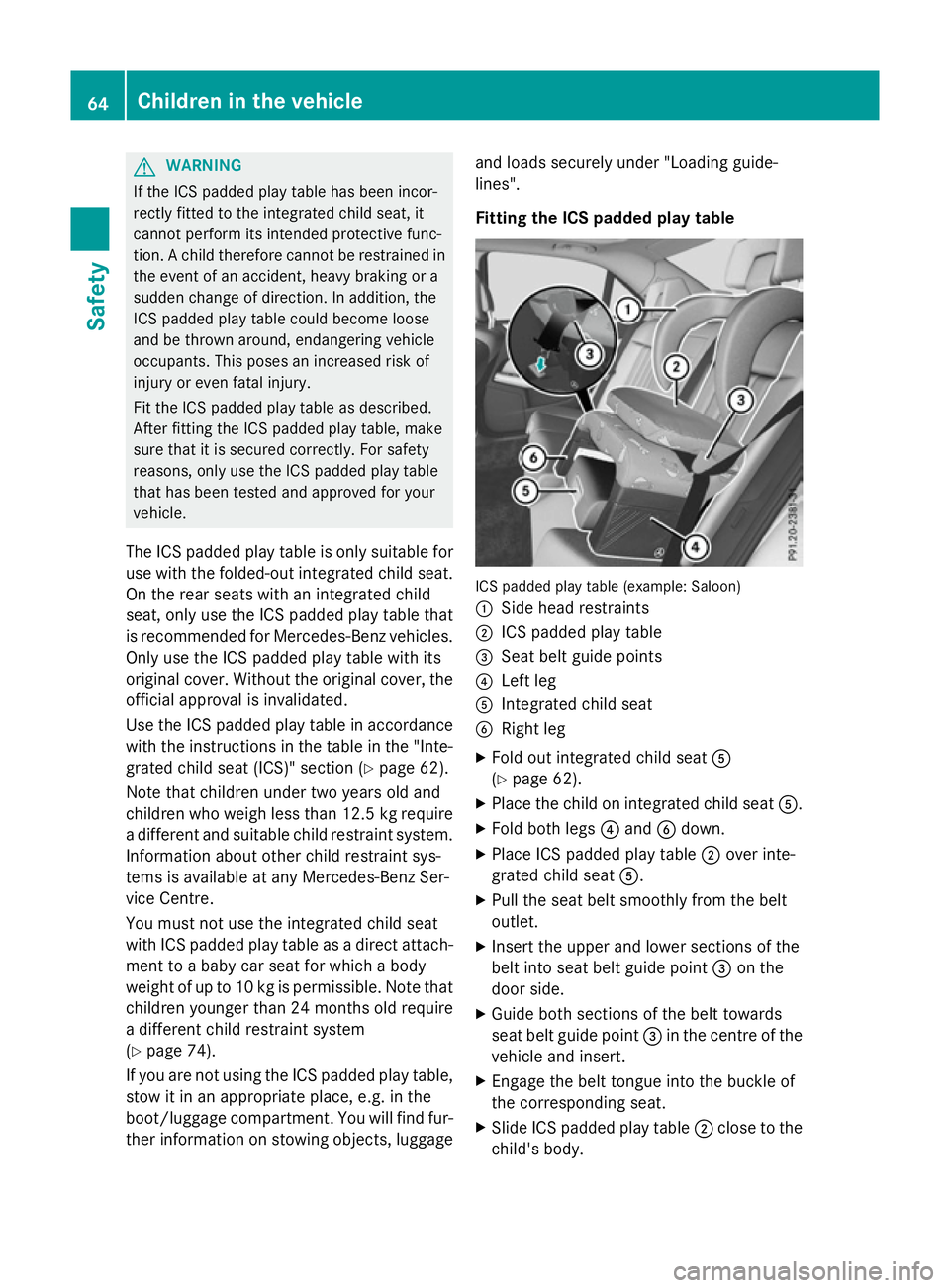
Fittin gthe ICSp added play table ICS padded pla
ytable (example: Saloon)
: Side headr estraints
; ICS padded playt able
= Seat beltg uide points
? Left leg
A Integrated child seat
B Right leg
X Fold out integrated child seat A
(Y page6 2).
X Place the child on integrated child seat A.
X Fold both legs ?and Bdown.
X Place ICS padded playt able;over inte-
grated child seat A.
X Pullt he seat belts moothly from the belt
outlet.
X Insert the upper and lower sections of the
belti nto seat beltg uide point=on the
door side.
X Guide both sections of the beltt owards
seat beltg uide point =in the centre of the
vehicl eand insert.
X Engage the beltt ongue into the buckle of
the corresponding seat.
X Slide ICS padded playt able;close to the
child's body. 64
Children in the vehicleSafety
Page 69 of 497
chil
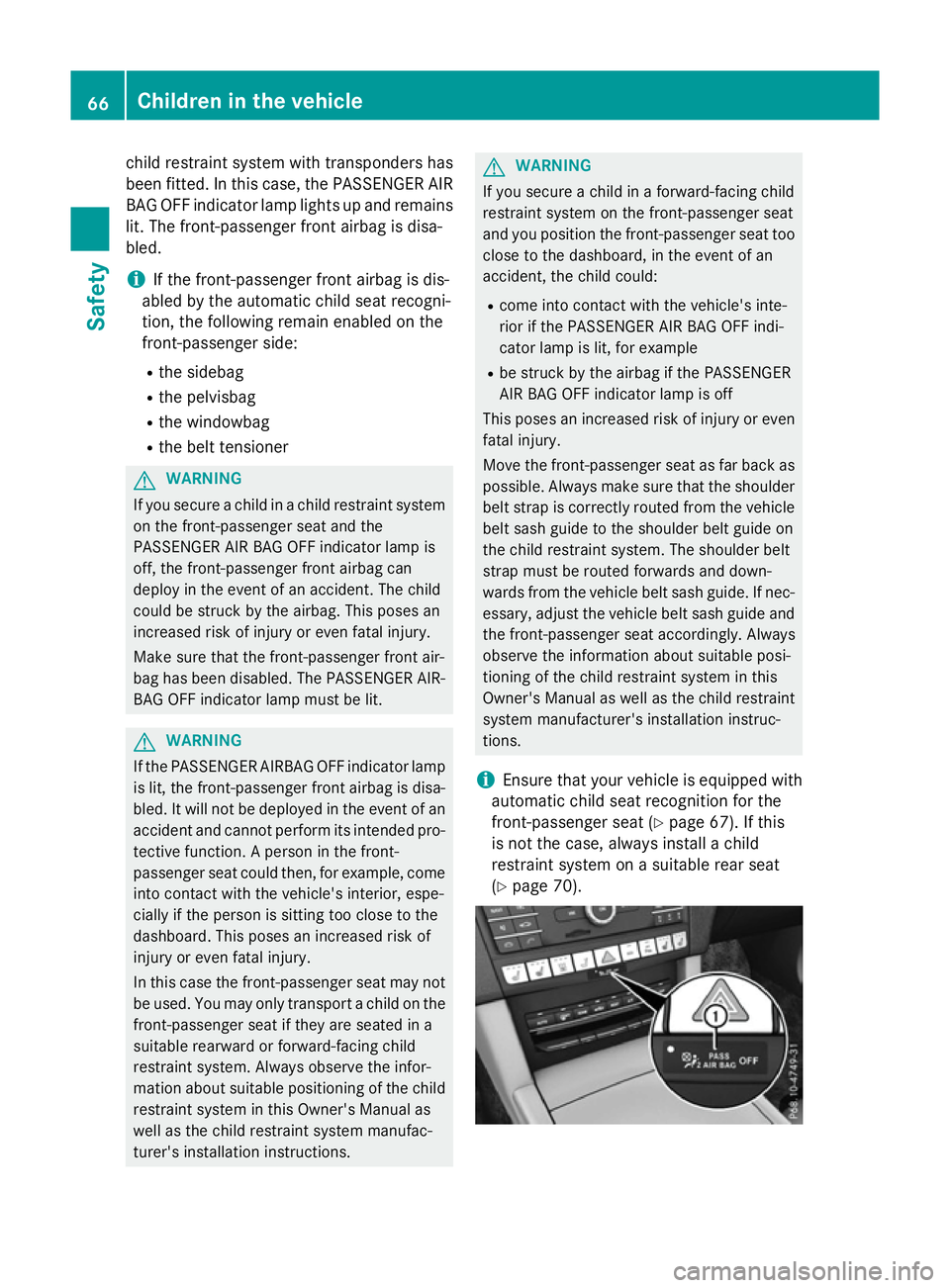
drestraint system with transponders has
bee nfitted .Inthis case, the PASSENGER AIR
BAG OFF indicator lamp lights up and remains
lit. The front-passenger front airba gisdisa-
bled.
i If the front-passenger front airba gisdis-
able dbyt he automatic chil dseatrecogni-
tion, the following remain enabled on the
front-passenger side:
R the sidebag
R the pelvisbag
R the windowbag
R the bel ttensioner G
WARNING
If yo usecure achildinac hildr estraint system
on the front-passenger sea tand the
PASSENGER AIR BAG OFF indicator lamp is
off, the front-passenger front airba gcan
deploy in the event of an accident. The child
could be struck by the airbag. Thi sposes an
increased ris kofinjury or eve nfata linjury.
Make sure that the front-passenger front air-
ba gh asbee ndisable d. The PASSENGER AIR-
BAG OFF indicator lamp mus tbelit. G
WARNING
If the PASSENGER AIRBAG OFF indicator lamp is lit, the front-passenger front airba gisdisa-
bled. It will not be deployed in the event of an
accident and cannot perform its intended pro-
tectiv efunction. Aperson in the front-
passenger sea tcould then, for example, come
into contact with the vehicle's interior ,espe-
ciall yift he person is sitting too clos etothe
dashboard. Thi sposes an increased ris kof
injury or eve nfata linjury.
In this cas ethe front-passenger sea tmay not
be used. You may only transpor tachildont he
front-passenger sea tifthey are seated in a
suitabl erearward or forward-facing child
restraint system. Alway sobserve the infor-
mation abou tsuitabl epositioning of the child
restraint system in this Owner's Manua las
well as the chil drestraint system manufac-
turer's installation instructions. G
WARNING
If yo usecure achildinaf orward-facing child
restraint system on the front-passenger seat
and yo uposition the front-passenger sea ttoo
close to the dashboard, in the event of an
accident, the chil dcould:
R come into contact with the vehicle's inte-
rio rift he PASSENGER AIR BAG OFF indi-
cator lamp is lit, for example
R be struck by the airba gifthe PASSENGER
AIR BAG OFF indicator lamp is off
Thi sposes an increased ris kofinjury or even
fata linjury.
Move the front-passenger sea tasfar back as
possible .Alway smake sure that the shoulder
bel tstra pisc orrectly routed from the vehicle
bel tsashg uide to the shoulder bel tguide on
the chil drestraint system. The shoulder belt
stra pmustb erouted forward sand down-
wards from the vehicle bel tsashg uide .Ifnec-
essary ,adjust the vehicle bel tsashg uide and
the front-passenger sea taccordingly .Always
observe the information abou tsuitabl eposi-
tioning of the chil drestraint system in this
Owner's Manua laswellast he chil drestraint
system manufacturer' sinstallation instruc-
tions.
i Ensur
ethat your vehicle is equipped with
automatic chil dseatrecognition for the
front-passenger sea t(Ypage 67). If this
is not the case, always install achild
restraint system on asuitabl erears eat
(Y page 70). 66
Childre
ninthe vehicleSafety
Page 75 of 497
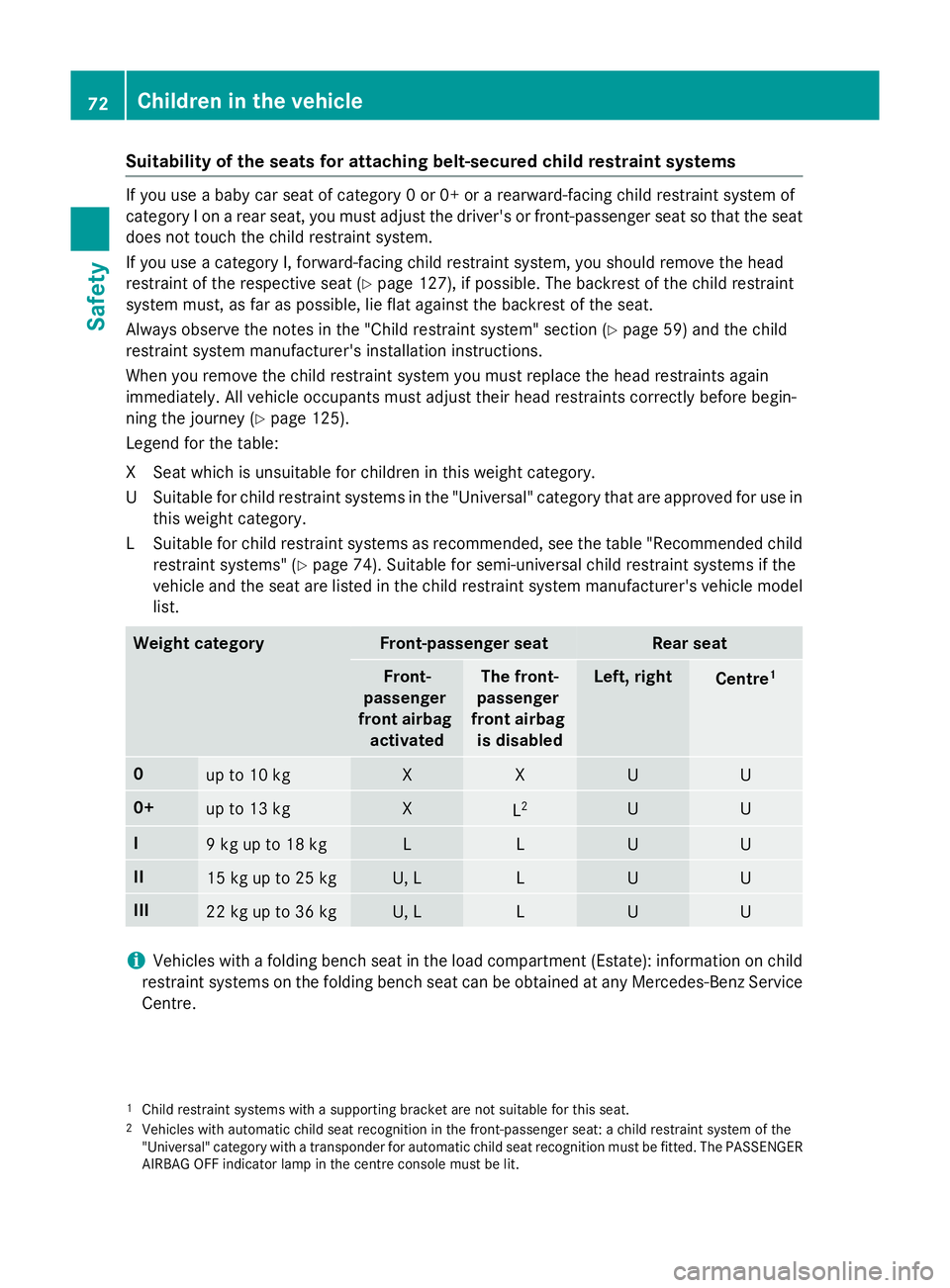
Suitability of the seats for attaching belt-secured child restraint systems
If you use
ababy car seat of category 0or0+orarearward-facing child restraint system of
category Ionarear seat, you must adjust the driver's or front-passenger seat so that the seat
does not touch the child restraint system.
If you use acategory I, forward-facing child restraint system, you should remove the head
restraint of the respective seat (Y page 127), if possible. The backrest of the child restraint
system must, as far as possible, lie flat against the backrest of the seat.
Always observe the notes in the "Childr estraint system" section (Ypage 59) and the child
restraint system manufacturer's installation instructions.
When you remove the child restraint system you must replace the head restraint sagain
immediately. All vehicle occupants must adjust their head restraint scorrectly before begin-
ning the journey (Y page 125).
Legend for the table:
XS eat which is unsuitable for children in this weight category.
US uitable for child restraint systems in th e"Universal" categor ytha tare approve dfor use in
this weigh tcategory.
LS uitable for child restraint systems as recommended, see th etable "Recommended child
restraint systems "(Ypage 74). Suitable for semi-universal child restraint systems if the
vehicl eand th eseat are listed in th echild restraint system manufacturer' svehicl emodel
list. Weight category Front-passenger seat Rea
rseat Front-
passenger
front airbag activated Th
ef ront-
passenger
front airbag is disabled Left
,right Centre
1 0
up to 10 kg X X U U
0+
up to 13 kg X
L
2 U U
I
9kgupt
o18kg L L U U
II
15 kg up to 25 kg U, L L U U
III
22 kg up to 36 kg U, L L U U
i
Vehicles wit
hafoldin gbench seat in th eload compartmen t(Estate): information on child
restraint systems on th efoldin gbench seat can be obtaine datany Mercedes-Ben zService
Centre.
1 Child restrain tsystems wit hasupporting bracke tare no tsuitable for this seat.
2 Vehicles wit hautomatic child seat recognition in th efront-pa ssenger seat :achild restrain tsystem of the
"Universal" categor ywithat ransponder for automatic child seat recognition mus tbefitted. The PASSENGER
AIRBA GOFFindicator lamp in th ecentr econsol emustbel it. 72
Children in th
evehicleSafety
Page 76 of 497
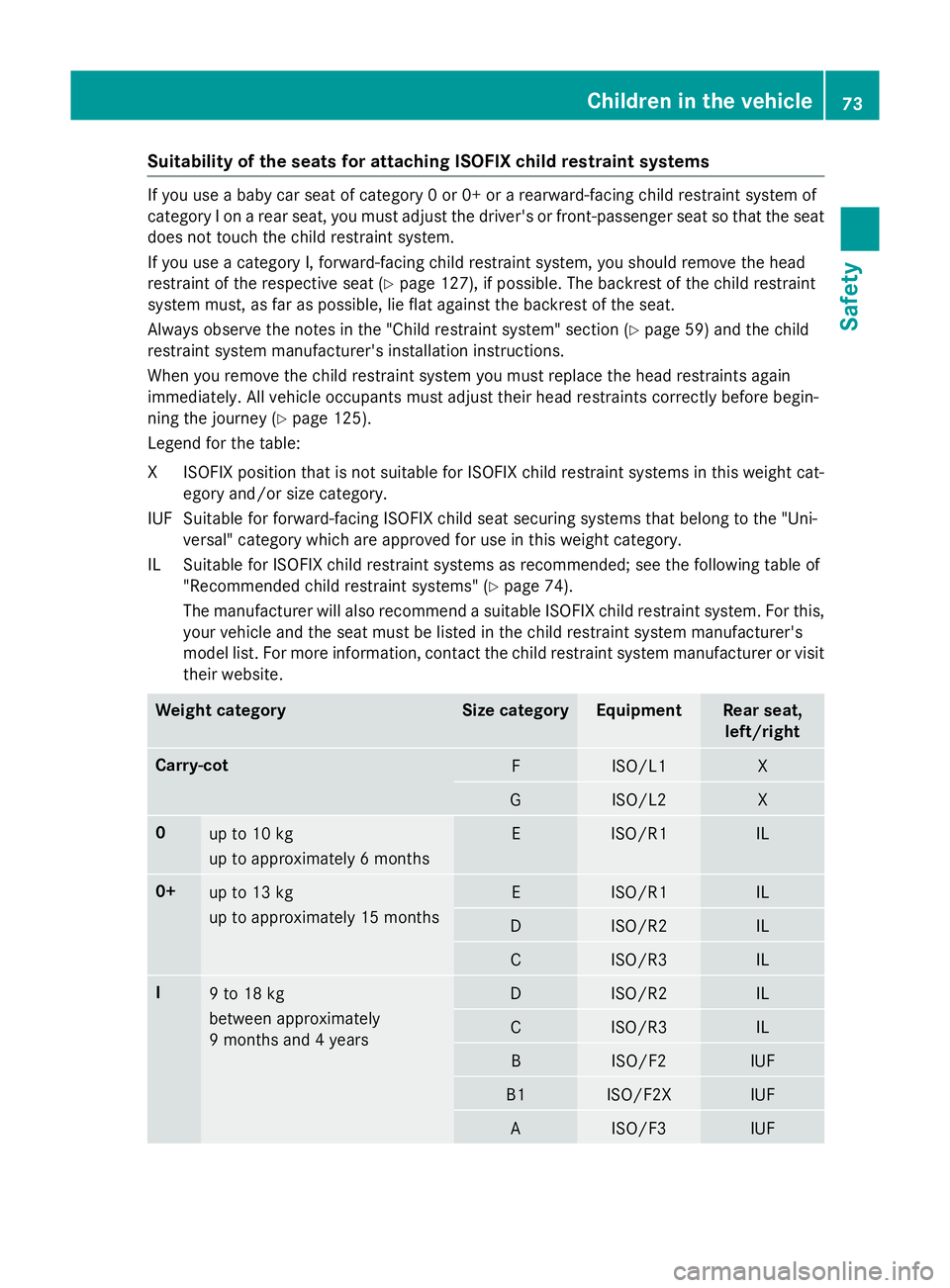
Suitability of the seats for attaching ISOFIXc
hild restraint systemsIf you use
ababy car seat of category 0or0+orarearward-facing child restraint system of
category Ionarear seat, you must adjust the driver's or front-passenger seat so that the seat
does not touch the child restraint system.
If you use acategory I, forward-facing child restraint system, you should remove the head
restraint of the respective seat (Y page 127), if possible. The backrest of the child restraint
system must, as far as possible, lie flat against the backrest of the seat.
Always observe the notes in the "Childr estraint system" section (Ypage 59) and the child
restraint system manufacturer's installation instructions.
When you remove the child restraint system you must replace the head restraint sagain
immediately. All vehicle occupants must adjust their head restraint scorrectly before begin-
ning the journey (Y page 125).
Legend for the table:
XI SOFIX position tha tisn ot suitabl efor ISOFIX child restraint systems in this weight cat-
egory and/or size category.
IUF Suitable for forward-facing ISOFIX child sea tsecuring systems tha tbelong to the "Uni-
versal "categor ywhich are approved for us einthis weight category.
IL Suitable for ISOFIX child restraint systems as recommended ;see the following table of
"Recommended child restraint systems "(Ypage 74).
The manufacturer will also recommend asuitabl eISOFIX child restraint system. For this,
your vehicl eand the sea tmustb elisted in the child restraint system manufacturer's
model list. For more information, contact the child restraint system manufacturer or visit
thei rwebsite. Weight category Siz
ec ategory Equipment Rear seat,
left/right Carry-cot
F ISO/L1 X
G ISO/L2 X
0
up to 10 kg
up to approximatel
y6months E ISO/R1 IL
0+
up to 13 kg
up to approximatel
y15m onths E ISO/R1 IL
D ISO/R2 IL
C ISO/R3 IL
I
9t
o18kg
between approximately
9m onths and 4years D ISO/R2 IL
C ISO/R3 IL
B ISO/F2 IUF
B1 ISO/F2X IUF
A ISO/F3 IUFChildre
ninthe vehicle
73Safety Z
Page 80 of 497
atio
nisp ossible usin gthe switches in the
rear compartment. Pet
sint hevehicle G
WARNING
If you leave animals unsupervised or unse-
cured in th evehicle ,the ym ay push abutton
or as witch ,for example.
They could:
R activat evehicle equipmen tand become
trapped, for example
R switch vehicle systems on or off ,thus
endangering other road users
In th eevent of an accident, sudde nbraking or
abrupt changes of direction ,unsecured ani-
mals could be flun garoun dthe vehicle ,injur-
ing th evehicle occupants .Ther eisar iskofan
acciden tand injury.
Never leave animals unattende dinthevehi-
cle .Always secure animals correctly durin ga
journey, e.g .inananimal transpor tbox. Driving safety systems
Driving safety systems overview
In this section, you will fin dinformatio nabout
th ef ollowin gdriving safety systems:
R AB S(Anti-lock Braking System)
(Y page 77)
R BA S(Brake AssistSystem) (Y page 78)
R BA SP LUS(Brake AssistSystem PLUS) with
Cross-Traffic Assist (Y page 78)
R COLLISION PREVENTION ASSIST PLUS
(distanc ewarning function and Adaptive
Brake Assist )(Y page 80)
R Adaptive brak elamps (Y page 83)
R ESP ®
(E lectronic Stability Program)
(Y page 83)
R EB D( electronic brakeforce distribution)
(Y page 86)
R ADAPTIV EBRAKE (Y page 86) R
PRE-SAFE ®
Brake (Y page 87)
R STEE RCONTROL (Y page 89) Important safety notes
If you fail to adapt your driving style or if you
are inattentive, th edriving safety systems can
neither reduc ethe riskofana ccidentnor
override th elaws of physics. Drivin gsafety
systems are merely aids designe dtoassist
driving .You are responsible for maintaining
th ed istanc etothevehicle in front, for vehicle
speed, for braking in good time, and for stay- ing in lane .Always adapt your driving style to
suit th eprevailin groad and weather condi-
tions and maintain asafe distanc efromt he
vehicle in front. Drive carefully.
The driving safety systems describe donly
work as effectivel yaspossible when there is
adequat econtac tbetween th etyres and the
road surface. Pleas epay special attentio nto
th en otes on tyres, recommended minimum
tyr etread depths etc. (Y page 416).
In wintry driving conditions, always use winter
tyres (M+ Styres) and ,ifnecessary, snow
chains .Onlyint hisw ay will th edriving safety
systems describe dinthiss ectio nwork as
effectivel yaspossible. ABS (Anti-lock Braking System)
General notes AB
Sr egulate sbrak epressure in suc haway
that th ewheels do no tloc kw hen you brake.
This allows you to continue steering th evehi-
cle when braking.
The yellow !ABSw arning lamp in the
instrumen tcluste rlight supw hen th eignition
is switched on .Itgoes out when th eengineis
running.
Important safety notes i
Observ
ethe "Important safety notes" sec-
tio n(Ypage 77). Driving safety systems
77Safety Z
Page 86 of 497
Adaptive brak
elamps
i Observ
ethe "Importan tsafet ynotes "sec-
tion (Y page 77).
The adaptive brak elights warn followin gtraf-
fic in an emergenc ybraking situation:
R by flashin gbrak elamps
R theh azard warning lamp sare activated
If you brak esharply from aspee dofm ore
than 50 km/h or if braking is assisted by BAS or BA SPLUS, th ebrak elamp sflas hrapidly. In
this way, traffic travellin gbehind you is
warned in an eve nmoren oticea ble manner.
If you brak esharply from aspee dofm ore
than 70 km/h to astandstill, th ehazard warn-
ing lamp sare activated automatically. If the
brakes are applie dagain ,the brak elamps
ligh tupc ontinuo usly. The hazard warning
lamp sswitch off automatically if you travel
faste rtha n1 0k m/ h.You can also switch off
th eh azard warning lamp susingthe hazard
warning butto n(Ypage 145). ESP
®
(Electronic Stabilit yProgram)
Genera lnotes i
Observ
ethe "Importan tsafet ynotes "sec-
tion (Y page 77).
ESP ®
monitors driving stabilit yand traction,
i.e .p ower transmission between th etyres
and th eroad surface.
If ESP ®
detects that th evehicl eisd eviating
from th edirection desired by th edriver, one
or mor ewheels are braked to stabilis ethe
vehicle. The engin eoutput is also modifie dto
keep th evehicl eont hedesired cours ewithin
physical limits .ESP ®
assist sthe driver when
pullin gaway on wet or slippery roads. ESP ®
can also stabilis ethe vehicl eduring braking.
ETS/4ET S(Electronic Traction System) ET
St raction control is part of ESP ®
.Onv ehi-
cle sw ith4 MATIC ,4ETSisa component of
ESP ®
. Traction control brakes th
edrivew heels indi-
vidually if they spin .This enables you to pull
away and accelerate on slippery surfaces, for exampl eiftheroad surfac eisslippery on one
side .Ina ddition ,mored rivet orque is trans-
ferred to th ewhee lorw heels wit htraction.
Traction control remain sactive if you deacti-
vat eE SP®
.
Important safety notes i
Observ
ethe "Importan tsafet ynotes "sec-
tion (Y page 77). G
WARNING
If ESP ®
is malfunctioning ,ESP ®
is unable to
stabilis ethe vehicle. In addition ,other driving
safet ysystems are switched off .This increa-
ses th eriskofs kiddin gand an accident.
Drive on carefully. Hav eESP®
checke data
qualified specialist workshop.
! Vehicles wit
h4MATIC :function or per-
formance test smay only be carrie dout on
a2 -axled ynamometer. Befor eoperating
th ev ehicl eons uchad ynamometer, please
consult aqualified specialist workshop.
You could otherwise damag ethe driv etrain
or th ebrak esystem.
Vehicles without 4MATIC: when towin gyour
vehicl ewitht he rear axl eraised, observ ethe
note sonE SP®
(Y page 410).
When ESP ®
is deactivated, the åESP®
OF Fw arning lamp lights up continuously.
If the ÷ warning lamp and the åwarn-
ing lamp are lit continuously, ESP ®
is not
available due to amalfunction.
Observ ethe information on warning lamps
(Y page 333) and display message swhich
may be shown in th einstrumen tcluster
(Y page 300).
i Only use wheels wit
hthe recommended
tyr es izes. Only then will ESP ®
function
properly. Driving safety systems
83Safety Z