Page 655 of 886

6554-1. Maintenance and care
4
Maintenance and care NOTICE■
Cleaning detergents ●
Do not use the following types of detergent, as they may discolor the vehicle inte-
rior or cause streaks or damage to painted surfaces:
• Non-seat portions: Organic substances such as benzene or gasoline, alkaline
or acidic solutions, dye, or bleach
• Seats: Acidic solutions, such as thinner, benzene, or alcohol●
Do not use polish wax or polish cleaner. The instrument panel's or other interior
part’s painted surface may be damaged.■
Preventing damage to leather surfaces
Observe the following precautions to avoid damage to and deterioration of leather
surfaces: ●
Remove any dust or dirt from leather surfaces immediately.●
Do not expose the vehicle to direct sunlight for extended pe riods of time. Park
the vehicle in the shade, especially during summer.●
Do not place items made of vinyl, plastic, or that contain wax on the upholstery, as
they may stick to the leather surface if th e vehicle interior heats up significantly.■
Water on the floor
Do not wash the vehicle floor with water.
Vehicle systems such as the audio syst em may be damaged if water comes into
contact with electrical components under the floor of vehicle. Water may also
cause the body to rust.■
Cleaning the inside of the rear window ●
Do not use glass cleaner to clean the re ar window, as this may cause damage to
the rear window defogger heater wires or antenna. Use a cloth dampened with
lukewarm water to gently wipe the window clean. Wipe the window in strokes
running parallel to the heater wires or antenna.
●
Be careful not to scratch or damage the heater wires or antenna.
Page 661 of 886
6614-2. Maintenance
4
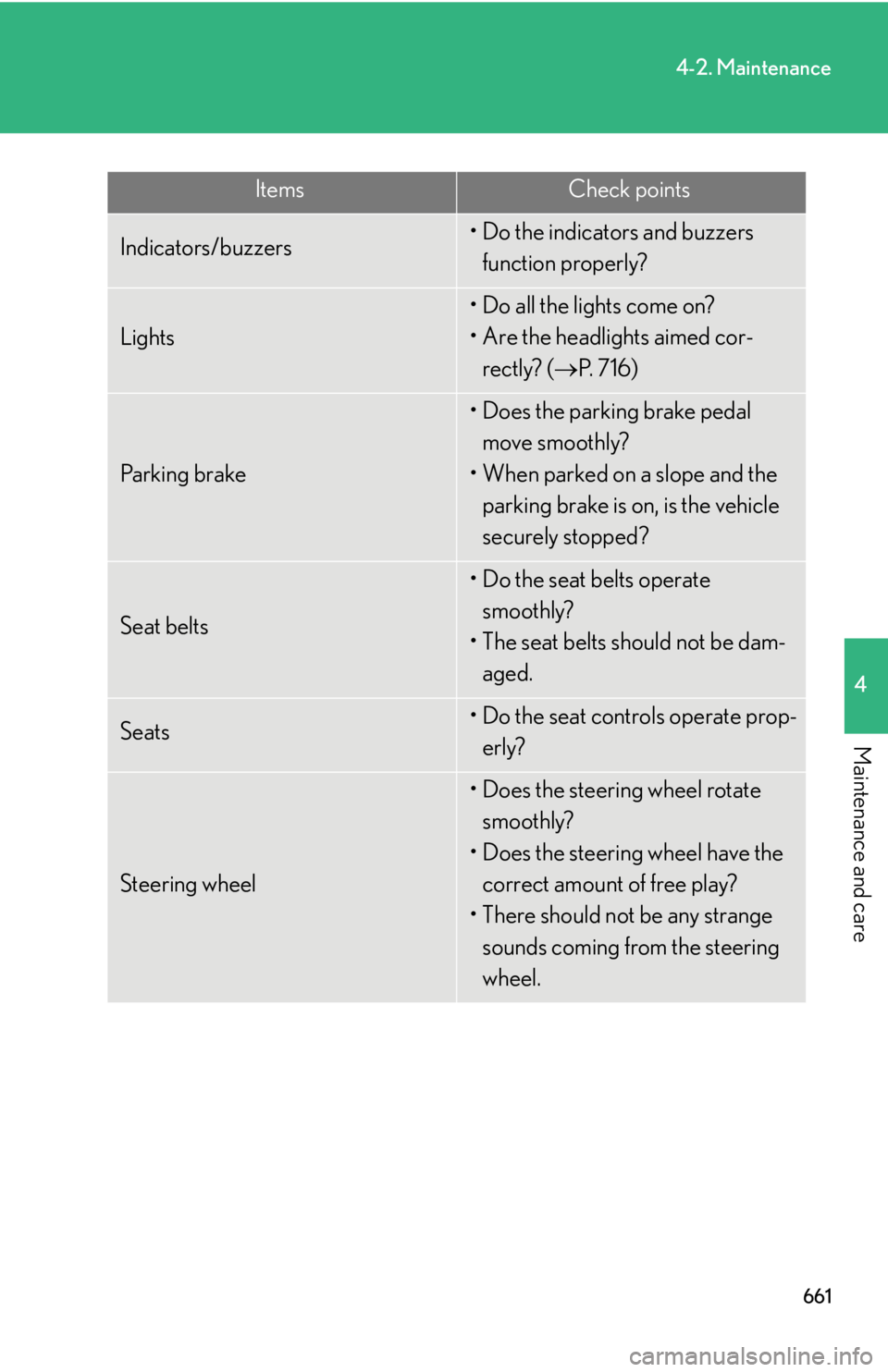
Maintenance and care Items Check points
Indicators/buzzers • Do the indicators and buzzers
function properly?
Lights • Do all the lights come on?
• Are the headlights aimed cor-
rectly? ( P. 7 1 6 )
Pa r k i n g b r a ke • Does the parking brake pedal
move smoothly?
• When parked on a slope and the
parking brake is on, is the vehicle
securely stopped?
Seat belts • Do the seat belts operate
smoothly?
• The seat belts should not be dam-
aged.
Seats • Do the seat controls operate prop-
erly?
Steering wheel • Does the steering wheel rotate
smoothly?
• Does the steering wheel have the
correct amount of free play?
• There should not be any strange
sounds coming from the steering
wheel.
Page 665 of 886
6654-3. Do-it-yourself maintenance
4
Maintenance and care Items Pa r t s a n d t o o l s
Engine oil level ( P. 6 74 ) • “Toyota Genuine Motor Oil” or
equivalent
•Rag or paper towel
• Funnel (used only for adding
engine oil)
Fuses ( P. 7 0 3 ) • Fuse with same amperage rating as
original
Tire inflation pressure ( P. 6 9 3 ) • Tire pressure gauge
• Compressed air source
Headlight aim ( P. 7 1 6 ) • Phillips-head screwdriver
Radiator and condenser ( P. 6 7 8 )
Wa s h e r f l u i d ( P. 6 8 3 ) • Water or washer fluid containing
antifreeze (for winter use)
• Funnel (used only for adding water
or washer fluid)
Page 667 of 886
6674-3. Do-it-yourself maintenance
4
Maintenance and care Hood
CAUTION■
Pre-driving check
Check that the hood is fully closed and locked.
If the hood is not locked properly, it may open while the vehicle is in motion and
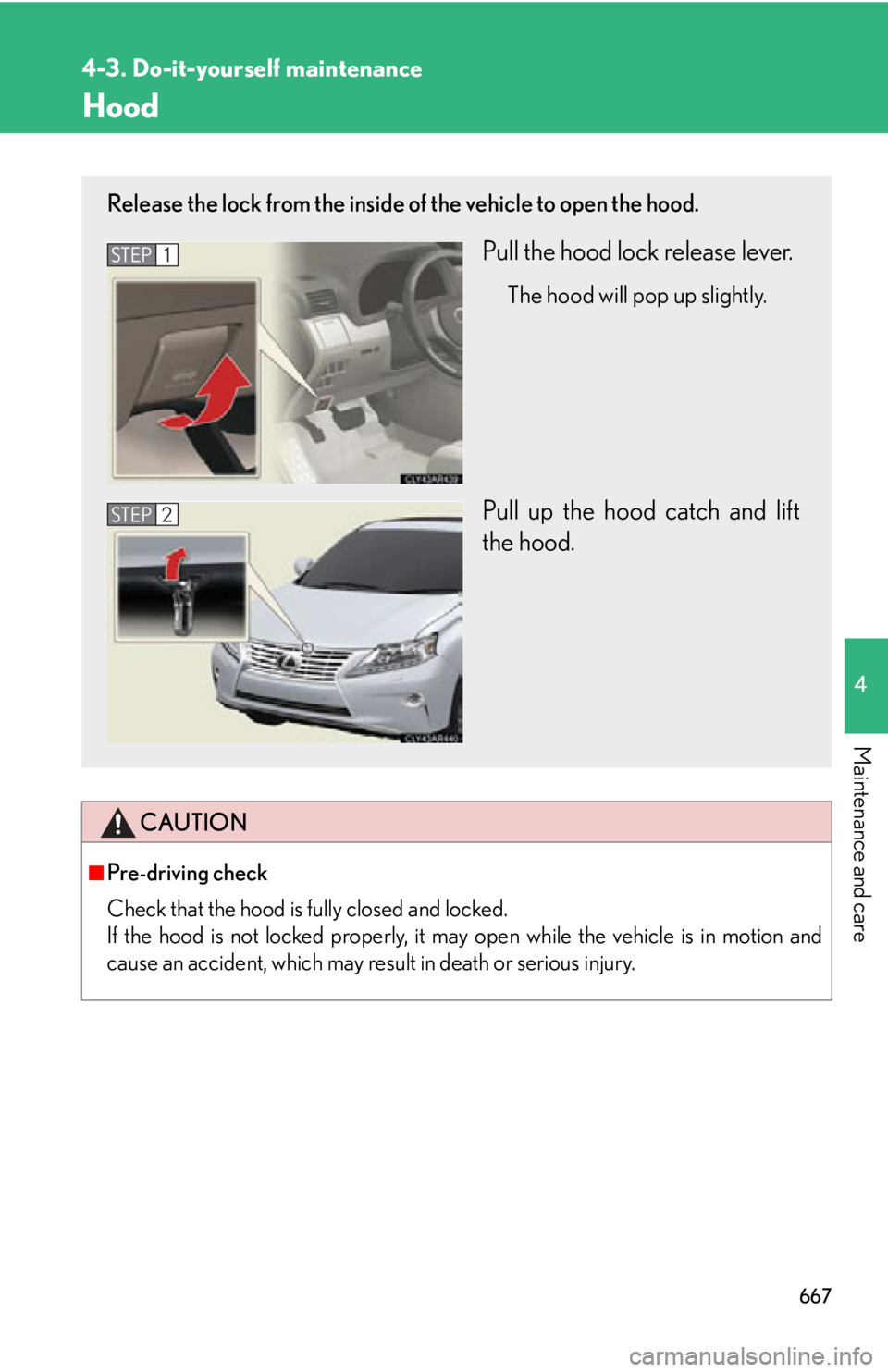
cause an accident, which may result in death or serious injury.Release the lock from the inside of the vehicle to open the hood.
Pull the hood lock release lever. The hood will pop up slightly.
Pull up the hood catch and lift
the hood.STEP 1
STEP 2
Page 680 of 886
6804-3. Do-it-yourself maintenance
■
Brake fluid can absorb moisture from the air
Excess moisture in the brake fluid can cause a dangerous loss of braking efficiency.
Use only newly opened brake fluid.
CAUTION■
When filling the reservoir
Take care because brake fluid can harm your hands or eyes and damage painted
surfaces.
If fluid gets on your hands or in your eyes, flush the affected area with clean water
immediately.
If you still experience discomfort, see a doctor.
NOTICE■
If the fluid level is low or high
It is normal for the brake fluid level to go down slightly as the brake pads wear out or
when the fluid level in the accumulator is high.
If the reservoir needs frequent re filling, may be a serious problem.
Page 682 of 886
6824-3. Do-it-yourself maintenance
CAUTION■
Chemicals in the battery
Batteries contain poisonous and corrosive sulfuric acid and may produce hydrogen
gas which is flammable and explosive. To reduce the risk of death or serious injury,
take the following precautions while working on or near the battery: ●
Do not cause sparks by touching the battery terminals with tools.●
Do not smoke or light a match near the battery.●
Avoid contact with eyes, skin and clothes.●
Never inhale or swallow electrolyte.●
Wear protective safety glasses when working near the battery.●
Keep children away from the battery.■
Where to safely charge the battery
Always charge the battery in an open area. Do not charge the battery in a garage or
closed room where there is insufficient ventilation.■
How to recharge the battery
Only perform a slow charge (5 A or less). The battery may explode if charged at a
quicker rate.■
Emergency measures regarding electrolyte ●
If electrolyte gets in your eyes
Flush your eyes with clean water for at least 15 minutes and get immediate medi-
cal attention. If possible, continue to apply water with a sponge or cloth while
traveling to the nearest medical facility.●
If electrolyte gets on your skin
Wash the affected area thoroughly. If you feel pain or burning, get medical atten-
tion immediately.●
If electrolyte gets on your clothes
It can soak through clothing on to your skin. Immediately take off the clothing and
follow the procedure above if necessary.
●
If you accidentally swallow electrolyte
Drink a large quantity of water or milk. Get emergency medical attention imme-
diately.
Page 686 of 886
6864-3. Do-it-yourself maintenance
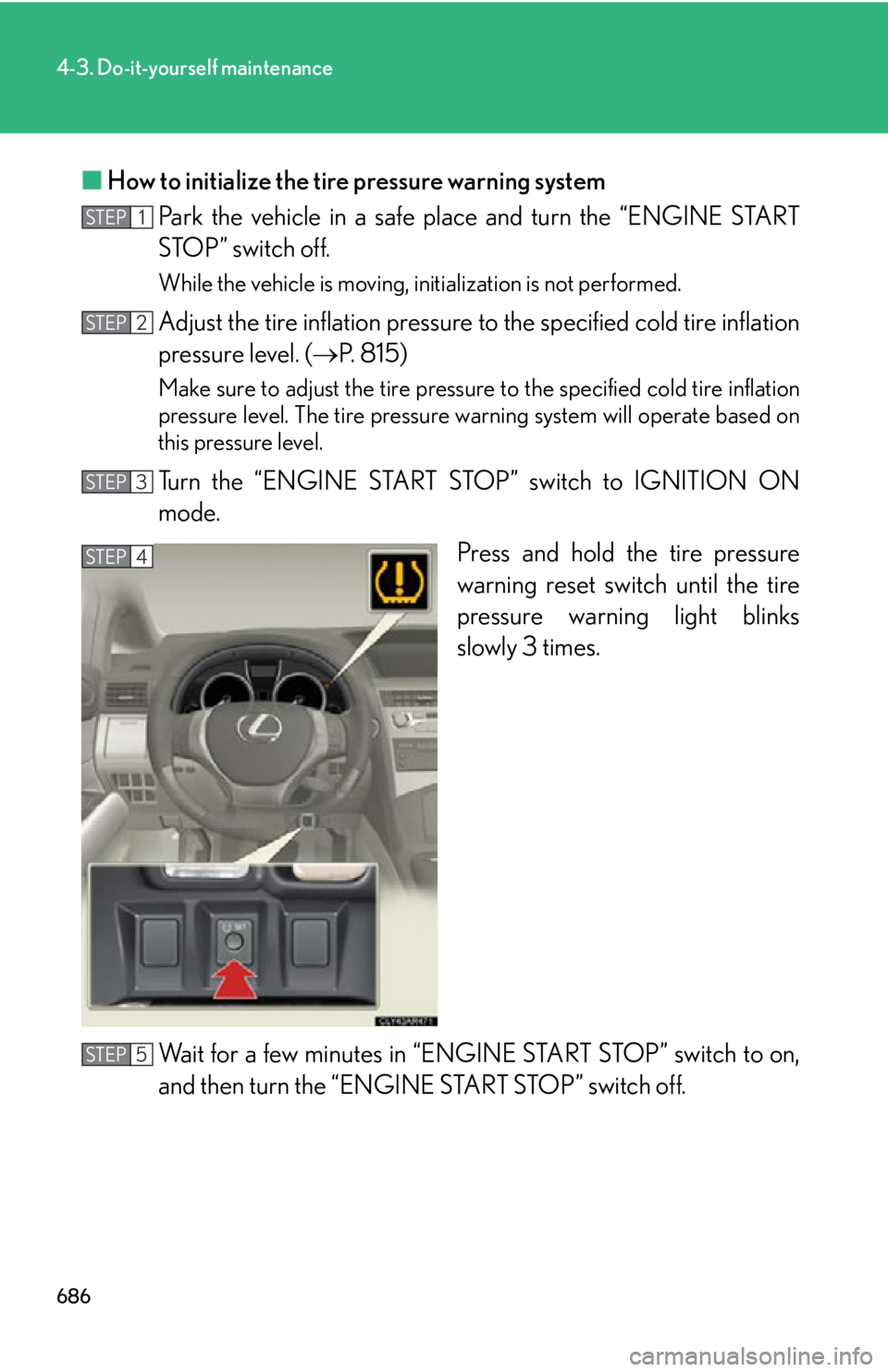
■ How to initialize the tire pressure warning system
Park the vehicle in a safe plac e and turn the “ENGINE START
STOP” switch off. While the vehicle is moving, initialization is not performed.
Adjust the tire inflation pressure to the specified co ld tire inflation
pressure level. ( P. 815)Make sure to adjust the tire pressure to the specified cold tire inflation
pressure level. The tire pressure warning system will operate based on
this pressure level.
Turn the “ENGINE START STOP” switch to IGNITION ON
mode.
Press and hold the tire pressure
warning reset switch until the tire
pressure warning light blinks
slowly 3 times.
Wait for a few minutes in “ENG INE START STOP” switch to on,
and then turn the “ENGINE START STOP” switch off.STEP 1
STEP 2
STEP 3
STEP 4
STEP 5
Page 687 of 886

6874-3. Do-it-yourself maintenance
4
Maintenance and care Registering ID codes
The tire pressure warning valve and transmitter is equipped with a unique
ID code. When replacing a tire pressure warning valve and transmitter, it
is necessary to register the ID code. Ha ve the ID code registered by your
Lexus dealer. ■
When to replace your vehicle’s tires
Tires should be replaced if: ●
You have tire damage such as cuts, splits, cracks deep enough to expose the
fabric, and bulges indicating internal damage.●
A tire goes flat repeatedly or cannot be properly repaired due to the size or
location of a cut or other damage.
If you are not sure, consult with your Lexus dealer.■
Replacing tires and wheels
If the ID code of the tire pressure warn ing valve and transmitter is not registered,
the tire pressure warning system will not work properly. After driving for about 20
minutes, the tire pressure warning light blin ks for 1 minute and stays on to indicate a
system malfunction.■
Tire life
Any tire over 6 years old must be checked by a qualified technician even if it has sel-
dom or never been used or damage is not obvious.■
If the tread on snow tires wears down below 0.16 in. (4 mm)
The effectiveness of the tires as snow tires is lost.■
Routine tire inflation pressure checks
The tire pressure warning system does not replace routine tire inflation pressure
checks. Make sure to check tire inflation pressure as part of your routine of daily
vehicle checks.