Page 2 of 886

TABLE OF CONTENTS Index
21-1. Key information
Keys ..................................................... 30
1-2. Opening, closing and locking
the doors
Smart access system with
push-button start .......................... 35
Wireless remote control .............. 49
Side doors .......................................... 52
Back door ........................................... 56
1-3. Adjustable components
(seats, mirrors,
steering wheel)
Front seats .......................................... 68
Rear seats ........................................... 72
Driving position memory ................ 76
Head restraints.................................. 81
Seat belts ........................................... 83
Steering wheel................................. 90
Anti-glare inside rear
view mirror ...................................... 92
Outside rear view mirrors ........... 95 1-4. Opening and closing the
windows and moon roof
Power windows................................ 98
Moon roof ......................................... 101
1-5. Refueling
Opening the fuel tank cap......... 105
1-6. Theft deterrent system
Engine immobilizer system ........ 110
Alarm.................................................... 112
Theft prevention labels ................. 116
1-7. Safety information
Correct driving posture ............... 117
SRS airbags ....................................... 119
Front passenger occupant
classification system .................. 132
Child restraint sy stems ............... 137
Installing child restraints ............... 1411
Before drivingFor vehicles with a navigation system, refer to the “Navigation System Owner’s
Manual” for information regarding the equipment listed below.
• Navigation system
• Air conditioning controls
• Windshield wiper de-icer
• Rear view monitor system • Intuitive parking assist
• Audio/video system
• Rear window and outside rear view
mirror defogging
Page 29 of 886

Before driving
1
291-1. Key information
Keys .............................................. 30
1-2. Opening, closing and
locking the doors
Smart access system with
push-button start .................... 35
Wireless remote control ......... 49
Side doors.................................... 52
Back door .................................... 56
1-3. Adjustable components
(seats, mirrors,
steering wheel)
Front seats ................................... 68
Rear seats .................................... 72
Driving position memory ........ 76
Head restraints ........................... 81
Seat belts .................................... 83
Steering wheel .......................... 90
Anti-glare inside rear view
mirror ......................................... 92
Outside rear view mirrors ...... 95 1-4. Opening and closing the
windows and moon roof
Power windows .......................... 98
Moon roof .................................. 101
1-5. Refueling
Opening the fuel tank
cap ............................................ 105
1-6. Theft deterrent system
Engine immobilizer
system....................................... 110
Alarm........................................... 112
Theft prevention labels ........... 116
1-7. Safety information
Correct driving posture ......... 117
SRS airbags ............................... 119
Front passenger occupant
classification system............ 132
Child restraint systems ......... 137
Installing child restraints........ 141
Page 105 of 886
1051
Before driving 1-5. Refueling
Opening the fuel tank cap Perform the following steps to open the fuel tank cap:
■ Before refueling the vehicle
● Turn the “ENGINE START STOP” sw itch off and ensure that all
the doors and windows are closed.
● Confirm the type of fuel. ( P. 1 0 7 )
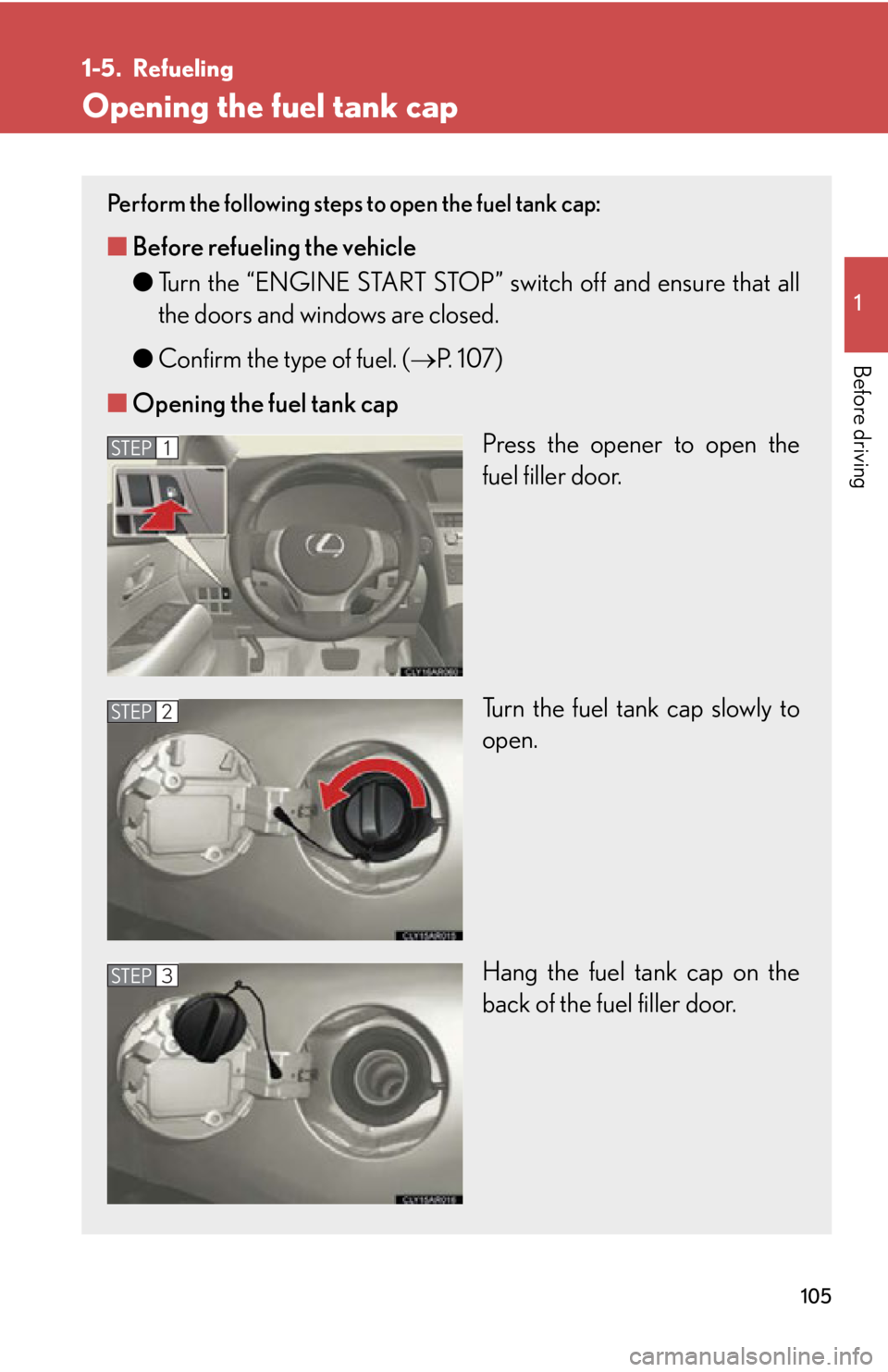
■ Opening the fuel tank cap
Press the opener to open the
fuel filler door.
Turn the fuel tank cap slowly to
open.
Hang the fuel tank cap on the
back of the fuel filler door.STEP 1
STEP 2
STEP 3
Page 106 of 886
1061-5. Refueling
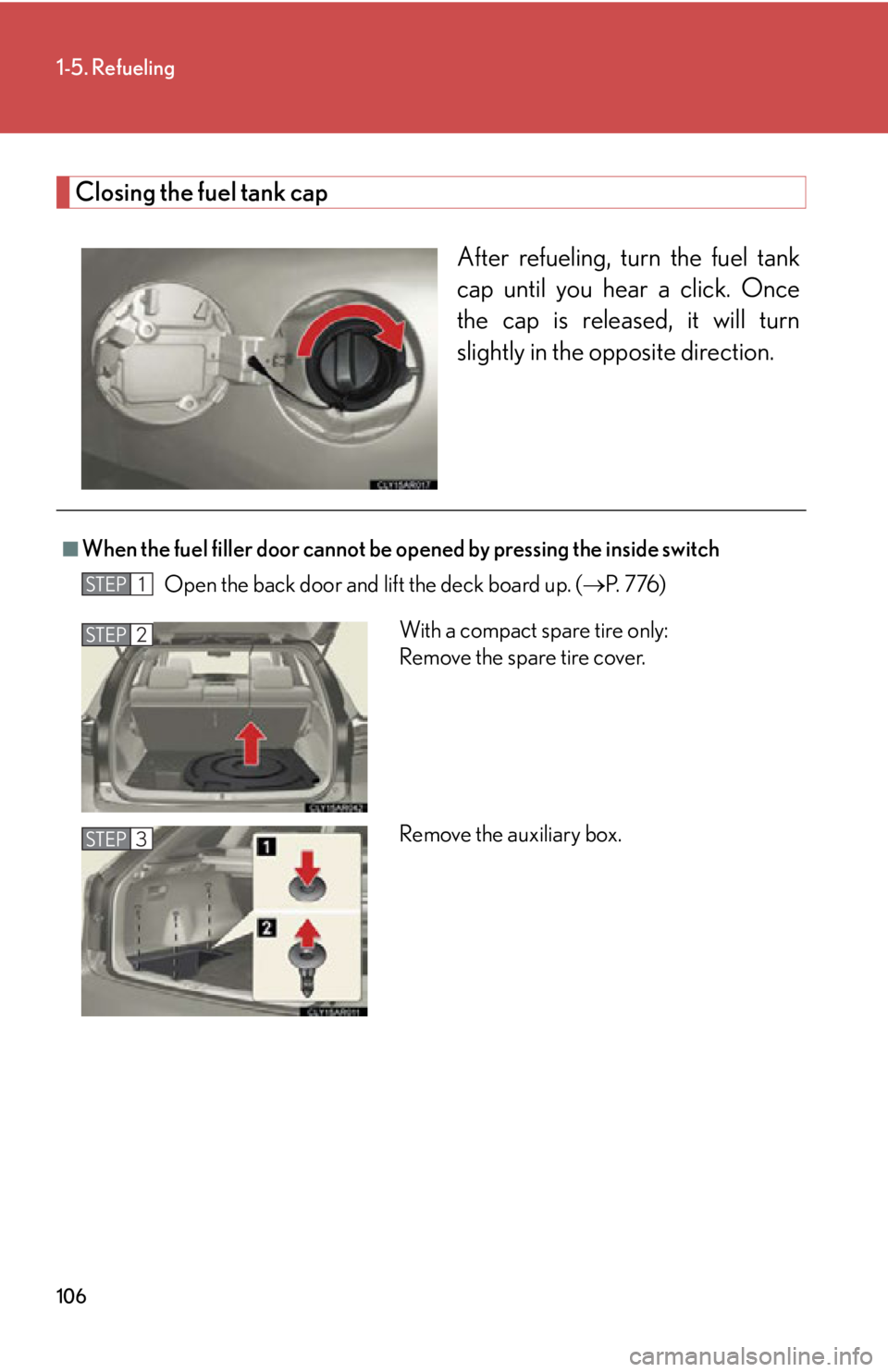
Closing the fuel tank cap
After refueling, turn the fuel tank
cap until you hear a click. Once
the cap is released, it will turn
slightly in the opposite direction.■
When the fuel filler door cannot be opened by pressing the inside switch
Open the back door and li ft the deck board up. ( P. 7 76 )STEP 1
With a compact spare tire only:
Remove the spare tire cover.
Remove the auxiliary box.STEP 2
STEP 3
Page 108 of 886
1081-5. Refueling
CAUTION■
When refueling the vehicle
Observe the following precautions while refueling the vehicle. Failure to do so may
result in death or serious injury. ●
After exiting the vehicle and before opening the fuel door, touch an unpainted
metal surface to discharge any static electricity. It is important to discharge static
electricity before refueling because sparks resulting from static electricity can
cause fuel vapors to ignite while refueling.●
Always hold the grips on the fuel tank cap and turn it slowly to remove it.
A whooshing sound may be heard when the fuel tank cap is loosened. Wait until
the sound cannot be heard before fully re moving the cap. In hot weather, pressur-
ized fuel may spray out of the filler neck and cause injury.●
Do not allow anyone that has not discharged static electricity from their body to
come close to an open fuel tank.●
Do not inhale vaporized fuel.
Fuel contains substances that are harmful if inhaled.●
Do not smoke while refueling the vehicle.
Doing so may cause the fuel to ignite and cause a fire.●
Do not return to the vehicle or touch an y person or object that is statically
charged.
This may cause static electricity to build up , resulting in a possible ignition hazard.■
When refueling
Observe the following precautions to prevent fuel overflowing from the fuel tank: ●
Securely insert the fuel nozzle into the fuel filler neck●
Stop filling the tank after the fuel nozzle automatically clicks off●
Do not top off the fuel tank
■
When replacing the fuel cap
Do not use anything but a genuine Lexus fuel tank cap designed for your vehicle.
Doing so may cause a fire or other incident which may result in death or serious
injury.
Page 296 of 886

2962-5. Driving information
Cargo and luggage
Capacity and distribution
Cargo capacity depends on the to tal weight of the occupants.
(Cargo capacity) = (Total load capa city) — (Total weight of occupants)
Steps for Determining Correct Load Limit
(1) Locate the statement “The combined weight of occupants and cargo
should never exceed XXX kg or XXX lbs.” on your vehicle’s placard.
(2) Determine the combined weight of th e driver and passengers that will
be riding in your vehicle.
(3)Subtract the combined weight of the driver and passengers from
XXX kg or XXX lbs.
(4)The resulting figure equals the av ailable amount of cargo and luggage
load capacity.
For example, if the “XXX” amount equals 1400 lbs. and there will be
five 150 lb passengers in your ve hicle, the amount of available cargo
and luggage load capacity is 650 lbs. (1400 750 (5 150) = 650
lbs.)
(5)Determine the combined weight of luggage and cargo being loaded
on the vehicle. That weight may no t safely exceed the available cargo
and luggage load capacity calculated in Step 4. Take notice of the following information about storage precautions, cargo
capacity and load.
● Stow cargo and luggage in the luggage compartment whenever
possible.
● Be sure all items are secured in place.
● Be careful to keep the vehicle level. Placing the weight as far for-
ward as possible helps maintain vehicle balance.
● For better fuel economy, do not carry unnecessary weight.
Page 663 of 886

6634-2. Maintenance
4
Maintenance and care Emission inspection and maintenance (I/M) programsSome states have vehicle emission inspection programs which include
OBD (On Board Diagnostics) checks. The OBD system monitors the oper-
ation of the emission control system.
■ If the malfunction indicator lamp comes on
The OBD system determines that a problem exists somewhere in
the emission control system. Your vehicle may not pa ss the I/M test
and may need to be repaired. Cont act your Lexus dealer to service
the vehicle.
■ Your vehicle may not pass the I/M test in the following situations:
● When the battery is disconnected or discharged
Readiness codes that are set during ordinary driving are erased.
Also, depending on your driving habits, the readiness codes may
not be completely set.
● When the fuel tank cap is loose
The malfunction indicator lamp comes on indicating a temporary
malfunction and your vehicle may not pass the I/M test.
■ When the malfunction indicator la mp still remains on after several
driving trips
The error code in the OBD system will not be cleared unless the
vehicle is driven 40 or more times.
■ If your vehicle does not pass the I/M test
Contact your Lexus dealer to prep are the vehicle for re-testing.
Page 695 of 886

6954-3. Do-it-yourself maintenance
4
Maintenance and care ■
Effects of incorrect tire inflation pressure
Driving with incorrect tire inflation pressure may result in the following: ●
Reduced fuel efficiency●
Reduced driving comfort and tire life●
Reduced safety●
Damage to the drive train
If a tire needs frequent inflating, have it checked by your Lexus dealer.■
Instructions for checking tire pressure
When checking tire inflation pressure, observe the following: ●
Check only when the tires are cold.
If your vehicle has been parked for at least 3 hours or has not been driven for
more than 1 mile or 1.5 km, you will get an accurate cold tire inflation pressure
reading.●
Always use a tire pressure gauge.
The appearance of the tire can be mislea ding. In addition, tire inflation pressure
that is even just a few pounds off can degrade ride and handling.●
Do not reduce tire inflation pressure after driving. It is normal for tire inflation
pressure to be higher after driving.●
Never exceed the vehicle capacity weight.
Passengers and luggage weight should be placed so that the vehicle is bal-
anced.