2015 AUDI TT ROADSTER ECO mode
[x] Cancel search: ECO modePage 93 of 244
Driving Safely
General notes
Safe driving habits
Please remember -safety first!
This chapter contains important information,
tips, instructions and warnings that you need
to read and observe for your own safety, the
safety of your passengers and others . We have
summarized here what you need to know
about safety belts, airbags, child restraints as
well as child safety. Your safety is for us
priori
ty number 1.
Always observe the information
and warnings in this section - for your own
safety as well as for that of your passengers.
The information in this section applies to all
model versions of your vehicle . Some of the
features described in this sections may be
standard equipment on some models, or may
be optional equipment on others. If you are
not sure, ask your authorized Audi dealer.
A WARNING
- Make certain that you follow the instruc
tions and heed the WARNINGS in this
Manual. It is in your interest and in the
interest of your passengers.
- Always keep the complete Owner's Liter
ature in your Audi when you lend or sell
your vehicle so that this important infor
mation will always be available to the
driver and passengers.
- Always keep the Owner's literature handy
so that you can find it easily if you have
questions.
Safety equipment
The safety features are part of the occupant
restraint system and work together to help
reduce the risk of injury in a wide variety of
accident situations .
Your safety and the safety of your passengers
should not be left to chance. Advances in
technology have made a variety of features
available to help reduce the risk of injury in an
Driving Safely 91
accident. The following is a listing of just a
few of the safety features in your Audi:
- sophisticated safety belts for driver and all
passenger seating positions,
- safety belt pre-tensioners,
- front airbags,
- knee airbags for the front seats,
- side airbags in the front seats,
- LATCH anchorages for child restraints,
- adjustable steering column.
These individual safety features can work to
gether as a system to help protect you and
your passengers in a wide range of accidents.
These features cannot work as a system if
they are not always properly adjusted and
properly used!
Safety is everybody's responsibility!
Important things to do before driving
Safety is everybody's job! Vehicle and occu
pant safety always depends on the informed and careful driver.
For your safety and the safety of your passen
gers,
before driving always:
~ Make sure that all lights and signals are op
erating correctly .
~ Make sure that the tire pressure is correct.
~ Make sure that all windows are clean and af
ford good visibility to the outside.
~ Secure all luggage and other items carefully
c::> page 65.
~ Make sure that nothing can interfere with
the pedals.
~ Adjust front seat, head restraint and mirrors
correctly for your height .
~ Instruct passengers to adjust the head re
straints according to their height .
~ Make sure to use the right child restraint
correctly to protect children¢
page 129,
Child Safety.
~ Sit properly in your seat and make sure that
your passengers do the same¢
page 59,
General recommendations. .,..
•
•
Page 124 of 244

122 Airbag sys te m
- Never modify t he front bumper or parts
of the veh icle body .
- Always make sure that the side airbag
can inflate without interference:
- Never install seat covers or replace
ment upholstery ove r the front seat
backs that have not been spec ifi cally
approved by A udi.
- Never use add itiona l seat cushions that
cover the areas whe re the side airbags
inflate .
- D amage to the o rigina l seat covers or
to the seam in the area of the side air
bag module must always be repaired
immediately by an authorized Audi
dealer.
- The airbag system can be activated only once . Afte r an airbag has inf lated, it
must be replaced by an author ized Audi
dealer or qualified technic ian who has
the techn ica l information, tra ining and
special equipment necessary.
- The airbag system can be deployed only
once. After an a irbag has been deployed,
it must be replaced w ith new replace
ment parts designed and approved espe
cially for your Aud i model version. Re
placement of complete a irbag systems
or airbag componen ts must be per
formed by qualified workshops only .
Make sure that any airbag service act ion
is entered in your Audi Warranty
& Main
tenance booklet under
AIRBAG REPLACE
MENT RECORD.
-For safety reasons in severe accidents,
the a lternator and starter are separated
from the vehicle battery with a pyrotech
nic circuit interrupter.
- Work on the pyrotechnic cir cuit inter
rupter must on ly be performed by a
qua lified dealer - risk of an accident !
- If the vehicle or the c ircuit interrupter
is sc rapped, all applicable safety pre
cautions must be followed.
{® For the sake of the environment
Undeployed airbag modules and preten
s ioners might be classif ied as Perchlorate
Materia l -special handling may app ly, see
www .dtsc.ca.gov/hazardouswaste/per
ch lorate . When the veh icle or parts of the
restraint system including airbag modu les
and safety belts with pretensioners are
scra pped, all applicab le laws and regu la
tions must be obse rved. Your authorized
A udi dealer is familia r with these require
ments and we recommend that you have
your dealer perform this service fo r you .
· Other things that can affect Advanced
Airbag performance
Chang ing the veh icle's suspens io n system can
change the way that the Advanced Airbag Sys
tem perfo rms in a c rash. For examp le, using
t ir e- rim combinat ions not approved by A udi ,
lower ing the veh icle, c hanging the st iffness of
the suspens ion, including the spr ings, suspen
sio n struts, shock absorbers etc . can change
the forces that ar e measured by the airbag
sensors and sent to the electronic contro l
unit. Some suspension changes can, for exam
ple, increase the force levels measured by the
senso rs and make the airbag system deploy in
c rashes in which it wou ld no t deploy if the
c h anges had not been made. Other kinds of
c h anges may reduce the fo rce leve ls meas
u red by the sensors and p reven t the airbag
from dep loying when it should.
A WARNING
Changing the vehicle's suspension includ
i ng use of unapproved tire-rim combina
tions can change Advanced Airbag per
fo rmance and increase the r isk of serious
personal injury in a crash .
- Never install suspension components
that do not have the same performance characterist ics as the components origi
na lly installed on your vehicle .
- Never use tire-rim combinations that
have no t been approved by Audi.
Page 133 of 244

typical 1 year-old chi ld, the Advanced Airbag
System compares the weig ht meas ured by the
weight sensing mat with t he informat ion stor
ed in the electron ic control unit.
The electronic control unit a lso registers the
tension on the front passenger safety be lt.
The tens ion on the safety belt for the front
passenger seat will be different for an adult
who is properly using the safety belt as com
pared to the tension on the be lt when it is
used to attach a child restraint to the seat.
The sensor below the latch for the safety be lt
for the front seat passenger measu res the
tension on the be lt. T he inp ut from this sen
sor is then used with the we igh t to "decide",
whether there is a chi ld restraint with a typica l
1 year-old child o n the front passenger seat
and whether or not the airbag must be turned
off.
Child restraints and Advanced Airbags
Regardless of the child restraint that you use,
make sure that it has been ce rtified to meet
United States Federal Motor Vehicle Safety
Standa rds and has been certified by its manu
facture r fo r u se wi th a n air bag. If in excep
tional c ircu ms tances you m ust use it on the
front passenger seat, caref ully read all of the
i n formation on c hild safety and Advanced Air
bags and heed all of the app licable WARN
INGS. Make certain that the child restraint is
correctly recognized by the weig ht-sensing
mat inside the front passenger seat, that the
fro nt passenger airbag is tur ned off and that
the airbag status is a lways correctly signaled
by the
PASSENGER AIR BAG OFF light.
Many types and models of child restra ints
h ave been ava ilable over the years, new mod
e ls are introduced regularly incorporating new
and improved designs a nd older models a re
t aken out of p rod uction. Child restrain ts are
not standardized . Ch ild restra ints o f the same
type typically have different weights and sizes
and diffe rent 'footprints,' the size and shape
of the bottom of the child restraint that sits
on the seat, when they are installed on a vehi
cle seat. These differences make it virtually
Child Sa fet y 131
impossible to certify comp liance with the re
quirements for advanced airbags with eac h
and every child restra int that has ever been
sold in the past or will be sold over the course
of the useful life of your veh icle.
Fo r th is reason, the United States National
Highway Traffic Safety Adm inistrat ion has
published a list of spec ific type, makes and
models of child restraints that must be used
to certify compliance of the Advanced Airbag
System i n your veh icle with the suppression
requirements of Federal Motor Vehicle Safety
Standard 208. These child re straints are:
Subpart A -Car bed child restraints
Model Manufactured on or
after
Angel Guard Angel September 2S, 2007 R ide AA 2403FOF
Subpart B - Rear-facing child restraints
Model Manufactured on or
after
Ce ntury Smart Fit Decembe r 1, 1999
4S 43
Cosco Ar riva September 2S, 2007
22-013PAW and base
22-999WHO
Evenflo Discovery Ad -December 1, 1999
just Right 212
E ven flo First Choice Decembe r 1, 1999
20 4
Graco Infant 8457 December 1, 1999
Graco Snugride September 25, 2007
Peg Perego Primo Vi- September 25, 2007
aggio SIP IMUNOOUS
Subpart C -Forward-facing and
convertible child restraints
Model Manufactured on or
after
Br itax Roundabout September 2S, 2007
E 9L02xx
Cosco Touriva 02519 December 1, 1999
•
•
Page 154 of 244

152 Driving and en vironm ent
Avoid full throttle
Driving at moderate speeds saves fuel and
improves your mileage .
"'Try and keep well below your car 's maximum
speed.
Accelerating gently reduces fuel consump
tion, engine wear, and does not disturb the
environment. F ue l consumption, exhaust emissions and en
gine no ise increase disproportionately at high
speeds. If you drive at approximately three
quarters of top speed, fuel consumption will be reduced by one half. Never dr ive faster
than the posted speed limit and weather con
d itions permit .
Reducing unnecessary idling
Even when your car is just idling it burns up
fuel.
"'Shut the engine off when you are not driv ing
the vehicle .
"'Do not warm up the veh icle by letting the
engine run at idle .
It makes sense to shut
off the e ngine in traff ic
jams, when waiting for trains to pass at ra il
road crossings , or at traff ic lights that have
l ong wa its on red. Turning the engine
off fo r
just
30-40 seconds saves more fue l than is
burned s tarting the eng ine again .
It takes a long time for the engine to warm up
fully when it is running at idle . Howeve r, wear
and nox ious em issions are especially high
when the engine is warming up. So you should
drive away as soon as you start the engine and
avoid running at high RPMs while the engine
is sti ll warming up.
([) Note
Do not leave engine idling unattended af
ter starting . If warning lights should come
on to indicate improper operation, they
wou ld go unheeded. Extended idling also
produces heat, which cou ld result in over- heating or other damage to the vehicle or
other property .
Regular maintenance
A badly tuned engine unnecessarily wastes a
lot of fuel.
"' Have your ve hicle serviced at reg ular in ter -
vals.
By having your veh icle regu la rly serviced by an
Audi dealer he lps to ensure that it runs p rop
erly and economically. The condition of your
vehicle not only affects its sa fety and ability to
hold its val ue, it also affects
fuel con sum p
tion .
Check your oil e ach time you fill your t ank .
The amount of o il used is related to engine
load and speed .
It is normal for the oil consumption of a new
engine to reach its lowest value after a certa in
mileage has been driven.
You must drive your veh icle about 3,000 m iles
(5,000 kilometres) before you can properly
assess oil consumpt ion.
This also app lies to fue l cons umption and en
gine output.
(D Note
- Have your vehicle maintained proper ly
and in accordance with the service rec
ommendations in your Warranty
& Main
tenance booklet. Lack of proper ma inte
nance as well as improper use of the ve
hicle will impair the function of the
em iss ion contro l system and cou ld lead
to damage.
- Do not alter or remove any component of
the Emission Control Sys tem unless ap
proved by the manufacturer.
- Do not alte r or remove any device, such
a s hea t sh ie lds, switches, ig nition w ires,
valves, which are designed to protec t
your vehicle's Emission Control System
and other impo rtant vehicle compo
nents .
Page 173 of 244

@ For the sake of the environment
-Before changing your oil, first make sure
you know where you can properly dispose
of the used o il.
- Always dispose of used engine oil proper
l y. Do not dump it on garden soi l, wood
ed areas, into open streams or down
sewage dra ins.
- Recycle used engine oil by taking it to a
used engine oil collection facility in your
area, or contact a service station .
Engine cooling system
Coolant
The engine coolant performs two functions: it
keeps the engine from overheating and it pro tects the engine from freezing in the winter.
The cooling system is sea led and generally re
q uir es lit tle atten tion .
The cooling system has been filled at the fac
tory with a pe rmanent coo lant which does not
need to be c hanged. The coolant consists of a
mixture o f spec ial ly conditioned water and the
manuf acturer 's glyco l-basedcoolan t addi -
tiv e G13 antifreeze with ant icorros ion addi
tives (50% for USA models ; 60% for Canadian
mod els) . This mixture both assures the neces
sary
frost protection and p rotects metal com
ponents in the engine's coo ling system from
corrosion and scaling . It a lso raises the boil
i ng point of the coolant .
Do not reduce the concentration o f the coo l
ant in the summer by adding plain water.
The
proportion of coolant add it ive must be at
l e a st 50 % but not mor e than 60 %
to main
tain antifreeze protection and coo ling efficien
cy .
If the coolant frost protect io n is too low,
the coolant cou ld free ze and dam age the veh i
cle heating and eng ine cooling system.
For yea r-round driving, antifreeze is added at
the fac to ry for tempera tures down to:
-- 31°F( -35°C)USA
- -40 °F ( -40 °C) Canada.
Checkin g and fillin g 171
If you must add coo lant, use a mixture of wa
ter and coolant additive . Mix ing the coo lant
additive with distilled water is recommended.
_& WARNING
Before you c heck anything in the engine
compartment, always read and heed a ll
WARNINGS
c> .& in Working in the engine
comportment on page 164.
Q) Note
- Before winter sets in, have the coo lant
checked to see if the coolant additive in
your vehicle is sufficient to meet the cli mate condi tions. This is especi ally impor
tan t if you live i n a region wher e th e win
ter is ex treme ly co ld . If necessary, i n
crease t he p ropo rtion of coo lant add itive
to 60% .
- Whe n ad ding coolant additive t o yo ur
c ooling sys tem, reme mbe r:
- We recommend using on ly coolant ad
d itive G12++ or G13 for your vehicle .
This coolant additive is availab le at au
thor ized Audi dealers . O ther types of
a ntifreeze can s ignifica ntly reduc e cor
rosion prote ction. The result ing cor ro
sion can cau se a loss o f coolan t and se
rio us engine d amage .
- Do not add any ty pe of rad iator leak seal
a nt to yo ur vehicle 's engine c oolant .
A dd ing radia tor repair fl uid may adverse
ly affect the f unction and pe rformance of
your coolin g system and co uld resu lt in
damage not covered by your New Ve hicle
L imited Warranty.
-
•
•
Page 176 of 244

17 4 Che cking and filling
Brake fluid
Checking brake fluid level
Fig . 133 Engine compa rtment: cove r on the brake fluid
reservo ir
Before you check anything in the engine com
partment,
a lw ays read and h eed all WA RN
ING S ¢&. in Working in the engine compart
ment on page 164.
,.. Read the brake fluid level from the brake
fluid reservoir¢
page 166, fig . 128. T he
brake flu id leve l must be between the "MIN"
and "MAX" markings.
The brake flu id rese rvo ir is located behind the
rear part ition of the eng ine compartment o n
the left side ¢
page 166.
The fluid level may drop slightly after some
time due to the automatic adjustment of the b rake pads . This is not cause for alarm.
If the brake fluid level falls
considerably be
low the "MIN" mark, the brake warning/indi
cator light (U.S. models: . , Canadian mod
e ls: . ) w ill come on
¢page 14. Do not con
tinue to operate the vehicle. The comp lete
brake system shou ld be thoroughly checked
by an authorized A udi dealer or other quali
fied facility and the cause corrected.
If the
brake fluid level is too low, the brake warn ing/
indicator light w ill illuminate. Contact an au
thor ized Audi dealer
imm ediatel y.
Changing brake fluid
Have the brake fluid changed by an experi
enced technician .
Brake fluid absorbs moisture from the air. If
the water content in the brake fluid is too high, corrosion in the brake system may result
after a period of time . The boiling point of the
brake flu id will also decrease conside rably and
decrease braking pe rformance.
Therefore, the brake fluid must be changed
eve ry two y ears. Always use new brake flu id
which conforms to Federal Motor Veh icle
Standard "F MVSS 116 DOT 4".
The brake fluid reservoir can be diff icult to
reach, therefore, we recommend that you
have the brake fluid changed by your author
ized
Audi dealer . Your dealer has the correct
tools, the right brake fl uid and the know -how
to do this for you.
A WARNING
- Brake fluid is poisonous . It must be stor
ed only in the closed original container
out of the reach of children!
- Brake failure can resu lt from o ld or inap
propriate brake flu id. Observe these pre
cautions:
- Use only brake f luid that meets SA E
specifica tion
J 1 7 03 and conforms to
Federa l Moto r Ve hicl e Standard 1 16.
Always check with yo ur authorized Aud i
dealer to make sure yo u are using the
correct brake fluid. The correct type of brake f lu id is also ind icated on the
brake flu id reservoir.
- The brake fluid must be new. Heavy use
of the brakes can cause a vapor lock if
the brake fluid is left in the system too
l ong. This can seriously affect the effi
c iency of the brakes as well as your
safety. This cou ld resu lt in an accident.
(D Note
Brake fluid will damage the paint of your
vehicle .
Page 187 of 244
Tires an d wheel s 185
you have stored. The system does not
recognize the load condition of your vehicle.
The effectiveness of the ti re pressu re monitor
ing sys tem w ill be impaired if you store no r
mal load pressures but then operate the vehi
cle at its maximum load¢,&.
See the illustration¢
fig. 136 for the location
of the label on dr iver's side B-pillar (color of
the actual labe l and exact location on the ve
hicle wi ll vary slig htly) .
Note that the fo llowing tab le is accurate at
the t ime o f go ing to press and is subject to change. In the
event of discrepancies, the ti re
pressure label (on driver's side B-pi llar) always
takes precedence .
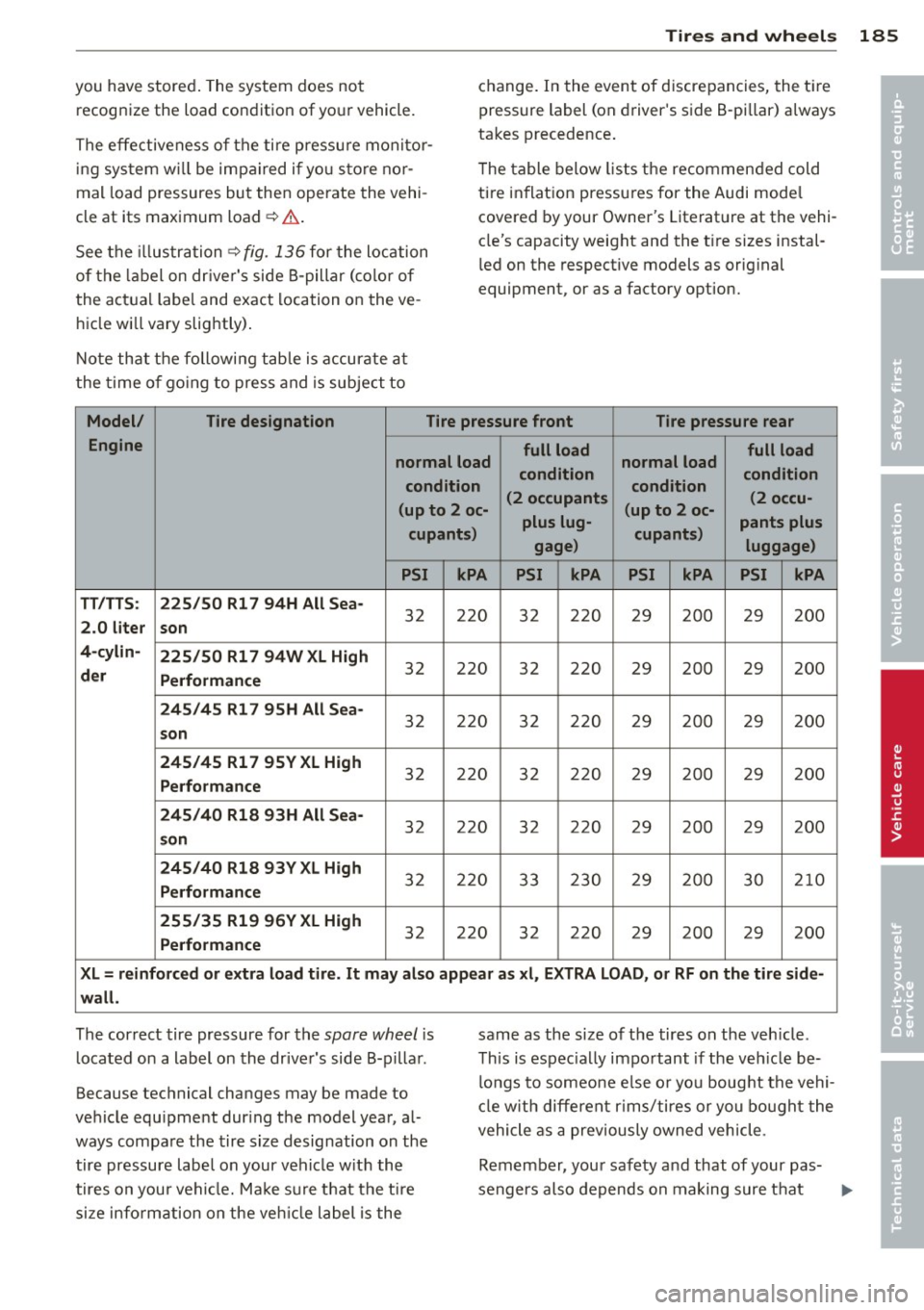
T he table below lists the recommended cold
ti re inflation pressures for the Audi mode l
covered by your Owner's Literature at the vehi
cle's capacity weight and the t ire sizes instal
led on the respective models as orig inal
equipment, or as a factory option.
Model/ Tire designation Tire pressure front Tire pre ssure rear
Engine full load full load
normal load condition normal load
condition
condition
(2 occupants condition
(2 occu-
( upto 2 oc-
plus lug- (
up to 2 oc-
pants plus
cupants) gage ) cupants)
luggage)
PSI kPA PSI kPA PSI kPA PSI kPA
TT /TI S: 225 /50 Rl 7 94H All Sea -
32 220 32 220 29 200 29 200 2.0 liter son
4-cyl in-
225/50 Rl 7 94W XL Hi gh
d er
Perf or man ce
32 220 32 220 29 200 29 200
24 5/ 45 Rl 7 95 H All S ea-
32 220 32 220 29 200 29 200 son
245 /45 R1 7 95YX L High
32 220 32 220 29 200 29 200 Performance
245 /40 R18 93H All S ea-
32 220 32 220 29 200 29 200 son
2 45 /40 R18 93Y XL High
32 220 33 230 29 200 30 210 Perf or mance
255 /35 R19 96 Y XL High
32 220 32 220 29 200 29 200
Perfo rmance
X L= r einf orced or extra lo ad tire. It ma y al so app ear a s xl, EX TR A LO AD, or RF on the tir e side-
wa ll.
The correct tire pressure for the spare wheel is
located on a label on the driver's side B-pillar.
Because technical changes may be made to
vehicle equ ipment during the model year, al
ways compare the tire size designation on the
tire pressure label on your vehicle w ith the
tires on your vehicle. Ma ke sure that the tire
size information on the veh icle label is the same
as the size of the tires on the veh icle.
Th is is espec ially important if the veh icle be
longs to someone else o r you boug ht the vehi
cle w ith diffe rent rims/tires or you bought the
vehicle as a prev iously owned vehicle.
Remember, your safety and that of your pas-
sengers also depends on making sure that
IJll,
•
•
Page 199 of 244
snow c hains are suitably cove red . Check
the position of the snow chains after
driving a few yards and correct if neces
sary. Follow the instructions from the
snow cha in manufacturer when doing so.
Where snow cha ins are mandatory oncer
tain roads, this normally also applies to
veh icles with all-wheel dr ive.
Wheel bolts
Wheel bolts must always be tightened to the
correct torque.
The design of whee l bolts is matched to the
factory insta lled r ims . If different rims are fit
ted, the correct wheel bo lts with the right
length and correctly shaped bolt heads must
be used. This ensures t hat wheels are fitted
securely and that the brake system functions
correctly .
In certain circumstances, you may not use
wheel bo lts from a different vehicle -even if it
i s the same model
¢ page 227.
A WARNING
Imprope rly tig htened or maintained wh eel
bolts can become loose ca using loss of
con trol, a collision and serious person al in
jury.
- Always keep the w heel bolts and the
threads in the wheel hubs clea n so the
wheel bolts can tu rn easily and be p rop
er ly tightened .
- Never grease or oil the wheel bo lts and
the threads in the wheel hubs. They can become loose w hile driving if greased or
o iled, even if tig htened to the specif ied
torque.
- Only use whee l bolts that belong to the
rim being installed.
- Never use different whee ls bolts on your
vehicle.
- Always maintai n the co rrect tig htening
torq ue fo r the wheel bo lts to reduce the
risk of a wheel loss. If the tightening tor-
Tire s an d wheel s 197
que of t he whee l bolts is too low, they
can loosen and come out when the vehi
cle is mov ing. If the tig htening torq ue is
too high, the wheel bolts and threads
can be damaged and the whee l can be
come loose.
(D Note
The specified torque for the whee l bolts is
90 ft lb (120 Nm) with a tolerance of± 7,4
ft lb(± 10 Nm). Torq ue whee l bolts diago
nally. After changing a whee l, the tor que
must be checked as soon as possible with a
torq ue w rench -prefe rably by an au thor
iz ed A udi de aler or qu alified workshop .
Low aspect ratio tires
Your Audi is factory -eq uipped w ith low aspect
r atio tires . These tires have been tho roughly
tested and been se lected specifically for your
model for their superb performance, road fee l
and handli ng under a var iety of driving condi
tions . Ask your authorized Audi dealer for
more d etails.
The low aspect ratio of these t ires is ind icated
by a numeral of
55 or less in the tire's s ize
designation . The numeral represents the ratio
of the t ire's sidewa ll height in relation to its
t read width exp ressed in pe rce ntage. Conven
t iona l tires have a he ight/w idth rat io of 60 or
more.
The performanc e of low-a spect-ratio tire s is
particularly sensitive to impr oper inflation
pre ssure .
It is therefore important that low
a spect ratio tire s are inflated to the specified
pres sure and that the inflation pressure is
regularly checked and maintained. Tire pre s
sures should be checked at least once a month and always befo re a long trip
¢ page 186, Checking tire pressure.
What you can do to avoid tire and rim
damage
Low aspect ratio tires can be damaged mo re
easily by impact w it h potholes, curbs, gul lies ..,.
•
•