2015 AUDI TT ROADSTER roof
[x] Cancel search: roofPage 43 of 244
Convertible top
Convertible top
General information
The comprehensively engin eered design of the
f abric convertib le top a llows it to be operated
qu ickly and simply. When open, the convert i
b le top is stowed completely in a tonneau pro
vided spec ifically for this purpose.
I n normal operating conditions, the converti
b le top is wind -and waterp roof. Under certa in
circumstances, a small quantity o f droplets
might form, but on ly in extremely inclement
weather, e.g . torrentia l or contin uous heavy
rain. This is normal and not a cause for con
cern.
F ollow the care instructions
Q page 154 to
maintain the convertible top's attractive ap
pearance and to keep it wind- and waterproof.
Please follow these instructions as well:
- Stow and open the convertib le top only
when it is clean. When the top is folded
away, sharp-edged contaminants can build
up as silt and cause wear spots o n the rear
window, which may damage the convertible
top over time. Of course, ice and snow should also be removed before open ing the
convertible top.
- Under no c ircumstances should you use
sharp-edged or abrasive objects to remove
ice and snow . Use a commerc ial ice scraper
to remove ice from o f the rear window.
- T he convert ible top should be opened only if
it is complete ly d ry. If the convertib le top is
opened and then stored wet, unattractive
indentations may develop . In addition, over
time, mold and mildew stains can develop.
- Do no t leave the convertible top open for
several weeks at a time; instead, open and
close it from time to time so that the fabric
does not disco lor where it folds, and to pre
vent creases from forming. This is espec ially
important if it happens to be stowed wh ile
still damp on occasion.
- Because the fabric becomes less flexible
when temperatures drops below zero, we
Convertible top 41
recommend not operating the convertible
top below O°C.
A WARNING -
- When operat ing the convertible top,
make sure that any external factors (e.g.
the wind) do not impair its funct ion or
e ndanger other drivers.
- Never drive wh ile the convertib le top is
not properly secured. Otherwise , it may
be pulled open by the wind. This can
cause injur ies and damage to the vehicle
- danger of an accident!
- When opening and closing the converti-
ble top make sure to keep yourself and
o thers clear of a ll movi ng pa rts. Risk of
in jur y!
d) Note
-Always make su re that there is enough
clearance above the veh icle so that the
c onvertib le top is not damaged when
opening and clos ing.
- Do not place any objects in the tonneau
t o avoid damage when open ing the con
ver tible top.
(D Tips
- Th e convert ible top should be operated
only wi th the ign ition sw itched on.
- When pa rking the ca r with the convert i
ble top open, bear in mind t hat the vehi
cle's in terior is not p rotec ted fro m dam
age due to unexpec ted weather condi
tions, o r unauthorized access . It is there
fore advisab le to close the convertib le
top before leaving the veh icle. If objects
are left inside the vehicle, they should be
locked in the luggage compartment.
Page 112 of 244
110 Airbag sys te m
Safety Standard 208 as applicable at the time
your vehicle was manufactured.
The Standard requires the front a irbag on t he
passenger side to be turned off ("sup
pressed") if a child up to about one year of
age restrained in one of the rear-facing or for
ward -facing infant restra ints listed in Federal
Motor Vehicle Safety Standard 208 with which
the Advanced A irbag System in your vehicle
was certified has been installed on the front passenger seat . For a listing of the child re
straints that were used to certify compliance
with the US Safety Standard¢
page 131.
The PASSENG ER AIR BAG OFF light in the in
strument panel tells you when the front Ad
vanced A irbag on the passenger side has been
turned off by the e lectronic control unit.
Each t ime you turn on the ignition, the
PAS
SENGER AIR BA G OFF
light w ill come on for a
few seconds and:
- will stay on if the front passenger seat is not
occupied,
- will stay on if there is a small child or child
restraint on the front passenger seat,
- wi ll go off if the front passenger seat is oc
cupied by an adult as registered by the
weight-sensing mat
¢ page 118, Monitor
ing the Advanced Airbag System .
The PASSEN GER AIR BAG OFF light comes on
when the control un it detects a total weight
on the front passenger seat that requires the
front airbag to be turned off .
If the tota l weight on the front passenger
seat is more than that of a typical 1 year-old
child but less than the weight of a small
adult, t he front airbag on the passenger s ide
can dep loy (the
PAS SENGER AIR BAG OFF
light does not come o n). If the PASSENGER
AIR BAG OFF
l igh t does not come on , the
front airbag on the passenger side has not
been turned off by the electronic control unit
and can dep loy if the control unit senses an
impact that meets the conditions stored in its
memory .
For example , the airb ag ma y depl oy if :
- a small ch ild tha t is heav ier than a typical 1
year-old chi ld is on the front passenger seat
(regard less of whether the child is in one of
the child safety seats listed
¢ page 131), or
- a child who has outgrown child restraints is
on the front passenger seat.
If the front passenger airbag is turned off, the
PASSENGER AIR BAG OFF light comes on in
t h e instr ument pane l and stays on.
T he front airbag on the passenge r side may
not dep loy (the PASSENGER AIR BAG OFF
li ght does not illum inate and stay lit) even if a
small adult or teenager, or a passenger who is
not sitt ing upright w ith their back against a
non-recl ined backrest w it h their feet on the
vehicle floor in front of the seat is on the front
passenger seat¢
page 92, Proper seating po
sition for the driver .
If the front passenger airbag deploys, the
Federal Standard requ ires the airbag to meet
the "low risk" deployment cr iteria to reduce
the risk of injury th rough interact ion w ith the
airbag. "Low risk" deployment occurs in those
crashes that ta ke pla ce at lower dece le rat io ns
as de fined in t he electronic control uni t
¢ page 119, PASSENGER AIR BAG OFF light.
Always remember, a child safety seat or infant
ca rrier in stalled on the fron t seat may be
stru ck and knoc ked out of posit ion by the rap
idly in flat ing passenger 's airbag in a fronta l
collision. The a irbag co uld great ly red uce the
effectiveness of the ch ild restraint and even
seriously in jure the chi ld during inflation .
A WARNING
-
A child in a rearward-fac ing ch ild safety
seat installed on the front passenger seat
will be serious ly injured and can be killed if
the front airbag inflates -even with an Ad
van ced A irbag System.
- The inflating airbag will h it the ch ild
safety seat or infant carrie r with great
for ce and will smash the child safety seat
a nd child ag ai nst t he backrest, door or
roof.
Page 113 of 244
-Never install a rearward facing child
safety seat on the front passenger seat
unless the
PAS SEN GER AIR BAG OFF
light comes on and stays on. If the PA S
SEN GER AIR BA G OFF
light does not
com e on an d stay on th e inflating airbag
will hit the child safety seat or inf ant ca r
rier with great force and will smash the
child safety seat and child against the
backrest, door or roof . Have the airbag
system inspected immediately by your
authorized Audi dealer .
- Forward-facing chi ld safety seats instal
led on the front passenger's seat may in
terfere with the deployment of the air bag and cause serious personal injury to
the ch ild.
A WARNING
If, in exceptional c ircumstances, you must
install a forward-facing child restra int on
the front passenger's seat:
- Always make sure the forward-fac ing
seat has been des igned and certified by
its manufacturer for use on a front seat
with a passenger front and side airbag.
- Never put the forward-facing child re
straint up aga inst or very near the instru
ment pane l.
- Always move the passenger seat into its
rearmost position in the seat's fore and
aft adjus tment range, as far away from
the a irbag as poss ible be fore installing
the forward -facing child restraint. The
backrest m ust be adjusted to an upright
posit ion.
- Make sure that the
PASSENGER AIR BAG
OFF
light comes on and stays on all the
t ime whenever the ignition is switched
on.
A WARNING
To reduce the risk of serious injury, make sure that the
PASSENGER AIR BAG OFF
light will be d isplayed whenever a ch ild re
st raint is installed on the front passenger
seat and the ig nit io n is switched on.
A irbag system 11 1
-If the PASSENGER AIR BAG OF F light
does not stay on, perform the checks de
scribed
c> page 118, Monitoring the Ad
vanced Airbag System .
-Have the airbag system inspected by
your Aud i dea ler immediately.
-Always carefully follow instructions from
child restraint manufacturers when in
stalling ch ild restra ints .
A WARNING
--=
If, in except ional circumstances, you must
install a forward o r rearward-facing child
restra int on the front passenger's seat:
- Improper installation of ch ild restraints
can reduce their effectiveness or even prevent them from providing any protec
tion.
- An improperly installed ch ild restra int
can interfere with the airbag as it de
ploys and seriously inj ure o r even kill the
child -even with an Advanced Airbag
System.
- Always carefu lly follow the manu fact ur
er 's ins truc tions p rov ided with the chi ld
safety seat or carrier .
- Never p lace ad dition al items on the seat
that can increase the total weight reg is
tered by the weight-sensing mat and can cause injury in a crash.
•
•
Page 116 of 244

114 Airbag sys te m
- a small adu lt or teenager is on the front pas
senger seat
- a passenger who is not sitting upright with
their back against a non-reclined backrest
with their feet on the vehicle floor in front
of the seat is on the front passenger seat.
I f the front passenger airbag deploys, the
Federal Standard requires the airbag to meet
the " low risk" deployment criteria to help re
duce the risk of in jury through interaction
with the airbag . "Low risk" deployment occurs
in those cr ashes that take place at lower de
celerations as defined in the electronic control un it
Q page 118 .
Always rem ember : Please be sure to read the
impor tant informa tion in the sections tha t
follow and be sure to heed all of the WARN
INGS .
A WARNING
To reduce the r isk of injury when an airbag
inf lates , a lways wear safety belts prope rly.
- If you are unrestrained, lean ing forward,
sitting sideways or out of position in any
way, your risk of in jury is much higher.
- You w ill also receive serious inju ries and
cou ld even be killed if you are up against
the a irbag or too close to it whe n it in
flates - even with an Advanced Airbag
Q page 108.
A WARNING
-
A child in a rearward-facing child safety
seat insta lled on the front passenger seat
w ill be seriously injured and can be k illed if
the front a irbag inflates - even with an Ad
vanced Airbag System .
- Although the Advanced A irbag System in
your vehicle is designed to turn off the
front a irbag when a rearward -fac ing
child restraint has been installed on the
front passenger seat, nobody can abso l u te ly guarantee that deployment is im
poss ible in a ll conce ivable situations th at
may happen d uring the useful life of your
vehicle. -
The inflating airbag will h it the ch ild
safety seat or infant carrier with great
force and will smash the child safety seat and child aga inst the backrest, door, or
roof.
- If you must install a rearward fac ing
child safety seat on the front passenger
seat because of exceptiona l circumstan
ces and t he
PASSENGER AIR BAG OFF
light does not come on and s tay on have
the airbag system inspecte d by your Audi
dealer.
A WARNING
--=
If, in exceptiona l circumstances, you m ust
i nstall a forward -facing child restraint on
the front passenger's seat:
- Always make sure the forward- facing
seat has been designed and certified by
its manufacturer for use on a front seat
wit h a passenger front and s ide a irbag.
- Never p ut the fo rward-facing chi ld re
straint up against or very near the instru
ment panel.
- Always move the passenger seat into its
rea rmost pos ition in the seat's fore and
aft ad justment range, as far away from
the airbag as possible, before install ing
the forward-fac ing ch ild restra int . The
backrest must be ad justed to an up right
position.
- Make sure that the
PASSENGER AIR BAG
OFF
li ght comes on a nd stays o n all the
time wheneve r the ignit ion is switched
on .
Advanced Airbag System components
The front passenge r seat in yo ur vehicle has a
lot of very important parts of the Advanced
Airbag System in it . These parts i nclude the
weight-sensing mat, sensors, wiring, brack ets, and more. The funct ion of the system in
the front passenger seat is checked by the electron ic control unit when the ignition is on .
The cont rol unit monito rs the Advanced A ir
bag System and turns the airbag indicato r
li ght on w hen a malfun ct io n in t he system
Page 120 of 244

118 Airbag sys te m
- The inflating airba g will hit the child
safety seat or infant carri er w it h great
force and w ill smash the ch ild safety seat
and child against the backrest, cente r
arm r est, door or ro of.
- Ne ver install a r earward facing child
sa fety seat on the fro nt passenger seat
unl ess the
PASSENGER AIR BAG OFF
ligh t co me s on and stays on. If the PA S
SENGER AIR BAG OFF
ligh t does no t
come on and stay on, the inflating airbag
will hit the child safety seat or infant car
rier with great force and will smash the
child safety seat and child against the
backrest, door or roof. Have the airbag
system inspected immediately by your
authorized Audi dealer .
A WARNING
Objects between you and the a irbag will
increase the risk of injury in a crash by in
terfering with the way the airbag unfolds
or by being pushed into you as the a irbag
inflates.
- Never hold th ings in your hands or on
yo ur lap when the vehicle is in use.
- Never transport items on or in the area
of the front passenge r seat. Objects
c ou ld move into the area of the front air
bags dur ing braking or other s udden ma
neuver and become dange rous projec
tiles that can cause serious personal in
jury if the airbags inflate.
- Never place o r attach accessories or oth
er objects (such as cup ho lders, tele
phone brackets, large, heavy or b ulky ob
jects) on the doors, over or near the area
marked "AIRBAG" on the steering wheel,
instrument panel, seat backrests or be
tween those a reas and yourself. These
objects co uld cause injury in a crash, es
pecially when the airbags inflate.
- Never recline the front passenger's seat
to transport objects. Items can also
move in to the area o f the side airb ag or
the front airbag dur ing braking or in a
sudden maneuver. Objects near the air -
-
bags can become projectiles and cause
inju ry, partic ularly when the seat is re
clined.
A WARNING
The fine dust created when airbags deploy
can cause breathing prob lems for people
with a history of asthma or other breath
i ng cond itions.
- To reduce the risk of breath ing problems,
those with asthma o r othe r respiratory
conditions shou ld get fresh air righ t
away by getting o ut of the ve hicle or
open ing win dows or doors.
- I f you are i n a collision in which airbags
deploy, wash your hands and fa ce with
mild soap and wate r before ea ting.
- Be ca reful not to get the dust into your
eyes, o r into any c uts or s cratches.
- If the res id ue should get into your eyes,
flush them w ith wate r.
Monitoring the
Advanced Airbag System
tii Airbag monitoring indicator light
Two separate indicators monitor the function
of the Advan ced Airbag Sy stem: the airbag
monitoring indicator light and the
PASSEN
GER AIR BAG OFF
light.
T he Advanced A irbag Sys tem ( incl uding the
ele ctron ic cont rol unit, sensor circ uits and sys
tem wir ing) is monitored continuously to
make sure that it is functioning properly
whenever the ignition is on. Eac h time you
turn on the ignition, the a irbag monitoring in
dicator light . will come on for a few sec
onds (self diagnostics).
The system must be inspected when the
i ndicator light•=
-does not come on when the ignition is
sw itched on,
- does not go out a few seconds after you
have switched on the ignit ion, or
Page 131 of 244
Child Safety
Important things to know
Introduction
The physical principles o f what happens when
your ve hicle is in a crash app ly also to chi ldren
c::> page 101, What happens to occupants not
wearing safety belts? .
But unlike adults and
teenagers, the ir muscles and bones are no t
fully developed . In many respects children are
at greater risk of serious injury in crashes than
adu lts.
Because children's bod ies are no t fully devel
oped, they require restra int systems especial
l y designed for the ir size, weight, and body
structure . Many count ries and all states of the
United States and provinces of Canada have
l aws req uiring the use of approved ch ild re
straint systems for in fants and small chi ldren.
I n a fronta l crash at a speed of 20-35 mph
(30-56 km/ h) the fo rces acting on a 13-po und
(6 kg) inf ant will be more than 20 t imes the
weight of the child. This means the weight of
the child would suddenly be more than
260 pounds ( 120 kg) . Under these conditions,
only an appropriate chi ld restraint properly
used can reduce the risk of ser ious injury.
C hi ld restra ints, like adult safety belts, must
be used properly to be effective . Used improp
erly , they can increase the risk of ser ious in
ju ry in an accident.
Consult the child safety seat manufacturer's i nstructions in order to be sure the seat is
right fo r you r ch ild 's s ize
c::> page 132, Impor
tant safety instructions for using child safety
sea ts.
P lease be su re to read and heed all of
the impo rtan t informat io n a nd WAR NINGS
about child safety, Advanced A irbags, and the
installation of child rest raints in this chapter .
There is a lot you need to know abou t the Ad
vance d Airbags in yo ur vehicle and how they
wo rk when infants and children in child re
straints are o n the front passenger seat. Be
cause of the large amount of important infor -
Child Safet y 129
mation, we cannot repeat it a ll here . We urge
yo u to read the detai led information in this
owner 's man ua l about ai rbags and the Ad
vanced Airbag System in your vehicle and the
very important information about transport
ing ch ildren on the front passenger seat.
Please be sure to heed the WARNINGS -they
ar e extremely importa nt for your safety and
the safety of you r passenge rs, especially in
f an ts a nd small chi ld ren.
A WARNING
-
A ll vehicle occupants and especially chi l
d ren must be restra ined properly w henev
er riding in a vehicle. An unrestrained or
improperly restra ined child could be in
jured by str iking the interior or by being
e jected from the vehicle dur ing a sudden
maneuve r or impact. A n unrestra ined o r
improperly restr ained child is also at great
e r r isk of inju ry or d eath thro ugh contact
wi th an inflat ing a irbag.
_& WARNING
C hildren on the front seat of any car even
wi th Advanced Airbag s can be ser io usly in
j ur ed or even kil led when an a irba g in
flates. A child in a rearwar d-fac ing ch ild
safety seat insta lled on t he front passen
ger seat will be ser iously injured and can
be killed if the front airbag inflates .
- The inflating airbag will h it the ch ild
safety seat or infant carrier with great
force and will smas h the child safety seat
a nd chi ld agai nst the bac krest , door or
roof.
- Never i nstall a rearward faci ng child
safety seat on the front passenger s eat
un less the
PASSENGER AIR BAG OFF
light comes o n and stays on. If the PAS·
SENGER AIR BAG OFF
l ight does no t
come on and st ay on, have the air bag
sys tem inspected immediately by your
Aud i dea le r.
•
•
Page 135 of 244
-Commercially available child safety seats
are required to comply with U.S. Federal
Motor Vehicle Safety Standard (FMVSS)
213 (in Canada CMVSS 213).
- When buying a child restraint, select
one that fits your child and the vehicle.
- Only use child restraint systems that
fully contact the flat portion of the
seat cushion. The child restraint must not tip or lean to either side. Audi does
not recommend using child safety
seats that rest on legs or tube-like
frames. They do not provide adequate contact with the seat.
- Always heed all legal requirements per
taining to the installation and use of
child safety seats and carefully follow
the instructions provided by the manu
facturer of the seat you are using .
- Never let more than one child occupy a
child safety seat .
- Never let babies or older children ride in
a vehicle while sitting on the lap of an
other passenger .
- Holding a child in your arms is never a substitute for a child restraint system.
- The strongest person could not hold
the child with the forces that exist in
an accident. The child will strike the in
terior of the vehicle and can also be
struck by the passenger .
- The child and the passenger can also
injure each another in an accident.
- Never install a rearward facing child
safety seat on the front passenger seat
unless the
PASSENGER AIR BAG OFF
light comes on and stays on . If the PAS
SENGER AIR BAG OFF
light does not
come on and stay on the inflating airbag
will hit the child safety seat or infant car
rier with great force and will smash the
child safety seat and child against the
backrest, door or roof. Have the airbag
system inspected immediately by your
Audi dealer.
- Forward-facing child safety seats instal
led on the front passenger's seat can in-
Child Safety 133
terfere with the airbag when it inflates
and cause serious injury to the child.
- If exceptional circumstances require the
use of a forward-facing child restraint on
the front passenger's seat, the child's
safety and well-being require that the
following special precautions be taken:
- Make sure the forward-facing seat has
been designed and certified by its man
ufacturer for use on a front seat with a
passenger front and side airbag.
- Always carefully follow the manufac
turer's instructions provided with the
child safety seat or carrier.
- Always move the front passenger seat
into the rearmost position of the pas
senger seat's fore and aft adjustment range, and as far away from the airbag
as possible before installing the child restraint.
- Always make sure that nothing pre
vents the front passenger's seat from
being moved to the rearmost position
in its fore and aft adjustment range .
- Always make sure that the backrest is
in the upright position .
- Always buckle the child safety seat firmly
in place even if a child is not sitting in it.
A loose child safety seat can fly around
during a sudden stop or in a collision.
- Always read and heed all WARNINGS
whenever using a child restrained in ave hicle is being used<=>
page 100, Safety
belts,
<=> page 108, Airbag system and
<=> page 129, Child Safety.
A WARNING
To reduce the risk of serious injury, make
sure that the
PASSENGER AIR BAG OFF
light comes on and stays on whenever a
child restraint is installed on the front pas
senger seat and the ignition is switched
on .
- Never install a rearward facing child
safety seat on the front passenger seat
unless the
PASSENGER AIR BAG OFF
•
•
Page 136 of 244
134 Child Safe ty
light comes on and stays on. If the PAS·
SEN GER AIR BAG OFF
light does not
come on and stay on the inflating airbag
will hit the child safety seat or infant car
rier with great force and will smash the
child safety seat and child against the
backrest, door or roof. Have the airbag
system inspected immediately by your
Audi dealer .
Child safety seats
Infant seats
Babies and infants up to about one year old
and 20 lbs. or
9 kg need special rearward-fac
ing child restraints that support the back,
neck and head in a crash.
I
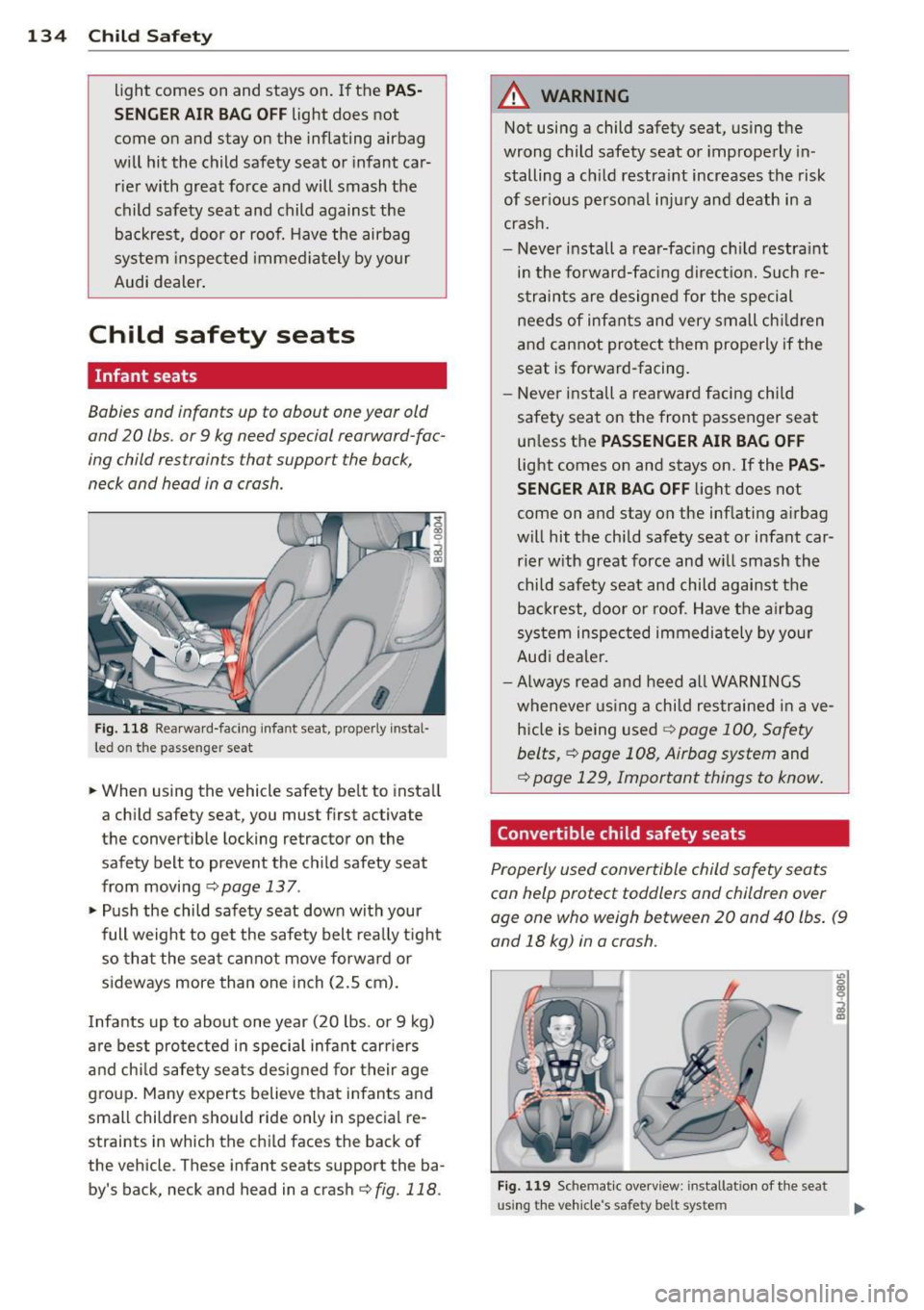
Fi g. 118 Rearwa rd-facing infant seat, proper ly insta l·
led on the passenge r seat
~ When using the vehicle safety belt to install
a child safety seat, you must first activate
the convertible locking retractor on the
safety belt to prevent the child safety seat
from moving
c:::;, page 13 7 .
~ Push the child safety seat down with your
full weight to get the safety belt rea lly t ight
so that the seat cannot move forward or
sideways more than one inch (2.5 cm).
I nfants up to about one year (20 lbs . or 9 kg)
are best protected in specia l infant carriers
and chi ld safety seats des igned for their age
group. Many experts believe that infants and
small children should ride only in special re
straints in which the child faces the back of
the vehicle. These infant seats support the ba·
by's back, neck and head in a crash
c:::;, fig. 118 .
A WARNING
-
Not using a child safety seat, using the
wrong child safety seat or improperly in
stalling a ch ild restra int increases the risk
of ser ious personal in jury and death in a
crash.
- Never install a rear-fac ing ch ild restra int
in the forward-fac ing direct ion. Such re
straints are designed for the special
needs of infants and very small ch ildren
and cannot protect them properly if the
seat is forward-facing.
- Neve r install a rearward faci ng ch ild
safety seat on the front passenger seat
un less the
PASSENGER AIR BAG OFF
light comes on and stays on. If the PAS
SENGER AIR BAG OF F
light does not
come on and stay on the inflating airbag
will hit the child safety seat or infant car
rier with great force and w ill smash the
child safety seat and child against the
backrest, door or roof. Have the a irbag
system inspected immediately by your
Aud i dealer.
- Always read and heed all WAR NINGS
wheneve r using a child res trained in ave
hicle is being used
c:::;, page 100, Safety
belts,
c:::;, page 108, Airbag system and
c:::;, page 129, Important things to know .
Convertible child safety seats
Properly used convertible child safety seats
can help protect toddlers and children over
age one who weigh between 20 and 40 lbs . (9
and 18 kg) in a crash .
Fig . 1 19 Schema tic overview: ins tallat ion of the seat
using the vehicle's safety be lt sys te m
Ill>