2015 AUDI TT ROADSTER air condition
[x] Cancel search: air conditionPage 112 of 244
110 Airbag sys te m
Safety Standard 208 as applicable at the time
your vehicle was manufactured.
The Standard requires the front a irbag on t he
passenger side to be turned off ("sup
pressed") if a child up to about one year of
age restrained in one of the rear-facing or for
ward -facing infant restra ints listed in Federal
Motor Vehicle Safety Standard 208 with which
the Advanced A irbag System in your vehicle
was certified has been installed on the front passenger seat . For a listing of the child re
straints that were used to certify compliance
with the US Safety Standard¢
page 131.
The PASSENG ER AIR BAG OFF light in the in
strument panel tells you when the front Ad
vanced A irbag on the passenger side has been
turned off by the e lectronic control unit.
Each t ime you turn on the ignition, the
PAS
SENGER AIR BA G OFF
light w ill come on for a
few seconds and:
- will stay on if the front passenger seat is not
occupied,
- will stay on if there is a small child or child
restraint on the front passenger seat,
- wi ll go off if the front passenger seat is oc
cupied by an adult as registered by the
weight-sensing mat
¢ page 118, Monitor
ing the Advanced Airbag System .
The PASSEN GER AIR BAG OFF light comes on
when the control un it detects a total weight
on the front passenger seat that requires the
front airbag to be turned off .
If the tota l weight on the front passenger
seat is more than that of a typical 1 year-old
child but less than the weight of a small
adult, t he front airbag on the passenger s ide
can dep loy (the
PAS SENGER AIR BAG OFF
light does not come o n). If the PASSENGER
AIR BAG OFF
l igh t does not come on , the
front airbag on the passenger side has not
been turned off by the electronic control unit
and can dep loy if the control unit senses an
impact that meets the conditions stored in its
memory .
For example , the airb ag ma y depl oy if :
- a small ch ild tha t is heav ier than a typical 1
year-old chi ld is on the front passenger seat
(regard less of whether the child is in one of
the child safety seats listed
¢ page 131), or
- a child who has outgrown child restraints is
on the front passenger seat.
If the front passenger airbag is turned off, the
PASSENGER AIR BAG OFF light comes on in
t h e instr ument pane l and stays on.
T he front airbag on the passenge r side may
not dep loy (the PASSENGER AIR BAG OFF
li ght does not illum inate and stay lit) even if a
small adult or teenager, or a passenger who is
not sitt ing upright w ith their back against a
non-recl ined backrest w it h their feet on the
vehicle floor in front of the seat is on the front
passenger seat¢
page 92, Proper seating po
sition for the driver .
If the front passenger airbag deploys, the
Federal Standard requ ires the airbag to meet
the "low risk" deployment cr iteria to reduce
the risk of injury th rough interact ion w ith the
airbag. "Low risk" deployment occurs in those
crashes that ta ke pla ce at lower dece le rat io ns
as de fined in t he electronic control uni t
¢ page 119, PASSENGER AIR BAG OFF light.
Always remember, a child safety seat or infant
ca rrier in stalled on the fron t seat may be
stru ck and knoc ked out of posit ion by the rap
idly in flat ing passenger 's airbag in a fronta l
collision. The a irbag co uld great ly red uce the
effectiveness of the ch ild restraint and even
seriously in jure the chi ld during inflation .
A WARNING
-
A child in a rearward-fac ing ch ild safety
seat installed on the front passenger seat
will be serious ly injured and can be killed if
the front airbag inflates -even with an Ad
van ced A irbag System.
- The inflating airbag will h it the ch ild
safety seat or infant carrie r with great
for ce and will smash the child safety seat
a nd child ag ai nst t he backrest, door or
roof.
Page 114 of 244
112 Airbag system
Front airbags
Description of front airbags
The airbag system can provide supplemental
protection to properly restrained front seat occupants.
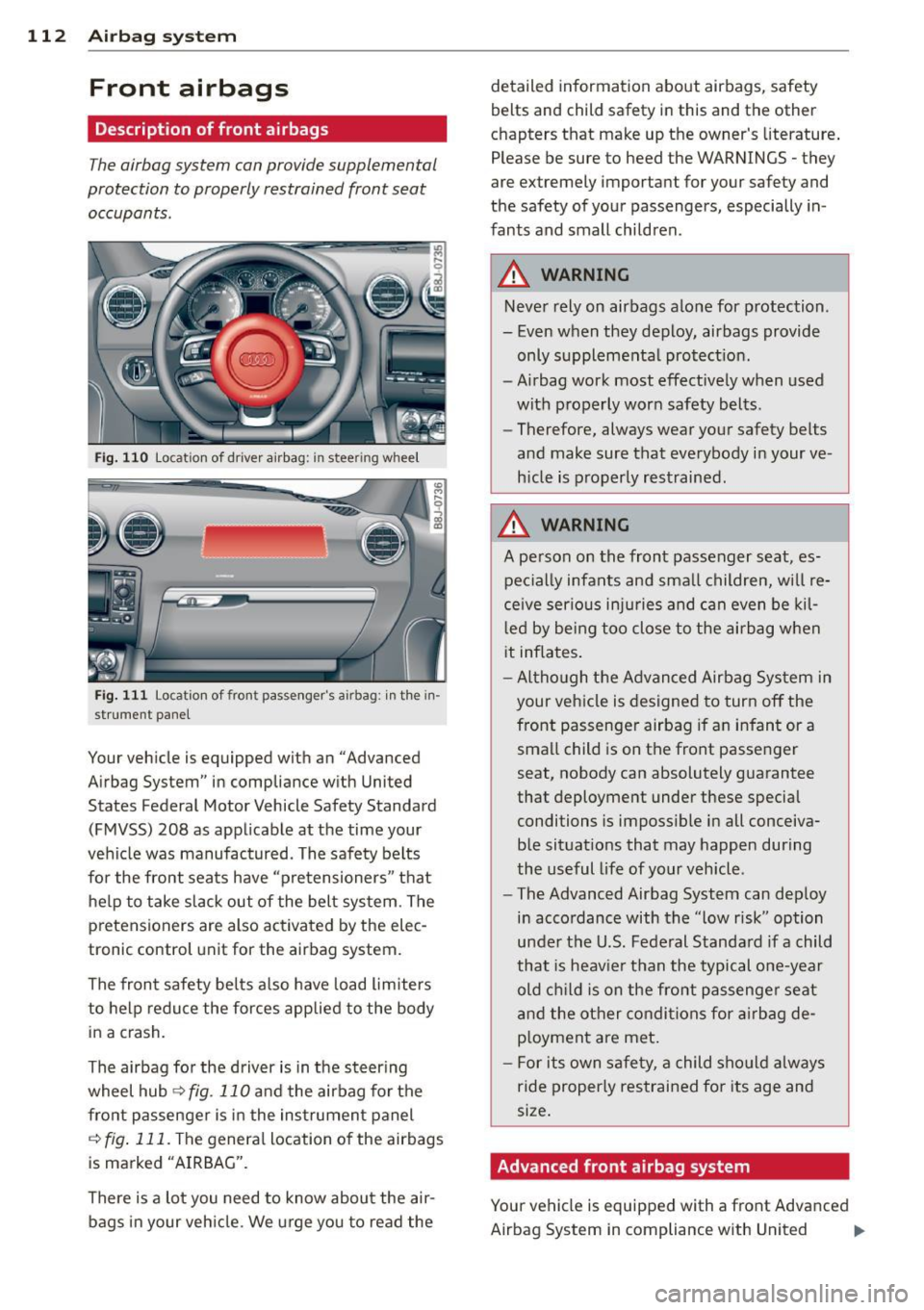
Fig . 110 Locat ion of driver airbag: in steering wheel
Fig. 111 Locatio n of front passenger 's ai rbag: in t he in·
strument panel
Your vehicle is equipped with an "Advanced
Airbag System" in compliance with United
States Federal Motor Vehicle Safety Standard
(FMVSS) 208 as applicable at the time your
vehicle was manufactured . The safety belts
for the front seats have "pretensioners" that
help to take slack out of the belt system. The
pretensioners are also activated by the elec·
tronic control unit for the airbag system.
The front safety belts also have load limiters
to help reduce the forces applied to the body in a crash.
The airbag for the driver is in the steer ing
wheel hub ¢
fig. 110 and the airbag for the
front passenger is in the instrument panel
¢
fig . 111. The general location of the airbags
is marked "AIRBAG".
There is a lot you need to know about the air
bags in your vehicle. We urge you to read the detailed information abo
ut airbags, safety
belts and child safety in this and the other
chapters that make up the owner's literature .
P lease be sure to heed the WARNINGS -they
are extremely important for your safety and
the safety of your passengers, especially in
fants and small children .
A WARNING
Never rely on airbags alone for protection .
- Even when they deploy, airbags provide only supplemental protect ion.
- Airbag work most effective ly when used
with properly worn safety belts.
- Therefore, always wear your safety belts
and make sure that eve rybody in your ve
h icle is p roperly restrained.
A WARNING
A person on the front passenger seat, es
pec ially infants and sma ll children, w ill re
ceive serious injuries and can even be kil
l ed by be ing too close to the airbag when
i t inflates .
- Al tho ugh the Advanced Airbag System in
your veh icle is designed to tur n
off the
front passenger airbag if an infant or a
small child is on the front passenger
seat, nobody can absolutely guarantee
that deployment under these special
conditions is impossible in all conceiva
b le situations that may happen during
the useful life of your vehicle .
- The Advanced Airbag System can dep loy
in accordance with the "low risk" option
under the U.S . Federal Standa rd if a child
that is heav ie r th an the typical one-year
old ch ild is on the front passenger seat
and the other condi tions for a irbag de
p loyment are met .
- F or its own safe ty, a child sho uld always
ride properly restrained for its age and
size .
Advanced front airbag system
-
Your vehicle is equipped with a front Advanced
Airbag System in compliance with United ..,_
Page 120 of 244

118 Airbag sys te m
- The inflating airba g will hit the child
safety seat or infant carri er w it h great
force and w ill smash the ch ild safety seat
and child against the backrest, cente r
arm r est, door or ro of.
- Ne ver install a r earward facing child
sa fety seat on the fro nt passenger seat
unl ess the
PASSENGER AIR BAG OFF
ligh t co me s on and stays on. If the PA S
SENGER AIR BAG OFF
ligh t does no t
come on and stay on, the inflating airbag
will hit the child safety seat or infant car
rier with great force and will smash the
child safety seat and child against the
backrest, door or roof. Have the airbag
system inspected immediately by your
authorized Audi dealer .
A WARNING
Objects between you and the a irbag will
increase the risk of injury in a crash by in
terfering with the way the airbag unfolds
or by being pushed into you as the a irbag
inflates.
- Never hold th ings in your hands or on
yo ur lap when the vehicle is in use.
- Never transport items on or in the area
of the front passenge r seat. Objects
c ou ld move into the area of the front air
bags dur ing braking or other s udden ma
neuver and become dange rous projec
tiles that can cause serious personal in
jury if the airbags inflate.
- Never place o r attach accessories or oth
er objects (such as cup ho lders, tele
phone brackets, large, heavy or b ulky ob
jects) on the doors, over or near the area
marked "AIRBAG" on the steering wheel,
instrument panel, seat backrests or be
tween those a reas and yourself. These
objects co uld cause injury in a crash, es
pecially when the airbags inflate.
- Never recline the front passenger's seat
to transport objects. Items can also
move in to the area o f the side airb ag or
the front airbag dur ing braking or in a
sudden maneuver. Objects near the air -
-
bags can become projectiles and cause
inju ry, partic ularly when the seat is re
clined.
A WARNING
The fine dust created when airbags deploy
can cause breathing prob lems for people
with a history of asthma or other breath
i ng cond itions.
- To reduce the risk of breath ing problems,
those with asthma o r othe r respiratory
conditions shou ld get fresh air righ t
away by getting o ut of the ve hicle or
open ing win dows or doors.
- I f you are i n a collision in which airbags
deploy, wash your hands and fa ce with
mild soap and wate r before ea ting.
- Be ca reful not to get the dust into your
eyes, o r into any c uts or s cratches.
- If the res id ue should get into your eyes,
flush them w ith wate r.
Monitoring the
Advanced Airbag System
tii Airbag monitoring indicator light
Two separate indicators monitor the function
of the Advan ced Airbag Sy stem: the airbag
monitoring indicator light and the
PASSEN
GER AIR BAG OFF
light.
T he Advanced A irbag Sys tem ( incl uding the
ele ctron ic cont rol unit, sensor circ uits and sys
tem wir ing) is monitored continuously to
make sure that it is functioning properly
whenever the ignition is on. Eac h time you
turn on the ignition, the a irbag monitoring in
dicator light . will come on for a few sec
onds (self diagnostics).
The system must be inspected when the
i ndicator light•=
-does not come on when the ignition is
sw itched on,
- does not go out a few seconds after you
have switched on the ignit ion, or
Page 131 of 244
Child Safety
Important things to know
Introduction
The physical principles o f what happens when
your ve hicle is in a crash app ly also to chi ldren
c::> page 101, What happens to occupants not
wearing safety belts? .
But unlike adults and
teenagers, the ir muscles and bones are no t
fully developed . In many respects children are
at greater risk of serious injury in crashes than
adu lts.
Because children's bod ies are no t fully devel
oped, they require restra int systems especial
l y designed for the ir size, weight, and body
structure . Many count ries and all states of the
United States and provinces of Canada have
l aws req uiring the use of approved ch ild re
straint systems for in fants and small chi ldren.
I n a fronta l crash at a speed of 20-35 mph
(30-56 km/ h) the fo rces acting on a 13-po und
(6 kg) inf ant will be more than 20 t imes the
weight of the child. This means the weight of
the child would suddenly be more than
260 pounds ( 120 kg) . Under these conditions,
only an appropriate chi ld restraint properly
used can reduce the risk of ser ious injury.
C hi ld restra ints, like adult safety belts, must
be used properly to be effective . Used improp
erly , they can increase the risk of ser ious in
ju ry in an accident.
Consult the child safety seat manufacturer's i nstructions in order to be sure the seat is
right fo r you r ch ild 's s ize
c::> page 132, Impor
tant safety instructions for using child safety
sea ts.
P lease be su re to read and heed all of
the impo rtan t informat io n a nd WAR NINGS
about child safety, Advanced A irbags, and the
installation of child rest raints in this chapter .
There is a lot you need to know abou t the Ad
vance d Airbags in yo ur vehicle and how they
wo rk when infants and children in child re
straints are o n the front passenger seat. Be
cause of the large amount of important infor -
Child Safet y 129
mation, we cannot repeat it a ll here . We urge
yo u to read the detai led information in this
owner 's man ua l about ai rbags and the Ad
vanced Airbag System in your vehicle and the
very important information about transport
ing ch ildren on the front passenger seat.
Please be sure to heed the WARNINGS -they
ar e extremely importa nt for your safety and
the safety of you r passenge rs, especially in
f an ts a nd small chi ld ren.
A WARNING
-
A ll vehicle occupants and especially chi l
d ren must be restra ined properly w henev
er riding in a vehicle. An unrestrained or
improperly restra ined child could be in
jured by str iking the interior or by being
e jected from the vehicle dur ing a sudden
maneuve r or impact. A n unrestra ined o r
improperly restr ained child is also at great
e r r isk of inju ry or d eath thro ugh contact
wi th an inflat ing a irbag.
_& WARNING
C hildren on the front seat of any car even
wi th Advanced Airbag s can be ser io usly in
j ur ed or even kil led when an a irba g in
flates. A child in a rearwar d-fac ing ch ild
safety seat insta lled on t he front passen
ger seat will be ser iously injured and can
be killed if the front airbag inflates .
- The inflating airbag will h it the ch ild
safety seat or infant carrier with great
force and will smas h the child safety seat
a nd chi ld agai nst the bac krest , door or
roof.
- Never i nstall a rearward faci ng child
safety seat on the front passenger s eat
un less the
PASSENGER AIR BAG OFF
light comes o n and stays on. If the PAS·
SENGER AIR BAG OFF
l ight does no t
come on and st ay on, have the air bag
sys tem inspected immediately by your
Aud i dea le r.
•
•
Page 143 of 244
Intelligent technology Notice about data
recorded by vehicle
control modules
Your vehicle is not equipped with an Event Da
ta Recorder (EDR), installed by some manu
facturers for the express purpose of capturing
data for retrieval after an accident or crash
event. EDR's are sometimes called "crash re
corders".
Some state laws restrict the retr ieval or down
loading of data stored by EDR's that were in
stalled in a vehicle for the express purpose of
retrieving data after an accident or crash
event without the owner's consent.
Although your vehicle is not equipped with an
EDR, it is equipped with a number of electron
ic control modules for various vehicle systems
such as, for examp le, engine function, emis
sion control, as well as for the airbags and
safety belts.
These electronic control modules also record
vehicle-related data during norma l vehicle op
eration for diagnostic and repair purposes.
The recording capacity of the electronic con
trol modules is limited to data (no sound is re
corded) and only a small amount of data is ac
tually recorded over a very limited period of
time and stored when a system fault or other
condition is sensed by a control unit. Some of
the data then stored may relate to vehicle
speed, direction, braking as we ll as restraint
system use and performance in the event of a
crash or other condition. Stored data can only be read and downloaded with special equip
ment.
Electronic Stabilization
Control (ESC)
Description
ESC helps to improve road holding and vehicle
dynamics to help reduce the probability of
skidding and loss of veh icle control. It works
only when the engine is running. ESC detects
Intelligent technology 141
certain difficult driving situations, including
when the vehicle is beginning to spin (yaw)
out of control and helps you to get the veh icle
back under control by se lectively braking the
wheels, and/or reducing engine power and
providing steering ass istance to help hold the
vehicle on the driver's intended course. The in
dicator light
B.J in the instrument cluster
blinks when ESC is taking action to help you
control the vehicle.
ESC has limitations .
It is important to remem
ber that ESC cannot overcome the laws of
physics.
It will not always be able to help out
under all conditions you may come up against.
For example, ESC may not always be able to
help you master situations where there is a
sudden change in the coefficient of friction of
the road surface. When there is a section of dry road that is suddenly covered with water,
slush or snow, ESC cannot perform the same
way it would on the dry surface. If the vehicle
hydroplanes (rides on a cushion of water in
stead of the road surface), ESC will not be
able to help you steer the vehicle because con
tact with the pavement has been interrupted
and the vehicle cannot be braked or steered .
During fast cornering, particularly on winding
roads, ESC cannot always deal as effectively
with difficu lt driving situations as at lower
speeds.
Always adjust your speed and driving style to
road, traffic §&and weather conditions. ESC
cannot override the vehicle's physical limits,
increase the available traction, or keep a vehi
cle on the road if road departure is a result of
driver inattention. Instead, ESC improves the
poss ibility of keeping the vehicle under con
trol and on the road dur ing extreme maneu
vers by usin g the driver's steering inputs to
help keep the vehicle going in the intended di
rection. If you are traveling at a speed that
causes you to run off the road before ESC can
provide any assistance, you may not experi
ence the benefits of ESC.
ESC includes and/or works together with the
anti- lock brake system (ABS), brake assist sys -
tem and anti-slip regu lation (ASR). ESC is
Ill>
•
•
Page 154 of 244

152 Driving and en vironm ent
Avoid full throttle
Driving at moderate speeds saves fuel and
improves your mileage .
"'Try and keep well below your car 's maximum
speed.
Accelerating gently reduces fuel consump
tion, engine wear, and does not disturb the
environment. F ue l consumption, exhaust emissions and en
gine no ise increase disproportionately at high
speeds. If you drive at approximately three
quarters of top speed, fuel consumption will be reduced by one half. Never dr ive faster
than the posted speed limit and weather con
d itions permit .
Reducing unnecessary idling
Even when your car is just idling it burns up
fuel.
"'Shut the engine off when you are not driv ing
the vehicle .
"'Do not warm up the veh icle by letting the
engine run at idle .
It makes sense to shut
off the e ngine in traff ic
jams, when waiting for trains to pass at ra il
road crossings , or at traff ic lights that have
l ong wa its on red. Turning the engine
off fo r
just
30-40 seconds saves more fue l than is
burned s tarting the eng ine again .
It takes a long time for the engine to warm up
fully when it is running at idle . Howeve r, wear
and nox ious em issions are especially high
when the engine is warming up. So you should
drive away as soon as you start the engine and
avoid running at high RPMs while the engine
is sti ll warming up.
([) Note
Do not leave engine idling unattended af
ter starting . If warning lights should come
on to indicate improper operation, they
wou ld go unheeded. Extended idling also
produces heat, which cou ld result in over- heating or other damage to the vehicle or
other property .
Regular maintenance
A badly tuned engine unnecessarily wastes a
lot of fuel.
"' Have your ve hicle serviced at reg ular in ter -
vals.
By having your veh icle regu la rly serviced by an
Audi dealer he lps to ensure that it runs p rop
erly and economically. The condition of your
vehicle not only affects its sa fety and ability to
hold its val ue, it also affects
fuel con sum p
tion .
Check your oil e ach time you fill your t ank .
The amount of o il used is related to engine
load and speed .
It is normal for the oil consumption of a new
engine to reach its lowest value after a certa in
mileage has been driven.
You must drive your veh icle about 3,000 m iles
(5,000 kilometres) before you can properly
assess oil consumpt ion.
This also app lies to fue l cons umption and en
gine output.
(D Note
- Have your vehicle maintained proper ly
and in accordance with the service rec
ommendations in your Warranty
& Main
tenance booklet. Lack of proper ma inte
nance as well as improper use of the ve
hicle will impair the function of the
em iss ion contro l system and cou ld lead
to damage.
- Do not alter or remove any component of
the Emission Control Sys tem unless ap
proved by the manufacturer.
- Do not alte r or remove any device, such
a s hea t sh ie lds, switches, ig nition w ires,
valves, which are designed to protec t
your vehicle's Emission Control System
and other impo rtant vehicle compo
nents .
Page 169 of 244

oils available today provide better engine lu
brication that can outlast traditional petrole
um-based oils, making them a smart choice
for use throughout the life of your Audi.
Whether you use synthetic or petroleumbased engine oil, the oil that you use must
conform to Audi's oil quality standard
VW 502 00 to help keep your vehicle's engine running smoothly and help prevent the for
mation of harmful deposits, sometimes called
" sludge," that over time can lead to expensive
repairs .
At the time of printing, engine oils available in the U .S . and Canada that meet the exacting
specifications of Audi oil standard VW 502 00
are synthetic engine oils . This does not mean,
however, that every synthetic engine oil will
meet Audi oil standard VW 502 00 . So always
be sure that you use an approved oil.
To help prevent the formation of harmful de posits use only oil with the following specifi
cations printed on the oil container :
Audi oil standard VW S02 00
Oil container labels may carry the specifica
tion singly or in combination with other desig
nations and oil quality standards .
Viscosity
Engine oils are graded according to their vis
cosity . The proper viscosity grade oil for your
engine depends on climactic or seasonal con
ditions where you drive. You can use oil with a
viscosity grade of SA E SW40 across all tem
perature ranges for normal driving conditions.
However, if engine oil viscosity grade SAE
SW40 is not available, you can also use viscos
ity grade SAE SW-30 or SAE OW-40 as long as
it meets Audi oil quali ty standard VW 502 00
specifications .
Because engine oil that meets the Audi oil
standard may not be available everywhere
when you need it, we strongly recommend
that you always carry with you an extra quart (liter) of oil that expressly conforms to the
Checking and filling 167
VW 502 00 specification, in case you have to
top
off the oil while on the road.
Only if the level of the oil is at or below the
minimum mark on the oil dipstick - and no oil
that expressly conforms to Audi oil standard
VW 502 00 specifications is available - may
you top
off with a high quality engine oil, pref
erably synthetic-based, that meets ACEA A3
or API SM specifications, but even then, only
in viscosity grades SA E SW-40, SA E 5W -30, or
SAE OW-40. However, during the entire time
between oil change intervals, never top
off
with more than a total of 0.5 qt/liter engine
oil that does not conform to Audi oil specifica
tion VW 502 00.
For more information about engine oil that
has been approved for your vehicle, please
contact either your autho rized Audi dealer or
Audi Customer Relations at 1 (800) 822-2834
or visit our web site at www.audiusa .com or
www.audicanada.ca . Here you will also find a
current list of oils (manufacturers, brand
names etc.) that conform to Audi oil standard
vw 502 00.
Changing the engine oil
The engine oil and oil filter must be changed
according to the mileage (kilometers) and
time intervals specified in your vehicle's War
ranty
& Maintenance booklet. Do not exceed
these intervals -harmful deposits from old
engine oil can reduce engine performance and
can lead to expensive engine repairs.
Changing the oil at the recommended inter
vals is so very important because the lubricat
ing properties of oil decrease gradually during
normal vehicle use. If you are not sure when
you have your oil changed, ask your author
ized Audi Serv ice Adv isor.
Under some circumstances the engine oil
should even be changed more frequently. Change oil more often if you drive mostly
short distances, operate the vehicle in dusty
areas or mostly under stop-and-go traffic con
ditions, or when you use your vehicle where
temperatures stay below freezing point for
long periods.
•
•
Page 173 of 244

@ For the sake of the environment
-Before changing your oil, first make sure
you know where you can properly dispose
of the used o il.
- Always dispose of used engine oil proper
l y. Do not dump it on garden soi l, wood
ed areas, into open streams or down
sewage dra ins.
- Recycle used engine oil by taking it to a
used engine oil collection facility in your
area, or contact a service station .
Engine cooling system
Coolant
The engine coolant performs two functions: it
keeps the engine from overheating and it pro tects the engine from freezing in the winter.
The cooling system is sea led and generally re
q uir es lit tle atten tion .
The cooling system has been filled at the fac
tory with a pe rmanent coo lant which does not
need to be c hanged. The coolant consists of a
mixture o f spec ial ly conditioned water and the
manuf acturer 's glyco l-basedcoolan t addi -
tiv e G13 antifreeze with ant icorros ion addi
tives (50% for USA models ; 60% for Canadian
mod els) . This mixture both assures the neces
sary
frost protection and p rotects metal com
ponents in the engine's coo ling system from
corrosion and scaling . It a lso raises the boil
i ng point of the coolant .
Do not reduce the concentration o f the coo l
ant in the summer by adding plain water.
The
proportion of coolant add it ive must be at
l e a st 50 % but not mor e than 60 %
to main
tain antifreeze protection and coo ling efficien
cy .
If the coolant frost protect io n is too low,
the coolant cou ld free ze and dam age the veh i
cle heating and eng ine cooling system.
For yea r-round driving, antifreeze is added at
the fac to ry for tempera tures down to:
-- 31°F( -35°C)USA
- -40 °F ( -40 °C) Canada.
Checkin g and fillin g 171
If you must add coo lant, use a mixture of wa
ter and coolant additive . Mix ing the coo lant
additive with distilled water is recommended.
_& WARNING
Before you c heck anything in the engine
compartment, always read and heed a ll
WARNINGS
c> .& in Working in the engine
comportment on page 164.
Q) Note
- Before winter sets in, have the coo lant
checked to see if the coolant additive in
your vehicle is sufficient to meet the cli mate condi tions. This is especi ally impor
tan t if you live i n a region wher e th e win
ter is ex treme ly co ld . If necessary, i n
crease t he p ropo rtion of coo lant add itive
to 60% .
- Whe n ad ding coolant additive t o yo ur
c ooling sys tem, reme mbe r:
- We recommend using on ly coolant ad
d itive G12++ or G13 for your vehicle .
This coolant additive is availab le at au
thor ized Audi dealers . O ther types of
a ntifreeze can s ignifica ntly reduc e cor
rosion prote ction. The result ing cor ro
sion can cau se a loss o f coolan t and se
rio us engine d amage .
- Do not add any ty pe of rad iator leak seal
a nt to yo ur vehicle 's engine c oolant .
A dd ing radia tor repair fl uid may adverse
ly affect the f unction and pe rformance of
your coolin g system and co uld resu lt in
damage not covered by your New Ve hicle
L imited Warranty.
-
•
•