2015 AUDI S3 SEDAN ignition
[x] Cancel search: ignitionPage 214 of 282

Checking and Filling
of vehicle batteries improperly is very danger
ous to the environment.
Windshield washer system
F ig . 165 Eng ine compartment: washer fluid reservoir cap
M
"' -')'
"" 00 a,
The washer fluid reservoir O contains the wind
shield washer fluid¢ page 200, fig. 157. Reser
voir capacity¢ page 260.
"' Read and follo w all
WARNINGS before working
in the engine compartment ¢page
198 .
... Open the cap .
... Add the washer f luid and close the cap .
To reduce the risk of lime scale depos its on the
spray nozzles, use clean water with low amounts
of calcium. Always add a window cleaner to th
water. It should contain freeze protection in the
winter.
(D Note
- Never add radiator anti-freeze or other addi
tives to the washer fluid.
- Do not use a glass cleaner that contains
paint solvents, there is a risk of damaging
the pa int.
212
Service interval display
The service interval display detects when your ve
hicle is due for service.
Fig. 166 Instrument cluster: Service interval display (ex·
amp le)
Fig. 167 Display in the MMI panel: service interval display
(example)
l6 M 0 ;:;. co m
The service interval display works in two stages:
-Inspection or oil change reminder: After a cer
tain distance driven, a message appears in the
instrument cluster display each time the igni
tion is switched on or off¢ fig. 166. The re
maining distance or time is disp layed briefly.
- Inspection or oil change due: If your vehicle
has reached an inspection or oi l change interval
or both intervals at the same time, the mes
sage:
Inspection due! or Oil change due! or Oil
change and inspection due!
appears briefly af
ter switching the ignition on/off.
Checking service intervals
You can check the rema ining distance or time un
til the next oil change or next inspection in the
MMI
¢ fig. 167. Select the I MENU I button> Car>
Systems*
control button > Service & control >
Service intervals.
Page 235 of 282
....,
N
0 > co
rl I.O
"'
"'
"'
rl
If the Tire Pressure Monitoring System
indicator appears
Applies to vehicles: with t ire p ressure monitoring syste m
The tire pressure indicator in the instrument
cluster informs you if the tire pressure is too low
or if there is a system malfunction.
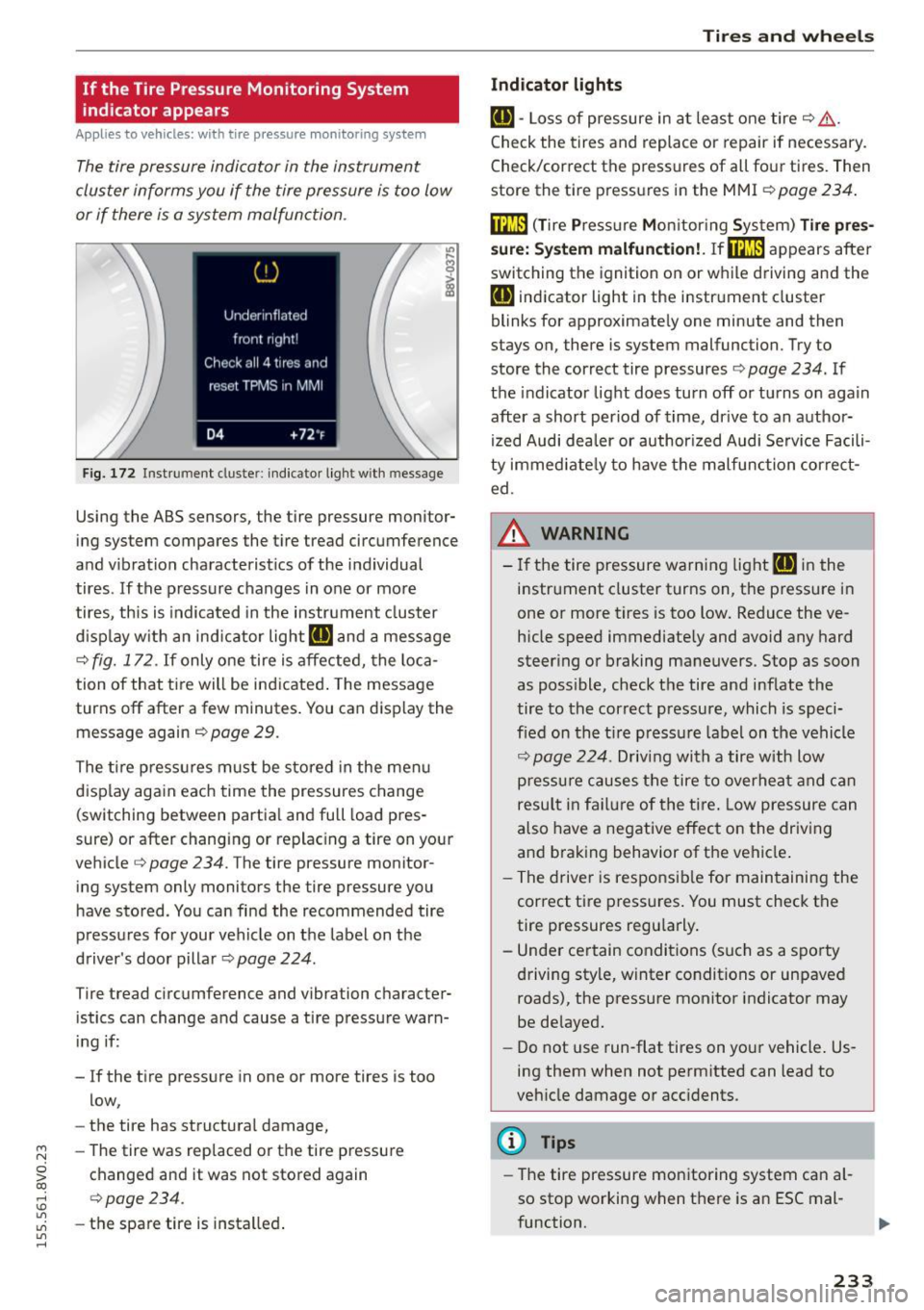
F ig. 172 Instrument cluster: in dicator light w ith message
Using the ABS sensors, the tire pressure monitor
ing system compares the tire tread circumference
and v ibration characterist ics of the ind ividual
tires.
If the pressure changes in one or mo re
tires, th is is indicated in the instrument cluster
d isp lay w ith an ind icator light
RE and a message
¢
fig. 172. If only o ne tire is affected, the loca
tion of that ti re will be indicated . The message
turns off after a few minutes . You can display the
message again
r::;,page 29.
The tire p ressu res m ust be stored in the menu
disp lay aga in each time the pressures change
(switching between partia l and full load pres
sure) or after changing or replac ing a tire on your
ve hicle¢
page 234. The tire pressure monitor
ing system only monitors the tire pressure you
have stored. You can find the recommended tire
pressures for your vehicle on the label on the
driver's door pillar¢
page 224.
Tire tread circumference and vibration character
istics can change and cause a tire pressure warn
in g if:
- If the tire pressure in one or more tires is too
low,
- the tire has structural damage,
- The tire was replaced or the tire pressure
changed and it was not stored again
¢ page 234.
-the spare tire is insta lled .
Tires and wheels
Indicator lights
RE -Loss of pressure in a t least one tire ¢ ,&.
Check the tires and replace or repair if necessary.
Check/correct the pressures of all four t ires. Then
store the tire p ressu res in the MMI ¢
page 234.
film (T ire Pressure Mon itor ing Sys tem) Tire pres
s ure: Sy stem malfunction!. If@m
appears after
switching the ignition on or while driving and the
RE ind icator light in the instr ument cluster
blinks for approximate ly one minute and then
stays on, there is system malfunction. Try to
store the correct tire pressures ¢
page 234. If
the indicator light does turn off or turns on aga in
after a short period of time, dr ive to an author
i zed Audi dea ler or author ized Audi Serv ice Facili
ty immed iate ly to have the malfunction corre ct
ed.
,&. WARNING
- If the tire pressure warning light RE in the
i n str ument cluster turns on, the pressure in
one or more tires is too low . Reduce the ve
h icle speed immediate ly and avoid any hard
steer ing or braking maneuvers. Stop as soon
as poss ible, check the tire and inf late the
tire to the correct pressure, which is speci
fied on the t ire p ress ure label on the vehicle
r::;, page 224. Driv ing with a tire with Low
p ressu re causes the tire to overhea t and c an
resul t in fa il ur e of the tire . Low pressure can
a lso have a negative effect on the driving
and b rak ing behavior of t he vehicle .
- T he drive r is respons ib le for main taining the
correct ti re press ures . You must check the
tire pressures regu larly .
- Under certain conditions (such as a sporty
driving style, winter conditions or unpaved
roads), the pressure monitor indicator may
be de layed.
- Do not use run-flat tires on yo ur vehicle . Us
ing them when not permitted can lead to
veh icle damage or acc idents.
(D Tips
- The tire pressure monitoring system can al
so stop working when t here is an ESC mal-
function. ..,.
233
Page 236 of 282
Tires and wheel s
-Using snow chains may result in a system
malfunction.
- The t ires wi th the ident ificat ion "AO" or
"RO"¢
page 221 have been matche d with
your A udi tire pressure monitoring system.
We recommend that you use these t ires.
- The tire pressure monitoring system can on
l y mon itor the ti re p ress ure of the dr iv ing
tires. Check the tire pressure of the spare
whee l in the luggage compartment so that
i f necessary it is ready for use.
Storing tire pressures
Applies to vehicles: w ith tire pressure monitoring system
A change in tire pressure or a change in tires
must be stored in the system .
The tire p ressu re is stored in the MMI.
.., Make sure befo re stori ng th at t he tire pressures
of all fo ur t ires meet the specified va lues and
are adapted to the load . Otherwise the system
cou ld ma lf u nction
¢ page 224 .
.., Switc h on the ignition .
.,. Se lect : the IMENU! button> Car> Systems *
control button > Service & control > Tire pres
sure monitor > Stor e tire pressure > Yes, store
now .
(]} Tips
Do not store the t ire press ures if snow cha ins
are i nstalled . Otherwise the system could
malf unct io n.
234
Page 238 of 282
Care and cleaning
& WARNING
- Only wash the vehicle when the ignition is
off an d follow the i nstructions fr om the car
wash operator to r educe the r isk of acci
dents.
- To reduce the r isk of cuts, protect yourself
from sharp metal components when wash ing the underbody or the inside of the wheel
hous ings.
- After washing the vehicle, the braking effect
may be delayed due to moisture o n the
brake rotors or i ce in the winte r. T he bra kes
mus t be d ried first w ith a few caref ul bra ke
applications .
@ Note
-If you wash the ve hicle in an au tomatic car
wash, you m ust fold the e xterior m irrors in
to reduce the ris k of damage to the mirrors .
Power folding exterior mirrors* must only
be fo lded i n and out using the power folding
funct ion. -
To prevent paint damage, do not wash the
vehicle in direct sunlight.
- T o reduce the r is k of damage to the sur face,
do not use insect remov ing sponges, kitchen
sponges or similar items.
- Mat te finish painted vehicle components:
- To reduce the risk of damage to the sur-
face, do not use po lishi ng agents or hard
wax.
- Never use protective wax.
It can destroy
the matte finish effect.
- Do not place any stickers or magnet ic
signs on vehicle parts painted w ith matte
finish paint. The pa int co uld be damaged
when the sticke rs o r mag nets are re
moved.
@ For the sake of the environment
Only wash the ve hicle in facilities spec ially de
s igned fo r that purpose. This w ill reduce the
r isk of dir ty wa ter co ntaminated w ith oil from
entering the sewe r system.
Cleaning and care information
When cleaning and caring for individua l vehicle
components, refer to the following tables. The
information contained there is simply recommen
dations. For quest ions or for components that are not listed,
consult an authorized A udi dealer
or authorized Audi Service Facility . Also follow
the information found in
¢ _6.
Exterio r cleaning
Component Situation Solution
Windshield wiper
Deposits ¢ page 50, Cleaning windshield wiper blades
blades
Headlights /
Deposits Soft sponge with a mild soap
solutiona)
Tail lights
Sensors /
Deposits Sensors: soft cloth with solvent-free cleaning so lution
camera len se s Camera le ·nses : soft clot h w ith a lcohol-free clea ning so lu-
tion
Snow/ ice Hand brush/solvent-free de- icing spray
Wheel s Road sa lt Water
Brake dust Acid-free specia l cleaning solution
E xhau st tail pipe s Road salt Water, clean
ing solution su itab le for stain less stee l, if nee -
essary
D ecorative parts / Deposits Mild soap solution al, a clean ing solution suitable for stain-
trim l ess stee l, if necessary
236
Page 250 of 282

Fuses and bulbs
Fuses and bulbs
Electrical fuses
Replacing fuses
A fuse that has blown will have metal strips that
have burned through.
Fig. 184 Steering column area: cover
Fig. 1 85 Left side of the engine compartment: fuse cover
Fuses in the interior
The fuses are behind the cover in the steering col
umn a rea
r::;,fig. 184.
" Switc h the ignition and all e lectr ica l equipment
off .
" Check the following table to see which fuse be
l o ngs to the equipment
r::;, page 249.
"Remove the cover ("AIRBAG" label) r::;,fig. 184 .
Begin at the bottom right corner -arrow-.
" Remove the plastic clip from the fuse panel
cover in the engine compartment<=>
fig. 185.
"Remove the fuse using the plastic clamp.
" Rep lace the bur ned fuse with an identical new
one .
" Install the cover .
Fuses in the engine compartment
"Turn off the ignit ion and the failed electrical
equipment.
248
" Check the following tab le to see wh ich fuse be
longs to the equipment¢
page 250.
" Remove the fuse panel cover ¢fig . 185.
" Remove the plastic clip from the fuse pane l
cover
r::;, fig. 185 .
.. Remove the fuse using the plastic clamp .
" Replace the burned fuse with an identical new
one .
.. Reins tall the cover.
The ind iv idual circuits are protected by safety
fuses . The fuses a re located under the steering
whee l beh ind a cover and in the left s ide of the
engine compa rtment.
Fuse color identification
Color Current rating
in amps
Bla ck 1
Purple 3
Light brown 5
Brown 7,5
Red 10
Blue 15
Yellow 20
Wh ite or transparent 25
green 30
orange 40
&, WARNING
Do not repa ir fuse s and never replace a blown
f u se w ith one that has a hig her amp rating.
T his c an c ause damage to t he e lectr ica l sys
tem and a fi re .
(D Note
If a new fuse blows again shortly after you
h ave installed i t, have the ele ct ric al sys tem
checked by an a uth orized Audi deale r o r au
thorized Audi Service Facili ty.
{!) Tips
- Th e followi ng table does not l ist fuse loca
t ions tha t are not u sed.
Page 255 of 282

....,
N
0 > co
rl I.O
"'
"'
"'
rl
When jump starting or charging the battery,
never connect the negative ground cable to
the battery negat ive post because the battery
manager system must be able to detect the
battery's state of charge. Always connect the
negative g round cab le to the negative ground
post of the battery manager control unit.
Using jump start cables
Connect the jump start cables in the exact order
described below.
Fig. 188 Engine compa rtment: connectors for jump start
cables and a charger
Fig. 189 Ju m p sta rting the battery with anot her veh icle:
@ -drained battery, @-starter battery
The battery is located to the left in the eng ine
compartment.
Do not jump start a frozen or
thawed battery
c> A in Starting with jumper ca
bles on page
252! Replace the battery. The pro
cedure for connecting jump start cables that is
described next is designed to help jump start
your veh icle.
Vehicle with drained battery: .. Read the following carefullyc>
page 252
.. Set the parking brake and place the selector
lever in the P position .
Emergency situations
.. Turn the ignition and electrica l equipment off
in both vehicles.
Connecting the negative terminal(-) to the
negative terminal(-) (black)
.. To reach the battery terminals, flip the battery
cover cap to the side
c> fig . 188 .
1. Clamp the end of the red jump start cable to
the terminal © c>
fig. 189 on the dead bat
tery ®
¢0) in Starting with jumper cables
on page 252 .
2. Clamp the other end of the red jump start ca
ble to the terminal@on the charging bat
tery @.
Connect NEGATIVE (-) to NEGATIVE (-)
(black)
3 . Clamp the black end of the jump start cable
preferably at the ground point , or on the
negative term inal @ on the charg ing battery
® ·
4. Clamp the other black end of the jump start
cable
only on the ground point@) on your
vehicle ®
¢(D.
5. Route the jump start cab les so they cannot
get caught in the moving parts in the engine
compartment .
Starting the engine
6. Start the engine in the vehicle giving the
charge and let it run at idle.
7. Start the engine in the vehicle with the dead
battery and wait two to three minutes until it
"runs smoothly" .
8. If the engine does not start: stop the starting
procedure after
10 seconds and then repeat
it after approximately
30 seconds .
9. In the vehicle that is being jump started,
switch the heater fan and rear window de
froster on to reduce any voltage peaks that
may occur when disconnecting the jumper ca
bles. The headlights must be switched off .
10. With the engines running, remove the cables
in
reverse orde r of the way they were instal
led . Make sure the cables do not get caught
in moving eng ine components .
11. Switch the heater fan and rear w indow de
froster off .
12 . Close the battery cover .
253
Page 260 of 282

Technical data
Technical data
Vehicle identification
F ig. 197 Ve hicle Ident if icat ion Number (VlN) p late: loca·
tio n on d river 's side dash pane l
XXXXX XX -X -XX XX XXX XX
@-+ ~J:~t::1 ::: xxxxxxxx xx x xxxx xxx x
IYP lf'VPE XXX X XX
XX XXXXXXX XX X X XX
XXX KW XXX
\YT IM:.COll/fAANS ,COOE XXX XXX 15\_L I MOIOlll
@-+ ~~
1
:tr:~i XXXX I XXXX XXX I XX
II. -AUSST . / OPTIO NS
EO A 7D5 4UB 6X
M SSG SR W
2EH JOZ lLB lAS
1BA
3FC SM U 7 X1
FO A
9G3 O
G7 OY H
OJF
TL 6 3 KA BEH UlA X 9B Q
Z7
l XW
803 908
8Z4 020
7T6 C V7 7 KO 4X3 2K2
3L4 4KC 3YO 413
502
lS A 7GB 01A
4GO
XX X XX X
XX X xxxx
Fig. 198 The ve hicle ide ntif ic ati on label - inside t he lug ·
gage compar tmen t
Vehicle Identificat ion Number (VlN )
The Veh icle Iden tifica tion Number is located in
differen t places :
- u nder the windshield on the driver's side
¢ fig . 197.
- in the MMI: Select: the I MENU I button> Car >
System s* cont ro l button > Service & control >
VIN number .
-on the vehicl e identification label.
258
Vehicle identification label
The vehicle identification label is located i n the
l uggage compartment in the spare whee l we ll.
The label
9 fig . 198 shows the follow ing vehicle
da ta:
(D Vehicle Ident ificat ion Number (VIN)
@ Vehicle type, engine o utput, transmission
@ Engine and transm ission code
@ Pa int number and interior
® Optional equipment numbers
The information of the vehicle identification label
can also be fo und in your Warranty
& Ma inte
nance booklet.
Safety complianc e sticker
The safety compliance sticker is your assurance
that your new vehicle complies with all applicable
Federa l Mo to r Ve hicl e Safety Standards which
were in e ffect at the time the vehicle w as m anu
factured. You can find this sticker on the door
jamb on the d river's s ide. It shows the month and
year of production and the vehicle identification number of your veh icle (perforation) as we ll as
the Gross Veh icle Weight Rating (GVWR) and the
Gross Axle Weight Rating (GAWR).
H igh volt age warning label
The hig h voltage warning label is located i n the
engine compartment next to the engine hood re
l ease. The spark ignition system complies with
the Canadian standard ICES-002 .
Weights
Gross Vehicle Weight Rating
The Gross Vehicle Weight Rating (GVWR), and
the Gross Axle We ight Rating (GAWR) for front
and rear are listed on a st icker on the door jamb
o n the dr iver 's side.
The Gross Vehicle Weight Rating includes the
weight of the basic vehicle plus fu ll fuel tank, oil
and coolant, plus maxim um load, which includes
passenger weight (150 lbs/68 kg per designated
seat ing pos ition) and luggage weight ¢,&. . ..,_
Page 265 of 282

today's automobiles, have steadily reduced the
scope of maintenance and repairs which can be
carried out by vehicle owners .
Also , s afety a nd
en viro nm enta l
concerns place very strict limits
on the nature of repa irs and adjustments to en
g ine and transmission parts which an owner can
perform.
Maintenance, adjustments and repa irs usua lly re
qu ire spec ial tools, testing devices and other
equ ipment available to specially trained work
shop perso nnel in order to assure proper per
formance, reliab ility and safety of the vehicle and
its many systems.
Improper ma intenance, adjustments and repairs
can impair the operation and reliability of your
vehicle and even void your vehicle warranty .
Therefore, proof of se rv icing in accordance with
the m aintenance schedule may be a condi tion for
upho ld ing a possib le warranty cla im made w ith in
the warranty period .
Above all, operational safety can be adversely af
fected, creating unnecessary r isks fo r you and
your passengers.
I f in doubt about any servicing, have it done by
your author ized Audi dealer or any other prope rly
equ ipped and qua lified workshop. We st rongly
urge you to give your authorized Audi dealer the
opport unity to perform all sched uled mainte
nance and necessary repairs . Your dealer has the
fac ilities, origina l parts and trained specia lists to
keep yo ur vehicle runn ing properly.
P e rforming lim it e d ma inten anc e y ours elf
The fo llowing pages describe a limited number of
proced ures which can be performed on yo ur vehi
cle with ordinary tools, should the need arise and
trained personne l be unavailable. Before per
forming any of these procedures, always thor
oughly read all of the applicable text and careful
ly follow the instructions g iven . Always rigorously
observe the
W ARNINGS prov ided .
Befo re you check an ything in the engine com -
"' partm ent, always r ead and h eed all WARNING S
N
~ c:> .&. and c:> page 198 .
co ,...., \!) ..,.,
..,.,
..,., ,....,
Co nsum er information
A WARNING
- Ser ious personal injury may occur as a result
of improperly performed maintenance, ad
justments or repairs.
- Always be extremely careful when work ing
on the vehicle. Always follow commonly ac
cepted safety practices and general com mon sense. Never ris k personal injury.
- Do not attempt any of the maintenance,
checks or repairs descr ibed on the following
pages if you are not fully familia r wi th these
or other procedures w ith respect to the vehi
cle, or a re unce rtain how to proceed .
- Do not do any work without the proper tools
a nd eq uipment. Have the necessary work
done by your authorized Audi dealer or an
other properly equipped and qualified work
shop .
- The engine compar tment o f any motor vehi
cle is a potentially hazardous area. Never reach into the area around or touch the radi
ator fan. It is temperature contro lled and
can switch on suddenly - even when the en
g ine is off. The radiator fan sw itches on au
tomatically when the coolant reaches a cer
tain tempe ratu re and will continue to run
until the coolant temperature drops.
- Always sw itch off the ignition before anyone
gets under the vehicle.
- Always support your veh icle with safety
stands if it is necessary to work underneath
the vehicle. The jack supplied w ith the vehi
cle is not adequate for this purpose and
could collapse caus ing serious personal in
jury.
- If you m ust wor k underneath t he vehicle
with the wheels on the ground, a lways make
sure the vehicle is on level ground, that the
wheels are a lways secure ly blocked and that
the engine cannot be started.
- Always make sure the transmission se lector
lever (automatic transmiss ion) is in P (Park
position) and the park brake is applied.
Ill>
263