2015 AUDI S3 SEDAN steering
[x] Cancel search: steeringPage 143 of 282
....,
N
0 > co
rl I.O
"'
"'
"'
rl
Why use safety belts?
Frontal collisions and the law of physics
Frontal crashes create very strong forces for peo
ple riding in vehicles .
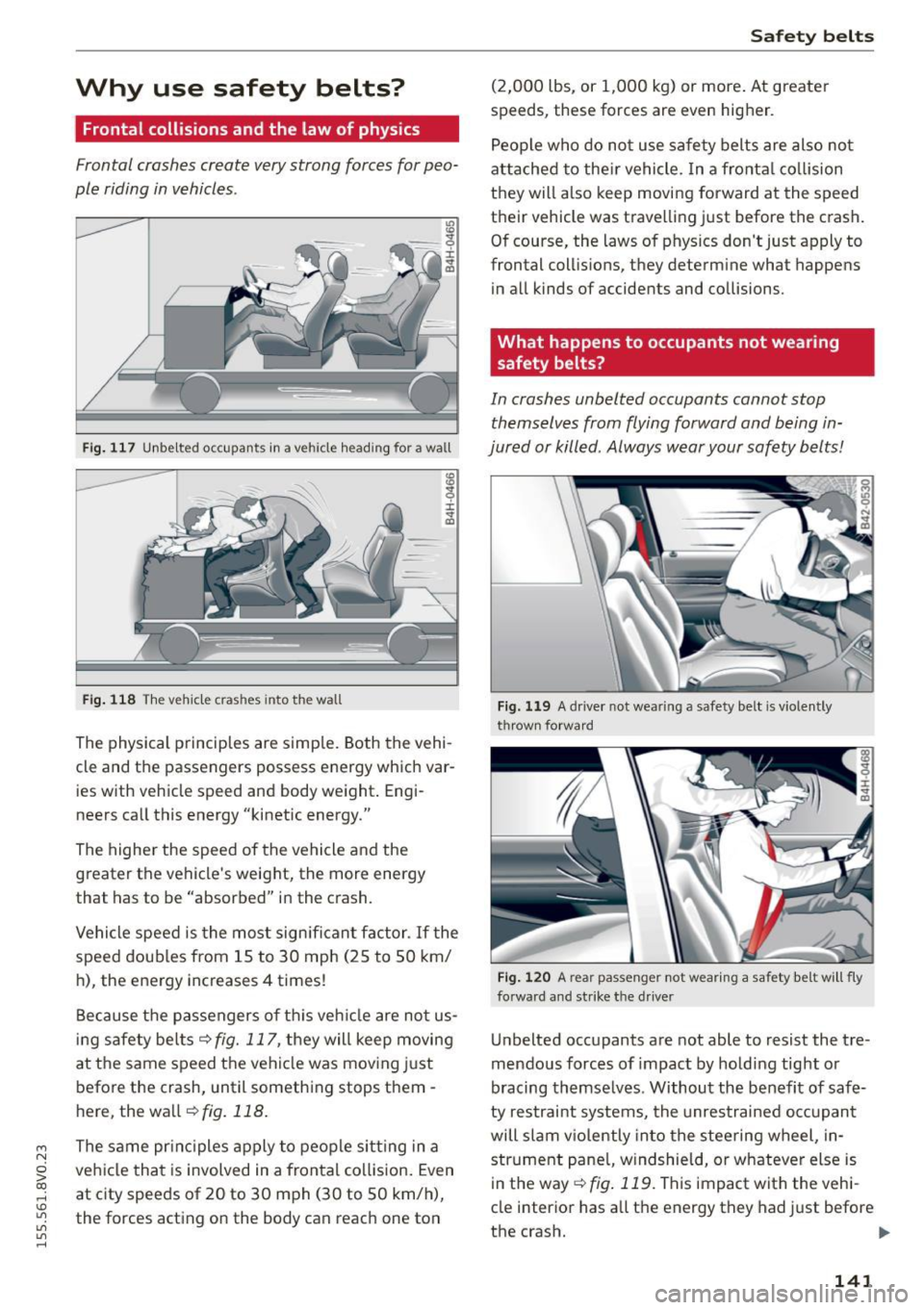
Fig. 117 Unbelted occupants in a ve hicle heading for a wall
Fig . 118 The vehicle cras hes into th e wall
CD
~ ±
cle and the passengers possess energy which var ies with vehicle speed and body weight . Engi
neers call this energy "kinetic energy."
The higher the speed of the vehicle and the
greater the vehicle's weight, the more energy
that has to be "absorbed" in the crash.
Vehicle speed is the most significant factor. If the
speed doubles from 15 to 30 mph (25 to 50 km/
h) , the energy increases 4 times!
Because the passengers of this vehicle are not us
ing safety belts
q fig. 117, they will keep moving
at the same speed the vehicle was moving just
before the crash, until something stops them -
here, the wall
qfig. 118 .
The same principles apply to people sitting in a
vehicle that is involved in a frontal collision. Even
at city speeds of 20 to 30 mph (30 to 50 km/h),
the forces acting on the body can reach one ton
Safety belts
(2,000 lbs, or 1,000 kg) or more . At greater
speeds, these forces are even higher .
People who do not use safety belts are also not
attached to their vehicle. In a frontal collision
they will also keep moving forward at the speed
their vehicle was travelling just before the crash.
Of course, the laws of physics don't just apply to
frontal collisions, they determ ine what happens
in all kinds of accidents and collisions.
What happens to occupants not wearing
safety belts?
In crashes unbelted occupants cannot stop themselves from flying forward and being in
jured or killed . Always wear your safety belts!
Fig. 119 A dr iver not wea ring a safety belt is vio lently
thrown forward
Fig. 120 A rear passenger not wearing a sa fety belt w ill fly
fo rward and strike t he drive r
Unbelted occupants are not able to resist the tre
mendous forces of impact by holding tight or
bracing themselves . Without the benefit of safe
ty restraint systems, the unrestrained occupant
will slam v iolently into the steering wheel, in
strument panel, windshie ld, or whatever else is
in the way
q fig . 119 . This impact with the vehi
cle interior has all the energy they had just before
the crash. ..,_
141
Page 150 of 282
Airbag system
Airbag system
Important information
Importance of wearing safety belts and
sitting properly
Airbags are only supplemental restraints . For
airbags to do their job, occupants must always
properly wear their safety belts and be in a prop er seating position.
For your safety and the safety of your passen
gers, befo re driving off, always:
"' Adjust the driver's seat and steering wheel
properly
Q page 131,
"'Adjust the front passenger's seat properly
Qpage 54,
"'Wear safety be lts properly C? page 142,
"'Always properly use the proper child restraint
to protect children
Qpage 172.
In a coll is ion, airbags must inflate within the
blink of an eye and with considerable force. The
supp lemental airbags can cause injuries if the
driver or the front seat passenger is not seated
properly . Therefore in order to he lp the airbag to
do its job, it is important, both as a driver and as
a passenger to sit properly at all times.
By keeping room between your body and the
steering whee l and the front of the passenger
compartment, the airbag can inflate fully and
completely and provide supplemental protection
in certain frontal collisions
c> page 131, Correct
passenger seating positions.
Fo r details on the
operation of the seat adjustment controls
c>page54.
It's especially important that children are proper
ly restrained
Qpage 172.
There is a lot that the driver and the passengers
can and must do to help the individual safety fea
tures installed in your Audi work together as a
system .
Proper seat ing position is important so that the
front airbag on the driver side can do its job. If
you have a phys ical impairment or condition that
prevents you from sitt ing properly on the dr iver
seat with the safety be lt properly fastened and
148
reaching the pedals, or if you have concerns with
regard to the function or operation of the Ad
vanced Airbag System, please contact your au
thori zed Audi dea ler or qualified workshop, or
call Audi Customer Relations at 1-800-822-2834
for possible modifications to your vehicle.
When the airbag system dep loys, a gas generator
will fill the airbags, break open the padded cov
ers, and inflate between the steering wheel and
the driver and between the instrument panel and
the front passenger . The air bags w ill deflate im
med iate ly after deployment so that the front oc
cupants can see through the windshield again
without interruption.
All of th is takes place in the blink of an eye, so
fast that many people don't even realize that the
a irbags have deployed. The airbags also inf late
with a grea t deal of force and nothing should be
in their way when they dep loy. Front airbags in
combination with properly worn safety belts s low
down and limit the occupant's forward move
ment . Together they he lp to prevent the driver
and front seat passenger from hitting parts of
the inside of the vehicle while reducing the forces
acting on the occupant during the crash . In this
way they help to reduce the risk of injury to the
head and upper body in the crash . Airbags do not
protect the a rms or the lower parts of the body.
Both front a irbags w ill not inflate in all fronta l
collisions . The triggering of the airbag system de
pends on the veh icle deceleration rate caused by
the collis ion and registered by the electronic con
trol unit. If th is rate is below the reference val ue
programmed into the control unit, the airbags
will not be triggered , even though the car may be
badly damaged as a result of the collision . Vehi
cle damage, repair costs or even the lack of vehi
cle damage is not necessarily an indication of
whether an a irbag should inflate or not.
Since the circumstances will vary considerably between one co llision and another, it is not possi
ble to define a range of vehicle speeds that will
cover every possible kind and angle of impact
that w ill always trigger the airbags . Important
factors include, for example, the nature (hard or
soft) of the object wh ic h the car hits, the angle of
i mpact, vehicle speed, etc. The front airbags will .,.
Page 151 of 282
M N
0 > co ,...., \!) 1.1'1
1.1'1
1.1'1
,....,
also not inflate in side or rear co llisions, or in roll
overs .
Alwa ys rememb er: Airbag s wi ll deploy on ly once,
and on ly in cer tain kinds of collisions. Your safety
b e lts a re a lways there to offer protection in those
situations in which airbags are not supposed to
deploy, or when they have already deployed; for
examp le, when your vehicle str ikes or is struck by
another vehicle after the first collision.
This is just one of the reasons why an airbag is a
supp lementary restraint and is not a substitute
for a safety belt. The airbag system works most
effectively when used w ith the safety belts.
Therefore, always properly wear your safety belts
c::>page 140.
A WARNING
Sitting too close to the steer ing whee l o r in
strument panel will decrease the effect ive
ness of the airbags and will increase the risk
o f persona l injury in a coll is ion .
- Never sit closer than 10 inches (25 cm) to
the steering wheel or instrument panel.
- If you cannot sit more than 10 inches
(25 cm) from the steer ing whee l, investi
gate whethe r adaptive equipment may be
available to help yo u reach the peda ls and
increase your seating distance from the
steering wheel.
- All veh icle occupants and especially children
must be restrained properly whenever riding
in a vehicle. An unrestrained or improperly
restrained child cou ld be injured by striking
the inte rior or by being ejected from the ve
hicle during a sudden maneuver or impact.
An unrestrained or improperly restrained
child is also at greater risk of injury o r death
thro ugh contact wi th an infla ting airbag.
- If you are unrestrained, lean ing fo rward, sit
t ing s ideways o r ou t of position in any way,
yo ur risk of in jury is much highe r.
- You w ill also receive serio us inju ries and
c ou ld even be killed if you are up against the
airbag or too close to it when it in flates -
even with an Advanced Ai rbag .
-
Airbag syste m
- To reduce the risk of injury when an a irbag
inflates, always wear safety belts properly
c::> page 143, Safety belts.
- Always make certain that ch ildren age 12 or
younger always ride in the rear seat. If chil
dren a re not properly restrained, they may
be severe ly injured or killed when an a irbag
inflates.
- Never let ch ildren ride unrestrained or im
properly rest rained in the vehicle . Ad just the
front seats p roperly .
- Never ride with the backrest reclined.
- Always sit as far as possible from the steer-
ing wheel or the instrument panel
c::> page 131.
- Always sit upright with your back against
the backrest of your seat .
- Never p lace your feet on the instrument
panel or on the seat. Always keep both feet
on the floor in front of the seat to help pre
vent serious injur ies to the legs and hips if
the airbag inflates.
- Never recli ne the front passenger 's seat to
transport objects. Items can also move into
the area of the side airbag or the front air
b ag during bra king or in a sudden maneu
ver . Ob je cts near the airbags can become
p rojectiles and ca use inj ury when an airbag
inflates.
A WARNING
Airbags that have deployed i n a crash must be
replaced.
- Use on ly original equipment airbags ap
proved by Aud i and installed by a trained
technician who has the necessary too ls and
d iagnostic equipment to properly rep lace
any airbag in your vehicle and assure system
effectiveness in a crash.
- Never permit salvaged or recycled airbags to
be installed in you r vehicle.
Child restraints on the front seat - some
important things to know
.,. Be s ure to read the importa nt information and
heed the WARNI NGS for important detai ls
149
Page 154 of 282
Airb ag syst em
-Always carefully follow the manufacturer's
instructions provided with the child seat or
carr ier.
- Always make sure that there is nothing on
the front passenger seat that will cause the
capacit ive passenger detection system in
the seat to signal to the Airbag System that
the seat is occupied by a person when it is
not, or to signa l that it is occupied by some
one who is heav ier than the person actually
sitting on the seat. The presence of addi
tional objects could cause the passenger
front a irbag to be turned on when it should
be off, or could cause the airbag to work in a
way that is different from the way it would have worked without the object on the seat.
Front airbags
Description of front airbags
The airbag system can provide supplemental
protection to properly restrained front seat occu
pants.
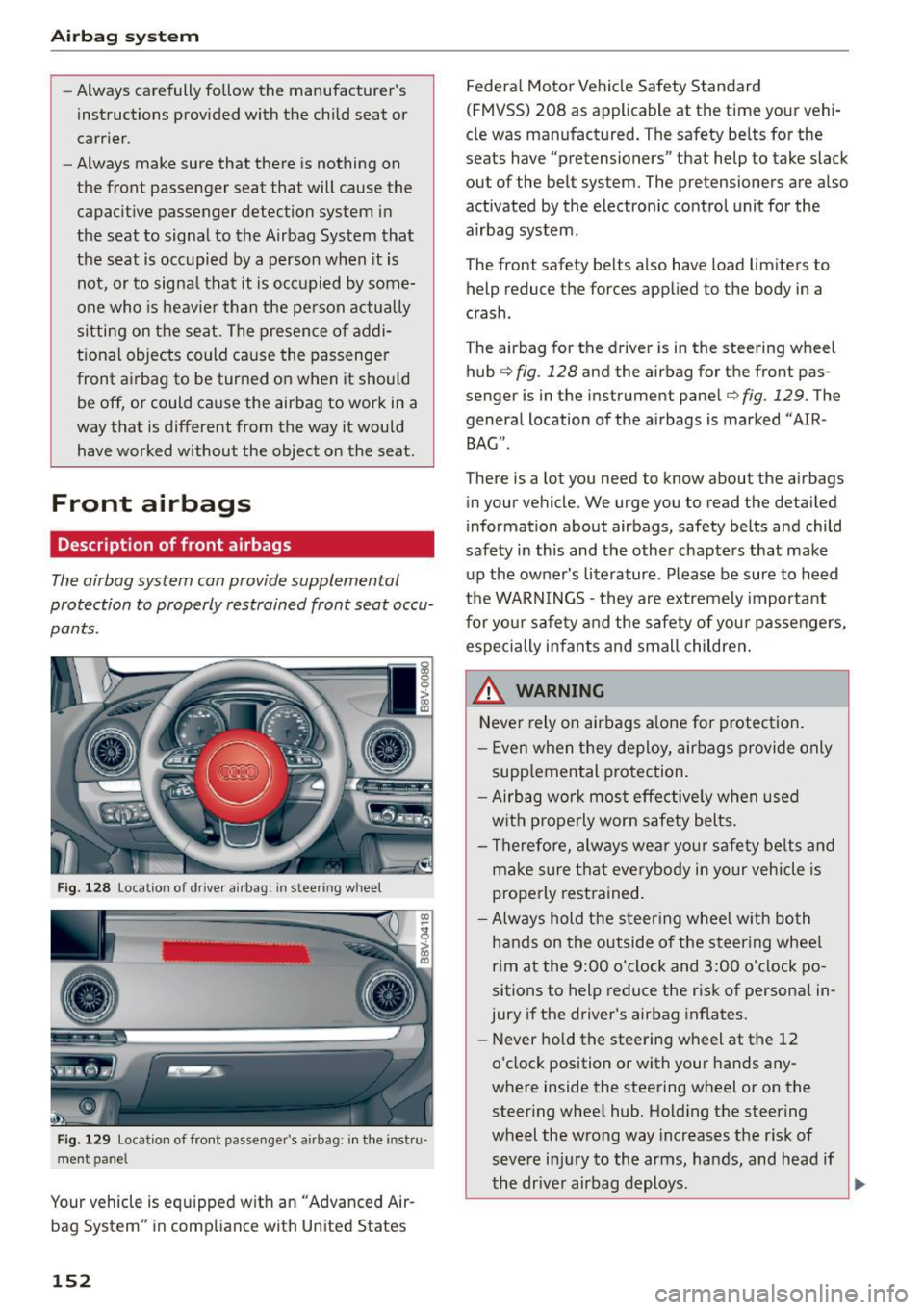
F ig. 128 Location of d river ai rbag: in steeri ng w heel
F ig. 129 Location of fro nt passenger's a irbag: in the i nstru
m ent pane l
Your vehicle is equipped w ith an "Advanced Air
bag System" in compliance with United States
152
Federa l Moto r Vehicle Safety Standard
(FMVSS) 208 as applicable at the time your vehi
cle was manufactured. The safety be lts for the
seats have "pretensioners" that help to take slack
out of the belt system. The pretensioners are also
activated by the electronic control unit for the
airbag system.
The front safety belts also have load lim iters to
help reduce the forces applied to the body in a
crash .
The airbag for the driver is in the steering wheel
hub ¢
fig. 128 and the airbag for the front pas
senger is in the instrument panel¢
fig. 129. The
genera l location of the airbags is marked ''AIR
BAG ".
There is a lot you need to know about the a irbags
in your vehicle. We urge you to read the detailed
information about airbags, safety belts and child
safety in this and the other chapte rs that make
up the owner's literature . Please be sure to heed
the WARN INGS - they are extremely important
for your safety and the safety of your passengers,
especially infants and small children .
A WARNING -
Never rely on airbags alone for protection.
- Even when they deploy, airbags provide only
supp lemental p rotection.
- Airbag wor k most effective ly when used
w it h properly worn safety belts.
- Therefore, alw ays wea r your safe ty belts and
ma ke sure that everybody in your vehicle is
properly rest rained.
- Always hold the s teer ing whee l w ith bo th
hands on the outside of the steer ing whee l
r im at the 9:00 o'clock and 3:00 o'clock po
sitions to help reduce the r isk of persona l in
jury if the driver's airbag in flates.
- Never hold the steering wheel at the 12
o'clock position or with your hands any
where inside the steering wheel or on the
steer ing whee l hub. Hold ing the steer ing
wheel the wrong way increases the risk of
severe in jury to the arms, hands , and head if
the dr iver airbag deploys .
ll>
Page 155 of 282

M N
0 > co ...... \!) 1.1'1
1.1'1
1.1'1
......
_& WARNING
Objects between you and the airbag will in
crease the risk of injury in a crash by interfer
ing with the way the airbag unfolds and/or by
being pushed into you as the airbag inflates.
- Always make sure nothing is in the front air-
bag deployment zone that could be struck
by the airbag when it inflates.
- Objects in the zone of a deploying airbag
can become projectiles when the airbag de
ploys and cause serious personal injury.
- Never hold things in your hands or on your
lap when the vehicle is in use.
- Never place accessories or other objects
(such as cup holders, telephone brackets,
note pads, navigation systems, or things
that are large, heavy, or bulky) on the doors; never attach then to the doors or the wind
shield; never place them over or near or at
tach them to the area marked ,,AIRBAG" on
the steering wheel, instrument panel or the
seat backrests; never place them between
these areas and you or any other person in
the vehicle.
- Never attach objects to the windshield
above the passenger front airbag, such as
accessory GPS navigation units or music
players. Such objects could cause serious in
jury in a collision, especially when the air
bags inflate.
- Never recline the front passenger seat to
transport objects. Items can also move into
the deployment area of the side airbags or
the front airbag during breaking or in a sud den maneuver. Objects near the airbags can
fly dangerously through the passenger com
partment and cause injury, particularly
when the seat is reclined and the airbags in
flate.
_& WARNING
A person on the front passenger seat, espe cially infants and small children, will receive
serious injuries and can even be killed by be
ing too close to the airbag when it inflates.
- Although the Advanced Airbag System in
your vehicle is designed to turn off the front
-
Airbag system
passenger airbag if an infant or a small child
is on the front passenger seat, nobody can
absolutely guarantee that deployment un
der these special conditions is impossible in
all conceivable situations that may happen
during the useful life of your vehicle.
- The Advanced Airbag System can deploy in
accordance with the ,,low risk" option for 3-
and 6-year-old children under the U.S. Fed
eral Standard if a child with electrical capac
itance greater than the combined capaci
tance of a typical one-year old infant re
strained in one of the forward facing or rear
ward-facing child seats with which your ve
hicle was certified is on the front passenger
seat and the other conditions for airbag de
ployment are met.
- Accident statistics have shown that children
are generally safer in the rear seat area than
in the front seating position .
- For their own safety, all children, especially
12 years and younger, should always ride in
the back properly restrained for their age
and size.
Advanced front airbag system
Your vehicle is equipped with a front Advanced
Airbag System in compliance with United States
Federal Motor Vehicle Safety Standard 208 asap
plicable at the time your vehicle was manufac
tured.
The front Advanced Airbag System supplements
the safety belts to provide additional protection
for the driver's and front passenger's heads and
upper bodies in frontal crashes. The airbags in
flate only in frontal impacts when the vehicle de
celeration is high enough.
The front Advanced Airbag System for the front
seat occupants is not a substitute for your safety
belts. Rather, it is part of the overall occupant re
straint system in your vehicle. Always remember
that the airbag system can only help to protect
you, if you are sitting upright, wearing your safe-
ty belt and wearing it properly . This is why you ..,.
153
Page 158 of 282
Airbag syste m
-An Advanced Airbag wi th gas generator for the
driver inside the steering wheel hub.
- An Advanced Airbag with gas generator inside
the instrument pane l for the front passenger.
- A capacitive passenger dete ct ion system under
neath the front passenge r seat cover. This sys
tem measures the e lectrical capacitance of the
person in the seat. The information registered
is sent continuously to the electronic control
unit to regulate deployment of the front Ad
vanced Airbag on the passenger s ide.
- An airbag monitoring system and indicator
light in the instrument cluster¢
page 160.
-A sensor in each front seat registers the dis
tance between the respect ive seat and the
steering wheel or instrument panel. The infor
mation registered is sent cont inuously to the
electronic control unit to regulate deployment
of the front Advanced Airbags.
- The
PASSENGER AIR BAG OFF light comes on
and stays on in the center of the instrument
pane l¢
page 198 a nd tells you when the front
Advanced Airbag on the passenger side has been t urned off .
- A sensor in the safety belt latch for the dr iver
and for the front seat passenger that senses
whether that safety belt is latched or not and
transmits this information to the e lectronic
control unit .
_&. WARNING
Damage to the front passenger seat can pre
vent the front airbag from work ing properly.
- Improper repair or disassembly of the front
passenger and driver seat w ill prevent the
Advanced Airbag System from funct ioning
properly.
- Repairs to the front passenger seat must be
performed by qualified and properly trained
workshop personnel.
- Never remove the front passenger or driver
seat from the veh icle.
- Never remove the upholstery from the front
passenger seat.
- Never disassemble or remove parts from the
seat or disconnect wires from it.
156
- Never carry sharp objects in yo ur poc kets or
put them on the seat. The capacitive pas
senger detection mat in the front passenger
seat will not function properly if it is punc
tured.
- Never carry things on you r lap or carry ob
jects on the front passenger seat. Such ob
jects can influence the capacitance regis
tered by the capac itive passenger detection
sy stem, so that in correct info rmation is pro
vided to the airbag cont rol uni t.
- Never store items under the front passenger
se at. P arts of the Advanced Airbag System
under the passenger seat could be dam
aged, p reventing t hem and the airbag sys
tem from wo rking properly.
- Never p lace sea t covers or rep lacement up
holstery that have not been specifically ap
proved by Audi on the front seats .
- Seat covers can prevent the Advanced Air
bag System from recognizing c hild re
straints or occupants on the front passenger
seat and prevent the side a irbag in the seat
backrest from deploying properly.
- If a seat heater has been retrofitted or oth
erw ise added to the front passenger seat,
never install any child restraint system on
this seat.
- Never use cushions, pillows, b lankets, or
sim ila r items on the front passenger seat .
The additional layers prevent the capacitive
passenger detection system from accurately
measuring the capacitance of the child safe
ty seat and/or the person on the seat and
thus keep the Adv ance d Airbag System from
wo rking properly .
- Never p lace or u se any e lectr ic al device
(s uc h a s a laptop, CD player, elec tronic
games device, power inve rter or seat heater
for child seats) on the front passenger seat if the device is connected to the 12 -volt
socket or the cigarette lighter soc ket. Such
dev ices can influence the capac itance regis
tered by the capac itive passe nger detection
system, so that incorrect info rmation is pro-
vided to the ai rbag cont rol unit.
~
Page 161 of 282
M N
0 > co ,...., \!) 1.1'1
1.1'1
1.1'1
,....,
smash the child seat and child against the
backrest, center armrest, door or roof.
- Always install rear-facing child seats on the
rear seat.
- If you must install a rearward facing child
seat on the front passenger seat because of
exceptional circumstances and the
PASSEN
GER AIR BAG OFF
light does not come on
and stay on, immediately install the rear
facing child seat in a rear seating position
and have the airbag system inspected by
your Audi dealer.
A WARNING
Objects between you and the airbag will in
crease the risk of injury in a crash by interfer
ing with the way the airbag unfolds or by be
ing pushed into you as the airbag inflates.
- Never hold things in your hands or on your
lap when the vehicle is in use.
- Never transport items on or in the area of
the front passenger seat. Objects could
move into the area of the front airbags dur
ing braking or other sudden maneuvers and
become dangerous projectiles that can
cause serious personal injury if the airbags
inflate.
- Never place or attach accessories or other objects (such as cup holders, telephone
brackets, large, heavy or bulky objects) on
the doors, over or near the area marked "AIRBAG" on the steering wheel, instru
ment panel, seat backrests or between
those areas and yourself. These objects could cause injury in a crash, especially
when the airbags inflate.
- Never recline the front passenger's seat to
transport objects. Items can also move into
the area of the side airbag or the front air
bag during braking or in a sudden maneu
ver. Objects near the airbags can become
projectiles and cause injury, particularly
when the seat is reclined.
- Never place or transport objects on the front passenger seat. Objects on the front passenger seat could cause the capacitive
sensor in the seat to signal to airbag system
Airbag system
that the seat is occupied by a person when it
in fact is not, or that the person on the seat
is heavier than he or she actually is. The
change in electric capacitance because of
such objects can cause the passenger front
airbag to be turned on when it should be off,
or can cause the airbag to work in a way that
is different from the way it would have
worked without objects on the seat.
-Always make sure that there is nothing on
the front passenger seat that will cause the
capacitive passenger detection system in
the seat to signal to the Airbag System that
the seat is occupied by a person when it is
not, or to signal that it is occupied by some
one who is heavier than the person actually
sitting on the seat. The presence of an ob
ject could cause the passenger front airbag to be turned on when it should be off, or
could cause the airbag to work in a way that is different from the way it would have
worked without the object on the seat.
_LD. WARNING
The fine dust created when airbags deploy can
cause breathing problems for people with a
history of asthma or other breathing condi
tions.
- To reduce the risk of breathing problems,
those with asthma or other respiratory con
ditions should get fresh air right away by
getting out of the vehicle or opening win
dows or doors.
- If you are in a collision in which airbags de
ploy, wash your hands and face with mild
soap and water before eating .
- Be careful not to get the dust into your eyes,
or into any cuts or scratches.
- If the residue should get into your eyes,
flush them with water.
159
Page 165 of 282
M N
0 > co ,...., \!) ..,.,
..,.,
..,., ,....,
seat into its rearmost position in the seat's
fore and aft adjustment range, as far away
from the airbag as possible . The backrest
must be adjusted to an upright position .
Make sure that the
PASSENGER AIR BAG
OFF
light comes on and stays on all the time
whenever the ignition is switched on.
A WARNING
- If the PASSENGER AIR BAG OFF light does
not go out when an adult is sitting on the
front passenger seat after taking the steps
described above, make sure the adult is
properly seated and restrained at one of the
rear seating positions.
- Have the airbag system inspected by your
Audi dealer before transporting anyone on
the front passenger seat.
(D Tips
If the capacitive passenger detection system
determines that the front passenger seat is
empty, the frontal airbag on the passenger
side will be turned off, and the
PASSENGER
AIR BAG OFF light will stay on .
Repair, care and disposal of the airbags
Parts of the airbag system are installed at many
different places on your Audi . Installing, remov
ing , servicing or repairing a part in an area of the
vehicle can damage a part of an airbag system
and prevent that system from working properly
in a collision.
There are some important things you have to know to make sure that the effectiveness of the
system will not be impaired and that discarded
components do not cause injury or pollute the
environment.
A WARNING
-
Improper care, servicing and repair proce
dures can increase the risk of personal injury
and death by preventing an airbag from de
ploying when needed or deploying an airbag
unexpectedly:
Airbag system
-Never cover, obstruct, or change the steer
ing wheel horn pad or airbag cover or the in
strument panel or modify them in any way.
- Never attach any objects such as cup holders
or telephone mountings to the surfaces cov
ering the airbag units.
- For cleaning the horn pad or instrument
panel, use only a soft, dry cloth or one mois
tened with plain water . Solvents or cleaners
could damage the airbag cover or change
the stiffness or strength of the material so
that the airbag cannot deploy and protect
properly.
- Never repair, adjust, or change any parts of
the airbag system.
-All work on the steering wheel, instrument
panel, front seats or electrical system (in
cluding the installation of audio equipment,
cellular telephones and CB radios, etc.)
must be performed by a qualified technician
who has the training and special equipment
necessary.
- For any work on the airbag system, we strongly recommend that you see your au
thorized Audi dealer or qualified workshop.
- Never modify the front bumper or parts of
the vehicle body.
- Always make sure that the side airbag can inflate without interference:
- Never install seat covers or replacement upholstery over the front seatbacks that
have not been specifically approved by
Audi .
- Never use additional seat cushions that
cover the areas where the side airbags in
flate.
- Damage to the original seat covers or to
the seam in the area of the side airbag
module must always be repaired immedi
ately by an authorized Audi dealer.
- The airbag system can deploy only once. Af
ter an airbag has been deployed, it must be
replaced with new replacement parts de
signed and approved especially for your Audi model version. Replacement of complete
airbag systems or airbag components must be performed by qualified workshops only.
Make sure that any airbag service action is
163