2015 AUDI S3 SEDAN weight
[x] Cancel search: weightPage 180 of 282
Child safety
_& WARNING
A child in a child safety seat installed with the LATCH lower anchorages or with the standard
safety belt or a child in a booster seat on the
rear seat cou ld play with unused rear seat
safety belts and become entangled. This
could cause the child serious personal injury
and even death.
- Always secure unused rear seat safety belts
out of reach of children in child seats such
as by properly routing them around the
head restraint of the seat where the child re
straint is installed.
- Never activate the convertible locking re tractor when routing the safety belts around
the head restraints.
- Never let anyone sit at the center rear seat
ing position if the center rear safety belt has
been routed around a rear head restraint.
Child seats
Infant seats
Babies and infants up to about one year old and
20 lbs. or 9 kg need special rearward-facing
child restraints that support the back, neck and
head in a crash.
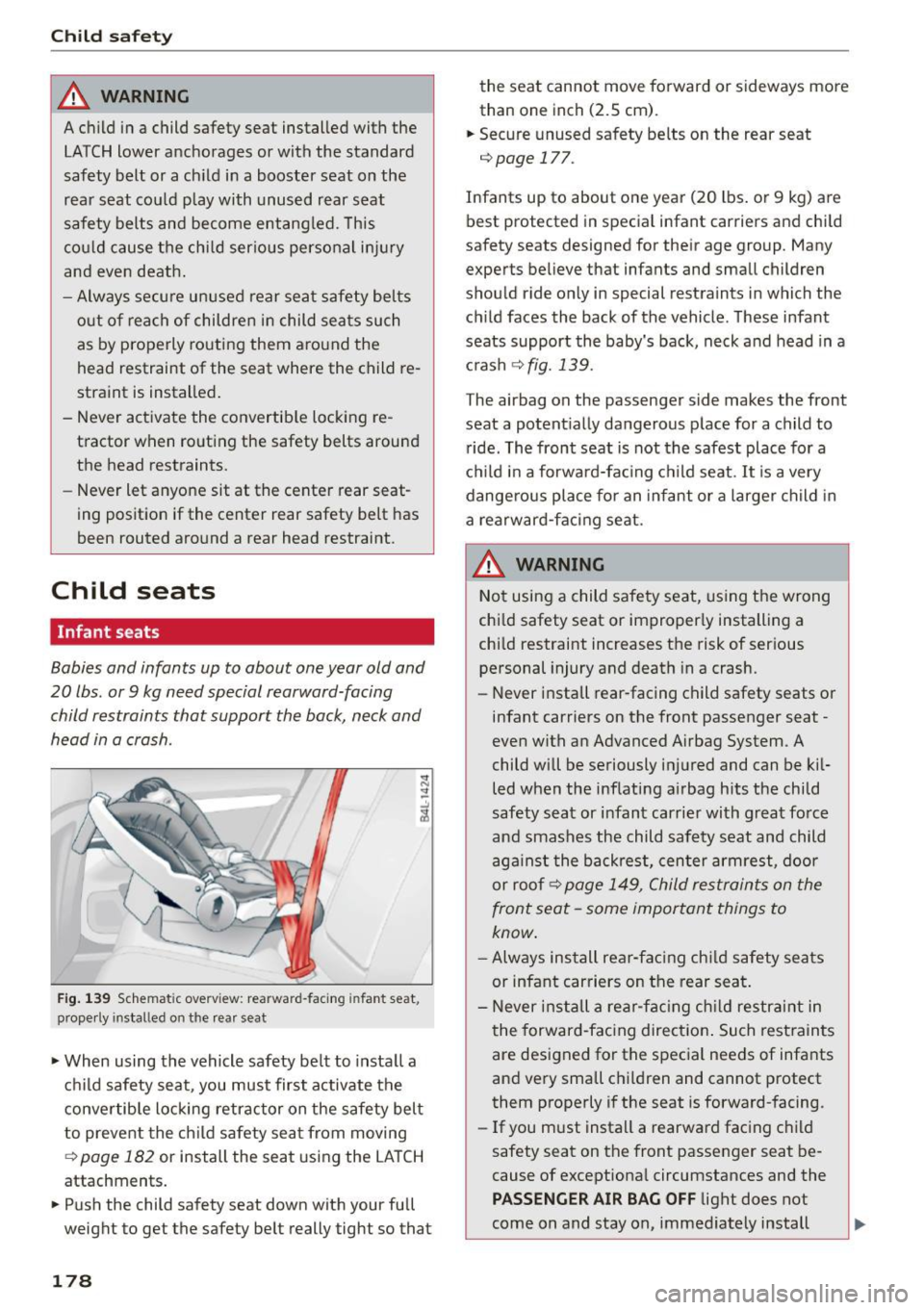
Fig. 139 Schematic overview: rearward-facing infant seat,
properly installed on the rear seat
.. When using the vehicle safety be lt to install a
child safety seat, you must first activate the
convertible locking retractor on the safety belt
to prevent the child safety seat from moving
c::> page 182 or install the seat using the LATCH
attachments.
.. Push the child safety seat down with your full
weight to get the safety belt really tight so that
178
the seat cannot move forward or sideways more
than one inch (2.5 cm).
.. Secure unused safety belts on the rear seat
c::>page 177.
Infants up to about one year (20 lbs. or 9 kg) are
best protected in special infant carriers and child
safety seats designed for their age group. Many
experts believe that infants and small children
should ride only in special restraints in which the
ch ild faces the back of the vehicle. These infant
seats support the baby's back, neck and head in a
crash
c::> fig. 139.
The airbag on the passenger side makes the front
seat a potent ially dangerous place for a child to
ride . The front seat is not the safest place for a
child in a forward-facing ch ild seat.
It is a very
dangerous place for an infant or a Larger child in
a rearward-facing seat.
_& WARNING
Not using a child safety seat, using the wrong
child safety seat or improperly installing a
child restraint increases the risk of serious personal injury and death in a crash.
- Never install rear-facing child safety seats or
infant carriers on the front passenger seat -
even with an Advanced Airbag System. A
child will be seriously injured and can be kil led when the inflating airbag hits the child
safety seat or infant carrier with great force
and smashes the child safety seat and child
against the backrest, center armrest, door
or roof
c::> page 149, Child restraints on the
front seat -some important things to
know .
-Always install rear-facing chi ld safety seats
or infant carriers on the rear seat.
- Never install a rear-fac ing ch ild restraint in
the forward-facing direction. Such restraints
are designed for the special needs of infants
and very small children and cannot protect
them properly if the seat is forward-facing.
- If you must install a rearward facing child
safety seat on the front passenger seat be
cause of exceptional circumstances and the
PASSENGER AIR BAG OFF light does not
come on and stay on, immediately install
~
Page 181 of 282
....,
N
0 > co
rl I.O
"'
"'
"'
rl
the rear-facing ch ild safety seat in a rear
seating pos it ion and have the airbag system
inspected by your Audi dealer.
- Never place or use any electrical device
(such as a laptop, CO player, electron ic
games dev ice, power inverter or seat heater
for child seats) on the front passenger seat if the dev ice is connected to the 12-volt
socket or the c igarette lighter socket.
- If a seat heater has been retrofitted or oth
erwise added to the front passenger seat,
never i nstall any ch ild restra int system on
this seat.
- Make sure that there are no wet objects
(such as a wet towel) and no wa ter or othe r
liquids on the front passenger seat c ushion.
- Never place objects on the seat (such as a
laptop, CD playe r, e lectronic games dev ice,
power inverter or seat heater for chi ld
seats). These may influence the e lectr ica l
capacitance measured by the capacitive pas·
senger detection system and can a lso fly
around in an accident and cause serious per
sonal injury.
- Always read and heed all WARNINGS when·
ever using a child restrained in a vehicle is
being used
c:::> page 140, Safety belts,
¢ page 148, Airbag system and
c::> page 172, Important information.
Convertible child safety seats
Properly used convertible child safety seats can
help protect toddlers and children over age one
who weigh between 20 and 40 lbs. (9 and 18 kg)
in a crash.
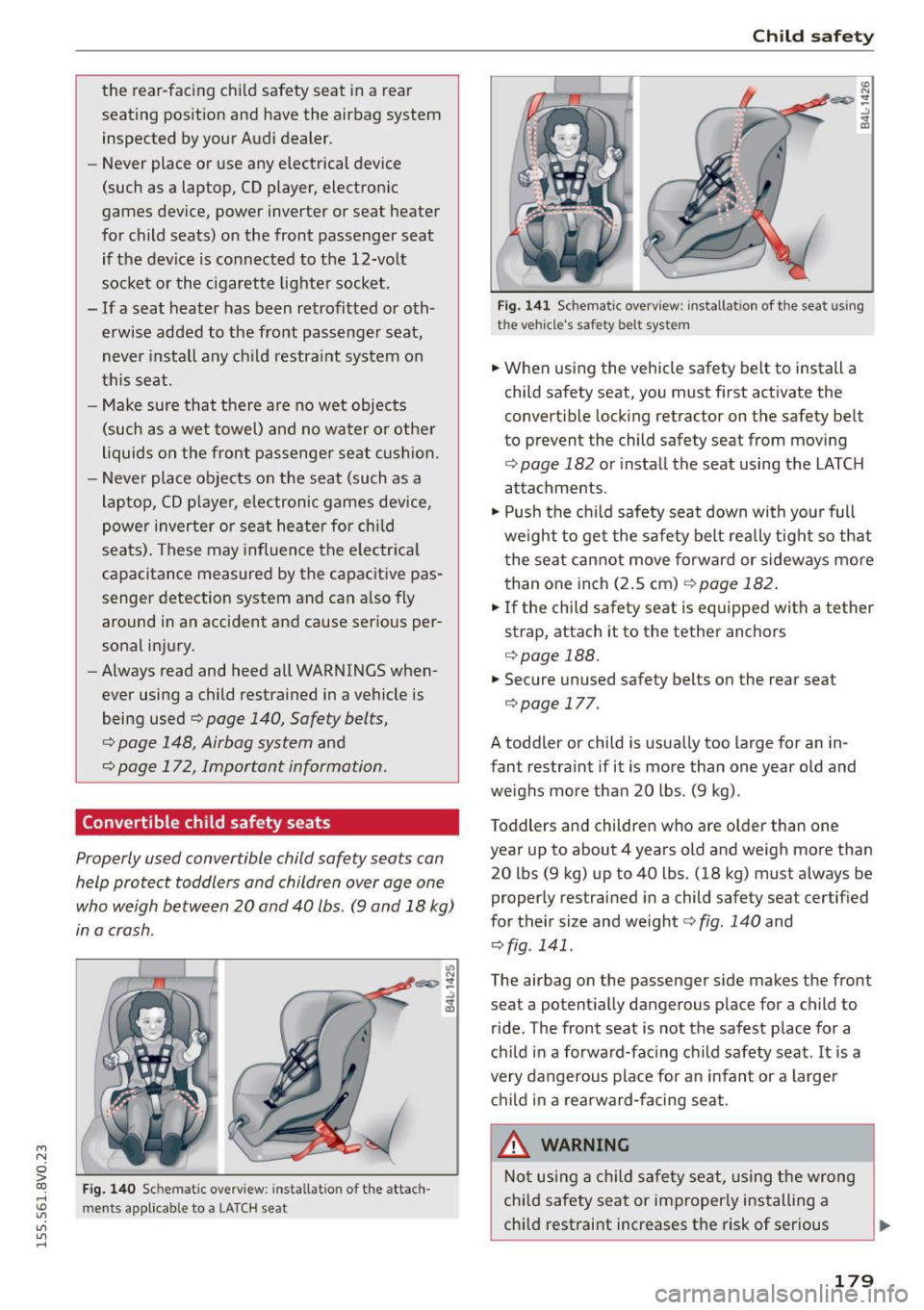
F ig . 140 Schemat ic overview : installat ion of t he atta ch
ments applicab le to a LATCH seat
Chil d sa fe ty
Fig. 141 Schemat ic overv iew: installat io n of the seat us ing
the vehicle's sa fety belt system
.. When using the vehicle safety belt to install a
child safety seat, you must first activate the
convert ible lock ing retractor on the safety belt
to prevent the child safety seat from moving
c::> page 182 or install the seat using the LATC H
attachments .
.. Push the ch ild safety seat down with your full
weight to get the safety belt rea lly t ight so that
t he seat cannot move forward or sideways more
than one inch (2.5 cm)
c::> page 182.
.. If the child safety seat is equipped with a tether
strap, attach it to the tether anchors
c::> page 188 .
.. Secure unused safety belts on the rear seat
c::>page 177.
A toddler or child is usua lly too large for an in
fant restraint if it is more than one year old and
weighs more than 20 lbs. (9 kg).
Toddlers and children who are older than one
year up to about 4 years old and weigh more than 20 lbs (9 kg) up to 40 lbs. (18 kg) must always be
properly restrained in a child safety seat certif ied
for their size and we ight
c:::> fig . 140 and
c::> fig . 141.
The airbag on the passenger side makes the front
seat a potent ially dangerous p lace for a child to
ride . The front seat is not the safest place for a
child i n a forward-fac ing child safety seat. It is a
very dangerous place for an infant or a larger
c h ild in a rearward-facing seat.
_&. WARNING
No t using a child sa fety seat, us ing the wrong
child safety seat or improper ly installing a
child restraint increases the risk of serious
~
179
Page 183 of 282
....,
N
0 > co
rl I.O
"'
"'
"'
rl
airbag system inspected by your authorized
Audi dealer.
- Take the child restraint off the front passen
ger seat and install it properly at one of the
rear seat pos it ions if the
PASSENGER AIR
BAG OFF
light does not stay on whenever
the ignition is switched on .
Booster seats and safety belts
Properly used booster seats can help protect
children weighing be tween about 40 lbs. and 80
lbs . (18 kg and 36 kg) who are less than 4
ft. 9
in . (57 inches/1 .45 meters) tall .
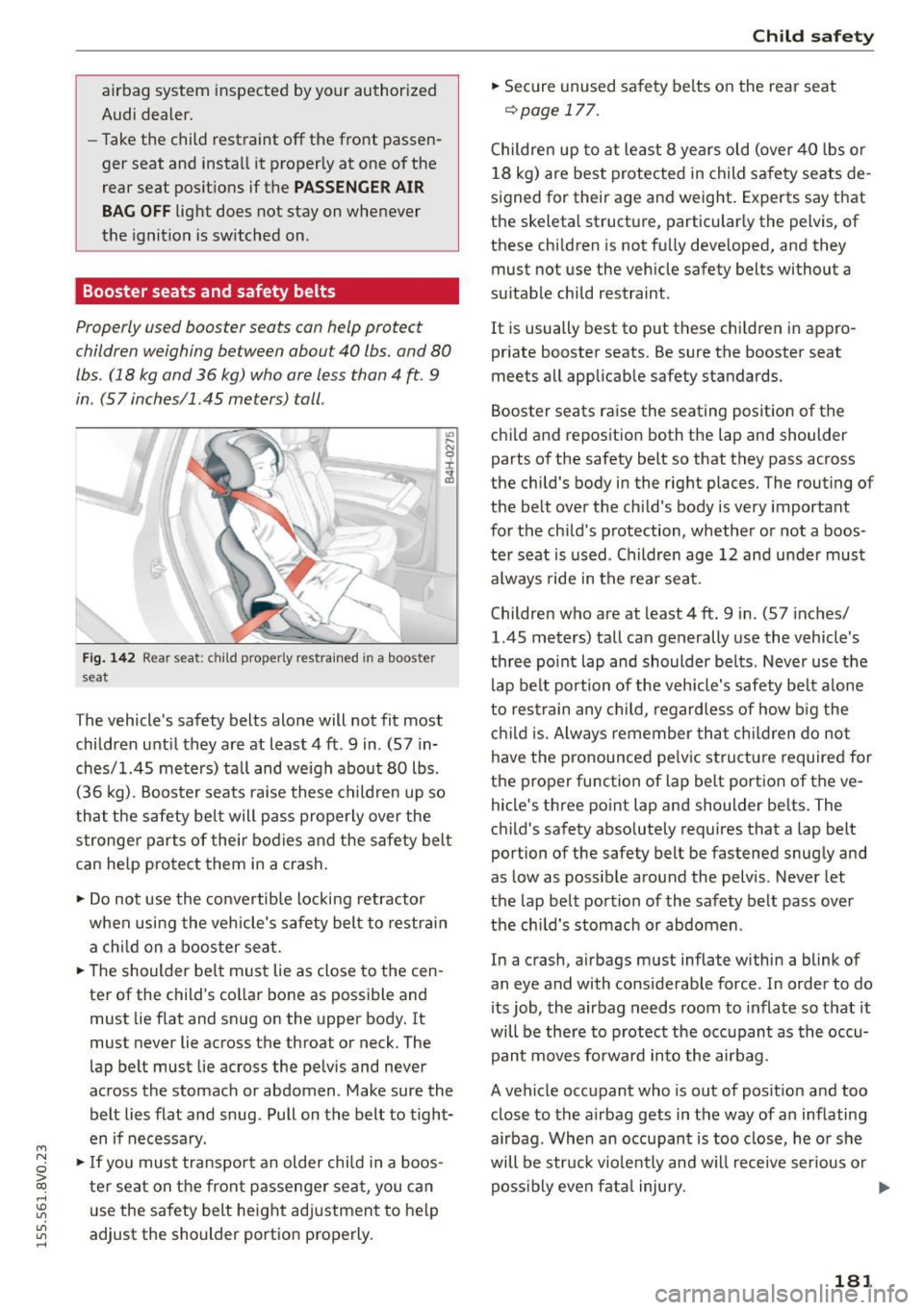
Fig. 14 2 Re ar seat: child pro perl y restrain ed in a booster
seat
T he vehicle's safety belts alone will not fit most
children unti l they are at least 4
ft . 9 in . (57 in
ches/1.45 meters) tall and we igh about 80 lbs .
(36 kg) . Booster seats raise these children up so
that the safety bel t will pass properly over the
stronger parts of their bodies and the safety belt
can help protect them in a c rash.
.,. Do not use the co nvertib le locking retractor
when using the vehicle's safety bel t to restra in
a ch ild on a boos ter sea t.
.. The shoulder be lt must lie as close to the cen
te r of the child's co llar bone as possible and
must lie flat and snug on the upper body. It
must never lie across the throat or neck. The
lap belt must lie across the pelvis and never
ac ross the stomach or abdomen . Make sure the
belt lies flat and snug . Pull on the belt to tight
en if necessary .
.,. If you must transpo rt an older chi ld in a boos
ter seat on the front passenger sea t, you can
use the safety belt height adj ustmen t to help
adjust the shoulder port ion properly .
Child sa fe ty
.. Secure unused sa fety belts on the rear seat
i=> page 177.
Childre n up to at least 8 yea rs old (over 40 lbs or
18 kg) are best protected in child safety seats de
s igned for their age and weight . Experts say that
the skeleta l structure, particularly the pelvis, of
these chi ldren is not f ully deve loped, and they
must not use the vehicle safety belts without a
su itable child restraint .
It is usually best to put these child ren in appro
priate booster seats . Be sure the booster seat
meets all applicab le safety standards.
Booster seats ra ise the seating position of the
child and reposit ion both the lap and shoulder
parts of the safety belt so that they pass across
the chi ld's body in the right places. The routing of
the be lt over the chi ld 's body is very important
for the ch ild's protection, whether or not a boos
te r seat is used . Children age 12 and under must
always ride in the rear seat.
Children who are at least 4
ft. 9 in . (57 inches/
1.45 meters) tall can generally use the vehicle's
th ree po int lap and shoulder be lts . N ever use the
lap belt portion of the veh icle's safety belt a lone
to re strain any child , regardles s of how b ig the
c hi ld i s. A lways remember that c hildren do no t
have the pronounced pe lv ic struct ure required for
the p roper function of lap belt port ion of the ve
hicle 's t hree point lap and shoulder be lts . The
c h ild 's safety abso lutely requires that a lap belt
portion of the safety belt be fastened snug ly and
as low as possible around the pelvis . Never let
the lap belt portion of the safety belt pass over
the ch ild's stomach or abdomen .
In a crash, a irbags must inflate within a blink of
an eye and with considerable force . In order to do
its job, the airbag needs room to inflate so that it
will be the re to p rotect the occ upant as th e occu
pant moves fo rward into the airbag .
A vehicle occupant who is out of posit ion and too
close to the a irbag gets in the way of an inflating
airbag . When an occupan t is too close, he o r she
will be struck violent ly and w ill receive ser ious or
poss ibly eve n fa ta l injury. .,,.
181
Page 186 of 282
Child safety
-Always make sure the forward-facing seat
has been designed and certified by its man
ufacturer for use on a front seat with a
passenger front and side airbag.
- Never put the forward-facing child restraint
up, aga inst or very near the instrument pan
el.
- Always move the passenger seat into its
rearmost position in the seat's fore and aft
adjustment range, as far away from the air
bag as possible before installing the for
ward-fac ing child restraint. The backrest
must be adjusted to an upright posit ion.
- Make sure that the
PASSENGER AIR BAG
OFF
light comes on and stays on all the time
whenever the ignition is switched on.
_&. WARNING
Rearward-fac ing ch ild restra ints:
- A child in a rearward-facing child safety seat
installed on the front passenger seat will be
seriously injured and can be killed if the
front airbag inflates -even with an Ad
vanced Airbag System .
- T he inflating airbag wil l hit the child safety
seat or infant carrier with great force and
will smash the chi ld safety seat and child
against the backrest, center armrest, door
or roof.
- Always be especially carefu l if you must in
stall a rearward facing child safety seat on
the front passenger seat in exceptional cir
cumstances.
- Make sure that the
PASSENGER AIR BAG
OFF
light comes on and stays on all the t ime
whenever the ignition is switched on .
- If the
PASSENGER AIR BAG OFF light does
not come on and stay on, immed iately in
stall the rear-fac ing ch ild safety seat in a
rear seating position and have the airbag
system inspected by your Aud i dealer.
184
· Activating the convertible locking retractor
Use the convertible locking retractor to secure a
child restraint.
Always heed the child safety seat manufacturer's
instructions when installing a child restraint in
your vehicle . T o activate the convert ible locking
retractor:
.. Place the child restraint on a seat, preferably on
the rear seat .
.. Slowly pull the belt
all the way out.
.. Route it around or through the child restraint
belt pat h
c::> ,&..
.. Push the ch ild safety seat down with your full
weight to get the safety belt really tight.
.. Insert the belt tongue into the buckle for that
seating position.
.. Guide the safety be lt back into the retractor un
til the belt lies flat and snug on the ch ild safety
seat.
.. You should hear a "clicking" noise as the belt
w inds back into the inertia reel. Test the con
vert ible lock ing retractor by pulling on the belt .
You should no longer be able to pull the belt
out of the ret ractor. The convertible locking re
tractor is now activated .
.. Make sure that the red release button is facing
away from the child restraint so that it can be
unbuckled quickly .
.. Pull on the belt to make sure the safety belt is
properly tight and fastened so that the seat
cannot move forward or s ideways more than
one inch (2 .5 cm).
_&. WARNING
Using the wrong child restraint or an improp
erly installed child restraint can cause serious
personal injury or death in a crash.
- Always make sure that the safety belt re
tractor is loc ked when insta lling a child safe
ty seat. An unlocked safety belt retractor
cannot hold the child safety seat in place
during normal driving or in a crash.
- Always buckle the child safety seat firmly in
place even if a chi ld is not sitting in it. A
loose child safety seat can fly around during
a sudden stop or in a crash.
.
Page 218 of 282
Tires and wheels
be happy to provide more infor
mation .
® Mud and snow capabilit y
"M/S" or "M+S" indicates the tire
has characteristics that make it
suitab le for driving on mud and
snow.
& indicates a winter tire.
@ Compos ition of the tire cord
and materi als
The number of plies indicates the
number of rubberized fabric lay
ers in the tire. In general : the
more laye rs, the more weight a
tire can carry. Tire manufacturers
must also specify the materials
used in the tire. These include
steel , nylon, polyester and other
materials.
@ Maximum permitted load
This number indicates the maxi
mum load in kilograms and
pounds that the tire can carry.
@ Uniform tire quality grade
standards for treadwear,
traction and temperature
resistance
Treadwear, traction and tempera
ture ranges r:>
page 231.
@ Running direction
The arrows indicate the running
direction o f unidirectional tires .
216
You m ust always follow the speci
fied runn ing direction
.:> page 245.
@ Maximum permitted
inflation pressure
This number indicates the maxi
mum pressure to which a tire can
be inflated under normal operat
ing condit ions .
Glossary of tire and loading
terminology
Accessory weight
means the combined we ight (in
excess of those standard items
which may be replaced) of auto
matic transmission, power stee r
ing, power brakes , power win
dows, power seats, radio, and heater, to the extent that these
items are available as fac to ry-in
stalled equipment (w hether in
stalled or not).
Aspect ratio
means the ratio of the height to
the width of the tire in percent .
Numbers of 55 or lower ind icate a
low si dewall for imp roved steer
ing response and better overa ll
handling on dry pavement . .,.
Page 219 of 282
Bead
means the part of the tire that is
made of steel wires, wrapped or
reinforced by ply cords and that is
shaped to fit the rim.
Bead separation
means a breakdown of the bond
between components in the bead.
Cord
means the strands forming the
plies in the tire .
Cold tire inflation pressure
means the tire pressure recom
mended by the vehicle manufac
turer for a tire of a designated
size that has not been driven for
more than a couple of miles (kilo
meters) at low speeds in the three
hour period before the tire pres
sure is measured or adjusted.
Curb weight
means the weight of a motor ve
hicle with standard equipment in
c luding the maximum capacity of
fuel, oil, and coolant, air condi
tioning and add itional weight of
optional equipment.
E xtra load t ire
means a tire designed to operate
at higher loads and at higher in -
Tires a nd whe els
flation pressures than the corre
spond ing standard tire. Extra load
tires may be identified as "XL",
" xl", "EXTRA LOAD", or "RF" on
the sidewall.
Gross A xle Weight R ating
( " GAWR")
means the load -carrying capacity
of a single axle system, measured
at the tire-ground interfaces .
Gross Vehicle Weight Rating
(" GVWR ")
means the maximum total loaded
weight of the vehicle.
Groove
means the space between two ad
jacent tread ribs.
Load rating (code )
means the maximum load that a
tire is rated to carry for a given in
flation pressure . You may not find
this information on all tires be cause it is not required by law.
Ma ximum load rating
means the load rating for a tire at
the maximum permissible infla
tion pressure for that tire.
Ma ximum loaded vehicle
weight
means the sum of:
217
...
Page 220 of 282
Tires and wheels
(a) Curb weight
(b) Accessory weight
(c) Vehicle capacity weight, and
(d) Production options weight
Ma ximum (permissible )
inflation pres su re
means the max imum cold infla
tion pressure to which a tire may be inflated. Also called "maxi
mum inflation pressure."
Normal occupant weight
means 150 lbs. (68 kilograms)
times the number of occupants
seated in the vehicle up to the to
tal seating capacity of your vehi
cle .
Occupant d istribution
means distribution of occupan ts
in a vehicle .
Outer diameter
means the overall diameter of an
inflated new tire.
Overall width
means the l inear distance be
tween the exteriors of the side
walls of an infla ted tire, including
elevations due to labeling , deco
rations, or protective bands or
ribs.
2 18
Ply
means a layer of rubber -coated
parallel cords.
Production options weight
means the comb ined weight of
those installed regular production
options weighing over 5 lbs. (2.3 kg) in excess of those standard
items which they rep lace, not pre
viously considered in cu rb weight
or accessory weight, including heavy duty brakes, ride levelers,
roof rack, heavy duty battery, and
special trim.
Radial ply tire
means a pneumatic tire in which
the ply co rds that extend to the
beads are laid at substantially 90
deg rees to the centerline of the
tread.
Recommended inflation
pressure
see ~ page 217 , Cold tire infla
tion pressure.
Reinforced tire
means a tire designed to operate
at higher loads and at higher in
flation pressures than the corre sponding standard tire. Rein
forced tires may be identified as
Page 222 of 282
Tires and wheels
Uniform Tire Qu ality Gr ading
is a tire information system devel
oped by the United States Nation
al Highway Traffic Safety Adminis
tration (NHTSA) that is designed
to help buyers make relative com
parisons among tires. The UTQG is
not a safety rating and not a guar
antee that a tire will last for a prescribed number of miles (kilo
meters) or perform in a certain
way . It simply gives tire buyers
additional information to com
bine with other considerations,
such as price, brand loyalty and
dealer recommendations . Under
UTQG, tires are graded by the tire manufacturers in three areas:
treadwear, traction, and tempera
ture resistance . The UTQG infor
mation on the tires, molded into
the sidewalls.
U.S. DOT T ire Identification
Number (TIN )
This is the tire 's "serial number" .
It begins with the letters "DOT "
and indica tes that the tire meets
all federal standards . The next
two numbers or letters indicate
the plant where it was manufac
tured, and the last four numbers represent the week and year of
manufacture. For example,
220
DOT ... 2214 ...
means that the tire was produced
in the 22nd week of 2014. The
other numbers are marketing co
des that may or may not be used
by the tire manufacturer . This in
formation is used to contact con sumers if a tire defect requires a recall.
Vehicle capacity we ight
means the rated cargo and lug
gage load plus 150 lbs . (68 kilo
grams) times the vehicle's desig nated seating capacity .
Vehicle maximum load on the
tire
means that load on an ind ividual
t ire that is determined by distrib
uting to each axle its sha re of the
maximum loaded vehic le weight
and dividing by two.
Vehicle normal load on the tire
means that load on an individual
tire that is determined by distrib uting to each axle its share of the
curb weight, accessory weight ,
and normal occupant weight (dis
tributed in accordance with
¢ ta
ble on page 226) and dividing by
two.
...