2015 AUDI S3 SEDAN warning
[x] Cancel search: warningPage 244 of 282
Emergency assistance
_& WARNING
Always read and follow all WARNINGS and in
formation
c:> & in Raising the vehicle on
page 244
and c:> page 245.
After changing a wheel
A wheel change is not complete without the do
ing the following .
.. Always store the vehicle tool kit, the jack* and
the replaced tire in the luggage compartment
c:> page 136 .
.. Check the tire pressure on the spare wheel im
med iate ly after mounting it .
.. As soon as possible, have the
tightening tor
ques
on all wheel bolts checked with a torque
wrench. The correct tightening torque is 90 ft
lb
(120 Nm) .
.. Have the flat tire
replaced as soon as possible.
@ Tips
-If you notice that the wheel bolts are cor
roded and difficult to turn while changing a
tire, they should be replaced before you
check the tightening torque.
- Drive at reduced speed until you have the
tightening torques checked.
- After changing a wheel, the tire pressure in
all four tires must be checked/corrected and
the tire pressure mon itoring indicator must
be stored in the MMI
c:> page 234.
Decorative wheel covers
Applies to vehicles: with decorative wheel covers
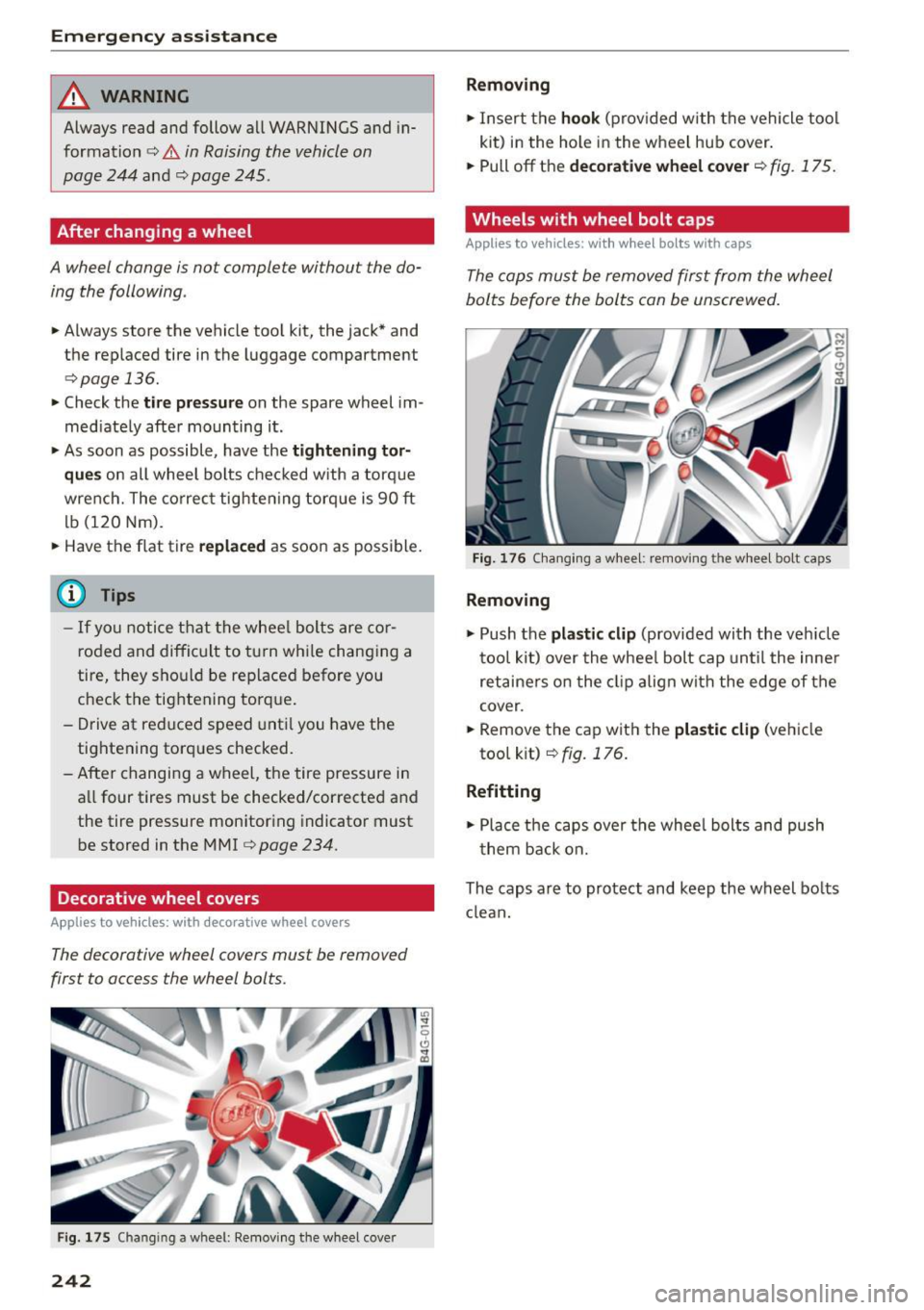
The decorative wheel covers must be removed
first to access the wheel bolts .
Fig. 175 Chan gin g a w hee l: Removing the wheel cover
242
Removing
.. Insert the hook (provided with the vehicle tool
kit) in the hole in the wheel hub cover.
.. Pull off the
decorative wheel cover c:> fig. 175.
Wheels with wheel bolt caps
Applies to vehicles: with wheel bolts with caps
The cops must be removed first from the wheel
bolts before the bolts con be unscrewed .
Fig. 176 Changing a wheel: removing th e whee l b olt caps
Removing
.. Push the plastic clip (provided with the veh icle
tool kit) over the wheel bolt cap until the inner
retaine rs on the clip align with the edge of the
cover .
.. Remove the cap with the
plastic clip (vehicle
tool k it)
c:> fig. 176.
Refitting
.. Place the caps over the wheel bolts and push
them back on.
The caps are to protect and keep the wheel bolts
clean.
Page 245 of 282
....,
N
0 > co
rl I.O
"'
"'
"'
rl
Loosening and tightening the wheel bolts
The wheel bolts must be loosened before raising
the vehicle.
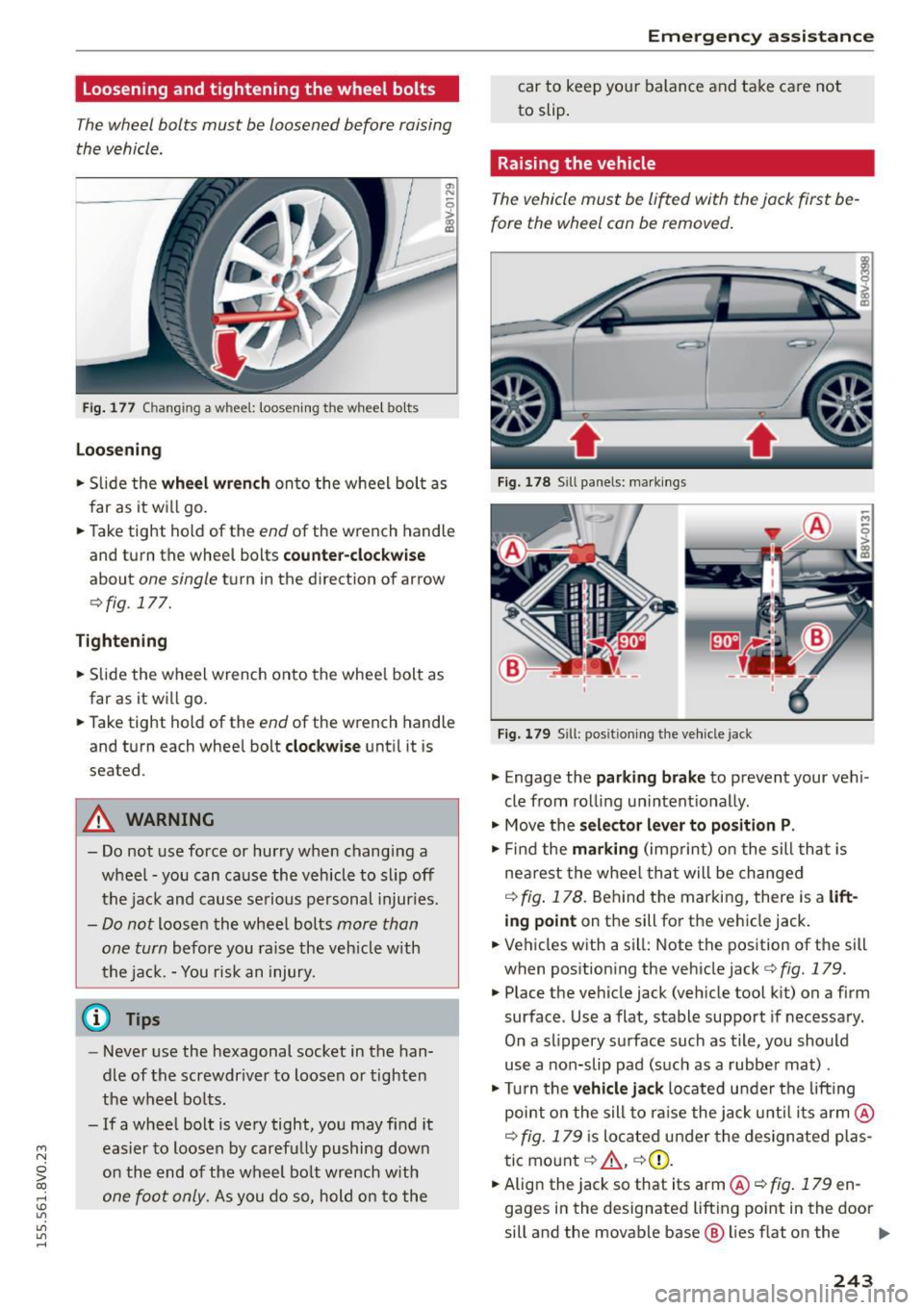
Fig . 177 Changing a wheel: loosening the whee l bo lts
Loosening
... Slid e the wheel wren ch onto the wheel bolt as
far as it will go .
... Take tight hold of the
end of the wrench handle
and turn the wheel bolts
counter-clockwise
about one single turn in the direction of arrow
r:=>fig. 177.
Tightening
... Slide the wheel wrench onto the whee l bolt as
far as it will go .
... Take tight hold of the
end of the wrench handle
and turn each whee l bolt
clockwise until it is
seated.
A WARNING
- Do not use force or hurry when changing a
wheel -you can ca use the vehicle to sl ip off
the jack and cause serious personal injuries.
-Do not loose n the wheel bolts more than
one turn
before you raise the vehicle with
the jack. -You risk an injury.
(D Tips
-Never use the hexagonal socket in the han
dle of the screwdriver to loosen or tighten
the wheel bolts.
- If a whee l bolt is very tight, you may find it
easier to loosen by carefully pushing down
on the end of the wheel bolt wrench with
one foot only . As you do so, hold on to the
Emergen cy assistance
car to keep your balance and take ca re not
to slip .
Raising the vehicle
The vehicle must be lifted with the jack first be
fore the wheel can be removed .
Fig. 178 Sill panels: marking s
Fig. 179 Sill: pos itio ning the vehicle jack
... Engage the parking brake to prevent your vehi
cle from rolling unintent ionally .
... Move the
selector lever to position P .
... Find the marking (imprint) on the sill that is
nea rest the wheel that will be changed
q fig. 178. Behind the marking, there is a lift
ing point on the sill for the vehicle jack.
... Vehicles with a si ll: Note the position of the sill
when position ing the vehicle jack
q fig. 179.
... Place the vehicle jack (vehicle tool k it) on a firm
surface. Use a flat, stable support if necessary.
On a slippery surface such as tile, you should
use a non-slip pad (such as a rubber mat) .
... Turn the
vehicle jack located under the lifting
point on the sill to ra is e the jack u ntil its arm@
Q fig. 179 is located under the designated plas
tic mount
q .&., q(j) _
... Align the jack so that its arm @ c:::> fig. 179 en
gages in the designated lifting point in the door
sill and the movable base @ lies flat on the ..,.
243
Page 246 of 282
Eme rge ncy ass ista nce
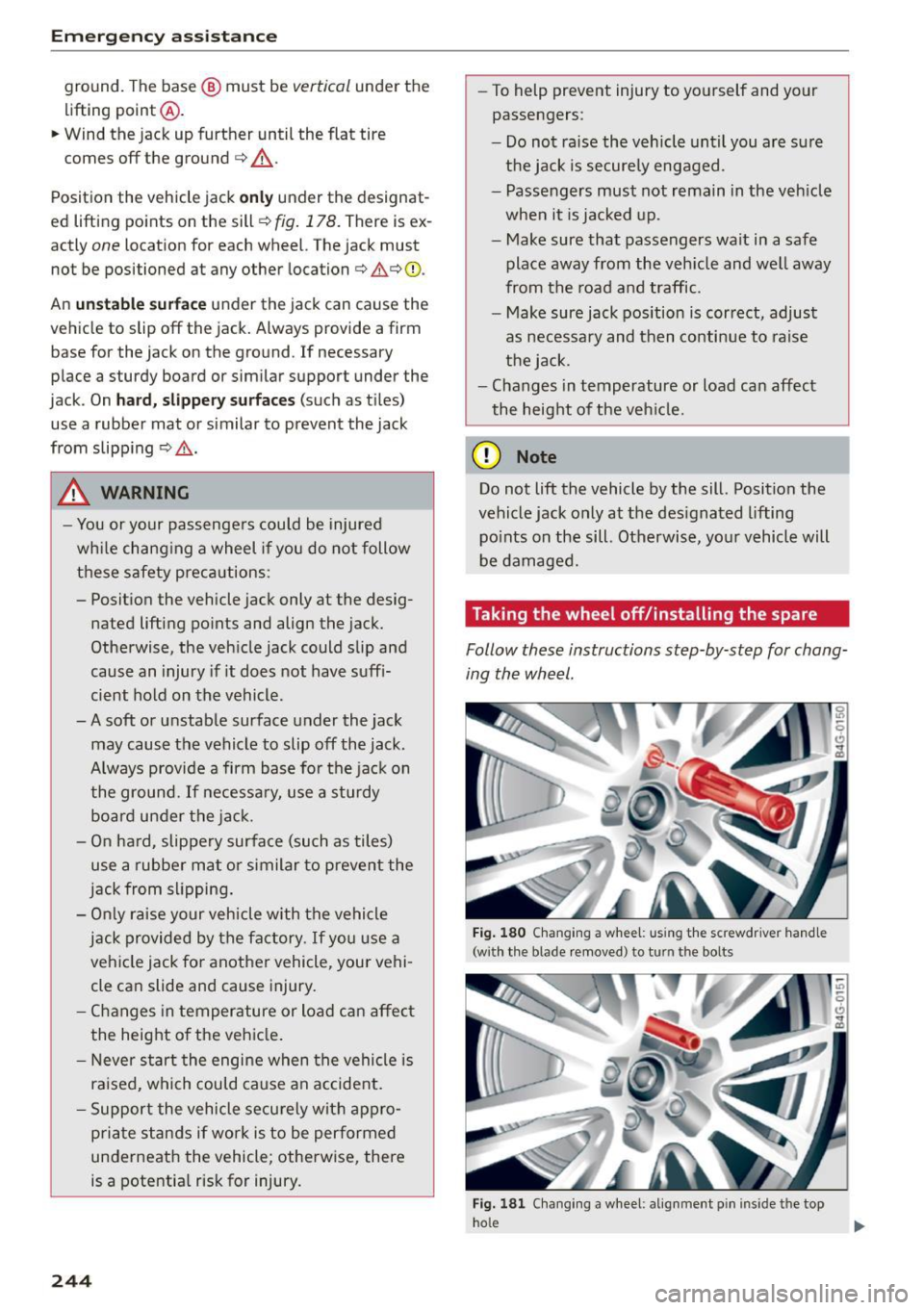
ground. The base @ must be vertical under the
lifting point @.
.. Wind the jack up further until the flat tire
comes off the ground
c> .&_.
Position the vehicle jack onl y under the designat
ed lifting points on the sill
c> fig. 178. There is ex
actly
one location for each wheel. The jack must
not be positioned at any other location
c> &c>Q) .
An uns table s urfac e under the jack can cause the
vehicle to slip off the jack. Always provide a firm
base for the jack on the ground . If necessary
place a sturdy board or similar support under the
jack. On
har d, sli ppery su rfaces (such as tiles)
use a rubber mat or similar to prevent the jack
from slipping
c> & .
A WARNING
-
-You or your passengers could be injured
wh ile chang ing a wheel if you do not follow
these safety precautions:
- Position the vehicle jack only at the desig
nated lifting points and align the jack.
Otherwise, the vehicle jack could slip and
cause an injury if it does not have suff i
cient hold on the vehicle.
-A soft or unstable surface under the jack may cause the vehicle to slip off the jack.
Always provide a firm base for the jack on
the ground. If necessa ry, use a sturdy
board under the jack.
- On ha rd, slippery surface (such as tiles)
use a rubber mat o r similar to prevent the
jack from slipping .
- On ly raise your vehicle with the vehicle
jack provided by the factory . If you use a
vehicle jack for another vehicle, your vehi
cle can slide and cause injury.
- Changes in temperature or load can affec t
the height o f the vehicle .
- Never start the engine when the vehicle is
raised, which could cause an accident.
- Support the vehicle securely with appro
priate stands if work is to be performed
underneath the vehicle; otherwise, there
is a potentia l risk for injury .
244
-To help prevent injury to yourself and your
passengers :
- Do not ra ise the vehicle until you are su re
the jack is securely engaged.
- Passengers must not remain in the veh icle
when it is jacked up.
- Make sure that passengers wait in a safe place away from the veh icle and we ll away
from the road and traffic.
- Make sure jack position is correct, adjust
as necessary and then continue to raise
the jack.
- Changes in temperature or load can affect
the height of the vehicle.
(D Note
Do not lift the vehicle by the sill. Position the
vehicle jack only at the des ignated lifting
po ints on the sill. Otherwise, your vehicle will
be damaged.
Taking the wheel off /installing the spare
Follow these instructions step-by-step for chang
ing the wheel.
Fig. 180 Chang ing a whee l: us ing the screwdriver hand le
(w ith the blade removed) to turn the bolts
Fig. 181 Changing a w heel: alignment pin inside the top
hole
Page 248 of 282
Emergency assistance
-Have the wheel bolt tightening torque
checked with a torque wrench as soon as pos
sible by your authorized Audi dealer or a
qualified service station .
- With steel and alloy wheel rims , the wheel
bolts are correctly tightened at a torque of
90
ft lb (120 Nm).
- If you notice that the wheel bolts are corroded
and difficult to turn while changing a tire ,
they should be replaced before you check the
tightening torque.
- Replace the flat tire w ith a new one and have
it installed on your vehicle as soon as possi
ble . Remount the wheel cover.
Until then, dri ve with extra care and at reduced
speeds .
A WARNING
-If y ou ar e go ing to equip y our vehicle with
t ir es or rims wh ic h differ from t hose w hich
were factory install ed , th en be s ure to read
t h e info rmat io n
~ pag e 22 1.
- Always make su re the damaged w heel or
ev en a flat tir e and t he ja ck and too l kit are
p ro perly secured i n the luggage compar t
m ent an d are no t lo ose in the p assenge r
comp artment.
- In an accide nt o r su dden mane uver they
c ou ld fly forw ard, injuring anyo ne in t he ve
hicle .
- Always store d amaged w heel, ja ck and tool s
se cur ely in the L uggage comp artment. Oth
erwise , in an acciden t or sudden maneuve r
t h ey could fly forward, ca using injury to pas
sengers in the vehicle.
246
-
Spare tire
General information
Applies to vehicles: with space -saving spare tire {compac t
spare tire)
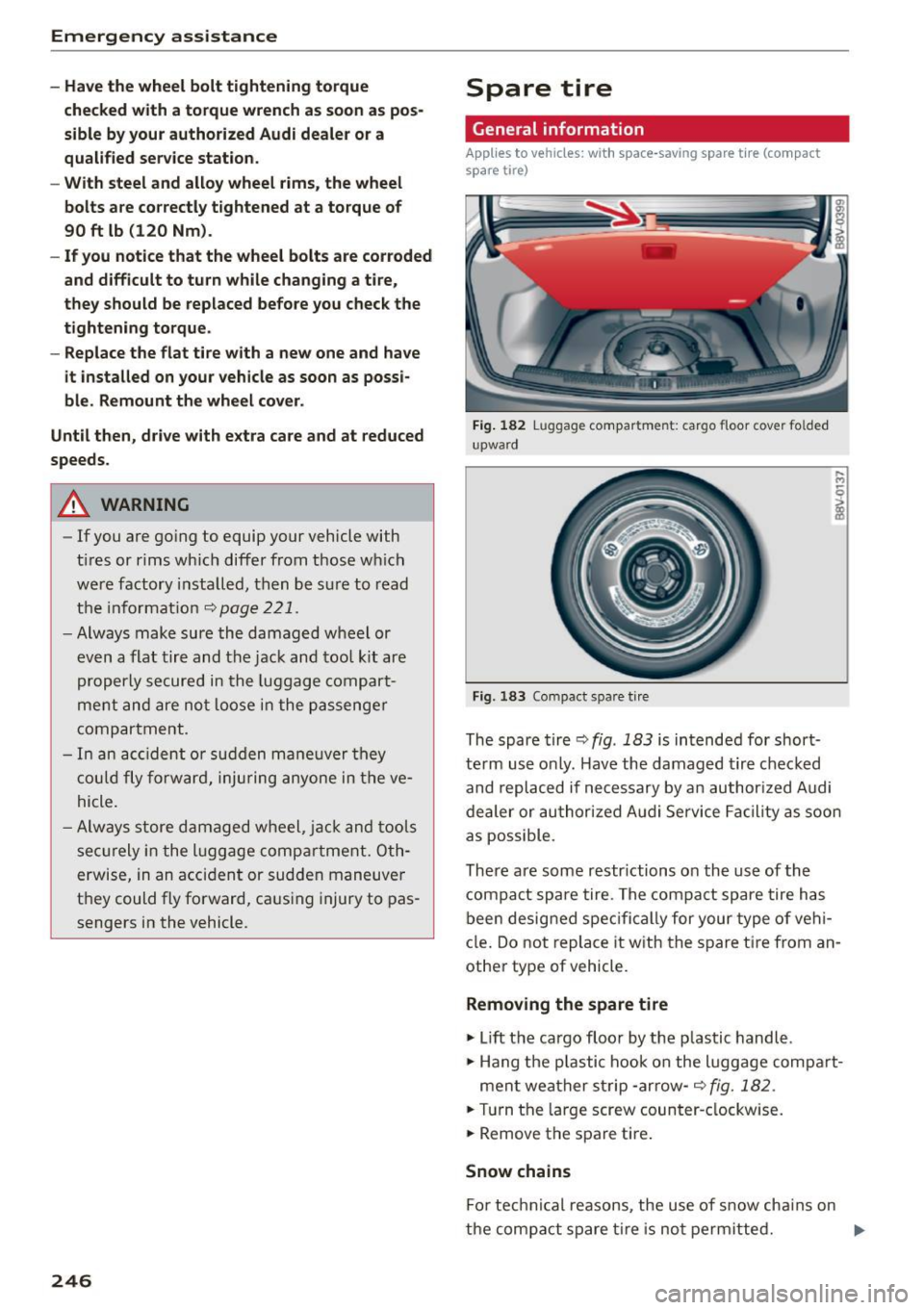
Fig. 1 82 Lu ggage compartme nt: cargo floor cove r fo lded
upward
Fi g. 183 Compact spare t ire
The spare t ire ~ fig . 183 is intended for short
te rm us e onl y. H ave the damaged tire c hec ked
and replaced if ne cessary by an authori zed Audi
de aler or au thori zed A udi Se rvice Facility as soon
as possible.
There are some restr ictions o n the use of the
compa ct spare tire . T he compa ct spare tire has
been desig ned spec ifi cal ly for your type o f ve hi
cl e. Do no t r eplace it w ith the s pare t ire from an
other type of vehicle.
Removing the spare tire
... lift th e cargo flo or by the p lastic handl e .
... Hang the p lastic hook on the luggage compart-
ment weather strip -arrow-~
fig. 182 .
... Tur n the lar ge screw coun ter -cl ockwise .
... Remove the spa re t ire .
Snow chains
Fo r tec hnical reasons, the use of s now cha ins on
the compact spare t ire is no t permitte d. .,.
Page 249 of 282
M N
0 > co ,...., \!) 1.1'1
1.1'1
1.1'1
,....,
If you have to drive with snow chains and a front
tire fai ls, mount the spare wheel in place of a rear
tire. Install the snow chains on the rear t ire that
you removed, and install that in place of the
front tire that failed.
A WARNING
-After installing a spare tire, the t ire pressure
must be checked as soon as possible. The
t ire pressure is availab le
onr::::;,page 224,
fig. 171.
- If the spare t ire is more than 6 years old,
use it only in an emergency and w ith ex
t reme caution and careful d riving.
- The spare tire is intended only for tempora
ry and short-term use.
It should be replaced
as soon as possible with the normal wheel
and tire.
- After mounting the compact spare tire, the
tire pressure must be checked as soon as
possible . The tire pressure o f the compact
spare tire must be 61 psi (420 kPA); other
wise, you risk having an accident .
- Do not drive faster than SO mph (80 km/h). You risk having an accident.
- Avoid fu ll-throttle acce leration, heavy brak
ing, and fast cornering . You risk having an
accident.
- Never drive using more than one spare wheel and tire. You risk having an accident .
- Norma l summer or winter tires must not be
mounted on the compact spare wheel rim.
- F or technical reasons, the use o f ti re chains
on the spare tire is not permitted . If it is
necessary to drive with tire chains, the spare
wheel m ust be mounted on the front axle in
the event of a flat in a rear tire. The newly
available front wheel must then be installed
in place of the rear wheel with the flat tire.
Installing the tire cha in before mounting
the wheel and t ire is recommended.
- loose items in the passenger compartment
can cause ser ious personal inju ry during
hard bra king or in an accident. Never store
the inflatable spare tire or jack and tools in
the passenger compartment.
- No rma l summer or winte r tires must not be
mounted on the comp act spare wheel r im.
Em erge ncy ass is tanc e
247
Page 250 of 282

Fuses and bulbs
Fuses and bulbs
Electrical fuses
Replacing fuses
A fuse that has blown will have metal strips that
have burned through.
Fig. 184 Steering column area: cover
Fig. 1 85 Left side of the engine compartment: fuse cover
Fuses in the interior
The fuses are behind the cover in the steering col
umn a rea
r::;,fig. 184.
" Switc h the ignition and all e lectr ica l equipment
off .
" Check the following table to see which fuse be
l o ngs to the equipment
r::;, page 249.
"Remove the cover ("AIRBAG" label) r::;,fig. 184 .
Begin at the bottom right corner -arrow-.
" Remove the plastic clip from the fuse panel
cover in the engine compartment<=>
fig. 185.
"Remove the fuse using the plastic clamp.
" Rep lace the bur ned fuse with an identical new
one .
" Install the cover .
Fuses in the engine compartment
"Turn off the ignit ion and the failed electrical
equipment.
248
" Check the following tab le to see wh ich fuse be
longs to the equipment¢
page 250.
" Remove the fuse panel cover ¢fig . 185.
" Remove the plastic clip from the fuse pane l
cover
r::;, fig. 185 .
.. Remove the fuse using the plastic clamp .
" Replace the burned fuse with an identical new
one .
.. Reins tall the cover.
The ind iv idual circuits are protected by safety
fuses . The fuses a re located under the steering
whee l beh ind a cover and in the left s ide of the
engine compa rtment.
Fuse color identification
Color Current rating
in amps
Bla ck 1
Purple 3
Light brown 5
Brown 7,5
Red 10
Blue 15
Yellow 20
Wh ite or transparent 25
green 30
orange 40
&, WARNING
Do not repa ir fuse s and never replace a blown
f u se w ith one that has a hig her amp rating.
T his c an c ause damage to t he e lectr ica l sys
tem and a fi re .
(D Note
If a new fuse blows again shortly after you
h ave installed i t, have the ele ct ric al sys tem
checked by an a uth orized Audi deale r o r au
thorized Audi Service Facili ty.
{!) Tips
- Th e followi ng table does not l ist fuse loca
t ions tha t are not u sed.
Page 253 of 282

M N
0 > co ,...., \!) ..,.,
..,.,
..,., ,....,
enter housings that have not been properly re
sealed .
F or your safety, we recommend that you have
your author ized Audi dealer replace any bulbs for
you, since your dealer has the proper tools, the
correct bulbs and the expertise .
Gas disc har ge la mps (X enon li g ht s):
Due to the high electrical voltage, have the bulbs
replaced by a qualif ied techn ician . H eadlights
with Xenon light can be identified by the high
voltage sticke r.
L ED headlights* requ ire no ma intenance . Please
contact your authorized Audi dealer if a bulb needs to be replaced .
_& WARNING
Contact with high-voltage components of the
electrical system and improper replacement
o f gas discharge (Xenon) headlight bu lbs can
cause serious personal injury and death.
- Xenon bulbs are pressurized and can ex -
plode when being changed.
- C hang ing Xenon lamps requires the spe cial
training, instructions and equipment .
- Only an authorized Aud i dea ler or othe r
qualified workshop shou ld change the bulbs
in gas discharge lamps.
_& WARNING
There are parts with sharp edges on the open ings and on the b ulb holders that can cause
ser ious c uts.
- If you are uncertain about what to do, have
the work performed by an author ized Audi
dealer or other qualif ied workshop. Ser ious
persona l injury may result from improperly
performed work .
- If you still pre fer to replace the light bulbs
yourself, be aware that the engine compart
ment is a hazardous area to work in
i:> page l 98 i:> .&
-It is best to ask your authorized A udi dealer
whenever you need to change a bulb.
Fu ses a nd bulb s
251
Page 254 of 282

Emerg enc y s it uat ion s
Emergency situations
General
T his c hapt er is inte nded fo r tra ined e merg ency
c rews a nd worki ng p ers onn el w ho h ave the nec
e ssa ry tool s and equipm ent t o perf orm the se
op era tion s.
Starting by pushing or
towing
CD Note
Veh icles w ith an automatic transmission can
not be started by push ing or tow ing.
Starting with jumper
cables
If necessary, the engine con be started by con
necting it to the battery of another vehicle .
If the engine should fail to start because of a d is
charged or weak battery, the battery can be con
nected to the battery of
another vehicle, using a
p air o f jump er ca bles to start the engine.
Jump er c able s
Use only jumper cables of sufficiently large cr oss
se ction
to carry the starter current safely. Refer
to the manufacturer's specifications.
Use on ly jumper cables with
insulated term inal
clamps which are d istinctly mar ked:
pl us( +) cabl e in most cases co lored re d
minu s(-) cable
in most cases colored black .
A WARNING
Batteries contain electricity, ac id, and gas.
Any of these can cause very ser ious or fatal in
jury . Follow the inst ruct ions be low for safe
hand ling of your veh icle's battery.
- Always shield your eyes and avoid leaning
over the battery w henever possible.
- A discharged battery can freeze at tempera
tures just below 32
°F (0 °C). Before con
nect ing a jumper cab le, you must thaw the
25 2
frozen battery completely, otherwise it
could explode.
- Do not allow battery acid to contact eyes or
skin. Flush any contacted area with water immediately.
- Improper use of a booster battery to start a
veh icle may cause an explosion.
- Vehicle batteries generate explosive gases .
Keep sparks, flame and lighted cigarettes
away from batteries.
- Do not try to jump start any vehicle with a
low acid level in the battery.
- The voltage of the booster battery must al
so have a 12-volt rating. The capacity (Ah) of
the booster battery should not be lower
than that of the discharged battery. Use of
batter ies of different voltage or substantial
ly different "Ah" rating may cause an explo
sion and personal injury.
- Never charge a frozen battery. Gas trapped in the ice may cause an explosion .
- Never charge or use a battery that has been
frozen. The battery case may have be weak
ened .
- Use of batter ies of different voltage or sub
stantially d ifferent capacity (Ah) rating may
cause an explosion and injury. The capacity
(Ah) of the booster battery should not be
lowe r than that of the discharged battery.
- Before you check anything in the engine
compartment, always read and heed a ll
WARNINGS
qpoge 198.
CD Note
-App lying a higher voltage booster battery
wi ll cause expensive damage to sensitive
elec tronic components, such as control
units, re lays, radio, etc.
- T here must be no electrical contact between
the vehicles as otherwise cu rrent cou ld al
ready start to flow as soon as the positive
(+) termina ls are connected.
@ Tips
The discharged battery must be properly con-
nected to the vehicle's electrical system. .,.